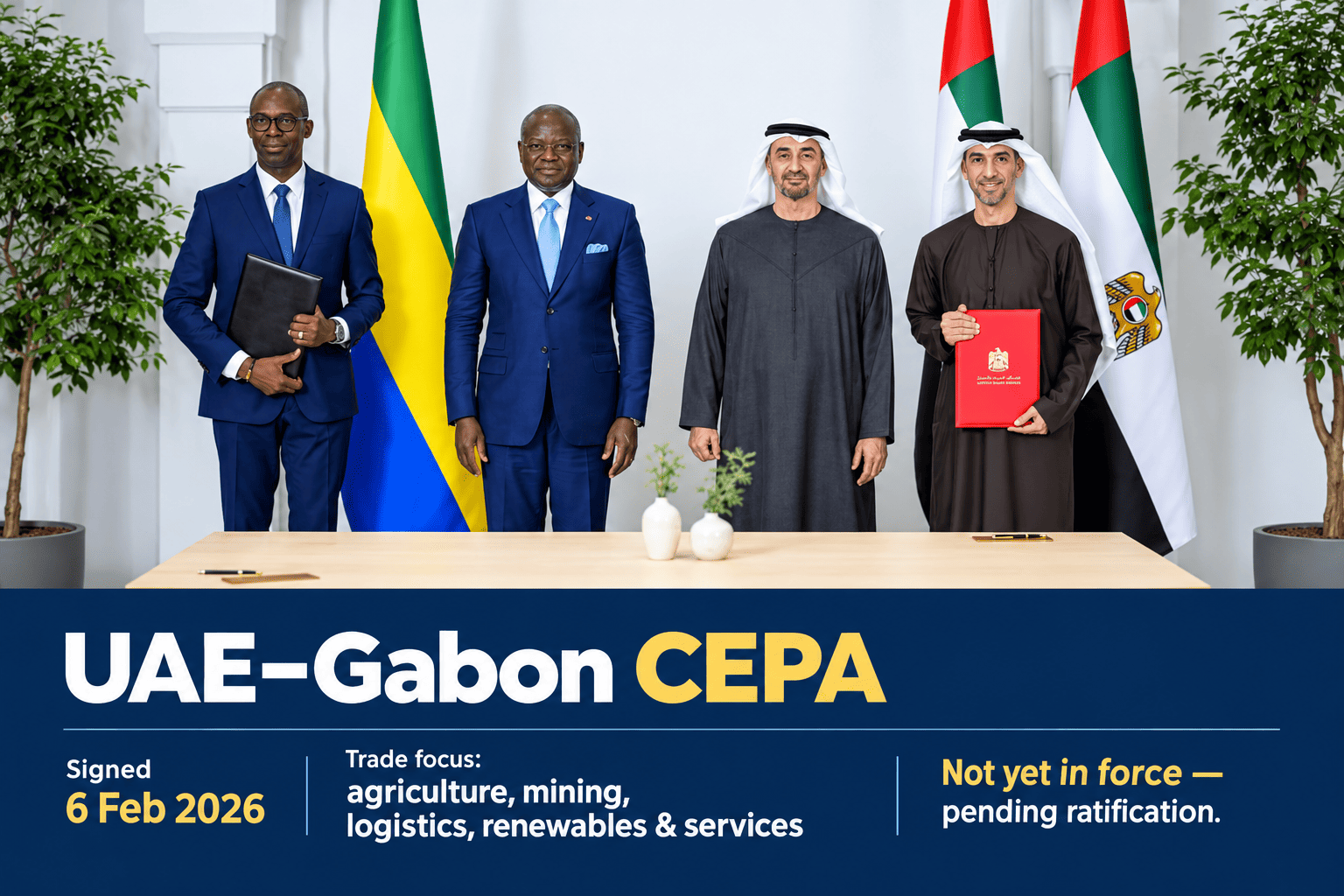
The United Arab Emirates and Gabon signed a Comprehensive Economic Partnership Agreement (CEPA) in Abu Dhabi on 6 February 2026, in the presence of President Sheikh Mohamed bin Zayed Al Nahyan and Gabon’s President Brice Oligui Nguema. The deal was signed by Dr Thani bin Ahmed Al Zeyoudi, UAE Minister of Foreign Trade, and Thierry Minko, Gabon’s Minister of Economy, Finance, Debt and Investment. It targets agriculture, mining, logistics, renewable energy, and services, and is aimed at helping Gabon diversify away from oil. The agreement has been signed but has not yet entered into force, pending ratification by both sides.
📅 Signed 6 February 2026📍 Abu Dhabi, UAE📋 CEPA / FTA⏳ Status: Signed, not in force
The UAE-Gabon CEPA is the latest addition to the UAE’s fast-growing network of Comprehensive Economic Partnership Agreements, a trade programme launched in September 2021 that is central to the country’s “We the UAE 2031” vision of reaching USD 1.1 trillion in non-oil foreign trade. For Gabon, a country whose economy has historically leaned heavily on oil and hydrocarbons, the agreement is framed as a tool for economic diversification, structuring more sustained trade in logistics, agro-industry, energy, and mining while opening services and SME trade to international flows.
This explainer covers what was actually signed, who signed it, what sectors it touches, where it stands in the ratification process, and, most importantly, what it means in practice for manufacturers, distributors, and raw material suppliers weighing up whether and how to act on the new corridor it opens between the UAE and Central Africa. This page is part of GTsetu’s wider FTA Tracker, which follows CEPAs and reciprocal trade agreements as they are signed around the world.
💡 How to read this page
Sections 2 to 5 cover the facts of the agreement itself: what was signed, the numbers behind it, the sectors it targets, and its current legal status. Section 6 places the deal in the context of other recent FTAs and CEPAs our tracker is following. Section 7 moves from the agreement to practical next steps for anyone sourcing from, selling into, or partnering across the UAE-Gabon trade lane.
Section 1
What Is the UAE-Gabon CEPA?
A Comprehensive Economic Partnership Agreement is the UAE’s standard format for bilateral free trade deals, going beyond simple tariff reduction to also cover investment facilitation, services trade, and private-sector cooperation. The UAE-Gabon CEPA was signed in Abu Dhabi on 6 February 2026, witnessed by UAE President Sheikh Mohamed bin Zayed Al Nahyan and Gabon President Brice Oligui Nguema, and formally signed on behalf of the two governments by Dr Thani bin Ahmed Al Zeyoudi and Thierry Minko.
Alongside the CEPA itself, the two countries also announced a number of related agreements during the same visit, including cooperation on defence, the establishment of a joint UAE-Gabon Business Council to support private-sector engagement, and a cooperation programme between the General Women’s Union and Gabon’s Ministry of Social Affairs on women’s empowerment. Officials described the agreement as a transformative moment in bilateral relations, intended to accelerate trade, connect Gabonese exporters to global supply chains, and open new avenues for investment in high-value projects.
Section 2
Key Facts at a Glance
Deal Snapshot
The cards below summarise the core facts of the agreement as confirmed in official statements and coverage at the time of signing.
1
Signing Details
Who signed, where, and in whose presence
Abu Dhabi6 Feb 2026
The CEPA was signed in Abu Dhabi by Dr Thani bin Ahmed Al Zeyoudi, UAE Minister of Foreign Trade, and Thierry Minko, Gabon’s Minister of Economy, Finance, Debt and Investment, in the presence of UAE President Sheikh Mohamed bin Zayed Al Nahyan and Gabon President Brice Oligui Nguema.
Signed on a state visit by President Oligui Nguema to Abu Dhabi
Accompanied by a defence cooperation agreement
Announcement of a new joint UAE-Gabon Business Council
Women’s empowerment cooperation programme also announced
2
Trade Numbers
Non-oil trade volume between the UAE and Gabon
Growing+27% exports
Non-oil trade between the two countries reached approximately USD 320.7 million in 2025, more than double the level recorded in 2021. The momentum continued into 2026.
2025 non-oil trade: ~USD 320.7 million (≈AED 1.18 billion)
H1 2026 non-oil trade: ~USD 141.7 million (≈AED 520 million)
UAE non-oil exports to Gabon rose 27% to USD 61.1 million in 2025
UAE exports more than doubled to USD 62.7 million in H1 2026
3
Legal Status
Where the agreement stands in the ratification process
SignedNot in Force
The agreement has been signed by both governments but, as with other UAE CEPAs, entry into force follows a separate ratification process in each country. No entry-into-force date has been announced for the UAE-Gabon CEPA as of this writing.
Signed: 6 February 2026, Abu Dhabi
Ratification: pending in both the UAE and Gabon
In force: not yet confirmed
Context: of the UAE’s 38 signed CEPAs, a smaller subset have formally entered into force to date
📌 Signed is not the same as in force
A CEPA being “signed” means both governments have agreed and formalised the text. It does not automatically mean preferential tariffs or market-access terms are active. Businesses planning around this corridor should track the ratification stage closely rather than assume benefits are available from the signing date.
Section 3
Why Gabon, Why Now
Gabon’s economy remains heavily dependent on natural resources, particularly oil, which has historically made trade diversification a national priority. Officials framed the CEPA as a structural step toward accelerating that diversification, building more sustained trade relationships in sectors beyond hydrocarbons. For the UAE, the deal fits a broader, deliberate pattern of expanding economic ties across Africa, following a wave of CEPAs with other African economies over the preceding two years, including the UAE-DRC CEPA, signed just four days before Gabon’s, and the UAE-Nigeria CEPA and UAE-Sierra Leone CEPA, both part of the same regional push.
Dr Al Zeyoudi described Gabon as a promising economic partner supported by stable growth prospects, and said the agreement would strengthen the UAE’s presence in West and Central Africa, a region officials characterised as having strong potential for sustainable growth and diversification. The timing also follows closely on the heels of the UAE-DRC CEPA, underlining how quickly the UAE has been sequencing agreements across Central Africa.
Section 4
Sectors Covered
Priority Areas Named in the Agreement
Officials and coverage of the signing consistently named the following as priority sectors for investment and trade cooperation under the agreement:
Mining. Gabon’s mineral resources, including manganese, are a named priority for joint investment and offtake arrangements.
Agriculture and food production. A core diversification sector, with the CEPA aiming to structure more sustained bilateral trade in food and agro-industry.
Logistics. Explicitly flagged as a target for cooperation, reflecting the role logistics infrastructure plays in connecting Gabonese exporters to global supply chains.
Renewable energy. Named alongside mining and agriculture as a priority investment sector, consistent with the UAE’s wider renewable-energy push across its Africa CEPA programme.
Services and SMEs. The agreement is also intended to open services trade and give small and medium-sized enterprises in both countries a more structured platform for cross-border cooperation.
Section 5
Timeline: Signed vs. In Force
Understanding where the UAE-Gabon CEPA sits in its lifecycle matters for anyone planning around it. The table below lays out the sequence as it has unfolded so far, alongside what typically happens next for a UAE CEPA.
Stage
Status
Date / Notes
Negotiation
✓ Completed
Preceded the February 2026 signing, following earlier ministerial engagement
Signing
✓ Completed
6 February 2026, Abu Dhabi, witnessed by both heads of state
Domestic ratification (UAE)
⚠ Pending
No confirmed date announced as of this writing
Domestic ratification (Gabon)
⚠ Pending
No confirmed date announced as of this writing
Entry into force
✗ Not yet in force
Follows ratification by both sides, per standard UAE CEPA practice
Section 6
How It Fits the Wider Global FTA Landscape
The UAE-Gabon CEPA is one entry in a much larger wave of trade-agreement activity moving through 2026. The UAE alone has been signing CEPAs at pace across Africa and Asia, while the US has pursued a parallel track of reciprocal trade agreements with partners across Latin America and Asia, and the EU and other blocs have been finalising long-running negotiations of their own. The table below places Gabon’s agreement alongside a selection of other deals our FTA Tracker is following.
Two patterns stand out across this list. First, Ecuador appears on both the UAE and US tracks, with the UAE-Ecuador CEPA, the US-Ecuador reciprocal agreement, and the Canada-Ecuador FTA all advancing around the same period, a reminder that a single market can sit at the centre of several overlapping corridors at once. Second, the clustering of UAE-Africa signings, Gabon alongside the DRC, Nigeria, and Sierra Leone CEPAs, shows how quickly the regulatory landscape across a region can shift within a matter of months.
Section 7
What It Means for Manufacturers & Distributors
A signed CEPA is a signal, not yet a set of active preferential terms. For manufacturers, distributors, and raw material suppliers watching the UAE-Gabon corridor, the practical question is what to do in the window between signing and entry into force, and that comes down to groundwork: identifying real counterparties, verifying them properly, and preparing commercial and legal terms before access conditions actually change. The same groundwork applies whether the corridor in question is UAE-Gabon, the UAE-Philippines CEPA, or any of the reciprocal agreements the US has been signing, such as the US-El Salvador and US-Guatemala agreements.
🔍
Scope the Gabonese market before committing
Understand demand, competition, and regulatory specifics in mining, agri, and logistics before the deal is in force.
Market research first
🤝
Identify a verified distributor or supply partner
Build relationships with Gabonese or UAE-based intermediaries now, so you are ready when terms activate.
Verified partner search
📄
Prepare partnership and supply contracts in advance
Draft terms, NDAs, and agreements ahead of time so you can move quickly once the CEPA is ratified.
Contract readiness
🏭
Check certifications and compliance requirements
Mining, agriculture, and energy sectors often carry specific certification and compliance obligations.
Compliance check
🚢
Map logistics and supply chain routes early
Logistics cooperation is a named CEPA priority; understanding routing options now avoids delays later.
Supply chain mapping
🌐
Watch parallel corridors, not just this one
Agreements like the UAE-DRC CEPA and UAE-Nigeria CEPA may open adjacent regional opportunities worth tracking together.
Regional tracking
Businesses with existing exposure to other active or pending FTAs should also keep an eye on how multiple corridors intersect. A manufacturer already tracking the India-EU FTA or the US-India trade deal, for instance, may find that sourcing or distribution strategies built around the UAE-Gabon corridor complement rather than compete with those wider plans. Likewise, businesses active in Southeast Asia may want to compare this agreement against the pace of the US-Indonesia, US-Taiwan, and Japan-Bangladesh agreements moving through similar stages on our tracker.
🤝 For Long-Term Industrial Partnerships
GTsetu: Verified Partner Discovery for the UAE-Gabon Corridor and Beyond
New CEPAs and FTAs open a trade corridor on paper, but someone still has to find, verify, and formally engage the actual company on the other end, whether that is a Gabonese distributor, a UAE-based intermediary, or a raw material supplier in any of the markets covered on our FTA Tracker. GTsetu is built specifically for that step. It is not a directory and not a government trade portal. It is a structured partnership platform where every company is verified on 6 government-sourced points before engagement, where discovery is anonymous until mutual interest is confirmed, where NDAs are executed digitally before any commercial information changes hands, and where all document exchange happens through an encrypted workspace.
GTsetu is used by industrial manufacturers, distribution companies, and raw material suppliers across 100+ countries, including markets covered by agreements like the UAE-Nigeria CEPA and UAE-DRC CEPA, to find, vet, and formally engage trade partners ahead of, during, and after a corridor comes fully into force.
🏛️
6-Point Government-Sourced Verification
Name, Address, Registration Number, Company Status, Company Type, and Date of Incorporation, verified using government tie-ups before any engagement.
🕵️
Anonymous Discovery
Browse verified partner profiles across 100+ countries without revealing your own identity or commercial strategy until you choose to engage.
📄
Built-In NDA Workflow
Digital NDA with timestamped signatures before any pricing, supply terms, or product specs are shared. No sensitive information exposed without protection.
🔐
Encrypted Document Workspace
All commercial documents shared through encrypted channels with a full access audit trail, not email attachments.
🌍
100+ Countries
Verified manufacturers and distributors across Asia, Middle East, Europe, Africa, Australia, and the Americas. Built for cross-border partnership formation, not raw record volume.
🚫
Zero Commission
No success fee, no broker commission, ever. Your partnership economics remain entirely between you and your partner.
📌 GTsetu tracks the deal; you build the relationship
Trade agreements lower the barriers between markets, but they do not pre-vet the specific company you end up doing business with. Many manufacturers planning around the UAE-Gabon CEPA, or any of the other agreements on our FTA Tracker, use this window to identify and verify partners on GTsetu, so that by the time preferential terms are active, the commercial relationship, contract, and documentation are already in place.
FAQ
Frequently Asked Questions
QIs the UAE-Gabon CEPA in force yet?
No. The agreement was signed in Abu Dhabi on 6 February 2026 but has not yet entered into force. Under the UAE’s usual CEPA practice, entry into force follows a separate ratification process in both countries, which has not been completed or dated as of this writing.
QWhat sectors does the UAE-Gabon CEPA cover?
The agreement targets agriculture and food production, logistics, mining, renewable energy, and services, alongside measures aimed at opening up SME trade between the two countries. It is designed to help Gabon diversify away from its historical dependence on oil and hydrocarbons.
QHow big is UAE-Gabon trade?
Non-oil trade between the UAE and Gabon reached roughly USD 320 million in 2025, more than double the level recorded in 2021. In the first half of 2026, bilateral non-oil trade reached about USD 141.7 million, with UAE non-oil exports to Gabon more than doubling year-on-year to roughly USD 62.7 million.
QWho signed the UAE-Gabon CEPA?
The agreement was signed by Dr Thani bin Ahmed Al Zeyoudi, UAE Minister of Foreign Trade, and Thierry Minko, Gabon’s Minister of Economy, Finance, Debt and Investment, in the presence of UAE President Sheikh Mohamed bin Zayed Al Nahyan and Gabon President Brice Oligui Nguema.
QHow does the Gabon CEPA fit with the UAE’s other African trade agreements?
The UAE-Gabon CEPA is one of several agreements the UAE has signed with African economies in this window, including the UAE-DRC CEPA signed just days earlier, the UAE-Nigeria CEPA, and the UAE-Sierra Leone CEPA. Together these form part of a broader UAE strategy to deepen economic ties across Africa as part of its 2031 non-oil trade target.
QWhat should a manufacturer do now, before the agreement enters into force?
The signing-to-force window is best used for groundwork: researching the Gabonese market, identifying and verifying potential distributors or supply partners, checking sector-specific certification and compliance requirements, mapping logistics routes, and preparing contract terms in advance. Acting during this period means a business is ready to move as soon as preferential terms become active, rather than starting due diligence from scratch once the deal is in force. The same applies to other pending agreements tracked on our FTA Tracker, such as the UAE-Ecuador CEPA or the EU-Mercosur agreement.
Planning Ahead of the UAE-Gabon CEPA Entering Into Force?
GTsetu is purpose-built for manufacturers, distributors, and raw material suppliers in industrial sectors seeking verified long-term trade partnerships, across 100+ countries, with government-sourced partner verification, built-in NDA workflows, and zero commission.
They represents the product, and research team behind GTsetu, a global B2B collaboration platform built to help companies explore cross-border partnerships with clarity and trust. The team focuses on simplifying early-stage international business discovery by combining structured company profiles, verification-led access, and controlled collaboration workflows.
With a strong emphasis on trust, and disciplined engagement, Team GTsetu shares insights on global trade, partnerships, and cross-border collaboration, helping businesses make informed decisions before entering deeper commercial discussions.