U.S.–Bangladesh Agreement on Reciprocal Trade: Full Breakdown | GTsetu
Home ›
FTA Tracker ›
US–Bangladesh Reciprocal Trade Agreement
📋 FTA Tracker · Signed 9 February 2026
U.S.–Bangladesh Agreement on Reciprocal Trade
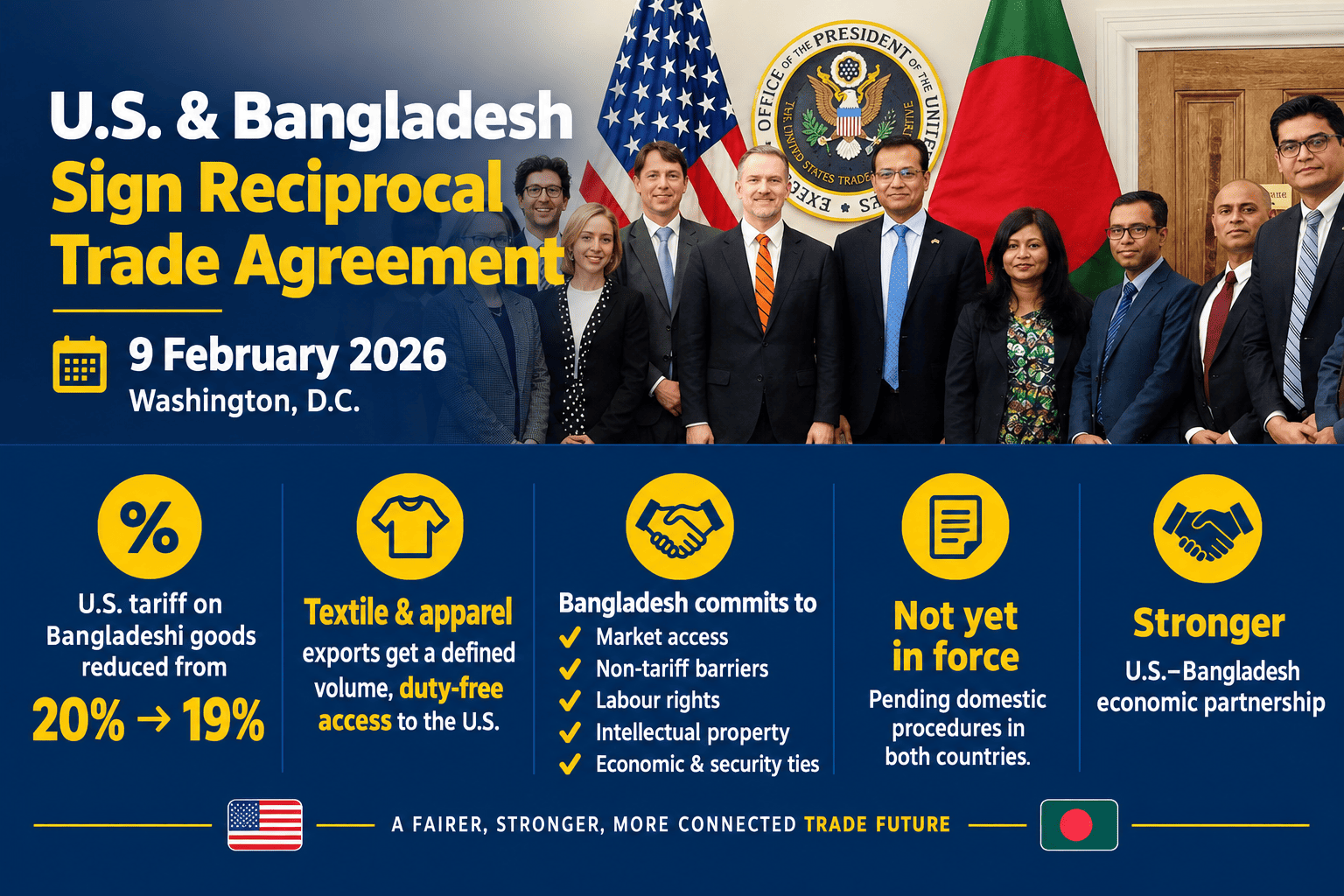
The United States and Bangladesh signed an Agreement on Reciprocal Trade on 9 February 2026 in Washington, D.C. The agreement reduces the U.S. reciprocal tariff on Bangladeshi goods from 20 percent to 19 percent, opens a mechanism for a defined volume of Bangladeshi textile and apparel exports to enter the U.S. duty-free, and sets out Bangladeshi commitments on market access, non-tariff barriers, labour rights, intellectual property, and broader economic and security alignment. As of signing, the agreement is not yet in force, pending domestic procedures in both countries.
📅 Signed: 9 February 2026⏱ 14 min read✍️ GTsetu Trade Desk🔄 Updated: 9 February 2026
On 9 February 2026, U.S. Trade Representative Jamieson Greer and senior Bangladeshi officials signed a Joint Statement establishing the framework for a U.S.–Bangladesh Agreement on Reciprocal Trade. The agreement is one of a series of reciprocal trade deals the United States has negotiated since 2025 under its revised tariff framework, following similar agreements with Guatemala, El Salvador, and Indonesia, and followed more recently by comparable agreements with Taiwan, Ecuador, and Argentina.
This page breaks down what the agreement actually contains, where it stands procedurally, how it has been received, and where it fits among the broader wave of trade agreements being finalised around the same time. The GTsetu FTA Tracker covers each of these deals individually so businesses can compare terms across markets rather than tracking them one at a time.
💡 How to read this page
Section 2 covers what the agreement actually commits each side to. Section 4 covers where the agreement stands today and how it has been received in both countries. Section 5 places it alongside other trade agreements moving through the same 2026 cycle.
Section 1
Background: From TICFA to Reciprocal Trade
Trade between the United States and Bangladesh had, since 2013, been governed primarily by the U.S.–Bangladesh Trade and Investment Cooperation Forum Agreement (TICFA), a framework agreement rather than a tariff-reduction pact. In April 2025, the U.S. imposed a 20 percent reciprocal tariff on Bangladeshi imports under Executive Order 14257, part of a broader revision of U.S. tariff policy. A subsequent order, Executive Order 14346 issued in September 2025, created a mechanism for reducing tariffs for countries that reached bilateral trade and security agreements with the United States, informally referred to as “aligned partners.”
Negotiations between the two countries accelerated in January 2026, with Bangladesh’s National Security Adviser meeting the U.S. Trade Representative in Washington to finalise outstanding terms. The agreement was signed on 9 February 2026, shortly before Bangladesh’s 12 February 2026 general election, and was negotiated by Bangladesh’s interim government led by Chief Adviser Muhammad Yunus. Bangladesh has separately been negotiating the Japan-Bangladesh Economic Partnership Agreement, a parallel track worth watching alongside this one for companies assessing Bangladesh’s overall trade position.
📌 Why the timing matters
Because the agreement was signed by an interim government just before a national election, its final status has depended partly on the stance of the government that followed. This is covered in Section 4.
Section 2
Key Provisions of the Agreement
What Each Side Commits To
The Joint Statement sets out commitments across tariffs, non-tariff barriers, labour, environment, intellectual property, digital trade, and broader economic and security alignment. The sections below summarise each major area.
1
Tariff Reduction & Market Access
Reciprocal tariff cut plus targeted zero-duty categories
Tariffs
The United States agreed to lower its reciprocal tariff on Bangladeshi goods from 20 percent to 19 percent, and to identify specific products from Annex III of Executive Order 14346 to receive a zero percent reciprocal tariff rate. In return, Bangladesh commits to preferential market access for a broad range of U.S. industrial and agricultural goods.
Bangladesh opens access for
Chemicals, medical devices, machinery, motor vehicles and parts
ICT equipment and energy products
Soy, dairy, beef, poultry, tree nuts and fruit
Reported by Bangladeshi press
Duty-free access reportedly extended to roughly 6,710 U.S. goods
Tariff relief reported on roughly 1,638 Bangladeshi items
🎯
Note: Figures on item counts come from Bangladeshi press reporting following the signing, not the Joint Statement text itself, and should be treated as reported rather than officially confirmed.
2
Textile & Apparel Mechanism
Zero-tariff volume tied to U.S.-origin textile inputs
Textiles
The United States committed to establishing a mechanism allowing a defined volume of Bangladeshi textile and apparel goods to enter the U.S. at a zero reciprocal tariff rate. The volume permitted is tied to the quantity of U.S.-produced cotton and man-made fibre textile inputs used in the finished goods, meaning the zero-tariff benefit is conditional on sourcing certain raw materials from the United States rather than being unconditional.
What this means practically
Zero-duty access is volume-linked, not a blanket exemption
Eligibility depends on incorporating U.S.-origin cotton or man-made fibres
Directly affects raw material sourcing decisions for apparel exporters
Open questions at signing
The exact permitted volume was not specified in the Joint Statement
Implementation mechanics were still to be finalised
🎯
Why it matters: This is arguably the provision with the most direct commercial impact on Bangladesh’s largest export industry, and the one worth monitoring most closely as implementation details are finalised.
3
Non-Tariff Barriers & Regulatory Alignment
Vehicle standards, FDA certificates, remanufactured goods
Regulatory
Bangladesh commits to accepting vehicles built to U.S. federal motor vehicle safety and emissions standards, recognising U.S. FDA certificates and prior marketing authorisations for medical devices and pharmaceuticals, and removing import restrictions or licensing requirements on U.S. remanufactured goods and parts.
Additional commitments
Free cross-border data transfer between trusted jurisdictions
Digitalising customs procedures
Adopting good regulatory practices more broadly
Scope
Commitments in this area run primarily one direction, toward Bangladesh adapting to U.S. standards
🎯
Why it matters: Regulatory recognition reduces duplicate certification costs for U.S. exporters entering the Bangladeshi market, particularly in autos, medical devices, and pharmaceuticals.
4
Labour Rights & Environmental Standards
Forced labour prohibition, collective bargaining, environmental enforcement
Labour & ESG
Bangladesh commits to prohibiting the import of goods produced by forced or compulsory labour, amending its labour laws to protect freedom of association and collective bargaining including in export processing zones, and strengthening labour law enforcement generally. It also commits to maintaining high levels of environmental protection and enforcing environmental laws, including on sustainable fishing and illegal wildlife trade.
What’s covered
Forced labour import prohibition
Freedom of association and collective bargaining protections
WTO Fisheries Subsidies Agreement implementation
Context
These are binding commitments, not aspirational language, under the agreement’s terms
🎯
Why it matters: For buyers sourcing apparel or manufactured goods from Bangladesh, these commitments are directly relevant to supply chain compliance going forward.
5
Intellectual Property & Geographical Indications
Treaty accession and protections for U.S. cheese and meat producers
IP Protection
Bangladesh commits to a robust standard for intellectual property protection and enforcement, including ratifying or acceding to certain international IP treaties. The agreement includes specific provisions on geographical indications intended to preserve U.S. market access for cheese and meat producers that use common product names, an area that has historically been a sticking point in U.S. trade negotiations with several countries.
What’s covered
Accession to key international IP treaties
Geographical indication provisions protecting common product names
Context
Full implementation will depend on domestic legislative changes in Bangladesh
🎯
Why it matters: Stronger IP enforcement is relevant to any company evaluating a licensing or technology-sharing arrangement tied to Bangladeshi manufacturing.
6
Economic & National Security Alignment
Export controls, procurement provisions, and third-country clauses
Security Alignment
The agreement includes commitments beyond conventional trade terms, including cooperation on export controls, information sharing on inbound investment, and anti-corruption enforcement. Separate reporting on the signed text indicates provisions addressing Bangladeshi defence procurement sourcing and complementary measures tied to U.S. national security actions, though the full treaty text and its binding scope were still being clarified at signing.
What’s covered per the Joint Statement
Cooperation on export controls and duty evasion
Information sharing on inbound investment
Strengthened anti-corruption enforcement
Treated with caution
Reporting on specific defence and third-country clauses varies by source and warrants independent verification against the final treaty text
🎯
Why it matters: This is the area generating the most geopolitical commentary and the most domestic debate in Bangladesh, covered further in Section 4.
Section 3
Tariff & Market Access Breakdown
The table below summarises the headline tariff terms set out in the Joint Statement, alongside related commercial commitments noted in the same announcement.
Item
Before Agreement
Under Agreement
Status
General US reciprocal tariff on Bangladeshi goods
20% (Executive Order 14257)
19%
✓ Confirmed in Joint Statement
Select Annex III products
Standard reciprocal rate
0%
⚠ Specific product list to be identified
Textile & apparel (volume-linked)
Standard reciprocal rate
0% on a defined volume
⚠ Volume and mechanics pending
US agricultural product purchases
—
~$3.5 billion (wheat, soy, cotton, corn)
✓ Noted as commercial deal in Joint Statement
US energy product purchases
—
~$15 billion over 15 years
✓ Noted as commercial deal in Joint Statement
Aircraft procurement
—
Noted in Joint Statement; Boeing order reported separately
⚠ Ancillary deal, reported independently
💡 Figures worth double-checking before acting on them
The commercial figures above are drawn from the Joint Statement and subsequent press reporting. Specific product lists, exact textile volumes, and the final treaty text were still being finalised at the time of signing. Businesses making sourcing or pricing decisions based on this agreement should verify current terms directly against the official U.S. Trade Representative and Bangladesh government publications before committing.
Section 4
Status, Timeline & Reception
The Joint Statement itself specifies that both countries would, “consistent with their respective internal procedures, promptly finalize the Agreement” and “undertake domestic formalities in advance of the Agreement entering into force.” In plain terms: the 9 February 2026 signing established the framework and headline terms, but did not by itself bring the agreement into legal force in either country.
The agreement was signed by Bangladesh’s interim government just three days before the country’s 12 February 2026 general election, which has made its final status partly dependent on the position of the government that followed. Domestic reaction in Bangladesh has been mixed: U.S. and some Bangladeshi officials described the deal as a significant step forward in market access, while some Bangladeshi economists and political groups have characterised it as placing comparatively heavier binding obligations on Bangladesh than on the United States, a view reflected in commentary analysing the agreement’s language. The incoming government signalled it would review rather than immediately ratify or scrap the agreement.
The agreement also drew commentary in neighbouring India, where opposition and government figures offered differing views on whether the Bangladesh textile provisions could affect India’s own textile exports and cotton demand; Indian officials stated that India expected to secure comparable tariff treatment of its own, a dynamic worth watching alongside the separate India-EU Free Trade Agreement and US-India trade talks moving in parallel. Readers should treat these as contested political and economic claims from named parties rather than settled fact, and the GTsetu FTA Tracker will update this page as the agreement’s status changes.
📌 Bottom line on status
As of signing, this is a signed framework, not yet in force. Businesses should treat the headline terms, the 19 percent tariff, the textile mechanism, the market access list, as the direction of travel rather than terms they can rely on contractually until both governments complete ratification and the agreement formally takes effect.
Section 5
Part of a Broader Wave of 2026 Trade Agreements
The US-Bangladesh agreement did not happen in isolation. It arrived in the middle of one of the busiest periods for new trade agreements in recent years, spanning several regions and negotiating blocs at once. Understanding where it sits in that wider pattern helps gauge how durable, and how replicable, its terms might be.
When this many bilateral and regional deals are moving simultaneously, sourcing and market-entry decisions benefit from comparing terms across agreements rather than evaluating one in isolation. A manufacturer weighing Bangladesh against another emerging sourcing market may find a more favourable near-term tariff position, or a clearer path to ratification, elsewhere in this same wave of agreements.
Section 6
What To Do While the Agreement Isn’t Yet in Force
A signed-but-not-in-force agreement is exactly the kind of moment where planning ahead pays off, provided the groundwork is reversible if final terms shift. Use this reference to match your next step to your situation.
🏭
You manufacture in Bangladesh and export apparel to the US
The textile mechanism directly affects your raw material sourcing economics.
Model U.S.-fibre sourcing scenarios
📦
You’re a U.S. exporter of chemicals, machinery, or ag goods
You stand to gain preferential access once the agreement enters into force.
Track ratification progress
🌍
You’re comparing Bangladesh against other sourcing destinations
Several comparable agreements are moving through ratification at the same time.
You’re building a distribution network across South Asia
Bangladesh’s shifting trade position may change its role in a regional strategy.
Monitor regional FTA developments
FAQ
Frequently Asked Questions
QWhen was the U.S.–Bangladesh Agreement on Reciprocal Trade signed?
The agreement was signed on 9 February 2026 in Washington, D.C., by U.S. Trade Representative Jamieson Greer and Bangladeshi officials including Commerce Adviser Sheikh Bashir Uddin and National Security Adviser Khalilur Rahman. As of signing, the agreement was not yet in force, pending domestic procedures in both countries.
QWhat tariff rate does the agreement set for Bangladeshi exports to the US?
The United States agreed to reduce its reciprocal tariff on Bangladeshi goods from 20 percent, as set under Executive Order 14257, to 19 percent, with a zero percent rate identified for specific products listed in Annex III of Executive Order 14346. A separate mechanism was also established for a defined volume of Bangladeshi textile and apparel goods to enter the US at a zero tariff rate, conditional on the use of U.S.-origin cotton or man-made fibre inputs.
QWhat does Bangladesh commit to under the agreement?
Bangladesh commits to preferential market access for a wide range of US goods including chemicals, medical devices, machinery, vehicles, ICT equipment, energy products, and various agricultural goods. It also commits to addressing non-tariff barriers, protecting labour rights, enforcing environmental laws, strengthening intellectual property protection, and aligning on certain national security and export control matters.
QIs the agreement controversial?
Yes. Some Bangladeshi economists and political groups have characterised the agreement as placing disproportionately heavier obligations on Bangladesh, citing analysis of the agreement’s text. The government that followed Bangladesh’s February 2026 election signalled it would review the agreement rather than immediately ratify or scrap it. US officials have described the agreement as a step toward greater market access and economic alignment. These are contested characterisations from different parties, and this page presents them as reported views rather than settled conclusions.
QHow does this agreement compare to other trade deals signed around the same time?
The US-Bangladesh agreement is one of several reciprocal trade agreements the United States negotiated in 2025 and 2026, alongside similar deals with Guatemala, El Salvador, Ecuador, Indonesia, Taiwan, and Argentina. It arrived during a broader wave of trade liberalisation globally, which also included new UAE Comprehensive Economic Partnership Agreements across several African and Latin American markets, an EU-Mercosur agreement, and separate negotiations such as the India-EU and US-India trade talks. The full set is tracked on the GTsetu FTA Tracker.
QCan businesses rely on the agreement’s terms today?
With caution. The headline tariff direction and commitments are set out in the signed Joint Statement, but the agreement was not yet in force at signing, and implementation details, including the exact textile volume mechanism and the full Annex III product list, were still being finalised. Businesses making sourcing, pricing, or contractual decisions should verify current status against official U.S. Trade Representative and Bangladesh government sources before relying on specific terms.
GTsetu: Verify and Formalise Trade Partnerships While Terms Are Still Finalising
Trade agreements shift tariff economics, but they don’t verify who you’re actually doing business with. While the U.S.–Bangladesh agreement and the wider wave of 2026 trade deals move through ratification, GTsetu lets manufacturers, distributors, and raw material buyers identify and formally engage verified partners in Bangladesh and across 100+ other countries today, every company checked on 6 government-sourced points before you ever make contact, so you’re ready to move the moment final terms are confirmed rather than starting the search from scratch.
Browse anonymously, protect your sourcing strategy and product specs with a built-in NDA workflow, and exchange documents through an encrypted workspace, all before committing to a formal partnership.
🏛️
6-Point Government-Sourced Verification
Name, Address, Registration Number, Company Status, Company Type, and Date of Incorporation, verified before any engagement.
🕵️
Anonymous Discovery
Browse verified manufacturers and distributors in Bangladesh and beyond without revealing your sourcing strategy early.
📄
Built-In NDA Workflow
Digital NDA with timestamped signatures before any pricing, formulations, or product specs are shared.
🔐
Encrypted Document Workspace
All commercial documents shared through encrypted channels with a full access audit trail.
🌍
100+ Countries
Verified manufacturers, distributors, and raw material suppliers across Asia, the Middle East, Europe, Africa, Australia, and the Americas.
🚫
Zero Commission
No success fee, no broker commission, ever. Your partnership economics remain entirely between you and your partner.
Tracking the US–Bangladesh Agreement’s Impact on Your Business?
GTsetu helps manufacturers, distributors, and raw material buyers verify and formally engage trade partners in Bangladesh and 100+ other countries, with government-sourced verification, built-in NDA workflows, and zero commission.
They represents the product, and research team behind GTsetu, a global B2B collaboration platform built to help companies explore cross-border partnerships with clarity and trust. The team focuses on simplifying early-stage international business discovery by combining structured company profiles, verification-led access, and controlled collaboration workflows.
With a strong emphasis on trust, and disciplined engagement, Team GTsetu shares insights on global trade, partnerships, and cross-border collaboration, helping businesses make informed decisions before entering deeper commercial discussions.