EU–Mexico Modernised Global Agreement & Interim Trade Agreement Explained
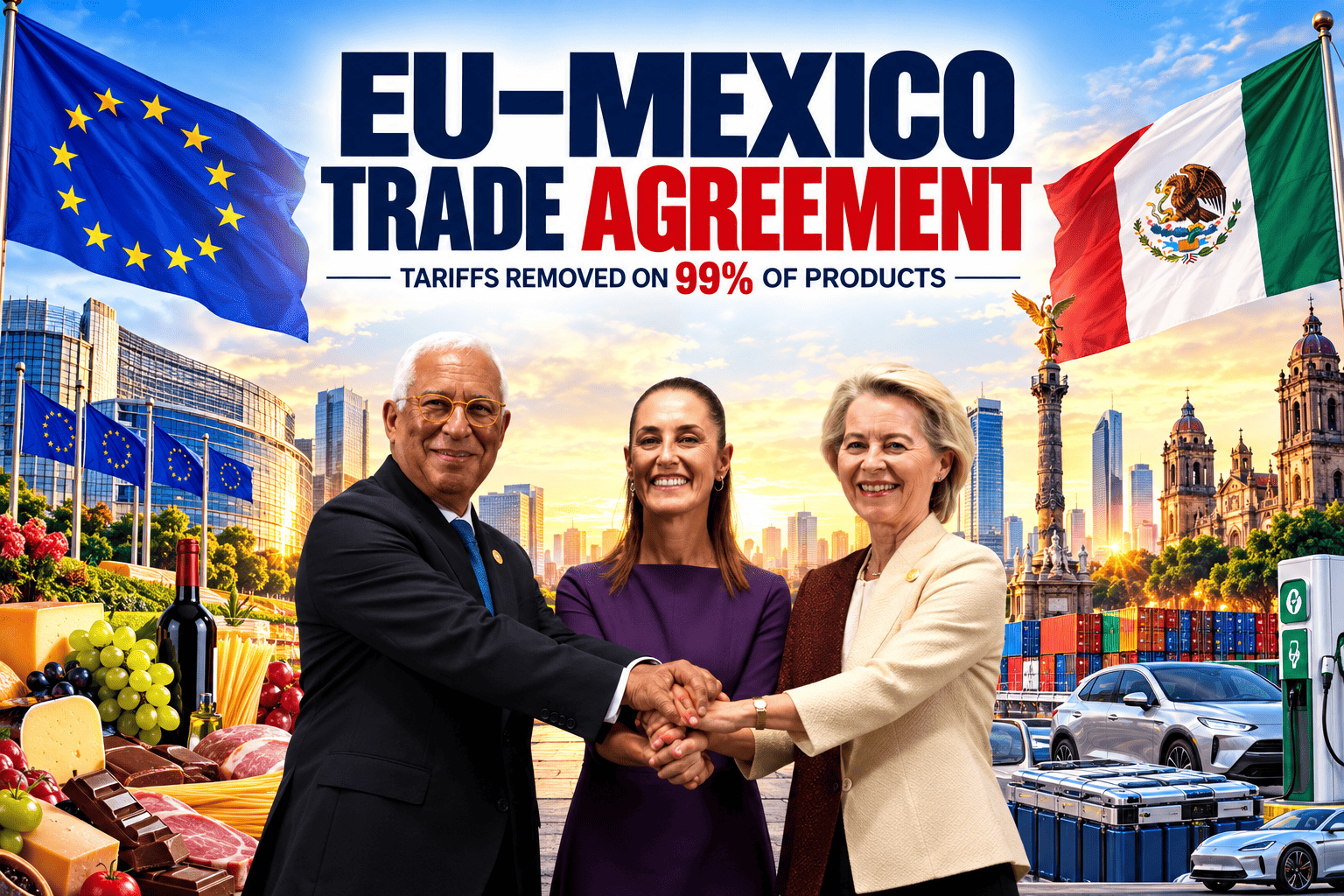
Direct Answer: On 22 May 2026, at the 8th EU–Mexico Summit in Mexico City, the European Union and Mexico signed the Modernised Global Agreement (MGA) and an accompanying Interim Trade Agreement (ITA), updating a trade framework in place since 2000. The deal eliminates tariffs on 99% of products traded between the two parties, removes 95% of high Mexican tariffs on EU agri-food exports (with up to 100% elimination on products like cheese, pork, poultry, pasta, chocolate and wine), eliminates mutual tariffs on EVs and batteries, and protects 568 EU and 26 Mexican geographical indications. Annual two-way trade in goods and services exceeds €100 billion. The ITA enters into force once the European Parliament consents (approved 8 July 2026); the broader MGA requires ratification by all 27 EU member states.
📅 September 2, 2026⏱ 14 min read✍️ GT Setu Editorial Team🔄 Updated regularly
99%
Of Traded Products Get Tariff Elimination
95%
Reduction in High Mexican Tariffs on EU Agri-Food
568
EU Geographical Indications Protected in Mexico
€100B+
Annual EU–Mexico Trade in Goods & Services
After a decade of on-and-off negotiations that began in 2016, the European Union and Mexico have finally modernised the trade and cooperation framework that has governed their relationship since 2000. The signing took place at the 8th EU–Mexico Summit in Mexico City on 22 May 2026, the first such summit since 2015, with Commission President Ursula von der Leyen, Council President António Costa, and Mexican President Claudia Sheinbaum presiding over the ceremony.
The timing is notable. The agreement follows closely on the heels of the EU’s EU–Mercosur trade agreement, and arrives as both the EU and Mexico look to diversify trade relationships away from overreliance on the United States amid rising global tariff uncertainty. This guide covers what the agreement contains, its tariff and market-access provisions, which sectors benefit most, and what remains before it fully enters into force.
🌍 Who Is This Guide For?
This guide is written for exporters, importers, investors, and trade and compliance teams in the EU and Mexico, particularly in agri-food, automotive, pharmaceuticals, machinery, and critical raw materials, who need to understand what the Modernised Global Agreement changes and when.
Looking to source or export between the EU and Mexico?Find verified manufacturing and distribution partners through GTsetu.
Signed; ratification and implementation underway (European Parliament consent given 8 July 2026)
Negotiations Concluded
17 January 2025
Replaces
The original EU–Mexico Global Agreement, in force since 2000
Trade Volume
€86.8 billion in goods (2025) + €29.7 billion in services (2024); over €100 billion annually combined
SECTION 2
2 What Is the EU–Mexico Modernised Global Agreement?
🎯 The Core Definition
The modernisation of the EU’s Global Agreement with Mexico is split into two instruments to speed up implementation. The Modernised Global Agreement (MGA) covers political dialogue, cooperation, and investment. The Interim Trade Agreement (ITA) focuses exclusively on trade liberalisation, which falls under the EU’s exclusive competence. Together, they replace the original EU–Mexico Global Agreement that has been in force since 2000, making Mexico one of the EU’s longest-standing trade agreement partners.
The two-instrument structure exists for a practical legal reason: the ITA, covering trade matters alone, can enter into force once the European Parliament gives its consent, without needing ratification by the national parliaments of all 27 EU member states. The broader MGA, being a “mixed” agreement spanning cooperation and investment as well as trade, requires ratification by each EU member state individually. Once that ratification process is complete, the MGA will replace the ITA in its entirety.
⚖️
Replaces a 25-Year-Old Framework
The agreement updates the EU–Mexico Global Agreement that has governed bilateral trade and cooperation since 2000, modernising it for current trade realities.
🤝
A Relaunched Strategic Partnership
The 8th EU–Mexico Summit was the first since 2015. Alongside the trade agreement, both sides signed a letter of intent for renewed political and strategic dialogue on global issues.
🌎
Part of a Broader EU Latin America Push
The deal follows the EU–Mercosur agreement and reinforces the EU’s wider strategy of deepening trade ties across Latin America.
SECTION 3
3 Timeline: From Negotiation to Signature
2016
Modernisation Talks Begin
Negotiations to modernise the EU–Mexico Global Agreement, in force since 2000, formally begin, the start of a process that would take nearly a decade to conclude.
Jan 2025
Negotiations Conclude
On 17 January 2025, the European Commission and Mexico’s Ministry of Economy announce the conclusion of negotiations for the Modernised Global Agreement.
11 May 2026
EU Council Authorises Signature
The EU Council formally authorises the signing of both the Modernised Global Agreement and the Interim Trade Agreement.
21–22 May 2026
8th EU–Mexico Summit & Signing
At a summit in Mexico City, Presidents Claudia Sheinbaum and Ursula von der Leyen sign both agreements on 22 May, alongside a letter of intent on political and strategic dialogue signed a day earlier.
8 Jul 2026
European Parliament Approves
The European Parliament approves both the Modernised Global Agreement and the Interim Trade Agreement, clearing a key step for the ITA’s entry into force.
Ongoing
Ratification by EU Member States & Mexican Senate
The ITA proceeds to entry into force following European Parliament consent; the full MGA requires ratification by all 27 EU member states, while Mexico’s own ratification runs through its Senate.
SECTION 4
4 Tariff Elimination & Market Access
The headline outcome of the agreement is sweeping tariff elimination. The new pact removes tariffs on 99% of products traded between the EU and Mexico, with Mexico eliminating 95% of its high tariffs on EU agri-food exports specifically. On a number of iconic European categories, tariff elimination reaches up to 100%.
Product / Sector
Tariff Outcome
Cheese, pork & poultry meat
Tariffs eliminated by up to 100%
Pasta, apples, jams & preserves
Tariffs eliminated by up to 100%
Chocolate & wine
Tariffs eliminated by up to 100%
Electric vehicles & batteries
Mutual tariff elimination
Car parts
Importation liberalised, benefiting automotive supply chains on both sides
Critical raw materials
Elimination of export restrictions, including import duties
Overall traded products
99% tariff-free trade once fully implemented
Mexican Economy Secretary Marcelo Ebrard noted that the reduction of more than 90% of tariff lines creates an opportunity for Mexico to attract faster-growing EU investment, while EU officials have framed the agri-food liberalisation as a direct opportunity for European producers to expand into one of Latin America’s largest food-import markets, Mexico imported €2.5 billion of EU agri-food products in 2025 alone, making it the region’s second-largest importer of such goods.
SECTION 5
5 Sectors Most Affected
🧀High Impact
Agri-Food & Beverages
The elimination of Mexican restrictions on agri-food imports opens the door for EU producers of cheese, meat, wine, chocolate, and preserved goods to expand into the Mexican market with up to 100% tariff removal.
🚗High Impact
Automotive & EVs
Liberalisation of car parts importation benefits automotive companies already investing in Mexico, while mutual tariff elimination on EVs and batteries supports electrification supply chains on both sides.
💊High Impact
Pharmaceuticals
The agreement gives EU companies new market access for pharmaceutical products, alongside stronger intellectual property protections exceeding WTO TRIPS standards.
⚙️High Impact
Machinery & Industrial Equipment
Expanded market access for machinery exports, alongside simplified export procedures intended to facilitate faster, cheaper trade in industrial equipment.
⛏️Strategic
Critical Raw Materials
The agreement ensures fairer trade and investment in raw materials through the elimination of export restrictions, including import duties, strengthening critical mineral supply chains for the EU.
🏛️Strategic
Public Procurement & Services
Mexico brings its public procurement rules in line with the WTO Government Procurement Agreement, giving EU companies equal-terms access to public contracts and public-private partnership models.
💡 A Platform With Dual Preferential Access
With this agreement, Mexico becomes one of the few countries offering simultaneous preferential access to both North America (through USMCA) and the European Union. For EU companies, this strengthens Mexico’s appeal not just as a destination market, but as a manufacturing and export platform serving both trade blocs.
Exploring Mexico as a manufacturing or export base?Connect with verified Mexican manufacturers and distributors through GTsetu.
The agreement significantly expands protection for iconic and traditional food and drink products. It extends legal protection to 568 EU geographical indications and 26 Mexican geographical indications, covering products whose names are tied to a specific region’s reputation, methods, or origin, such as European cheeses, hams, and wines, and Mexican products such as tequila and mezcal.
Beyond geographical indications, the agreement establishes intellectual property standards higher than the WTO’s TRIPS baseline, including extended protection for industrial designs of up to 25 years, while also revising and relaxing certain standards to better match current industry needs.
SECTION 7
7 Investment, Procurement & Raw Materials
🏦
Investment Court System
A permanent tribunal, jointly established by the EU and Mexico, resolves disputes between foreign investors and host states, replacing older ad hoc investor-state arbitration mechanisms.
🏢
Easier Investment Access
The agreement makes it easier for EU companies to invest in Mexico and allows EU firms to provide services in Mexico across a range of important sectors.
📑
WTO-Aligned Procurement Rules
Mexico brings its transparency and non-discrimination rules in line with the WTO’s Government Procurement Agreement, opening public contracts to EU bidders on equal terms.
🔋
Critical Minerals & Clean Tech
The agreement supports cooperation on clean technologies and boosts critical mineral projects in Mexico, reinforcing EU supply-chain resilience in strategic raw materials.
🌱
Sustainable Development Commitments
A dedicated chapter sets legally binding commitments on labour rights, environmental protection, climate change, and responsible business conduct, monitored by civil society forums and Domestic Advisory Groups.
🚫
Anti-Corruption Measures
The agreement includes measures to prevent and combat corruption, reinforcing rule-of-law commitments alongside its trade and investment provisions.
SECTION 8
8 Ratification: What Happens Next
⏳ Current Status
The Interim Trade Agreement (ITA) requires only European Parliament consent to enter into force, since it falls under the EU’s exclusive competence and does not need approval from national parliaments. The European Parliament approved both the MGA and the ITA on 8 July 2026. The ITA is expected to enter into force later in 2026, pending Mexican Senate ratification. The broader Modernised Global Agreement (MGA), covering political dialogue, cooperation, and investment, is a “mixed” agreement requiring ratification by all 27 EU member states individually, a longer process that will culminate in the MGA replacing the ITA entirely once complete.
For businesses, this means the trade-liberalisation provisions, tariff elimination, geographical indications, and market access, are on a faster track toward taking effect than the full cooperation and investment framework. Companies planning sourcing, export, or investment strategies around the agreement should track both the ITA’s entry into force and the slower-moving MGA ratification process across EU member states.
SECTION 9
9 Why This Agreement Matters Strategically
Beyond its commercial terms, the EU and Mexico have both framed this agreement in explicitly geopolitical language. European officials describe it as a statement in support of open markets, multilateralism, and a rules-based international order, a contrast to rising protectionism elsewhere. For Mexico, the deal reinforces a broader diversification agenda away from near-total reliance on the US market, strengthening its position as a production platform with simultaneous preferential access to both North America and the EU.
The agreement also sits inside a wider pattern of EU trade diplomacy in 2025–2026, following the conclusion of the EU–Mercosur agreement and running alongside parallel EU efforts such as the India–EU free trade agreement negotiations and the EU–Philippines free trade agreement. Taken together, these deals signal a deliberate EU push to deepen trade relationships across multiple regions simultaneously.
FAQ
? Frequently Asked Questions
QWhen was the EU–Mexico Modernised Global Agreement signed?
The EU and Mexico signed the Modernised Global Agreement (MGA) and the Interim Trade Agreement (ITA) on 22 May 2026, at the 8th EU-Mexico Summit held in Mexico City, the first such summit since 2015. Negotiations on the modernised agreement had concluded on 17 January 2025, with the EU Council authorising signature on 11 May 2026.
QWhat tariffs does the EU-Mexico agreement eliminate?
The agreement eliminates tariffs on 99% of products traded between the EU and Mexico. It removes 95% of high Mexican tariffs on EU agri-food exports, including up to 100% tariff elimination on products such as cheese, pork and poultry meat, pasta, apples, jams and preserves, chocolate and wine. It also eliminates mutual tariffs on electric vehicles and batteries, and liberalises car parts importation.
QWhat is the difference between the Modernised Global Agreement and the Interim Trade Agreement?
The modernisation is split into two instruments to speed up implementation. The Interim Trade Agreement (ITA) covers trade liberalisation exclusively, falls under EU exclusive competence, and enters into force once the European Parliament gives consent, without requiring ratification by national parliaments. The Modernised Global Agreement (MGA) is a broader “mixed” agreement covering political dialogue, cooperation and investment, and requires ratification by all 27 EU member states before it replaces the ITA in its entirety.
QHow many geographical indications does the agreement protect?
The agreement protects 568 European Union geographical indications and 26 Mexican geographical indications, extending legal protection to iconic and traditional food and drink products from both regions.
QHow big is EU-Mexico trade today?
EU-Mexico trade in goods reached €86.8 billion in 2025, with two-way trade in services reaching €29.7 billion in 2024, combined annual trade in goods and services exceeds €100 billion. More than 43,000 European companies currently export to Mexico, and over 11,000 EU businesses operate in the country. Mexico is the EU’s second-biggest trading partner in Latin America.
🌍 GTsetu — Verified Partner Discovery for EU–Mexico Trade
Find Verified Partners to Act on the EU–Mexico Agreement
As tariffs fall on agri-food, automotive, pharmaceutical, and machinery trade between the EU and Mexico, the companies that move first on verified sourcing, distribution, and manufacturing partnerships stand to benefit most. GTsetu pre-verifies manufacturers, suppliers, and distributors on both sides of the corridor, so you can discover and engage credible partners with confidence.
🏭
Verified Manufacturers & Suppliers
Pre-verified companies across agri-food, automotive, pharma, and machinery in the EU and Mexico.
🕵️
Anonymous Discovery
Evaluate potential partners without revealing your plans until you choose to engage.
📄
NDA Before Specifications
A digital mutual NDA is in place before sensitive product or pricing details are shared.
🚫
Zero Broker Commission
No commission on any partnership formed through the platform.
Put the EU–Mexico Agreement to Work for Your Business
Find pre-verified manufacturers, suppliers, and distribution partners across the EU and Mexico, anonymous discovery, built-in NDA, and zero broker commissions.
They represents the product, and research team behind GTsetu, a global B2B collaboration platform built to help companies explore cross-border partnerships with clarity and trust. The team focuses on simplifying early-stage international business discovery by combining structured company profiles, verification-led access, and controlled collaboration workflows.
With a strong emphasis on trust, and disciplined engagement, Team GTsetu shares insights on global trade, partnerships, and cross-border collaboration, helping businesses make informed decisions before entering deeper commercial discussions.