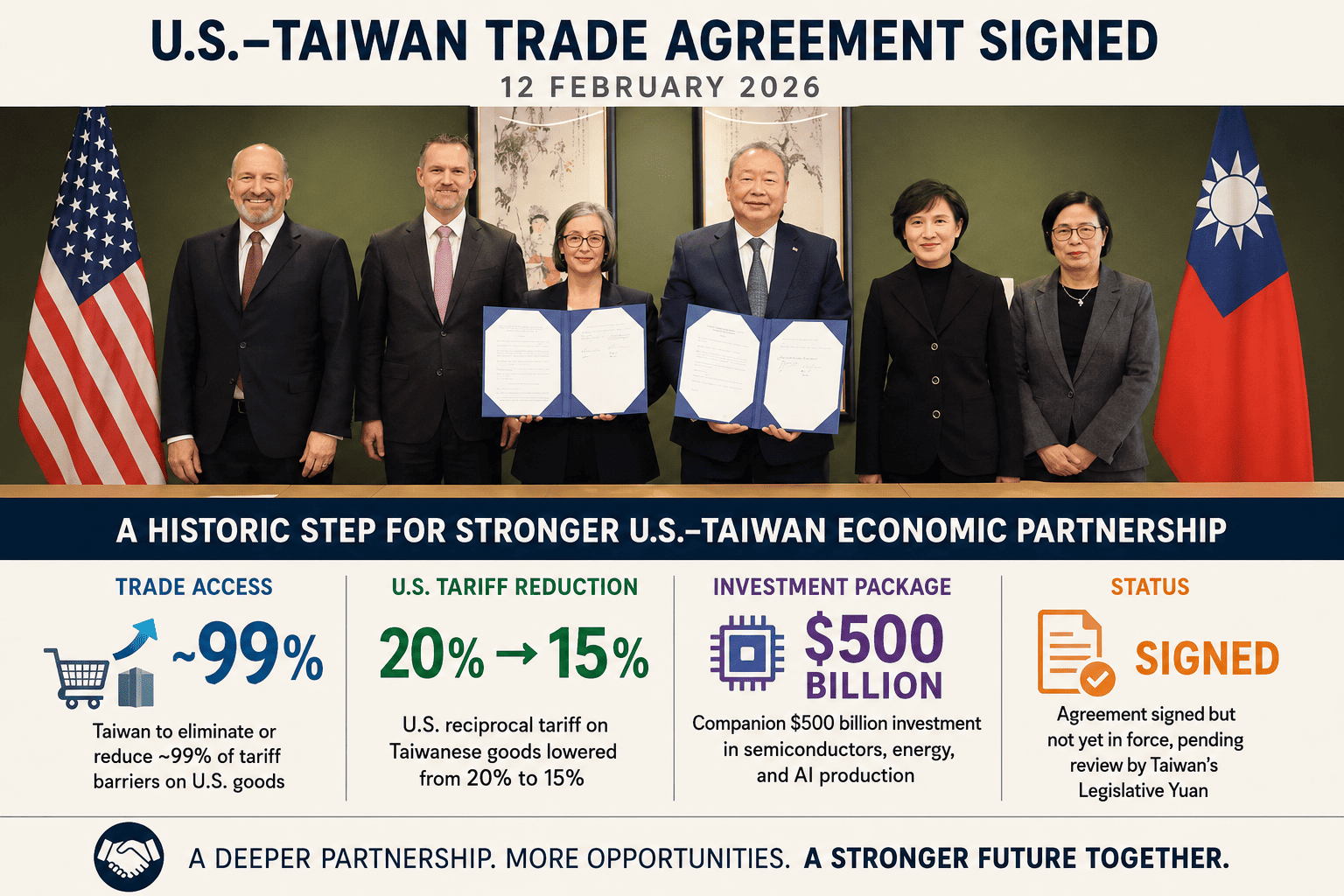
On 12 February 2026, the American Institute in Taiwan (AIT) and the Taipei Economic and Cultural Representative Office (TECRO) signed the Agreement on Reciprocal Trade (ART), the most substantial trade deal between the United States and Taiwan in decades. It commits Taiwan to eliminating or reducing roughly 99 percent of its tariff barriers on U.S. goods, lowers the U.S. reciprocal tariff on Taiwanese goods from 20 percent to 15 percent, and sits alongside a companion $500 billion investment package aimed at semiconductors, energy, and AI production. The agreement is signed but not yet in force, pending review by Taiwan’s Legislative Yuan.
📅 Signed February 12, 2026⏱ 13 min read✍️ GTsetu Editorial🔄 Updated September 10, 2026
The ART is being described by trade analysts as the closest thing the United States and Taiwan are likely to have to a full bilateral free trade agreement. It builds on a Memorandum of Understanding signed a month earlier, on 15 January 2026, and replaces the ad hoc tariff actions of the preceding two years with a structured, phased framework covering tariffs, regulatory alignment, export controls, intellectual property enforcement, and purchase commitments. Two-way trade in goods and services between the U.S. and Taiwan totalled more than $185 billion in 2024, and the agreement is framed by both sides as deepening supply-chain resilience, particularly in semiconductors and other high-technology sectors.
Sections 3 and 4 cover the substantive tariff and regulatory terms. Section 6 covers where implementation currently stands, since the agreement is signed but not yet in force. Section 7 places the ART alongside the other reciprocal and preferential agreements signed in the same window, and Section 8 is the practical section for businesses deciding how to act on the new terms.
Section 1
Agreement Overview
The ART was signed under the auspices of AIT and TECRO, the unofficial bodies that conduct U.S.–Taiwan relations in the absence of formal diplomatic ties. It is a comprehensive agreement spanning tariff schedules, non-tariff barriers, regulatory alignment, economic and national-security cooperation, enforcement of intellectual property and labor standards, and future purchase commitments. According to USTR, the deal will eliminate tariff and non-tariff barriers facing U.S. exporters while significantly enhancing the resilience of supply chains in high-technology sectors.
Crucially, the ART does not stand alone. It formalises and builds on a separate Memorandum of Understanding on Taiwan–U.S. investment signed on 15 January 2026, under which Taiwanese semiconductor and technology firms committed to a combined $500 billion investment package in the United States. Both instruments qualify for implementation under Executive Order 14346, though as of the most recent federal notice, only the MOU is being actively implemented; the ART itself awaits entry into force.
📌 Two linked but separate instruments
The MOU (15 Jan 2026) covers the $500B investment and credit-guarantee package and is being implemented now. The ART (12 Feb 2026) covers the tariff schedule and regulatory commitments and requires Taiwan’s Legislative Yuan to approve it before its tariff provisions take effect. Treat these as related but distinct when assessing what is actually actionable today.
Section 2
Key Numbers at a Glance
99%
Of Taiwan’s tariff lines reduced or eliminated under the ART
20%→15%
U.S. reciprocal (IEEPA) tariff rate cut on Taiwanese goods
$500B
Combined Taiwanese investment & credit guarantees for the U.S.
$85B
Taiwan’s purchase commitments from the U.S. through 2030
$185B
Two-way U.S.–Taiwan trade in goods and services (2024)
3 yrs
Phased implementation window for most tariff reductions
Section 3
Tariff Reduction Schedule
What Taiwan Is Cutting
Taiwan’s tariff commitments are staged across several categories rather than applied uniformly. Some lines drop to zero immediately on entry into force, others are phased down over three years, and a short list of politically sensitive agricultural lines remains unchanged. The table below summarises the staging categories as set out in the agreement’s tariff schedule annex.
On the U.S. side, the reciprocal (IEEPA) tariff rate applied to Taiwanese goods falls from 20 percent to 15 percent, inclusive of the Most Favored Nation (MFN) rate, meaning goods with an MFN rate below 15 percent will carry a total rate of 15 percent. A 25 percent Section 232 tariff on Taiwanese auto parts, timber, lumber, and wood derivative products under the Trade Expansion Act of 1962 is reduced to 15 percent. Tariffs on generic pharmaceuticals, generic ingredients, aircraft components, and certain unavailable natural resources drop to zero, and future semiconductor tariffs will run on a quota system tied to Taiwanese investment levels in the U.S. Taiwan is also set to receive preferential treatment in the ongoing Section 232 investigation into semiconductors and semiconductor manufacturing equipment.
💡 Why the staging matters for sourcing decisions
Because tariff cuts are staggered by category and some politically sensitive lines are frozen, manufacturers evaluating new import or export lines should check the specific HS code against the annex rather than assuming a blanket rate applies, the same diligence worth applying when comparing against a tariff-staging structure like the one in the US–Argentina Reciprocal Trade Agreement.
Section 4
Non-Tariff, Security & Enforcement Provisions
1
Non-Tariff Barrier Reductions
Regulatory acceptance for autos, medical devices, and agricultural products
Regulatory
Safety-standard mismatches have long acted as an effective non-tariff barrier for American exporters into Taiwan. The ART addresses several of these directly.
Key commitments
Taiwan accepts vehicles compliant with U.S. Federal Motor Vehicle Safety Standards
Taiwan accepts medical devices approved by the U.S. FDA
Food and agricultural safety standards aligned with international norms, covering beef, pork, and animal byproducts
Reduced barriers for bison, poultry, dairy, aquatic products, potatoes, and agricultural biotechnology
🎯
Relevance: Exporters in automotive, medical device, and agricultural categories gain a materially faster path to market entry under this provision alone.
2
Economic & National Security Cooperation
Export control alignment, investment screening, and China-related guardrails
Security
Taiwan commits to align its export controls with the U.S. Foreign Direct Product Rule on semiconductors and related equipment, and to maintain robust research-security measures, including not entering agreements with the PRC on AI, biotechnology, or quantum computing.
Key commitments
Alignment with U.S. Foreign Direct Product Rule on semiconductors
Comprehensive review mechanism for inbound and outbound investment
If Taiwan signs a new FTA or digital trade deal with China, the U.S. may terminate the ART and reimpose tariffs (Articles 4.3 and 5.4.6)
Phase-out of technology from “countries of concern” in 5G/6G networks, subsea cables, cloud, and port cranes
🎯
Relevance: Technology partners and supply-chain planners should treat these clauses as a durability signal, the agreement’s economic terms are explicitly conditioned on continued geopolitical alignment, not unlike the sensitivity built into the UK–GCC Free Trade Agreement.
3
Regulatory Alignment & Digital Trade
Geographical indications, digital taxes, data flows, rare earth recycling
Digital & Regulatory
On more technical matters, Taiwan commits to transparent treatment of geographical indications, no digital services taxes on U.S. companies, and free cross-border data transfer between trusted jurisdictions. The two sides also agree to expand rare earth recycling cooperation.
Key commitments
No digital services taxes targeting U.S. companies
Free flow of data across trusted borders
Expanded rare earth recycling cooperation
Crackdown on illegal logging, unregulated fishing, and illegal wildlife trade
🎯
Relevance: Comparable digital-trade language also appears in newer agreements such as the EU–Mexico Modernised Trade Agreement, suggesting this is becoming a template clause across recent deals.
4
IP & Labor Enforcement
Intellectual property protection and labor-rights commitments
Enforcement
Taiwan commits to a robust standard of IP protection, including effective civil, criminal, and border enforcement systems against infringement, including online infringement. It also commits to enforcing internationally recognised labor rights and eliminating forced or compulsory labor, particularly in distant-water fishing fleets.
Key commitments
Civil, criminal, and border IP enforcement systems
Protection of union and labor rights
Elimination of forced or compulsory labor, including in fishing fleets
Alongside tariff and regulatory terms, the ART includes substantial Taiwanese purchase commitments from the United States running through 2030, and sits next to a separate but closely linked investment agreement signed a month earlier.
Commitment
Value
Scope
LNG & crude oil purchases
$44.4 billion
Through 2030, from the United States
Power equipment & grid infrastructure
$25.2 billion
Power grids, generators, storage, marine & steel-making equipment
Civil aircraft & engines
$15.2 billion
Through 2030
Total purchase commitments
~$85 billion
Through 2030
Direct investment in the U.S. (companion MOU)
$250 billion
By Taiwanese semiconductor and technology enterprises
Government credit guarantees (companion MOU)
$250 billion
Backing additional Taiwan-side investment
Total investment package
$500 billion
Focused on semiconductors, energy, and AI production
Neither the ART nor the companion investment agreement addresses a bilateral tax treaty, which remains an open gap given the scale of planned investment. The investment package is expected to fund expansion of advanced semiconductor, energy, and AI production capacity, along with the broader supply-chain ecosystems that support them, and Taiwan is also expected to facilitate U.S. LNG export capacity investment while building its own LNG storage, to be filled with American LNG. The scale of this commitment is unusual even against other large 2026 agreements, including the US–India Trade Deal and the EU–Mercosur Trade Agreement.
Section 6
Implementation Timeline & Status
Date
Milestone
Status
15 January 2026
AIT–TECRO investment MOU signed ($500B package)
✓ Signed, being implemented
12 February 2026
Agreement on Reciprocal Trade (ART) signed in Washington, DC
⚠ Signed, not yet in force
~March 2026 (expected)
Taiwan’s Legislative Yuan begins formal review of the ART
⚠ Pending legislative review
Ongoing
U.S. implementing MOU-related tariff and Section 232 elements under Executive Order 14346
✓ In progress
Pending
ART tariff schedule enters into force once Taiwan’s domestic approval is complete
✗ Not yet in force
The path to entry into force is not purely procedural. Taiwan’s Legislative Yuan is controlled by an opposition coalition, and the ruling party will need to spend considerable political capital to secure approval. Opposition lawmakers have raised concerns that the deal could affect food safety and expose domestic automotive and agricultural industries to new competition. Local elections later in the year add further uncertainty to the timeline, and U.S. trade officials have signalled limited patience for delays, meaning tariffs could revert upward if Taiwan’s legislative process stalls.
📌 Practical takeaway on timing
Businesses should not assume the lower tariff schedule is active yet. Until the Legislative Yuan approves the ART and it formally enters into force, current IEEPA and Section 232 rates (as modified under the January MOU) remain the operative figures for customs planning, the same caution worth applying before acting on the signed-but-pending US–El Salvador Reciprocal Trade Agreement or the US–Guatemala Reciprocal Trade Agreement.
Section 7
Where the ART Fits in the 2026 Trade Agreement Wave
The ART is not an isolated event. It is one of a cluster of bilateral reciprocal trade agreements the United States has signed with Indo-Pacific and Latin American partners in the same period, alongside similar structures with Bangladesh, Indonesia, El Salvador, Guatemala, Ecuador, and Argentina. Each follows a broadly comparable template: a reduced U.S. reciprocal tariff rate offered in exchange for market-access, regulatory, and purchase commitments from the partner country, though the specific numbers and carve-outs vary considerably by market.
Running in parallel to the U.S. reciprocal trade series is a separate wave of Comprehensive Economic Partnership Agreements (CEPAs) the UAE has been signing with partners across Africa, Asia, and Latin America, including the UAE–Philippines CEPA, the UAE–Nigeria CEPA, the UAE–Sierra Leone CEPA, the UAE–DRC CEPA, the UAE–Gabon CEPA, and the UAE–Ecuador CEPA. These CEPAs tend to move faster to entry into force than reciprocal trade agreements of the ART’s scale, since they typically involve smaller, more targeted tariff schedules.
Trade agreements lower the cost of doing business between two markets, but they do not by themselves verify a counterparty, draft a contract, or protect confidential commercial information. Once the ART enters into force and tariff lines on vehicles, machinery, agricultural goods, and components drop, the practical bottleneck for most manufacturers and distributors shifts from “can we access this market” to “who do we actually work with in it, and how do we verify them.” The same question applies equally to businesses positioning around the US–Ecuador Reciprocal Trade Agreement or the US–Bangladesh Reciprocal Trade Agreement.
A U.S. manufacturer of refrigerated trucks or power equipment looking at Taiwan’s falling tariff lines still needs a verified distributor or supply partner on the ground. A Taiwanese machinery exporter benefiting from zero-rated entry into the U.S. still needs to confirm its own certifications are recognised on the other side. None of that changes because a tariff line moved from 17.5 percent to zero.
🚗
Automotive & components exporters
Passenger vehicle tariffs into Taiwan drop to zero on entry into force; U.S. Section 232 rates on auto parts fall to 15%.
Review HS codes against the annex
🌽
Agriculture & food processing
Significant cuts on fruit, pork, and poultry lines, but rice, oysters, and chicken meat remain frozen.
Check category-by-category staging
💻
Semiconductors & technology
Future tariffs run on an investment-linked quota; the $500B investment deal is the larger driver here.
Track Section 232 semiconductor ruling
⚡
Power & energy equipment
Part of Taiwan’s $25.2B equipment purchase commitment, a direct near-term demand signal.
Approach via verified distributors
🏭
Industrial machinery manufacturers
Thousands of machinery lines move to zero tariff on entry into force, widening the addressable market both ways.
Verify partners before scaling
🤝
Finding a distributor once the ART is in force
Lower tariffs create new demand, but someone still has to find, vet, and formalise the relationship on the other side.
GTsetu
🤝 Acting on the Agreement, Not Just Reading About It
GTsetu: Verified Partner Discovery for Manufacturers and Distributors Positioning Around the U.S.–Taiwan Agreement
Trade agreements open doors; they do not vet who is standing on the other side of them. If you are a manufacturer, distributor, or raw material supplier planning to act on the ART’s tariff reductions, whether sourcing Taiwanese machinery and semiconductor equipment components, or finding a U.S. distributor for Taiwanese goods entering under the new schedule, GTsetu is built for the step that comes after the headline: finding a verified, long-term partner rather than a one-off buyer.
Companies weighing a move into Taiwan or the U.S. under the ART use the same platform to evaluate opportunities opening up under parallel agreements, whether that is the US–Indonesia Reciprocal Trade Agreement, the UAE–Nigeria CEPA, or the India–EU Free Trade Agreement, verifying counterparties across 100+ countries before any commercial information changes hands.
🏛️
6-Point Government-Sourced Verification
Name, Address, Registration Number, Company Status, Company Type, and Date of Incorporation, verified before any engagement.
🕵️
Anonymous Discovery
Browse verified manufacturers and distributors in Taiwan, the U.S., and 100+ other countries without revealing your identity until you choose to engage.
📄
Built-In NDA Workflow
Digital NDA with timestamped signatures before pricing, specifications, or supply terms are shared.
🔐
Encrypted Document Workspace
Share tariff classifications, certifications, and commercial terms through an encrypted channel with a full audit trail.
🌍
100+ Countries
Verified manufacturers and distributors across North America, Asia, Europe, the Middle East, and Africa.
🚫
Zero Commission
No success fee or broker commission on any partnership formed through the platform.
📌 Contracts should account for agreement conditionality
Because the ART’s benefits are explicitly conditioned on continued compliance (Taiwan’s export-control alignment, the China-related termination clauses, and the Legislative Yuan’s approval), any long-term supply or distribution agreement signed around this deal should factor in that conditionality, much as it should for counterpart terms under the US–Argentina Reciprocal Trade Agreement.
FAQ
Frequently Asked Questions
QWhat is the U.S.–Taiwan Agreement on Reciprocal Trade?
The Agreement on Reciprocal Trade (ART) is a bilateral trade agreement signed on 12 February 2026 by AIT and TECRO. It reduces or eliminates roughly 99 percent of Taiwan’s tariff barriers on U.S. goods, lowers the U.S. reciprocal tariff on Taiwanese goods from 20 percent to 15 percent, and includes commitments on non-tariff barriers, export controls, intellectual property enforcement, and purchase volumes through 2030.
QIs the U.S.–Taiwan trade agreement in force yet?
No. As of this writing the ART has been signed but is not yet in force. It requires domestic approval procedures on both sides, most significantly a review and vote by Taiwan’s Legislative Yuan, before its tariff provisions take effect. The companion investment MOU signed 15 January 2026 is being implemented separately and is already in motion.
QHow much is Taiwan committing to invest in the United States?
Under the companion investment agreement signed 15 January 2026, Taiwanese semiconductor and technology enterprises have committed to $250 billion in new direct investment in the United States, backed by a further $250 billion in credit guarantees from the Taiwan government, for a combined $500 billion package focused on semiconductors, energy, and AI production.
QWhich products get the biggest tariff cuts?
Over 6,300 product lines move to zero tariff immediately on entry into force, including passenger vehicles (currently 17.5%), tobacco, tomatoes, guitars, knives, and glassware. Politically sensitive agricultural lines, including rice, oysters, garlic, and chicken meat, remain unchanged, while pork, duck, and certain fruit lines see partial, staged reductions over three years.
QWhat happens if Taiwan signs a trade deal with China?
Article 5.4.6 of the ART states that if Taiwan enters a new bilateral free trade agreement or preferential economic agreement with China, the United States may terminate the ART and reimpose tariffs. A similar provision, Article 4.3, applies if Taiwan signs a digital trade agreement with China. These clauses make the agreement’s benefits explicitly conditional on continued strategic alignment.
QHow does the U.S.–Taiwan agreement compare to other reciprocal trade agreements signed in 2026?
The ART is one of several bilateral reciprocal trade agreements the United States signed in this period, alongside deals with Bangladesh, Indonesia, El Salvador, Guatemala, Ecuador, and Argentina. Each follows a broadly similar structure, a reduced U.S. reciprocal tariff in exchange for market-access and regulatory commitments from the partner country, though the specific tariff rates, purchase commitments, and sector carve-outs differ by country. A separate, faster-moving track of UAE CEPAs with partners such as the Philippines, Nigeria, Sierra Leone, the DRC, Gabon, and Ecuador is unfolding in parallel.
GTsetu is purpose-built for manufacturers, distributors, and raw material suppliers seeking verified long-term trade partnerships in the U.S., Taiwan, and 100+ other countries, with government-sourced partner verification, built-in NDA workflows, and zero commission.
They represents the product, and research team behind GTsetu, a global B2B collaboration platform built to help companies explore cross-border partnerships with clarity and trust. The team focuses on simplifying early-stage international business discovery by combining structured company profiles, verification-led access, and controlled collaboration workflows.
With a strong emphasis on trust, and disciplined engagement, Team GTsetu shares insights on global trade, partnerships, and cross-border collaboration, helping businesses make informed decisions before entering deeper commercial discussions.