U.S.–Indonesia Agreement on Reciprocal Trade: What It Covers | GTsetu FTA Tracker
Home ›
FTA Tracker ›
US-Indonesia Reciprocal Trade Agreement
🇺🇸 🇮🇩 Trade Agreement Tracker · 2026
U.S.–Indonesia Agreement on Reciprocal Trade: What It Covers
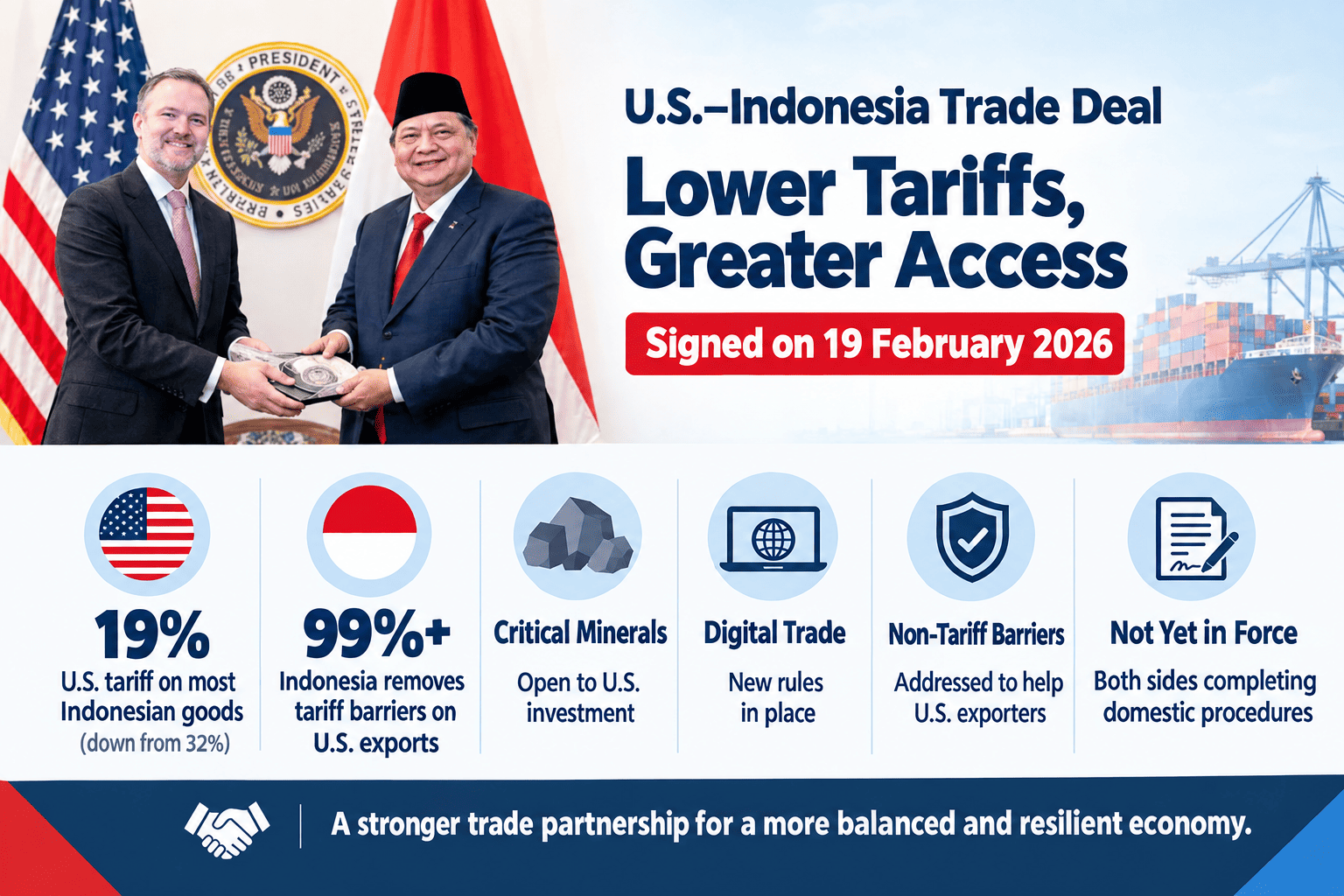
On 19 February 2026, U.S. Trade Representative Jamieson Greer and Indonesia’s Coordinating Minister for Economic Affairs Airlangga Hartarto signed the U.S.–Indonesia Agreement on Reciprocal Trade in Washington, locking in a 19 percent U.S. tariff on most Indonesian goods, down from an initial 32 percent, in exchange for Indonesia eliminating tariff barriers on more than 99 percent of U.S. exports. The deal also opens Indonesian critical minerals to U.S. investment, sets new digital trade rules, and addresses a long list of non-tariff barriers that had constrained U.S. exporters. The agreement is signed but not yet in force, with both governments still completing domestic procedures. This article covers what’s actually in the text and what businesses on both sides should track, as part of our broader FTA Tracker coverage of agreements such as the US–El Salvador reciprocal trade agreement and the US–India trade deal.
📅 Published February 25, 2026⏱ 12 min read✍️ GTsetu Editorial🔄 Updated October 1, 2026
Date
19 Feb 2026
Parties
🇺🇸 USA – 🇮🇩 Indonesia
Agreement
U.S.–Indonesia Agreement on Reciprocal Trade
Type
Reciprocal Trade Agreement
Status
Signed; not yet in force
Few trade agreements have been as closely tied to a single number as this one. The entire negotiation, from its July 2025 framework through its February 2026 signature, revolved around whether Indonesia could talk the U.S. down from a 32 percent tariff, and by how much. The answer, 19 percent, became the headline. What’s underneath that number, and what Indonesia gave up to get there, is where this agreement actually gets interesting, and it fits a pattern repeating across many of 2026’s reciprocal trade deals, from the US–Bangladesh reciprocal trade agreement to the US–Taiwan reciprocal trade agreement.
Section 1
Overview: From 32% to 19%
The path to signature ran through two separate White House announcements eight months apart. In July 2025, the two countries agreed to a Framework for negotiating an Agreement on Reciprocal Trade, with the U.S. committing to reduce its reciprocal tariff on Indonesian goods to 19 percent from the 32 percent rate set in Executive Order 14257, in exchange for Indonesia eliminating over 99 percent of its tariff barriers on U.S. exports. By February 2026, that framework had become a signed agreement, with Indonesia becoming the third Southeast Asian nation, after Malaysia and Cambodia, to finalize a reciprocal trade agreement with the U.S., following a similar path to the US–Guatemala reciprocal trade agreement and the US–Ecuador reciprocal trade agreement.
19%
U.S. reciprocal tariff rate on Indonesian goods, down from the original 32% rate
99%+
of U.S. tariff barriers Indonesia will eliminate across agriculture, health, seafood, ICT, automotive, and chemicals
1,819
Indonesian tariff lines granted zero-duty treatment under the Agreement on Reciprocal Tariff, per Indonesian officials
$38.4B
in commercial deals signed between Indonesian and U.S. companies in the week surrounding the agreement’s signature
The White House’s February 2026 fact sheet frames the deal as correcting a structural imbalance: before the agreement, Indonesia’s simple average applied tariff stood at 8 percent while the U.S. average applied tariff was 3.3 percent, with the U.S. citing a $23.7 billion total goods trade deficit with Indonesia in 2025, its 15th largest bilateral goods deficit.
💡 A tariff rate wrapped in a much larger document
It’s easy to reduce this agreement to a single tariff number, but the text itself runs far beyond that. Indonesia’s government confirmed the deal addresses tariff and non-tariff barriers, rules of origin, digital trade, economic security, and labor standards, a scope that puts it closer to a mini trade agreement than a simple tariff adjustment.
Section 2
What’s Actually in the Agreement
Beyond the Headline Tariff Number
The U.S. Embassy’s fact sheet and the White House’s official release lay out the agreement’s core components. Each addresses a different category of barrier that had constrained bilateral trade.
1
Indonesia’s Tariff Elimination on U.S. Goods
99%+ of tariff lines, spanning agriculture to automotive
Market Access
Indonesia will eliminate tariff barriers on a preferential basis on over 99 percent of U.S. products exported to Indonesia across all sectors, including agricultural products, health products, seafood, information and communications technology, automotive products, and chemicals, according to the official fact sheet.
🎯
Why it matters: This is one of the broadest tariff-elimination commitments in a recent U.S. bilateral deal, covering nearly the entire tariff schedule rather than a curated list of priority sectors.
2
Dismantling Non-Tariff Barriers
Local content rules, certification standards, pre-shipment inspections
Regulatory Access
Indonesia will address a range of non-tariff barriers, including local content requirements and burdensome certification standards, and will accept U.S. product standards on vehicle safety, emissions, medical devices, and pharmaceuticals, per the White House release. Indonesia also committed to removing recently enacted pre-shipment inspections and verification requirements that had suppressed U.S. agricultural exports.
🎯
Why it matters: Non-tariff barriers often matter more than the tariff itself; accepting foreign product standards and dropping inspection requirements removes friction that a tariff cut alone wouldn’t fix.
3
Digital Trade Commitments
No tariffs on intangible products, WTO e-commerce moratorium support
Digital Economy
Indonesia committed to eliminate existing HTS tariff lines on “intangible products,” support a permanent moratorium on customs duties on electronic transmissions at the WTO immediately and without conditions, and ensure a level playing field for U.S. digital exports, according to the embassy’s fact sheet. Indonesia also immediately dropped plans to levy tariffs on internet data flows.
🎯
Why it matters: Digital trade rules often lag behind goods trade in bilateral agreements; locking in a duty-free approach to electronic transmissions matters disproportionately for software, cloud, and data-driven businesses.
4
Facilitative but Protective Rules of Origin
Benefits meant to accrue to the US and Indonesia, not third countries
Origin Protection
The United States and Indonesia committed to negotiate facilitative rules of origin that ensure the benefits of the agreement accrue to the United States and Indonesia, not third countries, per the original framework statement. Officials also confirmed the deal does not regulate trade categorized as transshipment from China, since Indonesian officials stated no such business is conducted there.
🎯
Why it matters: Rules-of-origin language aimed at blocking third-country benefit is a direct response to U.S. concerns about transshipment, a recurring theme across many of the Trump administration’s bilateral deals, including the US–Argentina reciprocal trade agreement.
Section 3
Tariff Treatment: Who Gets What
The 19 percent figure is the base rate, not a universal one. Both governments carved out exceptions in each direction, and Indonesian officials have said the deal grants zero-duty treatment to 1,819 Indonesian tariff lines spanning agricultural and industrial sectors.
The agreement reportedly gives the U.S. the right to terminate it and reimpose the 32 percent tariff if Indonesia enters into a new bilateral free trade agreement or preferential economic arrangement that the U.S. judges jeopardizes its essential interests, language widely read as aimed at discouraging a parallel deepening of ties with China.
Section 4
Critical Minerals and Market Access
Beneath the tariff schedule sits a second major thread: critical minerals. Washington has been explicit that securing Indonesia’s cooperation on lifting restrictions on critical mineral exports was a central goal, framed as protecting U.S. supply chain security for the materials needed in batteries, electronics, and defense applications, a priority that echoes the minerals-and-supply-chain focus of agreements like the UAE–DRC CEPA and the UAE–Ecuador CEPA.
Indonesia will remove restrictions on exports to the United States for all industrial commodities, including critical minerals, and will also allow and facilitate U.S. investment in critical minerals and energy resources under conditions similar to how Jakarta treats its own domestic investors, according to USTR statements. That said, the scope here has been genuinely contested: earlier reporting in 2025 cited Indonesian government statements that the country would not export raw, unprocessed minerals to the U.S., underscoring that the final text’s exact mineral provisions deserve direct verification rather than assumption.
Export restriction removal — Indonesia has committed to removing restrictions on industrial commodity exports, including critical minerals, to the United States.
Investment access — U.S. investment in Indonesian critical minerals and energy resources is to be facilitated under terms comparable to domestic investor treatment.
Steel excess capacity — Indonesia committed to joining the Global Forum on Steel Excess Capacity and addressing global oversupply in the sector.
Unresolved raw-material scope — Whether the deal covers raw, unprocessed mineral exports specifically remains a point worth confirming directly against the final signed text rather than earlier framework-stage statements.
Section 5
Timeline: From Framework to Signature
This agreement moved through a defined sequence the White House itself laid out at the framework stage: negotiate, finalize, prepare for signature, then complete domestic formalities before entry into force. As of the deal’s signing, the first three steps were complete; the fourth remained outstanding.
✓
22 July 2025
Framework for Reciprocal Trade announced
The White House and Indonesia announce a framework to negotiate the Agreement on Reciprocal Trade, with the U.S. committing to reduce tariffs to 19% from 32%.
✓
Mid-2025 to early 2026
Negotiation rounds and commercial deal-making
Multiple rounds of negotiation follow, alongside Indonesia’s offer to purchase $34 billion in U.S. goods ahead of the tariff deadline, and a further $38.4 billion in company-to-company deals signed in the week of signature.
✓
19 February 2026
Agreement finalized and announced
The Trump Administration announces the finalized deal, maintaining the 19% reciprocal tariff with identified 0% exceptions.
✓
20 February 2026
Formal signature in Washington
USTR Jamieson Greer and Indonesia’s Airlangga Hartarto formally sign the Agreement on Reciprocal Trade; Presidents Trump and Prabowo Subianto sign a joint commitment document.
⏳
In progress
Domestic procedures in both countries
Both the United States and Indonesia must undertake domestic formalities before the agreement enters into force, as set out in the original framework statement’s defined path forward.
⏳
Pending
Entry into force
The agreement becomes legally binding once both sides complete their respective domestic procedures, a step not yet finalized as of this writing.
⚠️ Signed does not mean settled
Indonesia’s own government acknowledged that, although the agreement had been signed, full details and specific tariff arrangements had not yet been fully disclosed domestically at the time of signature. Businesses should treat the publicly released fact sheets as the operative summary and confirm specific tariff-line treatment against the official schedule once fully published, rather than assuming blanket terms apply.
Section 6
The “Reciprocal” Debate
Not every assessment of the deal has been celebratory. Indonesian legal commentary has raised pointed questions about how evenly the obligations are actually distributed. One widely discussed critique noted that the phrase “Indonesia shall” appears more than 200 times in the agreement text, arguing the word “reciprocal” in the title functions more as a diplomatic label than a description of balanced obligations, and that the agreement requires substantial changes to Indonesia’s domestic legal and regulatory system to meet U.S.-set conditions.
That critique doesn’t necessarily mean the deal is a bad one for Indonesia in net terms, Indonesian officials have pointed to the $38.4 billion in commercial deals and framed the agreement as ushering in a “new golden age” in bilateral ties, but it does mean the obligations are asymmetric in structure even where the outcomes may be mutually beneficial. It’s a tension worth comparing against how other recently concluded deals, such as the EU–Mercosur trade agreement and the EU–Mexico modernised trade agreement, have balanced obligations between parties of very different economic weight.
Section 7
What It Means for Businesses on Both Sides
Whatever the final balance of obligations, the practical questions for companies on the ground are similar regardless of which side of the deal they’re on: what applies today, what’s still pending, and how to protect a deal that’s riding on an agreement not yet fully in force.
🏛️
Verify counterpart registration independently
Confirm a U.S. or Indonesian partner’s legal registration and standing directly, rather than relying on the agreement’s existence as a proxy for due diligence.
Government-sourced verification
📄
Build agreement-contingent terms into contracts now
Draft contracts that explicitly account for the gap between “signed” and “in force,” rather than pricing deals as if the 19% rate and 99% elimination are fully operative today.
Contract-first engagement
📜
Confirm which product standards actually apply
Check certification requirements relevant to your category against Indonesia’s commitment to accept U.S. vehicle, medical device, and pharmaceutical standards.
Certification audit
⚖️
Plan for the termination clause, not just the tariff rate
Factor disruption risk and the agreement’s reported termination provisions into longer-term sourcing commitments tied to Indonesia.
Contingency terms
🔬
Research Indonesia’s manufacturing and minerals landscape directly
Cross-check the deal’s critical-minerals framing with independent, on-the-ground research before committing capital to new Indonesian supply relationships.
Location-level research
🤝
Get expert guidance before a first move into this corridor
For companies new to U.S.–Indonesia trade, expert guidance can clarify which provisions actually affect your category today versus after ratification.
Expert-guided entry
🤝 For Verified Long-Term Manufacturing Partnerships
GTsetu: Verified Discovery and Secure Engagement for Manufacturers, Distributors, and Raw Material Suppliers
A tariff schedule tells you what a shipment will cost. It doesn’t tell you whether the company on the other end of the deal is who they claim to be. Whether you’re a U.S. manufacturer eyeing Indonesia’s critical minerals and newly opened market, or an Indonesian exporter looking to reach U.S. buyers at a lower reciprocal tariff, GTsetu is built to close the identity and documentation gap that a trade agreement alone can’t address. It is a structured partnership platform, not a directory or a general marketplace, where every company is verified on 6 government-sourced points before engagement, where discovery is anonymous until mutual interest is confirmed, where NDAs are executed digitally before any commercial information changes hands, and where document exchange happens through an encrypted workspace rather than email attachments.
GTsetu is used by industrial manufacturers, distributors, and raw material suppliers across 100+ countries, including the United States and Indonesia, to build long-term relationships meant to last well beyond this agreement’s ratification timeline. It complements the market access a trade agreement creates, but it removes much of the identity and documentation risk before that market access is ever put to use.
🏛️
6-Point Government-Sourced Verification
Name, Address, Registration Number, Company Status, Company Type, and Date of Incorporation, verified using government tie-ups before any engagement.
🕵️
Anonymous Discovery
Browse verified manufacturer and distributor profiles across 100+ countries without revealing your identity or sourcing strategy until you choose to engage.
📄
Built-In NDA Workflow
Digital NDA with timestamped signatures before any pricing, formulations, or product specs are shared.
🔐
Encrypted Document Workspace
All commercial documents shared through encrypted channels with a full access audit trail, not email attachments.
🌍
100+ Countries, Including the U.S. and Indonesia
Verified manufacturers and distributors across Asia, Europe, the Middle East, Africa, Australia, and the Americas.
🚫
Zero Commission
No success fee, no broker commission, ever. Your partnership economics remain entirely between you and your partner.
QWhat is the U.S.–Indonesia Agreement on Reciprocal Trade?
The U.S.–Indonesia Agreement on Reciprocal Trade (ART) is a bilateral trade agreement signed on 19 February 2026 by U.S. Trade Representative Jamieson Greer and Indonesia’s Coordinating Minister for Economic Affairs Airlangga Hartarto. Under the deal, the U.S. maintains a 19% reciprocal tariff on most Indonesian goods, down from an initial 32% rate, while Indonesia eliminates tariff barriers on more than 99% of U.S. exports and addresses a range of non-tariff barriers.
QIs the U.S.–Indonesia trade agreement in force?
As of the deal’s signing, the agreement had been signed but not yet entered into force. Both countries still needed to complete domestic procedures to make the agreement effective, following the pattern set out in the original July 2025 framework statement, which called for negotiating, finalizing, preparing for signature, and then undertaking domestic formalities before entry into force.
QWhat products get zero tariffs under the agreement?
Certain identified Indonesian products receive a 0% reciprocal tariff rate rather than the standard 19%, including commodities like crude palm oil, coffee, and cocoa according to Indonesian government statements, and products such as lauan plywood that have no domestic U.S. substitute. A mechanism was also committed for a to-be-specified volume of Indonesian textile and apparel goods to receive 0% tariff treatment.
QWhy has the agreement faced criticism in Indonesia?
Some Indonesian legal scholars and commentators have argued the deal is unevenly weighted, noting that obligations fall heavily on Indonesia’s side of the text and that the agreement requires significant changes to Indonesian regulation to meet U.S. conditions. The debate reflects a broader tension in the deal: Indonesia secured a lower tariff and functions like critical minerals market access, in exchange for extensive commitments on non-tariff barriers, standards, and digital trade rules.
GTsetu is purpose-built for manufacturers, distributors, and raw material suppliers in industrial sectors seeking verified long-term trade partnerships, across 100+ countries including the United States and Indonesia, with government-sourced partner verification, built-in NDA workflows, and zero commission.
They represents the product, and research team behind GTsetu, a global B2B collaboration platform built to help companies explore cross-border partnerships with clarity and trust. The team focuses on simplifying early-stage international business discovery by combining structured company profiles, verification-led access, and controlled collaboration workflows.
With a strong emphasis on trust, and disciplined engagement, Team GTsetu shares insights on global trade, partnerships, and cross-border collaboration, helping businesses make informed decisions before entering deeper commercial discussions.