UAE–DRC CEPA: Full Summary & What It Means for Business
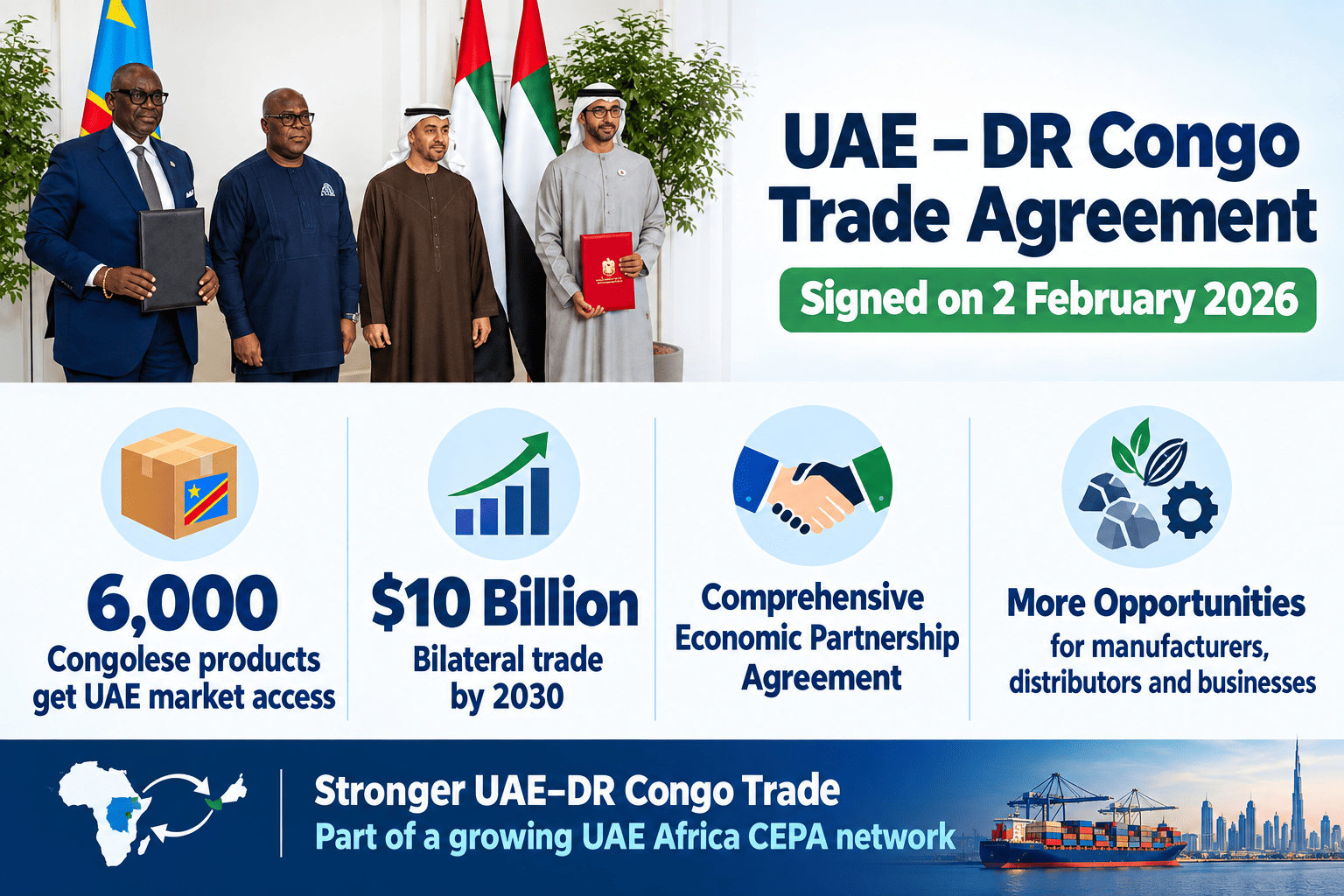
On 2 February 2026 in Abu Dhabi, the United Arab Emirates and the Democratic Republic of Congo signed a Comprehensive Economic Partnership Agreement, opening the UAE market to 6,000 Congolese products and setting a joint target of doubling bilateral trade to $10 billion by 2030. Here is what has been agreed, what it covers, and what it means for manufacturers, distributors, and businesses weighing it alongside the UAE’s wider African CEPA network, including its agreements with Sierra Leone, Gabon, and Nigeria.
The UAE–DRC Comprehensive Economic Partnership Agreement is a trade and investment deal between the United Arab Emirates and the Democratic Republic of Congo, signed on 2 February 2026 at a ceremony at Qasr Al Shati in Abu Dhabi, in the presence of UAE President Sheikh Mohamed bin Zayed Al Nahyan and DRC President Félix Tshisekedi. The agreement itself was signed by Dr Thani bin Ahmed Al Zeyoudi, UAE Minister of Foreign Trade, and Julien Paluku Kahongya, Minister for International Trade of the DRC.
The DRC’s GDP stands at approximately $70.75 billion, making it one of Africa’s ten largest economies. UAE-DRC non-oil trade reached $2.9 billion in the first nine months of 2025 alone, a 16.1% increase year-on-year, and the deal is part of a UAE CEPA programme that now spans more than 30 agreements concluded, with 14 already in force, as the UAE works toward a target of $1.1 trillion in non-oil foreign trade by 2031.
💡 How to read this page
This page summarises the terms confirmed in official UAE and DRC government statements around the signing. The agreement has been signed but is not yet in force, so implementation detail may be refined as each side completes ratification. Section 7 places the deal alongside the UAE’s wider CEPA programme and other global trade agreements.
Section 1
Overview: What Was Signed
The CEPA is a trade and investment framework aimed at reducing tariffs and eliminating non-tariff trade barriers between the two countries. A few headline features stand out:
UAE market access for 6,000 Congolese products. The CEPA gives Congolese exporters access to the UAE market across 6,000 product lines, aimed at easing market entry by cutting customs duties and strengthening trade safeguards.
A joint $10 billion trade target by 2030. Both governments have set a goal of doubling bilateral trade to $10 billion within the decade, building on non-oil trade that already reached $2.9 billion in the first nine months of 2025.
A parallel mining investment MoU. The UAE and DRC presidents witnessed the signing of a Memorandum of Understanding on investment cooperation in the mining sector, extending a relationship that includes a 2023 agreement worth $1.9 billion to develop at least four industrial mines in eastern Congo.
A deep-water port MoU with DP World. A separate memorandum signed with the DRC’s National Transport Office covers the Banana deep-water port project, which Kinshasa regards as a strategic maritime hub for the country.
Diplomatic and institutional cooperation. A further MoU establishes a diplomatic training partnership between the Anwar Gargash Diplomatic Academy and the Congolese Diplomatic Academy under the DRC’s Ministry of Foreign Affairs, International Cooperation, and the Francophonie.
Section 2
Why This Deal Matters
For the UAE, the agreement extends a fast-growing CEPA programme across Africa and reflects its strategy of positioning itself as a global trade and logistics hub, with the DP World-backed Banana port MoU in particular extending its reach into Central African maritime infrastructure. The deal sits alongside the UAE’s other African CEPAs, including those with Sierra Leone and Gabon, and its broader push into Asia through partnerships such as the Japan-Bangladesh Economic Partnership Agreement track.
For the DRC, as one of Africa’s top ten economies by GDP, the agreement opens a significant new export channel and investment relationship, with the UAE already exporting vehicles, machinery, electrical equipment, iron, and mineral fuels to the DRC, while the DRC supplies copper, natural pearls, and precious metals in return. The deal complements a wider pattern of resource-rich economies diversifying their trade relationships, visible elsewhere in agreements such as the US-Argentina reciprocal trade agreement and the UAE-Ecuador CEPA.
Section 3
Market Access & Trade Figures
Metric
Detail
Congolese product lines gaining UAE market access
6,000 products
Joint bilateral trade target
$10 billion a year by 2030
UAE-DRC non-oil trade (first 9 months of 2025)
$2.9 billion, up 16.1% year-on-year
DRC GDP
~$70.75 billion, among Africa’s top 10 economies
UAE CEPA programme size
30+ agreements concluded, 14 already in force
UAE non-oil foreign trade target
$1.1 trillion by 2031
Prior mining investment (2023)
$1.9 billion deal to develop at least four industrial mines in eastern Congo
Section 4
Investment, Side Deals & Priority Sectors
⛏️
Mining
A dedicated investment cooperation MoU signed alongside the CEPA
Parallel MoU
The UAE and DRC presidents witnessed the signing of an MoU on investment cooperation in the mining sector, extending a relationship that already includes a 2023 agreement worth $1.9 billion to develop at least four industrial mines in eastern Congo, and reflecting the DRC’s position as a key global source of copper and precious metals.
🚢
Ports & Logistics
The Banana deep-water port project, developed with DP World
Parallel MoU
A memorandum signed with the DRC’s National Transport Office covers the Banana deep-water port project being developed with DP World, which Kinshasa regards as a strategic maritime hub for the country and a significant upgrade to the DRC’s limited coastal trade infrastructure.
🏭
Manufactured Goods & SMEs
Vehicles, machinery, and electrical equipment moving from the UAE
Core Trade Flow
The UAE exports vehicles, machinery, electrical equipment, iron, and mineral fuels to the DRC, while the CEPA is described as supporting small and medium-sized enterprises on both sides to access new markets under the agreement’s wider trade facilitation measures.
🎓
Diplomatic & Institutional Cooperation
A training partnership between the two countries’ diplomatic academies
Day-One Signing
A further MoU establishes a diplomatic training partnership between the UAE’s Anwar Gargash Diplomatic Academy and the Congolese Diplomatic Academy under the DRC’s Ministry of Foreign Affairs, International Cooperation, and the Francophonie, underscoring the broader institutional relationship behind the trade deal.
Section 5
Timeline: From Signature to Entry Into Force
2023
Prior mining investment agreement
The UAE and DRC sign a $1.9 billion deal to develop at least four industrial mines in eastern Congo, laying groundwork for deeper economic ties.
2 February 2026
CEPA formally signed
The agreement is signed at Qasr Al Shati in Abu Dhabi, in the presence of President Sheikh Mohamed bin Zayed Al Nahyan and President Félix Tshisekedi, alongside MoUs on mining investment, the Banana port project, and diplomatic training.
In progress
Domestic ratification
Both sides must complete domestic ratification procedures before the agreement enters into force, consistent with the UAE’s wider CEPA programme, where 14 of more than 30 concluded agreements are currently in force.
Pending
Entry into force
The CEPA’s tariff reductions and market access commitments take effect once ratification is complete on both sides.
📌 Current status
The agreement has been signed but has not yet entered into force. There is no confirmed entry-into-force date at this stage. Businesses planning around the deal should track official UAE Ministry of Foreign Trade and DRC government communications for updates, rather than assuming market access already applies.
Section 6
What It Means by Sector
⛏️
Mining & critical minerals
A dedicated investment MoU builds on a 2023 $1.9 billion industrial mining agreement in eastern Congo.
Priority sector
🚢
Ports & maritime logistics
The DP World-backed Banana deep-water port project is positioned as a strategic trade gateway for the DRC.
Priority sector
🚗
Vehicles & machinery
Core UAE exports to the DRC, alongside electrical equipment, iron, and mineral fuels.
Core trade flow
🥉
Copper & precious metals
Core DRC exports to the UAE, alongside natural pearls, reflecting the country’s resource base.
Core trade flow
🧑💼
SMEs
The CEPA is positioned to support small and medium-sized enterprises on both sides entering each other’s markets.
Broad access
📦
Market access for Congolese exporters
6,000 Congolese product lines gain access to the UAE market under the agreement.
Headline figure
🎓
Institutional & diplomatic cooperation
A training partnership between the two countries’ diplomatic academies underpins the wider relationship.
Parallel MoU
🌍
Non-oil trade growth
A joint target of $10 billion in bilateral trade by 2030, up from current non-oil trade levels.
2030 target
Section 7
The UAE’s Wider Trade Agreement Network
The UAE-DRC CEPA is one strand in a rapidly expanding UAE trade agreement programme spanning Africa, Asia, and Latin America. In Africa alone, the UAE has pursued CEPAs with the DRC, Sierra Leone, and Gabon, alongside its earlier agreement with Nigeria. In Asia, the UAE has concluded a CEPA with the Philippines, while in Latin America it has signed the UAE-Ecuador CEPA.
GTsetu: Verified Long-Term Collaboration for Manufacturers, Distributors, and Raw Material Suppliers Entering UAE and DRC Markets
As the UAE-DRC corridor opens up to new market access, the practical challenge shifts from trade policy to finding the right partner. GTsetu is a structured partnership platform, not a marketplace or directory, where every company is verified on 6 government-sourced points before engagement, where discovery is anonymous until mutual interest is confirmed, where NDAs are executed digitally before any commercial information changes hands, and where all document exchange happens through an encrypted workspace, supporting genuine long-term supply chain relationships rather than one-off transactions.
GTsetu is used by industrial manufacturers, distribution companies, and raw material suppliers across 100+ countries, including the UAE and the DRC, to find, vet, and formally engage with trade partners they intend to work with for the long term, whichever trade agreement, from this CEPA to any of the other deals tracked above, ultimately governs the tariffs on their shipment.
🏛️
6-Point Government-Sourced Verification
Name, Address, Registration Number, Company Status, Company Type, and Date of Incorporation, verified using government tie-ups before any engagement.
🕵️
Anonymous Discovery
Browse verified partner profiles across 100+ countries without revealing your own identity or commercial strategy until you choose to engage.
📄
Built-In NDA Workflow
Digital NDA with timestamped signatures before any pricing, formulations, or product specs are shared.
🔐
Encrypted Document Workspace
All commercial documents shared through encrypted channels with a full access audit trail, not email attachments.
🌍
100+ Countries, Including the UAE & DRC
Verified manufacturers and distributors across the Gulf, Africa, Asia, Europe, and the Americas.
🚫
Zero Commission
No success fee, no broker commission, ever. Your partnership economics remain entirely between you and your partner.
The UAE-DRC Comprehensive Economic Partnership Agreement is a trade and investment agreement between the United Arab Emirates and the Democratic Republic of Congo, signed on 2 February 2026 in Abu Dhabi in the presence of UAE President Sheikh Mohamed bin Zayed Al Nahyan and DRC President Felix Tshisekedi. It opens the UAE market to 6,000 Congolese products and aims to reduce tariffs and eliminate non-tariff trade barriers between the two countries.
QHas the UAE-DRC CEPA entered into force?
No. The agreement has been signed but has not yet entered into force. It must still complete domestic ratification procedures in both the UAE and the DRC before its tariff reductions and market access commitments take effect, following the pattern of the UAE’s wider CEPA programme, which has over 30 agreements concluded and 14 already in force.
QWhat does the UAE-DRC CEPA cover?
The CEPA opens the UAE market to 6,000 Congolese products and is aimed at cutting customs duties, removing non-tariff barriers, and strengthening trade safeguards. It was signed alongside memorandums of understanding on investment cooperation in the mining sector, the Banana deep-water port project being developed with DP World, and a diplomatic training partnership between the two countries’ diplomatic academies. Both governments have set a target of doubling bilateral trade to $10 billion by 2030.
QWhat does the UAE-DRC CEPA mean for manufacturers and distributors?
The agreement is expected to ease market entry across mining, logistics, and manufactured goods, including vehicles, machinery, and electrical equipment moving from the UAE, alongside copper, precious metals, and minerals moving from the DRC. For manufacturers and distributors, this lowers the cost of entering each other’s markets, but finding and formally engaging a verified long-term distributor or manufacturing partner still requires separate due diligence beyond what the CEPA itself provides.
Planning to Enter the UAE or DRC Market Once the CEPA Takes Effect?
GTsetu is purpose-built for manufacturers, distributors, and raw material suppliers seeking verified long-term trade partnerships across 100+ countries, including the UAE and the Democratic Republic of Congo, with government-sourced partner verification, built-in NDA workflows, and zero commission.
They represents the product, and research team behind GTsetu, a global B2B collaboration platform built to help companies explore cross-border partnerships with clarity and trust. The team focuses on simplifying early-stage international business discovery by combining structured company profiles, verification-led access, and controlled collaboration workflows.
With a strong emphasis on trust, and disciplined engagement, Team GTsetu shares insights on global trade, partnerships, and cross-border collaboration, helping businesses make informed decisions before entering deeper commercial discussions.