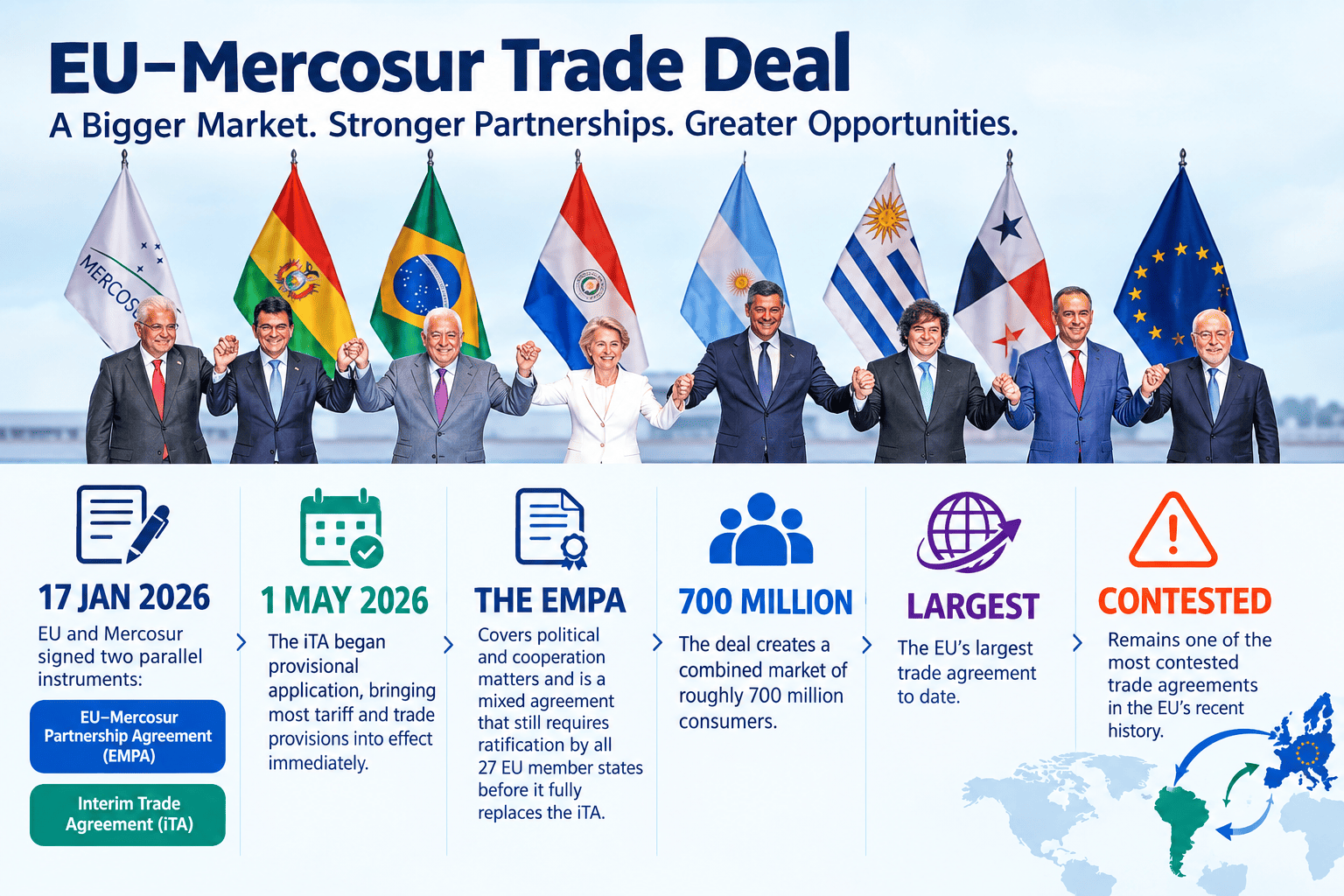
The European Union and the Mercosur bloc, Argentina, Brazil, Paraguay, and Uruguay, signed two parallel instruments on 17 January 2026: the EU-Mercosur Partnership Agreement (EMPA) and an Interim Trade Agreement (iTA). The iTA began provisional application on 1 May 2026, bringing most tariff and trade provisions into effect immediately. The broader EMPA, which also covers political and cooperation matters, is a mixed agreement that still requires ratification by all 27 EU member states before it fully replaces the iTA. The deal is the EU’s largest trade agreement to date, creating a combined market of roughly 700 million consumers, and remains one of the most contested trade agreements in the EU’s recent history.
📅 Signed: 17 January 2026⏱ 14 min read✍️ GTsetu Trade Desk🔄 Updated: 1 May 2026
The EU-Mercosur agreement is the product of more than two decades of on-and-off negotiation, finally reaching a political agreement on 6 December 2024 and formal signature on 17 January 2026. It is structured as two parallel instruments: a comprehensive Partnership Agreement (EMPA) covering trade, political dialogue, and cooperation, and a narrower Interim Trade Agreement (iTA) covering the trade provisions that fall under the EU’s exclusive competence. That split is what allowed part of the deal to start applying in May 2026 while the full agreement still works through a ratification process that could take considerably longer.
This page breaks down what each instrument actually contains, how the agreement’s two-track structure works, where it stands today, and how it compares to other trade agreements moving through ratification around the same time. The GTsetu FTA Tracker covers each of these deals individually so businesses can compare terms across markets.
💡 How to read this page
Section 2 covers what the agreement actually commits each side to. Section 4 covers the two-track ratification structure and the significant political opposition the deal has faced in parts of the EU. Section 5 places it alongside other trade agreements moving through the same 2026 cycle.
Section 1
Background: 25 Years in the Making
Negotiations between the EU and Mercosur began in 1999 and stalled repeatedly over agricultural market access, particularly EU concerns about Brazilian and Argentine beef, poultry, and sugar competing with European farmers. A political agreement was finally reached on 6 December 2024 after a renewed negotiating push. On 3 September 2025, the European Commission formally proposed the two-instrument structure, Council decisions authorising signature followed on 9 January 2026, and the EMPA and iTA were signed on 17 January 2026.
The two-instrument approach exists because the EMPA touches areas of shared competence between the EU and its member states, triggering a “mixed agreement” ratification process requiring approval from all 27 national parliaments, historically a multi-year process with real risk of being blocked by any single member state. The iTA, by contrast, covers matters within the EU’s exclusive competence, principally tariffs and trade rules, and can be brought into provisional application by the European Parliament and Council alone, which is what allowed the trade provisions to take effect on 1 May 2026 without waiting for full ratification.
📌 Why the two-track structure matters
The iTA gives exporters and importers real, binding tariff benefits starting 1 May 2026. The EMPA’s broader provisions, including some political and cooperation elements, remain pending. This distinction is covered in detail in Section 4.
Section 2
Key Provisions of the Agreement
What Each Side Commits To
The agreement’s goals, as set out by the European Commission, are to increase bilateral trade and investment while lowering tariff and non-tariff barriers, to create more stable and predictable trade rules, and to promote shared values around labour rights, climate action, and environmental protection. The sections below summarise the major areas covered.
1
Tariff Elimination & Market Access
The EU’s largest-ever trade agreement by market size
Tariffs
The agreement eliminates or substantially reduces tariffs across the large majority of goods traded between the two blocs. The EU is Mercosur’s second-largest trading partner in goods, with EU exports to the region valued at €57 billion in 2024, and accounts for roughly a quarter of total Mercosur trade in services, with EU services exports of €29 billion in 2023. The EU is also Mercosur’s largest foreign investor, holding an investment stock of €390 billion as of 2023.
What this opens up
Lower tariffs on EU industrial exports including machinery, chemicals, and vehicles
Improved Mercosur access to the EU for agricultural and processed goods
Particular emphasis on reducing barriers for small and medium-sized enterprises
Scale in context
Combined goods trade between the two blocs runs to roughly €111 billion annually
Described by the Commission as the EU’s most significant trade agreement to date
🎯
Why it matters: This is the largest trade zone the EU has created through a single agreement, covering a combined market of roughly 700 million consumers.
2
Agricultural Safeguard Mechanism
The provision at the centre of the deal’s political controversy
Agriculture
In response to strong opposition from France, Poland, and EU farming groups, the Commission added a safeguard mechanism for products it classifies as “sensitive,” including beef, poultry, sugar, and ethanol. Under this mechanism, the EU can suspend preferential access for these products if imports rise too sharply or if prices fall too suddenly, protecting EU producers from a sudden surge in Mercosur imports.
What’s covered
Temporary suspension of preferential access for sensitive farm products
Triggered by sudden import surges or sharp price drops
Thresholds for triggering the mechanism were lowered following a December 2025 European Parliament vote
Why it’s contested
Opponents argue the safeguard doesn’t go far enough to protect EU farmers
Mercosur producers may view it as an asymmetric constraint on their market access
🎯
Why it matters: This single mechanism was central to getting the deal through the EU’s internal political process, and it’s the provision most likely to see disputes and adjustments going forward.
3
Intellectual Property & Regulatory Standards
Geographical indications, food safety, and good regulatory practices
Regulatory
The agreement establishes stronger and more predictable rules around intellectual property rights, including protections for geographical indications, food safety standards, competition rules, and good regulatory practices, aimed at reducing the uncertainty that has historically made Mercosur markets harder for EU exporters and investors to navigate.
What’s covered
Geographical indication protections for EU regional products
Common food safety and good regulatory practice standards
Competition policy alignment
Context
Implementation detail for several of these areas falls within the broader EMPA, not the iTA
🎯
Why it matters: More predictable rules reduce the barriers that have historically discouraged smaller EU exporters and investors from entering Mercosur markets.
4
Sustainable Development & Labour Commitments
Workers’ rights, climate action, and environmental protection
Sustainability
Both sides commit to strengthening workers’ rights, fighting climate change, ensuring environmental protection, and encouraging responsible business conduct. This has been one of the most actively debated aspects of the agreement, with environmental groups raising concerns about its implications for deforestation and emissions tied to expanded agricultural trade.
What’s covered
Commitments to workers’ rights and labour standards
Climate and environmental protection provisions
Responsible business conduct expectations
Criticism
Environmental groups, including Friends of the Earth, have criticised the deal on climate and deforestation grounds
🎯
Why it matters: This is a genuine point of contested assessment: proponents frame it as the strongest sustainability chapter in an EU trade deal to date; critics argue expanded agricultural trade undercuts those same commitments in practice.
Positioned as a hedge against US tariffs and China reliance
Strategic
Beyond the tariff and regulatory detail, EU officials and proponents including Germany and Spain have framed the agreement as a strategic hedge: a way to diversify EU trade relationships away from heavy reliance on both the United States, amid tariff actions from Washington, and China, particularly for critical minerals and raw materials sourced from South America.
Strategic framing offered by proponents
Diversifies EU export markets beyond the US and China
Improves access to South American critical minerals
Deepens EU ties with Latin America at a time of global trade realignment
Context
This is a stated policy rationale from supportive officials, not a binding treaty provision
🎯
Why it matters: The deal arrived as part of a broader pattern of the EU accelerating trade talks with multiple partners simultaneously, covered further in Section 5.
Section 3
Trade & Market Access Breakdown
The table below summarises the headline trade and economic figures associated with the agreement, as published by the European Commission and subsequent reporting.
Metric
Figure
Source Period
Status
EU exports of goods to Mercosur
€57 billion
2024
✓ European Commission figure
EU services exports to Mercosur
€29 billion
2023
✓ European Commission figure
EU investment stock in Mercosur
€390 billion
2023
✓ European Commission figure
Total goods trade between the blocs
~€111 billion annually
Recent reporting
⚠ Press-reported aggregate figure
Combined consumer market
~700 million people
Current
✓ European Commission figure
iTA provisional application date
1 May 2026
Confirmed
✓ Official EU Official Journal publication
💡 What’s live today vs. what’s still pending
The tariff and trade provisions under the iTA are in provisional application as of 1 May 2026, meaning businesses can act on them now. Broader EMPA provisions covering political dialogue and cooperation remain pending full ratification. Businesses should check which specific provision they’re relying on falls under the iTA (already applying) or the EMPA (still pending) before acting on it commercially.
Section 4
Status, Ratification & Reception
The agreement’s path to this point has been genuinely contested, and remains so. On 21 January 2026, European Parliament lawmakers voted 334 to 324 to refer the EMPA for judicial review by the European Court of Justice, a step some analysts say could delay full ratification by up to two years. The iTA, which does not require the same ratification process, moved ahead on its own track and reached provisional application on 1 May 2026 regardless.
Opposition has centred heavily on agriculture. French and Polish farming groups led large protests against the deal, which critics have dubbed a “cars for cows” agreement, arguing that cheaper South American beef, poultry, and sugar could undercut EU producers, who already operate under stricter environmental and animal welfare standards than their Mercosur counterparts. France’s largest beef-producing status made it the agreement’s most vocal opponent, with France’s government at one point calling an earlier version of the deal “unacceptable.” In response, the European Commission introduced and subsequently strengthened the safeguard mechanism described in Section 2.
Supportive voices, including Germany and Spain, have argued the deal is strategically necessary, framing it as a way to offset the impact of US tariff actions and reduce EU dependence on China for critical minerals and other inputs. Environmental groups, including Friends of the Earth, have criticised the agreement on climate and deforestation grounds. Readers should treat these as contested political positions held by named parties rather than settled conclusions, and the GTsetu FTA Tracker will update this page as the EMPA’s ratification process develops.
📌 Bottom line on status
As of 1 May 2026, the trade provisions under the iTA are in provisional application. The broader EMPA remains pending ratification by all 27 EU member states, a process facing a judicial review referral that could extend it by up to two years. Businesses should treat the iTA’s tariff terms as currently operative, and the EMPA’s wider provisions as still subject to change.
Section 5
Part of a Broader Wave of 2026 Trade Agreements
The EU-Mercosur agreement arrived during one of the busiest periods for new trade agreements in recent memory, with the EU in particular accelerating talks with multiple partners simultaneously in response to US tariff actions and a broader push to diversify trade relationships.
When this many agreements move simultaneously across multiple blocs, comparing terms side by side, tariff timelines, safeguard mechanisms, and ratification risk, gives a clearer picture of where trade conditions are genuinely improving versus where political opposition could still reverse or delay benefits.
Section 6
What To Do While EMPA Ratification Is Pending
With the iTA’s trade provisions already in provisional application and the full EMPA still working through a contested ratification process, businesses are operating in a genuinely two-speed environment. Use this reference to match your next step to your situation.
🚜
You’re an EU producer of beef, poultry, or sugar
The safeguard mechanism directly affects your exposure to Mercosur import competition.
Monitor safeguard trigger thresholds
📦
You’re an EU exporter of machinery, chemicals, or vehicles
You stand to benefit from lower tariffs now live under the iTA.
Act on current iTA tariff terms
🌎
You’re a Mercosur exporter targeting EU markets
New market access is live, but sensitive-product categories carry safeguard risk.
Review your product’s safeguard classification
🤝
You’re negotiating a new manufacturing or distribution partnership
Terms should account for the EMPA’s pending ratification and ECJ referral.
Structure contracts for regulatory uncertainty
🔍
You want to verify a Mercosur manufacturing partner before committing
Agreement terms don’t substitute for verifying who you’re actually dealing with.
GTsetu verified discovery
📋
You need clarity on which provisions apply today
The iTA and EMPA cover different ground and are on different legal timelines.
Check iTA vs. EMPA scope directly
🧭
You’re comparing Mercosur against other emerging sourcing markets
Several comparable agreements are progressing through ratification at the same time.
You’re building a distribution network across South America
Mercosur’s expanding trade position may change its role in a regional strategy.
Monitor regional FTA developments
FAQ
Frequently Asked Questions
QWhen was the EU-Mercosur agreement signed?
The European Union and Mercosur (Argentina, Brazil, Paraguay, and Uruguay) signed both the Partnership Agreement (EMPA) and the Interim Trade Agreement (iTA) on 17 January 2026, following a political agreement reached on 6 December 2024 and formal Council authorisation on 9 January 2026.
QIs the EU-Mercosur agreement in force?
Partially. The Interim Trade Agreement (iTA) began provisional application on 1 May 2026, covering most of the trade-related provisions. The full Partnership Agreement (EMPA) is a mixed agreement that still requires ratification by all 27 EU member states and the European Parliament before it replaces the iTA, a process that could take years, and which already faces a referral for judicial review.
QWhy does the EU-Mercosur agreement have two separate instruments?
The EU split the deal into the Interim Trade Agreement (iTA), covering matters of exclusive EU competence such as tariffs, which the European Commission can bring into provisional application relatively quickly, and the broader Partnership Agreement (EMPA), which touches areas of shared competence with EU member states and requires full ratification by all 27 national parliaments. This structure let the trade provisions take effect without waiting years for every member state to ratify the complete agreement.
QWhy is the agreement controversial in Europe?
French and Polish farming groups have strongly opposed the deal, dubbing it a “cars for cows” agreement, arguing that increased imports of South American beef, poultry, and sugar could undercut EU farmers. The European Commission added a safeguard mechanism allowing preferential access for sensitive agricultural products to be suspended if imports surge or prices fall sharply. Environmental groups including Friends of the Earth have also criticised the deal on climate and deforestation grounds, while proponents, including Germany and Spain, argue it diversifies EU trade away from reliance on China and offsets the impact of US tariffs.
QHow does this agreement compare to other trade deals signed around the same time?
The EU-Mercosur agreement arrived during a broader wave of global trade liberalisation. On the US side, it ran parallel to a series of reciprocal trade agreements with countries including El Salvador, Guatemala, Ecuador, Indonesia, Taiwan, Argentina, and Bangladesh. The EU itself was simultaneously advancing the EU-Mexico Modernised Trade Agreement, the EU-Philippines Free Trade Agreement, and long-running India-EU negotiations, while the UAE rapidly expanded its CEPA network across Africa and Latin America. The full set is tracked on the GTsetu FTA Tracker.
QCan businesses rely on the agreement’s terms today?
For provisions covered under the iTA, largely yes, since those are in provisional application as of 1 May 2026. For provisions that fall under the broader EMPA, businesses should be more cautious, since that instrument remains subject to a lengthy ratification process and a pending judicial review referral that could still alter its scope. Businesses making sourcing, pricing, or contractual decisions should verify which specific provision they’re relying on and confirm its current legal status against official EU and Mercosur government sources.
GTsetu: Verify and Formalise EU-Mercosur Trade Partnerships While EMPA Ratification Is Pending
Trade agreements shift tariff economics, but they don’t verify who you’re actually doing business with. While the EU-Mercosur EMPA moves through a contested ratification process, GTsetu lets manufacturers, distributors, and raw material buyers identify and formally engage verified partners across Argentina, Brazil, Paraguay, Uruguay, the EU, and 100+ other countries today, every company checked on 6 government-sourced points before you ever make contact, so you’re ready to move as iTA benefits apply and EMPA terms firm up.
Browse anonymously, protect your sourcing strategy and product specs with a built-in NDA workflow, and exchange documents through an encrypted workspace, all before committing to a formal partnership.
🏛️
6-Point Government-Sourced Verification
Name, Address, Registration Number, Company Status, Company Type, and Date of Incorporation, verified before any engagement.
🕵️
Anonymous Discovery
Browse verified manufacturers and distributors across Mercosur and the EU without revealing your sourcing strategy early.
📄
Built-In NDA Workflow
Digital NDA with timestamped signatures before any pricing, formulations, or product specs are shared.
🔐
Encrypted Document Workspace
All commercial documents shared through encrypted channels with a full access audit trail.
🌍
100+ Countries
Verified manufacturers, distributors, and raw material suppliers across Asia, the Middle East, Europe, Africa, Australia, and the Americas.
🚫
Zero Commission
No success fee, no broker commission, ever. Your partnership economics remain entirely between you and your partner.
Tracking the EU-Mercosur Agreement’s Impact on Your Business?
GTsetu helps manufacturers, distributors, and raw material buyers verify and formally engage trade partners across Mercosur, the EU, and 100+ other countries, with government-sourced verification, built-in NDA workflows, and zero commission.
They represents the product, and research team behind GTsetu, a global B2B collaboration platform built to help companies explore cross-border partnerships with clarity and trust. The team focuses on simplifying early-stage international business discovery by combining structured company profiles, verification-led access, and controlled collaboration workflows.
With a strong emphasis on trust, and disciplined engagement, Team GTsetu shares insights on global trade, partnerships, and cross-border collaboration, helping businesses make informed decisions before entering deeper commercial discussions.