How to Become an OEM Manufacturer for Textiles & Apparel in Vietnam
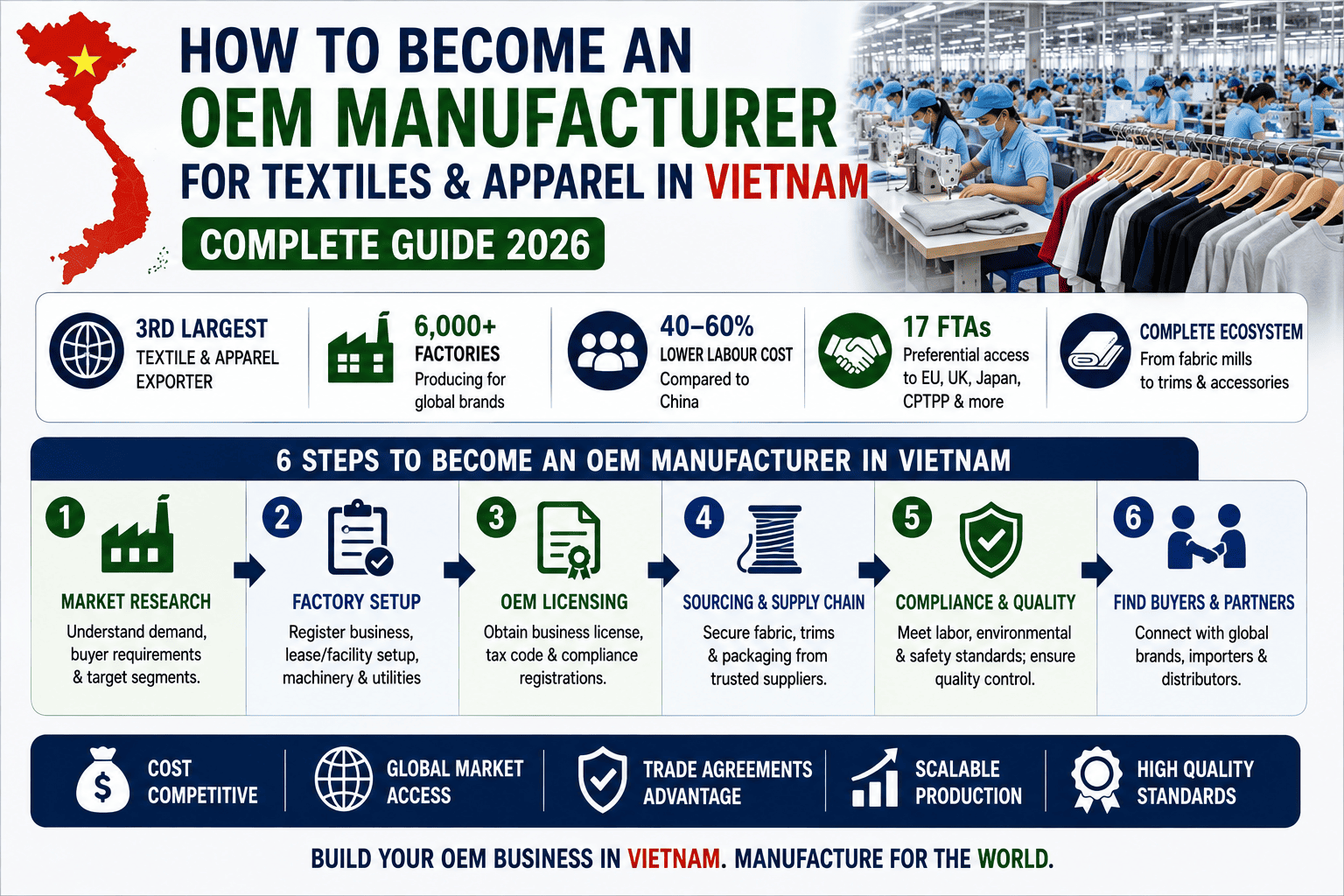
Direct Answer: Vietnam has become the world’s third-largest textile and apparel exporter, behind only China and Bangladesh, with over 6,000 factories churning out clothing for global brands. Becoming an OEM manufacturer in Vietnam means operating a factory that produces garments according to brand specifications, leveraging the country’s competitive labour costs (40–60% of China’s wages), 17 free trade agreements providing preferential tariff access to the EU, UK, Japan, and CPTPP markets, and a robust textile ecosystem from fabric mills to trim suppliers. This guide walks you through factory setup, OEM licensing, sourcing, compliance, partner discovery, and how GTsetu connects verified manufacturers and distributors with zero broker commissions.
📅 May 5, 2026⏱ 18 min read✍️ GT Setu Editorial Team🔄 Updated regularly
#3
Global Textile Exporter (World)
6,000+
Garment Factories Nationwide
17
Free Trade Agreements (EVFTA, CPTPP, RCEP)
0%
GTsetu Broker Commission
Vietnam’s rise as a global textile and apparel manufacturing powerhouse is one of the most remarkable industrial development stories of the 21st century. In just three decades, the country has transformed from a minor garment producer into the world’s third-largest textile exporter, behind only China and Bangladesh, with over 6,000 factories producing everything from basic T-shirts to high-end technical wear for brands like Nike, Adidas, H&M, Zara, Gap, and thousands of smaller labels.
For international manufacturers, brands, and entrepreneurs, becoming an OEM (Original Equipment Manufacturer) for textiles and apparel in Vietnam offers a compelling proposition: access to a skilled, young workforce with wages 40–60% lower than China; a comprehensive textile ecosystem spanning fibre production to garment finishing; a network of 17 free trade agreements providing preferential tariff access to the world’s largest consumer markets; and a government actively supporting manufacturing investment through FDI incentives, industrial zone development, and streamlined business registration.
This guide covers everything you need to become an OEM manufacturer in Vietnam, from initial market research through factory setup, sourcing, compliance, and commercial partnerships. See also our guides on expanding your manufacturing business to Vietnam, India, and China.
🇻🇳 Who Is This Guide For?
This guide is written for international brands, fashion entrepreneurs, garment retailers, and manufacturing investors seeking to establish OEM textile and apparel production in Vietnam, whether as a factory owner, a brand sourcing partner, or a distributor representing Vietnamese OEM manufacturers. It covers the full journey from concept to commercial production. If you are evaluating multiple manufacturing destinations, see our companion guides for China, India, Taiwan, and Hong Kong.
SECTION 1
1 Why Vietnam for OEM Textile & Apparel Manufacturing?
🎯 The OEM Value Proposition
Vietnam offers a combination of advantages for OEM textile and apparel manufacturing that few competing nations can match: competitive labour costs (40–60% of China’s wages), a deep textile ecosystem from fibre to finished garment, 17 free trade agreements providing preferential access to the EU, UK, Japan, CPTPP, and RCEP markets, a young and skilled workforce of 2.5+ million garment workers, and a government actively supporting manufacturing FDI through tax incentives, industrial zone development, and streamlined business registration. For brands and retailers, Vietnam offers a reliable, increasingly sophisticated manufacturing base that combines cost-competitiveness with quality, compliance, and supply chain resilience, making it the world’s most attractive China+1 sourcing destination.
#3
Global textile exporter, behind only China and Bangladesh (World Bank)
$40B+
Annual textile and garment export value (2024 estimate)
17
Free trade agreements, including EVFTA (EU), CPTPP, and RCEP
👕
Established Textile Ecosystem
Vietnam has a vertically integrated textile industry, from fibre and yarn production through fabric weaving/knitting, dyeing and finishing, to garment cutting, sewing, and final packaging. This reduces lead times and simplifies the OEM supply chain compared to sourcing fabric internationally.
💰
Competitive Labour Costs
Vietnamese garment workers earn approximately 40–60% of their Chinese counterparts, making Vietnam highly cost-competitive for labour-intensive apparel manufacturing. Wages start at approximately USD 200–300 per month in garment hubs, increasing with skill level and location.
📋
Comprehensive FTA Network
Vietnam’s 17 FTAs, including the EU-Vietnam Free Trade Agreement (EVFTA), CPTPP, and RCEP, provide Vietnamese OEM manufacturers with preferential tariff access to 50+ countries. EVFTA eliminates 99% of EU tariffs on apparel over 7–10 years, making Vietnamese OEM products significantly more competitive.
🔧
Skilled Workforce & Technical Training
Vietnam’s textile and garment industry employs over 2.5 million workers, supported by vocational training programmes, technical schools, and industry-specific training centres. Major manufacturing hubs have developed deep expertise in specific garment categories, from basic T-shirts to high-end technical outerwear.
🏛️
Government Support & FDI Incentives
Vietnam actively courts manufacturing FDI through tax holidays, land lease preferences, and streamlined business registration in industrial zones. The government’s Resolution 52/NQ-TW and National Strategy on Industry 4.0 provide policy support for smart factory adoption in the textile sector.
🚢
Strategic Logistics & Export Access
Vietnam’s location in the heart of Southeast Asia, with proximity to China, deep-water ports in Ho Chi Minh City, Hai Phong, and Da Nang, and growing logistics infrastructure, provides efficient export access to North America, Europe, Japan, and the broader Asia-Pacific region.
SECTION 2
2 Vietnam Textile & Apparel Industry Overview
Vietnam’s textile and apparel industry is the country’s second-largest export sector (after electronics) and employs approximately 2.5 million people directly, with millions more in supporting industries. The industry has grown consistently at 10–15% annually over the past decade, driven by FDI inflows from global brands, competitive labour costs, and preferential trade agreements. For OEM manufacturers, the industry offers a mature, vertically integrated ecosystem with established supply chains, skilled labour, and world-class export infrastructure.
Metric
Value
Source / Period
Global Export Ranking
#3 (Textiles & Apparel)
World Bank / WTO
Annual Export Value
$40+ billion (2024)
Vietnam Textile & Apparel Association (VITAS)
Number of Factories
6,000+ garment factories
VITAS / Industry Reports
Workforce
2.5+ million direct employees
VITAS / Vietnam General Statistics Office
Key Export Markets
USA (40%+), EU (20%+), Japan, South Korea, China, UK
VITAS / Customs Data
Main Garment Categories
Basic apparel, fast fashion, high-end fashion, technical/outdoor wear, underwear, denim
Industry analysis
Free Trade Agreements
17 including EVFTA, CPTPP, RCEP, VKFTA, VJEPA
WTO / Vietnamese government
Key Manufacturing Hubs
HCMC, Binh Duong, Dong Nai, Hanoi, Bac Ninh, Da Nang
Industry analysis
The industry’s growth trajectory is supported by strong fundamentals: rising global demand for apparel (3–4% annual growth), Vietnam’s increasing share of global sourcing (China+1 diversification), and the government’s commitment to developing the sector as a strategic industry. For OEM manufacturers, this means a growing addressable market with established infrastructure and a proven track record of delivering to international quality and compliance standards.
SECTION 3
3 Understanding the OEM Manufacturing Model
🏭 What Is OEM Manufacturing?
OEM (Original Equipment Manufacturer) manufacturing means producing goods according to specifications provided by a brand or retailer. In textiles and apparel, this means the OEM factory manufactures garments designed by the brand, using materials and trims sourced by or approved by the brand, and shipped under the brand’s label. The OEM is responsible for manufacturing, quality control, and often logistics, while the brand handles design, marketing, and sales. This model is the foundation of global apparel supply chains.
👔
Full-Package OEM
The OEM manufacturer handles everything from fabric sourcing and trim procurement through production, quality control, packaging, and logistics. The brand provides design specifications and technical drawings. This is the most common model for established OEM factories and provides the highest value-add per garment.
🧵
CMT (Cut, Make, Trim)
The brand provides the fabric and trims; the OEM handles cutting, sewing, and finishing. The OEM earns a margin on labour and overhead. This model is common for smaller brands, startups, and those with strong fabric sourcing capabilities but limited manufacturing capacity.
📐
Design-to-OEM
The brand develops initial concepts and patterns; the OEM provides pattern grading, sample making, production engineering, and full manufacturing. This model leverages the OEM’s technical expertise in garment construction and production optimisation. See our guide on co-development partnerships.
📦
FOB (Free on Board)
A common commercial term for OEM manufacturing: the OEM factory delivers goods to the port of departure (FOB port), and the buyer takes responsibility for shipping, insurance, and customs clearance. The OEM is responsible for production, quality control, and timely delivery to the port.
💡 OEM vs. ODM vs. EMS, Key Distinctions
In the apparel industry, OEM means the brand designs the garment and the factory manufactures it. ODM (Original Design Manufacturer) means the factory designs and manufactures the garment, and the brand buys it and sells it under its own label (common for private label and fast fashion). EMS (Electronics Manufacturing Services) is less common in apparel. For most international brands, OEM is the primary sourcing model because it maintains brand control over design and quality while leveraging factory expertise in production. See our guide on OEM vs ODM vs EMS for the complete comparison.
SECTION 4
4 Step-by-Step: Setting Up Your OEM Factory
01
Market Research & Niche Definition
Define your OEM manufacturing niche: garment category (basic, fast fashion, high-end, technical), target price point, quality level, and minimum order quantities. Research the competitive landscape, which garment categories are oversupplied? Which are underserved? What are the key quality standards and compliance requirements for your target export markets? This foundational step shapes every subsequent decision from factory location to equipment investment. See our guide on global market research for manufacturers.
02
Choose Your Business Structure & Location
Vietnam offers multiple business structures for foreign manufacturers: Wholly Foreign-Owned Enterprise (WFOE), most common for OEM factories, 100% foreign ownership; Joint Venture, shared ownership with a Vietnamese partner; or Contract Manufacturing/Toll Manufacturing, producing for a brand without a legal entity in Vietnam. Choose your industrial zone or factory location based on labour availability, logistics access, proximity to key customers, and tax incentives. Consult with a Vietnam-registered investment advisory firm to navigate the decision framework.
Foreign manufacturers require an Investment Registration Certificate (IRC) from the provincial Department of Planning and Investment (DPI) for investments above USD 300,000. Once the IRC is approved, obtain the Enterprise Registration Certificate (ERC) establishing your legal entity. For investments in designated industrial zones or hi-tech parks, zone authority approval precedes the DPI application. The timeline: IRC 15–45 days; ERC 3–5 working days. Engage a Vietnamese legal firm experienced in FDI registration to navigate this process efficiently.
04
Secure Factory Premises & Equipment
Lease or purchase factory space in your chosen industrial zone. Industrial zones provide serviced land, utilities, and infrastructure; costs vary significantly by location (premium zones in HCMC/Binh Duong vs. lower cost in central/northern zones). Investment in garment manufacturing equipment: cutting machines, sewing machines (single-needle, overlock, coverstitch, etc.), finishing equipment (steam presses, ironing stations), and quality control systems. Consider leasing vs. purchasing equipment to manage initial capital requirements. See contract manufacturing equipment models.
05
Build Your Supply Chain & Source Raw Materials
Develop relationships with fabric mills, trims suppliers (buttons, zippers, labels, threads), and packaging suppliers. Vietnam has a robust textile ecosystem, local sourcing is possible for cotton, polyester, and blended fabrics; speciality fabrics (high-end silk, technical textiles) may require imports from China, South Korea, or Japan. Establish a Quality Assurance (QA) process for incoming materials and final garments. See how to source manufacturing materials internationally.
06
Hire & Train Your Workforce
Vietnam has a large, skilled garment workforce, but training is essential for consistent quality, productivity, and meeting international compliance standards. Hire production managers with experience in your garment category; recruit line supervisors and skilled sewing machine operators from the local labour pool. Partner with vocational training centres in your region for pre-employment training and ongoing skills development. Establish clear Standard Operating Procedures (SOPs) for every production stage. Understand labour laws and workforce compliance requirements.
07
Implement Quality Management & Compliance Systems
Obtain ISO 9001 (quality management) and SA8000 (social accountability) certifications to demonstrate your factory’s commitment to quality and ethical manufacturing. Implement a quality control system: inspection of incoming materials, in-line quality checks, and final garment inspection. Document all production processes and maintain traceability from fabric to finished garment. Compliance with WRAP (Worldwide Responsible Accredited Production) is often a pre-requisite for securing OEM contracts with major brands. See quality control in international manufacturing.
08
Secure OEM Contracts & Begin Production
Once your factory is certified and production-ready, secure OEM contracts with brands and retailers. Develop a professional capability statement showcasing your factory’s capacity, certifications, quality control systems, and client testimonials. Attend industry trade fairs (SaigonTex, VTG, and others) to meet potential clients. Consider starting with smaller production runs for emerging brands to build your reputation and case studies before approaching larger retailers. Structuring manufacturer-distributor contracts and volume commitments appropriately is essential.
SECTION 5
5 Key Industrial Zones for Textile Manufacturing
Vietnam operates over 400 industrial zones, economic processing zones, and hi-tech parks. For textile and apparel OEM manufacturers, location selection significantly affects labour availability, logistics costs, tax incentives, and proximity to key export ports. These are the most relevant industrial zones for garment manufacturing:
🏭Southern Hub
VSIP Binh Duong
Vietnam’s most established and successful industrial zone, developed as a Vietnam-Singapore partnership. Home to hundreds of textile and garment factories including major OEMs for international brands. Excellent infrastructure, utilities, and logistics access to HCMC ports. Premium location with higher land costs but unmatched ecosystem and labour availability.
Best for: Large-scale OEM, fast fashion, export brands, premium logistics access
🧵Southern Hub
Bien Hoa Industrial Zone (Dong Nai)
One of Vietnam’s largest industrial zones, located approximately 30km from HCMC. Long-established textile and apparel manufacturing cluster with a large, experienced workforce. Competitive land costs relative to HCMC. Direct access to HCMC’s port infrastructure via National Highway 1A.
Best for: Mid-to-large scale manufacturing, cost-conscious OEMs, established garment clusters
👕Southern Hub
Tan Thuan Export Processing Zone (HCMC)
Located within HCMC itself, providing the best access to the city’s talent, services, and international airport. Specialised for export-oriented manufacturing with streamlined customs procedures. Higher land and labour costs but excellent for premium OEM manufacturing requiring rapid design-to-production cycles.
Northern Vietnam’s leading industrial zone, developed as a VSIP partnership. Connected to Hanoi and Hai Phong port. Growing textile and garment cluster serving brands sourcing from northern Vietnam. Attractive land and labour costs relative to the southern hub.
Best for: Brands seeking northern Vietnam presence, access to Hanoi talent pool, garment manufacturing for Korean and Japanese markets
📍Northern Hub
Quang Chau Industrial Zone (Bac Giang)
Emerging garment manufacturing hub near Hanoi, home to numerous textile and apparel factories, including suppliers to major global brands. Competitive land and labour costs with improving infrastructure. Close to the Hanoi-Hai Phong highway providing efficient port access.
Best for: Cost-competitive OEM manufacturing, large-scale production, labour-intensive garment categories
🏖️Central Hub
Da Nang Hi-Tech Park
Vietnam’s third-largest city, with a growing manufacturing base and the Da Nang Hi-Tech Park attracting technology-oriented manufacturing. For apparel OEM, the region offers lower labour costs than HCMC and Hanoi, proximity to the Da Nang port, and a growing textile cluster supported by the central government.
Best for: Brands seeking cost-competitive manufacturing, emerging garment cluster, central Vietnam logistics
SECTION 6
6 Raw Material Sourcing & Supply Chain
Building a reliable and cost-effective supply chain is a critical success factor for OEM textile manufacturers in Vietnam. The country offers a well-developed domestic textile ecosystem, but the availability and quality of fabrics and trims vary by garment category and factory location. Here’s what you need to know:
🌾
Local Sourcing, Cotton, Polyester, Blends
Vietnam produces high-quality cotton, polyester, and blended fabrics. Domestic fabric mills supply the majority of materials for basic garment categories. For cotton, Vietnam’s Mekong Delta and central highlands provide raw cotton; major textile groups (Vinatex, Thanh Cong, etc.) operate vertically integrated operations from yarn to fabric.
🧶
Imported Fabrics, Specialty & Technical Textiles
For high-end silk, technical textiles (waterproof, breathable, performance fabrics), and niche fibres, manufacturers typically import from China, South Korea, Japan, or Taiwan. Imported fabrics may add lead time and cost but are essential for premium and technical garment OEM. Managing import duties and logistics is key.
🔗
Trims & Accessories Supply Chain
Vietnam has a well-developed trims supply chain, buttons, zippers, labels, tags, threads, packaging materials. Local trims suppliers serve the garment industry from hubs in HCMC and Hanoi. For brand-specific trims (custom zippers, branded labels), sourcing from authorised suppliers (YKK, etc.) is often required.
🎨
Custom Fabric Development
Some OEM manufacturers offer custom fabric development services, working with fabric mills to create proprietary textiles with specific properties, patterns, or textures. This adds value for premium brands and can be a competitive advantage. It also requires longer lead times and higher minimum order quantities.
🇻🇳 Building a Resilient Supply Chain
For OEM manufacturers in Vietnam, building a resilient supply chain means: (1) Developing relationships with multiple fabric and trims suppliers to mitigate single-source risk. (2) Maintaining a 2–4 week buffer stock of critical materials to manage supply disruptions. (3) Establishing clear quality specifications and quality control for incoming materials. (4) Building relationships with logistics providers for efficient import/export. (5) Understanding the lead times for imported vs. locally sourced materials and planning production schedules accordingly. See our guide on supply chain resilience for manufacturers.
SECTION 7
7 Compliance & Certifications for OEM Manufacturing
Securing OEM contracts with international brands requires demonstrable compliance with quality, social, environmental, and technical standards. Vietnamese garment manufacturers should pursue certifications that demonstrate their commitment to responsible, high-quality production.
Certification
Focus Area
Relevance for OEM
ISO 9001
Quality Management Systems
Essential, demonstrates your factory has established, documented, and implemented quality management procedures. Prerequisite for most international OEM contracts.
ISO 14001
Environmental Management
Increasingly important, demonstrates commitment to environmental sustainability. Required by some brands (especially European) and growing in importance with CBAM and ESG regulations.
SA8000
Social Accountability
Important, demonstrates compliance with international labour standards including child labour prohibition, fair wages, safe working conditions, and freedom of association. Required by many global brands.
Highly relevant, WRAP is the most widely recognised social compliance certification in the global apparel industry. Often required by American and European brands for OEM factories.
GOTS (Global Organic Textile Standard)
Organic Textiles
Specialised, for organic cotton and certified organic textile manufacturing. Required for brands sourcing organic apparel. Includes environmental and social criteria.
Oeko-Tex Standard 100
Chemical Safety
Important, ensures textiles are free from harmful substances at all stages of production. Required by many brands for finished garments, especially for baby and children’s clothing.
BSCI (Business Social Compliance Initiative)
Social Compliance
Widely recognised, BSCI audits assess social and ethical manufacturing standards across supply chains. Many European brands require BSCI compliance from their OEM partners.
💡 Prioritising Certifications for Your OEM Business
For a new OEM factory in Vietnam, prioritise ISO 9001 (quality management) and BSCI or SA8000 (social compliance) as your foundation certifications. These are the most widely required by international brands. WRAP certification adds credibility for American and European clients. Additional certifications (GOTS, Oeko-Tex) are valuable for specific product categories, organic textiles, baby wear, etc., but should follow your market positioning. Certification costs typically range from USD 2,000–10,000 per standard, with annual renewal audits required. See our guide on manufacturing certifications.
SECTION 8
8 How Free Trade Agreements Benefit Your OEM Business
🌏 The FTA Advantage
Vietnam’s membership in 17 free trade agreements (FTAs) provides a significant competitive advantage for OEM textile manufacturers. The EU-Vietnam Free Trade Agreement (EVFTA) eliminates 99% of EU tariffs on apparel over 7–10 years, making Vietnamese OEM products significantly more competitive in Europe than those from countries without EU FTAs. The CPTPP provides preferential access to Canada, Mexico, Japan, and other Pacific economies. The RCEP integrates Vietnam into Asia-Pacific supply chains, facilitating tariff-free sourcing of fabrics and trims from member countries. Understanding and leveraging these FTAs is essential for cost-competitive OEM manufacturing.
FTA
Key Markets
Benefit for Apparel OEM
EVFTA
EU (27 countries)
99% of EU tariffs on apparel eliminated over 7–10 years. Vietnam becomes more competitive than China (which faces EU tariffs) for OEM exports to Europe.
CPTPP
Canada, Mexico, Japan, Australia, New Zealand, others
Preferential tariff access to 11 Pacific economies. Canada and Mexico tariffs reduced, making Vietnamese OEM products more competitive vs. Asian competitors.
RCEP
China, South Korea, Japan, ASEAN, Australia, New Zealand
Tariff-free sourcing of fabrics and trims from RCEP countries (especially China, South Korea), reducing input costs for OEM manufacturers. Also provides export tariff preferences.
VKFTA
South Korea
Preferential access to South Korea, a major apparel import market and source of fabric/trims. Benefits OEM manufacturers exporting to Korea or using Korean materials.
VJEPA
Japan
Preferential access to Japan, a major apparel importer. Critical for OEM manufacturers producing for Japanese brands or the Japanese market.
UK-Vietnam FTA
United Kingdom
Continuation of tariff preferences for UK market post-Brexit. Important for OEM manufacturers exporting to the UK.
SECTION 9
9 Finding Verified OEM Partners & Distributors
For international brands seeking OEM partners in Vietnam, or for OEM manufacturers seeking distribution partners, finding a verified, reliable partner is the most commercially consequential early decision. Vietnam’s garment ecosystem is highly developed but opaque, quality and reliability vary significantly. Verification and qualification are essential.
✅
Verified Business Identity
Vietnam Investment Registration Certificate (IRC), Enterprise Registration Certificate (ERC), tax registration, and any relevant sector certifications. GTsetu verifies all of these before any Vietnam company appears in the network. See business verification requirements.
🏭
Factory Capacity & Capability
Does the factory have experience with your garment category? What is its monthly production capacity? What machinery does it have? What is its workforce size and skill level? A capable OEM partner will provide a comprehensive factory profile. See our guide on manufacturing capability assessment.
📋
Certifications & Audits
Does the factory have ISO 9001? SA8000? WRAP? BSCI? What are its audit results? Brands increasingly require documented compliance. Partners with current certifications and clean audit histories are lower-risk. See supplier audits in international sourcing.
🌏
Export Experience
Has the factory exported to your target market? Does it understand the labelling, packaging, and documentation requirements for your destination country? Experience with similar export markets reduces risk. See our guide on global trade compliance.
🔐
IP & Confidentiality Standards
Vietnam’s IP framework is improving but still developing. For OEM relationships involving proprietary designs, branding, and production techniques, execute an NDA governed by Vietnamese or international law before any sensitive technical or commercial exchange. See mutual vs one-way NDA.
📞
Communication & Transparency
Clear, regular communication and transparent pricing and production reporting are hallmarks of a reliable partner. If communication is unclear, this may indicate potential problems in production management. Establish communication protocols and reporting frequency from the outset.
Channels for Finding Verified Vietnam OEM Partners
💻
GTsetu Verified B2B Platform
GTsetu provides access to compliance-verified Vietnamese manufacturers, suppliers, and distributors, with anonymous discovery, built-in NDA workflow, and encrypted collaboration. Zero broker commissions. The most efficient and secure channel for verified Vietnam partner discovery.
Best for Verified Discovery
🎪
Industry Trade Fairs, SaigonTex, VTG
SaigonTex (Vietnam Textile & Garment Industry Expo) and VTG (Vietnam International Textile & Garment Exhibition) are the premier industry events for meeting Vietnam garment manufacturers and suppliers. HKTDC and other trade promotion organisations also host business matching events.
In-Person Channel
📋
Vietnam Textile & Apparel Association (VITAS)
VITAS is the national industry association representing Vietnam’s textile and garment sector. It maintains directories of member factories, provides trade promotion services, and acts as a bridge between international buyers and Vietnamese manufacturers.
Industry Body
🏢
Sourcing Agents & Consultancies
Vietnam-based sourcing agents provide factory identification, qualification, and negotiation services. They conduct factory visits, audits, and quality control on behalf of international brands. While they charge a fee, they can significantly reduce the search and qualification burden.
Service Channel
📱
Online B2B Platforms
Alibaba, Global Sources, Vietnam Suppliers Directory, and other B2B platforms list Vietnamese garment factories. However, verification and qualification are limited; use these as initial discovery tools and then independently verify any shortlisted factories.
Discovery Channel
SECTION 10
10 Common Challenges & How to Navigate Them
🧵
Workforce Turnover & Skills Gaps
Vietnam’s garment industry experiences workforce turnover rates of 15–20% annually in some regions, driven by labour mobility between factories and migration patterns. Skills gaps exist in technical roles (machinery maintenance, quality management).
Mitigation: Implement employee retention programmes, invest in continuous training, partner with vocational schools, and consider automation for repetitive tasks. See labour management.
📦
Supply Chain Vulnerability
Reliance on imported fabrics and trims creates supply chain risk (price volatility, lead time variability, geopolitical disruptions). Cotton and polyester prices impact production costs.
Mitigation: Diversify suppliers (local and imported); maintain inventory buffers; develop relationships with multiple fabric mills; consider forward contracts for key materials.
📋
Regulatory Complexity for FDI
Vietnam’s FDI registration process (IRC and ERC) requires navigating provincial and national regulations, with timelines varying by location and sector. Environmental Impact Assessments (EIA) can be time-consuming for manufacturing facilities.
Mitigation: Engage a Vietnam-registered legal firm with FDI experience before beginning the registration process. Start EIA preparation concurrently with IRC application. See FDI regulatory compliance.
💵
Minimum Order Quantity (MOQ) Challenges
Many Vietnam garment factories require MOQs of 500–2,000+ pieces per style, which can be prohibitive for startups and small brands. Fabric suppliers also have MOQs that limit flexibility.
Mitigation: Work with OEM factories offering flexible MOQs (increasingly available); use standard fabrics to reduce fabric MOQ constraints; consider splitting orders across multiple styles to meet MOQ thresholds.
🌐
Intellectual Property Protection
Vietnam’s IP enforcement is improving but remains less robust than developed markets. Counterfeit production and unauthorised copying of designs can occur.
Mitigation: Register trademarks, designs, and patents in Vietnam before commencing OEM relationships. Execute NDAs and contracts with explicit IP ownership and confidentiality clauses. See IP protection in manufacturing.
♻️
Environmental & ESG Compliance
Vietnamese textile manufacturers face increasing pressure on environmental compliance (wastewater, chemical management) and ESG reporting from international buyers. Non-compliance can affect OEM contract renewals.
Mitigation: Implement environmental management systems (ISO 14001), treat wastewater to meet Vietnamese and international standards, adopt sustainable practices (organic cotton, recycled polyester), and prepare for ESG reporting. See ESG in manufacturing.
SECTION 11
11 How GTsetu Connects You with Verified Vietnam Partners
🇻🇳 GTsetu, Verified B2B Platform for Vietnam Market Entry
Discover Verified Vietnam OEM Manufacturers & Distributors, No Broker Commission
GTsetu provides international manufacturers, brands, and distributors with direct access to compliance-verified Vietnamese OEM manufacturers, fabric mills, trim suppliers, garment factories, and distribution partners, across every textile and apparel category and Vietnam’s key manufacturing regions. Every company in GTsetu’s Vietnam network has been verified through Investment Registration Certificate, Enterprise Registration Certificate, and relevant sector certifications before appearing in the platform. You discover, qualify, and engage, without broker intermediaries taking a percentage of your commercial economics.
🏛️
Multi-Layer Compliance Verification
Every Vietnam partner verified: IRC, ERC, tax registration, and relevant certifications, by GTsetu’s compliance team. Eliminates fraud risk and due diligence workload.
🕵️
Anonymous Discovery
Browse verified Vietnam partner profiles without revealing your own identity. Protect your sourcing strategy until you choose to engage.
📄
Built-In NDA Workflow
Digital mutual NDA with timestamped signatures, activated before sensitive technical or commercial data can be exchanged.
🔐
Encrypted Document Workspace
AES-256 encryption at rest, TLS in transit. Role-based access controls. Full audit trail. No unprotected email attachments for sensitive data.
🚫
Zero Broker Commission
GTsetu charges zero commission on any partnership formed. All commercial economics stay between you and your Vietnam partner, always.
🌏
100+ Countries Including Vietnam
GTsetu’s network covers Vietnam and global markets, supporting your Vietnam entry today and expansion to China, India, and Taiwan tomorrow.
QWhat does it mean to become an OEM manufacturer for textiles and apparel in Vietnam?
Becoming an OEM (Original Equipment Manufacturer) in Vietnam means you operate a factory that produces textiles or garments according to designs and specifications provided by a brand or retailer. You are responsible for sourcing raw materials (or working with customer-supplied materials), manufacturing the product, quality control, and often logistics, while the brand handles design, marketing, and sales. Vietnam has become a global OEM hub due to its competitive labour costs, strong free trade agreement network, and extensive garment industry ecosystem. See our OEM vs ODM vs EMS guide for the complete distinction.
QWhat are the key steps to setting up an OEM textile factory in Vietnam?
The key steps are: (1) Research the industry landscape and define your niche (garment category, target price point, quality level). (2) Choose your business structure (WFOE, Joint Venture, Contract Manufacturing) and location (industrial zone selection). (3) Obtain Investment Registration Certificate (IRC) and Enterprise Registration Certificate (ERC). (4) Secure factory premises and equipment. (5) Build a supply chain for fabric and trims. (6) Hire and train workforce. (7) Implement quality management and compliance systems (ISO 9001, SA8000, WRAP, etc.). (8) Secure OEM contracts and begin production. This timeline typically takes 12–24 months from market research to first production order for a new setup.
QWhich Vietnamese industrial zones are best for textile and apparel OEM manufacturing?
Key industrial zones for textiles and apparel in Vietnam include: VSIP Binh Duong, well-established with strong infrastructure and a large garment cluster; Bien Hoa Industrial Zone (Dong Nai), large, near HCMC with a mature workforce; Tan Thuan Export Processing Zone (HCMC), within the city, best for premium OEM; VSIP Bac Ninh, northern Vietnam’s leading industrial zone; and Quang Chau Industrial Zone (Bac Giang), an emerging, cost-competitive hub. The choice depends on labour availability, logistics access, target export markets, and tax incentives. See our detailed section on industrial zones above.
QHow do free trade agreements benefit OEM textile manufacturers in Vietnam?
Vietnam’s participation in 17 free trade agreements, including the EU-Vietnam Free Trade Agreement (EVFTA), CPTPP, and RCEP, provides OEM manufacturers with preferential tariff access to major export markets. EVFTA eliminates 99% of EU tariffs on apparel over 7–10 years, making Vietnamese OEM products significantly more competitive in Europe compared to manufacturers in countries without such agreements. CPTPP provides access to Canada, Mexico, Japan, and other Pacific economies. RCEP facilitates tariff-free sourcing of fabrics and trims from member countries, reducing input costs. This tariff advantage is a critical factor for brands choosing Vietnam as their OEM sourcing destination.
QWhat are the minimum order quantities (MOQs) for OEM apparel manufacturing in Vietnam?
MOQs vary significantly by factory type and product complexity. For basic T-shirts or polo shirts, MOQs can be as low as 300–500 pieces per style. For more complex garments (jackets, suits, technical wear), MOQs are typically 1,000–2,000+ pieces. Some Vietnamese OEM factories offer flexible MOQs specifically for startups and smaller brands, especially if you are willing to work with standard fabrics and simpler designs. It is important to clarify MOQ expectations early in the sourcing process and to factor fabric supplier MOQs into your planning. See our guide on volume commitments for more.
QWhat certifications should a Vietnamese OEM textile manufacturer have?
Key certifications include: ISO 9001 (quality management), ISO 14001 (environmental management), SA8000 (social accountability), WRAP (responsible production), GOTS (organic textiles), Oeko-Tex Standard 100 (chemical safety), and BSCI (ethical manufacturing). For specific markets, you may need additional certifications such as OCS (Organic Content Standard) or RDS (Responsible Down Standard). These certifications are often prerequisites for securing OEM contracts with major international brands. Prioritise ISO 9001 and BSCI/SA8000 as your foundation certifications, then add others based on your product category and target market.
Connect with verified Vietnam textile mills, garment factories, and distributors on GTsetu, compliance-backed verification, anonymous discovery, built-in NDA workflows, and zero broker commissions on every OEM or sourcing partnership you form.
They represents the product, and research team behind GTsetu, a global B2B collaboration platform built to help companies explore cross-border partnerships with clarity and trust. The team focuses on simplifying early-stage international business discovery by combining structured company profiles, verification-led access, and controlled collaboration workflows.
With a strong emphasis on trust, and disciplined engagement, Team GTsetu shares insights on global trade, partnerships, and cross-border collaboration, helping businesses make informed decisions before entering deeper commercial discussions.