Supply Chain Resilience for Manufacturers: Strategies, Metrics, and How to Build It | GTsetu Blog
Home ›
Blogs ›
Supply Chain Resilience for Manufacturers
🛡️ Supply Chain & Risk Management · 2026
Supply Chain Resilience for Manufacturers: Strategies, Metrics, and How to Build It
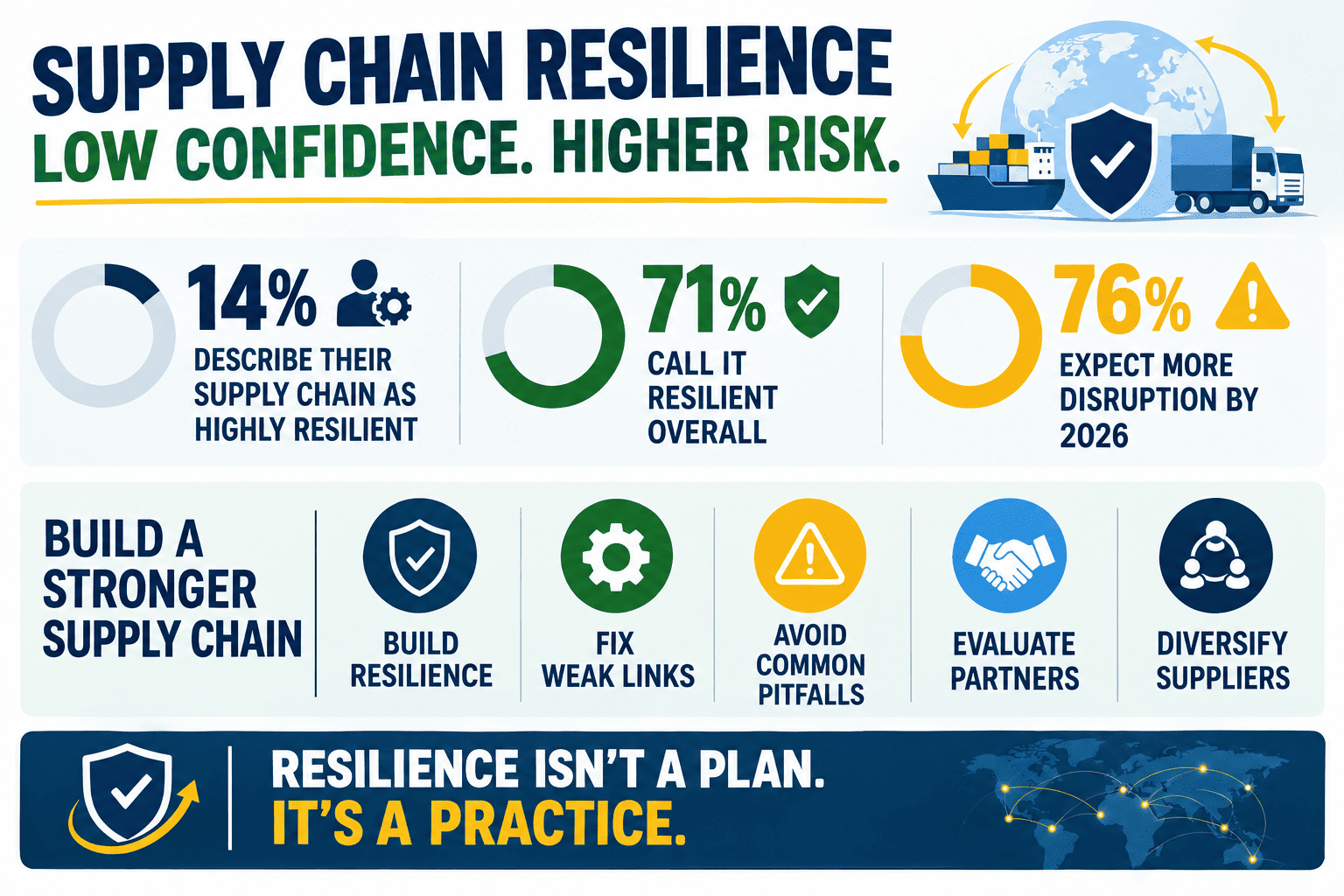
Only 14 percent of manufacturing leaders describe their supply chain as highly resilient, even though 71 percent call it resilient overall, and 76 percent of global supply chain executives expect disruption to keep intensifying through 2026. That gap between confidence and readiness is the story of this article. Resilience has stopped being a once-a-year contingency plan and become, in the words of practitioners now writing about it, a continuous operational discipline. This piece looks at what resilience actually means for a manufacturer, the strategies that build it, where those efforts commonly break down, and how to formalise the supplier relationships that resilience ultimately depends on, including proper partnership evaluation criteria applied to backup and diversification suppliers, not just primary ones.
📅 Published September 8, 2026⏱ 12 min read✍️ GTsetu Editorial🔄 Updated September 8, 2026
For most of the last two decades, supply chain strategy optimised for one variable: cost. Lean inventory, single-source contracts, and geographically concentrated supplier bases delivered efficiency when nothing went wrong. The problem, as a string of disruptions since 2020 has made clear, is that something is now going wrong often enough that efficiency alone is no longer a viable strategy on its own. Building genuine resilience increasingly means treating supplier relationships as part of a broader cross-border manufacturing partnership strategy, not a series of transactional purchase orders.
Section 1
The State of Supply Chain Resilience in Numbers
The data on manufacturing supply chains heading into 2026 tells a consistent story: awareness of the need for resilience has risen sharply, but genuine confidence in preparedness still lags behind.
76%
Of global supply chain executives expect continued higher levels of disruption through 2026
71%
Of manufacturing leaders describe their supply chain as resilient, up from 50% in 2024, though only 14% call it highly resilient
73%
Of companies have made significant changes to their supply chain networks in the past two years specifically to improve resilience and flexibility
86%
Of supply chain leaders say trade policy changes and tariffs have already altered how their operations run
Behind the headline numbers is a more specific shift in how resilience is being pursued. Roughly a third of supply chain leaders now name building resilience their single top strategic priority, and the tactics reported alongside that priority are notable: nearly seven in ten are investing in AI and digital tools, close to six in ten are actively adapting resources to market shifts, and more than half are improving forecasting and risk management specifically. That is a portfolio of actions, not a single fix, which reflects how compound the disruption itself has become.
💡 Why the confidence gap matters
A company that believes its supply chain is resilient, without being able to say specifically why, is often more exposed than one that openly acknowledges gaps. The 14% of manufacturers reporting genuine high resilience are likely the ones who have moved beyond general confidence to specific, tested capabilities: mapped dependencies, qualified alternative suppliers, and contracts built to perform under stress. That distinction, tested versus assumed, is the difference this article focuses on.
Section 2
What Supply Chain Resilience Actually Means
Resilience is frequently confused with redundancy, and the two are related but not identical. A supply chain can carry extra inventory or backup suppliers and still fail to recover quickly from disruption if it lacks visibility into where the risk actually sits, or if those backups were never genuinely tested. A resilient supply chain, more precisely, is one that can anticipate a disruption where possible, absorb its impact without a proportional loss of output, and recover to normal operations within an acceptable timeframe, all without requiring a full operational scramble each time.
The Three Capabilities That Define It
1
Anticipate: Visibility Beyond Tier One
Mapping dependencies deep enough to see the real risk
Visibility
Most manufacturers have decent visibility into their direct, tier-one suppliers. Far fewer have mapped the tier-two and tier-three suppliers those companies depend on, which is frequently where genuine single points of failure live, a specialised sub-component, a single certified material source, a concentrated logistics chokepoint. Anticipation means extending dependency mapping deep enough to actually see those risks before they surface.
🎯
Why it matters: A disruption at a supplier a company has never heard of, three tiers removed, can shut down a production line just as effectively as a disruption at a primary vendor. Visibility that stops at tier one is visibility into only part of the actual risk.
2
Absorb: Buffers and Alternatives That Actually Work
Risk-based inventory and genuinely qualified backup suppliers
Buffer Capacity
Absorption capacity comes from risk-based safety stock on genuinely critical inputs, rather than lean inventory applied uniformly across every component regardless of how replaceable it is, and from alternative supply routes that have been pre-qualified and tested, not simply identified on a spreadsheet. Pragmatic use of domestic or nearer-shore sourcing for maintenance-critical components is increasingly part of this layer as well.
🎯
Why it matters: A backup supplier that has never actually shipped a real order is a hypothesis, not a resilience capability. The gap between “on paper” and “tested” is where most resilience plans quietly fail when they are needed most.
3
Recover: Relationships Designed to Perform Under Stress
Supplier contracts and communication built for disruption, not just normal operations
Recovery Speed
Recovery speed depends heavily on how a supplier relationship is structured before disruption hits: whether communication channels for a crisis are already defined, whether the contract addresses force majeure and disruption scenarios explicitly, and whether both sides have practiced, even informally, what happens when something goes wrong.
🎯
Why it matters: Two companies can face an identical disruption and recover at very different speeds, and the difference is rarely luck. It is almost always the quality of the relationship and the contract that existed before the disruption began.
Section 3
Core Strategies That Build Resilience
Translating the anticipate-absorb-recover framework into practice comes down to a consistent set of strategies that show up across manufacturers, consultancies, and standards bodies writing about resilience today.
Strategy
What It Involves
Primary Risk It Addresses
Deep Dependency Mapping
Extending visibility to tier-two and tier-three suppliers, not just direct vendors
Hidden single points of failure
Dual or Multi-Sourcing
Qualifying more than one supplier for genuinely critical components
Single-supplier dependency
Risk-Based Inventory
Holding buffer stock proportional to a component’s criticality, not applying lean inventory uniformly
Lead-time and logistics shocks
Geographic Diversification
Spreading production and sourcing across more than one region or country
Regional and geopolitical disruption
Real-Time Visibility Tools
Digital platforms and AI-assisted forecasting to flag disruption earlier
Slow detection and reaction time
Resilience-Built Contracts
Agreements that define disruption response, communication, and contingency terms upfront
Slow or disputed recovery
None of these strategies work well in isolation. Geographic diversification without deep dependency mapping can simply relocate the same hidden risk to a new region. Risk-based inventory without qualified alternative suppliers just delays a disruption rather than absorbing it. The strategies function as a system, which is why leading manufacturers increasingly treat resilience as a standing programme with its own budget and ownership, not a checklist completed once and revisited only after the next crisis.
Section 4
Where Resilience Efforts Commonly Break Down
Most resilience programmes do not fail because the strategy was wrong. They fail in the gap between the plan on paper and what actually happens under real disruption. These are the failure points that show up most consistently.
Visibility that stops at tier one. Companies that can name their direct suppliers but not the sub-suppliers behind them are frequently blindsided by disruption that originated two or three tiers removed from anywhere they were actually watching.
Backup suppliers that were never tested. A qualified alternative supplier that has never fulfilled a real order carries hidden risk of its own, unverified capacity, unverified lead times, unverified quality, that only surfaces during the exact moment it is being relied upon.
Lean inventory applied without discrimination. Treating every input the same way, whether it is a commodity part with dozens of alternate sources or a specialised component with one qualified supplier worldwide, leaves genuinely critical inputs under-buffered.
Resilience treated as a project, not a discipline. A resilience assessment completed once, then filed away, ages quickly as suppliers, geopolitics, and risk concentrations shift. The organisations reporting genuine high resilience tend to review and update their risk picture continuously.
No formal structure behind the supplier relationship. Even a well-chosen alternative supplier offers limited protection if the underlying business partnership contract was never updated to reflect what happens during a disruption, who absorbs which costs, and how quickly volume can shift.
📌 The honest read
Resilience is not a state a manufacturer reaches and then holds indefinitely. Risks concentrate in new places as supplier bases, geopolitics, and climate patterns shift, which is why the manufacturers reporting genuine confidence describe resilience as continuous discipline rather than a completed initiative. The practical implication is budget and ownership: resilience needs a standing programme, not a one-time project with an end date.
Section 5
Measuring Resilience: The Metrics That Matter
Resilience is harder to measure than cost or on-time delivery, but that does not mean it should go untracked. A useful resilience programme leans on a small set of leading and lagging indicators rather than a single composite score.
🗺️
Supplier dependency depth
What share of critical components have visibility mapped to tier two and beyond, not just the direct vendor relationship.
Leading indicator
🔁
Single-source exposure
What percentage of spend, by criticality, still depends on exactly one qualified supplier with no tested alternative.
Leading indicator
⏱️
Time to recovery
How quickly, after a past disruption, output returned to normal levels, tracked as a baseline to improve against.
Lagging indicator
📦
Buffer adequacy
Whether safety stock on critical inputs is sized against realistic disruption scenarios rather than average historical demand alone.
Leading indicator
🧪
Alternative supplier activation rate
How many qualified backup suppliers have actually fulfilled a live order in the past 12 months, versus sitting untested on a list.
Leading indicator
📄
Contract disruption coverage
What share of critical supplier contracts explicitly address force majeure, contingency terms, and disruption communication protocols.
Leading indicator
🤝 For Verified, Resilience-Ready Supplier Relationships
GTsetu: Verified Discovery and Secure Engagement for Manufacturers, Distributors, and Raw Material Suppliers
Resilience depends on having qualified, verified alternative suppliers ready before disruption hits, not scrambled together during one. That means running the same due diligence on a diversification or backup supplier that a company would run on a primary one, and doing it early enough that the relationship is tested, not theoretical. That is what GTsetu is built to support. It is a structured partnership platform, not a directory or a general marketplace, where every company is verified on 6 government-sourced points before engagement, where discovery is anonymous until mutual interest is confirmed, where NDAs are executed digitally before any commercial information changes hands, and where document exchange happens through an encrypted workspace rather than email attachments.
GTsetu is used by industrial manufacturers, distributors, and raw material suppliers across 100+ countries to build out a distributor network, source international wholesale distribution partners, or qualify the alternative technology and manufacturing partnerships that resilience planning depends on, well before a disruption makes finding them urgent. It complements, rather than replaces, on-the-ground supplier audits and risk assessments, but it removes much of the identity and documentation risk before that deeper diligence even begins.
🏛️
6-Point Government-Sourced Verification
Name, Address, Registration Number, Company Status, Company Type, and Date of Incorporation, verified using government tie-ups before any engagement.
🕵️
Anonymous Discovery
Browse verified manufacturer and distributor profiles across 100+ countries without revealing your own identity or sourcing strategy until you choose to engage.
📄
Built-In NDA Workflow
Digital NDA with timestamped signatures before any pricing, formulations, or product specs are shared. No sensitive information exposed without protection.
🔐
Encrypted Document Workspace
All commercial documents shared through encrypted channels with a full access audit trail, not email attachments.
🌍
100+ Countries
Verified manufacturers and distributors across Asia, the Middle East, Europe, Africa, Australia, and the Americas. Built for cross-border partnership formation, not one-off quotes.
🚫
Zero Commission
No success fee, no broker commission, ever. Your partnership economics remain entirely between you and your partner.
Identifying an alternative supplier is only the first step. Turning that relationship into a genuine resilience asset requires the same discipline a company would apply to any new cross-border business partnership: verifying the supplier’s legal registration and standing, confirming real production capacity rather than claimed capacity, checking relevant manufacturing certifications for international trade, and putting a formal agreement in place before any sensitive specifications or pricing are shared.
That agreement should explicitly address the scenarios resilience planning exists for: how force majeure in global trade is defined and handled, how quickly volume can shift from a primary to a backup supplier, and what compliance obligations, including global trade compliance, apply if sourcing moves across borders under pressure. Companies building geographic diversification into their resilience strategy for the first time, whether into an established alternative hub or an emerging region such as the Nigerian industrial and agro cluster, often benefit from dedicated international business development consulting and thorough market research for manufacturers before committing capital, alongside a consistent B2B matchmaking process for identifying and vetting the suppliers themselves. Getting this discipline right at the sourcing stage is what separates a resilience plan that holds up under real disruption from one that only looked good on paper, and it is foundational to any broader global expansion strategy built to withstand the disruption manufacturers increasingly expect as standard, not exceptional.
FAQ
Frequently Asked Questions
QWhat is supply chain resilience?
Supply chain resilience is a manufacturer’s ability to anticipate, absorb, and recover from disruption, whether that disruption comes from a supplier failure, a logistics bottleneck, a natural disaster, or a geopolitical or trade-policy shift, without a proportional loss of output, revenue, or customer trust. It is increasingly treated as a continuous operational discipline rather than a one-time contingency plan.
QWhat are the main strategies manufacturers use to build supply chain resilience?
Common strategies include mapping dependencies beyond tier-one suppliers, dual or multi-sourcing critical components, holding risk-based safety stock rather than relying purely on lean inventory, diversifying manufacturing and supplier locations, investing in real-time visibility and forecasting tools, and building supplier relationships and contracts specifically designed to perform under stress rather than only under normal conditions.
QWhy do so many supply chain resilience efforts fail in practice?
Resilience efforts commonly fail because visibility stops at tier-one suppliers while the real risk sits deeper in the chain, because backup suppliers exist on paper but were never actually qualified or tested, because lean inventory strategies were never adjusted for genuinely critical inputs, and because resilience is treated as a one-time project rather than an ongoing discipline that needs regular review as risks shift.
QHow does supplier vetting relate to supply chain resilience?
Resilience depends on having qualified, verified alternative suppliers ready before a disruption happens, not scrambled together during one. That requires the same due diligence used for a primary supplier, verifying legal registration, production capacity, certifications, and compliance history, applied in advance to backup and diversification partners as well, along with a formal agreement that addresses disruption scenarios explicitly.
QIs supply chain resilience the same as supply chain redundancy?
They are related but not identical. Redundancy, extra inventory or backup suppliers, is one input into resilience, but a supply chain can carry redundancy and still recover slowly if it lacks visibility into where risk actually concentrates, or if the backup suppliers were never genuinely tested with a real order. Resilience is the broader capability to anticipate, absorb, and recover; redundancy is one of several tools used to build it.
GTsetu is purpose-built for manufacturers, distributors, and raw material suppliers in industrial sectors seeking verified long-term trade partnerships, across 100+ countries, with government-sourced partner verification, built-in NDA workflows, and zero commission.
They represents the product, and research team behind GTsetu, a global B2B collaboration platform built to help companies explore cross-border partnerships with clarity and trust. The team focuses on simplifying early-stage international business discovery by combining structured company profiles, verification-led access, and controlled collaboration workflows.
With a strong emphasis on trust, and disciplined engagement, Team GTsetu shares insights on global trade, partnerships, and cross-border collaboration, helping businesses make informed decisions before entering deeper commercial discussions.