Manufacturing Capability Assessment: A Practical Framework for Buyers | GTsetu Blog
Home ›
Blogs ›
Manufacturing Capability Assessment
🏭 Sourcing & Due Diligence · 2026
Manufacturing Capability Assessment: A Practical Framework for Buyers
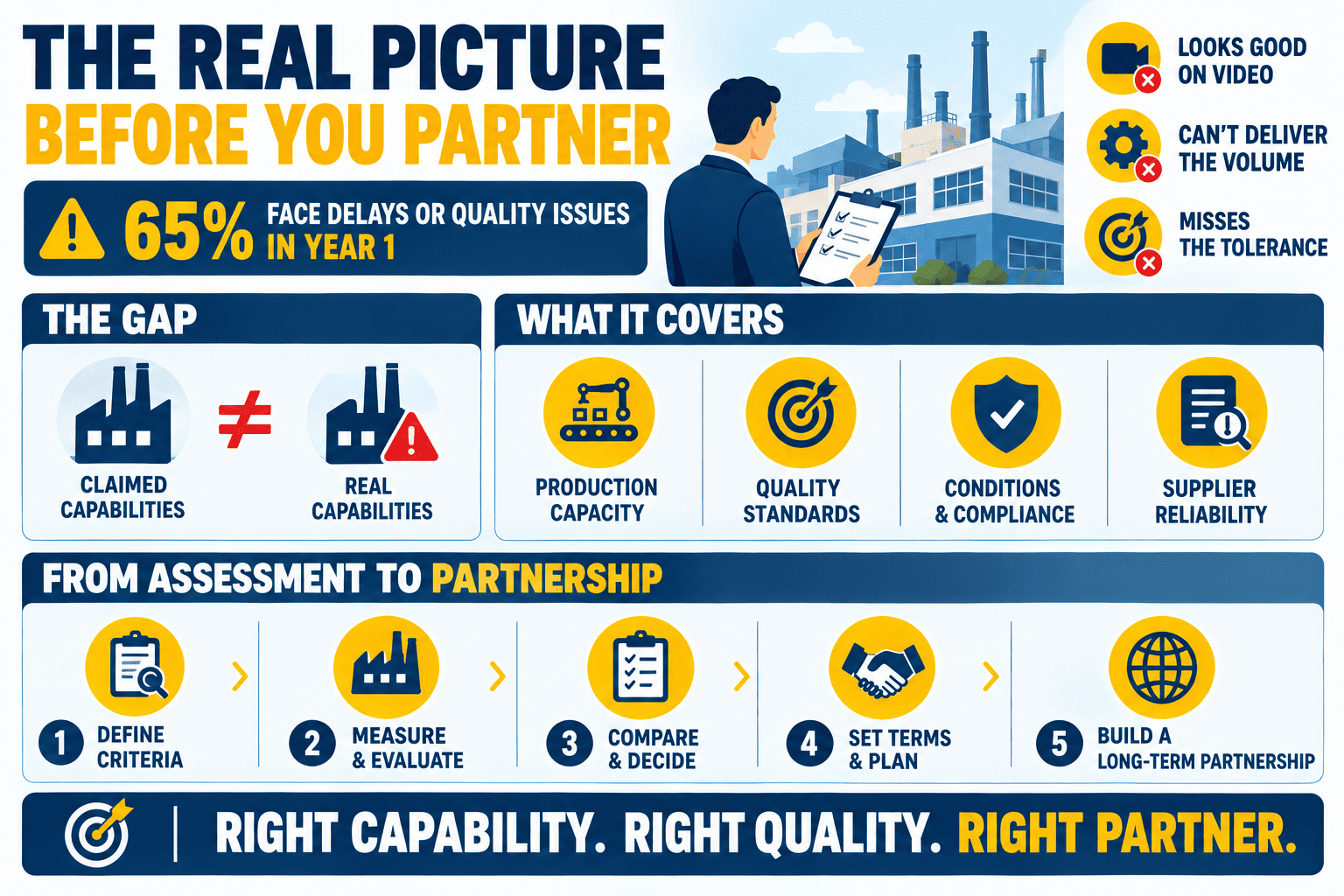
Nearly 65 percent of small and mid-sized businesses experience significant production delays or quality issues in their first year of sourcing from an unfamiliar manufacturer, and inadequate capability assessment is consistently the root cause. A facility can look impressive on a video call and still fail to deliver at the volume, tolerance, or consistency your product actually needs. The gap between a manufacturer’s claimed capabilities and its real ones is exactly what a structured capability assessment is designed to close, evaluating not just how much a factory can produce, but what it can reliably produce, at what quality, and under what conditions. This article walks through the dimensions that matter, how to measure them, and how to move from assessment to a properly formalised cross-border business partnership.
📅 Published September 8, 2026⏱ 13 min read✍️ GTsetu Editorial🔄 Updated September 8, 2026
A basic factory audit, checking facility size, counting machines, glancing at a certificate on the wall, only scratches the surface. It misses whether that equipment is actually used in production or displayed for visitors, whether the workforce operating it is stable or turns over every few months, and whether the quality system exists on paper or is genuinely practiced on the floor. A real capability assessment digs into all of this before you commit specifications, deposits, or exclusivity to a manufacturing partner.
Section 1
Capacity vs. Capability: Why the Distinction Matters
These two words get used interchangeably, but they answer different questions, and conflating them is one of the most common sourcing mistakes buyers make. Capacity refers to how much a facility can produce. Capability refers to what it can produce. A factory might have more than enough capacity to churn out 10,000 simple, standardized parts a week, but lack the capability to hold tight tolerances on a complex, highly engineered component, even with the machine-hours technically available. A proper assessment has to evaluate both together, because a high-capacity, low-capability factory and a high-capability, low-capacity factory fail in completely different ways.
~65%
Of small businesses report significant delays or quality issues in their first year sourcing from an unfamiliar factory
75-80%
Typical US manufacturing capacity utilization range reported since 2010, a useful benchmark for what “normal” looks like
3
Distinct capacity types, design, effective, and actual, each representing a different, non-interchangeable measurement
7+
Core dimensions a comprehensive capability framework typically evaluates beyond capacity alone
💡 The most expensive audit is the one skipped
Sourcing professionals often repeat a version of the same warning: the most expensive factory audit is the one you didn’t conduct before placing your order. Capability mismatches surface as production delays, quality inconsistencies, hidden rework costs, and compliance risk from undisclosed subcontracting, almost always after the order is already committed and much harder to unwind.
Section 2
The Core Dimensions of a Capability Assessment
What a Thorough Assessment Actually Covers
A comprehensive assessment evaluates several dimensions together, because strength in one area rarely compensates for weakness in another. A factory with excellent equipment but an unstable, poorly trained workforce will still produce inconsistent output.
Capacity evaluation looks past equipment counts to understand real throughput: machine utilization rates, how smoothly materials flow between production stages, where bottlenecks constrain overall output, and how capacity fluctuates during peak seasons. It also has to distinguish design capacity, the theoretical maximum under perfect conditions, from effective capacity under normal operations, and actual capacity once real-world downtime and defects are accounted for. Quoted maximums almost always describe design capacity; your planning should rely on actual capacity.
🎯
Why it matters: A factory quoting theoretical maximum output without disclosing setup time, maintenance, or typical defect rates can leave you 20 to 40 percent short of what you planned around, right when you need reliability most.
2
Technological Infrastructure and Equipment Integration
Equipment condition, automation level, digital connectivity, maintenance protocols
Technology
Assessing technology means looking beyond the presence of machinery to how well it’s integrated: equipment age and maintenance condition, automation level versus manual processes, precision and tolerance capabilities, and whether machines are digitally connected for monitoring and data collection. A common warning sign is mismatched equipment, sophisticated machines sitting alongside very basic ones, which often signals piecemeal investment without a coherent strategy, or advanced equipment kept dust-free for visitor tours but rarely used in actual production.
🎯
Why it matters: A factory’s pattern of technology investment, strategic and systematic versus reactive and showcase-driven, predicts how reliable a long-term partner they will be far better than a single equipment list does.
3
Quality Management Systems, Beyond the Certificate
Process controls, testing capability, defect tracking, quality culture
Quality
Certifications such as ISO 9001 provide a useful baseline, but implementation varies enormously between factories holding the same paper certificate. A real assessment checks whether the quality system is actively practiced, incoming material inspection procedures, in-process checks, statistical process control, defect tracking and root cause analysis, and whether workers actually understand and follow the documented procedures rather than just having them exist in a binder. Quality culture matters as much as quality documentation: does management prioritise quality over output, and can workers stop the line when something is wrong?
🎯
Why it matters: A certification without implementation depth creates a false sense of security while masking real quality risk, exactly the gap that surfaces after your first large order, not your sample run.
4
Workforce Stability and Supply Chain Integration
Turnover rates, skills training, sub-supplier transparency, material sourcing
People & Supply
The people running the equipment and the suppliers feeding it materials determine whether capability holds up order after order. Workforce assessment covers turnover rates, tenure of key technical staff, and training programs, since high turnover directly threatens production consistency. Supply chain assessment covers how the factory selects and monitors its own material suppliers, whether they disclose sub-supplier or subcontracting arrangements transparently, and whether backup suppliers exist for critical components, all of which affects your own international material sourcing risk one layer upstream.
🎯
Why it matters: Undisclosed subcontracting is one of the most common ways a capability assessment gets invalidated after the fact, your order may be produced somewhere entirely different from the facility you assessed.
Section 3
How to Actually Analyse Production Capacity
Capacity analysis follows a structured, repeatable process rather than a single conversation. The framework below, adapted from standard manufacturing capacity methodology, works whether you are assessing your own facility or a prospective partner’s.
Step
What to Do
What It Reveals
1. Define scope
Identify the specific line, department, or product to be analysed
Prevents irrelevant data from skewing the assessment
2. Identify design output
Determine each machine’s theoretical maximum output under ideal conditions
Establishes the raw performance baseline
3. Track nonproductive hours
Log planned and unplanned downtime, maintenance, changeovers, breakdowns
Shows how much theoretical capacity is actually lost
4. Calculate productive time
Subtract nonproductive hours from total available hours
Reflects real, achievable operating conditions
5. Calculate actual capacity
Multiply output rate by productive hours, adjusted for efficiency
Converts theoretical potential into a realistic output estimate
6. Identify bottlenecks
Compare actual capacity against design capacity across every stage
Pinpoints the constraint limiting your entire order timeline
For example, a workstation quoted at 150 units per hour that only delivers 38 productive hours in a standard week, after subtracting maintenance, changeovers, and quality adjustments, and runs at 90 percent efficiency, has a real weekly capacity of roughly 5,130 units, not the theoretical maximum of over 25,000 units a naive calculation might suggest. That gap between quoted and actual capacity is exactly what a buyer needs to surface before committing to a delivery timeline, and it connects directly to how contingency terms should be written into any business partnership contract.
Section 4
Technology Tiers and What They Mean for Your Product
Not every product needs a Tier 1, fully automated facility, and matching your product’s complexity to the right technology tier avoids both underdelivery and overpaying for capability you don’t need.
Technology Tier
Characteristics
Best Suited For
Tier 1: Advanced
State-of-the-art automation, digital integration, in-house R&D
Complex products, precision requirements, high-volume production
Tier 2: Modern
Modern equipment, partial automation, good process controls
Mid-complexity products with consistent quality needs
Very basic products, extremely price-sensitive items
Matching product complexity to the right tier also sets realistic expectations for pricing and lead time. A Tier 3 factory quoting Tier 1 precision and pricing should raise questions, while a Tier 1 facility may be unnecessarily expensive for a genuinely simple, high-volume commodity item. Understanding this landscape is part of the broader market research process for manufacturers entering a new sourcing region.
Section 5
Common Capability Misrepresentations to Watch For
Experienced sourcing teams see the same patterns of misrepresentation repeatedly. Knowing what they look like in advance makes them far easier to catch during your own assessment.
Theoretical capacity quoted as achievable capacity. A manufacturer quoting maximum possible output without accounting for setup time, maintenance, or quality control is describing design capacity, not what you should plan around.
Temporary capacity inflation. Hiring short-term workers or running extra shifts briefly to handle a large trial order does not reflect sustainable, ongoing capacity for repeat business.
Undisclosed subcontracting. Outsourcing portions of production to other, unassessed facilities without transparency breaks the entire premise of the capability assessment you conducted.
Sample-based extrapolation. Small batch production quality does not automatically scale linearly; the complexities of scale often introduce defects and delays that a sample run never reveals.
Showcase technology. Impressive equipment that is dusty, unused, or lacks the skilled technical staff to operate and maintain it properly signals investment for appearances rather than production reality, and connects to why verifying actual manufacturing certifications for international trade independently matters more than a factory tour alone.
📌 The honest read
None of these patterns is necessarily deliberate deception, factories often genuinely believe their theoretical numbers are achievable, or don’t distinguish clearly between what they can do once and what they can sustain repeatedly. That is exactly why an assessment needs to verify through records, references, and observation rather than taking any single conversation or document at face value.
Section 6
From Assessment to a Formal Manufacturing Partnership
A thorough capability assessment tells you whether a factory can do what you need. It does not, on its own, protect your specifications, establish legal recourse if capability turns out to be misrepresented, or account for what happens if capacity constraints emerge mid-relationship. That requires moving from assessment into formal documentation as part of a broader cross-border manufacturing partnership strategy.
🏛️
Confirm legal registration independently
Verify the company’s registration, incorporation date, and current standing before capability findings are acted on commercially.
Government-sourced verification
📄
Protect assessment findings and specifications
Put a formal NDA in place, and follow it with a proper business partnership contract, before sensitive specifications change hands.
NDA-first engagement
⚖️
Write capacity risk into the contract
Review how the agreement allocates responsibility for capacity shortfalls, including force majeure in global trade, before signing.
🤝 For Verified, Properly Assessed Manufacturing Partnerships
GTsetu: Verified Discovery Before You Ever Schedule a Capability Assessment
Every dimension in this framework assumes you already have a manufacturer willing to open their books, floor, and records to real scrutiny. The earlier problem is often finding a partner whose basic legal identity is genuinely verified before you invest the time and cost of a full capability assessment at all. That gap is what GTsetu is built to close. It is a structured partnership platform, not a directory or a general marketplace, where every company is verified on 6 government-sourced points before engagement, where discovery is anonymous until mutual interest is confirmed, where NDAs are executed digitally before any commercial information changes hands, and where document exchange happens through an encrypted workspace rather than email attachments.
GTsetu is used by industrial manufacturers, distributors, and raw material suppliers across 100+ countries to build out a distributor network, source international wholesale distribution partners, or find manufacturing and technology partnership relationships they intend to keep for years, not a single order cycle. It complements, rather than replaces, the full capability assessment described here, but it removes much of the identity and documentation risk before that deeper diligence even begins.
🏛️
6-Point Government-Sourced Verification
Name, Address, Registration Number, Company Status, Company Type, and Date of Incorporation, verified using government tie-ups before any engagement.
🕵️
Anonymous Discovery
Browse verified manufacturer and supplier profiles across 100+ countries without revealing your own identity or sourcing strategy until you choose to engage.
📄
Built-In NDA Workflow
Digital NDA with timestamped signatures before any pricing, specifications, or assessment findings are shared. No sensitive information exposed without protection.
🔐
Encrypted Document Workspace
All commercial documents shared through encrypted channels with a full access audit trail, not email attachments.
🌍
100+ Countries
Verified manufacturers and distributors across Asia, Europe, the Middle East, Africa, Australia, and the Americas. Built for cross-border partnership formation, not one-off quotes.
🚫
Zero Commission
No success fee, no broker commission, ever. Your partnership economics remain entirely between you and your partner.
It is also worth noting that capability standards and typical technology tiers vary meaningfully by region. Buyers assessing manufacturers across multiple geographies, including sectors such as textile and apparel manufacturing entering the US market, often find that applying consistent partnership evaluation criteria across every candidate, rather than assessing each informally, produces a far more defensible sourcing decision, and a platform built for B2B matchmaking across countries makes it easier to apply that standard consistently everywhere.
FAQ
Frequently Asked Questions
QWhat is a manufacturing capability assessment?
A manufacturing capability assessment is a systematic evaluation of a factory’s real ability to consistently produce goods that meet a buyer’s specifications, quality standards, and delivery requirements. It goes beyond checking facility size or equipment count to evaluate production capacity, technology sophistication, quality management systems, workforce stability, and supply chain integration together.
QWhat is the difference between manufacturing capacity and manufacturing capability?
Capacity refers to how much a facility can produce; capability refers to what it can produce. A facility might have enough capacity to produce 10,000 simple, standardized units per week, but lack the capability to produce complex or highly customized items, even with the time and equipment technically available. A full assessment needs to evaluate both together.
QWhat are the main dimensions of a manufacturing capability assessment?
A comprehensive assessment typically evaluates production capacity, technological infrastructure, quality management systems, workforce skills and stability, supply chain and material sourcing integration, financial stability, and communication and management responsiveness. Each dimension reveals a different kind of risk that a surface-level review or a single factory visit would miss.
QHow can a buyer verify a manufacturer’s claimed capacity is real?
Verification techniques include reviewing actual production records rather than relying on quoted maximums, checking order history and references with existing clients, understanding whether quoted capacity assumes any subcontracting, and distinguishing theoretical design capacity from the effective and actual capacity a factory sustains under normal operating conditions. Independent verification of legal registration and certifications adds a further layer of confidence.
Ready to Assess and Formalise Your Next Manufacturing Partnership?
GTsetu is purpose-built for manufacturers, distributors, and raw material suppliers in industrial sectors seeking verified long-term trade partnerships, across 100+ countries, with government-sourced partner verification, built-in NDA workflows, and zero commission.
They represents the product, and research team behind GTsetu, a global B2B collaboration platform built to help companies explore cross-border partnerships with clarity and trust. The team focuses on simplifying early-stage international business discovery by combining structured company profiles, verification-led access, and controlled collaboration workflows.
With a strong emphasis on trust, and disciplined engagement, Team GTsetu shares insights on global trade, partnerships, and cross-border collaboration, helping businesses make informed decisions before entering deeper commercial discussions.