Labor Laws in International Manufacturing: What Global Buyers Need to Know | GTsetu Blog
Home ›
Blogs ›
Labor Laws in International Manufacturing
⚖️ Global Sourcing & Compliance · 2026
Labor Laws in International Manufacturing What Global Buyers Need to Know
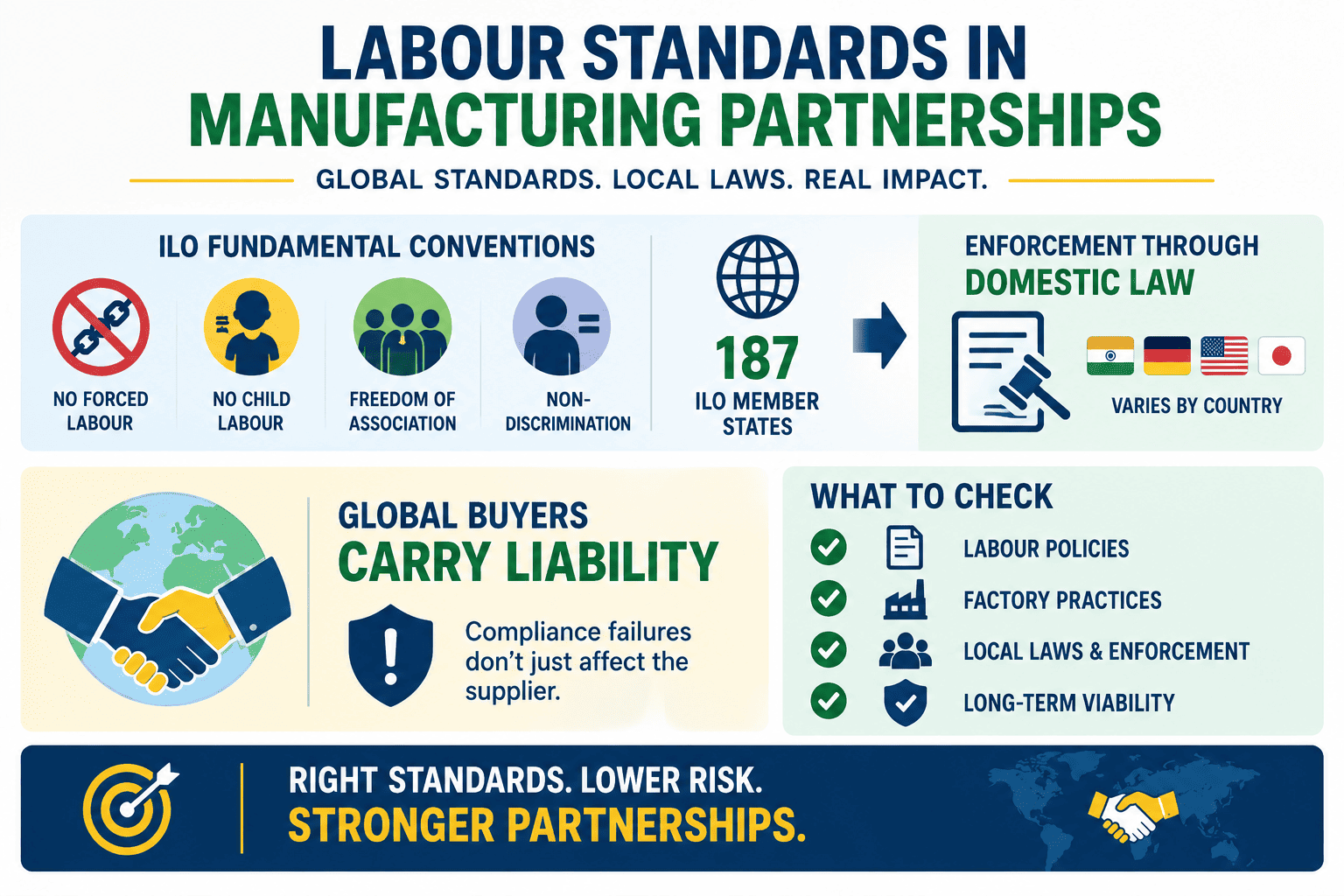
A manufacturing partnership is a commercial relationship on paper, but the labour standards inside a partner’s factory are what actually determine whether that relationship holds up under scrutiny. The International Labour Organization’s fundamental conventions, covering forced labour, child labour, freedom of association, and non-discrimination, are recognised across all 187 ILO member states, yet enforcement of those principles happens almost entirely through domestic law, which varies enormously by country. This article explains how the two layers, international standards and domestic labour law, actually interact, where global buyers carry real liability, and what to check before treating an overseas manufacturer as a long-term partner.
📅 Published August 4, 2026⏱ 13 min read✍️ GTsetu Editorial🔄 Updated September 7, 2026
Every manufacturing partnership formed across borders inherits two separate legal systems at once: the labour law of the country where production happens, and a set of internationally recognised standards that buyers, investors, and increasingly regulators expect suppliers to meet regardless of what local law requires. Understanding the gap between these two layers, and who is responsible for closing it, is one of the least discussed but most consequential parts of building cross-border manufacturing partnerships within global supply chains.
Section 1
How International Labour Standards Actually Work
The International Labour Organization, a United Nations agency with 187 member states, sets labour standards through conventions, which are legally binding treaties once ratified by a member state, and recommendations, which serve as non-binding guidance. Since 1998, a small subset of these conventions has been elevated to “fundamental” status, meaning the ILO considers them binding in principle on all member states regardless of whether that specific country has formally ratified them.
187
ILO member states bound by the 1998 Declaration on Fundamental Principles and Rights at Work
4 → 5
Core principle categories, expanded in 2022 to add safe and healthy working conditions
9
ILO instruments now classified as fundamental conventions, up from the original eight
1.5M+
Seafarers alone covered under just one ILO instrument, the Maritime Labour Convention, illustrating the framework’s scale
The four original core principles, later joined by a fifth, cover: freedom of association and the effective recognition of the right to collective bargaining; the elimination of all forms of forced or compulsory labour; the effective abolition of child labour; the elimination of discrimination in respect of employment and occupation; and, following a 2022 resolution, a safe and healthy working environment. Many multinational codes of conduct explicitly reference these conventions by number, and international framework agreements between global union federations and multinational enterprises typically build directly on them.
📌 The critical gap to understand
ILO conventions are not self-enforcing. The ILO’s supervisory system relies on independent legal experts and tripartite review bodies, but actual enforcement inside a factory, wage payment, working hours, safety standards, disciplinary action, happens through the domestic labour law of the country where that factory sits. A buyer relying only on “the country ratified the ILO convention” as evidence of compliance is missing the layer that actually matters day to day.
Section 2
Why Labor Law Compliance Is a Sourcing Risk, Not Just an HR Issue
The Business Case
Labor law compliance in a supplier’s factory used to be treated as a peripheral CSR concern. It is now a core part of sourcing risk management, sitting alongside quality, capacity, and financial stability as a factor that determines whether a manufacturing relationship is safe to build a long-term dependency on.
1
Reputational Exposure Travels Up the Supply Chain
A supplier’s labour violation becomes the buyer’s headline
Brand Risk
Since the 1970s, and accelerating through the 1990s, a large majority of multinational enterprises have adopted corporate social responsibility codes that explicitly commit to ILO fundamental conventions and other basic worker protections, both because it is the right thing to do and because it is now a reputational asset showcased to consumers and investors. The reverse is equally true: when a supplier is found in violation, the reputational cost lands on the buyer’s brand, not just the factory’s.
🎯
Why it matters: A brand’s public commitments to ethical sourcing are only as strong as its weakest supplier’s actual labour practices. Due diligence on a factory’s workforce compliance is functionally due diligence on the buyer’s own reputation.
2
Growing Legal Liability for Multinational Buyers
Due diligence legislation is shifting responsibility upstream
Legal Exposure
A growing body of scholarship and legislation is examining how far labor law liability extends up a global supply chain to the multinational corporations that buy from, but do not directly employ, factory workers. Import bans tied to forced labour findings, mandatory human rights due diligence laws in several jurisdictions, and contractual liability clauses are together narrowing the distance between “our supplier’s problem” and “our legal problem.”
🎯
Why it matters: Treating a supplier’s labour compliance as entirely their own legal responsibility is an increasingly outdated assumption. A proper risk allocation approach in cross-border deals now needs to address labour compliance explicitly, not leave it implied.
3
Operational Continuity Depends on It
Labour disputes and enforcement actions halt production
Continuity Risk
A factory facing a labour inspection shutdown, a strike over unresolved collective bargaining grievances, or an export ban tied to a forced labour finding does not just create a legal problem for the buyer, it creates an immediate production gap. For any company that has built a serious supply chain partner relationship around a specific factory’s output, this kind of disruption behaves exactly like a force majeure event, without any of the contractual protections one would normally expect for it.
🎯
Why it matters: Labour compliance risk and supply continuity risk are the same risk viewed from two angles. Weak labour practices are frequently a leading indicator of operational instability, not a separate concern.
Section 3
Where Compliance Gaps Commonly Show Up
Labour compliance gaps in international manufacturing rarely announce themselves outright. They tend to show up in a handful of recurring categories, each requiring a different kind of verification during workforce compliance checks and factory-level market research for manufacturers.
Compliance Area
Common Gap
Why It Gets Missed
What to Check
Working hours & overtime
Undocumented or unpaid overtime during peak order cycles
Time records often kept manually or altered for audits
Independent time-and-attendance data, not just factory-provided logs
Freedom of association
Informal suppression of worker organising
Rarely written into policy, enforced through management culture
Worker interviews conducted away from management presence
Forced & bonded labour
Recruitment fees, withheld documents, debt bondage among migrant workers
Often occurs upstream, at recruitment agencies rather than the factory itself
Recruitment chain audit, not just on-site factory review
Child labour
Underage workers in informal subcontracted tiers
Concentrated in unlisted sub-suppliers below the audited tier-1 factory
Sub-tier supplier mapping, not just direct supplier audits
Health & safety
Inadequate fire, chemical, or machinery safety measures
Capital-intensive to fix, easy to defer without external pressure
Physical site inspection against local building and safety codes
Wage compliance
Pay below legal minimum wage or with unlawful deductions
Complex piece-rate and deduction structures can obscure real pay
Payroll sampling against local minimum wage law
💡 The sub-tier blind spot
Most compliance failures uncovered in global supply chains in recent years did not occur at the audited, tier-1 factory a buyer directly contracted with. They occurred further upstream, at subcontractors, recruitment agencies, or informal sub-suppliers the buyer never formally vetted. A labour compliance programme that stops at the primary manufacturer is checking the visible part of the risk, not the largest part of it.
Section 4
Multinational Liability: What Buyers Are Actually Exposed To
The legal question of how far liability for a supplier’s labour violations extends to the buying company is genuinely unsettled and varies by jurisdiction, but the direction of travel is consistent: exposure is increasing, not decreasing. Academic and legal analysis of labor law liability in global supply chains points to several converging pressures on multinational buyers.
Mandatory human rights due diligence laws. A growing number of jurisdictions now require large companies to actively identify, prevent, and remediate labour rights risks across their supply chains, not just their own operations, shifting compliance from a voluntary code of conduct to a legal obligation.
Import and customs enforcement tied to forced labour. Several major markets can now block goods at the border on suspicion of forced labour involvement anywhere in the supply chain, placing the burden of proof on the importer rather than the enforcement agency.
Contractual liability flowing from supplier codes of conduct. When a buyer’s own supplier code of conduct references ILO conventions or similar standards, courts and arbitrators increasingly treat that code as an enforceable term, which is exactly why a properly drafted business partnership contract needs to specify labour compliance obligations precisely rather than gesture at them generally.
Investor and financing scrutiny. Institutional investors and trade finance providers increasingly factor supply chain labour risk into lending and investment decisions, meaning compliance gaps can affect a buyer’s cost of capital, not just its legal exposure.
None of this means every buyer is automatically liable for every violation at every tier of its supply chain. But it does mean that “we didn’t know” is a steadily weakening legal defence, and that proactive verification, documented in advance and revisited regularly, is now the more defensible position for any company relying on international sourcing of manufacturing materials or finished goods.
Section 5
A Closer Look: India’s Labour Law Landscape
India offers a useful case study in why domestic labour law cannot simply be inferred from a country’s ILO commitments. India’s employment law framework has historically been built around a patchwork of central and state-level statutes covering wages, industrial disputes, factories, and social security, which the government has been consolidating into four unified labour codes covering wages, industrial relations, social security, and occupational safety, health, and working conditions.
This consolidation is intended to simplify compliance for employers and buyers alike, but implementation has moved at different speeds across states, meaning the practical compliance burden for a manufacturer in one Indian state can differ meaningfully from an otherwise identical factory in another. For a global buyer, this reinforces a broader principle: general familiarity with “labour law in India,” or in any sourcing country, is not a substitute for state- or region-specific verification tied to the actual location of the factory in question, an important input into any serious global expansion plan involving Indian manufacturing capacity.
📌 The pattern beyond India
India is not unusual in this respect, it is representative. Most major manufacturing economies combine a national labour law framework with meaningful state, provincial, or regional variation in enforcement intensity, wage floors, and administrative practice. Treating “labour law in Country X” as a single, uniform answer is one of the most common oversimplifications in cross-border sourcing due diligence.
Section 6
Vetting a Manufacturing Partner’s Labour Practices
Country-level and even sector-level compliance patterns do not tell a buyer whether a specific factory, and its specific sub-tier suppliers, actually meet the standard the buyer needs. This is where general awareness of ILO principles and domestic law has to translate into a concrete, repeatable vetting process before any manufacturing relationship is formalised.
🏛️
Confirm legal registration and compliance history
Verify the manufacturer’s registration, business status, and any record of prior labour law violations before deeper engagement.
Build compliance obligations into the contract itself
Specify labour standards, audit rights, and remediation timelines directly in the business partnership contract, not just in a general code of conduct.
Contract terms review
⚖️
Plan for disruption caused by enforcement action
Understand how the agreement handles a compliance-driven shutdown, and how it relates to force majeure in global trade, before it happens.
🤝 For Verified Long-Term Manufacturing Partnerships
GTsetu: Verified Discovery and Secure Engagement for Manufacturers, Distributors, and Raw Material Suppliers
Understanding how ILO standards and domestic labour law interact tells you what to look for. It does not tell you whether a specific manufacturer is who they claim to be, or give you a documented, auditable record of the due diligence you carried out before entering a relationship with them. That gap is what GTsetu is built to close. It is a structured partnership platform, not a directory or a general marketplace, where every company is verified on 6 government-sourced points before engagement, where discovery is anonymous until mutual interest is confirmed, where NDAs are executed digitally before any commercial information changes hands, and where document exchange, including compliance documentation, happens through an encrypted workspace with a full audit trail.
GTsetu is used by industrial manufacturers, distributors, and raw material suppliers across 100+ countries to build out a distributor network, source international wholesale distribution partners, or formalise manufacturing and technology partnership relationships they intend to keep for years. It complements, rather than replaces, on-the-ground labour audits and legal review, but it removes much of the identity verification and documentation risk before that deeper diligence even begins.
🏛️
6-Point Government-Sourced Verification
Name, Address, Registration Number, Company Status, Company Type, and Date of Incorporation, verified using government tie-ups before any engagement.
🕵️
Anonymous Discovery
Browse verified manufacturer and distributor profiles across 100+ countries without revealing your own identity or sourcing strategy until you choose to engage.
📄
Built-In NDA Workflow
Digital NDA with timestamped signatures before any pricing, formulations, or product specs are shared. No sensitive information exposed without protection.
🔐
Encrypted Document Workspace
All commercial and compliance documents shared through encrypted channels with a full access audit trail, not email attachments.
🌍
100+ Countries
Verified manufacturers and distributors across Asia, the Middle East, Europe, Africa, Australia, and the Americas. Built for cross-border partnership formation, not one-off quotes.
🚫
Zero Commission
No success fee, no broker commission, ever. Your partnership economics remain entirely between you and your partner.
Labour compliance is one input into a broader partner evaluation, not a standalone checklist. It should sit alongside financial, quality, and capacity checks within a consistent set of partnership evaluation criteria, and it applies whether the relationship in question is a manufacturing contract, a cross-border business partnership, or a sourcing arrangement built through a B2B matchmaking platform. Sector-specific sourcing, such as work with a US market entry advisor for textile and apparel manufacturers, often carries additional labour compliance scrutiny given the industry’s history of supply chain labour issues, and should be treated accordingly.
FAQ
Frequently Asked Questions
QWhat labor laws apply to international manufacturing partnerships?
Two layers apply at once. The domestic labour law of the country where the factory operates governs day-to-day employment, wages, working hours, and workplace safety, and it is legally binding. Layered on top of that, the International Labour Organization’s core conventions on forced labour, child labour, freedom of association, and non-discrimination set globally recognised standards that most buyers now require as a condition of doing business, even where local law is weaker or less enforced.
QCan a buying company be held liable for labor violations at a supplier’s factory?
Increasingly, yes, particularly for large multinationals. A growing body of due diligence legislation, together with reputational and contractual exposure, means buyers can face legal, financial, and brand risk from labor violations occurring at a supplier’s facility, even without direct employment ties to the affected workers. This has made supplier-level labor compliance a board-level risk category rather than a purely operational one.
QWhat are the ILO core labour standards?
The ILO’s fundamental conventions cover freedom of association and the right to collective bargaining, the elimination of forced or compulsory labour, the effective abolition of child labour, and the elimination of discrimination in employment and occupation. A 2022 resolution added safe and healthy working conditions as a further fundamental principle. These principles apply to all ILO member states under the 1998 Declaration on Fundamental Principles and Rights at Work, regardless of whether a specific convention has been ratified.
QHow should a company check a manufacturing partner’s labor compliance?
Beyond a standard quality or capacity audit, a company should review the factory’s compliance history and any prior violations, confirm relevant labour and social compliance certifications, understand local labour law requirements for wages, hours, and safety, and build clear compliance obligations and audit rights into the manufacturing agreement itself. Verifying the legal status and track record of a manufacturer before engagement significantly reduces the risk of discovering labor issues after the relationship is already underway.
QDoes ratifying an ILO convention guarantee compliance on the factory floor?
No. Ratification signals a government’s legal commitment to a standard, but actual enforcement depends on domestic institutions, inspection capacity, and local legal practice, all of which vary widely even among countries that have ratified the same conventions. A buyer should treat a country’s ILO ratification record as context, not as evidence that a specific factory is compliant. Direct verification of the factory itself, and ideally its sub-tier suppliers, remains necessary regardless of national-level commitments.
Building a Manufacturing Partnership You Can Stand Behind?
GTsetu is purpose-built for manufacturers, distributors, and raw material suppliers in industrial sectors seeking verified long-term trade partnerships, across 100+ countries, with government-sourced partner verification, built-in NDA workflows, and zero commission.
They represents the product, and research team behind GTsetu, a global B2B collaboration platform built to help companies explore cross-border partnerships with clarity and trust. The team focuses on simplifying early-stage international business discovery by combining structured company profiles, verification-led access, and controlled collaboration workflows.
With a strong emphasis on trust, and disciplined engagement, Team GTsetu shares insights on global trade, partnerships, and cross-border collaboration, helping businesses make informed decisions before entering deeper commercial discussions.