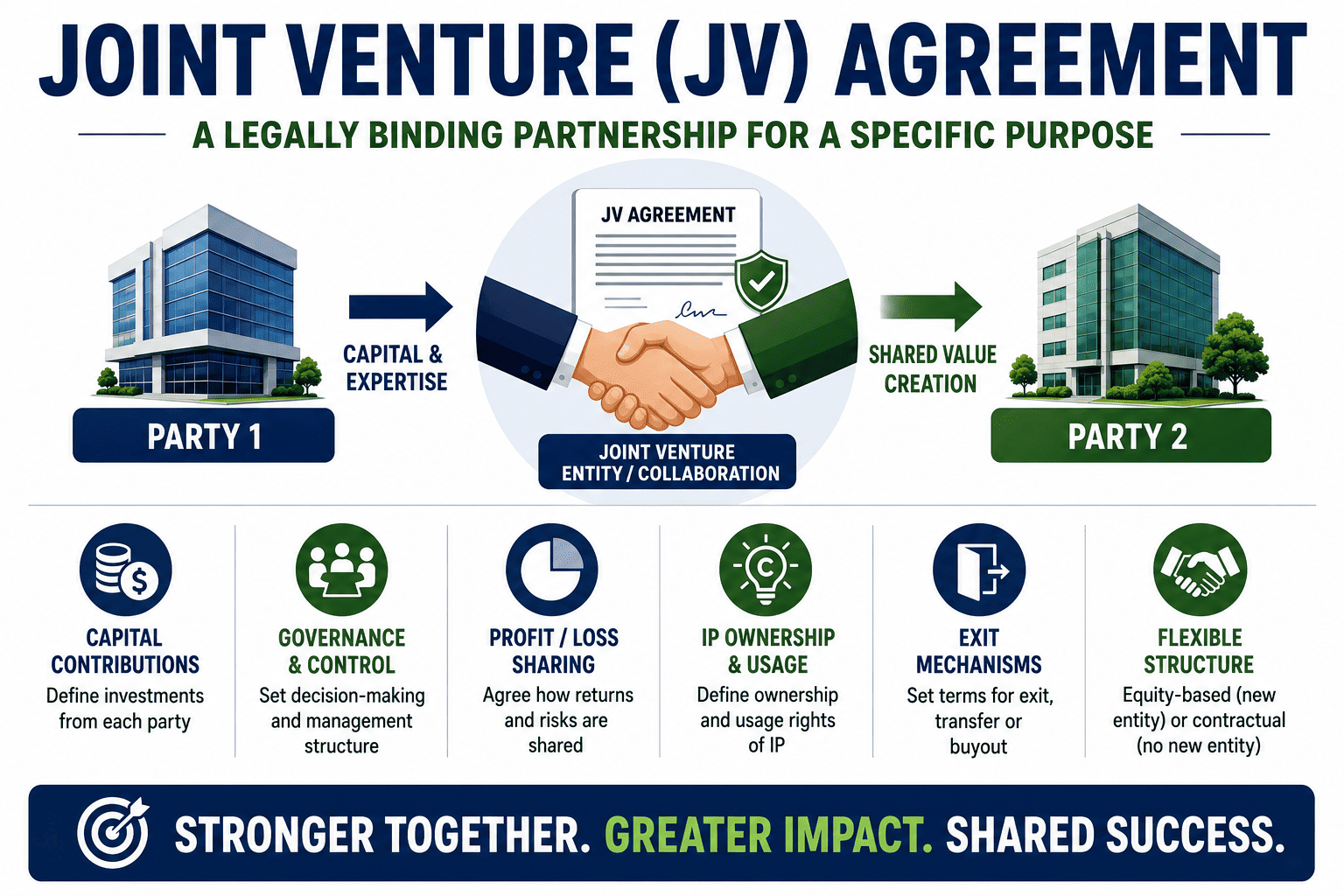
Why Joint Venture Agreements Matter
Joint ventures allow companies to achieve together what neither could accomplish alone. They combine complementary strengths: one partner may bring capital, another technology, a third local market knowledge or distribution networks. JVs are particularly valuable for entering regulated markets (e.g., India, China), pursuing capital-intensive projects (infrastructure, real estate), or co-developing new technologies. Unlike mergers, JVs preserve each partner’s separate identity while enabling shared risk and reward. According to industry data, JVs have a higher success rate in emerging markets than wholly-owned subsidiaries, primarily due to local partner expertise.
📊 Key Statistic
Cross-border joint ventures have a 5-year survival rate of approximately 45%, compared to 38% for wholly-owned foreign subsidiaries in emerging markets. The difference is attributed to local partners’ navigation of regulatory, cultural, and distribution challenges. However, JVs also face higher governance complexity and potential for partner conflict.
Benefits & Risks of Joint Ventures
| Benefits | Risks & Challenges |
|---|
| Shared financial risk and capital investment | Partner misalignment on strategy, values, or timelines |
| Access to local market knowledge and networks | Loss of control over operations and decision-making |
| Combined technology, IP, and expertise | Intellectual property leakage or disputes over improvements |
| Enhanced credibility through local association | Cultural and communication barriers |
| Regulatory and political risk mitigation | Governance deadlock (especially 50/50 JVs) |
| Flexibility to exit or restructure | Transfer pricing and tax complexity (cross-border) |
Types of Joint Venture Agreements
The optimal JV structure depends on the partners’ objectives, industry, regulatory environment, and desired level of integration.
| JV Type | Structure | Control & Governance | Best For |
|---|
| Equity-Based JV | New legal entity (LLC, corporation, partnership) created; partners hold equity shares | Shared governance proportional to equity; board representation | Long-term ventures, capital-intensive projects, regulated sectors |
| Contractual JV | No new legal entity; collaboration governed solely by a contract | Defined by agreement; typically project-specific with less formal governance | Short-term projects, co-marketing, R&D collaborations |
| Project-Based JV | Formed for a specific project (e.g., construction, infrastructure) | Dissolves after project completion; clear scope and milestones | Large-scale construction, energy, or government contracts |
| Cross-Border JV | Involves partners from different countries; may be equity or contractual | Complex governance due to differing legal systems; often includes arbitration clauses | International market entry, global supply chain coordination |
| Consortium JV | Multiple partners (3+) collaborate on a large venture | Governance often through a steering committee; decisions by consensus or majority | Mega-projects (airports, ports, telecom infrastructure) |
📌 India & Emerging Markets Note
In India, joint ventures were historically mandatory in many sectors. While 100% FDI is now permitted in most industries, local JV partners remain critical for navigating state-level regulations, distribution networks, and government relations. Successful examples include Starbucks-Tata (50/50 JV) and Maruti-Suzuki (pioneering JV in automotive).
Key Clauses & Structure
Essential Clauses in a Joint Venture Agreement
A well-drafted JV agreement addresses the entire lifecycle of the venture, from formation to exit. The following clauses are critical:
| Clause | Purpose & Key Considerations |
|---|
| Purpose & Scope | Defines the venture’s specific business activities, products, and markets. Prevents mission creep and unauthorised expansion. |
| Capital Contributions | Details each partner’s financial, asset, or IP contributions. Includes valuation method, contribution schedule, and treatment of additional capital calls. |
| Ownership & Profit Sharing | Specifies equity percentages and profit/loss allocation. Not necessarily 50/50; can be based on contributions or strategic importance. |
| Governance & Management | Defines board structure, voting rights, appointment of key executives, and day-to-day management authority. Includes reserved matters requiring unanimous consent. |
| Deadlock Resolution | Critical for 50/50 JVs. Mechanisms: mediation, arbitration, buy-sell (Russian roulette), or mediation with an independent expert. |
| Intellectual Property | Specifies ownership of pre-existing IP, new IP developed during the JV, and licensing rights. Includes confidentiality and non-use provisions. |
| Financial & Tax Provisions | Covers accounting methods, distribution policy, transfer pricing, tax sharing, and audit rights. Essential for cross-border tax compliance. |
| Dispute Resolution | Specifies governing law, jurisdiction, and arbitration framework (e.g., ICC, SIAC, LCIA). Critical for cross-border JVs to avoid home-court advantage. |
| Term & Termination | Initial term, renewal conditions, termination for cause (material breach, insolvency) and for convenience (buyout). Includes exit mechanisms and valuation methodology. |
| Non-Compete & Exclusivity | Restricts partners from competing with the JV during its term and for a period after exit. Must be reasonable in scope and duration. |
Drafting & Process
How to Draft a Joint Venture Agreement: Step-by-Step
Creating a robust JV agreement requires careful planning and negotiation. Rushing this process is a common cause of JV failure.
1
Define Strategic Objectives & Partner Selection
Clearly articulate the JV’s purpose, expected outcomes, and each partner’s role. Choose a partner with complementary strengths, aligned culture, and shared values.
3
Negotiate Key Commercial Terms
Agree on ownership percentages, capital contributions, profit sharing, governance structure, and strategic control points (reserved matters).
4
Draft the JV Agreement
Engage legal counsel from both sides to draft a comprehensive agreement. Address all key clauses: purpose, contributions, governance, deadlock, IP, dispute resolution, exit, and indemnification.
5
Sign, Implement, and Govern
Execute the agreement, form the JV entity (if equity-based), establish governance bodies, and begin operations. Implement regular monitoring and reporting mechanisms.
Real-World Example & Key Considerations
Real-World Example: The Havasu Project JV (SEC Filing Excerpt)
The following is a simplified excerpt from an actual joint venture agreement filed with the U.S. SEC (Exhibit 10.1), illustrating key clauses in practice:
📄 Excerpt: JV Agreement – The Havasu Project
Parties: Brent Fouch and Palomar Enterprises, Inc. (50/50 JV)
Purpose: To buy, sell, own, and operate specified real property.
Term: July 7, 2005 – December 31, 2025 (unless earlier terminated).
Capital Contributions: Palomar contributes 10% of purchase price; Fouch arranges financing for 90% (with Palomar executing promissory notes).
Governance: Fouch serves as Managing Joint Venturer with day-to-day authority. Major decisions (e.g., sale of property, new mortgages) require 51% approval.
Transfer Restrictions: Sale of interest requires 75% consent of other partners. Death of a partner allows continuation with estate or liquidation option.
Default: Failure to make contributions constitutes a default, with remedies including buyout or termination.
This example highlights key practical elements: purpose limitation, clear capital contribution terms, balanced governance with a designated manager, transfer restrictions, and default provisions. It also demonstrates the importance of a fixed term (20 years) and specific exit planning.
Risks & Mitigation
Common Joint Venture Risks & Mitigation Strategies
⚠️
Partner Misalignment & Cultural Friction
Mitigation: Define clear strategic objectives in the JV charter. Invest in cross-cultural training. Establish a joint steering committee with regular meetings to monitor alignment.
⚠️
Governance Deadlock (50/50 JVs)
Mitigation: Include robust deadlock resolution mechanisms: arbitration, mediation, or buy-sell (Russian roulette) provisions. Also consider giving a tie-breaking vote to an independent director or expert.
⚠️
Intellectual Property Disputes
Mitigation: Clearly define pre-existing IP ownership, and agree on ownership and licensing of new IP developed. Include confidentiality obligations and non-use restrictions. Register IP in the JV’s name where possible.
⚠️
Unequal Contributions & Financial Imbalance
Mitigation: Detail contribution schedules and valuation methods. Include provisions for additional capital calls, and specify consequences for failure to contribute (e.g., dilution or default).
⚠️
Cross-Border Regulatory & Tax Complexity
Mitigation: Engage local legal and tax advisors in the JV’s jurisdiction. Address transfer pricing, repatriation of profits, and double taxation in the agreement. Include a tax cooperation clause.
FAQ
Frequently Asked Questions about Joint Venture Agreements
QWhat is the difference between a joint venture and a strategic partnership?
A joint venture creates a new, separate legal entity owned by the parent companies, with shared equity, control, and liability. A strategic partnership is a contractual agreement between independent entities to cooperate on specific activities (e.g., distribution, co-marketing) without forming a new entity. JVs involve deeper integration, shared governance, and joint risk-taking.
QWhat are the key clauses in a joint venture agreement?
Essential clauses include: purpose and scope, capital contributions, ownership percentages, profit/loss sharing, governance and management structure, decision-making rights (including deadlock resolution), intellectual property ownership, confidentiality, dispute resolution (arbitration/mediation), term, termination, and exit mechanisms (buyout, liquidation). A well-drafted JV agreement also addresses fiduciary duties and non-compete obligations.
QWhat are the main types of joint ventures?
There are two primary types: (1) Equity-based JV – a new legal entity (LLC, corporation, or partnership) is formed, with each partner holding equity shares. (2) Contractual JV – no new entity is created; the collaboration is governed solely by a contract (often used for project-based cooperation). Equity JVs are more common for long-term, capital-intensive ventures, while contractual JVs offer more flexibility.
QWhat happens if a joint venture partner breaches the agreement?
The JV agreement should specify remedies for
breach, which may include: a
cure period to remedy the default, financial damages (
compensatory or consequential),
termination of the JV, forced buyout of the defaulting partner’s interest, or
dispute resolution (arbitration/mediation). Material breaches that go uncured typically allow the non-breaching party to terminate the venture and seek damages.
QIs a 50/50 split required in a joint venture?
No, a 50/50 split is not required. Ownership, profit sharing, and control can be allocated in any proportion the parties negotiate. Splits are often based on the relative value of contributions (capital, IP, resources), perceived risk, or strategic importance. However, 50/50 JVs are common because they signal equal partnership but require careful deadlock planning.