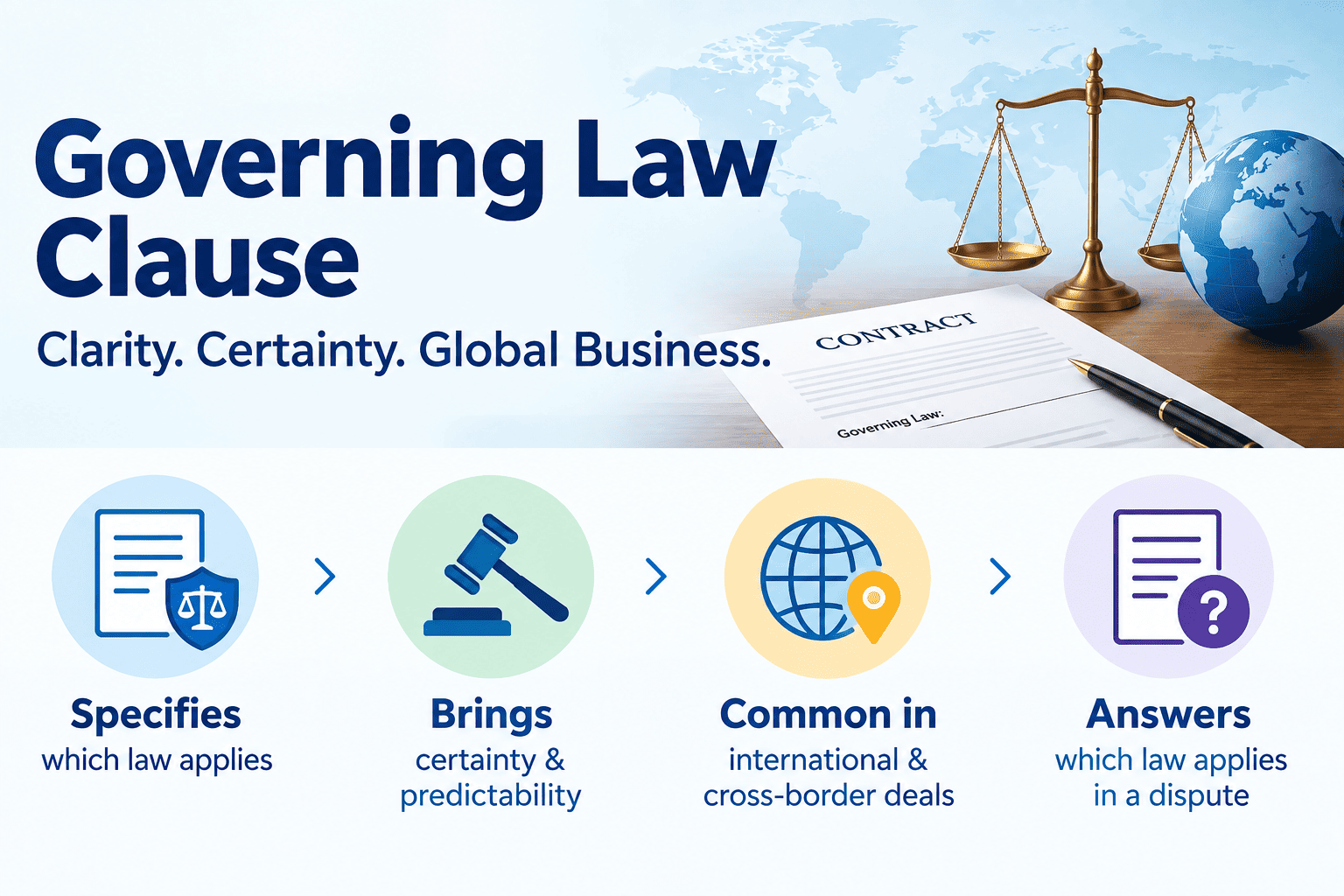
Why a Governing Law Clause Matters
The governing law clause is one of the most important provisions in any contract, yet it is often overlooked until a dispute arises. It provides the legal framework that will determine how the contract is interpreted, what remedies are available, and how the parties’ rights and obligations are enforced. In cross-border transactions, the stakes are even higher, as different legal systems can produce dramatically different outcomes on the same set of facts. A well-drafted governing law clause eliminates uncertainty, saves time and money, and allows parties to analyze their legal position with confidence.
📊 Key Principle
Most developed legal systems respect the parties’ choice of governing law. However, the chosen law must generally have a connection to the transaction or one of the parties, and mandatory local laws (such as consumer protection rules) may override the choice in certain circumstances.
Governing Law vs. Jurisdiction: Key Distinctions
These two concepts are frequently confused but serve distinct functions. Governing law determines which legal rules apply; jurisdiction determines which court or tribunal will hear the dispute. Understanding the difference is essential for effective contract drafting.
| Aspect | Governing Law | Jurisdiction |
|---|
| Definition | The legal system (statutes, case law, principles) that will interpret and enforce the contract. | The court or court system where a dispute will be heard and resolved. |
| Example | “This Agreement shall be governed by the laws of the State of New York.” | “The courts of New York shall have exclusive jurisdiction over any dispute.” |
| Function | Provides the substantive rules of decision (what is a breach, what remedies are available). | Determines the forum (where the case is filed and tried). |
| Flexibility | The governing law can be different from the jurisdiction. E.g., New York law in a Delaware court. | The jurisdiction can be chosen independently of the governing law. |
| Practical Impact | Determines the legal outcome of a dispute. | Determines the procedural rules, cost, and convenience of litigation. |
📌 Best Practice
Align your governing law and jurisdiction clauses wherever possible. If the governing law is New York law but disputes are resolved in English courts, the English court will require expert evidence on New York law, increasing costs and the risk of error. Keeping them consistent streamlines dispute resolution.
Key Components & Scope
Essential Elements of a Governing Law Clause
A well-drafted governing law clause is concise but precise. It should address the following elements:
| Element | Description |
|---|
| Choice of Law | Identify the specific legal system (e.g., “the laws of the State of New York,” “the laws of England and Wales,” “the laws of Singapore”). |
| Exclusion of Conflict-of-Laws Rules | State that the choice of law applies “without regard to conflict of laws principles” to prevent the application of another jurisdiction’s law. |
| Scope | Clarify whether the clause covers only the contract or also non-contractual claims (e.g., tort, misrepresentation). |
| Relationship to Jurisdiction | Optionally combine with a jurisdiction clause or state that the governing law does not affect the chosen forum. |
| Carve-Outs | Identify any matters that will be governed by different law (e.g., intellectual property validity, corporate authorization). |
How to Choose the Right Governing Law
Selecting the governing law is a strategic decision that affects risk, cost, and legal outcomes. The following factors should be considered:
1
Connection to the Transaction or Parties
Choose a law that has a genuine connection to the transaction or at least one of the parties. This ensures enforceability. Common choices include the law of the place where the contract is performed, where the parties are located, or where the subject matter is situated.
2
Neutrality
In cross-border deals, parties may prefer a neutral law that is familiar to both sides and perceived as fair. English law and New York law are common neutral choices due to their well-developed commercial jurisprudence and international recognition.
3
Familiarity and Predictability
Choose a law that your legal team understands and can advise on efficiently. A familiar legal system reduces legal costs and improves the accuracy of risk assessment.
4
Enforceability
Ensure that the chosen law will be recognized and enforced in the jurisdictions where you may need to enforce a judgment or award. Some legal systems are more favorable to enforcement than others.
5
Nature of the Agreement
Certain laws are more favorable for specific types of contracts. For example, intellectual property contracts may benefit from jurisdictions with robust IP protections, while finance transactions often use English or New York law due to their recognition of trusts and sophisticated financial legal principles.
Enforceability & Legal Framework
Enforceability of Governing Law Clauses
Most developed legal systems uphold the parties’ choice of governing law, but there are important limitations and exceptions to be aware of.
| Jurisdiction | Enforceability & Key Considerations |
|---|
| European Union (Rome I) | Parties may choose the governing law. However, mandatory rules of the consumer’s habitual residence or the employee’s place of work may override the choice in consumer and employment contracts. |
| United Kingdom | English courts uphold express choice of law clauses. Rome I applies as assimilated law. The choice must be of the law of a “country” and the contract must have a connection to the chosen jurisdiction or a valid commercial justification. |
| United States | Most states uphold choice of law clauses under the Restatement (Second) of Conflict of Laws. The chosen law must have a “reasonable relationship” to the transaction or parties, and the choice cannot violate a fundamental public policy of the forum state. |
| India | Indian courts uphold the parties’ choice of governing law in international contracts. For domestic contracts, the choice is subject to the Indian Contract Act and public policy considerations. Section 14 of the Specific Relief Act may limit specific performance in certain cases. |
| International Arbitration | Parties may choose any governing law, including non-national law (e.g., Sharia, lex mercatoria), in arbitration. Arbitral tribunals are more flexible than courts in giving effect to party autonomy. |
Drafting Best Practices
Drafting a Governing Law Clause: Best Practices
Simplicity and clarity are the hallmarks of an effective governing law clause. Avoid overcomplication and ensure consistency with other dispute resolution provisions.
| Best Practice | Explanation |
|---|
| Keep it Simple | Use plain language. A simple clause is sufficient: “This Agreement shall be governed by the laws of the State of New York.” |
| Be Specific | Identify the precise legal system. Say “the laws of the State of California,” not “US law.” In the U.S., each state has its own laws; in the UK, say “the laws of England and Wales.” |
| Exclude Conflict-of-Laws Rules | Add “without regard to its conflict of laws principles” to prevent a court from applying another jurisdiction’s law. |
| Align with Jurisdiction | Where possible, choose a governing law and jurisdiction that match. This avoids the need for expert evidence on foreign law and reduces costs. |
| Consider Non-Contractual Claims | Decide whether the clause should cover tort claims and other non-contractual obligations. Wording like “any dispute arising out of or in connection with this Agreement” is broader. |
| Avoid Ambiguity | Do not use vague terms like “international law” or “generally accepted principles.” Courts require a specific national law. |
Real-World Examples of Governing Law Clauses
Different organizations draft governing law clauses in various ways. Here are some illustrative examples:
📄 Example 1: Simple Bilateral Contract
“This Agreement shall be governed by and construed in accordance with the laws of the State of Delaware, without regard to its conflict of laws principles.”
📄 Example 2: Combined Governing Law and Jurisdiction
“This Agreement and any dispute or claim arising out of or in connection with it shall be governed by and construed in accordance with the laws of England and Wales. The courts of England and Wales shall have exclusive jurisdiction to settle any dispute or claim arising out of or in connection with this Agreement.”
📄 Example 3: Broad Clause Covering Non-Contractual Claims
“This agreement, and any dispute, controversy, proceedings or claim of whatever nature arising out of or in any way relating to this agreement or its formation (including any non-contractual disputes or claims), shall be governed by and construed in accordance with English law.”
📄 Example 4: Carve-Out for IP Validity
“This Agreement shall be governed by and construed in accordance with the laws of the State of New York, except that any question regarding the validity or enforceability of any patent, trademark, or copyright shall be governed by the laws of the jurisdiction in which such intellectual property right was granted or registered.”
Risks & Practical Guidance
Common Risks & How to Mitigate Them
⚠️
Omitting the Clause Entirely
Mitigation: Always include a governing law clause. Without it, courts will apply complex conflict-of-laws rules, leading to uncertainty, delays, and increased costs. The law applied may be entirely unexpected.
⚠️
Choosing an Unrelated Law
Mitigation: Choose a governing law that has a connection to the transaction or one of the parties. While some jurisdictions allow neutral choices, others require a “reasonable relationship.” An unrelated law may be unenforceable.
⚠️
Mismatch with Jurisdiction Clause
Mitigation: If the governing law and jurisdiction do not match, the chosen court will need expert evidence on foreign law. This increases cost and the risk of error. Align them where possible, or accept the additional cost and complexity.
⚠️
Overlooking Mandatory Local Laws
Mitigation: In consumer and employment contracts, mandatory laws of the consumer’s or employee’s residence may override the chosen governing law. Ensure the clause does not attempt to circumvent protections that cannot be waived.
FAQ
Frequently Asked Questions About Governing Law Clauses
QWhat is a governing law clause in a contract?
A governing law clause is a contractual provision that specifies which legal system (e.g., the laws of a particular state or country) will be used to interpret and enforce the agreement. It provides certainty and predictability by determining the applicable legal framework in case of a dispute.
QWhat is the difference between governing law and jurisdiction?
Governing law refers to the legal statutes and principles that will apply to interpret and enforce the contract. Jurisdiction refers to the court or court system where a dispute will be heard. They are often the same but do not have to match. For example, a contract could be governed by New York law but disputes resolved in the courts of Delaware.
QHow do I choose the governing law for my contract?
Consider factors such as: the location of the parties, the nature of the agreement, enforceability of the chosen law, neutrality (especially in cross-border deals), and consistency with the jurisdiction clause. Choose a law that has a connection to the transaction or at least one of the parties, and one that favors your business interests.
QWhy is a governing law clause important?
A governing law clause provides certainty and predictability. It avoids costly disputes over which law applies, ensures both parties understand their rights and obligations, and allows them to analyze their legal position with confidence. Without it, courts may apply complex conflict-of-laws rules that lead to uncertain outcomes.
QCan I choose any governing law I want?
In most developed legal systems, parties can choose the governing law, but it must generally have a connection to the transaction or one of the parties. Some jurisdictions also impose limits based on public policy or mandatory local laws (especially for consumer contracts). For international contracts, parties can often choose a neutral law, provided it is the law of a country.