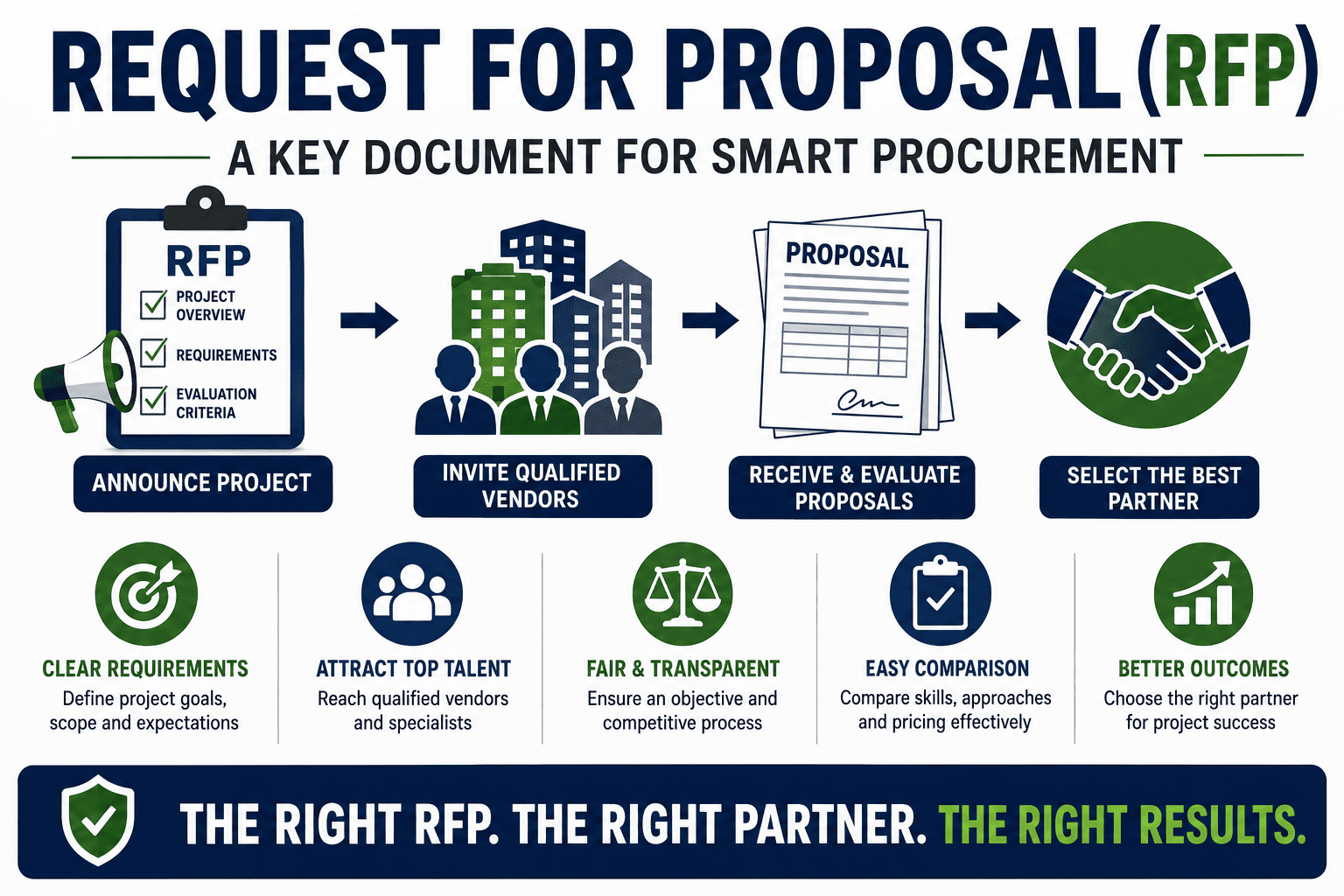
Why the RFP Process Matters
Issuing an RFP is a critical step for any organization that needs to acquire complex services, technology, or infrastructure. It provides a structured framework for vendor selection, ensuring that decisions are based on objective criteria rather than personal relationships. The RFP process fosters transparency and accountability, which is especially crucial for public sector entities that are legally required to maintain fair dealings. For corporations, the RFP process is essential for managing risk, optimizing costs, and finding the best strategic partner for high-stakes projects.
📊 Key Insight
In many federal, state, and local government entities, along with educational institutions and utilities, issuing an RFP is a legal requirement. This mandate ensures transparency and helps demonstrate that the organization received the right goods and services at a favorable price, while avoiding any appearance of favoritism or corruption.
RFI vs. RFP vs. RFQ: Understanding the Differences
These three procurement tools serve different purposes at different stages of the sourcing process. Choosing the right one is essential for efficiency.
| Document Type | Purpose | Stage of Process | Best Used When |
|---|
| Request for Information (RFI) | To gather general information about capabilities, solutions, and vendors available in the market. | Early stage: research | You are exploring options and don’t yet know what solutions exist. |
| Request for Proposal (RFP) | To solicit detailed proposals on scope, methodology, timeline, and cost for a complex project. | Mid to late stage: evaluation | You have a clear project need and want to compare comprehensive solutions from multiple vendors. |
| Request for Quotation (RFQ) | To gather pricing information for a specific, well-defined product or service. | Late stage: pricing | You know exactly what you need and are primarily comparing prices. |
💡 Pro Tip
Many organizations use an RFI before drafting an RFP. The information gathered from RFI responses can help you understand the market, refine your project requirements, and develop more targeted questions for your RFP, ultimately leading to better vendor proposals.
Key Benefits of Using an RFP
While the RFP process requires time and resources, the benefits it offers often outweigh the effort, especially for high-value or complex projects.
| Benefit | Description |
|---|
| Faster Vendor Selection | Streamlines the comparison process by standardizing vendor responses, allowing you to evaluate multiple options efficiently. |
| Competition & Equal Opportunity | Opens the door to both known and unknown vendors, fostering competition that can lead to better pricing and innovative solutions. |
| Transparency & Accountability | Provides a clear, documented trail of how and why a vendor was selected, which reduces the risk of favoritism and builds trust with stakeholders. |
| Clarity & Alignment | The act of drafting an RFP forces your organization to clarify its own project goals, scope, and budget, leading to better internal alignment. |
The RFP Process: 4 Key Steps
Step-by-Step Guide to the RFP Process
The RFP process is a multi-stage journey from internal planning to contract signing. Following a structured approach is essential for success.
1
Discovery & Internal Planning
Conduct a discovery phase with key stakeholders to define project boundaries, develop a realistic timeline, establish an estimated budget, and determine the evaluation criteria (scoring matrix) that will be used to judge proposals.
2
Draft & Issue the RFP
Create the RFP document using a structured template. The draft must include a clear project scope, timeline, submission guidelines, and evaluation criteria. Once finalized, publish the RFP through appropriate channels to reach the right vendors.
3
Score, Evaluate & Shortlist Proposals
As responses arrive, use your pre-defined scoring matrix to evaluate each vendor against your criteria. Conduct a detailed review, shortlist the highest-scoring vendors, and potentially hold clarification meetings or request presentations.
4
Select Winner & Send Contract
After final negotiations with your top choice, select the winning vendor. Notify all participants of the outcome, and then proceed to draft and execute a formal contract, which may be a Master Services Agreement (MSA).
Essential Sections of an RFP Document
What to Include in a Comprehensive RFP
A well-structured RFP is the foundation of a successful procurement process. The following sections are typically included to provide vendors with the information they need to submit a relevant and competitive proposal.
| Section | Key Details to Include |
|---|
| Company Introduction | Background of your organization: founding, locations, services, mission, and what makes you different. |
| Project Overview & Goals | Detailed description of the project, the specific problem you are trying to solve, and the business goals you expect to achieve. |
| Scope of Work (SOW) | Specific tasks, deliverables, requirements (e.g., required systems, materials), and a checklist of what the vendor must provide. |
| Budget | Provide an estimated budget or budget range to help vendors tailor their proposals accordingly. You can require itemized pricing. |
| Timeline & Milestones | Include the project start and completion dates, along with any key milestones. This helps vet vendors who cannot meet your deadlines. |
| Vendor Questions & Materials | A list of specific questions for vendors to answer (e.g., their approach, experience) and materials to submit (e.g., case studies, resumes of key staff). |
| Evaluation Criteria | Share your scoring criteria (e.g., 30% cost, 35% technical approach, 15% management). This adds transparency and helps vendors understand your priorities. |
| Possible Roadblocks | Highlight any known challenges, constraints, or risks that the project may face. This allows vendors to propose mitigation strategies. |
| RFP Guidelines & Submission | Instructions on how to submit, the number of copies required, the final deadline, and the contact person for questions. |
Governance & Related Contract Clauses
The RFP is the starting point. A strong final contract will incorporate key provisions that protect both parties and outline the rules of engagement. The clauses below are often critical in agreements that follow an RFP.
| Clause / Concept | Relevance to RFP-Based Agreements |
|---|
| Master Services Agreement (MSA) | Often the final contract structure, setting the overarching terms for the ongoing relationship with the selected vendor. |
| Conditional Agreement | An agreement that may be used when the contract is subject to further approvals or the satisfaction of specific conditions. |
| Non-Compete Clause | Can prevent the selected vendor from working with your direct competitors for a specific period during or after the project. |
| Condition Precedent | Defines specific events that must occur (e.g., securing financing) before the contract becomes binding. |
| Commercial Framework Agreement | Sets out the long-term commercial and pricing structure for a series of future projects or orders with the vendor. |
| Arbitration Clause | Specifies that disputes will be resolved through arbitration rather than litigation, a common feature in vendor contracts. |
| Mediation Clause | Requires the parties to attempt mediation before proceeding to formal dispute resolution. |
| Warranty Clause | The vendor’s promise that the deliverables will meet specified quality and performance standards. |
| Material Breach | Defines a serious failure by either party that justifies termination of the contract. |
| Cure Period | Specifies the time a party has to remedy a breach before the other party can take further action. |
| Termination for Convenience | Allows a party to terminate the contract without cause, often found in public sector contracts. |
| Indemnification Clause | Requires the vendor to compensate the client for losses arising from the vendor’s work or negligence. |
| Exclusivity Clause | Might be included if the vendor is granted sole rights to provide certain services to your organization for a period. |
| Breach of Contract | Defines what constitutes a failure to perform obligations and the legal consequences. |
| Consequential Damages | Often a key negotiation point to limit liability for indirect losses (e.g., lost profits) resulting from a breach. |
| Commercial Due Diligence | The evaluation of the vendor’s market position, growth potential, and commercial viability, often performed before finalizing the contract. |
| Due Diligence | The comprehensive investigation into a vendor’s legal, financial, and operational standing before signing a contract. |
| Limitation of Liability Clause | Caps the total financial liability of each party, often a critical clause following an RFP negotiation. |
| Market Entry Partnerships | If the RFP is for a partner to help enter a new market, this resource provides the framework for that strategic relationship. |
Tips for Vendors
Tips for Vendors Submitting an RFP Response
✅
Follow the Directions Exactly
Review the RFP carefully and adhere to all submission guidelines, format requirements, and deadlines. Failure to do so can lead to immediate disqualification.
✅
Highlight Your Unique Value
Clearly articulate why your solution is the best fit. Use examples, case studies, and customer testimonials to demonstrate your relevant experience and past successes.
✅
Understand the Client’s Needs
Read between the lines to understand the client’s underlying business problems and goals. Tailor your proposal to show how your solution addresses these specific challenges.
✅
Answer Every Question
Be thorough. If a question doesn’t apply, explain why. Incomplete responses can be viewed negatively and result in a lower score.
FAQ
Frequently Asked Questions about the RFP Process
QWhat is a request for proposal (RFP)?
A Request for Proposal (RFP) is a business document used by organizations to announce a project, outline its requirements, and solicit bids from qualified vendors or contractors. It’s a key part of the formal procurement process, designed to ensure transparency and find the best value for complex projects.
QWhen should my organization issue an RFP?
You should issue an RFP when you have a complex project or a specific need that requires external expertise or resources, and you do not already have a relationship with a qualified vendor. It is essential when you need to compare different solutions, methodologies, and prices objectively. For simple, straightforward purchases, an RFQ might be more efficient.
QWhat is the difference between an RFP, an RFI, and an RFQ?
An RFI (Request for Information) is for early-stage research to understand market capabilities. An RFQ (Request for Quotation) is used when you know exactly what you need and are primarily comparing prices. An RFP is the most comprehensive tool, used for complex projects to solicit detailed proposals on approach, timeline, and cost, allowing for a true comparison of vendor solutions.
QHow long does the RFP process typically take?
The RFP process can take anywhere from a few weeks to several months. This timeline depends on the complexity of the project, the number of vendors, and the efficiency of your internal evaluation process. A typical RFP submission window is around two to four weeks, with additional time needed for evaluation, shortlisting, and negotiation.
QWhat are the most common mistakes in writing an RFP?
Common mistakes include: being too vague about requirements, setting unrealistic timelines, omitting key sections (like evaluation criteria), not specifying the budget, and failing to proofread for clarity. It’s also a mistake to make the RFP overly complex, which can deter strong vendors. A clear, concise, and well-structured RFP is key to attracting high-quality bids.