Why Commercial Due Diligence Matters
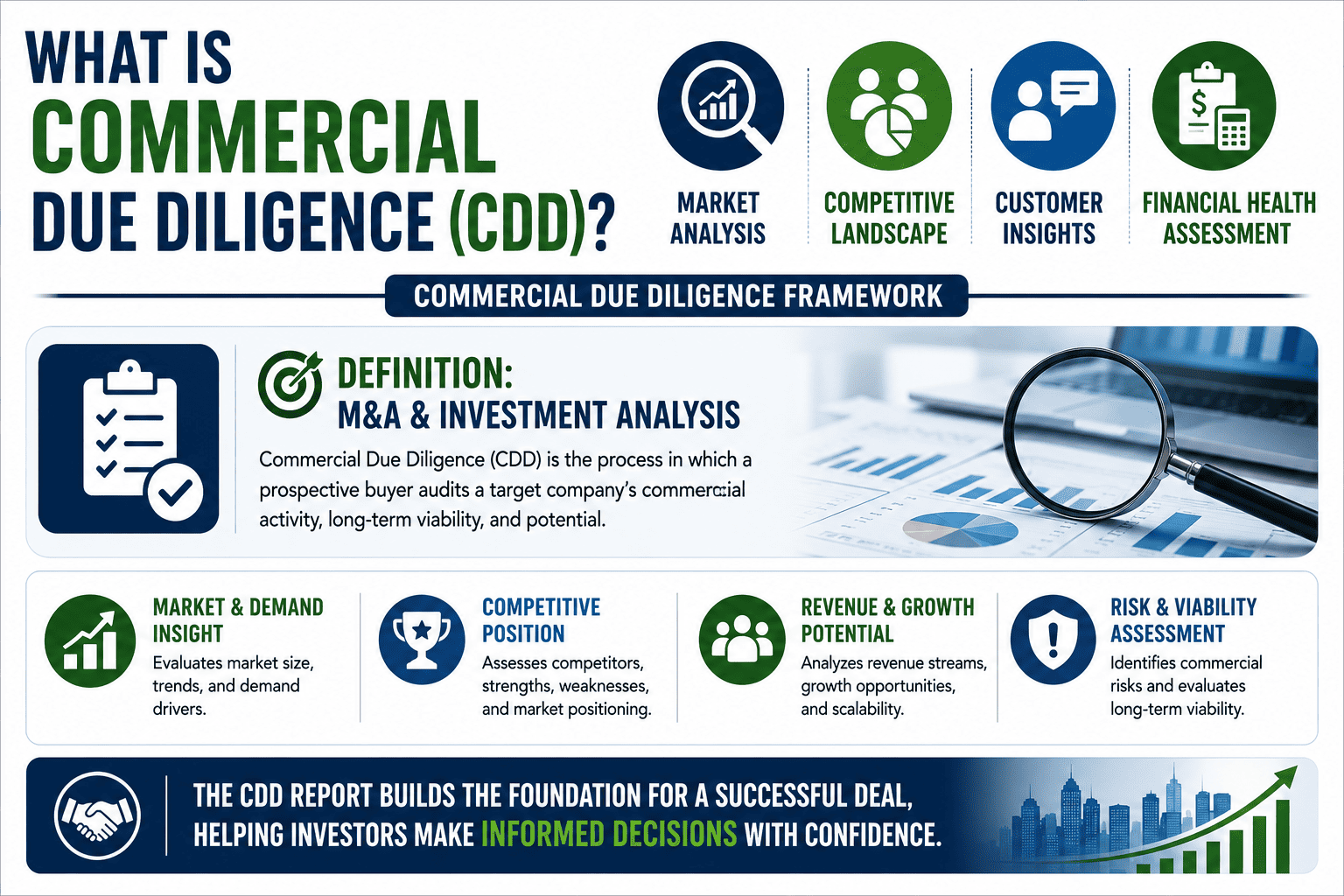
Commercial due diligence is critical in providing a prospective buyer with an in-depth understanding of a target’s current position and long-term viability. It allows all parties to make informed decisions and go into negotiations with an honest picture of the business. Without market DD, neither party can claim to know the business’s relative position, whether there are any impending threats to the business model, or how to navigate the post-deal industry landscape successfully.
📊 Key Statistic
Organizations that conduct thorough commercial due diligence report up to 30% higher deal success rates compared to those that skip or rush the process. CDD helps avoid costly mistakes by uncovering hidden risks and validating growth assumptions.
CDD vs. Financial Due Diligence vs. Legal Due Diligence
While commercial due diligence focuses on market potential and strategy, financial due diligence dives deep into revenue trends, cash flow, and historical financial data to validate performance metrics. Additionally, legal due diligence is essential for identifying regulatory compliance issues, litigation risks, and contractual obligations that could affect deal outcomes.
| Aspect | Commercial Due Diligence | Financial Due Diligence | Legal Due Diligence |
|---|
| Focus | Evaluates market position, competitive landscape, and growth potential. | Analyzes historical financial statements, revenue growth, and financial health. | Examines legal structure, employee agreements, and compliance risks. |
| Purpose | Assesses the target company’s commercial viability and future prospects. | Identifies financial risks and validates the accuracy of financial data. | Uncovers legal risks and ensures regulatory compliance. |
| Outcome | Provides a comprehensive understanding of the target company’s market position and potential. | Offers insights into the target company’s financial performance and stability. | Highlights organizational risks and legal constraints. |
📌 Note on Integration
In practice, CDD, FDD, and LDD are often conducted in parallel. The most valuable insights emerge from connecting findings across areas,seeing how customer feedback relates to competitive positioning, or how operational capabilities support (or limit) the business plan.
Essential CDD Components
What Should Be Included in a Commercial Due Diligence Report
A well-structured CDD report provides a comprehensive overview of the target company’s market position and potential. Missing or ambiguous sections can lead to poor investment decisions.
| Section | Description |
|---|
| Company Overview | General explanation of the target company’s history, mission statement, and critical operations. |
| Management Structure & Employee Agreements | Details on the company’s ownership, management, and employee obligations. |
| Legal Matters | Includes proper legal documentation, outstanding contracts, litigation, and compliance issues. |
| Products & Services | In-depth overview of product attributes, services, regulatory constraints, pricing models, and supply chain. |
| Financial Model | Historical and future financial performance, acquisition history, and sustainability of growth. |
| Marketing Analysis | Information on the company’s marketing strategy, customer base, and competitive advantages. |
| Competition | Details on current or potential competitors in the market and comparative market share. |
How to Conduct CDD Successfully
Step-by-Step Guide to Commercial Due Diligence
Conducting commercial due diligence requires a systematic approach. Rushing or missing details can lead to costly mistakes. Follow these steps to maximize your chances of success.
1
Define Objectives & Scope
Clearly define the objectives and scope of the analysis. What are the key questions that need answering? Focus on market position, growth potential, or identifying potential risks.
2
Collect Relevant Data
Gather data through market research, competitor insights, and review of the target company’s financial statements. Use virtual data rooms for secure access to critical documents.
3
Analyze Financial & Operational Performance
Evaluate revenue streams, cost structures, and operational efficiency. Identify red flags such as declining revenue growth or operational inefficiencies.
4
Conduct Risk Assessment
Identify potential risks such as market volatility, regulatory challenges, or competitive threats. Use a SWOT analysis to systematically evaluate these risks.
5
Present Findings & Recommendations
Compile the findings into a comprehensive commercial due diligence report. Provide a clear summary of the analysis, highlighting key insights and recommendations.
Types of Commercial Due Diligence
Understanding the Different Types of CDD
Commercial due diligence can be initiated in different ways depending on the specifics of the transaction. Here are the four main types:
| Type | Description |
|---|
| Buyer-initiated CDD | Conducted by potential buyers to understand the target company holistically before proceeding with a transaction. |
| Vendor-initiated CDD | Conducted by the seller of the business prior to the sale to prepare for potential buyer questions and increase value. |
| Red Flag CDD | An expedited, high-level assessment performed by the buyer to identify significant risks before in-depth analysis. |
| Top-up CDD | Applied to supplement existing due diligence processes when additional information in specific areas is needed. |
CDD Checklist
Commercial Due Diligence Checklist
The extent of commercial due diligence depends on how many products, services, markets, and customers the company has. Use this checklist to ensure thorough coverage:
| Area | Key Questions |
|---|
| Market Size | What are the key drivers? How is the market likely to grow? B2C or B2B? Sustainability of industry margins? |
| Competitive Landscape | Who are the main competitors? What advantages/disadvantages do they have? Barriers to entry? |
| Business Plan | Does it provide a clear path for revenue growth? Is it realistic? How does it fit with buyer’s objectives? |
| Customers | Psychographic and demographic characteristics? Average lifetime value? Retention and churn rates? |
| Sales & Marketing | Annual budget? Customer acquisition cost? How are customer relationships managed? |
| Financial Health | Revenue growth? Profitability margins? Free cash flow? Cost trends? Financial synergies? |
Real-World Example
Commercial Due Diligence Example: Wound-Care Market
The following example illustrates how CDD is applied in practice. A private equity firm was evaluating acquisition targets in the growing wound-care market. L.E.K. Consulting conducted a commercial due diligence assessment of a global wound-care provider, providing the firm with the facts and insights to complete a successful acquisition.
📄 CDD Case Study
Objective: Validate market attractiveness and growth potential of a wound-care target.
Scope: Assess market dynamics, competitive landscape, and customer insights.
Outcome: The PE firm purchased the company and subsequently sold it at a premium.
Risks & Mitigation
Common Challenges in Commercial Due Diligence & How to Mitigate Them
⚠️
Data Accuracy & Availability
Mitigation: Use multiple data sources. Cross-check information from management, customers, and industry reports. Leverage virtual data rooms for organized document management.
⚠️
Uncovering Hidden Risks
Mitigation: Conduct independent customer interviews. Perform a thorough SWOT analysis. Engage industry experts to identify less obvious threats.
⚠️
Market Volatility & External Factors
Mitigation: Use scenario analysis to test assumptions under different market conditions. Monitor leading indicators in the target industry.
FAQ
Frequently Asked Questions About Commercial Due Diligence
QWhat is the difference between Commercial Due Diligence and Financial Due Diligence?
Commercial Due Diligence (CDD) is a forward-looking assessment of a company’s market position, growth potential, and associated risks. It evaluates the target’s business model, competitive landscape, and customer insights. Financial Due Diligence (FDD) is a backward-looking analysis that focuses on the accuracy of historical financial statements, revenue trends, cash flow, and financial health to validate performance metrics.
QWhat are the key types of Commercial Due Diligence?
Common types include: Buyer-initiated CDD (conducted by potential buyers to understand the target); Vendor-initiated CDD (conducted by sellers to prepare for sale); Red Flag CDD (an expedited, high-level assessment to identify significant risks); and Top-up CDD (supplements other diligence processes with additional information in specific areas).
QWhat should a Commercial Due Diligence report include?
A CDD report typically includes: Company overview, management structure and employee agreements, legal matters, products and services analysis, financial model review, marketing analysis, competition analysis, and an assessment of the strategic business plan. It provides a comprehensive view of the target company’s market position and potential.
QWho conducts Commercial Due Diligence?
Commercial due diligence is typically conducted by private equity firms, investment banks, M&A advisors, and other stakeholders involved in investment decisions. These parties rely on CDD to gain a deeper understanding of the company’s operations, competitive advantages, and market share.
QWhat are the benefits of Commercial Due Diligence?
Benefits include: informed negotiation, assurance of a good investment, understanding of future market performance, and a comprehensive view of the competitive landscape. CDD helps investors make confident decisions by identifying risks and validating the investment thesis.