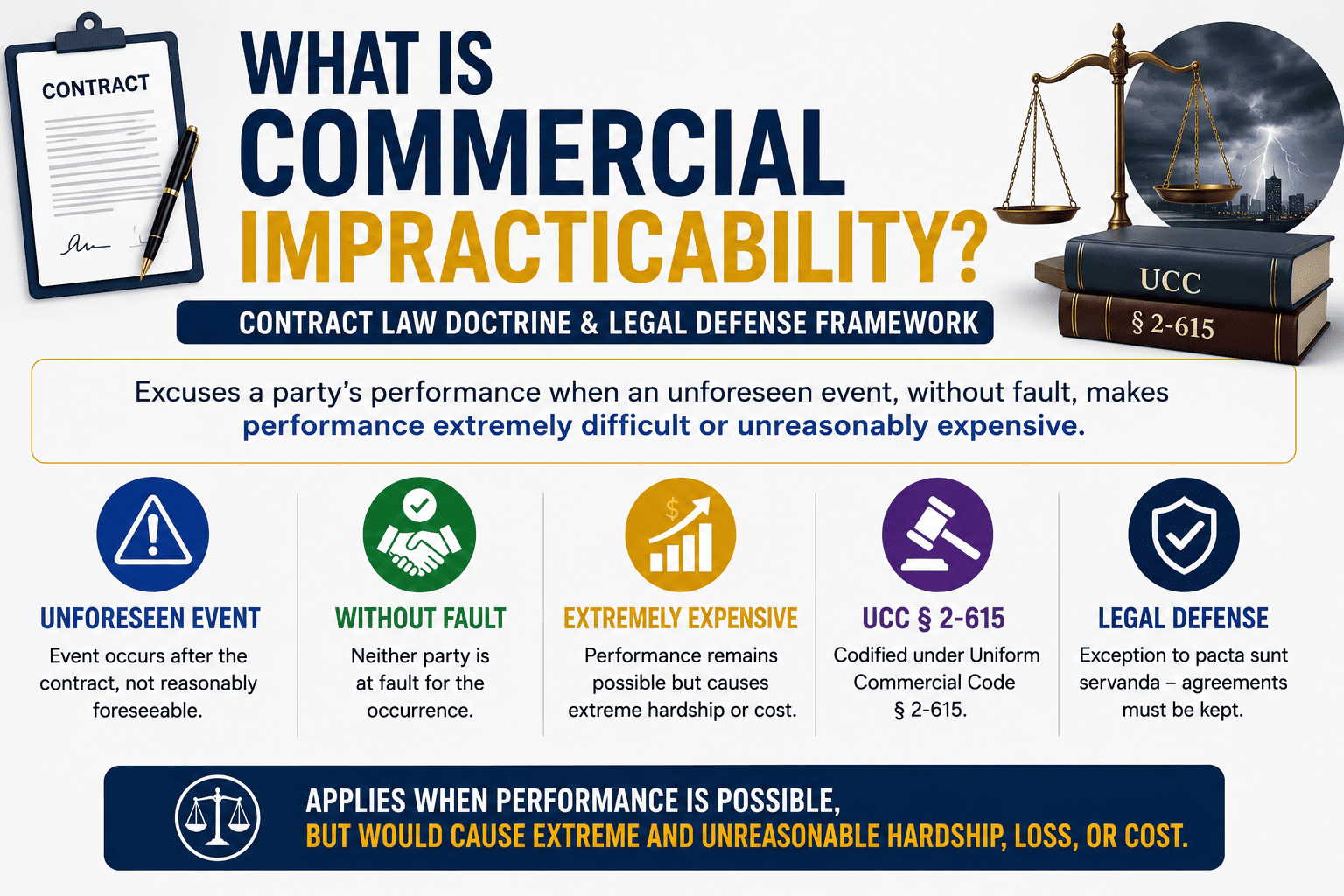
Why the Doctrine of Commercial Impracticability Matters
The doctrine of commercial impracticability serves as a critical safety valve in contract law. It balances the fundamental principle of pacta sunt servanda (sanctity of contract) with the need for fairness when unforeseen events fundamentally alter the nature of a contract. In procurement, supply chains, construction, and government contracting, this doctrine provides a legal basis for excusing performance when events like natural disasters, extreme price spikes, or regulatory changes make contractual obligations commercially unreasonable. Without this doctrine, parties would be bound to perform even when the very foundation of their agreement has been destroyed, leading to potentially ruinous outcomes.
📊 Key Insight
Courts apply rigorous standards to commercial impracticability claims. Mere increased expense or unprofitability is insufficient. For example, the Federal Circuit has held that a 57% cost overrun did not establish commercial impracticability (Raytheon Co. v. White), while a 148% overrun or a 3.75% yield rate in manufacturing did qualify in other cases.
Commercial Impracticability vs. Impossibility vs. Frustration of Purpose
These three doctrines are often confused but serve distinct purposes. Understanding the differences is crucial for selecting the appropriate legal defense.
| Doctrine | Definition | Key Difference |
|---|
| Commercial Impracticability | Performance is still technically possible, but only at extreme, unforeseen cost or hardship. | Focuses on excessive and unreasonable difficulty, expense, or loss. |
| Impossibility | Performance is objectively impossible (e.g., the subject matter is destroyed or a key person dies). | Requires literal or practical impossibility, not just difficulty. |
| Frustration of Purpose | The principal purpose of the contract is substantially frustrated or destroyed by an unforeseen event, even if performance is still possible. | Focuses on the destruction of the contract’s fundamental purpose, not on the difficulty of performance. |
📌 Note on UCC § 2-615
The Uniform Commercial Code explicitly uses the term “impracticable” rather than “impossible,” recognizing that performance may be excused when it becomes commercially unreasonable, not just impossible. This broader standard is particularly relevant in sales of goods.
Essential Elements & Types
Elements and Types of Commercial Impracticability
To successfully assert commercial impracticability as a defense, a party must prove several elements. Courts also recognize two distinct types of impracticability.
Elements Required to Prove Commercial Impracticability
| Element | Description |
|---|
| Unforeseen Event | The occurrence of an event that was not anticipated by the parties at the time of contracting. |
| Basic Assumption | The non-occurrence of the event was a fundamental assumption upon which the contract was made. |
| Performance Made Impracticable | The unforeseen event renders performance excessively burdensome, costly, or unfeasible (though not impossible). |
| No Fault | The party seeking relief must not be responsible for the occurrence of the unforeseen event. |
| No Assumption of Risk | The party claiming impracticability did not assume the risk of the event, either explicitly in the contract or by implication. |
Two Recognized Types of Commercial Impracticability
| Type | Description |
|---|
| Supervening Impracticability | Occurs when an unforeseen event arises after the contract is formed, making performance unreasonably difficult or costly. The event must not be the fault of the party seeking relief, and its non-occurrence must have been a basic assumption of the contract. |
| Existing Impracticability | Applies when a fact or condition that existed at the time the contract was signed made performance impracticable, but was unknown to the party claiming the defense and was not assumed in the risk allocation. The condition must not have been reasonably foreseeable. |
Landmark Case Law
Key Case Law Shaping Commercial Impracticability
The doctrine has evolved through significant judicial decisions in both the United States and India. These cases establish the standards and thresholds for invoking the doctrine.
| Case | Jurisdiction | Holding |
|---|
| Mineral Park Land v. Howard (1916) 172 Cal. 289 | California | Established the test: “A thing is impossible in legal contemplation when it is not practicable; and a thing is impracticable when it can only be done at an excessive and unreasonable cost.” Excused performance where removing gravel below water level was too costly. |
| Transatlantic Financing Corp. v. United States (1966) 363 F.2d 312 | D.C. Circuit | Held that “a contractual obligation is impracticable when it can only be done at an excessive and unreasonable cost.” This case involved the Suez Canal closure and is a leading modern statement of the doctrine. |
| Aluminum Co. of America v. Essex Group, Inc. (1980) 499 F. Supp. 53 | W.D. Pa. | Focused on whether performance was impracticable due to unforeseen cost increases and whether the party had assumed the risk. The court examined the basic assumptions of the contract. |
| Satyabrata Ghose v. Mugneeram Bangur & Co. (1954) SCR 310 | Supreme Court of India | Interpreted Section 56 of the Indian Contract Act, holding that “impossible” includes impracticability and futility where an unforeseen event upsets the very foundation of the agreement. |
| Energy Watchdog v. CERC (2017) 14 SCC 80 | Supreme Court of India | Clarified that a mere rise in cost or expense does not constitute frustration under Section 56; the doctrine applies only when an unforeseen event totally upsets the foundation of the contract. |
| Raytheon Co. v. White (2002) 305 F.3d 1354 | Federal Circuit | Held that a potential cost overrun of 57% did not by itself establish commercial impracticability, demonstrating the high threshold required. |
Practical Application
Examples of Commercial Impracticability
Understanding how courts apply the doctrine in real-world scenarios helps clarify its scope and limitations.
| Scenario | Application |
|---|
| Natural Disaster | A severe flood makes it impossible to deliver goods on time. If the flood was unforeseeable and not a basic assumption of the contract, performance may be excused. |
| Extreme Cost Increase | A contractor agrees to build a road, but a sudden regulatory change requires materials that cost 300% more than anticipated. If this was unforeseeable and not assumed as risk, impracticability may apply. |
| Supply Chain Disruption | War or pandemic prevents the import of essential components, making production commercially unreasonable. Courts will examine whether the risk was allocated. |
| Key Personnel Death or Disability | If a contract requires a specific expert’s services and that person dies or becomes disabled, performance may be impracticable if substitution is impossible or unreasonably difficult. |
Legal Framework in India
Commercial Impracticability Under Indian Law
In India, the concept of impracticability falls under Section 56 of the Indian Contract Act, 1872, which deals with the doctrine of frustration. However, Indian courts have been reluctant to excuse performance solely on grounds of increased difficulty or expense, emphasizing that the threshold for impossibility is high.
📜 Section 56 of the Indian Contract Act, 1872
Paragraph 1: “An agreement to do an act impossible in itself is void.”
Paragraph 2: “A contract to do an act which, after the contract is made, becomes impossible, or, by reason of some event which the promisor could not prevent, unlawful, becomes void when the act becomes impossible or unlawful.”
The Supreme Court in Satyabrata Ghose v. Mugneeram Bangur & Co. (1954) held that the word “impossible” in Section 56 does not mean literal impossibility but includes impracticability and futility, where an unforeseen event upsets the very foundation upon which the parties rested their agreement. However, later decisions like Energy Watchdog v. CERC (2017) have clarified that mere rise in cost or expense does not constitute frustration under Section 56. This has led to scholarly debate about whether Indian law should adopt a more flexible approach, possibly by referring to the UNIDROIT Principles on International Commercial Contracts.
Risk Allocation & Burden of Proof
Risk Allocation and Burden of Proof
Courts often examine how the contract allocates risk when determining whether commercial impracticability applies. The party claiming impracticability bears the burden of proof.
| Factor | Relevance |
|---|
| Greater Expertise | Which party had greater expertise in the subject matter? The party with superior knowledge is more likely to be held to have assumed the risk. |
| Control Over Conditions | Which party controlled the design, specifications, or method of performance? The party who proposed a particular method assumes the risk of any difficulty. |
| Explicit Contract Terms | Did the contract explicitly assign responsibility for certain types of risk? If so, the courts will usually enforce that allocation. |
| Exploration of Alternatives | The party claiming impracticability must prove it explored and exhausted reasonable alternatives before concluding performance was impracticable. |
| Cost Overrun Threshold | Courts typically require extreme cost overruns (often >70%) and evidence that the situation was unforeseeable and beyond the party’s control. |
FAQ
Frequently Asked Questions About Commercial Impracticability
QWhat is the difference between commercial impracticability and impossibility?
Impossibility means performance is objectively impossible (e.g., the subject matter is destroyed). Commercial impracticability excuses performance when it is still technically possible, but only at extreme, unforeseen cost or hardship that was not a basic assumption of the contract.
QWhat are the elements required to prove commercial impracticability?
To succeed, the party must prove: (1) an unforeseen event occurred, (2) the non-occurrence was a basic assumption of the contract, (3) performance was made impracticable (extremely difficult or expensive), (4) the party was not at fault, and (5) the party did not assume the risk.
QDoes a price increase justify commercial impracticability?
Generally no. Courts require extreme, disproportionate cost increases (often >70%) and evidence that the situation was unforeseeable and beyond the party’s control. Mere increased expense or unprofitability is insufficient.
QHow does commercial impracticability apply in government contracting?
In government contracting, impracticability has been treated as a type of constructive change to the contract. A contractor who proves commercial impracticability is entitled to recover costs incurred in attempting to perform, and the contract may be excused or adjusted.
QWhat is the status of commercial impracticability in Indian law?
In India, the concept falls under Section 56 of the Indian Contract Act, 1872, which deals with frustration. Indian courts have been reluctant to excuse performance solely on grounds of increased difficulty or expense, emphasizing that the threshold for impossibility is high. The Supreme Court in Satyabrata Ghose held that “impossible” includes impracticability, but later decisions like Energy Watchdog have clarified that mere cost increases do not qualify.