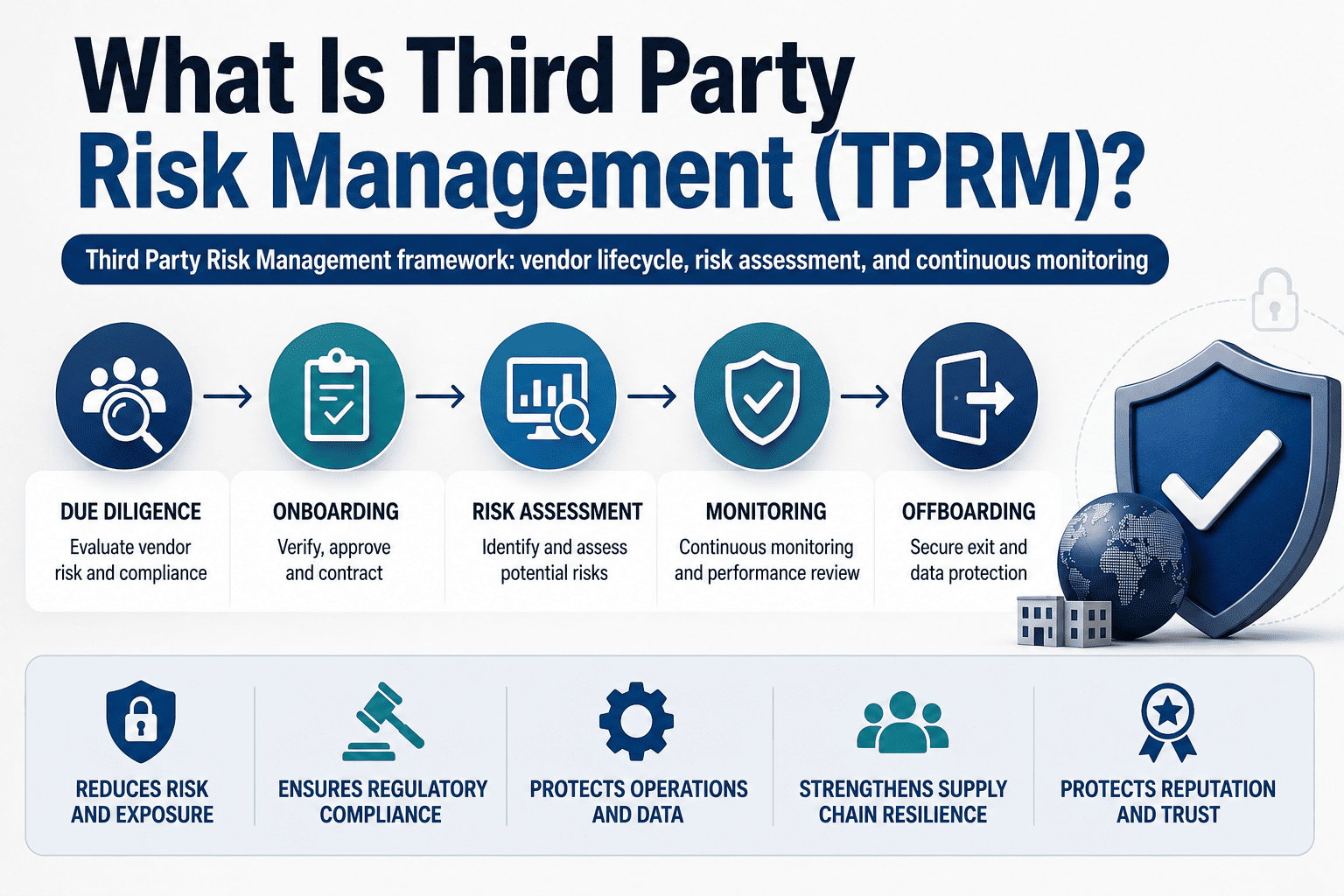
Why Third Party Risk Management Matters
Modern organizations rely extensively on third parties for innovation, cost savings, and operational efficiency. However, this dependency introduces significant vulnerabilities. Each external vendor , whether a cloud provider, logistics partner, or software supplier , expands the organization’s attack surface and can become a potential entry point for cyberattacks, as demonstrated by the 2013 Target data breach through a third-party HVAC contractor. Beyond cybersecurity, third-party failures can disrupt operations, violate regulatory mandates like GDPR or HIPAA, and cause lasting reputational damage. TPRM transforms this vulnerability into managed risk, enabling organizations to harness the benefits of outsourcing while safeguarding their core assets and stakeholder trust.
📊 Key Statistic
According to Gartner, 40% of compliance leaders report that between 11% and 40% of their third parties are high-risk. Organizations with mature TPRM programs can reduce the average cost of a data breach involving third parties , which averages $4.55 million , through proactive risk identification and mitigation.
The Third Party Risk Management Lifecycle
The TPRM lifecycle provides a structured framework for managing vendor relationships from start to finish. Each phase builds upon the previous, ensuring continuous oversight and risk mitigation.
| Lifecycle Phase | Key Activities |
|---|
| 1. Identification & Inventory | Build a comprehensive list of all third parties (including fourth/nth parties). Consolidate vendor data from spreadsheets, CMDBs, procurement systems, and stakeholder interviews. Classify vendors based on inherent risk and criticality. |
| 2. Evaluation & Selection | Assess potential vendors through RFPs, security questionnaires, and security ratings. Consider factors like data access, financial stability, business continuity plans, and regulatory compliance. |
| 3. Risk Assessment | Conduct in-depth assessments using frameworks like ISO 27001, NIST SP 800-53, or SIG. Evaluate cybersecurity posture, privacy practices, and compliance controls. Use pre-completed assessments where possible to improve efficiency. |
| 4. Risk Mitigation | Flag and score identified risks. Determine if risks are within the organization’s risk appetite. Assign risk owners to implement controls and reduce risks to acceptable residual levels. |
| 5. Contracting & Procurement | Negotiate contracts with key provisions: confidentiality, data processing agreements, SLAs, termination clauses, and indemnification. Ensure contract terms align with risk management requirements. |
| 6. Ongoing Monitoring | Continuously monitor vendors for changes in security posture, financial health, regulatory status, or negative news. Use automated security ratings and real-time alerts to detect emerging risks. |
| 7. Reporting & Recordkeeping | Maintain auditable records of all assessments, communications, and remediation activities. Generate reports for senior leadership, boards, and regulators to demonstrate program effectiveness. |
| 8. Vendor Offboarding | Securely return or destroy all data and assets. Follow a formal offboarding checklist to ensure compliance and maintain a detailed evidence trail for audit purposes. |
📌 Note on the Lifecycle
While presented sequentially, TPRM is an iterative and continuous process. Ongoing monitoring often leads back to reassessment and risk mitigation as the vendor relationship evolves, contracts are renewed, or regulatory requirements change.
Types of Third-Party Risks
Understanding the Spectrum of Third-Party Risks
Effective TPRM extends beyond cybersecurity to encompass a wide range of risk categories. A comprehensive program addresses the following risk types:
| Risk Type | Description | Example |
|---|
| Cybersecurity Risk | Exposure from cyberattacks, data breaches, ransomware, or other security incidents affecting the vendor. | Vendor’s compromised credentials lead to unauthorized access to your customer data. |
| Operational Risk | Disruption to business operations caused by vendor failures, outages, or performance issues. | A cloud service outage takes your e-commerce platform offline during peak shopping season. |
| Regulatory & Compliance Risk | Non-compliance with laws or industry regulations due to vendor actions or oversight. | Vendor mishandles PHI, resulting in HIPAA violations and fines for your organization. |
| Reputational Risk | Damage to brand image and customer trust from vendor misconduct, data leaks, or unethical behavior. | Vendor’s labor practices are exposed, leading to negative media coverage and boycotts. |
| Financial Risk | Negative impact on the organization’s bottom line from vendor insolvency, cost overruns, or contract disputes. | A critical supplier files for bankruptcy, causing supply chain disruption and lost revenue. |
| Strategic Risk | Inability to achieve business objectives due to vendor performance, misalignment, or strategic failures. | A software vendor’s product roadmap diverges from your digital transformation strategy. |
| Environmental, Social & Governance (ESG) Risk | Risks related to a vendor’s environmental impact, social responsibility, and governance practices. | Vendor’s carbon footprint or diversity policies do not align with your ESG commitments. |
Best Practices for TPRM Success
Proven Best Practices for Effective Third Party Risk Management
Implementing a robust TPRM program requires strategic focus and operational discipline. These best practices, drawn from industry leaders like Gartner, IBM, and OneTrust, provide a roadmap for success.
1
Establish a Clear Governance Structure
Designate a primary owner for TPRM, whether a dedicated team or a cross-functional committee. Develop RACI frameworks to define roles and responsibilities across departments, ensuring accountability and effective decision-making.
2
Maintain an Accurate, Centralized Vendor Inventory
Create a single source of truth for all third-party relationships, including upstream suppliers and downstream partners. Regularly update the inventory to reflect new vendors, contract changes, and offboarded entities.
3
Prioritize Vendors Based on Risk Criticality
Segment vendors into tiers (e.g., Tier 1: High Risk/Critical, Tier 2: Medium Risk, Tier 3: Low Risk). Allocate more intensive due diligence and monitoring resources to high-risk vendors, focusing efforts where they matter most.
4
Conduct Due Diligence Early in the Procurement Process
Integrate security assessments and risk evaluations into the initial vendor selection phase, not as an afterthought. This prevents costly delays and ensures security is a key criterion from the start.
5
Look Beyond Cybersecurity
Address the full spectrum of risks, including financial, operational, reputational, and strategic. A comprehensive TPRM program considers all potential vulnerabilities introduced by a vendor.
6
Leverage Automation and TPRM Software
Automate repetitive tasks such as vendor onboarding, questionnaire distribution, risk scoring, and report generation. This improves efficiency, reduces human error, and enables scalability across a growing vendor ecosystem.
7
Implement Continuous Monitoring
Move beyond point-in-time assessments. Use security ratings, news alerts, and automated monitoring to detect changes in vendor risk profiles in real time. Proactive monitoring enables rapid response to emerging threats.
8
Engage Stakeholders and Drive Collaboration
Involve stakeholders from procurement, legal, compliance, IT, and business units. Foster a culture of shared responsibility for TPRM, ensuring that business partners understand and communicate risks effectively.
TPRM in Practice: Real-World Example
TPRM in Action: Vendor Risk Assessment in Healthcare
The following example illustrates how a structured TPRM program delivers tangible benefits in a high-stakes environment like healthcare, where data sensitivity and regulatory requirements are paramount.
🏥 Case Study: Quadrupling Assessment Speed in Healthcare
Challenge: A large hospital system relied on manual, spreadsheet-based vendor reviews, creating a significant project backlog and resulting in inaccurate, “point-in-time” security assessments. This manual process took months to complete for a single vendor, delaying onboarding and increasing risk exposure.
Solution: The hospital adopted an automated TPRM platform, replacing its outdated spreadsheet process. The new system enabled the hospital to complete detailed security reports for its vendors in a quarter of the time.
Impact: The increased speed and accuracy saved valuable funds and freed up cybersecurity staff to focus on other critical security tasks. The new system ensured the hospital could quickly adopt and adhere to the latest security frameworks, such as the HIPAA Security Rule and the NIST CSF, significantly improving operational resilience and compliance.
Risks & Mitigation
Common TPRM Challenges & How to Overcome Them
⚠️
Lack of Speed & Scalability
Manual processes with spreadsheets and emails are slow and error-prone. Mitigation: Adopt automated TPRM software with pre-built questionnaire libraries and workflow automation to manage hundreds of vendors efficiently.
⚠️
Lack of Visibility into Fourth-Party (Nth-Party) Risks
Risks can cascade from your vendor’s subcontractors. Mitigation: Implement continuous monitoring tools that can discover and assess fourth-party relationships, integrating them into your risk inventory.
⚠️
Inconsistent Assessment Standards
Vendors may be evaluated against different criteria, leading to gaps. Mitigation: Standardize assessments using proven frameworks like SIG, NIST, or ISO 27001. Ensure all vendors, regardless of tier, are subject to a baseline set of checks.
FAQ
Frequently Asked Questions About Third Party Risk Management
QWhat is Third Party Risk Management (TPRM)?
Third Party Risk Management (TPRM) is a strategic process for identifying, assessing, and mitigating risks that arise from an organization’s use of external vendors, suppliers, contractors, and service providers. It ensures that third-party relationships do not compromise security, compliance, or operational integrity, and it covers the entire lifecycle from onboarding to offboarding.
QWhat are the key steps in the Third Party Risk Management lifecycle?
The TPRM lifecycle typically includes: 1) Identification and inventory of third parties, 2) Evaluation and selection, 3) Risk assessment, 4) Risk mitigation, 5) Contracting and procurement, 6) Ongoing monitoring, 7) Reporting and recordkeeping, and 8) Vendor offboarding. These steps ensure continuous risk oversight throughout the vendor relationship.
QWhat are the common types of third-party risks?
Common third-party risks include cybersecurity risks (data breaches, cyber attacks), operational risks (service disruptions, supply chain failures), regulatory and compliance risks (violations of GDPR, HIPAA, etc.), reputational risks (damage to brand image from vendor actions), financial risks (cost overruns, vendor insolvency), and strategic risks (failure to meet business objectives).
QWhat are the best practices for Third Party Risk Management?
Best practices for TPRM include: conducting thorough due diligence before onboarding, prioritizing vendors based on risk criticality, using automated TPRM platforms for efficiency, looking beyond cybersecurity to include all risk types, implementing continuous monitoring with real-time alerts, and establishing clear governance with cross-functional stakeholder buy-in.
QWhich department typically owns Third Party Risk Management?
TPRM ownership varies by organization. It can be owned by the Chief Information Security Officer (CISO), Chief Procurement Officer (CPO), Information Technology (IT), Risk and Compliance, or dedicated TPRM teams. Increasingly, organizations are adopting centralized or federated governance models to coordinate TPRM across functions.