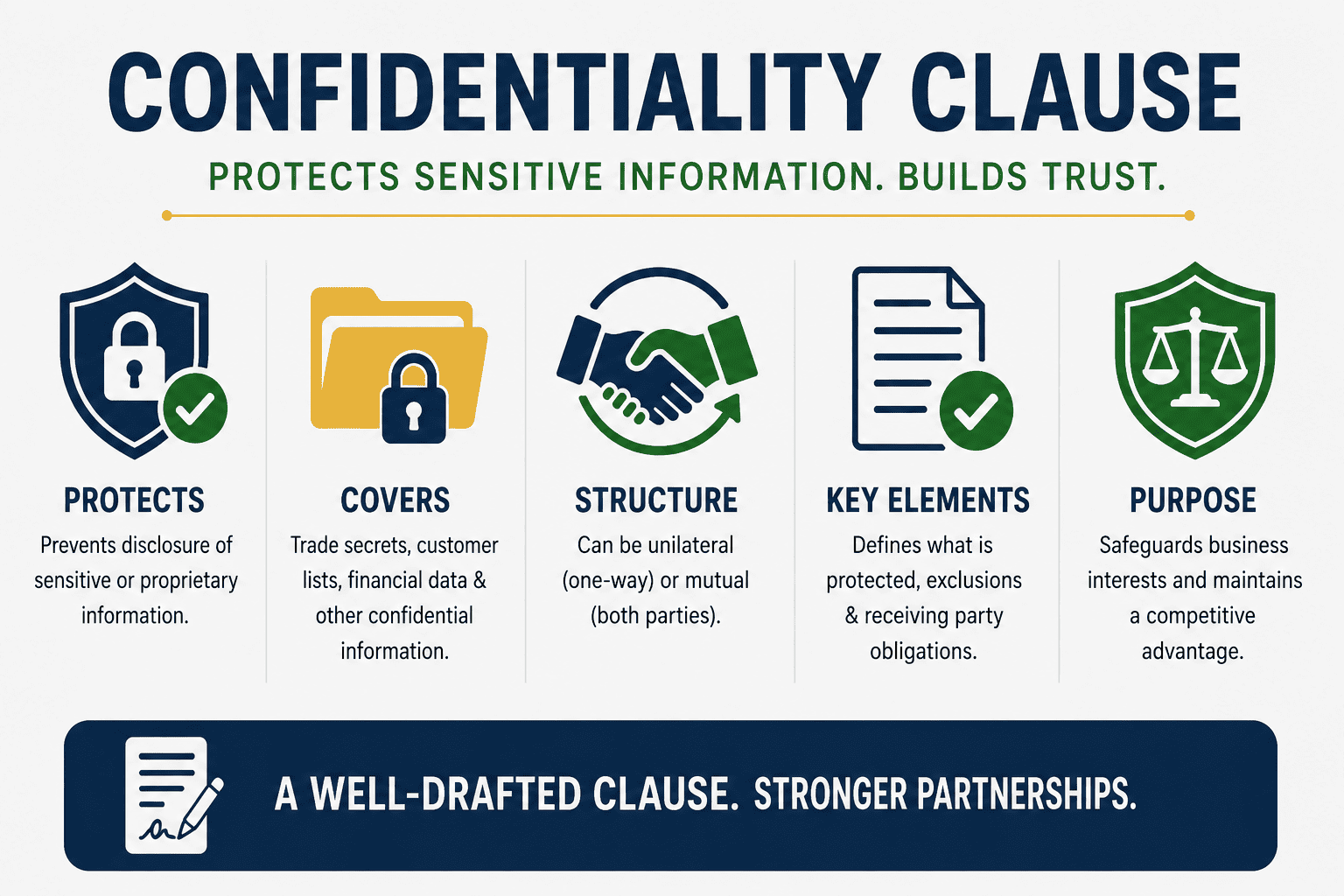
Why Confidentiality Clauses Are Critical in Commercial Contracts
Every business has information it needs to keep private, whether it’s proprietary code, client lists, pricing strategies, or trade secrets. Without a confidentiality clause, employees, partners, or contractors could share that information with competitors or the public, eroding your competitive advantage. The right confidentiality language prevents that exposure before it happens. These clauses also help businesses comply with data protection regulations, protect intellectual property, and maintain customer trust. In industries like technology, finance, and healthcare, they are non-negotiable.
📊 Key Statistic
According to the 2026 Contracting Benchmark Report, 75% of sales contracts require legal involvement, and confidentiality provisions are among the most heavily negotiated clauses. Poorly drafted clauses are frequently struck down as unenforceable, overly broad language is a primary reason.
What to Include in a Confidentiality Clause
Drafting a confidentiality clause isn’t about slapping a “do not share” label on your contract. You need to be specific about what’s protected and what isn’t. Here are the five essential components.
| Component | Description |
|---|
| Definition of Confidential Information | Clearly list specific categories like financial data, customer lists, proprietary code, marketing strategies, or trade secrets. Avoid blanket statements; precision improves enforceability. |
| Standard Exclusions & Carve-Outs | Information that is already public, independently developed, or known to the receiving party before the agreement is typically excluded from protection. |
| Obligations of the Receiving Party | Specify duties: using reasonable care to prevent unauthorized disclosure, limiting access to employees who need to know, and not using information for any purpose outside the agreement. |
| Duration & Time Limits | Specify how long the obligations last, typically 1 to 5 years. Trade secrets are often protected indefinitely. |
| Permitted Disclosures | Outline exceptions for court orders, regulatory requirements, or disclosures to legal/financial advisors, often requiring advance notice to the disclosing party. |
Unilateral vs. Mutual Confidentiality Clauses
Confidentiality clauses can be structured in two ways, depending on the flow of information between the parties. The choice affects the balance of obligations and the complexity of the drafting.
| Aspect | Unilateral (One-Sided) | Mutual (Reciprocal) |
|---|
| When Used | Only one party shares sensitive information (e.g., employer to employee, IP holder to licensee). | Both parties exchange confidential information (e.g., joint ventures, strategic partnerships). |
| Obligations | Only the receiving party is bound to maintain confidentiality. | Both parties are obligated to protect each other’s information. |
| Typical Context | Employment agreements, contractor agreements, patent applications, investor discussions. | Mergers and acquisitions, joint development agreements, complex service contracts. |
| Complexity | Simpler and shorter; focused on one party’s specific secrets. | More detailed; must balance obligations and address reciprocal risks. |
| Example Language | “The Receiving Party agrees to hold all Confidential Information in strict confidence and not to disclose such information to any third parties.” | “Each party agrees that it shall not disclose any Confidential Information of the other party to any third party and shall use it solely for the evaluation of the contemplated business relationship.” |
Common Applications
Where to Use Confidentiality Clauses
Confidentiality clauses are used in any contract that exposes employees, partners, or other parties to sensitive information. They are most effective in shorter-term contracts or for specific information with limited scope.
Employee and Contractor Agreements
Employers include confidentiality clauses in employment and contractor agreements to prevent disclosure of business plans, inventions, operation plans, pricing information, and trade secrets. These clauses often extend beyond the term of employment to protect information even after an employee leaves for a competitor.
Intellectual Property License Agreements
In IP license agreements, the IP holder (licensor) uses a unilateral confidentiality clause to limit the licensee from disclosing protected information such as accounting data, business operations, customer information, patents, trade secrets, test data, and research status.
Purchase and Sale Agreements
Sellers use confidentiality clauses in purchase and sale agreements to prevent buyers from sharing confidential information exposed during the sale process. These clauses restrict disclosure of business operations, financial data, IP, processes, and equipment.
📌 Best Practice
In high-stakes business relationships like mergers, acquisitions, or joint ventures, consider using a standalone Non-Disclosure Agreement (NDA) instead of a simple clause. NDAs provide broader scope, more detailed remedies, and can cover future unknowns that a single clause cannot address.
Enforceability & Risks
What Makes a Confidentiality Clause Unenforceable?
Just because you include a confidentiality clause in a contract doesn’t automatically mean a court will uphold it. Several common issues can render the clause ineffective right when you need it most.
⚖️
Overly Broad Language
Attempting to claim that every conversation, email, and passing thought is a protected trade secret will likely be struck down. Be realistic about what constitutes confidential information.
⚖️
Failure to Treat Information as Confidential
If you freely share your “secret” information on public forums or fail to use basic security measures, you cannot expect a court to penalize someone else for sharing it. You must protect it internally.
⚖️
Conflict with Public Policy or Whistleblower Protections
You cannot use a confidentiality clause to prevent an employee from reporting illegal activities or workplace harassment. The SEC has awarded nearly $2 billion to whistleblowers, making these protections a priority.
⚖️
No Clear Exclusions for Public Knowledge
Failing to exclude information that is already public or independently developed can make the clause overreaching and unenforceable. Standard carve-outs are essential.
Confidentiality Clause Examples
Seeing how these clauses look in practice helps you understand how the different elements come together. Here are two basic examples based on the flow of information.
📄 Unilateral Confidentiality Clause Example
Used when only one party is sharing sensitive information (e.g., employer to contractor).
“The Receiving Party agrees to hold all Confidential Information in strict confidence and not to disclose such Confidential Information to any third parties without the prior written consent of the Disclosing Party. The Receiving Party shall use the Confidential Information solely for the purpose of performing the Services outlined in this Agreement and shall protect the Confidential Information with at least the same degree of care it uses to protect its own confidential information.”
📄 Mutual Confidentiality Clause Example
Used when both parties are exchanging sensitive information (e.g., partnership discussions).
“Each party (as ‘Receiving Party’) agrees that it shall not disclose any Confidential Information of the other party (as ‘Disclosing Party’) to any third party and shall not use the Disclosing Party’s Confidential Information for any purpose other than the evaluation and execution of the business relationship contemplated by this Agreement. Both parties agree to take reasonable measures to protect the secrecy of and avoid disclosure and unauthorized use of the Confidential Information of the other party.”
Managing Confidentiality Clauses at Scale
Best Practices for Managing Confidentiality Clauses
As your company grows, managing confidentiality clauses across hundreds or thousands of agreements becomes a significant operational challenge. Many legal teams still write clauses from scratch or hunt through shared drives for templates, this inefficiency costs companies an average of 9.2% of contract value. Modern Contract Lifecycle Management (CLM) platforms include template libraries and clause management tools that allow legal teams to standardize confidentiality language once and apply it consistently across every contract. This reduces review time, ensures compliance, and accelerates deal execution.
1
Standardize Core Language
Define a baseline confidentiality clause with clear definitions, exclusions, and obligations. Use this template consistently for all low-risk agreements.
2
Use a Clause Library
Maintain a central repository of approved confidentiality clauses for different scenarios, unilateral, mutual, high-risk, and short-term. This ensures consistency and reduces drafting errors.
3
Automate Review and Extraction
Use AI-powered contract analysis tools to instantly extract and review confidentiality provisions in incoming agreements. This speeds up legal review and identifies non-standard language.
4
Train Teams on Exceptions
Ensure procurement, sales, and legal teams understand which agreements require mutual clauses, when to carve out whistleblower protections, and how to handle requests for sharing information.
5
Monitor Survival and Expiry
Track the duration of confidentiality obligations across your contract portfolio. Set reminders for renegotiation or for when obligations expire, especially for trade secrets that need indefinite protection.
Contractual Context
Key Contractual Clauses Related to Confidentiality
Confidentiality clauses interact with other important provisions in a contract. Understanding these relationships is essential for drafting a cohesive agreement.
| Clause | How It Relates to Confidentiality |
|---|
| Master Services Agreement (MSA) | Confidentiality is a core component of any MSA, defining how information shared during the service engagement will be protected. |
| Indemnification Clause | Breach of confidentiality often triggers indemnification obligations, requiring the breaching party to cover losses arising from the disclosure. |
| Breach of Contract | Unauthorized disclosure of confidential information is a classic breach, with remedies including damages, injunctive relief, and termination. |
| Material Breach | Depending on the contract, a serious confidentiality breach may be defined as a material breach, allowing the non-breaching party to terminate the agreement. |
| Consequential Damages | Many contracts exclude consequential damages, but breach of confidentiality is often carved out from this exclusion because the harm (e.g., loss of trade secrets) is inherently indirect. |
| Exclusivity Clause | May include confidentiality obligations to protect the exclusive relationship and prevent the sharing of sensitive information with competitors. |
| Warranty Clause | May include a warranty that the disclosing party has the right to share the information and that it is not subject to conflicting confidentiality obligations. |
| Termination for Convenience | Survival of confidentiality obligations after termination is a critical provision, these obligations often continue beyond the contract’s end. |
FAQ
Frequently Asked Questions About Confidentiality Clauses
QWhat is a confidentiality clause?
A confidentiality clause is a contractual provision that prevents signing parties from disclosing sensitive or proprietary information to the public, competitors, or other external parties. It protects trade secrets, financial data, customer lists, and other confidential business information. The scope varies by industry and relationship, and the clause can be unilateral (one party) or mutual (both parties).
QWhat are the key components of a confidentiality clause?
Every confidentiality clause should include: (1) a clear definition of what qualifies as confidential information, (2) standard exclusions for public knowledge and independent development, (3) specific obligations of the receiving party (e.g., reasonable care, access limitation), (4) explicit time limits for protection duration, and (5) permitted disclosures for legally required sharing (e.g., court orders, regulatory requirements).
QWhat is the difference between a confidentiality clause and an NDA?
A confidentiality clause is a single provision within a larger contract (e.g., an employment agreement or service contract). A Non-Disclosure Agreement (NDA) is a standalone, separate contract. NDAs are used in high-stakes relationships like mergers, acquisitions, or joint ventures where broader scope, more detailed remedies, and protection for future unknowns are needed. NDAs are more flexible and comprehensive than a simple clause.
QWhat makes a confidentiality clause unenforceable?
Common reasons include: overly broad definitions that claim everything is confidential, failure to treat the information as confidential internally (e.g., sharing it publicly), conflicts with public policy or whistleblower protections (you cannot prevent reporting of illegal activities), and lack of clear exclusions for public knowledge or independently developed information. Courts will strike down clauses that are unreasonable or overreaching.
QDoes a confidentiality clause survive contract termination?
Yes, unless the contract explicitly states otherwise. Confidentiality obligations almost always survive termination or expiration of the main agreement. The survival period is typically specified in the clause (e.g., “for a period of three years after termination”). Trade secrets are often protected indefinitely, while other information may have a defined time limit (1-5 years).
QCan a confidentiality clause be mutual?
Yes, a mutual (or reciprocal) confidentiality clause applies to both signing parties. This is common in joint ventures, strategic partnerships, and complex service agreements where both parties exchange sensitive information. Mutual clauses create symmetrical obligations, each party must protect the other’s confidential information with the same degree of care.