How to Expand Your Manufacturing & Industrial Automation Business to Hong Kong
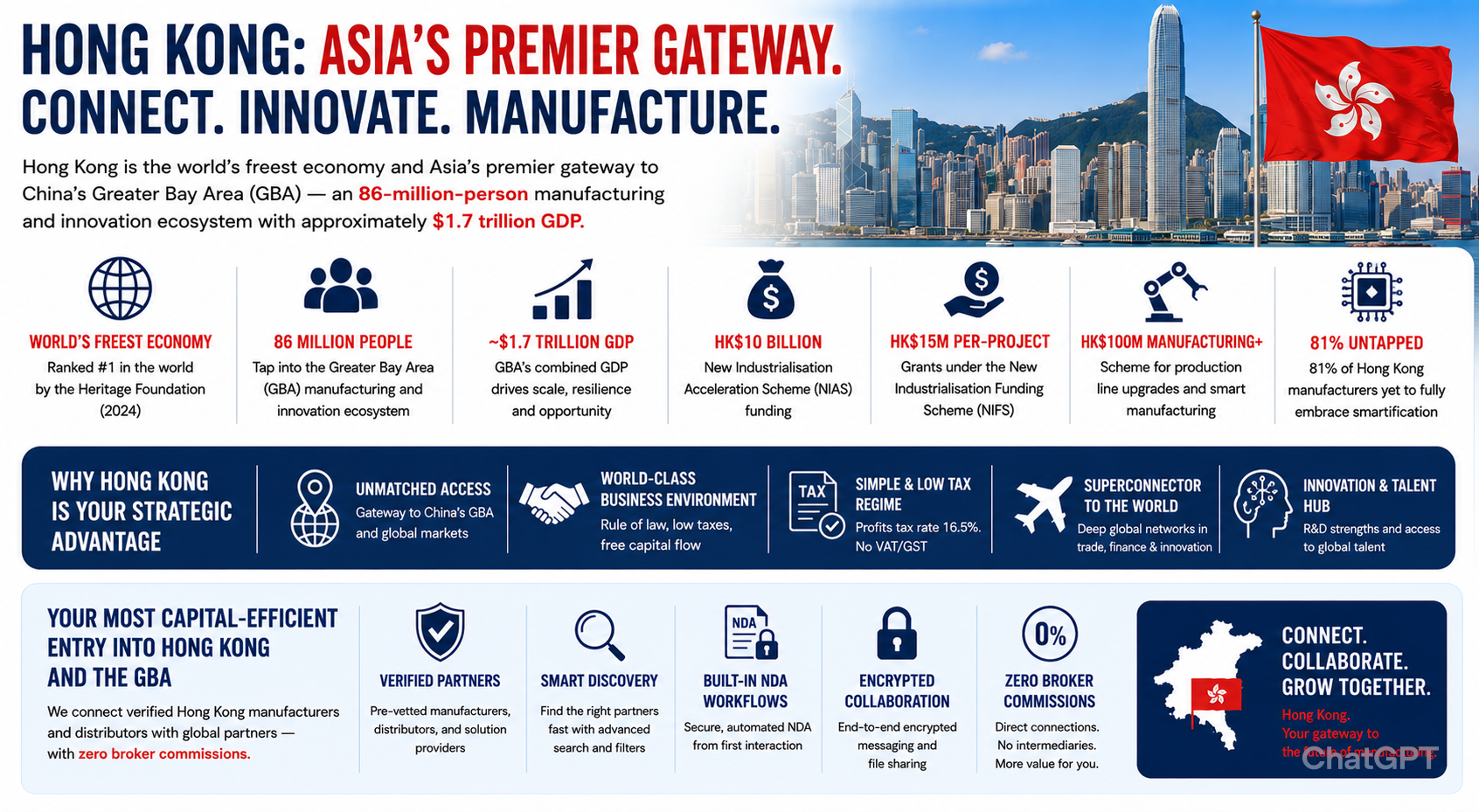
Direct Answer: Hong Kong is the world’s freest economy and Asia’s premier gateway to China’s Greater Bay Area (GBA), an 86-million-person manufacturing and innovation ecosystem with approximately $1.7 trillion GDP. The HKSAR Government’s New Industrialisation strategy provides HK$10 billion in New Industrialisation Acceleration Scheme (NIAS) funding, HK$15M per-project grants under NIFS, and a HK$100M Manufacturing+ scheme for production line upgrades. With 81% of Hong Kong manufacturers yet to fully embrace smartification, the automation opportunity is structural and expanding. GTsetu connects verified Hong Kong manufacturers and distributors with global partners, with zero broker commissions.
📅 May 5, 2026⏱ 20 min read✍️ GT Setu Editorial Team🔄 Updated regularly
HK$10B
NIAS Smart Manufacturing Fund
81%
Manufacturers Yet to Fully Smartify
$1.7T
GBA GDP, HK Gateway
0%
GTsetu Broker Commission
Hong Kong occupies a position in the global manufacturing and industrial automation landscape that no other city can replicate. As a Special Administrative Region of China operating under “One Country, Two Systems,” it simultaneously offers the world’s freest economy, a common law legal system aligned with international commercial practice, zero import tariffs on virtually all industrial goods, and the most direct gateway into China’s $1.7 trillion Greater Bay Area (GBA) manufacturing ecosystem, the world’s densest concentration of industrial manufacturing capability within a single contiguous urban-industrial zone.
For international manufacturing and industrial automation companies, Hong Kong in 2026 presents a dual opportunity. The first is Hong Kong itself: the HKSAR Government’s New Industrialisation strategy has committed HK$10 billion in NIAS funding for smart manufacturing companies in life and health technology, AI and data science, and advanced manufacturing. An HKPC study with Deloitte found that 81% of Hong Kong manufacturers have yet to fully embrace smartification, representing a massive greenfield automation adoption opportunity. The second is the GBA: Hong Kong’s CEPA arrangement provides preferential access to mainland China, making a Hong Kong entity the most commercially accessible entry point for companies targeting both the HK market and the Pearl River Delta’s 50+ million industrial workers. This guide covers everything you need to know to expand successfully, from funding schemes through to partner discovery and commercial structure. See also our guides on expanding to China and global expansion strategy.
🇭🇰 Who Is This Guide For?
This guide is written for international manufacturers, industrial automation OEMs, robotics companies, smart factory solution providers, and technology integrators seeking to enter or expand in Hong Kong, whether through a distributor partnership, technology licensing, joint venture, or direct entity establishment. It is also written for companies targeting the Greater Bay Area who want to use Hong Kong as their most commercially accessible China market gateway. If you are evaluating multiple Asia-Pacific markets alongside Hong Kong, see our companion guides: Taiwan, Vietnam, India, and Germany.
SECTION 1
1 Why Hong Kong for Manufacturing & Industrial Automation?
🎯 The Strategic Case
Hong Kong offers a combination of commercial advantages that is genuinely unique in Asia: zero import tariffs on virtually all industrial goods (one of only a handful of free ports globally), a common law legal system providing contract enforcement predictability aligned with international commercial standards, a government actively funding smart manufacturing adoption with HK$10B in NIAS and HK$15M per-project NIFS grants, and, critically, a direct gateway into the Greater Bay Area through CEPA arrangements that give Hong Kong-established companies preferential access to mainland China’s manufacturing economy. For industrial automation companies, the combination of a domestic market with 81% of manufacturers yet to fully adopt smart technologies, and a GBA hinterland of 50+ million industrial workers producing $1.7 trillion in annual output, creates a layered opportunity that few Asia-Pacific markets can match.
81%
of Hong Kong manufacturers have yet to fully embrace smartification, HKPC/Deloitte Manufacturing Development Study 2024
HK$200M
maximum NIAS funding per enterprise for smart manufacturing in life and health technology, AI, and advanced manufacturing
70%
of Hong Kong enterprises recognise the need to shift towards diverse, smaller-quantity production, driving automation investment demand
🆓
World’s Freest Economy & Zero Import Tariffs
Hong Kong is consistently rated the world’s freest economy (Heritage Foundation) and maintains 0% import tariff on virtually all goods, including industrial automation equipment. No VAT on most transactions. This makes Hong Kong one of the most cost-effective markets in the world for importing and distributing automation technology.
⚖️
Common Law Legal System
Hong Kong’s English common law system, independent from the Mainland Chinese legal system under “One Country, Two Systems”, provides internationally trusted contract enforcement, IP protection, and dispute resolution. It is the preferred governing law jurisdiction for cross-border commercial agreements in the GBA and broader Asia-Pacific region.
🇨🇳
CEPA, Preferential GBA Access
The Closer Economic Partnership Arrangement (CEPA) allows goods substantially manufactured in Hong Kong to enter mainland China with zero tariff. For automation technology companies, this means a Hong Kong entity can access China’s $4.2 trillion manufacturing economy with preferential commercial treatment unavailable to companies operating from other jurisdictions.
💰
Low Tax Environment
Hong Kong’s corporate profits tax is 16.5% (8.25% on the first HK$2M of assessable profits for qualifying corporations). No capital gains tax, no VAT, no withholding tax on dividends. For manufacturing and technology companies, a 300% enhanced tax deduction on qualifying R&D expenditure further improves the effective tax position.
🤖
Government-Funded Smart Manufacturing Push
The HK$10B NIAS and HK$15M per-project NIFS grants directly subsidise smart manufacturing adoption by Hong Kong companies, creating immediately fundable demand for automation solutions. The HK$100M Manufacturing+ scheme specifically targets production line upgrades for SMEs, expanding the addressable market to smaller manufacturers.
🌏
Asia-Pacific Hub for Regional Distribution
Hong Kong is the world’s third-largest trading economy per capita and maintains preferential FTA relationships across Asia. For automation companies serving Southeast Asian, Japanese, Korean, and Chinese clients, a Hong Kong distribution entity provides optimal logistics, financial, and legal infrastructure for multi-market Asia distribution strategies.
SECTION 2
2 Hong Kong Industrial Automation Market: Size & Growth 2026
Hong Kong’s industrial automation market is smaller in absolute size than neighbouring China, but structurally distinct in its characteristics: a high-income market with 0% import tariffs on automation equipment, government-funded adoption incentives, a concentration of high-value-added manufacturing (electronics, precision instruments, TCM/pharmaceuticals, apparel, and printing), and a growing role as the smart manufacturing demonstration and innovation hub for the broader Greater Bay Area ecosystem.
Research Source
Market Scope
Current Status
Key Growth Driver
6W Research
Hong Kong Industrial Automation Market
Growing market with strong government policy tailwind
New Industrialisation strategy, NIFS/NIAS funding, GBA integration
HKPC / Deloitte (2024)
Hong Kong Manufacturing Smartification
81% of manufacturers yet to fully embrace smartification
Massive greenfield automation demand from legacy manufacturers
Direct government co-investment in production line automation
OpenGov Asia / HKPC (Nov 2025)
Smart Manufacturing Adoption
New funding measures announced, larger projects and broader SME coverage
Expanded funding scope to cover large-scale industrial projects
The most commercially significant market intelligence for international automation companies: the HKPC/Deloitte 2024 study reveals that 81% of Hong Kong manufacturers have not yet fully implemented smart manufacturing technologies. With government funding schemes actively subsidising automation adoption on a 1:2 matching basis, the primary market constraint is not capital availability, it is the supply of qualified automation technology providers who can deliver appropriate smart manufacturing solutions to Hong Kong’s manufacturing base. For international automation companies with proven Industry 4.0 solutions, this represents a government-co-funded demand pipeline that most other Asian markets cannot match.
Key Market Drivers for International Automation Companies
🏛️
HK$10 Billion NIAS & HK$15M NIFS Grants
The New Industrialisation Acceleration Scheme (HK$200M max per enterprise) and New Industrialisation Funding Scheme (HK$15M max per project, 1:2 matching) directly co-fund smart production line establishment, creating immediately accessible, government-subsidised demand for automation solutions in Hong Kong’s manufacturing sector.
Policy Driver
🤖
81% Manufacturer Smartification Gap
With 81% of Hong Kong manufacturers yet to fully adopt smart manufacturing technologies, the greenfield automation demand opportunity is structural and multi-year. Unlike markets where automation adoption is already advanced (Japan, Germany), Hong Kong’s manufacturing base is at an early stage of its Industry 4.0 transition, meaning the adoption curve has decades of growth ahead.
Demand Driver
📦
Customisation & Small Batch Production Shift
70% of Hong Kong enterprises report customer demand for diverse, smaller-quantity production, a trend that cannot be met cost-effectively with manual processes. Flexible automation, collaborative robots, and smart production management systems are specifically suited to this demand profile, creating pull-through from market forces rather than just government incentives.
Market Driver
♻️
Sustainability & ESG Compliance Requirements
Over 65% of Hong Kong manufacturing companies have received customer requests to incorporate sustainable development standards into their production processes. Energy management systems, carbon monitoring, waste reduction automation, and green manufacturing intelligence platforms are all growing demand categories driven by ESG compliance requirements from international buyers.
ESG Driver
🇨🇳
GBA Integration, Serving the Pearl River Delta
Hong Kong’s growing integration with the Greater Bay Area creates demand for cross-border manufacturing management systems, remote factory monitoring, supply chain visibility platforms, and automation solutions that can bridge Hong Kong’s advanced service infrastructure with GBA’s manufacturing scale, a market segment unique to Hong Kong’s geography and legal position.
GBA Driver
💡
Innovation & Technology Ecosystem
Hong Kong’s five government R&D centres, HKPC’s Fraunhofer-partnership Industry 4.0 Hatch programme, five world-class universities, and InnoHK research clusters create a technology co-development ecosystem for international automation companies seeking to develop or adapt solutions for Hong Kong and GBA manufacturing applications.
Innovation Driver
SECTION 3
3 High-Demand Sectors for Industrial Automation in Hong Kong
Hong Kong’s manufacturing base is smaller but more specialised than neighbouring GBA cities, concentrated in high-value-added sectors where the combination of design sophistication, quality standards, brand requirements, and export market compliance creates strong pull for precision automation over mass-production automation.
💊NIAS Priority Sector
Life & Health Technology Manufacturing
One of three NIAS priority sectors, life and health technology manufacturing includes pharmaceuticals, Traditional Chinese Medicine (TCM), medical devices, and health food products. HKPC has specific automation programmes for TCM and pharmaceutical manufacturing. International food safety, GMP, and medical device regulatory compliance requirements are driving process automation, serialisation, and quality management system investment.
Key demand: GMP process automation, TCM extraction/packaging lines, medical device assembly, serialisation, QMS
🤖NIAS Priority Sector
AI, Data Science & Advanced Electronics
The second NIAS priority, AI and data science manufacturing includes smart electronics production, precision components manufacturing, and the local assembly of AI hardware. Hong Kong’s strengths in electronics design and testing, combined with GBA manufacturing integration, create demand for automated PCB assembly, vision inspection, yield management systems, and AI-driven quality analytics platforms.
The third NIAS priority, advanced manufacturing and new energy includes EV component manufacturing, battery technology production, precision engineering, and smart energy systems. Hong Kong is positioning itself as a new energy technology demonstration hub, creating demand for battery assembly automation, precision CNC systems, and energy management platforms.
Key demand: battery assembly automation, precision CNC, EV component manufacturing, energy management systems
🧵Legacy Modernisation
Apparel, Textiles & Fashion Technology
Hong Kong’s apparel and fashion industry, historically a major part of its manufacturing base, is undergoing transformation through smart manufacturing, mass customisation, and sustainable production. Garment manufacturers are using NIFS to set up digital knitting and cutting systems, RFID tracking, and lean manufacturing automation for the small-batch, high-variety production model demanded by global fashion brands.
Key demand: digital knitting/cutting, RFID tracking, small-batch flexible automation, sustainable production monitoring
🖨️High Adoption Readiness
Printing & Publishing Technology
Hong Kong’s printing and packaging industry, serving premium international brands, is one of the earliest adopters of automation technology in the city’s manufacturing base. Demand focuses on automated pre-press systems, digital inkjet manufacturing, colour management, and integrated print-pack finishing lines for high-value speciality packaging.
Key demand: automated pre-press, digital inkjet printing, colour management systems, finishing line automation
💎Premium Segment
Jewellery & Precision Manufacturing
Hong Kong is the world’s third-largest jewellery trading centre, with a significant local jewellery manufacturing cluster. Precision automation, CNC micro-machining, laser welding, quality inspection, and 3D additive manufacturing, is transforming jewellery production from fully manual to hybrid smart manufacturing. This is a high-value, technically demanding automation segment suited to specialist automation providers.
Hong Kong’s dense urban environment and ambitious smart city programme are driving demand for building management automation, smart energy management, intelligent transportation systems, and integrated infrastructure monitoring. This sector sits at the intersection of industrial automation and urban technology, growing as Hong Kong expands its smart city infrastructure investments.
Key demand: BMS automation, smart energy management, predictive maintenance for urban infrastructure, IoT integration
📦Logistics Hub
Logistics & Port Automation
Hong Kong International Airport (world’s busiest air cargo hub) and Kwai Tsing Container Terminal (one of Asia’s largest) are significant logistics automation markets. Automated storage, cargo handling, vehicle dispatch, and port management systems represent a large-scale, ongoing procurement pipeline for automation technology providers.
Key demand: cargo handling automation, AS/RS for air freight, port terminal management, vehicle dispatch systems
SECTION 4
4 Hong Kong as the GBA Gateway: The China Opportunity
🎯 The GBA Opportunity
China’s Guangdong-Hong Kong-Macao Greater Bay Area (GBA) is a manufacturing and innovation cluster of 86 million people and approximately $1.7 trillion GDP, including some of the world’s most important industrial cities: Shenzhen (electronics and precision manufacturing), Guangzhou (automotive and consumer goods), Dongguan (furniture, textiles, and consumer electronics), and Foshan (appliances and ceramics). Hong Kong, positioned at the southern tip of the GBA, provides the most commercially accessible entry point into this ecosystem for international companies, combining mainland China’s manufacturing scale with Hong Kong’s transparent legal system, English-language commercial environment, and internationally trusted financial infrastructure.
For international industrial automation companies, the GBA gateway opportunity operates on multiple levels. First, Hong Kong-based distributors and system integrators frequently serve GBA manufacturers as their primary customer base, meaning a Hong Kong distribution partnership provides automatic reach into the Pearl River Delta manufacturing ecosystem. Second, the CEPA arrangement allows goods substantially manufactured in Hong Kong to enter mainland China at zero tariff, relevant for automation companies considering local assembly in Hong Kong for China distribution. Third, cooperation zones specifically designed to facilitate cross-border Hong Kong-Shenzhen technology projects, including the Qianhai area and the Hetao Shenzhen-Hong Kong Science and Technology Innovation Cooperation Zone, provide structured mechanisms for co-development and technology transfer between Hong Kong and mainland Chinese partners. See our companion guide on expanding to China’s manufacturing market for the mainland-specific entry framework.
GBA City
Manufacturing Strength
Automation Demand Profile
Hong Kong Entry Advantage
Shenzhen
Electronics, EV manufacturing, precision components, robotics
High-end SMT automation, AGVs, EV battery assembly, AI quality inspection
CEPA zero tariff; Qianhai/Hetao cross-border zone; Shenzhen Bay crossing proximity
Foshan manufacturers increasingly adopting HK legal and financial structures for international export
Zhuhai
Aerospace components, games technology, pharmaceutical
Precision assembly, cleanroom automation, traceability systems
Proximity to HK-Zhuhai-Macao Bridge corridor; CEPA access for HK-origin technology
💡 The GBA Strategy Principle for Automation Companies
The most commercially effective GBA entry strategy for international automation companies is a two-stage approach: establish a Hong Kong entity first (2–4 weeks, minimal capital requirement, common law legal protection, zero import tariffs) to build local market presence and validate the GBA opportunity. Then, use the Hong Kong entity as the holding and IP structure for any GBA mainland operations, maintaining Hong Kong’s legal clarity while accessing China’s manufacturing scale. HKPC actively supports this model and provides specific assistance for companies implementing cross-border GBA manufacturing management.
SECTION 5
5 Market Entry Models: Choosing the Right Approach
Hong Kong offers some of the fastest and least capital-intensive market entry options in Asia. Company formation typically takes 3–5 working days, costs are minimal, and there are no foreign ownership restrictions in most commercial activities. Here is the complete entry model menu for manufacturing and industrial automation companies.
Entry Model
How It Works
Capital Required
Time to Revenue
Best For
Key Reference
HK Distributor / Channel Partner
Appoint a verified Hong Kong company to import, stock, sell, and support your products across HK and GBA
Very Low
2–6 months
Industrial automation hardware, sensors, PLCs, SCADA, fastest HK market validation with minimal capital
Establish a smart production line in Hong Kong, qualifying for 1:2 matching NIFS grants (up to HK$15M) or NIAS funding (up to HK$200M)
Moderate (matched 2:1 by government)
6–18 months (qualification + construction)
Automation companies with technology qualifying for NIAS priority sectors (life and health, AI/data science, advanced manufacturing); CEPA export to China
Unlike most markets where full entity establishment follows market validation, for Hong Kong we recommend incorporating an HK Private Limited Company relatively early in your market entry process, even before appointing a distributor. The reasons are practical: (1) NIAS and NIFS funding eligibility requires the technology provider or production partner to be a Hong Kong-incorporated company. (2) CEPA benefits for mainland China export require Hong Kong-origin certification from a HK-incorporated entity. (3) HK company formation takes 3–5 working days and costs less than USD 500, the opportunity cost of delay is high relative to the setup cost. Incorporate early; the HK entity becomes both your trading vehicle and your GBA access structure.
SECTION 6
6 New Industrialisation Strategy: NIFS, NIAS & Manufacturing+ Funding
🏛️ Funding Framework Overview
Hong Kong’s New Industrialisation funding framework is the most directly commercially accessible government manufacturing co-investment programme in Asia for international automation technology companies. Unlike production-linked incentives in India or free zone incentives in the UAE, which primarily benefit manufacturers, Hong Kong’s NIFS and NIAS schemes directly fund the technology adoption side of smart manufacturing: paying one-third of the cost of setting up smart production lines, with the technology provider receiving payment for their automation solutions from a government-co-funded project. Understanding these schemes is essential for any automation company entering Hong Kong.
Scheme
Funding Model
Maximum Grant
Eligible Applicants
Priority Areas
Administered By
NIFS (New Industrialisation Funding Scheme)
1 (Government) : 2 (Company) matching, government pays one-third of approved project cost
HK$15M per project; HK$45M total (3 projects max)
Companies incorporated in HK under Companies Ordinance (Cap. 622)
All smart manufacturing sectors, entire or significant portion of production line must meet smart manufacturing criteria
Innovation and Technology Fund (ITF) / HKPC support for applications
NIAS (New Industrialisation Acceleration Scheme)
Direct funding support (not matching) for priority sector smart production facilities
HK$200M per enterprise (2 projects max)
Enterprises in life and health technology, AI and data science, and advanced manufacturing and new energy technologies
Three NIAS priority sectors only, life/health tech, AI/data science, advanced manufacturing/new energy
Innovation and Technology Fund (ITF), launched September 2024
Manufacturing+ (Pilot Scheme)
HK$100M total scheme budget, subsidies for SME production line upgrades
Per-company limits set by scheme guidelines
SMEs upgrading existing production lines to smart manufacturing
Production line upgrade and smartification for existing HK manufacturers, broader sector scope than NIAS
Administered through HKPC one-stop application support
R&D Tax Deduction (Enhanced)
300% first HK$2M + 200% on additional qualifying R&D expenditure deductible from profits
No cap, tied to actual qualifying R&D expenditure
All HK-incorporated companies conducting qualifying R&D in HK
All sectors, covers software development, system integration R&D, AI model training for manufacturing applications
Inland Revenue Department, claimed via profits tax return
Technology Voucher Programme (TVP)
Cumulative funding cap of HK$600,000 for technology service or solution acquisition
HK$600,000 per company (6:1 government funding; company contributes 25%)
All HK-registered non-listed companies and organisations
Acquiring technology services/solutions to improve productivity, includes automation, ERP, IoT integration
HKPC, Technology Voucher Programme Secretariat
🇭🇰 How NIFS/NIAS Creates Direct Revenue for Automation Companies
When a Hong Kong manufacturer applies for NIFS funding to set up a smart production line, the automation technology provider selected to supply and integrate the production line is paid from a project budget one-third funded by the government. This means: (1) The buyer’s effective cost of your automation solution is reduced by 33%, significantly improving the procurement decision economics. (2) Project budgets are larger than they would otherwise be, NIFS-funded projects typically have budgets 30–50% higher than self-funded equivalents. (3) The application process creates structured, documented procurement requirements, providing qualified tender opportunities for automation companies with demonstrated solutions meeting HKPC’s smart manufacturing criteria. To access this pipeline, register your company and solutions with HKPC’s New Industrialisation team and the Future Manufacturing Hall, where HK manufacturers are actively matched with technology providers.
SECTION 7
7 Regulatory & Compliance Requirements for Entry
Hong Kong has one of the simplest regulatory environments in Asia for foreign businesses, the World Bank consistently ranks it in the global top 5 for ease of doing business. For manufacturing and industrial automation companies, the key compliance requirements are minimal compared to most other Asian markets.
01
Business Registration & Company Incorporation
All businesses operating in Hong Kong require Business Registration under the Business Registration Ordinance (Cap. 310), obtainable simultaneously with company incorporation in 3–5 working days via the Companies Registry. Hong Kong Private Limited Companies require a minimum of one director (any nationality), one shareholder, and a registered HK address. No local director requirement. No minimum paid-up capital (HK$1 is technically sufficient, though HK$10,000–100,000 is standard commercial practice). The One-Stop Company Registration and Business Registration Service handles both applications simultaneously. There is no government approval required for foreign investment in most commercial and manufacturing activities. Annual renewal of Business Registration is required (HK$2,000 fee).
02
Tax Registration & Profits Tax
Hong Kong uses a territorial tax system, only profits arising in or derived from Hong Kong are taxable. Hong Kong Profits Tax applies at 16.5% on assessable profits (8.25% on the first HK$2M for qualifying corporations). There is no capital gains tax, no VAT, no withholding tax on dividends. R&D expenditure qualifying under the Inland Revenue Ordinance benefits from a 300% enhanced deduction on the first HK$2M and 200% on additional expenditure, making Hong Kong one of the world’s most generous R&D tax environments. Tax registration is automatic upon Business Registration; profits tax returns are filed annually with the Inland Revenue Department. For automation companies with significant global revenue, transfer pricing documentation and substance requirements apply under Hong Kong’s Base Erosion and Profit Shifting (BEPS) compliance framework.
03
Product Safety Compliance
Hong Kong has no general product certification system equivalent to ESMA (UAE) or BIS (India). Product safety is primarily governed by the Consumer Goods Safety Ordinance (Cap. 456), which requires goods supplied in Hong Kong to be reasonably safe under normal use. Electrical products are subject to the Electricity Ordinance (Cap. 406) and require compliance with relevant technical standards (IEC standards generally accepted). For industrial automation products, PLCs, drives, sensors, industrial computers, CE marking (European standard) is widely accepted as evidence of safety compliance and is the most common approach used by international automation companies. There is no mandatory pre-market approval process for most industrial automation products, significantly simplifying market entry compared to markets with mandatory pre-certification requirements.
04
Factory Registration (if Manufacturing in HK)
Companies establishing manufacturing operations in Hong Kong must register under the Factories and Industrial Undertakings Ordinance (Cap. 59), registration with the Labour Department is required before commencing production. Factory registration is straightforward and does not require prior government approval for most manufacturing activities. Environmental permits are required for manufacturing operations with defined noise, air emission, or effluent outputs, the Environmental Protection Department (EPD) administers these. For NIFS/NIAS applications, factory registration and the associated environmental permits are prerequisites, ensuring all manufacturing complies with HK’s stringent environmental standards.
05
Import/Export & Strategic Trade Controls
Hong Kong maintains 0% tariffs on virtually all imports, no customs duties on industrial automation equipment, sensors, robots, or control systems. Import/export declarations are required under the Import and Export Ordinance (Cap. 60) for most goods, but this is an administrative process not an approval requirement. Strategic trade controls, under the Import and Export (Strategic Commodities) Regulations, apply to dual-use goods including some advanced automation technology components (encryption, high-performance computing, certain sensors). For automation companies whose products contain controlled technology, an assessment of Hong Kong’s strategic trade control classification should be conducted before market entry to identify any licence requirements for export to third countries via Hong Kong.
06
IP Protection in Hong Kong
Hong Kong provides robust IP protection under the Intellectual Property Department, patents (standard patents derived from UK/China/European patents; short-term patents available in HK), registered trademarks, registered designs, and copyright. Filing a Hong Kong standard patent based on an existing granted patent in the UK, Europe, or China is administratively straightforward. For automation companies, filing HK trademarks and relevant patent protection before market entry and before NIFS/NIAS applications is strongly recommended, these are valuable IP assets in the context of technology licensing to HK manufacturers and CEPA access to mainland China. Understand IP ownership frameworks before entering any HK co-development or manufacturing partnership. Execute mutual NDAs before sharing proprietary technology details with any HK partner.
SECTION 8
8 Finding a Verified Hong Kong Distribution or Technology Partner
For most international industrial automation companies entering Hong Kong, finding the right Hong Kong partner, a distributor, system integrator, NIFS project partner, or technology licensor, is the most commercially consequential early decision. Hong Kong’s industrial distribution ecosystem is highly developed, with well-established distributors serving both the local HK market and their GBA manufacturing customer bases. Quality and specialisation vary significantly, verification and qualification are essential.
What to Look for in a Hong Kong Industrial Automation Partner
✅
Verified Business Identity
HK Companies Registry registration, Business Registration Certificate, and any relevant sector certifications or HKPC accreditations. GTsetu verifies all of these before any HK company appears in the network. See business verification requirements.
🇨🇳
GBA Customer Network
The most valuable HK industrial automation distributors typically serve both HK-based manufacturers and GBA manufacturers in the Pearl River Delta. A partner with established customer relationships in Shenzhen, Dongguan, or Guangzhou multiplies your effective market reach significantly beyond HK’s relatively small local manufacturing base.
🏛️
NIFS/NIAS Project Experience
Has the partner successfully managed NIFS or NIAS funding applications with their customers? Experience navigating the ITF application process, meeting HKPC’s smart manufacturing criteria, and delivering against NIFS project milestones significantly improves the probability of successfully accessing government co-funded automation projects.
⚡
Technical Engineering Depth
HK industrial automation buyers, particularly in NIAS priority sectors, require deep technical application support. Does the partner have qualified engineers with your technology certifications who can design, commission, and support smart production line projects? NIFS-funded projects have specific documentation and validation requirements that demand technically capable implementation partners.
🏭
HKPC Relationship & Accreditation
HKPC is the primary intermediary between HK manufacturers and automation technology providers for NIFS/NIAS projects. Partners with established HKPC relationships, recognition in the Industry 4.0 Upgrade and Recognition Programme, or participation in the Future Manufacturing Hall ecosystem have preferential access to HKPC-facilitated project introductions.
🔐
IP & Confidentiality Standards
Hong Kong’s IP framework is among Asia’s strongest, but for automation companies sharing proprietary algorithms, software, or hardware designs with HK partners, execute a mutual NDA governed by HK law before any sensitive technical disclosure. Use encrypted channels for all sensitive data exchange, see B2B secure collaboration standards.
Channels for Finding Verified Hong Kong Partners
💻
GTsetu Verified B2B Platform
GTsetu provides access to compliance-verified HK manufacturers, distributors, system integrators, and technology companies, with anonymous discovery, built-in NDA workflow, and encrypted collaboration. Zero broker commissions. The most efficient and secure channel for verified HK partner discovery. Compare with alternatives to Alibaba for open marketplace comparisons.
Best for Verified Discovery
🏛️
HKPC New Industrialisation Team
The Hong Kong Productivity Council actively facilitates introductions between international technology providers and HK manufacturers seeking NIFS/NIAS eligible automation solutions. HKPC’s Future Manufacturing Hall events, Industry 4.0 Upgrade and Recognition Programme, and New Industrialisation one-stop services are the primary official pathway for technology provider introductions in HK’s smart manufacturing ecosystem.
Government Channel
🎪
Hong Kong Trade Shows
HKTDC Electronics Asia, Smart Manufacturing Expo HK, electronicAsia, and Automechanika Hong Kong are the primary sector events for meeting HK industrial partners. The HKTDC (Hong Kong Trade Development Council) also hosts business matching services for international companies entering HK. See our guide on top B2B networking places for manufacturers and distributors.
In-Person Channel
🏢
Bilateral Chambers of Commerce
The German-Hong Kong Chamber (GAHK), British Chamber of Commerce in HK (BritCham), American Chamber of Commerce HK (AmCham), and the Chinese Manufacturers’ Association (CMA) maintain directories of HK industrial companies and facilitate international technology partnership introductions.
Community Channel
🔬
InnoHK & University Technology Transfer
Hong Kong’s five government-sponsored InnoHK research clusters and five major universities (HKU, HKUST, CUHK, PolyU, CityU) have active technology transfer and industry collaboration programmes. For automation companies with academic-grade technology seeking commercialisation in HK and GBA, these channels provide structured co-development and pilot project opportunities.
Innovation Channel
SECTION 9
9 Step-by-Step Hong Kong Market Entry Roadmap
01
NIAS/NIFS Alignment Assessment, Does Your Solution Qualify?
Before beginning partner discovery, assess whether your automation solutions qualify for NIAS or NIFS funding, this dramatically shapes your Hong Kong market entry strategy. NIAS eligibility requires your technology to fall within life and health technology, AI and data science, or advanced manufacturing and new energy categories. NIFS eligibility is broader, applying to most smart manufacturing solutions that enable significant automation of production processes. HKPC’s New Industrialisation team provides free preliminary assessments of solution eligibility, contact them early. If your solution qualifies for NIAS, you are entering a HK$10 billion government-funded market with direct procurement pipeline access. If not, you access the broader NIFS-funded market and the open commercial HK industrial automation market.
02
HK Company Incorporation, Early and Fast
Incorporate a Hong Kong Private Limited Company early in your market entry process, before appointing a distributor or approaching NIFS manufacturers. As noted above, HK incorporation takes 3–5 working days, costs minimal capital, and is the prerequisite for NIAS/NIFS application eligibility and CEPA access. Use a registered HK company secretary service to manage the incorporation and annual compliance filing requirements. One HK director (any nationality) is sufficient. The HK entity immediately becomes your regional Asia-Pacific holding vehicle, R&D centre vehicle, and CEPA access structure, all for minimal cost.
03
HKPC Registration & Future Manufacturing Hall Presence
Register your company and automation solutions with HKPC’s New Industrialisation team and, if applicable, request a Future Manufacturing Hall showcase or demonstration slot. HKPC actively facilitates introductions between HK manufacturers seeking NIFS-funded projects and technology providers whose solutions meet the smart manufacturing criteria. A HKPC-recognised solution and an HKPC-listed technology provider profile positions your company for the most direct access to the government-co-funded smart manufacturing demand pipeline in Hong Kong.
04
Partner Discovery & Verification
Identify potential HK distribution or implementation partners through GTsetu’s verified platform, HKPC introductions, HKTDC trade shows, and bilateral chamber engagement. For every candidate, verify: HK Companies Registry registration, Business Registration Certificate, and HKPC programme participation or accreditation. GTsetu performs this verification before HK companies appear in the platform, eliminating the due diligence burden from your discovery process. See business verification requirements.
05
NDA Execution & Secure Technical Exchange
Execute a mutual NDA governed by Hong Kong law before sharing any proprietary technical or commercial information. HK contract law is based on English common law, commercial NDAs are well-understood and routinely enforced. For NIAS/NIFS project discussions where both parties share technology details and application requirements, a bilateral NDA is essential before joint project scoping begins. GTsetu’s NDA workflow activates before the encrypted workspace unlocks, ensuring all sensitive technical exchanges are protected. See B2B secure collaboration.
06
Commercial Negotiation, HK-Specific Terms
Negotiate commercial terms with HK-specific precision: territory rights (HK-only vs. HK + GBA; specific GBA cities coverage); exclusivity structure; pricing in HKD or USD (both widely accepted in HK commerce; HKD is pegged to USD at 7.75–7.85); payment terms; volume commitments; NIFS project delivery obligations and milestone payment terms; and termination provisions. For NIFS project contracts, align milestones with the ITF’s NIFS project reporting and disbursement schedule.
07
Agreement Execution with HK Legal Review
Execute the manufacturer-distributor contract or technology partnership agreement under Hong Kong law, typically straightforward given HK’s mature common law commercial framework. Specify HK as governing law and HKIAC (Hong Kong International Arbitration Centre) as arbitration body for any disputes. The HKIAC is internationally recognised as one of Asia’s premier arbitration institutions. Address IP ownership provisions, dispute resolution, and force majeure provisions with HK-specific context. For NIFS project agreements, include specific provisions for project milestone delivery, ITF reporting obligations, and smart manufacturing criteria compliance.
08
Market Launch, HKPC Promotion & GBA Expansion
A successful HK launch has two tracks running simultaneously: (1) Local HK market, participate in HKPC’s Future Manufacturing Hall, Industry 4.0 Upgrade events, and NIFS tender processes. Develop co-branded case studies with HK manufacturer reference sites. Engage HKTDC for export promotion support. (2) GBA expansion, use your HK entity and partner’s GBA network to begin serving Pearl River Delta manufacturers. Leverage CEPA for any HK-assembled or HK-processed products entering mainland China. Consider registering in the Hetao Shenzhen-Hong Kong cooperation zone for cross-border R&D projects if relevant to your technology development roadmap.
SECTION 10
10 Key Commercial Terms for Hong Kong Partnerships
Commercial Term
Hong Kong-Specific Consideration
Reference Guide
Currency & Pricing
The HKD is pegged to USD (7.75–7.85 band under the Linked Exchange Rate System since 1983), effectively eliminating USD/HKD FX risk. Price in either HKD or USD; both are universally accepted in HK commerce. This is one of the significant commercial advantages of HK vs. other Asian markets where currency volatility adds commercial complexity.
For NIFS/NIAS project contracts, payment schedules must align with the ITF’s disbursement milestones, government co-funding is released against verified project milestones, not upfront. Structure your implementation agreement to align payment milestones with ITF disbursement triggers to avoid cash flow pressure between delivery and government disbursement.
Explicitly define whether your HK partner’s distribution rights extend to GBA mainland cities (Shenzhen, Guangzhou, Dongguan, etc.) or are HK-only. GBA rights significantly expand commercial opportunity and complexity, including different legal frameworks, pricing structures, and payment terms for mainland Chinese customers vs. HK customers.
For NIFS-supported projects, both the technology provider and the manufacturer must maintain documentation demonstrating ongoing compliance with HKPC’s smart manufacturing criteria throughout the project period. Build compliance documentation obligations and milestone reporting responsibilities explicitly into your technology supply agreements.
NIFS-funded projects may generate new IP through customisation and integration of your automation technology for specific HK manufacturing applications. Define clearly in the project agreement who owns any new IP developed, whether the technology provider retains all IP, whether jointly developed improvements are co-owned, and whether the HK manufacturer gains any licence back rights.
Hong Kong commercial payment culture is generally reliable, 30–60 day credit terms are standard for established HK companies. L/C is less commonly used than in emerging markets given HK’s reliable commercial banking system. Payment defaults are uncommon but should be contractually protected with clear late payment provisions and rights of suspension for non-payment.
NIFS-funded smart production lines typically require multi-year warranty and support commitments, manufacturers use government-funded projects to establish long-term production infrastructure, not experiment with unserviced technology. Define warranty periods (typically 2–3 years), remote monitoring obligations, on-site response SLAs, and spare parts availability commitments explicitly.
HK distribution agreements under common law provide relatively balanced termination rights compared to some Asian markets. Specify notice periods (typically 30–90 days), post-termination inventory handling, NIFS project delivery obligations survival, and IP return or destruction requirements. HK law courts provide commercially predictable remedies for breach of contract.
Hong Kong has among the world’s highest commercial real estate, labour, and overhead costs. For automation companies establishing physical warehousing or service infrastructure in HK, cost planning must account for these premium levels. The practical solution: use lean HK operational structures (registered office + minimal staff) for the HK entity while maintaining primary logistics, service, and warehousing infrastructure in the GBA, particularly in Shenzhen or Dongguan where costs are 50–70% lower than equivalent HK space.
📋
NIFS Application Process Complexity
NIFS and NIAS applications require detailed technical documentation of smart manufacturing criteria compliance, project scope, milestone plans, and financial projections. First-time applicants without HKPC guidance frequently experience application delays or rejections due to documentation gaps. Engage HKPC’s one-stop advisory services or an experienced HK technology consultant for application support, the government funding is substantial enough to justify the advisory investment.
🔌
GBA Cross-Border Data Transfer Restrictions
Cloud-connected automation systems that transfer operational data between HK-based servers and GBA mainland factories must comply with both Hong Kong’s PDPO (Personal Data (Privacy) Ordinance) and mainland China’s PIPL and data localisation requirements. For IIoT platforms with cross-border data flows, assess regulatory compliance requirements for cross-border data transfer before product architecture is finalised.
🌐
HK Market Size Constraint
Hong Kong’s domestic manufacturing base, while growing under New Industrialisation, is small in absolute terms compared to regional neighbours. The commercial case for a HK automation market entry is strongest when it is explicitly structured as a GBA market entry, with HK as the legal and commercial hub and GBA as the primary demand market. Companies that enter HK as a standalone market (without GBA strategy) may find the total addressable market insufficient to justify the fixed costs of market establishment.
🇨🇳
GBA Mainland China Market Complexity
Using Hong Kong as a GBA gateway significantly simplifies mainland China market access, but does not eliminate the complexity of operating in mainland China. Mainland-specific requirements (ICP licences for cloud services, CCC certification for some products, local entity requirements for certain government-procurement activities) still apply to mainland Chinese commercial activities even when conducted from a HK entity. Have a clear legal framework for the mainland-side commercial activities before expanding the GBA strategy beyond direct HK-based distribution.
🔑
Strategic Trade Controls for Advanced Technology
Hong Kong maintains strategic trade controls on dual-use technology aligned with international export control regimes. Advanced automation technology, particularly AI systems, high-performance sensors, and encryption-capable industrial computers, may be subject to export licence requirements when re-exported from HK to certain destinations. Conduct an export control classification review before establishing HK as a distribution hub for technology with potential dual-use characteristics.
SECTION 12
12 How GTsetu Connects You with Verified Hong Kong Partners
🇭🇰 GTsetu, Verified B2B Platform for Hong Kong Market Entry
Discover Verified Hong Kong Manufacturers & Distributors, No Broker Commission
GTsetu provides international manufacturing and industrial automation companies with direct access to compliance-verified Hong Kong manufacturers, distributors, system integrators, and technology partners, across every industrial sector and HK’s key manufacturing districts. Every company in GTsetu’s HK network has been verified through Companies Registry registration, Business Registration Certificate, and sector certifications before appearing in the platform. You discover, qualify, and engage, without broker intermediaries taking a percentage of your commercial economics.
🏛️
Multi-Layer Compliance Verification
Every HK partner verified: Companies Registry, Business Registration Certificate, HKPC accreditations, by GTsetu’s compliance team. Eliminates fraud risk and due diligence workload.
🕵️
Anonymous Discovery
Browse verified HK partner profiles without revealing your own identity. Protect your HK and GBA market entry strategy until you choose to engage.
📄
Built-In NDA Workflow
Digital mutual NDA under Hong Kong law with timestamped signatures, activated before sensitive technical or commercial data can be exchanged. HKIAC arbitration clause option included.
🔐
Encrypted Document Workspace
AES-256 encryption at rest, TLS in transit. Role-based access controls. Full audit trail. No unprotected email attachments for sensitive technical or commercial data.
🚫
Zero Broker Commission
GTsetu charges zero commission on any partnership formed. All commercial economics stay between you and your HK partner, always.
🌏
100+ Countries Including HK & GBA
GTsetu’s network covers HK, GBA, and global markets, supporting your HK entry today and China expansion, Taiwan, and Vietnam expansion tomorrow.
QWhy should I expand my manufacturing or industrial automation business to Hong Kong?
Hong Kong offers a unique dual opportunity for industrial automation companies. Domestically: an HKPC/Deloitte study found 81% of HK manufacturers have yet to fully embrace smartification, the government has committed HK$10 billion in NIAS funding for smart manufacturing companies in priority sectors, and the HK$100M Manufacturing+ scheme subsidises SME production line upgrades on a 1:2 matching basis, creating immediately accessible, government-co-funded demand for automation solutions. Regionally: Hong Kong’s CEPA arrangement and proximity to China’s Greater Bay Area provides the most commercially accessible gateway to a $1.7 trillion GBA manufacturing ecosystem of 86 million people. Hong Kong is also the world’s freest economy with 0% import tariffs on industrial goods, a common law legal system, minimal company formation requirements (3–5 days, HK$1 minimum capital), and a competitive 16.5% corporate tax with 300% R&D expense deduction.
QWhat are NIFS and NIAS and how do they create demand for automation companies?
NIFS (New Industrialisation Funding Scheme) provides 1:2 matching grants, government pays one-third of approved project cost, up to HK$15M per project for companies setting up smart production lines in HK. Each company can receive up to HK$45M across three projects. NIAS (New Industrialisation Acceleration Scheme, launched September 2024) provides up to HK$200M per enterprise (two projects max) for companies in life and health technology, AI and data science, or advanced manufacturing and new energy categories. For automation technology companies, these schemes create a government-subsidised procurement pipeline: when a HK manufacturer applies for NIFS funding to set up a smart production line, the automation technology provider selected is paid from a budget one-third funded by government, effectively reducing the buyer’s cost of your automation solution by 33% and increasing average project budgets. To access this pipeline, register your solutions with HKPC’s New Industrialisation team.
QHow does Hong Kong provide access to China’s Greater Bay Area?
Hong Kong sits at the heart of China’s Guangdong-Hong Kong-Macao Greater Bay Area, a cluster of 86 million people and approximately $1.7 trillion GDP including major industrial cities like Shenzhen, Guangzhou, Dongguan, and Foshan. Hong Kong provides GBA access through: (1) CEPA, goods substantially manufactured in HK enter mainland China at zero tariff, making HK-assembled automation products cost-competitive vs. direct imports from other countries. (2) Established cross-border infrastructure, HK-Shenzhen border crossings, high-speed rail to Guangzhou, and the HK-Zhuhai-Macao Bridge enable rapid logistics and personnel movement within the GBA. (3) Legal and financial hub, HK serves as the preferred holding structure, IP base, and financing vehicle for GBA manufacturing companies, giving HK-based automation distributors direct access to GBA manufacturer decision-makers. (4) Cooperation zones, Qianhai and Hetao provide structured mechanisms for cross-border HK-Shenzhen technology projects.
QHow do I find a verified distributor for industrial automation products in Hong Kong?
how to find international distributors.
QWhat are the key regulatory requirements for manufacturing companies entering Hong Kong?
QWhich sectors in Hong Kong have the highest industrial automation demand?
The sectors with the highest industrial automation demand in Hong Kong in 2026: (1) Life and health technology manufacturing, pharmaceuticals, TCM, medical devices, and health food (NIAS priority sector; significant HKPC application support). (2) AI and data science / electronics manufacturing, smart electronics production, precision components, PCB assembly automation (NIAS priority). (3) Advanced manufacturing and new energy, EV components, battery technology, precision engineering (NIAS priority). (4) Apparel and textiles, garment manufacturers using NIFS for digital knitting, cutting, and flexible small-batch production automation. (5) Printing and premium packaging, automated pre-press, digital inkjet, and finishing line automation for high-value brand packaging. (6) Jewellery and precision manufacturing, CNC micro-machining, laser welding, and 3D additive manufacturing. (7) Logistics and air cargo, HKIA and Kwai Tsing terminal automation investment. The three NIAS priority sectors (life/health tech, AI/data science, advanced manufacturing/new energy) receive the highest government funding priority and should be the primary focus for companies targeting NIAS-funded project pipeline.
Ready to Expand Your Manufacturing Business to Hong Kong?
Connect with verified Hong Kong manufacturers, distributors, and technology partners on GTsetu, compliance-backed verification, anonymous discovery, built-in NDA workflows, and zero broker commissions on every HK market partnership you form.
They represents the product, and research team behind GTsetu, a global B2B collaboration platform built to help companies explore cross-border partnerships with clarity and trust. The team focuses on simplifying early-stage international business discovery by combining structured company profiles, verification-led access, and controlled collaboration workflows.
With a strong emphasis on trust, and disciplined engagement, Team GTsetu shares insights on global trade, partnerships, and cross-border collaboration, helping businesses make informed decisions before entering deeper commercial discussions.