Why Gross Negligence Matters in Business and Contracts
Gross negligence is one of the most consequential legal thresholds in contract and tort law. It determines whether a party can escape a limitation of liability cap, whether punitive damages can be awarded, whether an indemnification clause is enforceable, and in some cases whether criminal charges can be brought. In commercial contracts, sophisticated parties routinely carve out gross negligence from liability caps and consequential damages waivers , because public policy in most jurisdictions refuses to let a party contract out of liability for its own reckless conduct. Understanding where ordinary negligence ends and gross negligence begins is therefore essential for risk managers, in-house counsel, procurement teams, and business executives.
📊 Key Insight
Courts apply a high threshold for gross negligence. It requires more than a mere failure to exercise reasonable care , it requires an extreme departure from the standard of care, or reckless disregard of consequences. Because the standard is fact-intensive, it is almost always decided by a judge or jury rather than resolved on summary judgment.
Definition and Essential Elements of Gross Negligence
Gross negligence is a heightened degree of negligence, and courts have developed a set of common characteristics and elements that distinguish it from ordinary negligence. The table below summarises the core elements.
| Element | Description |
|---|
| Duty of Care | The defendant owed a duty of care to the claimant , whether imposed by law (tort), by contract, or by a professional or statutory standard. |
| Extreme Departure from Standard | The conduct represents a significant, extreme departure from the ordinary standard of care , not merely a lapse, but a failure to exercise even slight care. |
| Reckless Disregard | The defendant acted with reckless disregard for the safety, lives, or property of others , conscious indifference to known or obvious risks. |
| Knowledge of Risk | The defendant knew, or should have known, that the conduct would likely cause serious harm, injury, or death. |
| Causation | The grossly negligent conduct was the actual and proximate cause of the harm suffered by the claimant. |
| Damages / Harm | The claimant suffered actual harm , physical injury, property damage, or significant financial loss , as a result of the conduct. |
Negligence vs. Gross Negligence
Ordinary Negligence vs. Gross Negligence: Key Differences
Ordinary negligence is a failure to exercise reasonable care that results in harm, usually due to carelessness or inadvertence. Gross negligence is more serious and involves a conscious, voluntary act or omission that is likely to cause harm. The distinction matters because it changes the available remedies, the enforceability of contractual protections, and in some cases whether criminal liability attaches.
| Aspect | Ordinary Negligence | Gross Negligence |
|---|
| Degree of Care | Failure to exercise reasonable care , a lapse from the ordinary standard. | Extreme departure from the standard; failure to use even slight care. |
| State of Mind | Carelessness, inadvertence, or oversight , usually unintentional. | Reckless disregard, conscious indifference, or willful, wanton conduct. |
| Knowledge of Risk | Typically unaware of the specific risk, or failed to appreciate it. | Knew or should have known the conduct would likely cause serious harm. |
| Damages | Compensatory damages (general and special). | Higher damages, and in many jurisdictions, punitive damages. |
| Contractual Impact | Can generally be capped or excluded by a limitation of liability clause. | Often carved out from liability caps and consequential damages waivers. |
| Criminal Exposure | Generally not criminal unless a specific statute applies. | Can ground criminal charges (e.g., gross negligence manslaughter). |
📌 Note on the Spectrum
The line between ordinary negligence and gross negligence is not always clear. Gross negligence falls between ordinary negligence and intent to do wrongful harm. Courts consider the totality of the circumstances, including the magnitude of the risk, the defendant’s awareness of the risk, and the extent of the departure from the standard of care.
Gross Negligence vs. Willful Misconduct
Gross Negligence vs. Willful Misconduct
Gross negligence and willful misconduct are often grouped together in contract carve-outs, but they are distinct legal concepts. Willful misconduct involves a deliberate intention to cause harm or a knowing violation of a clear duty, whereas gross negligence involves reckless disregard for the consequences of one’s actions.
| Aspect | Gross Negligence | Willful Misconduct |
|---|
| Intent | No intent to cause harm, but conscious disregard of a known risk. | Deliberate intent to cause harm, or knowing violation of a duty. |
| State of Mind | Recklessness , aware of the risk but proceeding anyway. | Intentional, deliberate, or malicious conduct. |
| Nature of Conduct | Extreme departure from the standard of care; failure to use even slight care. | Conduct that is intentional and wrongful; may constitute fraud or deliberate breach. |
| Contractual Impact | Often a carve-out from liability caps and consequential damages waivers. | Almost universally a carve-out; cannot be excluded by contract as a matter of public policy. |
| Criminal Exposure | Can ground criminal charges in serious cases (e.g., manslaughter). | Often constitutes criminal conduct (fraud, embezzlement, assault). |
Landmark Cases & Examples
Landmark Cases Involving Gross Negligence
The doctrine of gross negligence has evolved through significant judicial decisions and real-world events. These cases establish the standards and thresholds for invoking the doctrine.
| Case / Event | Jurisdiction | Significance |
|---|
| R v Adomako (1994) | United Kingdom | Established the test for gross negligence manslaughter: the defendant owed a duty of care, breached it, and the breach was so gross as to justify a criminal conviction. |
| Amy’s Case (Study.com example) | United States (illustrative) | A parent left a toddler alone in a home with a swimming pool; the child drowned. The act was held to constitute gross negligence because the parent should have known the risk of serious harm or death. |
| Tainted Toothpaste (Study.com example) | United States (illustrative) | A CEO knowingly shipped toothpaste contaminated with industrial bleach to avoid the cost of discarding the batch. Customers suffered burns; the CEO was charged with gross negligence. |
| Nursing Home Bed Bug Case (Study.com example) | United States (illustrative) | Residents developed rashes from bed bug bites that staff failed to detect or treat. The case illustrates how gross negligence may involve a failure to follow expected medical protocols. |
| Indian Oil Corp v Amritsar Gas Service (1991) | India | Held that a contract determinable by a termination for convenience clause cannot be specifically enforced. While not directly a gross negligence case, it illustrates how Indian courts treat contractual risk allocation. |
| Raytheon Co. v White (2002) | United States (Federal Circuit) | Held that a cost overrun of 57% did not by itself establish commercial impracticability, demonstrating the high threshold for excusing performance , analogous to the high threshold for gross negligence. |
Impact on Contracts
How Gross Negligence Affects Commercial Contracts
Gross negligence is a critical concept in contract drafting because it determines whether a party can rely on contractual protections such as liability caps, consequential damages waivers, and indemnification clauses. Most sophisticated commercial contracts expressly carve out gross negligence from these protections.
| Clause | Impact of Gross Negligence |
|---|
| Master Services Agreement (MSA) | MSAs often carve out gross negligence from the limitation of liability, meaning the liability cap does not apply to grossly negligent acts. |
| Indemnification Clause | Indemnification for a party’s own gross negligence is often unenforceable as a matter of public policy. Many jurisdictions refuse to enforce such clauses. |
| Consequential Damages | Waivers of consequential damages typically carve out gross negligence, allowing the non-breaching party to recover indirect losses in gross negligence cases. |
| Breach of Contract | Gross negligence may elevate a breach of contract claim to a tort claim, opening the door to punitive damages and broader remedies. |
| Material Breach | Gross negligence is often evidence of a material breach, justifying termination and full compensatory damages. |
| Warranty Clause | Gross negligence can invalidate warranty disclaimers and limitations, particularly where the defect was known and concealed. |
| Termination for Convenience | Gross negligence by the terminating party may undermine the enforceability of a termination for convenience, especially in jurisdictions requiring good faith. |
| Exclusivity Clause | Gross negligence by a party to an exclusivity arrangement may justify early termination and damages for lost opportunities. |
| Asset Purchase Agreement (APA) | In M&A, gross negligence by the seller in its representations or by the buyer in its due diligence may affect indemnification claims and escrow releases. |
| Distribution Agreement | Gross negligence by a distributor or manufacturer may justify termination and expose the party to liability beyond the contractual cap. |
| Incoterms 2020 | In logistics contracts, gross negligence in the handling or transport of goods may override the risk allocation rules of Incoterms and expose the carrier to full liability. |
| FCA (Free Carrier) | Where the seller delivers goods to a carrier nominated by the buyer, gross negligence by either party in the delivery or handling process can affect liability. |
| CFR (Cost and Freight) | Under CFR, the seller bears the cost and freight to the destination port; gross negligence in arranging transport may expose the seller to liability beyond the contract price. |
Practical Example
Gross Negligence in Practice: Supply Chain Example
The following is a condensed example based on a typical commercial scenario, illustrating how gross negligence is assessed and why it matters.
📄 Case Example: Pharmaceutical Cold Chain Failure
Background: A pharmaceutical company (Buyer) contracts with a logistics provider (Carrier) to transport temperature-sensitive vaccines requiring storage between 2°C and 8°C.
Conduct: The Carrier’s driver turns off the refrigeration unit to save fuel, despite explicit warnings that the vaccines will spoil. The entire shipment is destroyed, causing $5 million in losses.
Analysis: The Carrier’s conduct is not mere negligence , it is a conscious disregard of a known risk, an extreme departure from the standard of care.
Outcome: The Carrier is found grossly negligent. The limitation of liability clause (capping liability at $100,000) does not apply because gross negligence is carved out. The Carrier is liable for the full $5 million, and the Buyer recovers consequential damages including lost profits from cancelled orders.
Risks & Mitigation
Common Risks & Mitigation Strategies
⚠️
Uncapped Liability for Gross Negligence
Mitigation: Understand that gross negligence carve-outs are standard and often unavoidable. Implement robust compliance, training, and quality control programs to reduce the risk of conduct that could be characterized as grossly negligent.
⚠️
Allegations of Gross Negligence in Disputes
Mitigation: Document all decisions and risk assessments. Maintain clear communication with counterparties. Ensure that decisions are made with due regard for known risks, not in conscious disregard of them.
⚠️
Insurance Coverage Gaps
Mitigation: Review insurance policies to confirm whether gross negligence is covered. Many policies exclude gross negligence or willful misconduct. Consider separate coverage or contractual protections.
⚠️
Cross-Border Enforcement Challenges
Mitigation: Conduct Commercial Due Diligence on counterparties in cross-border transactions. Understand the local law treatment of gross negligence and public policy limits on contracting out of liability.
FAQ
Frequently Asked Questions About Gross Negligence
QWhat is gross negligence?
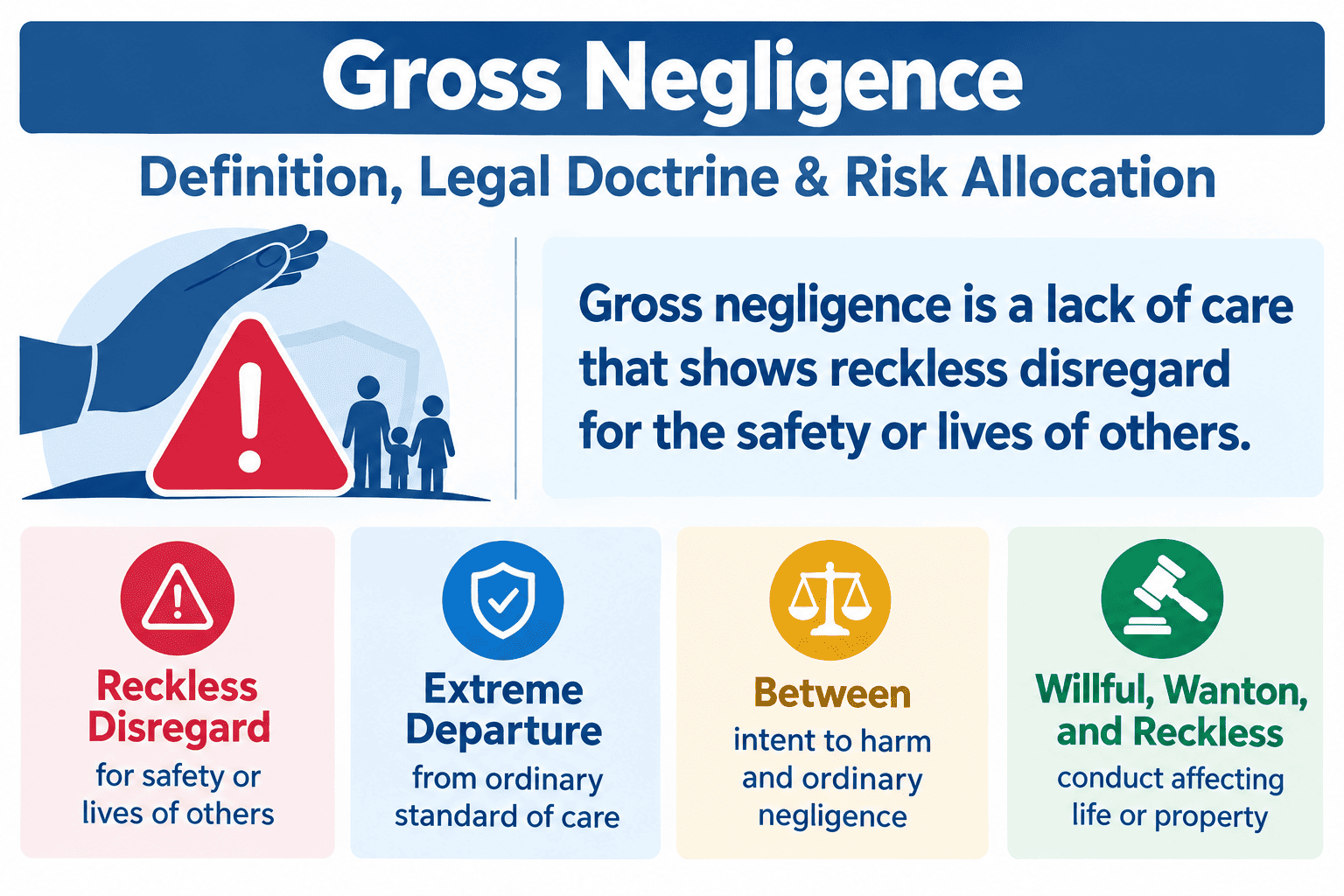
Gross negligence is a lack of care that demonstrates reckless disregard for the safety or lives of others, so great it appears to be a conscious violation of other people’s rights to safety. It is a heightened degree of negligence , an extreme departure from the ordinary standard of care , falling between intent to do wrongful harm and ordinary negligence. It is defined as willful, wanton, and reckless conduct affecting the life or property of another.
QWhat is the difference between ordinary negligence and gross negligence?
Ordinary negligence is a failure to exercise reasonable care that results in harm, usually due to carelessness or inadvertence. Gross negligence is more serious: it involves reckless disregard for the safety of others, or a conscious, voluntary act or omission that is likely to cause harm. Gross negligence implies a thoughtless disregard of consequences and a failure to use even slight care, and it can result in higher damages, including punitive damages.
QHow does gross negligence affect contracts and liability?
In commercial contracts, gross negligence is often a carve-out from limitation of liability clauses, meaning a party cannot cap its liability for gross negligence. It may also trigger exceptions to consequential damages waivers and can invalidate indemnification clauses that seek to indemnify a party for its own gross negligence. Many jurisdictions refuse to enforce contractual provisions that exempt a party from liability for gross negligence as a matter of public policy.
QIs gross negligence a crime?
Gross negligence can form the basis of criminal charges in some circumstances, particularly where it results in death or serious injury. For example, gross negligence manslaughter is a criminal offense in many common law jurisdictions, including the UK and India. In civil cases, gross negligence is a finding that can lead to higher damages, including punitive damages, but it is not itself a crime unless it violates a criminal statute.
QWhat is the difference between gross negligence and willful misconduct?
Gross negligence involves reckless disregard for the consequences of one’s actions, without intent to cause harm. Willful misconduct involves a deliberate intention to cause harm or a knowing violation of a clear duty. Willful misconduct is more culpable and almost universally carved out of liability caps. Gross negligence is also typically carved out, but the threshold is lower than for willful misconduct.
QCan a contract exclude liability for gross negligence?
In many jurisdictions, contractual provisions that seek to exclude or limit liability for gross negligence are unenforceable as a matter of public policy. However, the law varies by jurisdiction. Some jurisdictions allow sophisticated commercial parties to allocate risk as they see fit, while others strictly prohibit exclusions for gross negligence. Always check the governing law and consult legal counsel when drafting such provisions.