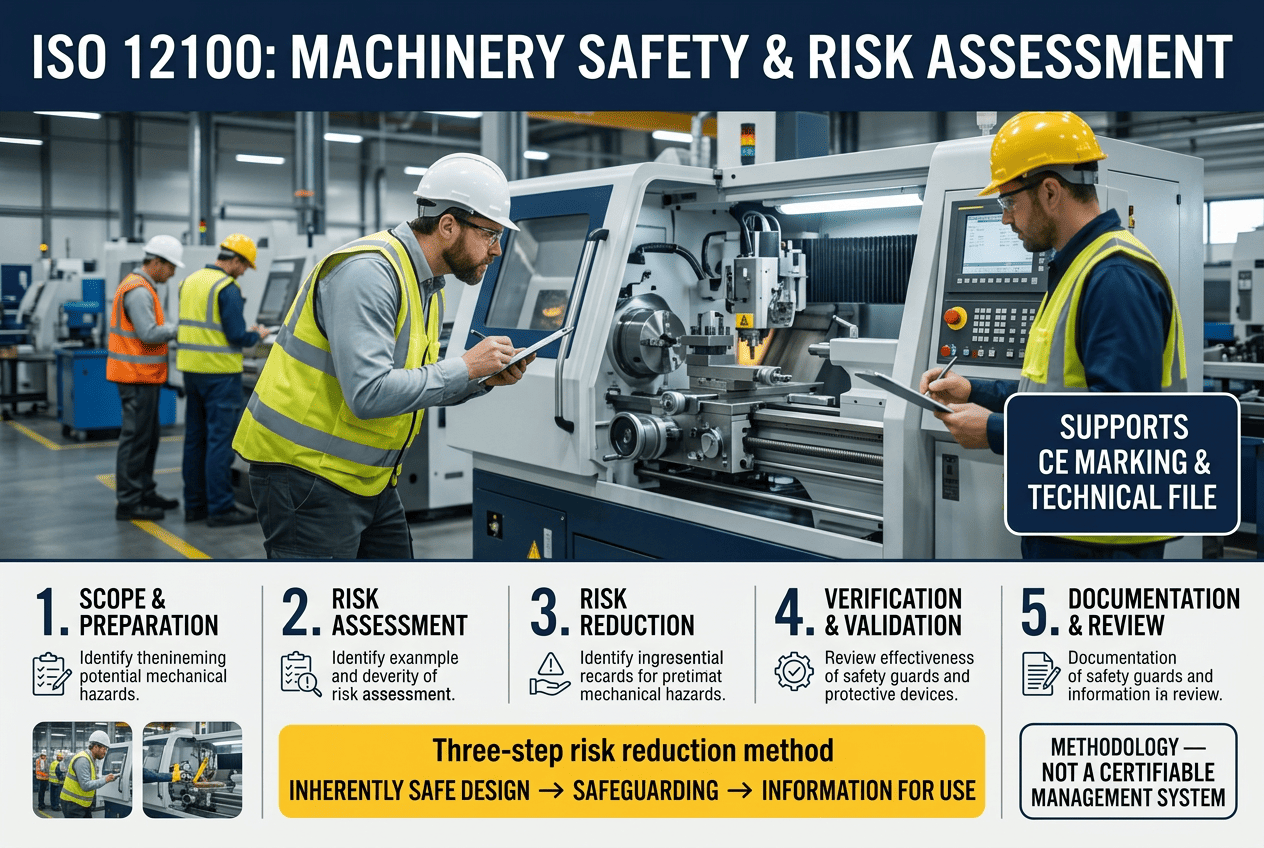
Direct Answer: ISO 12100:2010 is the foundational international standard for machinery safety, defining how to carry out risk assessment and risk reduction during design. It is a methodology rather than a management system, so there is no accredited ISO 12100 certificate like ISO 9001. Instead you demonstrate conformity through a 5-step process: Scope & Preparation, Risk Assessment, Risk Reduction (three-step method), Verification & Validation, and Documentation & Independent Review. The result supports CE marking and the technical file. Timelines range from weeks for a single machine to several months for a product range; get quotes for costs.
📅 November 3, 2026⏱ 14 min read✍️ GT Setu Editorial Team🔄 Updated regularly
2010
Current ISO 12100 Edition
5
Key Steps to Conformity
3
Step Risk Reduction Method
0%
GTsetu Broker Commission
Every machine, from a packaging line to a CNC centre, carries hazards. ISO 12100:2010 Safety of machinery – General principles for design – Risk assessment and risk reduction gives designers and manufacturers one systematic method for identifying those hazards and reducing risk to an acceptable level. It consolidates earlier standards on basic concepts and risk assessment into a single document, as BSI and other standards bodies describe.
This guide explains how to apply the standard and demonstrate conformity. Machinery makers often combine it with management systems such as ISO 9001, ISO 45001 and ISO 14001, and with functional safety work under ISO 26262 or ISO 14971 where relevant.
📋 Who Is This Guide For?
Machine designers, safety engineers, product managers, quality and compliance managers, and business owners at machinery manufacturers, system integrators and OEMs. It is also useful for distributors and buyers who need to judge whether a supplier’s machinery safety claims are credible before they commit to a partnership.
SECTION 1
1 What Is ISO 12100?
⚙️ The Standard Explained
ISO 12100 sets out basic terminology, principles and a methodology for achieving safety in machinery design. It describes how to identify hazards, estimate and evaluate risk, and reduce that risk through protective measures. It is a Type A standard, meaning it applies to all machinery and underpins the more specific Type B (safety aspects such as guards or emergency stops) and Type C (machine-specific) standards. Resources such as IDEC and Mitti provide practical overviews.
🌐
Common Language of Machinery Safety
Shared definitions for hazard, harm, risk and protective measure make documentation consistent across teams and borders.
🏛️
Market Access
In the EU, harmonised machinery standards give a presumption of conformity, supporting CE marking and customer acceptance.
🛡️
Safer by Design
Hazards are tackled at the design stage, where fixes are cheapest and most effective.
📈
Lower Liability & Rework
A documented, repeatable process reduces incidents, late design changes and product liability exposure.
SECTION 2
2 Certification vs Conformity: What You Can Actually Get
ISO 12100 is a design methodology, not a certifiable management system. Here is what organisations typically obtain in practice.
Outcome
Who Issues It
What It Means
Documented Risk Assessment & Technical File
The manufacturer
Core evidence that you applied the method and reduced risk. This is the foundation of everything else.
EU Declaration of Conformity & CE Marking
The manufacturer (with a notified body for certain high-risk machinery)
Legal route to market in the EU. ISO 12100 supports the required risk assessment.
Third-Party Review or Verification Report
Independent testing and certification bodies
Voluntary assessment that your risk assessment and safety design are sound. Wording and scope vary by provider.
Personnel Training Certificates
Training providers
Shows individual competence in risk assessment. It does not certify your organisation or machine.
💡 Check What Your Customer Wants
Ask buyers and regulators exactly which evidence they accept. Some require only a technical file and declaration, while others want independent verification, or conformity to specific Type B or Type C standards beyond ISO 12100.
SECTION 3
3 Key Concepts & Terminology
Concept
Meaning
Why It Matters
Hazard
A potential source of harm, such as a moving part, hot surface or stored energy.
Starting point for every assessment.
Risk
Combination of the probability of harm and its severity.
Decides whether protective measures are needed.
Intended Use & Foreseeable Misuse
How the machine is meant to be used, and reasonably predictable ways it may be used incorrectly.
Many accidents come from foreseeable misuse, not intended use.
Limits of Machinery
Use, space, time and other limits defined for the assessment.
Frames what is and is not assessed.
Protective Measure
Any action that reduces risk, by design, safeguarding or information.
Applied in order of priority.
Residual Risk
Risk remaining after protective measures are applied.
Must be communicated to users.
SECTION 4
4 Step 1: Scope & Preparation
1.1
Define the Machine and Its Lifecycle
Describe the machine, its variants and every lifecycle phase: transport, installation, commissioning, use, maintenance, cleaning, fault-finding and decommissioning.
1.2
Identify Applicable Standards and Laws
Map ISO 12100 to Type B and Type C standards and to the legal regime of each target market. Check which versions are currently harmonised.
1.3
Assemble a Cross-Functional Team
Include mechanical, electrical and control designers, maintenance, production and, where possible, operators. Diverse input uncovers hazards one discipline would miss. Align with ISO 45001 practices if you already run an occupational safety system.
1.4
Secure Management Support and Plan
Allocate time, tools and training, and agree how risk assessments will be recorded and reviewed. See the practical guidance in the standard’s catalogue entry for scope.
SECTION 5
5 Step 2: Risk Assessment
🔍 The Core of ISO 12100
Risk assessment is an iterative process: determine the limits of the machinery, identify hazards, estimate risk, and evaluate risk. If risk is not adequately reduced, you apply protective measures and repeat the assessment. Supplementary practical methods are given in ISO/TR 14121-2.
2.1
Determine the Limits of the Machinery
Define use limits (intended use and foreseeable misuse), space limits, time limits (lifetime and service intervals) and any other limits such as environment or user skill.
2.2
Identify Hazards and Hazardous Situations
Systematically list hazards across all lifecycle phases and tasks: mechanical, electrical, thermal, noise, vibration, radiation, materials, ergonomics and control system failures.
2.3
Estimate Risk
For each hazardous situation, estimate severity of harm and probability of occurrence, considering exposure, occurrence of the event and possibility of avoiding or limiting harm.
2.4
Evaluate Risk
Decide whether risk reduction is required. Record criteria and decisions so the reasoning can be audited later.
SECTION 6
6 Step 3: Risk Reduction
ISO 12100 prescribes a priority order for protective measures, known as the three-step method.
🧩
1. Inherently Safe Design
Eliminate hazards or reduce risk through design: remove pinch points, limit forces and speeds, use safer materials, and design for ergonomics.
Highest Priority
🚧
2. Safeguarding & Complementary Measures
Guards, interlocks, light curtains, emergency stop, safety-related control functions and means for rescue or isolation.
Technical
📘
3. Information for Use
Warnings, markings, instructions, training requirements and personal protective equipment guidance. Used for residual risk, never as a substitute for steps 1 and 2.
Last Resort
💡 Pro Tip: Do Not Skip Down the List
Warning labels and training are the weakest controls. Auditors and regulators look for evidence that you considered design changes and technical safeguards first.
SECTION 7
7 Step 4: Verification & Validation
✅
Verify Measures Work
Test, inspect and measure to confirm each protective measure achieves its intended risk reduction.
🔁
Re-Assess for New Hazards
Protective measures can create new hazards. Repeat the assessment after each change.
⚡
Validate Control Safety
For safety-related control systems, apply the relevant functional safety standards and validation methods. See also ISO 26262 for related safety lifecycle thinking in vehicles.
👷
Test With Real Users
Check that instructions, controls and safeguards work in practice, including during maintenance and fault-finding.
SECTION 8
8 Step 5: Documentation & Independent Review
Stage
What Happens
Key Focus
Compile Documentation
Risk assessment records, drawings, calculations, test reports, standards list and instructions for use.
Traceability from hazard to measure to verification
Internal Review
A person not involved in the design reviews completeness and consistency.
Gaps, unjustified assumptions, missing hazards
Independent Review (Optional)
A third-party body reviews your risk assessment and safety design.
Customer or regulator confidence
Declaration & Marking
Prepare the declaration of conformity and apply required marking.
Legal compliance in target markets
Maintenance
Update the assessment after design changes, incidents or field feedback.
Keeping evidence current
SECTION 9
9 ISO 12100 and EU Machinery Law
In the EU, EN ISO 12100 is a harmonised standard under the Machinery Directive 2006/42/EC, which gives machinery that follows it a presumption of conformity with the relevant essential health and safety requirements. The Machinery Regulation (EU) 2023/1230 replaces the Directive and applies from 20 January 2027. Harmonised-standard lists change, so always confirm current references with official EU sources and your notified body before relying on this summary. Other regions have their own rules, so check each target market.
SECTION 10
10 Costs & Timeline: What to Expect
📋 Indicative Only
There is no fixed fee for ISO 12100 conformity. Cost depends on machine complexity, number of variants, test needs and who does the work. Timeline comments below are planning guidance, not guarantees; request written quotes.
Factor
Impact on Cost
Impact on Timeline
Machine Complexity
More hazards and subsystems mean more analysis and testing
Longer assessment and validation
Number of Variants
Platform reuse lowers per-variant effort
Reuse can shorten later projects
Existing Documentation
Good records and prior assessments reduce effort
Faster compilation
Testing Needs
Lab testing and safety component qualification add direct cost
Depends on lab availability
Consultant or Third-Party Review
Adds fees, reduces internal learning curve and rework risk
Can accelerate set-up
Training
Per-person course fees for assessors and designers
ISO 12100:2010 is the foundational machinery safety standard. It sets out terminology, principles and a methodology for risk assessment and risk reduction in machinery design, and is a Type A standard underpinning more specific machinery standards.
QCan you get certified to ISO 12100?
Not in the way you can with ISO 9001. ISO 12100 is a design methodology, so you demonstrate conformity by documenting the risk assessment and risk reduction, compiling a technical file, and optionally obtaining third-party review. In the EU this supports CE marking.
Apply, in order: inherently safe design, then safeguarding and complementary protective measures, then information for use. Information for use should address residual risk only.
QHow does ISO 12100 relate to EU machinery law?
EN ISO 12100 is a harmonised standard under the Machinery Directive 2006/42/EC. The Machinery Regulation (EU) 2023/1230 applies from 20 January 2027. Confirm current harmonisation status with official sources and your notified body.
QHow long does it take and what does it cost?
It depends on machine complexity, variants and existing records. A single machine may take weeks to a few months; a product range or new safety programme takes longer. Get written quotes. For a related management-system route, see ISO 45001 and ISO 9001.
Ready to Build a Safer Machinery Supply Chain?
Connect with verified manufacturers, distributors and suppliers on GTsetu: compliance-backed verification, anonymous discovery, built-in NDA workflows and zero broker commissions.
They represents the product, and research team behind GTsetu, a global B2B collaboration platform built to help companies explore cross-border partnerships with clarity and trust. The team focuses on simplifying early-stage international business discovery by combining structured company profiles, verification-led access, and controlled collaboration workflows.
With a strong emphasis on trust, and disciplined engagement, Team GTsetu shares insights on global trade, partnerships, and cross-border collaboration, helping businesses make informed decisions before entering deeper commercial discussions.