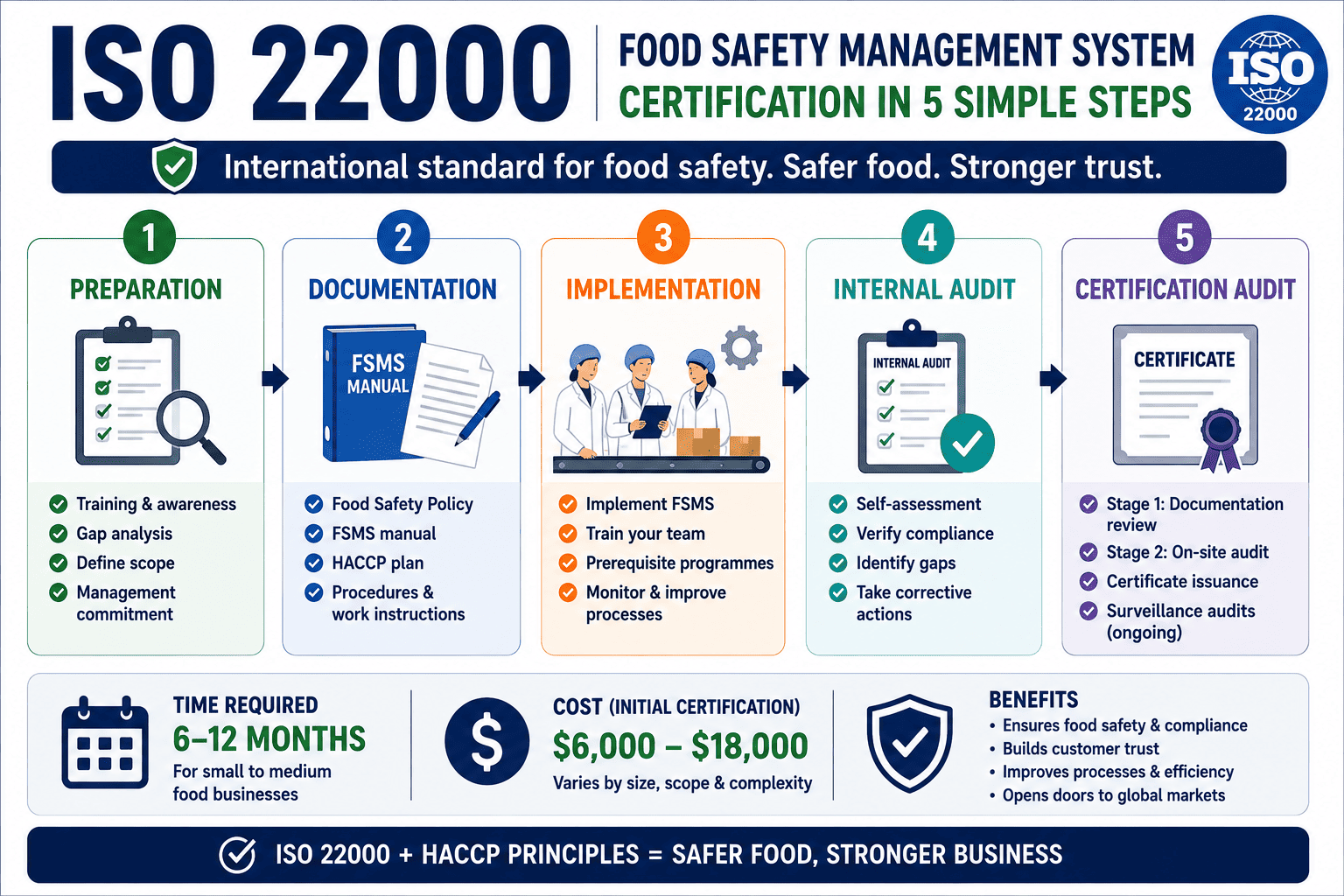
Direct Answer: ISO 22000 is the internationally recognised standard for Food Safety Management Systems (FSMS), with over 40,000 certified organisations globally. Getting certified involves a 5-step process: Preparation (training, gap analysis, scope definition, management commitment), Documentation (Food Safety Policy, FSMS manual, HACCP plan, procedures, work instructions), Implementation (rolling out the system, training staff, prerequisite programmes, process improvement), Internal Audit (self-assessment to verify compliance and effectiveness), and Certification Audit (two-stage audit by an accredited registrar, followed by certificate issuance). The process typically takes 6–12 months for a small to medium-sized food business, with costs ranging from $6,000–$18,000 for initial certification. This guide walks you through every step, with practical tips for a smooth certification journey and integration with HACCP principles.
📅 July 6, 2026⏱ 18 min read✍️ GT Setu Editorial Team🔄 Updated regularly
40K+
Certified Organisations Worldwide
5
Key Steps to Certification
6–12
Months (Typical Timeline)
0%
GTsetu Broker Commission
ISO 22000 is the world’s most widely recognised standard for food safety management systems. Developed by the International Organization for Standardization (ISO), it specifies requirements for a Food Safety Management System (FSMS) that organisations in the food chain can use to demonstrate their ability to control food safety hazards and ensure food safety. With over 40,000 certificates issued globally across the food supply chain, ISO 22000 is the foundational standard for organisations that take food safety seriously.
For food manufacturers, processors, distributors, and service providers, ISO 22000 certification is often a prerequisite for doing business with major retailers, food service chains, and international buyers. It signals that your organisation has implemented robust processes for hazard control, food safety management, and continuous improvement. This guide covers the complete certification process, from initial preparation through to the final certification audit, and provides practical, actionable advice for a smooth journey. See our related guides on ISO 9001, HACCP, and ISO 14001 to understand how food safety integrates with other management systems.
🍽️ Who Is This Guide For?
This guide is written for food safety managers, quality assurance professionals, business owners, and anyone responsible for implementing or maintaining a Food Safety Management System in the food chain. It covers both the DIY approach (using templates and internal resources) and the consultant-led route. It is equally relevant for food manufacturers seeking certification to secure new clients, processors needing to demonstrate food safety to their principals, and distributors who need to manage food safety across their supply chain. For related standards, see our guides on ISO 13485 (medical devices), ISO 27001 (information security), and ISO 45001 (occupational health and safety).
SECTION 1
1 What Is ISO 22000 & Why Get Certified?
🍽️ The Standard Explained
ISO 22000 is the international standard that defines the requirements for a Food Safety Management System (FSMS). It is built on the foundation of HACCP (Hazard Analysis and Critical Control Points) and incorporates the principles of the Codex Alimentarius. The current version is ISO 22000:2018. The standard is based on key elements: interactive communication, system management, prerequisite programmes (PRPs), and HACCP principles. Certification demonstrates that your organisation has a documented FSMS that meets these requirements, and that you are committed to food safety, customer confidence, and continuous improvement. It is applicable to all organisations in the food chain, from primary producers to food manufacturers, processors, distributors, retailers, and food service providers, as well as organisations that supply products and services to the food industry.
🌐
Globally Recognised Standard
ISO 22000 is recognised in over 100 countries, making it the most widely accepted food safety management standard globally. It provides a common framework for food safety across international food supply chains.
🏛️
Market Access & Competitive Advantage
Many major retailers, food service chains, and international buyers require ISO 22000 certification as a condition for doing business. It differentiates you from non-certified competitors and opens doors to new markets.
🛡️
HACCP-Based Framework
ISO 22000 incorporates the 7 principles of HACCP and the 12-step approach from Codex Alimentarius, providing a systematic, science-based framework for identifying and controlling food safety hazards.
📈
Customer Confidence & Trust
Certification signals to your customers and stakeholders that you have robust food safety controls and a commitment to food safety management, building trust and strengthening relationships.
SECTION 2
2 Key Benefits of ISO 22000 Certification
ISO 22000 certification delivers tangible benefits across operational, commercial, and regulatory dimensions. The certification process requires investment, but the return on that investment is well-documented across the food industry.
40%
Reduction in food safety incidents reported by certified organisations (ISO Survey)
25%
Higher customer satisfaction scores among certified food businesses (BSI / Harvard Business Review)
15–20%
Typical cost savings from reduced waste and rework after FSMS implementation (ASQ / Quality Progress)
🏷️
Enhanced Market Credibility
ISO 22000 certification signals to customers, regulators, and partners that you have a validated system for managing food safety. This credibility opens doors to new business opportunities with clients who require certified suppliers.
Commercial
💰
Cost Reduction & Efficiency Gains
By systematically identifying and controlling food safety hazards, certified organisations reduce waste, rework, and recall costs. The process-focused approach drives operational efficiency and reduces food safety incidents.
Operational
🔗
Supply Chain Integration
ISO 22000 provides a common framework for food safety across supply chains, enabling smoother collaboration with partners, easier audits, and consistent food safety throughout the value chain.
Partnership
📊
Data-Driven Decision Making
The standard requires organisations to collect and analyse food safety data, enabling evidence-based decisions and proactive hazard control. This reduces reliance on intuition and improves food safety outcomes.
Analytical
👥
Employee Engagement & Clarity
Clear processes, defined responsibilities, and documented procedures improve employee understanding of their roles in food safety, increasing engagement and reducing the risk of food safety breaches.
People
📋
Regulatory & Risk Management
ISO 22000’s risk-based approach helps organisations proactively identify and mitigate food safety risks, reducing exposure to regulatory non-compliance, product recalls, and liability issues.
Compliance
SECTION 3
3 The 7 HACCP Principles & 12 Implementation Steps
HACCP (Hazard Analysis and Critical Control Points) is the scientific foundation of ISO 22000. The standard incorporates the 7 principles of HACCP and the 12-step implementation process developed by the Codex Alimentarius Commission. Understanding these principles is essential for implementing an effective Food Safety Management System.
The 7 HACCP Principles
Principle 1
Conduct a Hazard Analysis
Identify potential biological, chemical, and physical hazards that could occur at each step of the food production process. Assess the likelihood and severity of each hazard to determine which ones need to be controlled.
Principle 2
Determine Critical Control Points (CCPs)
Identify the specific points in the process where hazards can be prevented, eliminated, or reduced to acceptable levels. A CCP is a step where control is essential to ensure food safety.
Principle 3
Establish Critical Limits
Define measurable standards for each CCP (e.g., cooking temperature, pH level, time). These limits distinguish between safe and unsafe conditions and must be achievable and verifiable.
Principle 4
Establish Monitoring Procedures
Define how and when each CCP will be monitored to ensure it stays within critical limits. This includes specifying who will monitor, what method will be used, and how often monitoring will occur.
Principle 5
Establish Corrective Actions
Define the actions to be taken when monitoring indicates a deviation from critical limits. Corrective actions must be documented, implemented, and verified to ensure they are effective.
Principle 6
Establish Verification Procedures
Confirm that the HACCP system is working as intended. Verification includes audits, tests, and reviews to ensure that critical limits are being met and that the system is effective.
Principle 7
Establish Record-Keeping & Documentation
Maintain comprehensive records of hazard analysis, CCPs, monitoring, corrective actions, and verification. Documentation is essential for demonstrating compliance and is a key focus of audits.
The 12-Step HACCP Implementation Process
The Codex Alimentarius guidelines establish a 12-step process for implementing a HACCP system. These steps incorporate the 7 principles and provide a structured approach to developing and implementing a HACCP plan tailored to your specific food business.
Step
Description
Key Action
1. Assemble the HACCP Team
Gather a multidisciplinary team with expertise in food safety, production, quality, and engineering.
Include personnel from operations, quality, maintenance, and management.
2. Describe the Product
Document the product’s composition, processing methods, packaging, shelf life, and storage conditions.
Create a comprehensive product description covering all aspects.
3. Identify Intended Use
Define how the product will be used by the end-user or consumer.
Identify consumer groups, especially vulnerable populations.
4. Construct a Flow Diagram
Create a detailed flow diagram that shows each step in the process, from receiving raw materials to final distribution.
Verify the flow diagram by walking through the actual process.
5. Verify the Flow Diagram
Confirm the flow diagram is accurate by physically observing and walking through the entire process.
Conduct a walk-through with the HACCP team.
6. Conduct a Hazard Analysis
Identify potential hazards at each step of the process (Principle 1).
Use a hazard analysis worksheet to document findings.
7. Determine Critical Control Points
Identify steps where hazards can be prevented, eliminated, or reduced to acceptable levels (Principle 2).
Apply the CCP decision tree to each significant hazard.
8. Establish Critical Limits
Define measurable standards for each CCP (Principle 3).
Set limits that distinguish between safe and unsafe conditions.
9. Establish Monitoring Procedures
Define monitoring methods, frequency, and responsibilities for each CCP (Principle 4).
Develop monitoring records and checklists.
10. Establish Corrective Actions
Define actions to take when monitoring shows a deviation from critical limits (Principle 5).
Create a corrective action plan with specific steps.
11. Establish Verification Procedures
Confirm the HACCP system is working (Principle 6).
Develop a verification schedule and procedures.
12. Establish Record-Keeping & Documentation
Maintain comprehensive records of the HACCP plan, monitoring, corrective actions, and verification (Principle 7).
Implement a record-keeping system for all HACCP activities.
💡 Pro Tip: Integrate HACCP with ISO 22000
ISO 22000 builds on HACCP by adding management system elements like communication, system management, and continuous improvement. If you already have a HACCP system in place, you are well positioned to implement ISO 22000. The key is to integrate the HACCP plan within the broader FSMS framework, adding elements such as the Food Safety Policy, management review, and continuous improvement processes. This integration approach is similar to integrating ISO 9001 with other management systems.
SECTION 4
4 Step 1: Preparation, Foundation & Planning
🏗️ Building the Foundation
The preparation phase sets the foundation for your entire ISO 22000 certification project. The goal is to ensure you have the knowledge, resources, and support in place before beginning the detailed work of documentation and implementation. This phase typically takes 2–4 weeks for a small organisation, longer for larger or more complex food operations.
1.1
Get Trained on ISO 22000
If you are managing the certification process, you need to understand the standard’s requirements and how to apply them in your food business. Consider an ISO 22000 implementer training course, online or in-person, to build foundational knowledge. Familiarise yourself with the HACCP principles and the Codex Alimentarius guidelines.
1.2
Secure Executive Support
Top management commitment is critical for food safety. They must “walk the talk” by allocating resources, supporting the project, and communicating its importance. Provide executives with a concise overview of ISO 22000’s role in food safety and the benefits certification will deliver.
1.3
Define Your Food Safety Goals & Scope
Define the specific food safety and commercial benefits you want from certification (e.g., reduced food safety incidents, new customer acquisition). Clearly define the scope of your FSMS: which products, processes, locations, or activities will be included? You can exclude certain areas, but consider the pros and cons of limiting the scope.
1.4
Conduct a Gap Analysis
Assess how compliant your organisation already is with ISO 22000 requirements and identify gaps. This helps you prioritise efforts and create a more accurate project plan. You can do this internally or with a consultant. For small organisations, multiple targeted mini-gap analyses during the documentation and implementation stages can be effective.
1.5
Create a Simple Project Plan
Plan your implementation steps, milestones, target dates, and responsibilities. For small and medium food businesses, avoid complex Gantt charts; focus on a clear, simple plan that everyone understands. Define who will be the ISO 22000 point person (Food Safety Team Leader) responsible for achieving and maintaining certification.
1.6
Generate Employee Awareness
Inform your staff about the ISO 22000 project early to prevent rumors and build engagement. Explain how certification benefits the company and individual employees, addressing concerns about job security and work processes. This creates buy-in and transforms staff into stakeholders in the project’s success.
💡 Pro Tip: Start with Prerequisite Programmes
Before you can implement ISO 22000, you need to have effective Prerequisite Programmes (PRPs) in place. These include Good Manufacturing Practices (GMP), Good Hygiene Practices (GHP), pest control, cleaning and sanitation (SSOPs), and employee training. PRPs are the foundation of any food safety management system and are critical for HACCP to work effectively. If you don’t have PRPs in place, start there. The same principle applies when implementing HACCP, build a solid foundation before adding complexity.
SECTION 5
5 Step 2: Documentation, Building Your FSMS
Documentation is often considered the most challenging phase of ISO 22000 certification. It requires aligning documents with the standard’s technical requirements while tailoring them to your company’s unique food safety context. The goal is to create a documentation set that is useful, practical, and compliant, not a bureaucratic burden.
Document Type
Description
Key Consideration
Food Safety Policy
A statement of your organisation’s commitment to food safety, approved by top management. It must be communicated to and understood by all employees.
Keep it concise and specific to your food business. It should provide a framework for setting food safety objectives.
Food Safety Objectives
Measurable goals aligned with the food safety policy. They should be documented, monitored, and communicated. Examples: “reduce customer complaints by 20% in 12 months.”
Objectives should be SMART (Specific, Measurable, Achievable, Relevant, Time-bound).
Scope Statement
Defines the boundaries of your FSMS: which products, services, locations, and activities are included and excluded.
Be clear about what is in scope and what is out. This is a key document for the auditor.
Prerequisite Programmes (PRPs)
Documented programmes that provide the foundation for the FSMS, including GMP, GHP, pest control, sanitation, and training.
PRPs must be established, implemented, and documented before the HACCP plan can be effective. They are a mandatory requirement of ISO 22000.
HACCP Plan
The core document of your FSMS, detailing the hazard analysis, CCPs, critical limits, monitoring, corrective actions, and verification.
Follow the Codex Alimentarius 12-step approach. The HACCP plan must be based on scientific evidence and tailored to your specific processes.
Procedures
Documented processes that describe how activities are performed. They can be combined or split to fit your business needs.
Create as many procedures as needed to address every requirement of ISO 22000, but avoid unnecessary bureaucracy. Use your company’s vernacular.
Work Instructions
Detailed step-by-step guidance for specific tasks, especially where errors would be costly or where tasks are rarely performed.
Use any format that’s useful: text, flowcharts, checklists, or even visual media. Focus on the end user’s needs.
Forms & Checklists
Tools for recording data, capturing evidence, and guiding work. They can serve as both work instructions and records.
Create forms where they save time and effort in meeting ISO 22000 requirements. Avoid creating forms for their own sake.
Records
Evidence that you meet the requirements stated in your procedures, policy, objectives, and work instructions.
Records must be retained for a defined period and be legible, identifiable, and retrievable. They are a key focus of food safety audits.
💡 Documentation Best Practices for Food Safety
DO: Look for the simplest way to meet a requirement and adapt it to your food business. Use your company’s vernacular and avoid “ISO language.” Use diagrams and illustrations rather than long-winded text. Use a visually appealing and easy-to-understand layout. Ensure all documentation is accessible to staff who need it.
DON’T: Include time-consuming references to other documents. Include bureaucratic requirements that are not suitable for your company’s circumstances or culture. Create documents that don’t add value to your food safety operations.
Consider using documentation templates, pre-written documents designed to be tailored to your company’s needs. They save time, reduce errors, and provide a reliable starting point. Ensure they come with detailed customisation instructions. This approach is also effective when implementing ISO 9001, start with a proven template and customise.
SECTION 6
6 Step 3: Implementation, Rolling Out Your FSMS
Implementation is where your carefully designed FSMS becomes a reality. This phase involves introducing your food safety procedures to the workforce, training them, and guiding them through adjustments to improve their work processes. The goal is seamless integration into daily operations, supported by a compelling incentive for adopting the new food safety processes.
📢
Introduce the Food Safety Policy
Top management should communicate the food safety policy, explaining its significance and how the company will put it into practice. Staff must understand the policy and connect it to their individual responsibilities, this is a mandatory requirement of ISO 22000.
Leadership
🎓
Provide Manager Training
Department managers and team leaders are critical to making the FSMS an integral part of daily operations. Equip them with knowledge and skills to leverage ISO 22000 for tangible food safety benefits and involve them actively in implementation.
Training
📋
Establish Prerequisite Programmes
Implement and document all required PRPs, including GMP, GHP, pest control, sanitation, and training. PRPs are the foundation of your FSMS and must be in place before the HACCP plan can be effectively implemented.
Prerequisites
🔄
Implement the HACCP Plan
Roll out the HACCP plan systematically. Train staff on CCP monitoring, record-keeping, and corrective actions. Start with a pilot area or process, learn from the experience, and then expand to the rest of the operation.
Implementation
✍️
Develop Work Instructions
Detailed step-by-step guidance is essential for food safety critical tasks. Staff directly involved in the work should write these instructions, using any format (text, flowchart, visual) that is beneficial to the end user.
Empowerment
📁
Maintain Records
As you integrate ISO requirements into operations, records are being created and kept on file. These records will be reviewed by auditors to assess compliance. Ensure records are complete, legible, and properly stored.
Compliance
📣
Reap Early Marketing Benefits
Even before certification, you can start marketing your commitment to food safety. Inform customers proactively about your pending accreditation, describe your FSMS, and announce your intended certification date. This can help you secure new business earlier in the process.
Commercial
SECTION 7
7 Step 4: Internal Audit, Self-Assessment
🔍 Verifying Your FSMS
Internal audits are a mandatory requirement of ISO 22000 and play a critical role in ensuring the effectiveness of your Food Safety Management System. These self-inspections involve observing food safety processes, interviewing management and staff, and examining records. The objective is to verify compliance not only with ISO 22000 requirements but also with your own procedures and work instructions. Internal audits must be conducted before seeking certification and periodically thereafter. They can be performed by trained internal staff or outsourced to expert food safety auditors.
📋
Set Up the Audit Program
Develop an audit schedule and methods for planning and preparing your food safety audits. Create documents, forms, and checklists that support the audit process. Consider using lead auditor training that includes a module on managing the audit program.
👤
Appoint Qualified Auditors
Small businesses often rely on their ISO 22000 point person, quality manager, or food safety inspector. Larger companies may form an audit team. Auditors should be objective and impartial, they cannot audit their own work.
🎓
Provide Auditor Training
Auditors must be familiar with the ISO 22000:2018 standard and HACCP principles, possess strong auditing skills, be capable of reporting findings and following up on corrective actions, and ideally, promote best practices and add operational value.
🔄
Start Audits Early
Use internal audits as training tools to support implementation. You can start auditing during Step 3, focusing on specific requirements or procedures initially, and expanding the scope as the system matures. This early start helps identify and fix issues before the formal certification audit.
✅
Conduct a Complete Internal Audit
To be eligible for ISO 22000 registration, you must complete a comprehensive internal audit covering your entire FSMS. Address all identified nonconformities before proceeding to the certification audit.
📄
Outsource If Needed
If you lack internal audit expertise, you can outsource the pre-certification internal audit to experienced food safety auditors. This ensures that all issues with your FSMS are identified and addressed, increasing confidence in passing the certification audit.
💡 Internal Audit as a Management Tool
Many organisations view internal audits purely as a certification requirement, but they are a powerful management tool for food safety. Use them to identify process improvements, uncover hidden food safety risks, and engage employees in food safety thinking. A well-conducted internal audit provides valuable insights that go far beyond compliance. This same principle applies to ISO 9001 internal audits, treat them as strategic tools, not just checkboxes.
SECTION 8
8 Step 5: Certification Audit, Getting Certified
The certification audit is the final step in obtaining ISO 22000 certification. It is conducted by an independent, third-party auditor from an accredited certification body (registrar). The audit is similar to your internal audits but with regulated scope and number of audit days. Successful completion results in the issuance of your ISO 22000 certificate, valid for three years.
Audit Stage
What Happens
Key Focus
Stage 1 Audit (Documentation Review)
The auditor reviews your food safety manual, HACCP plan, PRPs, and other documentation to ensure they meet ISO 22000 requirements and that your FSMS is ready for the on-site audit.
Completeness and adequacy of documentation. Identification of any gaps or nonconformities that must be addressed before Stage 2.
Stage 2 Audit (On-Site Verification)
The auditor visits your site to verify that your FSMS is effectively implemented and working in practice. They will interview employees, observe processes, review records, and assess HACCP implementation.
Effective implementation of the FSMS. Evidence that procedures are being followed and that the system is achieving its food safety objectives. Verification that Stage 1 nonconformities have been addressed.
Audit Report & Decision
Following Stage 2, the auditor prepares a report detailing findings. If no major nonconformities are found, or if corrective actions are successfully implemented, the certification body issues your ISO 22000 certificate.
Overall conformity assessment. The certificate is valid for three years from the date of issue.
Surveillance Audits
During the three-year certificate validity period, the certification body conducts annual surveillance audits to ensure your FSMS remains compliant and effective.
Ongoing compliance. The auditor checks that the FSMS is being maintained and that continuous improvement is taking place.
Recertification Audit
After three years, you must undergo a recertification audit to renew your certificate. This is typically a more comprehensive audit than surveillance audits.
Full system re-assessment. You must demonstrate that your FSMS remains effective and has evolved to meet changing business needs.
💡 Preparing for the Food Safety Certification Audit
Prepare your company and staff: Ensure food handling areas are clean and organised, outdated documents are removed, and staff are ready for the auditor. Explain what to expect, reduce anxiety, and rehearse typical questions like “How do you know you perform your work correctly?” and “How do you contribute to the company’s food safety policy objectives?” Staff should answer truthfully without volunteering additional information.
Select your registrar: Choose an accredited certification body that has experience in your food sector (e.g., food manufacturing, processing, distribution, or food service). Compare quotes, check their reputation, and ensure they are recognised by your customers or industry bodies. For GFSI-recognised certification, consider FSSC 22000, which is built on ISO 22000 and adds sector-specific PRPs and additional requirements.
SECTION 9
9 Costs & Timeline: What to Expect
The cost and timeline for ISO 22000 certification vary significantly based on organisation size, complexity, existing food safety processes, and the resources you allocate to the project. Understanding these variables upfront helps in planning and budget setting.
Factor
Impact on Cost
Impact on Timeline
Organisation Size (Employees)
Small (1–50): $6,000–$12,000 Medium (50–250): $12,000–$22,000 Large (250+): $22,000+
More complex operations (e.g., multiple product lines, high-risk foods) require more documentation and audit days, increasing cost.
Complexity extends documentation, implementation, and audit phases.
Industry / Level of Risk
Higher-risk food sectors (e.g., meat processing, dairy, ready-to-eat) require more rigorous audits and often higher fees.
Higher-risk = more audit days, potentially longer timeline.
Number of Working Shifts
Multi-shift operations require more audit time to cover all shifts, increasing cost.
May extend the audit schedule slightly.
Use of Templates / Digital Tools
Reduces consultant fees and internal time, significantly lowering cost.
Can cut timeline by 30–50% by streamlining documentation and implementation.
Consultant Involvement
Full consultant support: adds $5,000–$20,000+ to cost; DIY with templates: lower cost.
Consultant can accelerate timeline by providing expertise and templates.
FSSC 22000 vs ISO 22000
FSSC 22000 certification may have additional costs due to sector-specific PRP requirements and unannounced audit provisions.
FSSC 22000 requires annual surveillance audits with one unannounced audit every three years.
📋 FSSC 22000: The GFSI-Recognised Option
FSSC 22000 is a GFSI-recognised certification scheme built on ISO 22000. It adds sector-specific Pre-requisite Programmes (PRPs) from the ISO 22002 series and additional FSSC scheme requirements. FSSC 22000 is required by many major retailers and food manufacturers worldwide. If your customers require GFSI-recognised certification, FSSC 22000 is the preferred choice. The certification process is similar to ISO 22000 but includes additional requirements and an unannounced audit every three years. For more information, see DNV’s ISO 22000 services and Bureau Veritas’ ISO 22000 certification.
SECTION 10
10 How to Choose a Certification Body (Registrar)
The certification body (also called a registrar) is the independent organisation that will conduct your audit and issue your ISO 22000 certificate. Choosing the right registrar is a critical decision that affects the cost, timeline, and market recognition of your certification.
🏛️
Accreditation Status
Ensure the registrar is accredited by a recognised national accreditation body (e.g., UKAS in the UK, ANAB in the US, DAKKS in Germany, JAS-ANZ in Australia/New Zealand). Accreditation ensures the registrar follows international standards for food safety certification.
🏭
Industry Experience
Choose a registrar with auditors who have experience in your specific food sector (e.g., meat processing, dairy, bakery, beverages, food service). They will understand your processes, terminology, and risks, leading to a more relevant and valuable audit.
📋
Market Recognition
Consider whether your customers or industry bodies recognise the registrar’s certificate. For GFSI-recognised certification, choose a registrar that is licensed for FSSC 22000 if that is your target.
💰
Cost & Value
Compare quotes from multiple registrars. The cheapest option is not always the best, consider the value of the audit, the auditor’s expertise, and the registrar’s reputation. Ensure you understand what is included in the quoted fee.
🌐
Global Capability
If you have or plan to have multiple sites in different countries, choose a registrar that can audit all sites consistently. This simplifies the management of your certification across locations.
🤝
Relationship & Support
Choose a registrar you feel comfortable working with. The relationship should be collaborative, not adversarial. A good auditor will help you improve your FSMS, not just find faults.
💡 Registrar Selection Checklist
When evaluating registrars, ask: Are you accredited by a recognised national accreditation body? Do you have auditors with experience in my food sector? What is your audit process and how many days do you typically allocate for my organisation type? What is included in your fee and are there additional costs? How do you handle nonconformities and what is the process for issuing the certificate? Can you provide references from clients in my food sector? How do you conduct surveillance audits? For FSSC 22000, confirm the registrar is licensed by Foundation FSSC. Use this information alongside your ISO 9001 and HACCP knowledge to make an informed decision.
SECTION 11
11 Common Mistakes & How to Avoid Them
📋
Over-Documentation & Bureaucracy
Creating excessive documentation that adds no operational value and makes the system difficult to maintain. This creates employee resentment and audit fatigue.
Avoid: Focus on what is necessary to control your food safety hazards and demonstrate compliance. Use the simplest approach that meets the requirements. Ask: “Does this document add value to food safety?”
🏛️
Lack of Management Commitment
When leadership does not actively support the FSMS, it becomes a compliance exercise for employees rather than a strategic initiative, leading to poor implementation and audit failures.
Avoid: Secure top management commitment from the start. Ensure they understand the business case for food safety certification and communicate their support visibly to the organisation.
📖
“ISO Language” Instead of Your Language
Using standard-specific jargon instead of your company’s natural language makes procedures confusing and difficult for food handlers to follow and maintain.
Avoid: Write procedures in your company’s everyday language. Use diagrams and illustrations. Make them user-friendly and practical for the people who will use them.
🔄
Treating Certification as the End Goal
Focusing solely on passing the audit rather than building an FSMS that improves food safety. This leads to a system that is maintained only for the auditor, not for food safety performance.
Avoid: Design your FSMS to solve real food safety problems. Use the internal audits and management reviews for genuine improvement, not just audit readiness.
🎓
Inadequate Staff Training
Employees who do not understand the FSMS or how their role contributes to food safety will not follow procedures consistently, leading to nonconformities and audit findings.
Avoid: Invest in food safety training at all levels. Explain the “why” behind the procedures. Make training engaging and relevant to employees’ daily work.
🛡️
Weak Prerequisite Programmes
PRPs that are not effectively implemented or documented undermine the entire FSMS. Without strong PRPs, HACCP cannot function effectively.
Avoid: Ensure PRPs (GMP, GHP, pest control, sanitation, training) are fully implemented and documented before developing the HACCP plan. PRPs are the foundation of food safety.
SECTION 12
12 How GTsetu Supports Your ISO 22000 Certification Journey
ISO 22000 certification is a powerful tool for demonstrating food safety to customers and partners. GTsetu complements your certification by connecting you with verified food manufacturers, distributors, and suppliers who meet rigorous food safety standards. Our platform provides:
✅
Verified Company Profiles
Every company on GTsetu is verified on 6 key data points (Name, Address, Registration Number, Company Status, Company Type, Date of Incorporation) using government tie-ups, complementing your ISO 22000 due diligence.
🕵️
Anonymous Discovery
Browse verified partner profiles without revealing your identity until you’re ready to engage, protecting your sourcing strategy and commercial confidentiality.
📄
Built-In NDA Workflow
Digital mutual NDA with timestamped signatures, activated before any sensitive commercial or technical data is exchanged, supporting your IP protection and confidentiality commitments under ISO 22000.
🔐
Encrypted Document Workspace
AES-256 encryption at rest, TLS in transit, role-based access controls, and full audit trail, ensuring the secure exchange of food safety documentation, specs, and contracts with partners.
🚫
Zero Broker Commission
GTsetu charges zero commission on any partnership formed. All commercial value stays between you and your verified partner, supporting the cost management objectives of your FSMS.
🌏
Global Network of Verified Partners
Access verified food manufacturers, distributors, and suppliers across 100+ countries, supporting your supply chain food safety objectives and enabling you to build a network of ISO-aligned partners.
QWhat is ISO 22000 certification and why is it important?
ISO 22000 is the internationally recognised standard for Food Safety Management Systems (FSMS). It specifies the requirements for a systematic approach to managing food safety hazards in any organisation in the food chain. Certification demonstrates that your company has implemented an FSMS that meets these requirements, ensuring food safety, customer confidence, and compliance with regulatory requirements. It is often a prerequisite for doing business with major retailers, food service chains, and international buyers. For food manufacturers and distributors, it provides a competitive edge and is a key factor in supply chain quality management.
QWhat are the main steps to get ISO 22000 certified?
The main steps are: (1) Preparation, get trained, secure management support, conduct a gap analysis, define scope, and plan your project. (2) Documentation, create your Food Safety Policy, FSMS manual, procedures, work instructions, HACCP plan, and forms. (3) Implementation, roll out the FSMS, train your team, establish PRPs, and improve processes. (4) Internal Audit, conduct a self-assessment to verify the system works and complies with ISO 22000. (5) Certification Audit, undergo a two-stage audit by an accredited registrar and receive your certificate. This structured approach is similar to building any management system, start with a solid foundation and build methodically.
QHow long does it take to get ISO 22000 certification?
The timeline varies by company size and readiness. For small food businesses (under 50 employees), the process typically takes 6-9 months. Medium organisations (50-250 employees) usually take 9-12 months. Large organisations (250+ employees) may take 12-18 months. The timeline includes preparation, documentation, implementation, internal audit, and the final certification audit. Organisations already certified to ISO 9001 may find integration easier and faster. Using templates can significantly reduce the time to certification.
QHow much does ISO 22000 certification cost?
The cost varies based on company size, number of employees, complexity of food operations, industry risk level, and number of working shifts. Factors include: registrar fees (for the certification audit), consultant fees (if hired), internal resource time, and ongoing surveillance audit costs. A typical range for a small to medium food company is $6,000-$18,000 for the initial certification, with annual surveillance audits costing $3,000-$6,000. FSSC 22000 certification (GFSI-recognised) may have additional costs. For more details, see Bureau Veritas’ certification services.
QWhat documents are required for ISO 22000 certification?
Key required documents include: Food Safety Policy, Food Safety Objectives, Scope Statement, FSMS Manual, HACCP Plan (based on Codex Alimentarius 12 steps and 7 principles), Pre-requisite Programmes (PRPs) documentation, documented procedures (as needed), work instructions, forms and records, and process maps. ISO 22000:2018 requires documented information for specific clauses. The approach should be to create as many procedures as necessary to address every requirement of the standard, tailored to your food business needs. Using templates can help ensure completeness and reduce the burden of starting from scratch.
QHow does ISO 22000 relate to HACCP?
HACCP (Hazard Analysis and Critical Control Points) is the scientific foundation of ISO 22000. ISO 22000 incorporates the 7 principles of HACCP as a core component of the food safety management system. The standard requires organisations to conduct a hazard analysis, determine critical control points (CCPs), establish critical limits, and implement monitoring, corrective actions, verification, and record-keeping procedures. ISO 22000 builds on HACCP by adding management system elements like communication, system management, and continuous improvement. For a deeper dive, see our HACCP certification guide.
QWhat is the difference between ISO 22000 and FSSC 22000?
ISO 22000 is the international standard for Food Safety Management Systems. FSSC 22000 is a certification scheme built on ISO 22000, adding sector-specific Pre-requisite Programmes (PRPs) from the ISO 22002 series and additional FSSC scheme requirements. FSSC 22000 is recognised by the Global Food Safety Initiative (GFSI), making it a preferred certification for many major retailers and food manufacturers worldwide. FSSC 22000 requires annual surveillance audits (with one unannounced audit every three years) and recertification every three years. For more information, visit FSSC 22000’s certification page.
Connect with verified food manufacturers, distributors, and suppliers on GTsetu, compliance-backed verification, anonymous discovery, built-in NDA workflows, and zero broker commissions. Find partners who share your commitment to food safety.
They represents the product, and research team behind GTsetu, a global B2B collaboration platform built to help companies explore cross-border partnerships with clarity and trust. The team focuses on simplifying early-stage international business discovery by combining structured company profiles, verification-led access, and controlled collaboration workflows.
With a strong emphasis on trust, and disciplined engagement, Team GTsetu shares insights on global trade, partnerships, and cross-border collaboration, helping businesses make informed decisions before entering deeper commercial discussions.