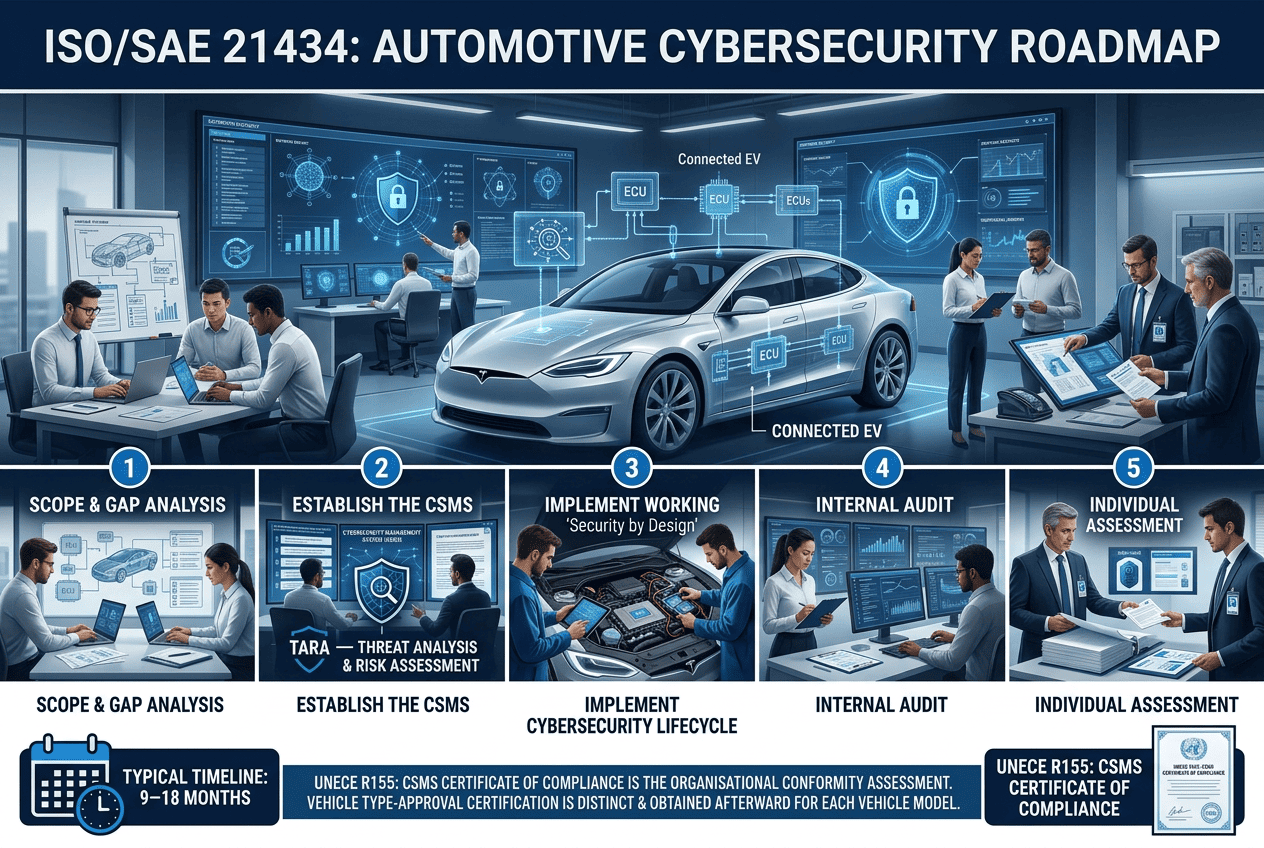
Direct Answer: ISO/SAE 21434:2021 is the international standard for cybersecurity engineering of road vehicles. Unlike ISO 9001, it is not a certificate-based scheme: organisations demonstrate conformity through an independent assessment or audit of their Cybersecurity Management System (CSMS) and cybersecurity processes. The path has 5 steps: Scope & Gap Analysis, Establish the CSMS, Implement the Cybersecurity Lifecycle (including TARA), Internal Audit & Assessment, and Independent Third-Party Assessment. Most organisations need roughly 9–18 months, depending on existing ISO 26262, ISO 27001 or ASPICE maturity. For vehicle type approval under UNECE R155, the approval authority issues a CSMS Certificate of Compliance to the vehicle manufacturer.
📅 November 2, 2026⏱ 14 min read✍️ GT Setu Editorial Team🔄 Updated regularly
2021
ISO/SAE 21434 First Edition
5
Key Steps to Conformity
9–18
Months (Indicative Timeline)
0%
GTsetu Broker Commission
Modern vehicles are software-defined, connected and updated over the air, which makes cybersecurity a safety and business issue. ISO/SAE 21434:2021 Road vehicles – Cybersecurity engineering, developed jointly by ISO and SAE International, gives OEMs, Tier 1 and Tier 2 suppliers and software vendors a common framework for managing cybersecurity risk across the vehicle lifecycle.
This guide explains how to implement the standard and demonstrate conformity. If your organisation already runs other management systems, see our guides on ISO 9001, ISO 27001 and ISO 26262, which overlap significantly with automotive cybersecurity work.
📋 Who Is This Guide For?
Cybersecurity managers, product security leads, functional safety engineers, quality managers and business owners at automotive OEMs, Tier 1/Tier 2 suppliers, ECU and software vendors, and engineering service providers. It is equally relevant for distributors and sourcing teams who need to evaluate whether a supplier’s cybersecurity claims are credible.
SECTION 1
1 What Is ISO/SAE 21434?
🚗 The Standard Explained
ISO/SAE 21434 specifies requirements for cybersecurity risk management in the engineering of road vehicle electrical and electronic (E/E) systems, including their components and interfaces. It covers concept, product development, production, operation, maintenance and decommissioning, and applies at both organisational and project level. It does not prescribe specific technologies; it defines what processes must exist and what work products must be produced, so you choose how.
🔗
Supply Chain Common Language
A shared vocabulary and work-product set that lets OEMs and suppliers exchange cybersecurity evidence through the Cybersecurity Interface Agreement (CIA).
⚖️
Regulatory Alignment
Widely used to show how an organisation meets the process expectations behind UNECE R155 and similar regulations.
🔄
Whole-Lifecycle Thinking
Security continues after start of production through monitoring, incident response and updates, not just design.
🎯
Risk-Based Approach
Effort is proportionate to risk, driven by Threat Analysis and Risk Assessment (TARA) and cybersecurity assurance levels.
SECTION 2
2 Certification vs Assessment: What You Can Actually Get
This is the most common point of confusion. ISO/SAE 21434 does not define a certification scheme with accredited registrars in the way ISO 9001 does. What the market uses in practice is shown below.
Outcome
Who Issues It
What It Means
CSMS Audit / Conformity Report
Independent assessor (e.g. DNV, TÜV and similar bodies)
Third-party evidence that your organisational cybersecurity processes conform to ISO/SAE 21434. Wording and format vary by provider.
Cybersecurity Assessment (project level)
Independent assessor
Judgement on whether a specific item or component achieves cybersecurity, supporting the release for production.
CSMS Certificate of Compliance (R155)
Type approval authority or technical service
Legal requirement for vehicle manufacturers under UNECE R155. Issued to the OEM, not to suppliers.
Personnel Training Certificates
Training providers (e.g. online courses, SAE and others)
Show individual competence. They do not certify your organisation.
💡 Check What Your Customer Wants
Ask your OEM or Tier 1 customer exactly which evidence they require: an audit report, a cybersecurity assessment per project, or both. Auditing guidance for CSMS audits is published as ISO/PAS 5112 Guidelines for auditing cybersecurity engineering, which extends ISO 19011 to this domain and is based on the processes in ISO/SAE 21434.
OEM, Tier 1, Tier 2 or software supplier? Your role decides which clauses and work products carry most weight, and which responsibilities are passed down through the Cybersecurity Interface Agreement.
1.2
Set the Scope
List the products, sites, engineering teams and tools in scope. Decide whether you are building an organisation-wide CSMS or starting with a single product line.
1.3
Run a Gap Analysis
Compare current practices with the standard’s clauses. Reuse existing evidence from ISO 27001, ISO 26262 and ISO 9001 where possible.
1.4
Secure Management Commitment & Build the Team
Name a cybersecurity lead, involve safety, quality, software and legal, and agree budget, tooling and a realistic plan.
SECTION 5
5 Step 2: Establish the CSMS
The CSMS is the organisational layer that makes cybersecurity repeatable across projects. A practical implementation approach begins with governance and then defines the processes projects will follow.
📜
Cybersecurity Policy & Governance
Management-approved policy, defined roles, escalation paths and a cybersecurity-aware culture.
Governance
⚙️
Process Definition & Tailoring
Documented processes for TARA, requirements, design, testing, vulnerability management and incident response, with tailoring rules per project.
Process
🧰
Tool Management & Competence
Qualified tools, controlled configurations, and training plans for engineers and auditors.
Capability
🤝
Supplier & Interface Management
Supplier selection criteria and a standard Cybersecurity Interface Agreement template.
Supply Chain
SECTION 6
6 Step 3: Implement the Cybersecurity Lifecycle
3.1
Item Definition & TARA
Define the item boundary and assets, then identify damage scenarios, threat scenarios and attack paths. Rate impact and attack feasibility, determine risk, and choose a treatment: avoid, reduce, share or retain.
3.2
Cybersecurity Goals & Concept
Derive cybersecurity goals from risks that need reduction, then allocate cybersecurity requirements to the architecture. Align this with functional safety work from ISO 26262 where safety and security interact.
3.3
Design, Integration & Verification
Specify and implement controls (secure boot, authentication, key management, secure communication), then verify through reviews, static and dynamic analysis, fuzzing and penetration testing.
3.4
Validation, Production & Operations
Validate cybersecurity goals, control production, and set up continual monitoring, vulnerability management and incident response, including software update processes.
3.5
Build the Cybersecurity Case
Collect work products into a cybersecurity case: a structured argument, backed by evidence, that the item is adequately secure for release.
💡 Pro Tip: Pilot on One Product
Run the full lifecycle on a single product first. The experience will show where your processes, tools and templates need work before you scale across product lines.
SECTION 7
7 Step 4: Internal Audit & Assessment
🔍 Verifying Your CSMS
Before inviting an external assessor, audit your own CSMS against the standard and your own processes. Use the audit-programme and auditor-competence guidance in ISO/PAS 5112, and complete an internal cybersecurity assessment for at least one project to confirm your evidence is complete and consistent.
📋
Audit Programme
Plan audits by clause and by project, with checklists drawn from the standard’s objectives.
👤
Independent Auditors
Auditors must be competent and impartial; engineers cannot audit their own work.
🛠️
Close Findings
Fix nonconformities with root-cause analysis before the external assessment.
SECTION 8
8 Step 5: Independent Third-Party Assessment
Stage
What Happens
Key Focus
Provider Selection
Choose an assessor with automotive cybersecurity references and recognised competence.
Customer acceptance, auditor expertise, scope fit
Document & Process Review
Assessor reviews policies, processes, templates and sample work products.
Completeness against the standard
On-Site / Remote Audit
Interviews, process walkthroughs and evidence sampling across selected projects.
Processes are actually followed
Report & Closure
Findings are reported and corrective actions agreed and verified.
Conformity statement or report
Maintenance
Periodic follow-up audits and updates as processes, products and threats change.
Ongoing effectiveness
SECTION 9
9 ISO 21434 and UNECE R155
UNECE Regulation No. 155 requires vehicle manufacturers to hold a valid CSMS Certificate of Compliance as a condition of type approval. ISO/SAE 21434 is not the regulation itself, but it is the most widely used process framework for showing how a CSMS meets R155’s expectations. Suppliers feel the effect through contractual requirements: OEMs push expectations down the chain, so supplier conformity evidence often becomes a sourcing criterion. Confirm current regional timelines and requirements with your approval authority.
SECTION 10
10 Costs & Timeline: What to Expect
📋 Indicative Only
No public fixed fee exists. Costs depend on scope, number of products, tooling and assessor day rates, so request written quotes. The timeline figures below are planning estimates, not guarantees.
Factor
Impact on Cost
Impact on Timeline
Existing Maturity (ISO 26262, ISO 27001, ASPICE)
High maturity lowers gap-closure effort
Can shorten to roughly 9–12 months
Number of Products in Scope
More TARAs, test campaigns and cybersecurity cases
Longer implementation
Tooling
TARA, vulnerability and requirements tools add licence cost but save effort
Faster evidence production
Consultant Support
Adds fees, reduces internal learning curve
Accelerates set-up
Assessor Scope
Organisation-only audit costs less than organisation plus project assessments
Environmental and occupational health and safety systems that sit alongside your automotive management systems. See also ISO 13485 and ISO 22000 for other sector schemes.
SECTION 12
12 Common Mistakes & How to Avoid Them
📜
Expecting a Certificate Like ISO 9001
Avoid: Confirm with customers whether they need an audit report, project assessment or both.
🎯
Weak or One-Off TARA
Avoid: Treat TARA as a living analysis, updated with new threats, vulnerabilities and design changes.
🤝
Ignoring Supplier Interfaces
Avoid: Agree responsibilities early through a Cybersecurity Interface Agreement.
🔧
Stopping at Start of Production
Avoid: Resource monitoring, vulnerability handling and update processes for the whole vehicle life.
🧩
Siloed Safety and Security
Avoid: Coordinate safety and cybersecurity teams so conflicts and dependencies surface early.
📄
Evidence Only for the Auditor
Avoid: Make work products part of daily engineering so evidence is a by-product, not a late scramble.
SECTION 13
13 How GTsetu Supports Your Journey
🔗 GTsetu, Verified B2B Platform
Connect with Verified Automotive Partners & Suppliers
Whether you are a supplier seeking OEM customers or a buyer vetting cybersecurity-capable suppliers, GTsetu helps you connect with verified manufacturers, distributors and service partners:
✅
Verified Company ProfilesEvery company is verified on 6 key data points using government tie-ups.
🕵️
Anonymous DiscoveryBrowse partner profiles without revealing your identity until you are ready.
📄
Built-In NDA WorkflowDigital mutual NDA with timestamped signatures before sensitive technical data is shared.
🔐
Encrypted Document WorkspaceAES-256 at rest, TLS in transit, role-based access and a full audit trail.
🚫
Zero Broker CommissionAll commercial value stays between you and your partner.
🌏
Global NetworkVerified partners across 100+ countries.
ISO/SAE 21434:2021 is the international standard for cybersecurity engineering of road vehicles. It defines requirements for managing cybersecurity risk across the vehicle lifecycle for E/E systems, components and interfaces, and was developed jointly by ISO and SAE International.
QCan you get certified to ISO/SAE 21434?
Not in the same way as ISO 9001. Organisations usually obtain an independent audit or assessment of their CSMS and cybersecurity processes from a third party. Under UNECE R155, the approval authority issues a CSMS Certificate of Compliance to the vehicle manufacturer. See our ISO 9001 guide for a conventional certification route.
QWhat are the main steps to implement ISO/SAE 21434?
(1) Scope & Gap Analysis, (2) Establish the CSMS, (3) Implement the Cybersecurity Lifecycle including TARA, (4) Internal Audit & Assessment, and (5) Independent Third-Party Assessment.
QWhat is TARA?
Threat Analysis and Risk Assessment identifies assets, damage and threat scenarios and attack paths, rates impact and attack feasibility, and determines risk and its treatment. Results drive cybersecurity goals and requirements.
QHow long does it take and what does it cost?
It varies widely. As a planning estimate, 9–18 months for a supplier building a CSMS from an existing quality base. Costs depend on scope, tooling and assessor rates, so get written quotes.
QHow does it relate to ISO 26262 and ISO 27001?
ISO 26262 addresses functional safety and ISO 26262 certification work overlaps with TARA and requirements. ISO 27001 covers organisational information security and can supply evidence for CSMS governance.
Ready to Build a Secure Automotive Supply Chain?
Connect with verified manufacturers, distributors and suppliers on GTsetu: compliance-backed verification, anonymous discovery, built-in NDA workflows and zero broker commissions.
They represents the product, and research team behind GTsetu, a global B2B collaboration platform built to help companies explore cross-border partnerships with clarity and trust. The team focuses on simplifying early-stage international business discovery by combining structured company profiles, verification-led access, and controlled collaboration workflows.
With a strong emphasis on trust, and disciplined engagement, Team GTsetu shares insights on global trade, partnerships, and cross-border collaboration, helping businesses make informed decisions before entering deeper commercial discussions.