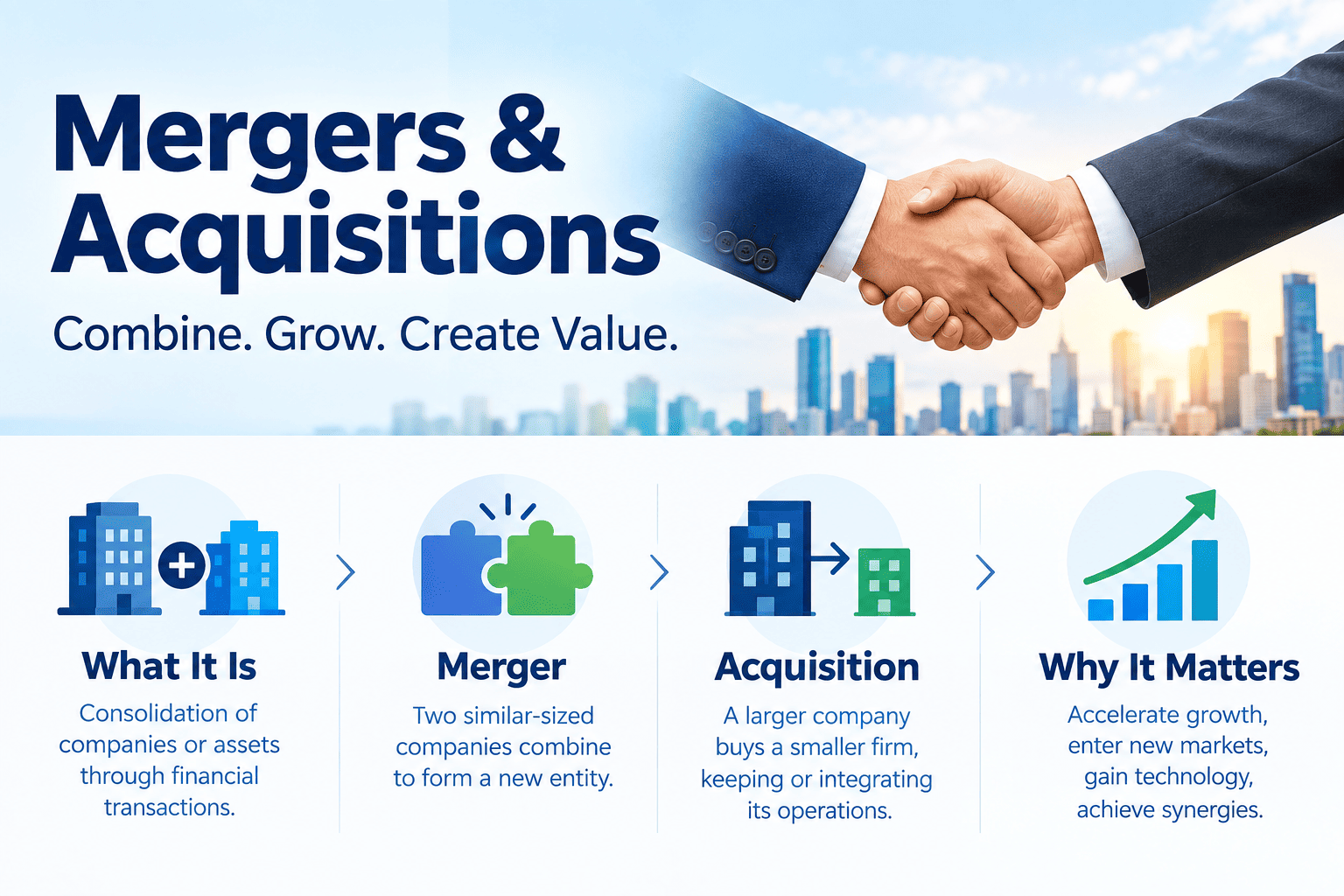
Why Mergers and Acquisitions Matter in Business
Growth in the business world often depends on strategic deals that reshape entire markets. M&A allows companies to combine resources, expand operations, and develop new capabilities in ways that might be impossible through organic growth alone. Enterprises often rely on M&A to accelerate growth more rapidly than internal methods might allow — whether the goal is to enter a new market, acquire cutting-edge technology, or outmaneuver the competition. The right deal offers immediate benefits like expanded capabilities or cost savings through resource consolidation, while opening the door to further innovation and market leadership.
📊 Key Statistic
According to industry research, 70% to 90% of mergers and acquisitions fail to achieve their expected value, with inadequate Due Diligence and poor post-merger integration consistently identified as primary causes. Thorough investigation and careful integration planning are essential for M&A success.
Mergers vs. Acquisitions vs. Takeovers
While people often group them together, there is a difference between a merger, an acquisition, and a takeover. Understanding these distinctions is essential for structuring the right deal and managing expectations.
| Deal Type | Definition | Key Characteristics |
|---|
| Merger | Two organizations of roughly similar size and influence join forces to form a new entity. | Blends leadership teams, product portfolios, and brand identities. Often described as a “merger of equals.” |
| Acquisition | A larger company purchases a smaller or target firm. | Sometimes keeping the acquired organization’s name, or folding its operations into the parent’s structure. Usually negotiated and friendly. |
| Takeover | Typically involves less negotiation and more unilateral action, although some takeovers can be friendly if the target’s leadership approves. | Can be hostile (unsolicited bid) or friendly. Often involves acquiring a controlling interest in the target. |
The Main Types of Mergers and Acquisitions
M&A transactions come in various forms, each with distinct strategic objectives and implications. Choosing the right type depends on the acquirer’s goals, industry dynamics, and regulatory environment.
| Type | Description | Best For | Key Consideration |
|---|
| Horizontal Merger | Two companies operating in the same industry and at a similar stage of production merge to form a unified entity. | Consolidating market share, reducing competition, combining complementary customer bases. | Often subject to antitrust scrutiny; potential for market dominance. |
| Vertical Merger | Firms along different supply chain stages unite, such as a manufacturer merging with its supplier or distributor. | Streamlining production, improving cost efficiency, ensuring consistent flow of critical resources. | Can lock in supply lines or secure distribution channels; may raise foreclosure concerns. |
| Conglomerate Merger | Companies from distinct industries or markets combine, broadening the acquiring firm’s overall portfolio. | Mitigating risk by diversifying revenue streams; bolstering earnings stability. | Less focused; may be harder to integrate; diversification benefits may not materialize. |
| Market Extension Merger | Two firms selling the same products merge to enter new geographic territories. | Expanding distribution networks and brand loyalty into new regions. | Requires local market knowledge; cultural integration challenges. |
| Product Extension Merger | Businesses offering related, but not identical, items combine to expand their product lines. | Cross-selling opportunities; unified R&D pipeline. | Product integration and brand positioning require careful planning. |
📌 Note on Acquisition Structures
Acquisitions can be structured as either an Asset Purchase (the acquirer buys selected assets and occasionally liabilities) or a Stock Purchase (the acquirer buys the target’s shares, assuming complete ownership of operations, obligations, and finances). Each approach carries unique legal, tax, and operational considerations.
The M&A Process
The M&A Process: From Deal Origination to Closing
Effective mergers and acquisitions begin well before any formal offer is made. The M&A process typically follows a structured sequence of stages, each critical to the deal’s success.
1
Pre-M&A Strategy: Identifying the Right Target
Companies outline strategic priorities like market expansion or technology acquisition, then research potential candidates that align with these objectives. Businesses zero in on top prospects that fit specific financial and strategic criteria using public data, industry analyses, or guidance from M&A advisory firms.
2
Due Diligence: Assessing Financial, Legal, and Operational Risks
M&A success lies in thorough investigation. Due diligence involves scrutinizing every aspect of the target firm: financial statements, customer contracts, intellectual property rights, employee agreements, and more. This stage reveals hidden debts, pending lawsuits, or operational inefficiencies that might affect deal valuation or post-transaction synergy.
3
Valuation and Pricing: How Are Companies Valued in M&A?
Parties consider earnings multiples, discounted cash flow analyses, and sector benchmarks to estimate a business’s intrinsic value. Occasionally, intangible factors like brand reputation or intellectual property will warrant additional premiums. Overpaying is among the most common M&A disadvantages, often fueled by overoptimism or competitive bidding wars.
4
Negotiation and Structuring: Key Deal Terms and Considerations
Once the buyer and seller settle on a ballpark figure, they hammer out specifics like deal structure (cash, stock, or hybrid), governance roles, and transition plans. At times, negotiations revolve around how leadership positions will be allocated or whether existing management stays on board. Earnouts or performance-based incentives may align interests post-closing.
5
Regulatory Approvals and Compliance Requirements
Before finalizing an M&A deal, companies may need clearance from relevant authorities, such as antitrust regulators. Large transactions can attract scrutiny if they risk creating monopolies or limiting consumer choice. Cross-border deals might demand clearance from multiple jurisdictions, each imposing a distinct set of filing rules.
6
Post-Merger Integration: Aligning Cultures, Systems, and Operations
The closing date signals the legal union of businesses, but the real work starts as teams blend cultures, IT systems, and operational procedures. Failure to execute integration effectively remains among the top M&A disadvantages, often negating the deal’s expected synergy. Melding diverse corporate environments demands strong leadership, transparent communication, and respect for each side’s strengths.
Valuation Methods
M&A Valuation Methods: How to Determine the Right Price
Arriving at a fair price stands as a critical milestone in mergers and acquisitions. Several valuation methodologies are used, often in combination, to determine the target’s intrinsic value.
| Method | Description | Best Used When |
|---|
| Comparable Company Analysis (CCA) | Compares the target’s financial metrics (e.g., revenue, EBITDA) with those of peer firms. Reviewing valuation multiples like price-to-earnings or EV/EBITDA infers a reasonable range for the target within its industry. | Quick, market-based benchmarks are needed; the target operates in a sector with publicly traded peers. |
| Precedent Transaction Analysis (PTA) | Examines premiums paid in similar M&A deals to gauge how markets value companies of a certain profile. | There are sufficient comparable transactions; care is taken to adjust for unique circumstances like distressed sales. |
| Discounted Cash Flow (DCF) Method | Projects future free cash flows for a firm and discounts them to the present value, capturing the time value of money and required rate of return. | Intangible assets or R&D pipelines contribute substantially to future prospects. |
| Leveraged Buyout (LBO) Model | An acquirer, often a private equity player, uses significant debt to purchase a target, with the target’s assets serving as collateral. | The acquirer anticipates selling off parts of the acquired business to pay down debt; substantial returns are expected. |
Synergies — the combined cost savings, revenue enhancements, or strategic advantages realized when two entities join — are central to justifying a premium. These can include reduced overhead, better negotiating clout with suppliers, or a unified R&D pipeline.
Contractual & Legal Considerations
Key Contractual Clauses in M&A Transactions
M&A transactions involve a complex web of contractual provisions that allocate risk between the buyer and seller. The following clauses are critical in the definitive agreements.
| Clause | Why It Matters |
|---|
| Asset Purchase Agreement (APA) | Defines the specific assets and liabilities being transferred. A key structural choice in M&A, offering liability isolation for buyers. |
| Warranty Clause | Seller’s representations and warranties about the target’s financial condition, assets, contracts, and compliance. Breaches can trigger indemnification claims. |
| Indemnification Clause | Shifts liability for losses arising from breaches of representations, warranties, or covenants. Typically subject to caps, baskets, and survival periods. |
| Material Breach | Defines what constitutes a serious failure that allows the other party to terminate the agreement and claim damages. |
| Termination for Convenience | Allows a party to terminate the deal without cause, typically with notice and sometimes a break fee. Rare in M&A but can appear in preliminary agreements. |
| Exclusivity Clause | Prevents the seller from soliciting or negotiating with other potential buyers during the negotiation period (often called a “no-shop” clause). |
| Breach of Contract | Defines the consequences when a party fails to perform its obligations, including remedies and termination rights. |
| Consequential Damages | Indirect losses from a breach (e.g., lost profits), often waived or limited in M&A agreements to provide cost certainty. |
| Master Services Agreement (MSA) | In cases where the target provides ongoing services, an MSA may establish the framework for post-closing service arrangements. |
| Distribution Agreement | If the target has distribution channels, these agreements must be reviewed and may require consent to assignment in an M&A transaction. |
| Incoterms 2020 | For cross-border M&A involving physical goods, Incoterms govern the transfer of risk and responsibilities in the supply chain. |
| FCA (Free Carrier) | An Incoterm often used in cross-border transactions; relevant when the target’s supply chain or logistics operations are part of the deal. |
| CFR (Cost and Freight) | Another Incoterm relevant to the target’s international trade operations, particularly for goods transported by sea. |
| Market Entry Partnerships | M&A is an alternative to partnerships like joint ventures and strategic alliances; understanding these options helps frame the M&A decision. |
Real-World Examples
Landmark M&A Deals and Regulatory Challenges
High-profile deals regularly draw the attention of regulators who must ensure that consolidation doesn’t stifle market competition. The following examples illustrate how regulatory scrutiny can reshape or even prevent M&A transactions.
| Deal | Value | Regulatory Outcome |
|---|
| Microsoft / Activision Blizzard (2023) | $69 billion | Faced intense scrutiny from U.S., U.K., and European regulators over concerns the deal would give Microsoft too much control over the gaming industry, particularly cloud gaming. After nearly two years of regulatory challenges, Microsoft made concessions, including selling cloud gaming rights to Ubisoft, to gain approval. |
| Nvidia / Arm (2020-2022) | $40 billion | Ultimately blocked due to antitrust concerns. Regulators in the U.S., U.K., and EU argued that allowing a single company to control Arm’s chip designs would stifle competition and innovation in the semiconductor industry. Facing mounting pressure, Nvidia abandoned the deal in early 2022. |
These cases highlight how the latest mergers and acquisitions, especially in industries like technology or healthcare, often face prolonged regulatory reviews that can reshape or even prevent deals from closing.
Risks & Mitigation
Common Risks in M&A Transactions & How to Mitigate Them
⚠️
Overvaluation and Deal Premium Risks
Mitigation: Conduct rigorous Commercial Due Diligence and financial analysis. Avoid competitive bidding wars that drive up premiums beyond intrinsic value. Use earnouts to align incentives.
⚠️
Cultural Clashes and Integration Failures
Mitigation: Prioritize open communication and an inclusive approach to reorganization. Conduct cultural assessments during due diligence. Develop a detailed integration plan before closing.
⚠️
Regulatory Hurdles and Antitrust Issues
Mitigation: Conduct pre-signing antitrust analysis. Engage with regulators early. Be prepared to offer concessions (divestitures, behavioral remedies) to secure approval. Plan for extended timelines.
⚠️
Financial Leverage and Debt Burden Risks
Mitigation: Evaluate leverage carefully. Stress-test cash flow projections under adverse scenarios. Ensure debt covenants are manageable and do not compromise capital investments or day-to-day operations.
⚠️
Employee Retention and Leadership Transition Challenges
Mitigation: Develop effective leadership transition plans and transparent communication channels. Identify key talent and create retention incentives. Address cultural concerns proactively.
FAQ
Frequently Asked Questions About Mergers and Acquisitions
QWhat are Mergers and Acquisitions (M&A)?
Mergers and Acquisitions (M&A) is the consolidation of companies or assets through mergers, acquisitions, and takeovers. A merger combines two organizations of roughly similar size into a new entity, blending leadership, products, and brands. An acquisition sees a larger company purchasing a smaller target firm, sometimes keeping the acquired name or folding operations into the parent. M&A is used to accelerate growth, enter new markets, acquire technology, and achieve synergies.
QWhat are the main types of mergers and acquisitions?
The main types include: Horizontal Merger (two competitors in the same industry combine), Vertical Merger (companies at different supply chain stages unite), Conglomerate Merger (companies from unrelated industries combine), Market Extension Merger (same products, new geographic territories), Product Extension Merger (related products to expand lines), and acquisition types: Asset Purchase vs. Stock Purchase.
QWhat are the key steps in the M&A process?
The M&A process typically involves: Pre-M&A Strategy (identifying the right target), Due Diligence (assessing financial, legal, and operational risks), Valuation and Pricing (determining fair value), Negotiation and Structuring (deal terms, cash/stock/hybrid), Regulatory Approvals (antitrust clearance), and Post-Merger Integration (aligning cultures, systems, and operations).
QWhat are the common risks in M&A transactions?
Common risks include: Overvaluation and deal premium risks, Cultural clashes and integration failures, Regulatory hurdles and antitrust issues, Financial leverage and debt burden risks, and Employee retention and leadership transition challenges. Thorough due diligence and careful integration planning are essential to mitigate these risks.
QHow are companies valued in M&A?
Companies are valued using several methods, often in combination: Comparable Company Analysis (CCA), Precedent Transaction Analysis (PTA), Discounted Cash Flow (DCF), and Leveraged Buyout (LBO) models. The choice of method depends on the availability of comparable data, the target’s growth profile, and the acquirer’s financing strategy. Intangible factors like brand reputation and intellectual property may also warrant premiums.
QWhat is the difference between a merger and an acquisition?
In a merger, two organizations of roughly similar size and influence join forces to form a new entity, blending leadership teams, product portfolios, and brand identities. In an acquisition, a larger company purchases a smaller target firm, sometimes keeping the acquired organization’s name or folding its operations into the parent’s structure. The distinction matters for governance, branding, and cultural integration.