Global Trade Compliance for Manufacturers: Complete 2026 Guide
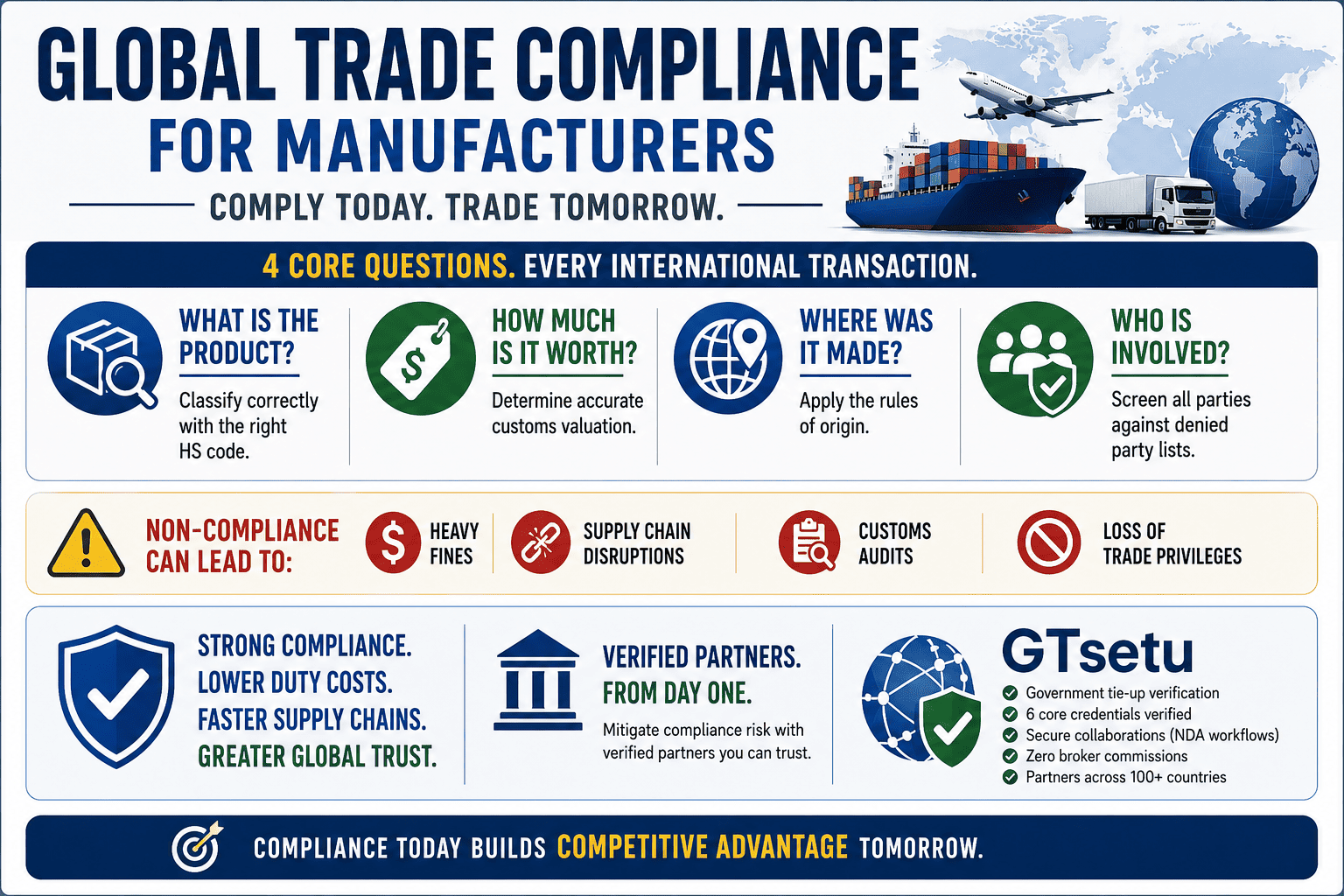
Direct Answer:Global trade compliance for manufacturers is the structured process of ensuring that all cross-border activities—from sourcing raw materials to shipping finished goods—follow the complex web of international laws and regulations. It is the system that answers four fundamental questions for every international transaction: what is the product (HS code), how much is it worth (valuation), where was it made (rules of origin), and who is involved (denied party screening). Non-compliance carries severe consequences: heavy fines, supply chain disruptions, customs audits, and potential loss of import/export privileges. For manufacturers, a robust compliance program is not just about avoiding penalties; it is a strategic enabler that minimizes duty costs, speeds up supply chains, and builds credibility with buyers and regulators worldwide. Finding and verifying the right trade partners is the first line of defense in this process, which is why platforms like GTsetu offer government‑tie‑up verification of six core credentials to help mitigate compliance risk from day one.
📅 Published August 24, 2026🔄 Updated August 24, 2026⏱ 15 min read✍️ GTsetu Editorial Team
5
Core Compliance Pillars
100+
Countries on GTsetu
6
Point Govt Verification
0%
Broker Commission
For manufacturers operating across borders, the regulatory landscape is as complex as the supply chains themselves. Every shipment, every new market, and every new partner introduces a fresh set of compliance requirements that, if missed, can halt operations, incur six-figure penalties, and damage hard-won commercial relationships. Unlike a standardized rulebook, trade compliance regulations vary by country, by product category, and often by the specific destination port, making it one of the most challenging operational functions for manufacturers to manage consistently.
This guide provides a comprehensive overview of global trade compliance for manufacturers: what it is, why it matters, the core regulatory pillars every exporter and importer must master, how financial compliance ties the transaction together, and how to build an internal program that protects your business. We also examine the critical role of company background verification (KYB) in reducing compliance risk, because a compliance program is only as strong as the counterparties you trust with your shipments and sensitive data.
💡 Who This Guide Is For
Manufacturers establishing or scaling export operations, procurement leaders vetting international suppliers, compliance officers building internal frameworks, and B2B distributors seeking to understand their regulatory obligations and those of their partners.
⚖️ Legal Disclaimer
This guide provides commercial and strategic context for understanding global trade compliance. It is not legal advice. Always engage qualified legal and customs counsel in the relevant jurisdictions before acting on any regulatory information.
SECTION 1
1 What Is Global Trade Compliance?
🎯 Definition
Global trade compliance is the structured system of processes, policies, and controls that ensures your cross-border business activities comply with all applicable laws and regulations governing the movement of goods, services, and funds. It is the discipline that translates complex regulatory requirements into daily operational procedures for classification, valuation, documentation, and screening, ensuring that shipments clear customs, payments are received, and your business remains legally protected in every jurisdiction where it operates.
At its core, trade compliance ensures that businesses correctly classify, value, and declare their imported and exported goods. Government agencies require answers to four fundamental questions for every international transaction:
🏷️
What’s the product?
Every product must have a Harmonized System (HS) code that classifies the type of product and determines the duty, tax rate, and other government charges. The code must be accurate and defendable, not chosen based on which has the lowest duty.
📌 Incorrect classification is one of the most common and costly compliance errors.
💰
How much is it worth?
This is the customs value—the total amount you paid to the foreign seller. It’s not just the invoice price; it may include “assists” like packaging, engineering, or tooling costs provided by the buyer to the seller.
📌 Under-declaring value can trigger penalties; over-declaring inflates landed cost unnecessarily.
🌍
Where was it made?
The country of origin is not necessarily the country of export. Accurate reporting of origin is critical because it may increase or decrease duty rates and is essential for claiming free trade agreement benefits.
📌 Preferential origin under FTAs can significantly reduce duty costs.
📦
How much of it is there?
The quantity, weight, and related data from the commercial invoice and packing list. The HS code determines which statistical data elements must be reported to authorities like Customs and the Department of the Census.
📌 Inaccurate quantity reporting can lead to duty miscalculations and fines.
In the end, all these factors come down to one thing: revenue. Customs and government agencies audit companies to ensure they receive the duties, taxes, and fees that are legally owed. Inadequate global trade management creates financial, operational, and strategic costs that extend far beyond compliance penalties. Many manufacturers still manage compliance using ERP extensions, spreadsheets, and institutional knowledge—methods that rely on experienced staff and stable trade rules, but that break down when regulations change or transaction volumes grow.
✨ GTsetu Insight
The foundation of any compliance program is knowing exactly who you are trading with. GTsetu’s 6-point government verification (legal name, registered address, registration number, company status, company type, incorporation date) ensures that the counterparty you are entrusting with your goods and compliance data is a legitimate, registered entity—reducing the risk of sanctions violations, fraud, and misdeclaration from day one.
SECTION 2
2 Why It Matters: The Cost of Non-Compliance
The consequences of non-compliance—whether intentional or accidental—are severe and can be financially devastating. They are not limited to paperwork; they hit your finances, reputation, and ability to trade.
The Cost of Non-Compliance
The ROI of a Robust Compliance Program
Heavy monetary fines under customs and foreign exchange laws
Faster customs clearance with fewer inspections
Seizure or detention of goods at ports
Predictable supply chains and reliable delivery timelines
Increased audits and regulatory scrutiny
Lower duty costs through correct classification and trade agreements
Suspension or loss of import/export privileges
Stronger credibility with banks, buyers, and regulators
Supply chain disruptions and customer trust erosion
Easier scaling into new markets with reduced risk
Reputational damage with buyers and partners
Strategic advantage over non-compliant competitors
Consider this scenario: a distributor buys goods from a manufacturer and sells them to a retailer. The retailer is responsible for ensuring the accuracy of the HS code, the correct quantity, and compliance with labor and environmental regulations—even if they rely on information from the distributor. This makes it imperative for importers to vet their suppliers, sometimes visiting factories to ensure compliance with trade laws.
One real-world compliance failure involved a civil enforcement action against an importer that marketed a branded sweetener product. The company was alleged to have violated laws that prevent goods made with forced labor from entering the country, and CBP assessed $575,000 in fines on that enforcement action. This is not an isolated case; non-compliance can easily equate to a six- or seven-figure profit loss linked to delays, lost revenues, and fines.
📌 Who Is Responsible?
The importer of record is ultimately responsible for ensuring compliance. A customs broker can provide guidance, but the legal and financial liability rests on the importer’s shoulders. This means importers must vet their suppliers and ensure the accuracy of all declarations, regardless of who prepares the paperwork.
SECTION 3
3 Core Pillars of a Compliance Framework
Every effective international trade compliance framework rests on five non-negotiable building blocks. These pillars ensure that your exports and imports remain lawful, financially accurate, and defensible during audits.
🏷️
Product Classification & HS Codes
Assigning the correct HS code determines duties, taxes, and regulatory controls. Errors can lead to excess duty payments, shipment delays, or regulatory audits.
📌 HS codes change periodically, so regular reviews are essential.
💵
Valuation & Duty Management
Customs valuation is the process of declaring the true transaction value. This must include required additions such as design, tooling, or R&D costs provided free or at reduced cost (“assists”).
📌 For related-party transactions, transfer pricing adds another layer of scrutiny.
🌐
Rules of Origin
Origin refers to where goods are manufactured or substantially transformed. Preferential origin allows you to claim lower tariffs under free trade agreements. Non-preferential origin applies for standard MFN tariffs.
📌 Certificates of Origin must match production and sourcing records precisely.
🚫
Denied Party Screening & Sanctions
You must screen customers, suppliers, and intermediaries against restricted party and sanctions lists (OFAC, EU, UN) before any transaction. Violations can occur without intent.
📌 Screening after shipment offers no protection against enforcement action.
🔒
Export Controls & Licensing
Certain goods, software, or technologies require export licenses due to military or strategic use. Dual-use items attract stricter controls even when exported for civilian purposes.
📌 Understanding global control regimes helps assess license needs early.
Tariff Engineering: A Strategic Tool
Tariff engineering is the practice of ensuring the lowest possible compliant duty for products, often by slightly re-engineering a product to alter its most appropriate HS code, potentially saving thousands of dollars in customs duties. For example, adding a plastic coating or decoration to an item can change its classification. However, changing an HS code for a previously imported product has repercussions and must be considered very carefully with expert advice.
SECTION 4
4 Financial Compliance: The Closing Loop of Trade
💡 Critical Insight
International trade does not end when goods are shipped or services are delivered. Financial compliance is the closing loop that ensures cross-border payments are processed correctly, documented properly, and aligned with regulatory reporting requirements. Just as customs authorities regulate the movement of goods, central banks and regulators closely monitor how money moves across borders.
🏦
Cross-Border Payments & Purpose Codes
Every inward or outward foreign payment must carry a purpose code that explains why the money is moving. Banks use these codes to report transactions to the central bank under FEMA and related regulations. Using an incorrect code can lead to payment rejections, delays, or regulatory flags.
🔑 Align the description on your invoice with your shipping documents and the selected purpose code to ensure smooth processing.
📄
FIRC Documentation
A Foreign Inward Remittance Certificate (FIRC)—or its electronic equivalent—serves as proof that export proceeds were received in foreign currency. It is required to claim export incentives, GST refunds, and tax exemptions, and to demonstrate legal realization of export earnings.
🔑 Automated FIRC generation is becoming a standard feature for modern export accounts, reducing documentation gaps.
✨ GTsetu Insight
Financial compliance risk is amplified when dealing with unverified partners. A well-documented KYB process, including verification of the partner’s company registration and legal status, ensures that payments are directed to legitimate entities, reducing the risk of fraud and regulatory queries. See our guide on cross-border business partnerships for more on structuring financially compliant relationships.
SECTION 5
5 Building an Internal Trade Compliance Program
Trade compliance is not a one-time setup. It is an ongoing business process that evolves as you enter new markets, add products, or change payment models. A strong internal program helps you spot risks early, stay audit-ready, and scale global operations without constant firefighting.
1
Conduct a Risk Assessment
Review your current products, services, export destinations, and customer types to identify higher-risk areas. Audit past shipments for errors in classification, valuation, documentation, or payment timelines. Assess the maturity of your internal controls—manual checks, approvals, and escalation processes.
2
Establish Written Policies and Procedures
Create a simple Trade Compliance Manual that documents how things are done. Include clear steps for invoice creation, shipping documentation, denied party screening, and payment tracking. Define ownership clearly so every task has a responsible person.
3
Implement Training and Record Keeping
Train sales, operations, and finance teams regularly on compliance red flags. Maintain trade and payment records for at least five years, as required under most regulations. Use digital tools to store documents securely for quick retrieval during audits.
💡 Compliance Records as Insurance
Think of compliance records like insurance—you may not need them daily, but when you do, delays can be costly. A digital, searchable audit trail is your best defense in a regulatory inspection.
Common Pitfalls in Manual Compliance Management
Many manufacturers still manage compliance using manual processes, spreadsheets, and institutional knowledge. Ask yourself:
Are more than 30% of your export steps still spreadsheet-driven?
Do shipping or compliance teams spend over an hour reconciling export data for a typical transaction?
Does your export compliance process rely on specific individuals instead of standardized procedures?
Do regulatory changes trigger ad hoc fixes rather than systematic adjustments?
Answering ‘yes’ to any of these questions highlights areas where a modern global trade management (GTM) solution can remove bottlenecks, reduce risk, and support growth. ERP systems are not designed to interpret complex export control laws across different jurisdictions or adapt swiftly to regulatory updates.
SECTION 6
6 Regional Trade Compliance Readiness
Trade compliance requirements vary significantly by region. Understanding the regulatory landscape and logistics maturity of your target markets is essential for assessing your own readiness and the risks involved.
Region
Regulatory Complexity
Logistics Quality
Key Compliance Considerations
East & Southeast Asia
High (China, Japan) to Moderate (Vietnam, Thailand)
Very High to Good
Complex certification (CCC in China, METI in Japan); significant sanctions and dual-use controls; RCEP and CPTPP benefits
South Asia (India, Bangladesh)
Moderate-High
Improving, variable by state
FEMA compliance for financial reporting; evolving import/export regulations; PLI incentives for manufacturing
North America (US, Canada, Mexico)
High (US) to Moderate
Very High
OFAC screening; USMCA rules of origin; FDA and CPSC compliance for certain products; CBP audit focus
European Union
High, with unified customs code
Very High
EU dual-use regulation; REACH and RoHS for chemicals; VAT reporting; UK-EU border controls post-Brexit
One of the most common and costly errors. Mitigate by conducting regular internal reviews, consulting with customs brokers, and using automated classification tools. Cross-check with sector-specific guidance.
🚫
Unvetted Trade Partners
Engaging with an entity that is on a sanctions list or is misrepresenting its identity. Mitigate by using a verified B2B platform like GTsetu with government tie-up verification for KYB.
📄
Inadequate Documentation
Missing or inaccurate customs paperwork leads to delays, detention, and fines. Mitigate by establishing a digital, auditable record-keeping system and training staff on documentation standards.
💸
Financial Reporting Errors
Incorrect purpose codes or missing FIRC documentation can block payments and trigger regulatory queries. Mitigate by ensuring invoice descriptions align with shipping and payment data, and using automated financial compliance tools.
📌 The Hidden Costs of Inadequate GTM
The most visible effects of weak export controls are delays, penalties, and enforcement actions. Less visible are the long-term secondary impacts: revenue leakage from licensing uncertainty, operational inefficiency from manual workarounds, and lost competitive advantage from avoiding entire markets because the compliance burden outweighs the opportunity.
SECTION 8
8 The Role of Partner Verification (KYB) in Compliance
🔐 Foundational Principle
A trade compliance program is only as strong as the counterparties it governs. Company background verification (KYB) is the process of independently confirming a business entity’s legal identity, registration status, and ownership structure before entering into a commercial relationship. It is the business-entity equivalent of KYC and is critical for managing sanctions risk, ensuring supply chain integrity, and maintaining contract enforceability. Without KYB, your compliance program has a blind spot on its most important variable: the identity and legitimacy of your partners.
KYB Check Category
What It Confirms
Compliance Risk Mitigated
Legal Name Verification
Entity name matches official registry
Prevents trading with imposters or companies using unregistered aliases
Company Registration Number
Registration number is valid and active
Identifies fabricated or duplicate registrations
Company Status
Entity is active, not struck-off or dissolved
Prevents engaging with a dissolved or insolvent entity
Registered Address
Official address matches presented address
Exposes ghost companies and misrepresented locations
UBO (Ultimate Beneficial Owner)
Individuals who own/control the entity
Essential for sanctions and AML screening of the true controllers
For manufacturers and distributors, the consequences of inadequate KYB are among the most consistently recurring causes of cross-border trade partnership failure, as detailed in our guide on company background verification. A thorough KYB check provides the foundational data needed for effective denied party screening, helps maintain supply chain integrity, and ensures that commercial contracts are enforceable against the correct legal entity.
SECTION 9
9 How GTsetu Helps Reduce Compliance Risk
🌐 Platform Spotlight, GTsetu
Verify Before You Transact: The Compliance-First Approach
Trade compliance begins with partner selection. A manufacturer’s entire compliance program—classification, valuation, sanctions screening, and documentation—is built on the assumption that the counterparty is a legitimate, registered entity. GTsetu provides the verified starting point for this process. Every company on GTsetu is verified using direct government tie-ups across six essential credentials: legal name, registered address, registration number, company status, company type, and date of incorporation. This verification infrastructure, detailed in our guide on KYB, ensures that when you engage a partner through GTsetu, you already have a documented, government-sourced record of their legal identity, reducing the risk of sanctions violations and fraud from the first contact.
✅
6-Point Govt Verification
Legal name, registered address, registration number, company status, company type, incorporation date—all verified via government tie-ups.
🚫
Sanctions & Watchlist-Ready
Verified legal names and registration details provide a solid foundation for screening against OFAC, EU, UN, and national sanctions lists.
🕵️
Anonymous Discovery
Explore verified profiles across 100+ countries without revealing your identity, keeping your sourcing strategy confidential.
📄
Built-In NDA Workflow
Formalize confidentiality before exchanging sensitive compliance data (like product specifications or pricing) with a fully audit-ready trail.
🔐
Secure Due Diligence Workspace
Share documents and collaborate in an encrypted environment, protecting IP and sensitive commercial data integral to compliance.
🌍
100+ Country Coverage
Verified partners across Asia, the Middle East, Europe, Africa, and the Americas, mapped to regional compliance requirements.
Verified manufacturers & distributors on one platform
✓ Single platform
✗ Separate sources
Encrypted document sharing
✓ Built-in
✗ Email risk
FAQ
? Frequently Asked Questions
QWhat is global trade compliance?
Global trade compliance is the process of adhering to all laws and regulations governing cross-border movement of goods, services, and funds. It encompasses customs requirements, export controls, sanctions screening, and financial documentation to ensure legal trade operations.
QWhy is HS code classification critical for manufacturers?
HS codes determine the duties, taxes, and regulations applicable to your products in every country. Incorrect classification leads to duty overpayments, severe regulatory fines, and extended shipment delays during customs audits. Errors in classification are one of the most common and costly compliance failures.
QWhat are the consequences of non-compliance with trade regulations?
Consequences can include heavy fines and penalties (sometimes six or seven-figure sums), supply chain disruptions due to customs holds and government inspections, increased regulatory scrutiny and audits, and in severe cases, the suspension or loss of import/export privileges.
QWho is responsible for trade compliance in an international transaction?
The importer of record is ultimately responsible for ensuring compliance. A customs broker can provide guidance, but the legal and financial liability rests on the importer’s shoulders. This means importers must vet their suppliers and ensure the accuracy of all declarations.
QWhat are the core pillars of a trade compliance framework?
The core pillars are: (1) Product Classification (using correct HS codes), (2) Customs Valuation (declaring the true transaction value), (3) Rules of Origin (determining where goods are made), (4) Denied Party Screening and Sanctions (checking against restricted party lists), and (5) Export Controls and Licensing (identifying when a license is needed).
QHow does financial compliance fit into global trade?
Financial compliance ensures cross-border payments are processed correctly using accurate purpose codes for central bank reporting. It also involves maintaining documentation like Foreign Inward Remittance Certificates (FIRC) to prove receipt of export proceeds, which is essential for claiming incentives and tax exemptions.
QWhat is denied party screening and why is it important?
Denied party screening is the process of checking customers, suppliers, and intermediaries against government-maintained restricted or sanctioned party lists (e.g., OFAC, EU, UN lists). It is critical because trading with a sanctioned entity, even unknowingly, can result in severe penalties, reputational damage, and loss of export privileges.
QWhat is the difference between preferential and non-preferential origin?
Preferential origin qualifies goods for reduced or zero tariffs under free trade agreements by meeting specific rules like regional value content. Non-preferential origin determines the standard country of origin for Most Favored Nation (MFN) tariffs, trade statistics, and quotas, without any duty preferences.
QWhat are the benefits of a robust trade compliance program?
A strong program minimizes duty costs through strategic use of trade agreements and tariff classifications, enables faster supply chain operations, reduces legal risks and prevents costly fines, and strengthens credibility with banks, buyers, and regulators. It transforms compliance from a cost center into a competitive advantage.
QHow do company verification and KYB reduce trade compliance risk?
Verifying the legal identity and status of your trade partners (KYB) is foundational to trade compliance. Working with a verified entity reduces the risk of sanctions violations, fraud, and supply chain integrity issues. GTsetu’s 6-point government tie-up verification helps manufacturers ensure their counterparties are legitimate and registered before any commercial engagement.
Ready to Build a Compliance-Ready Supply Chain?
Start with partners you can trust. Join GTsetu’s network of verified manufacturers, suppliers, and distributors across 100+ countries, with government-tie-up verification, built-in NDA workflows, and zero broker fees.
They represents the product, and research team behind GTsetu, a global B2B collaboration platform built to help companies explore cross-border partnerships with clarity and trust. The team focuses on simplifying early-stage international business discovery by combining structured company profiles, verification-led access, and controlled collaboration workflows.
With a strong emphasis on trust, and disciplined engagement, Team GTsetu shares insights on global trade, partnerships, and cross-border collaboration, helping businesses make informed decisions before entering deeper commercial discussions.