ASEAN as a Manufacturing Hub: Country Strengths, Key Sectors & Sourcing Guide
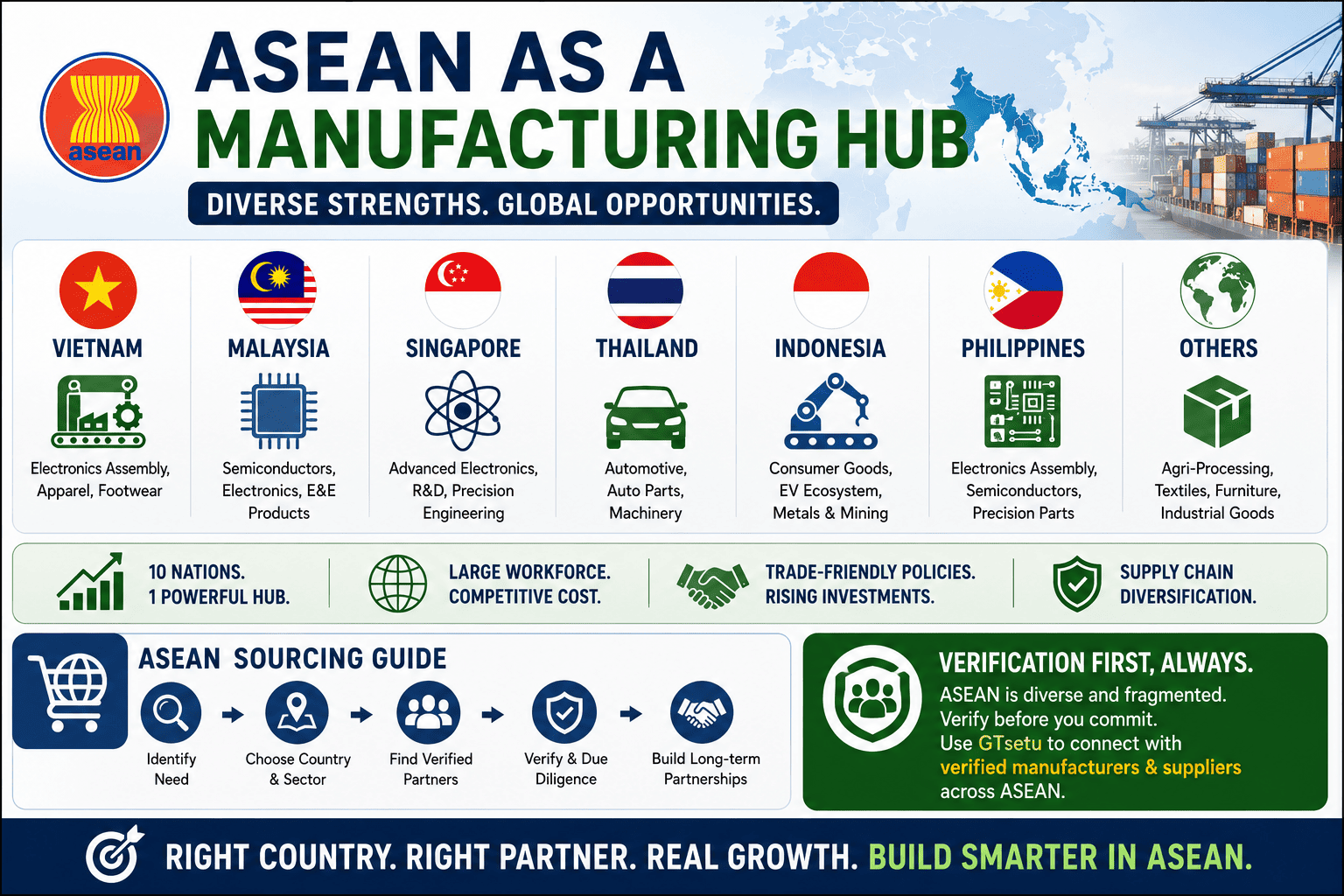
Direct Answer: ASEAN, the ten-nation Southeast Asian bloc spanning Vietnam, Indonesia, Malaysia, Thailand, the Philippines, Singapore, and others, has become one of the world’s fastest-growing manufacturing hubs, driven by a large and increasingly skilled workforce, trade-friendly policy, rising foreign direct investment, and companies pursuing supply chain diversification away from single-country concentration. Each country brings a different strength: Vietnam leads in electronics assembly and apparel, Malaysia and Singapore anchor semiconductors and advanced electronics, Thailand dominates automotive, Indonesia combines scale with a growing EV push, and the Philippines specializes in electronics assembly and precision components. This is the core dynamic behind the China Plus One shift reshaping global sourcing. The opportunity is real, but so is the fragmentation, ten different regulatory systems, company registries, and supplier ecosystems mean that verifying who you are actually dealing with matters as much as picking the right country, which is why partner verification through a platform like GTsetu belongs at the start of any ASEAN sourcing strategy.
📅 July 28, 2026⏱ 20 min read✍️ GTsetu Editorial Team🔄 Updated regularly
10
ASEAN Member Economies
6
Country Profiles Compared
100+
Countries on GTsetu
0%
GTsetu Partner Commission
A decade ago, “manufacturing in Asia” meant, for most buyers, one country. That assumption no longer holds. Southeast Asia has moved from a low-cost assembly afterthought to a genuine parallel manufacturing base, with its own semiconductor back-end clusters, automotive production lines, and electronics export corridors competing directly for the same global orders that once went almost exclusively elsewhere.
This guide explains why ASEAN’s manufacturing base has grown so quickly, what each member country actually specializes in, which sectors are leading the shift, and how buyers, distributors, and manufacturers should think about choosing where, and with whom, to build a supply chain across the region. For related context, see our guides on market entry partnerships, cross-border business partnerships, and the China Plus One strategy explained.
💡 Editorial Notice
This guide provides general commercial and market analysis of ASEAN manufacturing trends for educational purposes. It does not constitute investment, legal, or tax advice. Country-level regulations, incentive schemes, and sector dynamics change frequently and vary by product category. Always consult qualified local counsel and conduct current market research before committing to a sourcing or market entry decision. For guidance on finding and verifying manufacturing partners across the region, GTsetu’s verified matchmaking platform is available at platform.gtsetu.com.
SECTION 1
1 Why ASEAN Is Rising as a Manufacturing Hub
🎯 Core Drivers
ASEAN’s rise as a manufacturing hub rests on a combination of structural advantages: a large, relatively low-cost, and increasingly technically skilled workforce; a strategic geographic position between China, India, and major global shipping lanes; trade-friendly policy including a growing web of free trade agreements; government industrial strategies actively courting electronics, semiconductor, and automotive investment; and rising foreign direct investment from companies deliberately diversifying production away from a single manufacturing base. None of these factors alone would be decisive, together, they have made the region genuinely competitive rather than merely cheap.
Structural Advantage
Workforce, Location & Policy
A combined population of over 650 million provides a deep labor pool, with government-backed technical training programmes steadily upgrading skills in electronics, precision engineering, and process manufacturing.
Geographic proximity to China’s established supplier base allows component sourcing to remain efficient even as final assembly shifts to ASEAN countries.
National industrial strategies, such as Thailand 4.0, Making Indonesia 4.0, and Malaysia’s National Semiconductor Strategy, actively target high-value manufacturing investment.
Large workforceStrategic locationIndustrial policy
Structural Advantage
Investment & Diversification Demand
Rising FDI from global electronics, automotive, and semiconductor companies actively expanding or relocating capacity into Vietnam, Malaysia, and Indonesia.
Buyer-driven demand for supply chain diversification following recent years of geopolitical tension and single-source disruption risk.
Expanding port, industrial park, and logistics infrastructure specifically built to support export-oriented, semiconductor-ready, and green manufacturing.
In 2022, ASEAN’s combined exports reached roughly US$1.98 trillion, led by electronics and machinery, with Vietnam, Malaysia, and Thailand among the largest contributors. This is not a story of one breakout country, it is a region-wide shift, with each member state building on a distinct base of existing industrial capability. See also: international market entry for manufacturers and distributors.
SECTION 2
2 The China Plus One Shift and ASEAN’s Role
🔀
What China Plus One Actually Means
Diversification, not replacement
The Strategy
Companies deliberately add a second manufacturing location outside China, rather than concentrating all production capacity in a single country, to reduce exposure to tariff shifts, geopolitical tension, logistics disruption, and rising costs in any one market.
Why ASEAN Wins This Business
Proximity to existing China-based component supply chains, favourable trade agreements, growing industrial infrastructure, and government incentive programmes make ASEAN nations, especially Vietnam, Indonesia, Malaysia, and Thailand, the most common landing point for this diversified capacity.
Implication
China Plus One is a spreading of risk, not a wholesale relocation, many buyers retain China-based sourcing for components and mature processes while building parallel ASEAN capacity for final assembly, new capacity growth, or geographically diversified export routes. See: China Plus One strategy explained for a deeper breakdown of this pattern.
💡 Semiconductors Are the Clearest Example
The ASEAN semiconductor sector illustrates the pattern well: Malaysia and Singapore lead in wafer fabrication, advanced packaging, and process R&D; Vietnam, Thailand, and the Philippines are expanding roles in assembly, testing, and backend manufacturing; and Indonesia is emerging as a fast-growing production base backed by government investment in its semiconductor ecosystem. Global chipmakers are increasingly investing across several of these countries simultaneously rather than picking just one.
SECTION 3
3 Country-by-Country Manufacturing Strengths
ASEAN is a regional bloc, but treating it as a single homogenous sourcing destination misses the point, each member economy has developed a distinct manufacturing identity, and the right choice depends entirely on what is being produced.
🇻🇳
Vietnam
Electronics, textiles, and apparel assembly at global scale
Strengths
A global hub for electronics assembly, textiles, and apparel, with major investment from Samsung, Intel, and Foxconn. Vietnam’s electronics exports alone exceed US$100 billion, and the government continues upgrading workforce skills to move up the value chain.
Best Suited For
Consumer electronics assembly, apparel and textile production, and export-oriented light manufacturing seeking cost-competitive, high-volume capacity with strong existing supplier density.
🇲🇾
Malaysia
Semiconductor back-end manufacturing and high-tech electronics
Strengths
A key global player in semiconductors, with its electronics and electrical (E&E) sector producing roughly 13% of the world’s back-end semiconductor output and driving around 40% of the country’s exports. Malaysia is actively expanding into integrated circuit design and wafer fabrication.
Best Suited For
Semiconductor testing and packaging, advanced electronics manufacturing services, and buyers needing strong infrastructure and a skilled technical labor base for high-precision production.
🇹🇭
Thailand
Automotive manufacturing at regional scale
Strengths
Known as the “Detroit of Asia,” Thailand produces well over two million vehicles annually alongside a strong electronics sector, supported by the “Thailand 4.0” smart manufacturing strategy and deep, established automotive supplier networks.
Best Suited For
Automotive components and assembly, precision machinery, and buyers who need an established, high-volume vehicle-manufacturing ecosystem with mature supporting industries.
🇮🇩
Indonesia
Regional scale, automotive, and a growing EV push
Strengths
ASEAN’s largest economy, strong in automotive and textiles, with natural-resource industries such as palm oil and mining also significant. The “Making Indonesia 4.0” initiative targets building a global hub for electric vehicles, and Indonesia has become a dominant force in regional semiconductor manufacturing investment.
Best Suited For
Buyers seeking sheer market and production scale, EV and battery supply chain positioning, and access to a large domestic consumer market alongside export capacity.
🇵🇭
The Philippines
Electronics assembly, aerospace, and medical devices
Strengths
Focused on electronics assembly, shipbuilding, aerospace components, and medical devices, supported by a skilled, English-speaking workforce well suited to technical documentation, design outsourcing, and testing roles.
Best Suited For
Electronics testing and assembly, aerospace component manufacturing, medical device production, and buyers who value strong English-language business communication alongside technical capability.
🇸🇬
Singapore
Advanced R&D, design, and high-value precision manufacturing
Strengths
Anchors the region’s advanced semiconductor R&D, precision engineering, and process innovation, with a stable regulatory environment and deep capital markets supporting high-value manufacturing investment.
Best Suited For
Product design, R&D partnerships, regional headquarters functions, and high-value, low-volume precision manufacturing rather than mass-scale, cost-driven assembly. See: technology partnerships.
Country
Core Manufacturing Identity
Leading Sectors
Vietnam
High-volume electronics and apparel assembly hub
Electronics, textiles, apparel
Malaysia
Semiconductor and high-tech electronics leader
Semiconductors, E&E, testing/packaging
Thailand
Regional automotive manufacturing powerhouse
Automotive, electronics, machinery
Indonesia
Largest economy with scale and EV ambitions
Automotive, textiles, natural resources, EVs
Philippines
Electronics, aerospace, and medical device assembly
Electronics, aerospace, medical devices
Singapore
Advanced R&D and precision manufacturing hub
Semiconductor R&D, precision engineering
SECTION 4
4 Key Sectors Driving ASEAN Manufacturing
💾
Electronics & Semiconductors
ASEAN is central to the global electronics supply chain, with Vietnam, Malaysia, and Thailand as leaders and Singapore anchoring advanced R&D and design.
🚗
Automotive & EVs
Thailand and Indonesia dominate, with Thailand’s established export base and Indonesia’s growing electric vehicle industry, backed by major global brands.
🧵
Textiles & Apparel
Vietnam is among the world’s top apparel exporters, supported by low costs and a skilled workforce, with Indonesia and Cambodia also contributing significantly.
🏗️
Heavy Industries & Materials
The region produces steel, cement, and chemicals supporting regional infrastructure development, particularly across Indonesia, Vietnam, and Thailand.
🩺
Medical Devices
Growing rapidly in Singapore, Malaysia, and Thailand, which specialize in disposable and diagnostic equipment for global healthcare supply chains.
📦
Plastics & Packaging
Vietnam and Indonesia are seeing strong growth in plastics and flexible packaging, driven by demand from food, automotive, and consumer goods sectors.
SECTION 5
5 FDI, Trade Agreements, and Regional Infrastructure
💰
What Is Attracting Global Capital
Beyond low labor cost
Trade & Policy Framework
ASEAN’s proximity to major Asian markets and its trade-friendly policies, including regional free trade agreements, make it a preferred manufacturing and export base. National strategies, Vietnam’s industrial park expansion, Malaysia’s National Semiconductor Strategy, Indonesia’s Making Indonesia 4.0, actively target specific high-value sectors with incentives.
Infrastructure Investment
Provinces across Vietnam and Indonesia are developing semiconductor-ready, green, and smart industrial park infrastructure, alongside expanded port and logistics capacity, specifically designed to support the next wave of export-oriented manufacturing investment.
Implication
Buyers evaluating a new manufacturing hub should look past headline labor cost figures to the underlying trade agreement coverage, incentive eligibility, and infrastructure maturity, these increasingly determine total landed cost and reliability more than wage rates alone. See: cross-border business tax guide for manufacturers and distributors.
SECTION 6
6 Risks and Challenges of Manufacturing in ASEAN
The opportunity is real, but ASEAN is not a single, uniform market, it is ten countries with different regulatory systems, company registries, infrastructure maturity levels, and supplier ecosystems. Buyers who treat the region as interchangeable expose themselves to avoidable risk.
Risk Area
What It Looks Like in Practice
Uneven infrastructure
Strong capacity in flagship industrial hubs (Penang, Batam, Eastern Seaboard) alongside weaker logistics and power reliability in secondary regions
Regulatory fragmentation
Ten distinct company registration, tax, labor, and import/export regimes, each requiring separate due diligence
Skills gaps
Strong assembly-level labor availability, but shortages in higher-value technical and engineering roles in some markets
Component supply chain immaturity
Certain higher-value components still imported rather than locally produced, adding lead time and currency exposure
Supplier verification difficulty
Less centralized, less standardized company registries than more established sourcing destinations, making legitimacy checks harder without the right tools
⚠️ Diversification Does Not Remove Due Diligence
Moving capacity into ASEAN to reduce single-country concentration risk is a sound strategy, but it does not remove the need for the same rigor buyers should apply anywhere: verifying company legitimacy, auditing factory capability, and structuring the commercial relationship properly. A poorly verified ASEAN supplier is not a lower-risk alternative to a poorly verified supplier anywhere else. See: common red flags in international partnerships and factory audits explained.
SECTION 7
7 Decision Framework: Choosing an ASEAN Manufacturing Hub
Choosing where in ASEAN to source or set up manufacturing should be driven by product category, required scale, target export markets, and the specific technical capability needed, not by which country happens to be trending. The following framework maps common decision factors to the most relevant country strengths.
Decision Factor
→ Consider
→ Or Consider
Are you sourcing electronics assembly at high volume?
Singapore, English-language business and regulatory environment
Do you need R&D, design, or a regional HQ presence over mass production?
Singapore, capital markets, stability, precision engineering
Malaysia, expanding into design and higher-value segments
💡 Start With Two to Four Candidate Hubs, Not One
Rather than committing to a single ASEAN country as a wholesale China replacement, the most effective approach is to map the specific production process required, shortlist two to four candidate hubs based on the country strengths above, and run supplier outreach, capacity checks, and verification in parallel before narrowing to a final decision. This mirrors the broader China Plus One logic, diversify deliberately, rather than swapping one single point of concentration for another. See: trialing and scaling production for startups.
SECTION 8
8 Common Mistakes When Entering ASEAN Supply Chains
10
distinct national regulatory and company registration systems across ASEAN member states
2–4
candidate hubs is a practical starting shortlist size before narrowing to a final sourcing decision
High Cost
of treating ASEAN as one homogenous market instead of ten distinct sourcing environments
🚩
Treating ASEAN as a Single Market
Assuming that supplier quality, regulatory expectations, and company verification standards are consistent across all ten member states, when each country operates its own distinct system.
🚩
Chasing Labor Cost Alone
Selecting a hub purely on headline wage data without weighing infrastructure maturity, component supply chain depth, and trade agreement coverage, all of which affect total landed cost more than wages alone.
🚩
Skipping Factory Verification in “Hot” Markets
Assuming that because a country is a well-publicized manufacturing hub, individual suppliers within it don’t need the same audit and verification discipline applied elsewhere. See: factory audits explained.
🚩
No Plan for Long-Term Supplier Management
Onboarding an ASEAN supplier without a structured plan for ongoing quality monitoring, relationship management, and periodic re-verification as volumes scale. See: long-term supplier management.
🚩
Underestimating Supplier Switching Costs
Committing tooling, moulds, and process investment to a single ASEAN supplier without a contingency plan, then discovering how costly and slow switching suppliers becomes if the relationship underperforms. See: supplier switching risks.
🚩
Partnering With an Unverified Company
Committing to a supplier or distributor across an unfamiliar market without independently confirming company registration, legal status, and identity. Verify first with GTsetu’s verified matchmaking platform before structuring any agreement.
SECTION 9
9 Finding and Verifying ASEAN Manufacturing Partners
Choosing the right ASEAN country is only half the decision, choosing the right company within that country is the part that determines whether the sourcing strategy actually works. Ten distinct regulatory environments mean ten distinct ways a company can misrepresent itself, and traditional partner discovery methods often can’t verify legitimacy consistently across all of them. See: limitations of partner discovery and why trust breaks in global deals.
🤝 Platform Spotlight, GTsetu
Verified Manufacturing Partners Across the ASEAN Region
GTsetu is a verified B2B matchmaking platform that helps manufacturers and distributors identify, verify, and engage the right trade partners across Vietnam, Indonesia, Malaysia, Thailand, the Philippines, Singapore, and beyond. Every company on GTsetu is verified using government tie-ups on six key points: Name, Address, Registration Number, Company Status, Company Type, and Date of Certificate of Incorporation. AI-assisted matching then surfaces the highest-fit manufacturing partners by industry, geography, product category, company size, and partnership intent. Whether you are shortlisting a Vietnamese electronics assembler or evaluating a Malaysian semiconductor testing facility, GTsetu gives you verified, commercially relevant candidates, with a built-in NDA workflow and encrypted workspace to protect the due diligence process.
🏛️
6-Point Govt. Verification
Every partner verified on Name, Address, Registration Number, Company Status, Company Type, and Date of Incorporation through government sources before joining.
🆔
Company & Tax ID Checks
Cross-market TIN and registration verification designed for the fragmented regulatory landscape across ASEAN’s ten member economies.
🤖
AI-Assisted Matching
Multi-criteria fit scoring by industry, geography, product category, company size, and manufacturing capability, surfacing the highest-fit verified candidates automatically.
🕵️
Anonymous Discovery
Browse verified manufacturers across ASEAN and 100+ countries without revealing your identity or sourcing intentions until you are ready to signal interest.
📄
Built-In NDA Workflow
Digital NDA execution with timestamped signatures triggered before any commercially sensitive due diligence data is exchanged.
🔐
Encrypted Due Diligence Workspace
AES-256 encrypted document workspace with full audit trail for all information exchanged during partner assessment.
🚫
Zero Commission
No broker fee or success commission on any partnership formed across any ASEAN market. GTsetu’s incentives are fully aligned with finding you the best partner.
🌍
100+ Countries
Verified manufacturers and distributors across Asia, Middle East, Europe, Africa, Australia, and the Americas, available for matching from one platform.
📋
Full Audit Trail
Every access event, NDA signature, and document exchange logged with timestamp, providing a defensible record of due diligence across every market you enter.
Step 1, Verify the Company Before Evaluating the Country Fit
Every company on GTsetu is verified on six government-sourced points before joining, including company TIN number verification where applicable. When you identify a potential manufacturing partner in Vietnam, Malaysia, or elsewhere in ASEAN through GTsetu, you already know their company registration is legitimate and current, before any country-level strategy discussion begins.
Pre-Screening
🤖
Step 2, Match on the Sector Strengths That Matter
GTsetu’s AI-assisted matching scores prospective partners against your criteria across product category, geography, and technical capability, connecting an electronics buyer with the right Vietnamese or Malaysian candidates, or an automotive buyer with the right Thai or Indonesian ones. See: distributor network guide and international wholesale distributors.
Matching
🕵️
Step 3, Conduct Anonymous Discovery Across Candidate Hubs
Browse and assess potential manufacturing partners across several ASEAN countries anonymously before revealing your identity or sourcing volumes, protecting your negotiating position while you compare candidate hubs. See: B2B matchmaking tool guide and B2B business network guide.
Protection
📄
Step 4, Execute NDA Before Sharing Sourcing Documentation
GTsetu’s built-in NDA workflow ensures that the encrypted document workspace, where product specifications, capacity data, and commercial terms are shared, only unlocks after both parties have digitally signed a confidentiality agreement. See: business partnership contract guide for the clauses that follow.
Legal Gate
🔐
Step 5, Structure the Relationship With the Right Framework
Once a verified partner is identified, structure the relationship appropriately for the scale of investment involved, a distribution agreement, a technology partnership, or a full joint venture. See: collaboration agreement vs joint venture and global partner portal types and features for managing the relationship going forward.
Structuring
🚫
Step 6, Scale With Ongoing Quality and Cost Discipline
QWhy is ASEAN becoming a global manufacturing hub?
ASEAN is becoming a global manufacturing hub because it combines a large, relatively low-cost and increasingly skilled workforce, strategic geographic position between major Asian and global markets, trade-friendly policy and free trade agreements, and rising foreign direct investment from companies pursuing supply chain diversification away from a single-country concentration. Government industrial strategies in Vietnam, Indonesia, Malaysia, and Thailand have actively courted electronics, semiconductor, and automotive investment, while regional infrastructure and port capacity have expanded to support export-oriented production. See: market entry partnerships guide.
QWhich ASEAN country is strongest for which type of manufacturing?
Vietnam is a global hub for electronics assembly, textiles, and apparel, with heavy investment from companies such as Samsung, Intel, and Foxconn. Malaysia is a leader in semiconductor back-end manufacturing, testing, and packaging, and is expanding into design and wafer fabrication. Thailand, sometimes called the Detroit of Asia, dominates automotive manufacturing alongside a strong electronics sector. Indonesia is ASEAN’s largest economy, strong in automotive, textiles, and natural-resource industries, with a push toward electric vehicles. The Philippines focuses on electronics assembly, shipbuilding, aerospace components, and medical devices. Singapore anchors the region’s advanced R&D, precision engineering, and high-value electronics design.
QWhat is the China Plus One strategy and how does ASEAN fit in?
The China Plus One strategy refers to companies deliberately diversifying manufacturing capacity outside of China into a second country or region, rather than concentrating all production in one location. ASEAN nations, particularly Vietnam, Indonesia, Malaysia, and Thailand, are among the most common China Plus One destinations because of their proximity to China’s existing supply chains, growing industrial infrastructure, and trade agreements that provide preferential market access. This shift is not a wholesale replacement of China-based manufacturing but a deliberate spreading of production risk across multiple locations. See: China Plus One strategy explained.
QWhat are the main risks of manufacturing in ASEAN?
The main risks of manufacturing in ASEAN include uneven infrastructure quality between industrial hubs and secondary regions, variation in regulatory and legal frameworks across ten different countries, labor and skills shortages in higher-value technical roles, supply chain immaturity for certain component categories that still rely on imports, and the difficulty of verifying supplier legitimacy and capability across markets with less centralized company registries than more established sourcing destinations. These risks are manageable with proper due diligence, factory auditing, and verified partner selection, but they are materially different from the risks of sourcing from a single, more consolidated manufacturing base. See: common red flags in international partnerships and factory audits explained.
QHow do I choose which ASEAN country to source from or set up in?
Choosing an ASEAN manufacturing location depends on the product category, required scale, proximity to your target export markets, applicable trade agreements, and the specific technical capability required. Electronics and semiconductor buyers often prioritize Malaysia, Vietnam, or Singapore; automotive buyers typically look to Thailand or Indonesia; apparel and light assembly buyers often favor Vietnam; and buyers needing English-language business operations and precision electronics often consider the Philippines. The right approach is to map the specific production process required, shortlist two to four candidate hubs, and verify supplier capability through factory audits and company verification before committing. See: partnership evaluation criteria.
QHow should I verify an ASEAN manufacturing partner before committing?
Verification should start with confirming the company’s basic legal identity, registration, legal status, and address, against the relevant national registry, followed by a technical capability or factory audit once the company itself has been confirmed as legitimate. Because each ASEAN country operates its own registration system, this step is more fragmented than in more centralized markets, which is why platforms that perform government-sourced company verification across multiple ASEAN economies, such as GTsetu, are particularly useful before committing budget to travel, factory audits, or tooling investment. See: company TIN number verification.
Whether you’re evaluating Vietnam for electronics assembly or Malaysia for semiconductor testing, the partner decision is what makes or breaks the strategy. Join 500+ verified manufacturers and distributors across 100+ countries on GTsetu, AI-assisted matching, anonymous discovery, built-in NDA workflows, encrypted due diligence workspace, and zero broker commissions on every partnership formed.
They represents the product, and research team behind GTsetu, a global B2B collaboration platform built to help companies explore cross-border partnerships with clarity and trust. The team focuses on simplifying early-stage international business discovery by combining structured company profiles, verification-led access, and controlled collaboration workflows.
With a strong emphasis on trust, and disciplined engagement, Team GTsetu shares insights on global trade, partnerships, and cross-border collaboration, helping businesses make informed decisions before entering deeper commercial discussions.