How Do Companies Do Company Background Verification (KYB)? | GTsetu
Home ›
Blogs ›
Company Background Verification (KYB)
🏛️ Business Verification & KYB
How Do Companies Do Company Background Verification (KYB)?
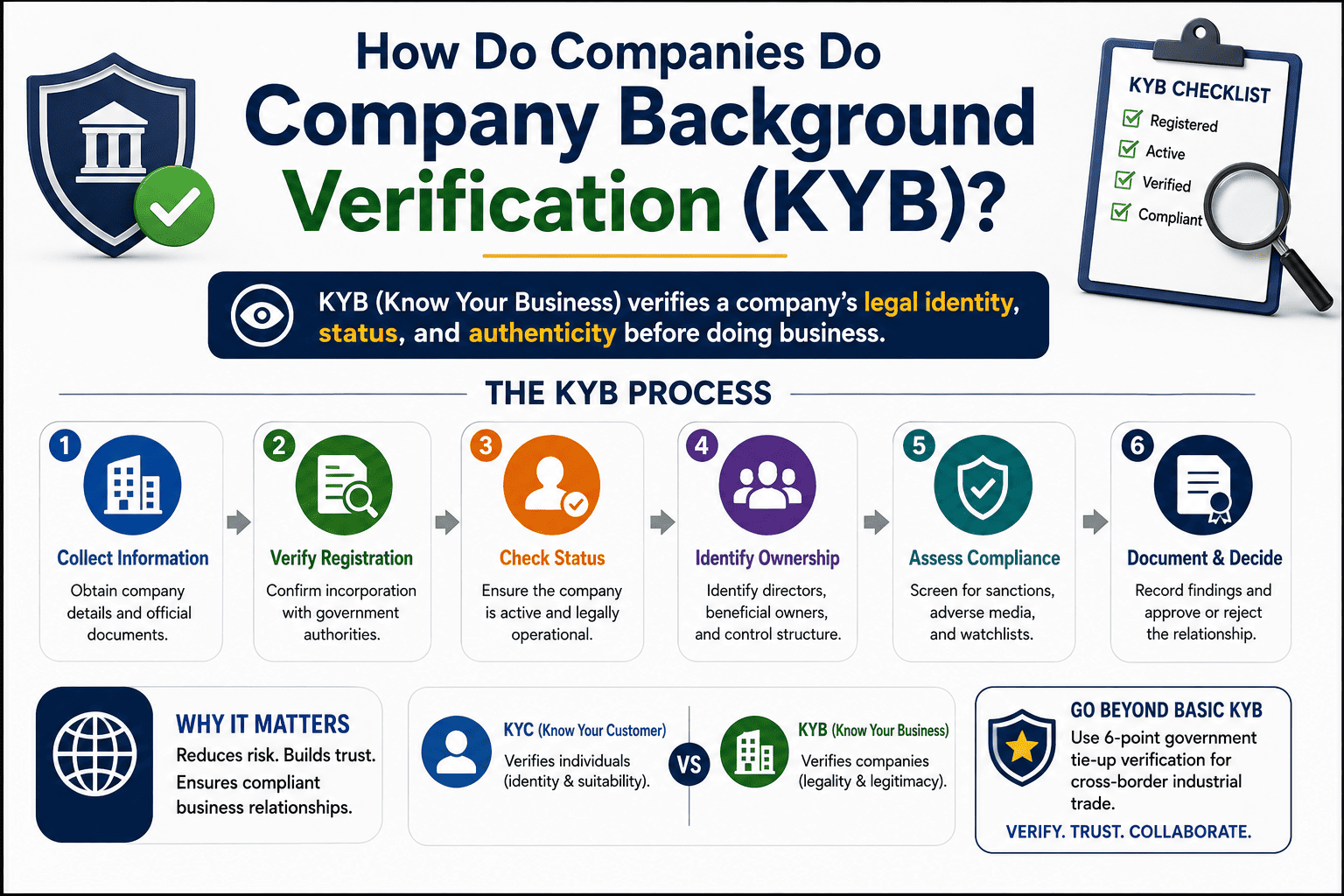
At a glance: Company background verification, formally called KYB (Know Your Business), is the process of independently confirming that a business entity is legally registered, currently active, and operating under the identity it presents before entering into a commercial relationship with it. It goes well beyond a Google search or a directory listing. This guide covers the complete KYB process: what it checks, how it differs from KYC, what companies do at each stage, the tools available globally, and why manufacturers and distributors in cross-border industrial trade need a 6-point government tie-up verification standard, not just a basic KYB check.
📅 July 2026⏱ 20 min read✍️ GTsetu Editorial Team🔄 Updated regularly
8
KYB Check Categories
6-Point
GTsetu Govt Verification
7.2%
Business Profiles Have Discrepancies
100+
Countries on GTsetu
Most businesses think they know their trade partners. They have traded with them for months or years. They have visited their offices or factories. They have seen their marketing materials and read their LinkedIn profiles. And yet, when something goes wrong, when an order is not delivered, when a payment disappears, when a product specification is misrepresented, when a distributor turns out to be a trading company with no real market presence, it frequently emerges that the partner’s identity was never independently verified against official government records.
This is the gap that company background verification, KYB (Know Your Business), is designed to close. Not a Google search. Not a reference call. Not a paid directory badge. A systematic, government-sourced check of the company’s legal name, registration number, current status, type, address, and ownership, confirming that the entity is who it says it is, is currently active, and has the legal structure and trading history it presents.
This guide covers the complete KYB process: what it is, what it checks, how it is performed, what tools and sources are available globally, and why manufacturers, distributors, and raw material suppliers in cross-border industrial trade need a more rigorous standard than standard KYB, one that is built into the partnership formation process, not bolted on afterwards.
💡 Who This Guide Is For
This guide is written for business development teams evaluating new trade partners, procurement managers onboarding suppliers, compliance officers building KYB frameworks, and manufacturers and distributors who want to understand what proper company verification looks like before entering into distribution, supply, or manufacturing agreements. For related reading, see: common red flags in international partnerships, why trust breaks in global deals, and company TIN number verification.
SECTION 1
1 What Is Company Background Verification (KYB)?
📖 Definition
Company background verification, formally known as KYB (Know Your Business), is the process of independently confirming a business entity’s legal identity, registration status, ownership structure, and commercial standing by checking its claimed credentials against official government and authoritative third-party records. It is the business-entity equivalent of KYC (Know Your Customer), which verifies individual identity. KYB confirms that a company is legally real, currently active, and operating as it represents, before any commercial, financial, or contractual relationship is entered into.
KYB originated in the financial services sector as a regulatory requirement for banks, payment processors, and financial institutions under Anti-Money Laundering (AML) and Counter-Terrorist Financing (CTF) frameworks. It has since expanded well beyond finance, manufacturers, distributors, procurement teams, and industrial businesses increasingly apply KYB standards when onboarding new trade partners, because the commercial risk of engaging an unverified entity is just as real as the financial risk.
7.2%
of business entities in large-scale verification exercises have at least one material discrepancy in their claimed credentials
32%
of business profiles with discrepancies involve fabricated company registrations or misrepresented entity types
85%
of commercial disputes in cross-border trade involve identity or credentials that were never independently verified at the formation stage
SECTION 2
2 KYB vs KYC: The Critical Difference
⚖️ Key Distinction, Verifying Companies vs Individuals
KYB and KYC are frequently confused, both are “know your” verification frameworks, but they target entirely different subjects. Understanding the difference is fundamental to building an effective business verification programme.
DimensionKYC, Know Your CustomerKYB, Know Your Business
Relatively straightforward, one identity, one record
More complex, entities can have subsidiaries, nominees, multiple directors
Used in
Banking, hiring, individual onboarding
B2B trade, supplier onboarding, partnership formation, AML compliance
ℹ️ Complete Business Verification Needs Both
A complete business partner verification process requires both KYB and KYC: KYB verifies the company entity, its legal registration, status, type, and address. KYC verifies the individuals behind it, the directors and Ultimate Beneficial Owners (UBOs) who own or control the entity. Without KYB, you cannot confirm the company is real. Without KYC on the UBOs, you cannot confirm the people behind it are legitimate and sanction-free. Both are required for full AML compliance and for meaningful trade partner due diligence. See: why trust breaks in global deals.
SECTION 3
3 Why Company Background Verification Matters
The risks of engaging with an unverified business entity are not theoretical. They are specific, common, and expensive. For manufacturers, distributors, and raw material suppliers, the commercial consequences of inadequate KYB are among the most consistently recurring causes of cross-border trade partnership failure.
🎭
Identity Fraud and Misrepresentation
Trading companies routinely present themselves as direct manufacturers. Newly registered entities claim years of trading history. Agents present as distributors with market reach they do not have. Without government-sourced identity verification, none of these misrepresentations are caught before the relationship begins. The incorporation date alone, verifiable in any company registry, immediately exposes a “15 years of experience” claim from a 2-year-old entity. See: common red flags in international partnerships.
💸
Payment Fraud and Invoice Manipulation
An entity that cannot be verified against government records may not exist in the form it presents, creating the conditions for advance payment fraud, invoice manipulation, and non-delivery. The financial services sector developed KYB specifically because the most common fraud vector is an entity whose claimed identity cannot be confirmed. In B2B trade, the same risk exists whenever payment precedes verified delivery from a verified counterparty.
⚖️
AML and Sanctions Compliance
For businesses operating under US, EU, or UK trade sanctions regimes, transacting with an unverified entity that turns out to be sanctioned or owned by a sanctioned individual creates regulatory liability. The entity’s legal name, registration details, and UBO ownership must be checked against OFAC, EU, UN, and other sanctions lists, a process that only works when the entity’s identity has been confirmed against official records first. See: cross-border business tax guide.
🏭
Supply Chain Integrity
For manufacturers with quality standards, regulatory certifications, or brand reputation commitments, knowing that their supply chain partners are the entities they claim to be is not optional. A contract manufacturer who turns out to be a broker subcontracting to unverified factories compromises quality control, certification compliance, and brand integrity simultaneously. See: quality control in overseas manufacturing and factory audits explained.
📋
Contract Enforceability
A commercial agreement, distribution agreement, supply contract, licensing deal, signed with an entity whose legal identity was not confirmed may be difficult or impossible to enforce if the entity’s true registration details differ from those used in the contract. Jurisdiction, governing law, and the right to sue all depend on correctly identifying the contracting entity. See: business partnership contracts.
🔍
Regulatory Audit Readiness
As supply chain due diligence regulations expand globally, EU Corporate Sustainability Due Diligence Directive (CSDDD), UK Modern Slavery Act, US FCPA, the ability to demonstrate that business partners were verified before onboarding is becoming a formal compliance requirement. Businesses without documented KYB records for their supply chain partners face regulatory exposure regardless of the nature of the underlying commercial relationship. See: long-term supplier management.
SECTION 4
4 What Does a Company KYB Check Cover?
A thorough company background verification covers multiple layers, each confirming a different dimension of the business entity’s identity, legal standing, and risk profile. The scope varies by jurisdiction, the nature of the commercial relationship, and the risk level assigned to the entity.
KYB Check Category
What It Confirms
Primary Data Source
Risk Caught
Legal Name Verification
The entity’s registered legal name matches the name it presents in commercial dealings
National company registry (MCA, Companies House, ACRA, etc.)
Name misrepresentation; trading under unregistered aliases
Company Registration Number
The registration number is valid, belongs to this entity, and is active in the registry
Any active or historical legal proceedings, regulatory actions, or enforcement orders involving the entity
Court records; regulatory databases; adverse media
Partners with significant litigation exposure or regulatory non-compliance history
GTsetu 6-Point Govt Tie-Up Verification
Legal name, registered address, registration number, company status, company type, date of incorporation, all 6 confirmed via live government tie-ups before any platform engagement
Government registries via direct API tie-up
All identity-layer risks, the foundation for every other check
SECTION 5
5 The Company KYB Verification Process, Step by Step
Company background verification is not a single check, it is a structured sequence of data collection, validation, and decision-making. The following process applies to the verification of a business entity as a potential trade partner, supplier, distributor, or commercial counterparty.
1
Collect the Company’s Claimed Credentials
Request the entity’s full legal name, company registration or incorporation number, registered address, company type, directors’ names, and tax identification number (TIN or equivalent). These are the claimed credentials that will be checked against government and authoritative records. At this stage, collect copies of incorporation documents, board resolutions, and any sector-specific licences or certifications the entity claims. See: company TIN number verification.
2
Check the National Company Registry
Query the relevant national company registry using the registration number and legal name. In India, this is the Ministry of Corporate Affairs (MCA21). In the UK, Companies House. In the UAE, the Department of Economic Development (DED) or the relevant emirate authority. This check confirms whether the entity is registered, active, and operating under the name and registration number it has provided. A discrepancy at this stage, where the registry returns a different entity name, a struck-off status, or no match at all, is an immediate red flag requiring investigation before any further engagement. See: limitations of partner discovery.
3
Verify Incorporation Date and Company Type
Confirm when the entity was incorporated and what type of legal structure it is. The incorporation date establishes actual trading history, a fundamental check against entities that claim years of market experience but were registered recently. The company type confirms whether the entity has the legal capacity to enter into the type of commercial agreement being contemplated, a sole trader, for example, has different contractual liability characteristics from a private limited company. See: collaboration agreement vs joint venture.
4
Confirm Registered Address
Verify that the registered address on the company registry matches the address the entity has presented. Note that many companies use registered agent addresses (law firms, accountants, company formation agents) that differ from their operational addresses, this is not inherently suspicious, but the operational address should also be verified, particularly for manufacturing and distribution partners where a physical presence is a core part of the commercial relationship being evaluated. See: factory audits explained.
5
Verify Directors and Identify UBOs
Confirm the individuals named as directors or officers against the registry and apply KYC identity verification to them. Then identify the Ultimate Beneficial Owners (UBOs), the individuals who ultimately own or control more than a defined threshold (typically 25%) of the entity, whether directly or through intermediate corporate structures. UBO identification is the most complex part of KYB and is a requirement under AML regulations in most major jurisdictions. For complex multi-level corporate structures, specialist corporate intelligence or legal advice may be needed. See: partnership evaluation criteria.
6
Run Sanctions and Watchlist Screening
Screen the entity and its identified UBOs and directors against relevant sanctions and watchlists, OFAC SDN (US), EU consolidated sanctions list, UN consolidated list, and any applicable national lists in the relevant jurisdictions. Sanctions screening must be performed on the legal entity name and all identified individuals, using the verified names from the registry rather than the names self-reported by the entity. Automated screening tools can run these checks in real time; for high-risk jurisdictions, manual review by a compliance specialist should supplement automated screening. See: challenges of global expansion.
7
Assess Financial Health and Credit Standing
For significant commercial relationships, exclusive distributors, primary suppliers, contract manufacturers, the entity’s financial health is a material risk factor. Credit reports from bureaux like Dun & Bradstreet, CIBIL, Creditsafe, or local equivalents provide payment behaviour data, credit ratings, and insolvency risk indicators. Financial distress in a key supply chain partner is a supply chain disruption waiting to happen; catching it before the relationship is formalised is far less costly than discovering it after contracts are signed and production commitments are made. See: supplier switching risks.
8
Check Litigation History and Adverse Media
Search for any active or historical legal proceedings involving the entity, particularly fraud claims, breach of contract actions, regulatory enforcement orders, or insolvency proceedings. Adverse media screening (structured search of news and media sources) captures reputational risk events that may not appear in formal legal or regulatory databases. For cross-border manufacturing and distribution partnerships, previous contract disputes or quality-related litigation involving the entity is highly relevant to the risk assessment. See: the true cost of global expansion.
9
Document, Decide, and Maintain an Audit Trail
Compile verification results into a structured report, ideally using a traffic-light system (green/amber/red) that clearly identifies the risk level associated with each check. The report is the basis for the onboarding decision. Critically, it must also be retained as an audit record, with timestamps and source references for each data point, to demonstrate compliance with AML, supply chain due diligence, and anti-bribery regulations. This audit trail is the only defensible evidence that proper KYB was performed if challenged by regulators, auditors, or in litigation. See: global partner portal types and features.
SECTION 6
6 KYB Requirements by Industry and Relationship Type
The depth and scope of company background verification varies significantly depending on the industry, the nature of the commercial relationship, and the risk level of the jurisdiction involved. The following table maps the typical KYB requirements across the relationship types most relevant to industrial trade.
Every national company registry is the authoritative source for company identity verification in its jurisdiction. The following table covers the registries most relevant to cross-border industrial trade involving Indian manufacturers and global distributors. Note that for countries with multiple registries (federal and state/emirate level), both may need to be queried for complete verification.
Country
Registry Name
Key Data Available
Access
🇮🇳 India
Ministry of Corporate Affairs (MCA21)
Company name, CIN, status, type, incorporation date, directors, registered address
mca.gov.in, public search, API for authorised parties
🇦🇪 UAE
Dept of Economic Development (per emirate) + MOHRE
Trade licence, company name, activity, expiry, shareholders
Per-emirate portals; third-party APIs for batch verification
🇬🇧 United Kingdom
Companies House
Company number, name, status, type, incorporation date, filing history, officers, PSC (persons with significant control)
find-and-update.company-information.service.gov.uk, free public + API
🇩🇪 Germany
Handelsregister (Commercial Register)
Company name, HRB/HRA number, legal form, registered address, managing directors
Cross-border access to company registry data across EU member states
e-justice.europa.eu/content_find_a_company
ℹ️ Direct vs Third-Party Registry Access
Most national registries provide public search tools that allow individual manual verification. For businesses conducting volume verification or building automated KYB workflows, direct API access (where available) or third-party platforms that aggregate registry data provide a more scalable approach. The key distinction is that authoritative registry data, not cached or aged third-party databases, is the only defensible source for legal compliance purposes. See: global partner portal types and features.
SECTION 8
8 KYB Tools and Platforms
A range of commercial tools and platforms support company background verification, from individual country registry lookups to multi-jurisdiction automated KYB platforms with sanctions screening, UBO identification, and document verification built in. The right tool depends on the volume of verifications needed, the jurisdictions covered, and the depth of verification required.
🏛️
National Government Registries
The authoritative source for any company verification, free in most jurisdictions, directly queryable, and legally defensible. Best for low-volume manual verification. For India: MCA21. For UK: Companies House. For Singapore: ACRA Bizfile. For EU: e-Justice BRIS. For UAE: per-emirate DED portals. Suitable for verifying one or two entities with full human review. See: company TIN number verification.
🌐
Dun & Bradstreet (D&B)
The world’s largest commercial data provider, covering 500M+ business entities globally with a DUNS number, credit risk scores, payment behaviour data, and corporate linkage (subsidiary/parent relationships) that is critical for UBO identification. D&B is the standard for enterprise supplier onboarding and financial due diligence. Strong on financial health; less strong as a real-time government registry source. See: B2B business networks.
🔍
Refinitiv World-Check / LSEG
The leading sanctions and PEP (Politically Exposed Person) screening database, used by financial institutions globally for AML compliance. Covers OFAC, EU, UN, and national sanctions lists along with adverse media and enforcement actions. Essential for the sanctions layer of KYB; typically combined with a registry data source rather than used as a standalone business identity tool.
🤖
Parcha AI / Persona / Alloy
AI-powered KYB platforms designed for fintech, marketplace, and enterprise B2B onboarding, combining document verification, registry lookup, sanctions screening, UBO identification, and adverse media into automated workflows. Best suited for high-volume business onboarding in financial or platform contexts. Provide API integration into existing systems. See: B2B matchmaking tools.
🇮🇳
AuthBridge / Ongrid / Veremark (India)
India-focused verification platforms covering corporate verification (MCA21 integration, GST verification, PAN/TAN lookup), director KYC, employment history, and court records. Widely used by Indian enterprises for supplier and partner onboarding KYB. Strong in-country coverage; vary in international capability. See: market entry partnerships guide.
📊
Creditsafe / Bureau van Dijk (Orbis)
Global business information platforms with credit scores, financial accounts, and corporate structure data for businesses in 160+ countries. Bureau van Dijk’s Orbis database is the most comprehensive source for corporate ownership and subsidiary mapping for UBO identification. Essential for complex corporate group structures where beneficial ownership is distributed across multiple jurisdictions.
SECTION 9
9 The 6-Point Standard: Beyond Basic KYB for Trade Partnerships
For most financial institutions, a standard KYB check is primarily driven by AML compliance requirements, confirming the entity’s identity and ownership before onboarding for financial services. For manufacturers, distributors, and raw material suppliers forming industrial trade partnerships, the risk calculus is different: the goal is not just regulatory compliance, but commercial assurance that the trade partner is genuinely who they present themselves as, with the legal standing, operational history, and commercial capacity that the partnership requires.
🏛️ What GTsetu’s 6-Point Government Tie-Up Verification Covers
GTsetu verifies every company on its platform before any commercial engagement is permitted, using direct government tie-up integrations rather than self-reported information or cached third-party databases. The 6-point standard confirms the identity layer completely: the foundation that every other due diligence check and commercial decision is built on.
1
Legal Name
The exact legal name as registered with the relevant government authority, not a trading name, brand name, or alias. Confirmed against the company registry record directly.
Catches: name misrepresentation, unregistered trading names
2
Registered Address
The official registered address as it appears on the government company registry, confirmed against the address the entity presents in commercial discussions.
Catches: ghost company addresses, misrepresented operational locations
3
Registration Number
The company registration or incorporation number, distinct from the tax identification number, confirmed against the companies registry as belonging to this legal entity and no other.
Catches: fabricated registration numbers, number sharing or reuse
4
Company Status
Whether the entity is currently active, in good standing, and not struck off, dissolved, dormant, or under administration, confirmed via a live registry query, not a cached historical record.
The legal structure of the entity, private limited company, LLP, public company, sole trader, partnership, etc., confirming it is the type of entity it claims and has the appropriate legal capacity.
Catches: trading companies presenting as manufacturers, structural misrepresentation
6
Date of Incorporation
The date the entity was legally formed, confirming actual trading history and ruling out newly registered entities presenting themselves as established market players.
Catches: new entities claiming years of experience, shell company formation patterns
These six points are not the complete due diligence picture, financial health, UBO identification, sanctions screening, facility audits, and regulatory compliance checks are all separately important. But they are the identity foundation without which every other check is built on an assumption that may be false. A KYB process that validates sanctions status without first confirming legal identity has verified the wrong entity. GTsetu makes 6-point government tie-up verification the non-negotiable entry condition for every company that appears in its verified partner network. See: China Plus One strategy, international market entry for manufacturers and distributors, and cross-border business partnerships.
SECTION 10
10 GTsetu: Government Tie-Up Verified Trade Partnerships
GTsetu was built specifically to solve the company background verification problem for industrial trade partnerships, not as a compliance checkbox, but as the foundation of every commercial relationship formed on the platform. Rather than conducting KYB reactively after a partner has been identified through a directory or trade show, GTsetu embeds 6-point government verification into the platform entry condition: no company appears in the verified partner network until all six credentials have been confirmed via direct government tie-up integrations.
🏛️ 6-Point Government Tie-Up Verification, Built In, Not Bolted On
GTsetu: Verified Trade Partnership Infrastructure for Manufacturers, Distributors & Suppliers
Every company on GTsetu is 6-point government verified before any engagement is permitted. Then add anonymous discovery, built-in NDA workflows, encrypted document workspaces, and zero broker commissions, and you have the complete verified partnership infrastructure for cross-border industrial trade across 100+ countries.
🏛️
6-Point Govt VerificationLegal name, registered address, registration number, company status, type, and incorporation date, all confirmed via direct government tie-ups before any platform engagement begins.
🕵️
Anonymous DiscoveryBrowse and evaluate verified partner profiles across 100+ countries without revealing your company identity or expansion strategy during the search phase.
📄
Built-in NDA WorkflowsLegal confidentiality protection triggered before any pricing, product data, or commercial strategy is shared, with a full digital audit trail and timestamps for compliance.
🔐
Encrypted Document SharingAES-256 at rest, TLS in transit. All commercial documents, pricing sheets, product specs, draft agreements, exchanged securely within the platform, never via unprotected email.
📋
Full Audit TrailTimestamped, downloadable record of all verifications, NDA executions, document exchanges, and engagement milestones, the compliance record your regulators and auditors require.
🚫
Zero CommissionNo percentage of deal value extracted. The full commercial economics of every partnership formed on the platform stay entirely between the two verified trading parties.
🌍
100+ CountriesVerified manufacturers, distributors, and raw material suppliers across the Middle East, Southeast Asia, Europe, Africa, Australia, and the Americas, all 6-point government verified.
🏭
Industrial Sector FocusPurpose-built for manufacturers, distributors, and raw material suppliers, not general directories or FMCG RFQ platforms. See: international business development consulting.
Why “Verified Before You Start” Beats “Due Diligence After Introduction”
No unprotected first contact, on unverified platforms, the first conversation happens before either party knows who the other really is. On GTsetu, both parties have been 6-point verified before any conversation begins
No information exposure before NDA, GTsetu’s NDA workflow is triggered before any commercial information changes hands, eliminating the most common source of unprotected data sharing in partnership formation. See: business partnership contracts
No fabricated trading history, the incorporation date check eliminates entities that claim years of experience but were registered recently, a pattern that is almost impossible to catch without government-sourced verification
No misrepresented entity type, trading companies presenting as manufacturers, agents presenting as distributors, and brokers presenting as supply chain principals are all caught by the company type verification before any engagement
Complete audit trail from day one, every interaction on GTsetu is timestamped and downloadable, providing the due diligence record needed for regulatory compliance, board reporting, and dispute evidence. See: global partner portal types and features
Zero broker commission on any partnership, unlike intermediaries who charge 5–15% of deal value for introductions that still require you to conduct your own KYB, GTsetu provides verified introductions at zero commission. See: limitations of partner discovery
FAQ
? Frequently Asked Questions
QWhat is KYB (Know Your Business) and how does it differ from background checks for employees?
KYB (Know Your Business) is the process of verifying a business entity’s legal identity, registration status, ownership structure, and commercial standing before entering a commercial relationship with it. It is fundamentally different from background checks for individual employees (KYC/BGV), which verify an individual person’s identity, criminal record, employment history, and educational credentials. KYB verifies the company as a legal entity, its registration number, legal name, company status, type, incorporation date, directors, and beneficial owners, not the individuals working within it. For cross-border industrial trade partnerships, KYB is the minimum foundation before any manufacturer, distributor, or supplier relationship is formalised. See: partnership evaluation criteria.
QHow do companies verify a business partner’s identity?
Companies verify a business partner’s identity through a structured KYB process: (1) collecting the partner’s claimed credentials, legal name, registration number, registered address, company type, directors, and TIN; (2) querying the relevant national company registry to confirm these details against official government records; (3) confirming the company is currently active and not struck off or dissolved; (4) verifying the incorporation date against the trading history claimed; (5) identifying the Ultimate Beneficial Owners (UBOs) and applying individual KYC to them; and (6) running sanctions and watchlist screening. For cross-border trade partners, GTsetu completes 6-point government tie-up verification covering the first four of these dimensions before any company appears in its verified partner network, eliminating the manual burden and delay for manufacturers and distributors who need fast, reliable partner verification. See: cross-border business partnerships.
QWhat documents are collected in a company background verification?
A company background verification typically collects: the certificate of incorporation (confirming legal name, registration number, type, and date of incorporation); registered address documentation; directors’ identity documents for KYC; tax identification number (TIN or equivalent, see: company TIN number verification); and any sector-specific licences, certifications, or regulatory approvals claimed by the entity. For manufacturing or distribution partnerships, additional documents often collected include import/export licences, product regulatory approvals in the target market, quality management certifications (ISO, GMP, etc.), and financial statements or credit references. The key principle is that documents provided by the entity must be cross-referenced against authoritative government or third-party records, not accepted at face value.
QHow long does company background verification (KYB) take?
The timeline for company KYB verification depends on the depth of checks required and the jurisdiction involved. Basic company registry verification, confirming legal name, registration number, status, type, and incorporation date against the national registry, can be completed within minutes for jurisdictions with accessible digital registries (UK Companies House, Singapore ACRA, India MCA21). More complex checks, UBO identification through multi-layer corporate structures, physical address confirmation, financial health assessment, and sanctions screening, add days to weeks depending on the complexity of the entity’s corporate structure. GTsetu’s 6-point government tie-up verification is completed before any company appears in its verified partner network, so by the time a manufacturer or distributor discovers a potential partner on the platform, the identity-layer verification is already done. See: international market entry for manufacturers and distributors.
QIs company KYB verification required by law?
Company KYB verification is mandatory for financial institutions in most jurisdictions under Anti-Money Laundering (AML) and Counter-Terrorist Financing (CTF) regulations, including the EU’s AMLD6, the US Bank Secrecy Act, and India’s Prevention of Money Laundering Act (PMLA). For non-financial businesses, KYB is increasingly required or strongly recommended under supply chain due diligence regulations, the EU Corporate Sustainability Due Diligence Directive (CSDDD), the UK Modern Slavery Act (with its supply chain transparency requirements), and the US Foreign Corrupt Practices Act (FCPA). Beyond legal requirements, KYB is commercially prudent for any business entering into significant commercial relationships, particularly cross-border ones where the ability to verify, investigate, and enforce against a problematic partner across different legal jurisdictions is genuinely limited without documented prior verification. See: the true cost of global expansion.
QWhat are the most common discrepancies found in company background verification?
The most common discrepancies found in company background verification for trade partnerships are: (1) trading companies presenting as direct manufacturers, the registry confirms the company type is a trading or import-export entity, not a manufacturing company; (2) incorporation date mismatch, the company claims years of market experience but registry records show it was incorporated recently; (3) company name discrepancy, the entity trades under a name that differs from the registered legal name without formal notification; (4) company status issues, the entity is struck off, dissolved, or not in good standing, while continuing to operate commercially; (5) registered address discrepancy, the address presented differs from the registered address; and (6) fabricated or shared registration numbers, a number that does not match the entity in the registry, was previously used by a different entity, or belongs to an entity in a different jurisdiction. Each of these is a specific red flag that structured KYB, particularly with direct government registry access, is designed to catch. See: common red flags in international partnerships.
QHow does GTsetu verify companies for cross-border trade partnerships?
GTsetu verifies every company on its platform using 6-point government tie-up verification before any commercial engagement is permitted: (1) legal name confirmed against the relevant national company registry; (2) registered address confirmed against official records; (3) company registration number matched and validated in the registrar’s database; (4) company status confirmed as currently active and in good standing; (5) company type confirmed as matching what the entity presents; and (6) date of incorporation confirmed against the registry’s certificate of incorporation. This verification is completed before any company appears in GTsetu’s verified partner network, meaning manufacturers and distributors who discover partners on the platform can engage with confidence that the identity-layer verification has already been performed via direct government data sources. For the further due diligence that significant partnerships require, financial health, facility audits, regulatory compliance, GTsetu’s NDA workflows, encrypted document workspaces, and full audit trails provide the infrastructure to conduct that deeper diligence securely. See: B2B matchmaking tools and international wholesale distributors.
Don’t Start with Who You Hope They Are. Verify Who They Actually Are.
GTsetu provides 6-point government tie-up verified trade partnerships for manufacturers, distributors, and raw material suppliers across 100+ countries, with anonymous discovery, built-in NDA workflows, encrypted document workspaces, and zero broker commissions. KYB built in, not bolted on.
They represents the product, and research team behind GTsetu, a global B2B collaboration platform built to help companies explore cross-border partnerships with clarity and trust. The team focuses on simplifying early-stage international business discovery by combining structured company profiles, verification-led access, and controlled collaboration workflows.
With a strong emphasis on trust, and disciplined engagement, Team GTsetu shares insights on global trade, partnerships, and cross-border collaboration, helping businesses make informed decisions before entering deeper commercial discussions.