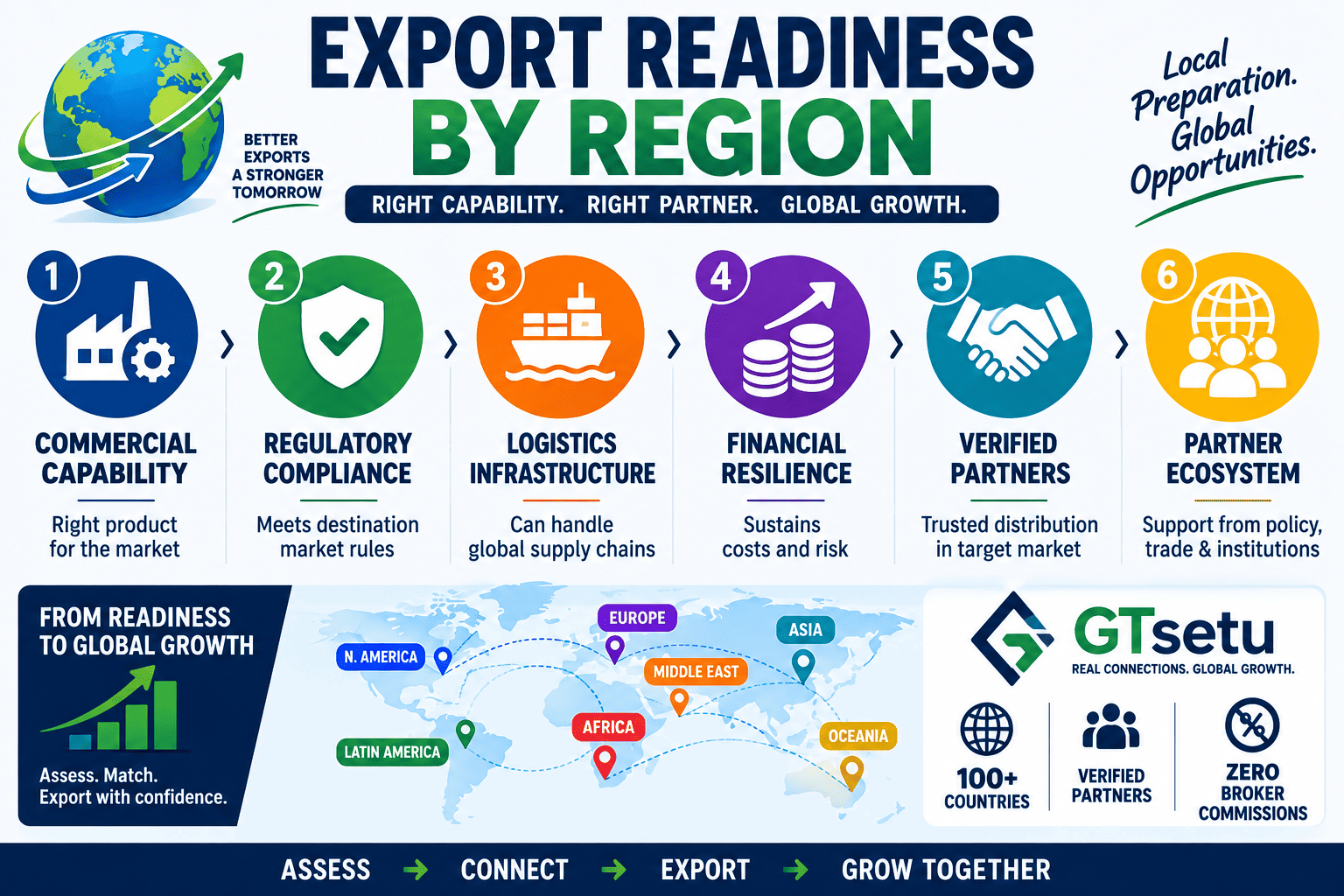
Export Readiness by Region: Complete Assessment Framework for Manufacturers & Distributors
Direct Answer: Export readiness by region is the degree to which a manufacturer, distributor, or exporting region has the commercial capability, regulatory compliance, logistics infrastructure, financial resilience, and partner ecosystem needed to enter and sustain commercial operations in a foreign market. At the company level, export readiness requires that your product meets destination-market regulatory requirements, your pricing remains viable after freight and tariffs, your supply chain can handle cross-border complexity, and you have a verified distribution partner identified in the target market. At the regional level, as measured by frameworks like India’s Export Preparedness Index, readiness reflects the collective infrastructure, policy environment, and institutional support available to exporters. This guide covers both dimensions: a regional capability map across the world’s major B2B trade geographies, the six readiness pillars every exporter must assess before committing to a new market, and how GTsetu’s verified matchmaking platform closes the most critical readiness gap, partner discovery, across 100+ countries with zero broker commissions.
📅 June 25, 2026⏱ 24 min read✍️ GTsetu Editorial Team🔄 Updated regularly
6
Major Trade Regions Covered
6
Readiness Pillars Assessed
100+
Countries on GTsetu
0%
GTsetu Partner Commission
Every manufacturer who has ever entered a new international market has faced the same moment: an opportunity is visible, competitive logic is compelling, and the board has given a cautious green light, but the actual readiness to execute is unclear. Is the product certifiable in the target market? Can the supply chain handle extended transit times? Is the pricing viable after landed cost? And most critically: is there a verified, commercially aligned distribution partner in place to actually move the product once it arrives?
Export readiness is not binary, it is a multi-dimensional capability profile that varies by company, by product, and crucially, by target region. A manufacturer with excellent regulatory compliance for European markets may have significant readiness gaps for Southeast Asia. A distributor with outstanding logistics infrastructure for GCC markets may lack the partner network for Sub-Saharan Africa. This guide provides a structured, region-by-region export readiness framework that identifies what readiness actually requires in each major B2B trade geography, and how to close the gaps systematically. For related context, see our guides on international market entry for manufacturers and distributors, challenges of global expansion, and the true cost of global expansion.
💡 Who This Guide Is For
This guide is written for manufacturers considering international market entry, distributors assessing new sourcing regions, procurement leaders evaluating regional supplier capability, business development teams building export strategy, and trade policymakers and consultants working on export promotion programmes. It draws on the Export Preparedness Index (EPI) framework, regional trade data, and GTsetu’s direct experience connecting manufacturers and distributors across 100+ countries. For the partnership structures that support market entry, see: market entry partnerships guide and collaboration agreement vs joint venture.
SECTION 1
1 What Is Export Readiness?
🎯 Definition
Export readiness is the degree to which a business, or a region, state, or country, has the commercial capability, regulatory compliance, logistics infrastructure, financial resilience, and partner ecosystem in place to successfully initiate and sustain commercial operations in a foreign market. At the company level, it is a composite assessment across six dimensions: regulatory preparedness for the target market, logistics and supply chain capability, financial resilience for cross-border trade, market intelligence quality, institutional support access, and, most critically for B2B manufacturers and distributors, partner readiness: having a verified, commercially aligned distribution or supply chain partner identified and qualified in the target market before the first shipment is attempted. Without a verified partner, the other five dimensions of export readiness produce only stranded inventory and sunk cost.
Export readiness is distinct from export ambition. Many manufacturers have the ambition to enter new markets and lack the structured readiness to do so profitably. The gap between ambition and readiness, when not identified and closed before market entry, is the primary driver of failed internationalisation attempts, stranded inventory, and the “why did we go there” conversations that follow premature market exits. A structured export readiness assessment by region, conducted before commitment, converts ambition into executable strategy. See: limitations of partner discovery methods for how inadequate partner readiness assessment drives the most expensive internationalisation failures.
Export Readiness: Company Level vs Regional Level
Level
What It Measures
Key Framework
Who Uses It
Outcome
Company-Level Export Readiness
Whether a specific business is prepared to enter a specific foreign market with a specific product
Company export readiness self-assessment (this guide’s Section 10 checklist)
Manufacturers, distributors, business development teams
Go / no-go / gap-close decision for a specific market entry
Regional Export Readiness
The collective infrastructure, policy environment, logistics, and institutional support available to exporters operating from or into a region
Export Preparedness Index (EPI), Logistics Performance Index (LPI), World Bank Doing Business Index
Trade policymakers, export promotion agencies, investors, international business consultants
Regional capability benchmarking; identification of infrastructure investment priorities
SECTION 2
2 The Export Preparedness Index (EPI): Framework Overview
The Export Preparedness Index (EPI) is a composite ranking framework developed by NITI Aayog (India’s national policy institution) in collaboration with the Institute of Competitiveness. It was created to assess and compare the export readiness of Indian states and union territories across four primary pillars, providing both a diagnostic tool for identifying structural gaps and a benchmarking mechanism for tracking progress over time. While developed in the Indian context, the EPI’s four-pillar framework translates directly into a general export readiness assessment model applicable to any exporting region or business.
Pillar 01
📜
Policy
The quality and comprehensiveness of export promotion policies, institutional frameworks, and government support mechanisms available to exporters. Includes: dedicated export promotion councils, special economic zones, free trade agreements, export finance institutions, and state-level export facilitation programmes.
For B2B manufacturers: which policy tools reduce your entry cost, accelerate certification, or provide financial support for market development in the target region?
Pillar 02
🏭
Business Ecosystem
The diversity, density, and competitiveness of the industrial base, including MSME presence, sector clustering, skill availability, R&D investment, and business environment quality (ease of contract enforcement, intellectual property protection, regulatory compliance burden).
For B2B buyers: how deep is the supplier ecosystem in this region for your product category? Is there genuine competition, or is the market concentrated in a few players?
Pillar 03
🚢
Export Ecosystem
The physical and digital infrastructure that supports export activity, port connectivity, road and rail links to ports, warehousing and cold chain availability, customs clearance efficiency, trade facilitation digital infrastructure, and third-party logistics provider quality.
For exporters: can your product physically reach the target market at competitive cost and within required transit times? What are the single-window customs clearance options?
Pillar 04
📊
Export Performance
The actual historical and current export output of the region, total export value, export growth rate, trade basket diversification, number of active trading partners, and export intensity (exports as a percentage of state/regional GDP).
For market entrants: what does actual performance data tell you about a region’s demonstrated export capability, beyond what policy documents and promotional materials claim?
💡 EPI Findings: What the Data Consistently Shows
Analysis of India’s EPI results across multiple years consistently reveals the same pattern: coastal states with strong port connectivity (Maharashtra, Gujarat, Karnataka, Tamil Nadu, Andhra Pradesh) outperform landlocked states on the Export Ecosystem pillar regardless of their Policy or Business Ecosystem scores. Landlocked states that overcome their geographic logistics disadvantage through rail connectivity, inland container depots, and SEZ development are the highest-improving performers over time. The lesson for B2B exporters: logistics infrastructure is the hardest readiness gap to close quickly, assess it first, before regulatory and partner gaps, because it constrains everything else. See: international business development consulting for logistics assessment frameworks.
SECTION 3
3 The Six Pillars of Export Readiness
Building on the EPI’s four-pillar framework, a company-level export readiness assessment requires six dimensions, adding Partner Readiness and Financial Readiness as explicit pillars that the regional-level EPI treats as supporting factors rather than primary assessment categories. For B2B manufacturers and distributors, these are often the most critical.
📋
Pillar 1, Regulatory Readiness
Does your product meet all destination-market regulatory requirements, safety standards, certification requirements, labelling obligations, import licensing, product registration, and any sector-specific regulatory frameworks (food safety, pharmaceutical, electrical, chemical)? Regulatory non-compliance is a market entry blocker, not a market entry challenge. The certification timeline must be factored into your market entry plan before the first shipment is committed. See: company TIN number verification for entity compliance prerequisites.
Blocker if absent
🚢
Pillar 2, Logistics and Infrastructure Readiness
Can your product reach the target market at competitive cost, within required transit times, and with the required handling conditions (cold chain, hazmat, fragile goods protocols)? Landed cost viability, the pricing of your product after freight, insurance, duties, and import clearance, is a mathematical reality check that must be completed before market entry commitment. Many products that are competitive at ex-works pricing become uncompetitive after landed cost calculation in distant markets. See: cross-border business tax guide.
Economic gate
🤝
Pillar 3, Partner Readiness
Have you identified, verified, and qualified a distribution partner in the target market? This is the most frequently underestimated readiness dimension and the most commonly cited cause of export failures. Without a verified, commercially aligned distribution partner, one whose territory coverage, product expertise, existing customer relationships, and commercial capability match your market entry requirements, your product arrives in the target market with no sales infrastructure. Partner readiness is not “we have a few contacts we found on LinkedIn.” It is a verified, qualified, contracted partner with confirmed commercial intent. This is precisely what GTsetu’s platform is built to provide. See: distributor network guide.
Most critical
💰
Pillar 4, Financial Readiness
Can your business manage the financial demands of cross-border trade: extended payment terms (30–90 days is standard in many markets, 120+ days in some), currency fluctuation between order and payment, trade finance requirements (letters of credit, documentary collections, export credit insurance), and the upfront cost of market development (regulatory certification, first-shipment discounts, co-marketing investment, staff or agency costs in the target market) before the first profitable orders arrive? See: the true cost of global expansion.
Often underestimated
🔍
Pillar 5, Market Intelligence Readiness
Do you have sufficient, current, and specific intelligence about demand, competition, pricing, consumer behaviour, channel dynamics, and seasonal patterns in the target market to make confident commercial decisions? Many market entry failures are caused not by poor execution but by market assumptions that were formed on the basis of insufficient data, typically a combination of publicly available industry reports, brief trade mission visits, and optimistic projections from prospective distributors whose commercial interest is in securing a new principal, not in providing conservative market estimates. See: partnership evaluation criteria.
Intelligence gap
🏛️
Pillar 6, Institutional Readiness
What export promotion infrastructure, trade agreements, duty preference schemes, and institutional support is available to your business in its home market and in the target market? Bilateral and multilateral trade agreements, FTAs, preferential tariff arrangements, mutual recognition agreements for regulatory standards, can dramatically change the economics of market entry. Export credit agencies, trade guarantee programmes, and market development grants reduce financial risk and upfront cost. Identifying and activating these before market entry, rather than discovering them retrospectively, can materially improve the economics of your export programme. See: cross-border business partnerships.
Often underutilised
SECTION 4
4 Region: East & Southeast Asia
East and Southeast Asia, encompassing China, Japan, South Korea, Taiwan, Vietnam, Thailand, Indonesia, Malaysia, the Philippines, and Singapore, represents the world’s largest concentration of manufacturing capability and one of its fastest-growing consumer and B2B trade markets. For manufacturers entering this region as buyers, and for Asian manufacturers seeking export markets, the readiness profile is highly differentiated by country and sector.
🇨🇳
China
World’s Largest ExporterRegulatory Complex
The world’s largest exporting nation by value, with the deepest manufacturing ecosystem across virtually every product category. For buyers, China offers unmatched supplier density, but at the cost of high supply chain risk concentration, IP protection challenges, and increasing geopolitical trade risk. For sellers targeting China, the regulatory entry requirements (CNCA, SAMR, CCC certification for many categories) are complex and time-consuming. See: China Plus One strategy explained.
Logistics
9.5/10
🇻🇳🇹🇭🇮🇩
Vietnam, Thailand, Indonesia
China+1 BeneficiariesFast Growing
The primary beneficiaries of China Plus One supply chain diversification. Vietnam leads in electronics, textiles, and footwear. Thailand is strong in automotive components, food processing, and industrial products. Indonesia is developing across consumer goods, petrochemicals, and palm oil derivatives. All three offer significantly lower labour costs than China and improving logistics infrastructure, but with more complex inland logistics and less mature quality management systems in the SME manufacturing base. See: international wholesale distributors.
Logistics
7.0/10
🇸🇬
Singapore
Trade HubHighest Ease of Trade
Consistently ranks as the world’s most trade-ready country by virtually every composite index. Singapore’s role is primarily as a regional trade hub and re-export centre, its own manufacturing sector is small, but its logistics infrastructure (Port of Singapore is the world’s second-busiest by container throughput), financial services ecosystem, IP protection, and regulatory certainty make it the entry point and distribution hub of choice for ASEAN market entry. Free Trade Agreements with 27 economies provide preferential market access for goods routed through Singapore. See: global partner portal types and features.
Very High, world-class port and inland infrastructure
Very Deep, mature distributor and agent networks across all major categories
RCEP, multiple bilateral FTAs
IP protection and regulatory navigation complexity
Japan
High, JIS standards, METI approvals, strict food and chemical regulations; language barrier significant
Very High, highly efficient logistics network
Deep but structured, vertical keiretsu distribution systems can be difficult to penetrate without local introduction
RCEP, EPA with EU, CPTPP
Distribution system access, finding the right introduction to a keiretsu-aligned distributor
Vietnam
Moderate, improving regulatory environment; food and pharma still complex
Good, ports improving; inland logistics variable
Growing, active distribution sector expanding rapidly with economic growth
RCEP, EVFTA, CPTPP
Quality management consistency at SME manufacturing level
Indonesia
Moderate-High, BPOM (food/pharma), SNI standards; local content requirements in some sectors
Moderate, inter-island logistics complex for a 17,000-island archipelago
Growing, formal distribution networks developing; informal trade still significant
RCEP, ASEAN FTAs
Archipelagic logistics complexity; inter-island distribution infrastructure
Singapore
Low, minimal trade barriers, efficient regulatory system
Very High, world-class port, air cargo, and digital trade infrastructure
Deep, mature re-export and distribution hub with ASEAN-wide reach
27 FTAs including EUSFTA, US FTA, CPTPP
Cost, Singapore’s operating costs are high; suitable for high-value goods, not commodity trade
SECTION 5
5 Region: South Asia (India, Bangladesh, Pakistan, Sri Lanka)
South Asia, led by India, with Bangladesh, Pakistan, and Sri Lanka as significant secondary manufacturing and trade economies, presents a rapidly evolving export readiness landscape. India in particular has undergone significant infrastructure investment and export policy reform in recent years, making it one of the most dynamically improving regions for both manufacturing export capability and market entry attractiveness.
🏆 India’s Export Preparedness Index, Key Findings
India’s Export Preparedness Index (EPI), published by NITI Aayog, ranks all 36 states and union territories across the four pillars of Policy, Business Ecosystem, Export Ecosystem, and Export Performance. Coastal states consistently outperform landlocked states, Maharashtra, Gujarat, Tamil Nadu, Karnataka, and Andhra Pradesh have dominated top positions across recent editions. Gujarat leads on Business Ecosystem metrics; Maharashtra leads on Export Performance. The states showing the most improvement are those investing in inland container depots, rail connectivity to ports, and SEZ development to offset geographic distance from coastlines. For B2B manufacturers and distributors, India’s EPI results translate directly into sourcing and market entry decisions: states with high Export Ecosystem scores offer better logistics infrastructure for time-sensitive supply chains; states with high Business Ecosystem scores offer deeper supplier networks and more competitive pricing.
🇮🇳
India
World’s 5th Largest EconomyRapidly ImprovingState-Level Variation Significant
India offers a vast and rapidly expanding manufacturing and consumer market, but export readiness varies dramatically by state, sector, and product category. Coastal manufacturing clusters in Gujarat, Maharashtra, Tamil Nadu, and Andhra Pradesh offer strong logistics connectivity. Landlocked states are improving through inland container depots and rail connectivity investment. India’s regulatory environment for imports is improving but remains complex in food, pharmaceutical, and electronics categories. India’s PLI (Production-Linked Incentive) scheme is driving significant new manufacturing capability in electronics, pharma, and auto components. The world’s largest middle-class market by population presents compelling demand-side entry opportunity for consumer and B2B goods. See: B2B business network guide.
Overall Readiness
7.2/10
🇧🇩
Bangladesh
RMG Global LeaderCategory Concentrated
Bangladesh is the world’s second-largest ready-made garment (RMG) exporter, a genuine world-class position in a specific, high-value category. Outside RMG, the export ecosystem is developing but less mature. Infrastructure investment is accelerating, particularly in the Chittagong port and road connectivity to inland manufacturing clusters. For garment and textile buyers, Bangladesh offers highly competitive pricing, large-scale production capacity, and improving sustainability compliance (LEED-certified factories). For other product categories, partner network depth is thinner and regulatory navigation more complex.
Mundra Port, India’s largest private container port
Very Deep, Ahmedabad, Surat, and Rajkot are major manufacturing and distribution hubs
Karnataka
Top Tier
Policy
Electronics, aerospace, IT products, garments, granite
Bengaluru air cargo (largest in India); Mangalore and Chennai ports within reach
Deep, Bengaluru has a highly developed technology and industrial partner ecosystem
Tamil Nadu
Top Tier
Export Ecosystem
Auto components, textiles, engineering, leather goods
Chennai Port and Ennore Port; strong road network to port
Deep, Chennai and Coimbatore are major auto and textile manufacturing hubs
Telangana
High Performer
Policy
Pharmaceuticals, life sciences, IT hardware
Hyderabad air cargo; improving road connectivity
Growing, Hyderabad pharma cluster is one of Asia’s largest
Andhra Pradesh
High Performer
Export Ecosystem
Aquaculture, rice, granite, pharmaceuticals
Krishnapatnam and Gangavaram ports, underutilised capacity
Moderate, developing; strongest in agri-processing and granite sectors
SECTION 6
6 Region: Gulf Cooperation Council (GCC)
The GCC, comprising Saudi Arabia, the UAE, Qatar, Kuwait, Bahrain, and Oman, is one of the world’s most commercially attractive destination markets for B2B manufacturers and distributors. High per-capita income, rapidly diversifying economies (Vision 2030 in Saudi Arabia, UAE Economic Vision), significant infrastructure investment, and a large expatriate professional population create strong demand across consumer goods, industrial products, food and beverage, pharmaceutical, and technology categories.
🇦🇪
UAE (Dubai / Abu Dhabi)
GCC Trade HubRe-export CentreHigh Income
Dubai is the commercial capital of the Middle East and the primary re-export hub for goods entering and leaving the GCC region, and increasingly for Africa and South Asia. Jebel Ali Port is the world’s ninth-busiest container port and the largest in the Middle East. Free zones (JAFZA, DAFZA, DIFC, and many others) offer 100% foreign ownership, zero corporate tax on free zone activities, and streamlined import/re-export procedures. For B2B manufacturers targeting the GCC, UAE is the natural first-entry point: a compliant, verified UAE distributor with GCC-wide reach is the most efficient market entry structure. See: technology partnership structures for UAE-specific B2B partnership frameworks.
Overall Readiness
9.3/10
🇸🇦
Saudi Arabia
Largest GCC EconomyVision 2030 Transformation
Saudi Arabia is undergoing the most significant economic transformation in its history under Vision 2030, diversifying away from oil dependency through industrial development, tourism, entertainment, and technology investment. This creates substantial new commercial opportunity for manufacturers in construction materials, industrial equipment, food production, healthcare, and consumer goods. SASO (Saudi Standards, Metrology and Quality Organization) certification is mandatory for most imported products, a regulatory prerequisite that must be planned well in advance. Local agent and distributor requirements apply in certain regulated sectors. The Saudi market demands locally-established distribution relationships rather than export-only arrangements.
Overall Readiness
7.8/10
⚡ GCC Entry Strategy: Always Start with UAE
For manufacturers entering the GCC region for the first time, UAE is almost always the correct first point of entry, even if Saudi Arabia or another GCC market is the ultimate commercial target. UAE’s regulatory environment is the most business-friendly, its logistics infrastructure the most developed, and its distributor ecosystem the most accessible to international manufacturers. A UAE-based distributor with GCC-wide reach can serve the entire six-country market from a single commercial relationship, and can provide market intelligence on each sub-market’s specific requirements before the manufacturer commits to individual country registrations and regulatory approvals. See: market entry partnerships guide for UAE-specific entry structures and distributor network guide for GCC distributor qualification criteria.
SECTION 7
7 Region: Europe (EU, UK, Eastern Europe)
Europe, encompassing the 27 EU member states, the UK post-Brexit, and the rapidly developing Eastern European manufacturing corridor, presents a highly differentiated export readiness landscape. The EU single market offers the world’s most comprehensive regulatory framework for manufactured goods, which creates both the highest regulatory compliance barrier to entry and, once cleared, access to a 450-million-consumer market with a single set of standards.
🇪🇺
European Union (27 States)
Single Market AccessHighest Regulatory BarrierPremium Price Point
The EU single market is the world’s largest trading bloc by GDP and offers manufacturers who achieve regulatory compliance access to 27 markets with a unified set of product standards (CE marking, REACH, RoHS, GDPR for digital products, and sector-specific regulations). The regulatory compliance investment is the highest of any major trade region, particularly for food, pharmaceutical, chemical, electrical, and children’s products, but the premium pricing environment, strong IP protection, and depth of distribution infrastructure make it highly attractive for manufacturers of quality-positioned products. Germany, the Netherlands (Amsterdam/Rotterdam as logistics hubs), and France are the primary entry points for most product categories. See: cross-border business tax guide for EU VAT and customs implications.
Logistics Quality
9.4/10
🇬🇧
United Kingdom
Post-Brexit Own StandardsActive FTA Programme
Post-Brexit, the UK has developed its own product conformity marking (UKCA replacing CE for most categories) and independent regulatory frameworks, creating a dual compliance requirement for manufacturers targeting both EU and UK markets. The UK’s active FTA negotiation programme (CPTPP membership, FTAs with India, GCC under negotiation, and a comprehensive deal with the UAE) is creating new preferential access opportunities. UK distribution infrastructure is mature, partner networks are deep, and the market is highly accessible for English-language manufacturers. The primary readiness gap is the dual UKCA/CE marking requirement that increases compliance cost for manufacturers serving both markets. See: B2B matchmaking tool guide for UK distributor identification.
Poland, Romania, Czech Republic, Hungary, and Slovakia are the primary beneficiaries of European supply chain nearshoring, the shift of manufacturing from Asia to geographically closer locations driven by supply chain risk, transit time, and ESG considerations. Turkey, while not an EU member, has a customs union with the EU for industrial goods and significant manufacturing scale in automotive, textiles, and machinery. For manufacturers seeking EU-compliant production with shorter supply chains, Eastern Europe and Turkey offer competitive labour costs, EU standards compliance, and improving logistics infrastructure. See: supplier switching risks for context on nearshoring transitions.
Manufacturing Readiness
7.5/10
SECTION 8
8 Region: Africa
Africa, a continent of 54 countries, 1.4 billion people, and a rapidly expanding middle class, represents one of the most significant long-term B2B trade opportunities globally, and one of the most structurally complex regions for near-term market entry. Export readiness by country varies more dramatically within Africa than within any other major trade region, and the African Continental Free Trade Area (AfCFTA) is creating new intra-African trade opportunities that are beginning to change the entry calculus for international manufacturers and distributors.
🇳🇬🇰🇪🇿🇦
Nigeria, Kenya, South Africa
Largest B2B MarketsHigh Partner Risk
South Africa offers Africa’s most developed trade infrastructure, Durban and Cape Town ports, sophisticated financial services, and the deepest formal distribution network. Nigeria and Kenya are the dominant markets in West and East Africa respectively, with large populations, active import trade, and rapidly growing middle classes. All three require careful partner verification, informal trade, unverified intermediaries, and payment risk are significant in all three markets. GTsetu’s verified matchmaking is particularly valuable in these markets: confirming a distribution partner’s legal registration, business status, and commercial standing before engagement is non-negotiable. See: why trust breaks in global deals.
Overall Readiness
5.5/10
🌍
AfCFTA Member States
Emerging Single MarketImplementation Varies
The African Continental Free Trade Area (AfCFTA), signed by 54 of the 55 AU member states, aims to create the world’s largest free trade area by number of participating countries. Full implementation will significantly improve intra-African trade economics, reducing tariffs across most categories to zero and creating common standards frameworks. Current implementation is partial and variable by country pair, but the direction of travel is clear: manufacturers and distributors who build African distribution partnerships now, particularly with verified pan-African distributors, will benefit disproportionately as AfCFTA implementation deepens. See: long-term supplier management for building resilient African supply partnerships.
Trajectory
6.5/10 ↑
SECTION 9
9 Region: Americas (North, Latin, South)
The Americas present a highly differentiated export readiness landscape across three sub-regions: North America (USA, Canada, Mexico, integrated through USMCA), Latin America (Colombia, Chile, Peru, Ecuador, with strong Pacific Alliance integration), and South America (Brazil, Argentina, larger markets with higher trade complexity). For international manufacturers, the US market is the world’s largest import economy; for exporters from the Americas, proximity to the US market is the dominant strategic consideration.
🇺🇸🇨🇦🇲🇽
North America (USMCA)
World’s Largest Import MarketTariff Complexity Increasing
The United States is the world’s largest single-country import market, making US market access the highest-value export readiness target for manufacturers globally. USMCA (US-Mexico-Canada Agreement) creates near-tariff-free trade within the bloc for qualifying goods, making Mexico an increasingly attractive manufacturing base for US market supply. For exporters to the US, FDA registration (food, pharma, cosmetics), CPSC compliance (consumer products), FCC certification (electronics), and UL safety marks are category-specific prerequisites. For manufacturers entering the US market, a compliant, verified US distributor or sales agent is the critical partner readiness requirement. See: trialing and scaling production for US market entry production planning.
Overall Readiness
9.1/10
🇧🇷🇦🇷
Brazil & Argentina
Large MarketsHigh Trade Complexity
Brazil is South America’s largest economy and a significant manufacturing base, but its reputation for trade complexity (the “Brazil cost” or “custo Brasil”) is well-earned. Import duties, bureaucratic customs procedures, INMETRO certification requirements, and complex tax structures significantly increase the landed cost and time-to-market for imported goods. Argentina faces similar structural trade barriers, exacerbated by currency controls and import licence requirements that have historically constrained import access. Both markets require a well-established local partner with deep regulatory expertise, not just commercial relationships. See: common red flags in international partnerships for Latin American partner vetting.
Overall Readiness
5.0/10
🇨🇴🇨🇱🇵🇪
Pacific Alliance (Colombia, Chile, Peru)
Most Open in S. AmericaStrong FTA Network
The Pacific Alliance, Colombia, Chile, Peru, and Mexico, represents Latin America’s most open and trade-friendly economic bloc. All four members have comprehensive FTA networks including agreements with the EU, the US, Canada, and several Asian markets. Chile in particular has one of the world’s most extensive FTA networks and among Latin America’s lowest trade barriers. Colombia and Peru are rapidly growing markets for consumer goods, industrial equipment, and food products with increasingly professional import distribution networks. For manufacturers making a first move into South America, Pacific Alliance markets offer significantly lower regulatory and partner risk than Brazil or Argentina. See: factory audits explained for supplier qualification in Latin American manufacturing sourcing.
Overall Readiness
6.8/10
SECTION 10
10 Export Readiness Self-Assessment Checklist
Before committing to market entry in any new region, every manufacturer and distributor should complete a structured export readiness self-assessment. The checklist below covers all six readiness pillars and is calibrated for B2B trade contexts, manufacturing export and distribution import. For each item, the question is not just “have we done this” but “is this complete, documented, and contractually secured?”
Pillar 1: Regulatory Readiness
All mandatory product certifications for the destination market identified (CE, FDA, SASO, BIS, etc.) and application timelines documented
Product labelling requirements confirmed for language, mandatory information, and format in the target market
Import licensing or registration requirements assessed and any pre-market approval processes initiated
Relevant trade agreement tariff preferences identified and exporter eligibility confirmed (Rules of Origin compliance)
Country-specific restricted or prohibited product lists reviewed for any applicable categories
Distribution partner identified, verified (company registration confirmed via government source), and commercially assessed against defined criteria. See: partnership evaluation criteria
Partner’s territory coverage, existing portfolio, customer relationships, and commercial capability assessed through direct engagement and reference checks
NDA executed before any pricing, product specifications, or market strategy shared with prospective partner
Letter of Intent or Heads of Terms agreed before detailed distribution contract negotiation begins
Distribution agreement drafted with clear territory definition, exclusivity status, minimum purchase commitments, performance milestones, and termination provisions. See: business partnership contract guide
Partner’s financial capability to place initial order and sustain working capital through the first season assessed
Contingency partner identified: what is the Plan B if the primary partner fails to perform in Year 1?
Pillar 4–6: Market Intelligence and Institutional Readiness
Target market demand validated through primary research (trade shows, buyer interviews, distributor feedback), not only secondary industry reports
Competitive landscape in the target market mapped: who are the incumbent brands, what are their pricing and positioning, what is our differentiation?
Trade promotion incentives available in the home market assessed: export grants, market development grants, tax incentives for exports
Trade mission or in-market visit planned before formal market entry commitment, nothing replaces direct market observation
Export promotion body membership activated in the home market for access to trade intelligence and trade fair support
At least two in-market reference contacts identified: either existing exporters to the same market in adjacent categories or verified partners who have agreed to provide references
SECTION 11
11 Common Export Readiness Gaps and How to Close Them
68%
of first-time international market entries fail within three years, most due to partner selection failure, not product failure
40%
of manufacturers underestimate landed cost in new markets by more than 20%, making their products uncompetitive at target price points
2–18 months
typical range for regulatory certification timelines in major markets, most exporters begin the process too late
🚩
Regulatory Certification Started Too Late
CE marking, FDA registration, SASO certification, and equivalent approvals in major markets take 2–18 months depending on product category. Most manufacturers begin the process after signing the distribution agreement, by which time the partner has committed commercially but cannot import the product legally. Start certification processes 12–18 months before the planned first shipment. See: factory audits explained.
🚩
Unverified Distribution Partner Selected
The single most common cause of export failure. A distributor identified through a trade show, directory, or broker, without independent verification of their legal registration, commercial standing, and genuine distribution capability, is an unassessed liability. Always verify partner credentials against government sources before any commercial commitment. GTsetu’s platform provides this verification as a platform prerequisite. See: limitations of partner discovery methods.
🚩
Landed Cost Calculation Not Completed
Many manufacturers price for export at their domestic ex-works price plus a freight estimate, without accurately calculating the full landed cost chain: freight, insurance, import duty (at MFN or preferential rate), import VAT, port handling, inland freight, and partner margin. Products that appear competitive at factory gate often become uncompetitive at the shelf. See: cross-border business tax guide.
🚩
No Payment Risk Management for First Shipments
First shipments to a new, unproven partner in a new market on open account payment terms are one of the highest-risk financial decisions in international trade. Export credit insurance, letters of credit, or advance payment requirements for initial orders are the appropriate risk management tools, not an expression of distrust, but a standard commercial risk management practice that protects both the manufacturer and the relationship. See: why trust breaks in global deals.
🚩
Market Intelligence Based Only on Partner Projections
Prospective distributors who are keen to secure a new brand will invariably project optimistic first-year sales. These projections reflect the distributor’s enthusiasm, not independent market analysis. Always validate market demand through primary research sources, trade mission visits, competitor analysis, consumer survey data, or third-party market intelligence, before committing commercial resource to a new market based on a distributor’s volume projections. See: international business development consulting.
🚩
No Exit Provision in the Distribution Agreement
Manufacturers who sign distribution agreements without defined performance milestones, minimum purchase commitments, and clear termination provisions for underperformance can find themselves locked into an exclusive distribution arrangement with a partner who is not performing, unable to appoint an alternative partner without breaching their own contract. Every distribution agreement must define what performance success looks like and what the consequences of non-performance are. See: ending a business partnership contract.
SECTION 12
12 How GTsetu Closes the Partner Readiness Gap
Of the six export readiness pillars, Partner Readiness is the one most frequently identified as the critical gap, and the one most poorly served by traditional partner discovery methods. GTsetu was built specifically to address this gap: providing verified, AI-matched, commercially aligned distribution and manufacturing partners across 100+ countries, with a built-in confidentiality and due diligence infrastructure that protects the discovery and qualification process.
🤝 Platform Spotlight, GTsetu
Close Your Partner Readiness Gap Before Market Entry
Export readiness without a verified partner is strategy without execution. GTsetu’s verified B2B matchmaking platform closes the partner readiness gap for manufacturers and distributors across 100+ countries, providing government-sourced verified companies, AI-assisted fit matching, anonymous discovery, built-in NDA workflows, and encrypted document sharing, with zero broker commissions on any partnership formed. Every company on GTsetu is verified on six key government-sourced points: Name, Address, Registration Number, Company Status, Company Type, and Date of Certificate of Incorporation.
🏛️
6-Point Govt. Verification
Every partner verified on Name, Address, Registration Number, Company Status, Company Type, and Date of Incorporation, before joining. The foundation of export partner readiness.
🤖
AI-Assisted Matching
Multi-criteria fit scoring by industry, geography, product category, company size, and partnership intent, surfacing verified partners in your target export region.
🕵️
Anonymous Discovery
Assess partner candidates in target markets without revealing your expansion intentions, protecting your market entry strategy during the evaluation phase.
📄
Built-In NDA Workflow
Commercial data, pricing, and product specifications shared only after a digitally signed, timestamped NDA, structural confidentiality from first exchange.
🔐
Encrypted Due Diligence
AES-256 encrypted workspace for all partner qualification data, with full audit trail for every document exchange and communication during the due diligence process.
🚫
Zero Commission
No broker fee on any partnership formed, in any of the 100+ countries on the platform. Export economics stay between you and your partner.
🌍
100+ Countries
Verified manufacturers and distributors across every major B2B trade region, East Asia, South Asia, GCC, Europe, Africa, and the Americas, from one platform.
📋
Full Audit Trail
Every access event, NDA signature, and document exchange timestamped and logged, creating a defensible record of the partner qualification process.
Complete six-pillar export readiness audit for target region.
📊 Structured
🔍
Anonymous Discovery
Browse verified partners in target market anonymously.
🔐 Protected
✅
Partner Verification
6-point govt. verification already complete on platform.
🏛️ Verified
📄
NDA & Due Diligence
Encrypted workspace for all qualification data sharing.
🔐 Secure
⚖️
Agreement
Distribution contract executed. Market entry begins.
✓ Complete
FAQ
? Frequently Asked Questions
QWhat is export readiness?
Export readiness is the degree to which a business has the commercial capability, regulatory compliance, logistics infrastructure, financial resilience, and partner ecosystem in place to successfully enter and sustain commercial operations in a foreign market. It is a six-dimensional assessment: regulatory readiness (does your product meet destination-market requirements?), logistics readiness (can your product reach the market at viable cost and lead time?), partner readiness (have you identified and verified a distribution partner?), financial readiness (can your business manage extended payment terms, currency risk, and market development costs?), market intelligence readiness (do you have sufficient understanding of demand and competition?), and institutional readiness (are you utilising available trade agreements, export promotion tools, and government support?). Export readiness is not binary, it is a capability profile that reveals which gaps must be closed before market entry can be attempted successfully. See: international market entry guide.
QWhat is the Export Preparedness Index (EPI)?
The Export Preparedness Index (EPI) is a composite ranking framework developed by NITI Aayog (India’s national policy institution) in collaboration with the Institute of Competitiveness. It assesses the export readiness of Indian states and union territories across four pillars: Policy (export promotion frameworks and institutional support), Business Ecosystem (industry diversity, MSME presence, and business environment quality), Export Ecosystem (logistics infrastructure, port connectivity, and trade facilitation infrastructure), and Export Performance (actual export value, growth rate, and trade basket diversity). The EPI was designed to identify structural gaps in state-level export capacity, benchmark performance over time, and direct policy attention and infrastructure investment toward the highest-leverage improvement areas. Its four-pillar methodology translates directly into a general export readiness assessment framework applicable to any exporting region or business. See: challenges of global expansion.
QWhich regions are most export-ready for B2B manufacturers?
Export readiness varies significantly by sector, product category, and specific target market. The highest-readiness regions across the broadest range of B2B categories are: Singapore (consistently the world’s most trade-ready country by composite index); the European Union (highest regulatory standards but also the most comprehensive certification framework once cleared); the United States (world’s largest import market, with deep distribution infrastructure); the UAE (GCC trade hub with world-class logistics, free zone infrastructure, and ASEAN-wide reach); and East Asian hubs (China, Japan, South Korea) for manufacturing supply chain relationships. For manufacturers making their first international market entry, UAE and Singapore are typically the lowest-friction entry points due to business-friendly regulations, English-language commercial environments, and deep established distribution ecosystems. See: market entry partnerships guide.
QWhat is the most commonly overlooked export readiness gap?
Partner readiness, having a verified, commercially qualified distribution partner in place before the first shipment, is the most frequently overlooked and the most consequential export readiness gap. Most manufacturers focus on the product-side readiness (regulatory compliance, logistics, pricing) and treat partner identification as something that will be sorted out during market entry rather than before it. The consequence is that products arrive in a new market with no sales infrastructure: compliant, landed, priced correctly, and sitting in a warehouse with no one to sell them. A verified partner should be identified and under a formal distribution agreement before the first shipment is committed, not discovered after the goods are in transit. GTsetu’s verified matchmaking platform is specifically designed to close this gap: providing government-verified, AI-matched, commercially assessed distribution partners across 100+ countries. See: limitations of traditional partner discovery methods and B2B matchmaking tool guide.
QHow long does it take to become export-ready for a new region?
The timeline to export readiness varies significantly by target region and product category. As a general framework: regulatory certification in the most demanding markets (EU CE marking, US FDA registration, SASO for Saudi Arabia) takes 6–18 months depending on product category and pre-existing compliance documentation. Partner identification, qualification, and agreement can take 3–6 months if approached systematically through a verified platform, or 12+ months through cold outreach and unstructured networking. Financial readiness (establishing trade credit, export insurance, and hedging arrangements) takes 1–3 months once the commercial decision is made. Logistics setup (freight forwarder appointment, Incoterms agreement, packing specification) takes 1–2 months. The critical path item is almost always regulatory certification, which is why the process must start significantly earlier than most exporters initiate it. See: the true cost of global expansion for financial planning timelines.
QWhat are the China Plus One strategy implications for export readiness?
The China Plus One strategy, the deliberate diversification of manufacturing supply chains away from sole reliance on China toward alternative production bases, creates significant export readiness implications for both buyers and alternative manufacturers. For buyers, China Plus One requires developing export readiness assessment capability for alternative manufacturing regions, Vietnam, India, Bangladesh, Indonesia, Mexico, that may have different regulatory frameworks, logistics infrastructure, quality management maturity levels, and partner ecosystem depth than the China relationships they are diversifying away from. For manufacturers in alternative regions, China Plus One creates a significant demand opportunity, but only for those who can demonstrate export readiness comparable to Chinese manufacturers: certified to destination-market standards, logistically capable of meeting lead time and volume requirements, and able to provide quality control documentation equivalent to what buyers are accustomed to receiving. See: China Plus One strategy explained and supplier switching risks.
Close Your Partner Readiness Gap, Find Verified Trade Partners by Region
Export readiness without a verified partner is strategy without execution. Join 500+ verified manufacturers and distributors across 100+ countries on GTsetu, AI-assisted matching by region and product category, anonymous discovery, built-in NDA workflows, encrypted due diligence workspace, and zero broker commissions on every partnership formed.
They represents the product, and research team behind GTsetu, a global B2B collaboration platform built to help companies explore cross-border partnerships with clarity and trust. The team focuses on simplifying early-stage international business discovery by combining structured company profiles, verification-led access, and controlled collaboration workflows.
With a strong emphasis on trust, and disciplined engagement, Team GTsetu shares insights on global trade, partnerships, and cross-border collaboration, helping businesses make informed decisions before entering deeper commercial discussions.