How to Comply with ISO 15223 Medical Device Symbols
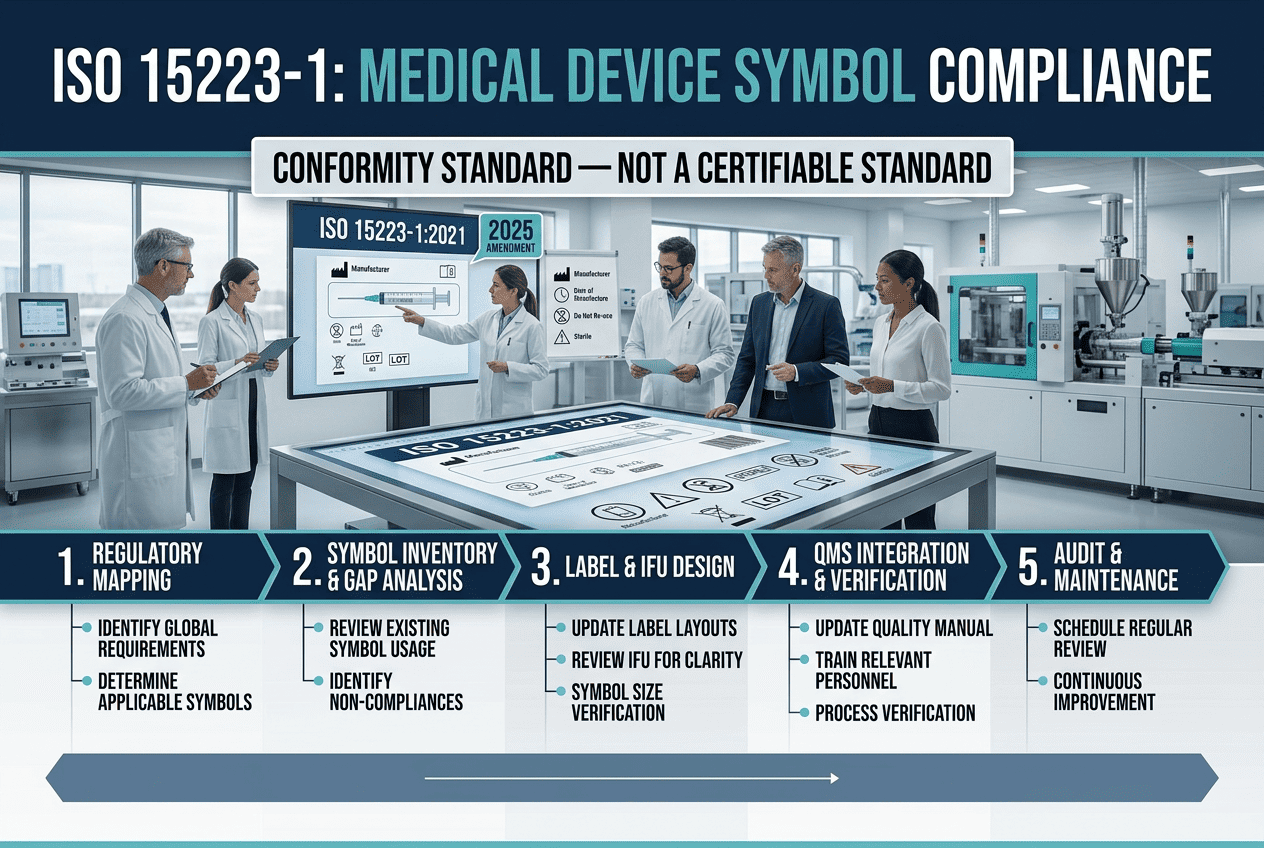
Direct Answer: ISO 15223-1 is the international standard that defines the symbols used to express information supplied with a medical device. It is not a certifiable standard, so no certification body issues an “ISO 15223 certificate.” Instead, manufacturers demonstrate conformity in 5 steps: Scope & Regulatory Mapping, Symbol Inventory & Gap Analysis, Label & IFU Design, QMS Integration & Verification (typically under ISO 13485), and Audit, Update & Maintenance. The current edition is ISO 15223-1:2021 (fourth edition, July 2021), amended in March 2025 to make the EC REP symbol region-neutral. This guide explains each step, the symbol categories, and how labeling connects to ISO 20417, ISO 14971, and EU MDR/IVDR.
📅 November 2, 2026⏱ 14 min read✍️ GT Setu Editorial Team🔄 Updated regularly
4th
Edition (July 2021)
2025
Amendment 1 Published
5
Steps to Compliance
0%
GTsetu Broker Commission
Every medical device must carry information: who made it, how to store it, whether it is sterile, when it expires, and how to use it safely. Written text must be translated for every market, which is slow, costly, and error-prone. ISO 15223-1 solves this by specifying internationally recognised symbols that express this information consistently, on the device, on its packaging, or in the accompanying documents.
For medical device manufacturers, importers, distributors, and authorised representatives, correct use of these symbols is a core part of regulatory readiness. This guide explains what the standard covers, how to demonstrate conformity, and how it fits with the wider quality framework, including ISO 13485 for quality management and ISO 14971 for risk management. Companies building a general quality system first may also start with our ISO 9001 guide.
📋 Who Is This Guide For?
This guide is written for regulatory affairs and quality managers, labeling and packaging teams, medical device start-ups, importers and distributors, and sourcing teams who must confirm that a supplier’s labeling meets international expectations. It is relevant whether you are preparing for EU MDR/IVDR, FDA, or other national submissions. For partner due diligence, see our guides on partnership evaluation criteria and business verification.
SECTION 1
1 What Is ISO 15223 & Why It Matters
🏷️ The Standard Explained
ISO 15223-1, Medical devices: Symbols to be used with information to be supplied by the manufacturer, Part 1: General requirements, specifies symbols used to express information supplied for a medical device. It applies to a broad spectrum of devices available globally that must meet different regulatory requirements. The symbols can appear on the device itself, on its packaging, or in accompanying information. The standard was prepared by ISO/TC 210, and the current main edition, ISO 15223-1:2021, replaced the 2016 third edition. A companion document, ISO 15223-2, defines the process for developing, selecting, and validating new symbols.
🌐
Language-Independent Labeling
Validated symbols convey information without translation, which simplifies labels for devices sold in many countries with different language requirements.
🏛️
Regulatory Support
EU MDR Annex I Section 23.1(h) expects information supplied by the manufacturer to use internationally recognised symbols, and ISO 15223-1 is the main reference for medical device symbols.
✅
Validated for Understanding
Symbols are drawn from ISO 7000, ISO 7001, or IEC 60417, or have passed a formal validation process, so users such as clinicians and patients interpret them consistently.
🔗
Supply Chain Clarity
Importers, distributors, and authorised representatives are identified with dedicated symbols, making responsibilities visible across the chain.
SECTION 2
2 Why There Is No ISO 15223 Certificate
Many search for “ISO 15223 certification,” but the standard works differently from management system standards. ISO 9001 or ISO 13485 describe a system that an accredited certification body can audit and certify. ISO 15223-1 is a reference list of symbols with usage rules. There is nothing to certify at organisation level; what matters is whether your labels use the symbols correctly.
⚠️ Beware of “ISO 15223 Certificates”
If a provider offers an “ISO 15223 certificate” as a standalone credential, treat it with caution. Conformity to ISO 15223-1 is normally shown through your labeling, technical documentation, and quality system records, then reviewed by a notified body or regulator as part of device conformity assessment. Always verify claims with the issuing body and your regulatory advisor.
Question
Management System Standard (e.g. ISO 13485)
ISO 15223-1
What it defines
Requirements for a quality management system
Symbols and rules for expressing supplied information
Certifiable?
Yes, by an accredited certification body
No separate certificate
How conformity is shown
Third-party certification audit
Correct labeling, documented in technical documentation and reviewed during QMS audits and conformity assessment
Legal status
Voluntary, often required by customers or regulators
Voluntary in most schemes; EU requires internationally recognised symbols where symbols are used
SECTION 3
3 Key Benefits of Compliant Labeling
1
Label design reused across many markets, reducing translated text
3
Places symbols can appear: the device, its packaging, accompanying information
4
Priority order for choosing symbols vs. text (see Step 3)
🏛️
Smoother Regulatory Reviews
Using recognised symbols gives notified bodies and regulators a familiar, defensible basis for your labeling choices.
Regulatory
💰
Lower Translation & Reprint Costs
Symbols replace repeated text blocks, saving label space and reducing translation and artwork variants.
Operational
🛡️
Safer Use
Consistent symbols for sterility, storage limits, and use instructions reduce misreading, supporting the information-for-safety controls in risk management.
Safety
🔗
Clear Roles in Distribution
Manufacturer, authorised representative, importer, distributor, and translator symbols make each party’s role transparent.
Partnership
SECTION 4
4 Symbol Categories in ISO 15223-1:2021
Clause 5 of the standard organises symbols by the kind of information they convey. The table below summarises the main groups and the examples most often discussed by practitioners. Clause numbers shown are those cited in public guidance on the 2021 edition; always check the purchased standard for the full, authoritative list.
Category
What It Communicates
Examples
5.1 Manufacturing
Who made the device and how to identify it
Manufacturer, authorised representative, importer, distributor, date of manufacture, use-by date, batch code, serial number, catalogue number (5.1.6), model number (5.1.10)
Temperature limits (5.3.5 to 5.3.7), humidity limitation (5.3.8), atmospheric pressure limitation (5.3.9), keep dry, fragile
5.4 Safe Use
Warnings and instructions
Do not re-use, consult instructions for use or electronic instructions for use (5.4.3), caution (5.4.4)
5.5 In Vitro Diagnostics
IVD-specific information
In vitro diagnostic medical device (5.5.1), control, sufficient for number of tests
5.7 Other
Regulatory and traceability information
Medical device symbol (5.7.7), translation (5.7.8), unique device identifier (5.7.10)
💡 Caution vs. Consult Instructions
The Caution symbol (5.4.4) and the Consult instructions for use symbol (5.4.3) are not interchangeable. Practitioners involved in the standard note that Caution must not be used to mean “consult the IFU,” and neither replaces the ISO 7010 mandatory-action “blue man” safety sign where IEC 60601-1 requires it as a primary risk control.
SECTION 5
5 Step 1: Scope & Regulatory Mapping
🏗️ Building the Foundation
Start by deciding what is in scope. ISO 15223-1 applies to all medical devices, including IVDs and software that meets the medical device definition, so the first job is mapping your products, markets, and the labeling rules each regulator applies.
1.1
List Devices & Packaging Levels
Record every device, accessory, and packaging level (unit, sterile barrier, shelf, shipper) that carries labeling or accompanying information.
1.2
Map Target Markets
Identify applicable rules for each market, such as EU MDR/IVDR, FDA labeling requirements, and national language rules. Confirm whether the national regulator has adopted or recognised the 2021 edition.
1.3
Identify Companion Standards
ISO 15223-1 does not cover every symbol. Add ISO 20417 (information supplied by the manufacturer), ISO 7000, ISO 7010, IEC 60417, and device-specific standards such as the IEC 60601 series where relevant.
1.4
Assign Ownership
Name a labeling owner in regulatory affairs or quality, and define review roles for packaging, marketing, and operations.
SECTION 6
6 Step 2: Symbol Inventory & Gap Analysis
Collect every current label, carton, IFU, and eIFU, and list each symbol, text statement, and barcode in use. Compare this inventory with ISO 15223-1:2021 and ISO 20417 to find gaps, outdated third-edition usage, and homemade symbols.
Inventory Item
What to Check
Typical Finding
Manufacturer & role symbols
Name and address present; authorised representative, importer, and distributor shown where applicable
Missing role symbols or region-specific EC REP usage that predates Amendment 1
Sterility symbols
Method and sterile barrier system shown correctly
Old sterility artwork not aligned with the 2021 edition
Identification
Catalogue or model number, batch or serial, dates
Both catalogue and model numbers used inconsistently
Traceability
UDI symbol next to the UDI carrier; MD symbol where required
Several barcodes on a label with no indication of which is the UDI
IFU references
Correct use of consult-IFU or eIFU symbols versus caution
Caution used in place of consult-IFU
Symbol glossary
Every symbol on the label explained in the IFU table of symbols
Glossary missing newly added symbols
💡 UDI Tip
The standard treats the UDI symbol (5.7.10) as optional, but ISO 20417 calls for it when more than one machine-readable carrier appears on a label. Using it consistently avoids confusion for users and regulators. See also how ISO 13485 handles labeling and traceability controls.
SECTION 7
7 Step 3: Label & IFU Design
🎨 Choosing Symbols Wisely
Industry practitioners recommend this priority order: (1) use symbols from ISO 15223-1, (2) use other appropriate symbols such as ISO and IEC ones, (3) use text alongside appropriate symbols, and (4) develop your own symbols only as a last resort. Validated symbols are the safest and most widely understood choice.
🖼️
Obtain Licensed Artwork
The standard text is copyrighted, so symbols should not be reproduced from it. Artwork is available through the ISO Online Browsing Platform or symbol collections.
Licensing
📐
Apply Usage Rules
Follow each symbol’s description, restrictions for use, and any required accompanying data such as dates, codes, or temperature values.
Design
📖
Build the Symbol Glossary
List every symbol with its meaning in the IFU, including the translation symbol where a distributor controls translated content.
IFU
🎨
Respect Colour Requirements
Safety signs defined in ISO 7010 carry required colours. A black-and-white version of a colour sign may not meet the requirement, so check the source standard first.
Safety Signs
SECTION 8
8 Step 4: QMS Integration & Verification
Symbols only stay compliant if the process behind them is controlled. Bring labeling into your quality management system so changes are reviewed, approved, and traceable. If you do not yet have a system, our ISO 13485 guide explains the medical device QMS that auditors will expect.
📁
Labeling Procedure
Document how labels, IFUs, and symbol glossaries are created, reviewed, approved, and controlled.
⚖️
Risk Management Link
Where the IFU or a warning is a risk control, record it in your ISO 14971 file and choose the correct symbol or safety sign.
🔍
Label Verification
Check printed labels against approved artwork, including symbol, data fields, size, and legibility on the real packaging material.
🔄
Change Control
Assess labeling changes for regulatory impact. Under EU rules a labeling change may count as significant, so consider notified body notification.
🔐
Information Security
Protect label artwork and technical files with controlled access, aligned with ISO 27001 practices.
🏭
General Quality Basics
Document control, training, and internal audits follow the same principles described in our ISO 9001 guide.
SECTION 9
9 Step 5: Audit, Update & Maintain
Because there is no ISO 15223 certification audit, assurance comes from the reviews you already face. Auditors checking your ISO 13485 system and notified bodies assessing device technical documentation will look at labels, IFUs, and symbol use. Prepare for these reviews and keep the system current.
Review Type
Who
What They Typically Check
Internal audit
Your quality team
Label control, symbol glossary, change records
QMS certification audit
Accredited certification body
Labeling process control within ISO 13485
Conformity assessment
Notified body or regulator
Labels and IFU against general safety and performance requirements
Post-market review
Your team and regulators
Complaints or field issues linked to labeling; risk file updates
Standard monitoring
Regulatory affairs
New amendments, edition changes, and national adoption dates
SECTION 10
10 What Changed: 2021 Edition & 2025 Amendment
📘
ISO 15223-1:2021 (Fourth Edition, July 2021)
Replaced the 2016 third edition with improved definitions and descriptions, plus new symbols aligned with regulatory needs, including the Medical Device (MD) symbol, Translation symbol, UDI symbol, and sterile barrier system symbols.
Main Edition
🆕
Amendment 1:2025 (March 2025)
Adds a defined term for “authorized representative” and modifies the EC REP symbol so it is not country or region specific. It also clarifies that where entities share the same name and address, applicable symbols can be grouped beside a single address.
Amendment
⏳
Adoption & Transition
ISO standards do not carry transition dates. Timing depends on each regulator and, in the EU, on harmonisation and citation. Check current status with your regulatory advisor before changing live labels.
Check Locally
⚠️ Verify Before You Rely
Standards status changes. The ISO catalogue showed ISO 15223-1:2021 under systematic review at the time of writing. Confirm the latest edition, amendments, and national recognition on iso.org, your national standards body, and the regulator’s website before finalising labels.
SECTION 11
11 Related Standards Compliance Map
ISO 15223-1 works alongside other standards. The table shows how the main ones connect to labeling and symbol compliance. Follow the links to our step-by-step guides.
Standard
Role Relative to ISO 15223
Guide
ISO 13485
Medical device QMS; controls labeling and packaging processes
Because no certificate is issued, there are no registrar or surveillance audit fees specific to ISO 15223. Costs depend mainly on how many products and label variants you manage. The timeline column is an indicative planning guide only; your own scope will vary.
Cost / Time Factor
Impact
Planning Note
Standard purchase
ISO lists the 2021 edition at about CHF 177 to 196 and Amendment 1 at about CHF 18 at the time of writing; national bodies price differently
Budget for the amendment as well as the main document
Symbol artwork
Single symbols were priced around CHF 30 each on the ISO Online Browsing Platform per practitioner guidance; collections are sold by subscription
Check current ISO pricing before purchase
Number of products & variants
More SKUs, languages, and packaging levels increase redesign and approval effort
Prioritise by market launch dates
Regulatory complexity
Multiple markets and device classes require more review
Align labeling updates with planned submissions
Label reprint & inventory
Obsolete labels and packaging may need to be used up or replaced
Plan changeovers to limit scrap
Consultant support
Optional gap assessments and training add external cost but speed up delivery
Useful for first-time or multi-market projects
Indicative timeline
From a few weeks for a small single-market range to several months for broad portfolios
Includes inventory, redesign, verification, and approvals
SECTION 13
13 Common Mistakes & How to Avoid Them
📜
Expecting a Certificate
Paying for an “ISO 15223 certificate” instead of demonstrating compliant labeling.
Avoid: Show conformity through label records, technical documentation, and QMS audits.
⚠️
Mixing Up Caution and Consult-IFU
Using one symbol where the other is intended, or substituting either for a required safety sign.
Avoid: Read each symbol’s description and restrictions, and link choices to your risk file.
🖨️
Copying Symbols Without a Licence
Reproducing artwork from the standard text or unofficial sources.
Avoid: Use licensed artwork and keep records of the source.
🏷️
Out-of-Date Symbols
Continuing with third-edition artwork or region-specific EC REP usage after the standard changed.
Avoid: Track amendments and confirm adoption dates for each market.
📖
Missing Symbol Glossary
Placing symbols on labels without explaining them in the IFU.
Avoid: Maintain a controlled glossary and update it with each label change.
🔄
Skipping Change Assessment
Changing labels without checking regulatory impact or notified body notification needs.
Avoid: Run every labeling change through formal change control.
SECTION 14
14 How GTsetu Supports Your Compliance Journey
🔗 GTsetu, Verified B2B Platform
Connect with Verified Medical Device Partners
Compliant labeling matters across the whole supply chain, from contract manufacturers and packaging suppliers to importers and distributors. GTsetu helps you find and engage verified partners who can support your regulatory and quality objectives. Our platform provides:
✅
Verified Company Profiles
Every company on GTsetu is verified on 6 key data points (Name, Address, Registration Number, Company Status, Company Type, Date of Incorporation) using government tie-ups.
🕵️
Anonymous Discovery
Browse verified partner profiles without revealing your identity until you are ready to engage.
📄
Built-In NDA Workflow
Digital mutual NDA with timestamped signatures, activated before any sensitive product or labeling data is exchanged.
🔐
Encrypted Document Workspace
AES-256 encryption at rest, TLS in transit, role-based access controls, and a full audit trail for sharing specifications and label files.
🚫
Zero Broker Commission
GTsetu charges zero commission on any partnership formed. All commercial value stays between you and your partner.
🌏
Global Network of Verified Partners
Access verified manufacturers, distributors, and suppliers across 100+ countries.
ISO 15223-1 is the international standard that specifies symbols used to express information supplied with a medical device, on the device itself, its packaging, or accompanying information. Using validated, internationally recognised symbols reduces text translation, avoids ambiguity across languages, and supports regulatory requirements such as EU MDR and IVDR labeling obligations. It works hand in hand with ISO 13485 quality systems.
QCan a company get ISO 15223 certified?
No. ISO 15223-1 is a symbols standard, not a management system standard, so no certification body issues an ISO 15223 certificate. Manufacturers demonstrate conformity by applying the symbols correctly, documenting this in labeling and technical documentation, and having it reviewed within their ISO 13485 audits and regulatory conformity assessment.
QWhat are the 5 main steps to comply with ISO 15223-1?
The 5 steps are: (1) Scope & Regulatory Mapping, identify devices, markets, and labeling rules. (2) Symbol Inventory & Gap Analysis, compare current labels with ISO 15223-1:2021 and ISO 20417. (3) Label & IFU Design, select symbols, obtain licensed artwork, and update glossaries. (4) QMS Integration & Verification, control labeling under ISO 13485 and link to ISO 14971 risk management. (5) Audit, Update & Maintain, support notified body or regulator review and track amendments.
QWhat is the current version of ISO 15223-1?
The current main document is ISO 15223-1:2021 (fourth edition, published July 2021), which replaced the 2016 third edition. Amendment 1:2025, published in March 2025, adds a defined term for authorized representative and modifies the EC REP symbol so it is not country or region specific. Always confirm the latest status on iso.org.
QIs using ISO 15223-1 symbols mandatory?
The standard itself is voluntary in most regulatory schemes. However, EU MDR Annex I Section 23.1(h) expects information supplied by the manufacturer to use internationally recognised symbols, so in practice ISO 15223-1 is the expected reference for EU market access. Confirm requirements with the regulator of each target market.
QHow much does it cost to comply with ISO 15223-1?
There is no certification fee because there is no certificate. Costs include purchasing the standard and amendment, licensed symbol artwork where needed, label redesign and reprinting, internal regulatory time, and optional consultant gap assessments. Prices for standards and symbols change, so check iso.org or your national standards body.
QHow does ISO 15223 relate to ISO 20417 and ISO 13485?
ISO 15223-1 defines the symbols, ISO 20417 defines what information the manufacturer must supply, and ISO 13485 requires controlled labeling processes within the quality system. With ISO 14971 for risk management, they form the core labeling compliance framework for medical devices. For broader quality foundations, see our ISO 9001 guide.
Ready to Build a Compliant Medical Device Supply Chain?
Connect with verified manufacturers, distributors, and suppliers on GTsetu: compliance-backed verification, anonymous discovery, built-in NDA workflows, and zero broker commissions.
They represents the product, and research team behind GTsetu, a global B2B collaboration platform built to help companies explore cross-border partnerships with clarity and trust. The team focuses on simplifying early-stage international business discovery by combining structured company profiles, verification-led access, and controlled collaboration workflows.
With a strong emphasis on trust, and disciplined engagement, Team GTsetu shares insights on global trade, partnerships, and cross-border collaboration, helping businesses make informed decisions before entering deeper commercial discussions.