Manufacturing Certifications for International Trade: Complete B2B Guide (2026) | GTsetu
Home ›
Blog ›
Manufacturing Certifications for International Trade
🏭 Manufacturing & Trade Compliance
Manufacturing Certifications for International Trade: Complete B2B Guide
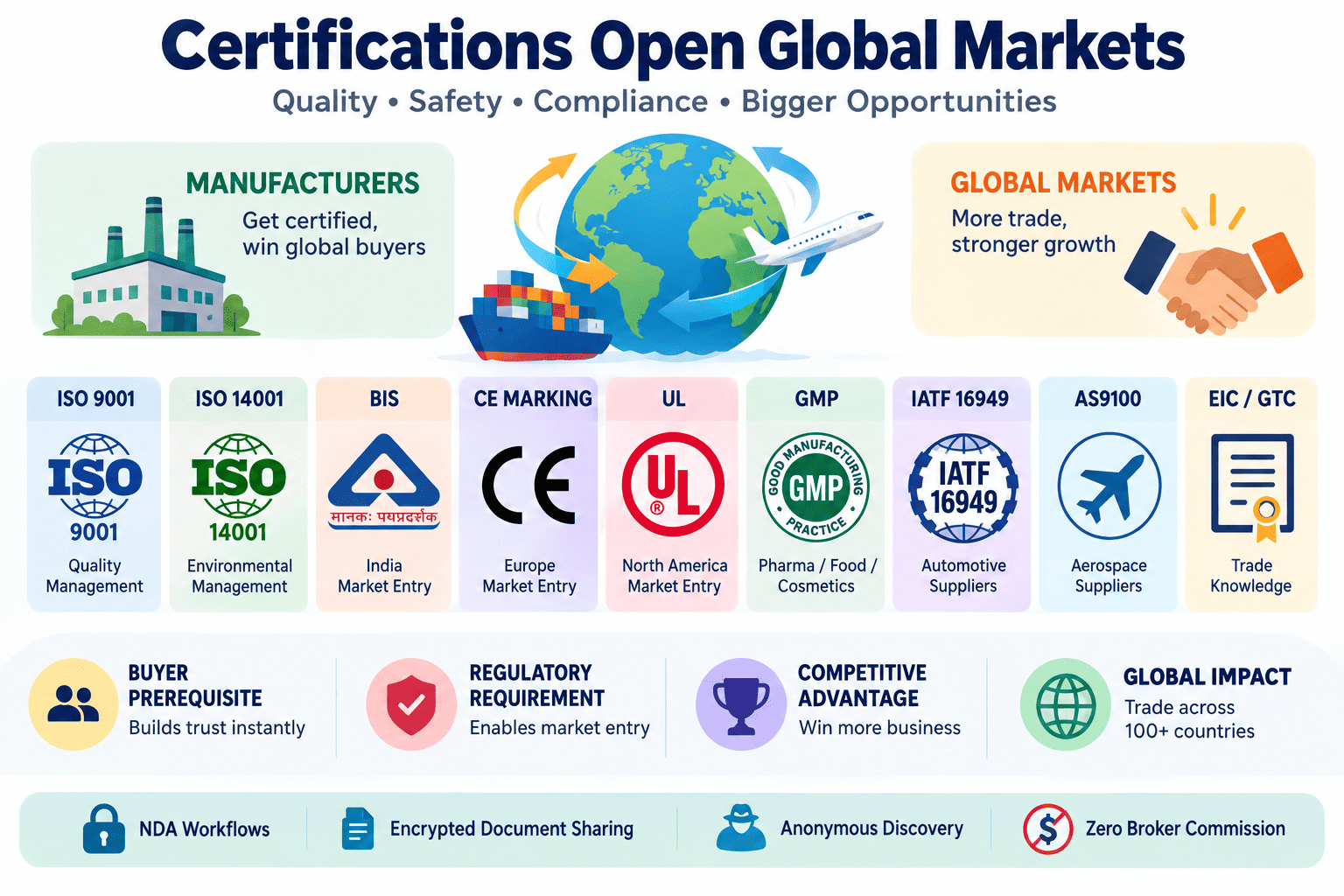
Direct Answer: Manufacturing certifications for international trade are formal credentials that verify a manufacturer’s compliance with quality, safety, environmental, or process standards recognised by regulatory authorities, industry bodies, or international customers. They range from ISO 9001 (quality management) and ISO 14001 (environmental management) to mandatory market-entry certifications like BIS certification (India), CE marking (EU), and UL certification (North America). Specialised credentials such as GMP (pharmaceuticals, food, cosmetics), IATF 16949 (automotive), and AS9100 (aerospace) are prerequisites for supplying to those sectors. Professional certifications like the ICC Export/Import Certificate (EIC) and Global Trade Certificate (GTC) equip individuals and teams with trade knowledge. For manufacturers, exporters, and distributors, these certifications are not optional in cross-border B2B trade; they are buyer prerequisites, regulatory entry requirements, and competitive differentiators. However, a certificate is only as trustworthy as the entity holding it , which is why verifying the manufacturer’s legal identity through GTsetu’s 6-point government tie-up verification (legal name, registered address, registration number, company status, company type, incorporation date) is the essential first step before accepting any certification claims. GTsetu does not verify industry certifications; those must be exchanged directly between partners. The platform provides built-in NDA workflows, encrypted document sharing, and anonymous discovery to facilitate secure certification exchange and due diligence, all with zero broker commission across 100+ countries.
📅 Published August 24, 2026🔄 Updated August 24, 2026⏱ 18 min read✍️ GTsetu Editorial Team
15+
Key Certifications Covered
100+
Countries on GTsetu
6-Point
Government Verification
0%
Broker Commission
In international B2B trade, a manufacturer’s certification is often the first thing a buyer checks , and the first deal-breaker. A supplier can present perfect pricing, a compelling product, and a polished sales pitch, but if they lack the mandatory certifications for the target market, the deal stops before it starts. Conversely, a manufacturer with robust certifications , ISO 9001, GMP, CE marking, BIS certification, or UL approval , signals reliability, compliance, and a maturity that buyers from developed markets increasingly demand as a baseline.
But navigating the world of manufacturing certifications is complex. There are hundreds of certification bodies, dozens of standards, and each target market has its own mandatory requirements. A certification that is essential for exporting electronics to the EU (CE marking) may be irrelevant for exporting textiles to the US. A BIS certification that is mandatory for selling electrical goods in India means nothing to a buyer in Singapore. And a GMP certification that is non-negotiable for pharmaceutical manufacturers may be only a nice-to-have for industrial parts suppliers.
This guide provides a comprehensive, 2026-updated overview of the most important manufacturing certifications for international trade: what they are, who issues them, which markets require them, how to obtain them, and , critically , how to verify that a manufacturing partner actually holds the certifications they claim. For related context, see our guides on company background verification (KYB), export readiness by region, and finding verified international distributors.
💡 Who This Guide Is For
Manufacturers seeking to understand which certifications they need for export, procurement professionals and distributors evaluating potential manufacturing partners, compliance officers building supplier verification frameworks, and business development teams looking to build competitive advantage through certification.
⚖️ Legal Disclaimer
This guide provides general commercial and educational information on manufacturing certifications for international trade. It does not constitute legal, regulatory, or certification advice. Certification requirements vary by product, market, and regulatory changes. Always consult qualified experts, certification bodies, and local legal counsel before committing to any certification programme or trade compliance decision.
SECTION 1
1 Certifications at a Glance
Before diving into detailed explanations, here is a visual orientation across the principal manufacturing certification types you will encounter in international trade, from quality management systems to market-entry compliance:
ISO
ISO 9001 / 14001 / 45001
Quality, environmental, and occupational health & safety management systems. The most widely recognised international manufacturing certifications.
🌍 Global Standard
BIS
BIS Certification (India)
Mandatory certification for foreign manufacturers exporting to India. Validates compliance with Indian quality and safety standards.
🇮🇳 India Market Access
GMP
Good Manufacturing Practice
Mandatory for pharmaceuticals, food, and cosmetics. Ensures products are consistently produced and controlled according to quality standards.
💊 Health & Safety
CE
CE Marking (EU)
Mandatory conformity marking for products sold in the European Economic Area. Confirms compliance with EU health, safety, and environmental standards.
🇪🇺 EU Market Access
UL
UL Certification (North America)
Safety certification for products sold in the US and Canada. Issued by Underwriters Laboratories, a globally recognised independent safety science company.
🔌 North American Safety
EIC
Export/Import Certificate (ICC)
Professional trade certification for individuals. Covers international trade, contracts, financing, logistics, and global business management.
📚 Trade Knowledge
📌 Why Certifications Are Often Misunderstood
Manufacturers sometimes treat certifications as a one-time compliance exercise rather than a continuous commitment. A certificate is a point-in-time validation. Maintaining certification requires ongoing audits, process discipline, and periodic recertification. A manufacturer who held ISO 9001 three years ago but let it lapse is not ISO-certified today. Buyers must verify both the existence of the certification and its current validity, not just accept a certificate copy presented in a sales pitch. See Section 12 for a detailed verification framework.
SECTION 2
2 Why Certifications Matter in International Trade
🎯 Core Reasons
Manufacturing certifications are not optional in international trade. They serve four essential functions: (1) Market Access , mandatory certifications like CE, BIS, and UL are legal requirements for selling in certain markets; (2) Buyer Confidence , certifications signal that the manufacturer operates to recognised standards, reducing the buyer’s due diligence burden; (3) Quality Assurance , certified manufacturers are more likely to produce consistent, defect-free products; and (4) Competitive Differentiation , in crowded supplier markets, certification can be the deciding factor that wins a contract over an uncertified competitor.
85%
of B2B buyers in developed markets consider ISO certification a minimum requirement for new suppliers, according to industry surveys
6-18 mo
typical timeline to obtain full certification for complex standards like ISO 9001, depending on the starting maturity of the quality system
20-40%
premium that certified manufacturers can sometimes command over uncertified competitors in the same product category, reflecting the reduced risk to buyers
3-5 yr
typical certification cycle for ISO standards; most require recertification or surveillance audits every 3 years
✨ GTsetu Insight
Certifications are only as trustworthy as the entity holding them. Before accepting a manufacturer’s certification claims, you need to verify that the company itself is legally registered, active, and operating under the identity it presents. GTsetu’s 6-point government tie-up verification (legal name, registered address, registration number, company status, company type, incorporation date) provides the foundational identity verification needed before you trust any certification claims. The platform also provides encrypted document exchange for sharing and validating certificates directly between partners.
SECTION 3
3 ISO Certification Series (9001, 14001, 45001, etc.)
🌍 Global Standard
The ISO (International Organization for Standardisation) series is the most widely recognised family of manufacturing certifications globally. ISO standards specify requirements for quality management systems, environmental management, occupational health and safety, and many other areas. ISO 9001 is the flagship standard for quality management, providing a framework for consistent product quality, customer satisfaction, and continuous improvement.
📋
ISO 9001: Quality Management
The most widely adopted ISO standard. Specifies requirements for a quality management system (QMS). Demonstrates the manufacturer’s ability to consistently provide products that meet customer and regulatory requirements.
🌿
ISO 14001: Environmental Management
Specifies requirements for an environmental management system. Demonstrates commitment to minimising environmental impact, increasingly a requirement for suppliers to large corporations and government contracts.
🛡️
ISO 45001: Occupational Health & Safety
Specifies requirements for an occupational health and safety (OH&S) management system. Demonstrates commitment to worker safety, increasingly important for manufacturers in high-risk industries.
🔬
ISO 13485: Medical Devices
Specific quality management standard for medical device manufacturers. Demonstrates compliance with regulatory requirements for medical devices in many markets, including the EU and US.
⚡
ISO 50001: Energy Management
Specifies requirements for an energy management system. Increasingly important for manufacturers seeking to reduce energy costs and demonstrate sustainability credentials.
🔧
ISO/TS 16949 (Now IATF 16949)
Automotive-specific quality management standard. Mandatory for suppliers to major automotive OEMs. Specifies requirements for quality management in the automotive sector.
How to Verify ISO Certification
1
Request the Certificate
Ask the manufacturer for a copy of their ISO certificate. It should include the certification body’s name, the standard (e.g., ISO 9001:2015), the scope of certification (e.g., “manufacture of automotive components”), the certificate number, and the expiry date.
2
Check the Certification Body Directory
Look up the certification body’s online directory to confirm that the certificate number is valid and active. Many certification bodies (e.g., SGS, TÜV, BSI) have public databases where you can verify certificate status.
3
Verify the Scope
Confirm that the scope of certification matches the products and processes relevant to your supply chain. A certificate for “management consultancy” does not validate a manufacturer’s production capability.
4
Check the Expiry Date
Ensure the certificate is current. Most ISO certificates are valid for three years, with surveillance audits in between. A certificate that expired 18 months ago is not valid.
SECTION 4
4 BIS Certification for Foreign Manufacturers
🇮🇳 India Market Access
BIS (Bureau of Indian Standards) certification is a mandatory certification for certain products imported into India. It confirms that the manufacturing facility and products meet Indian quality and safety standards. Foreign manufacturers must apply through the BIS Foreign Manufacturers Certification Scheme (FMCS), which involves factory inspection, product testing, and ongoing compliance monitoring. Without BIS certification, products in regulated categories (electronics, chemicals, food, etc.) cannot be legally sold in India.
Key Facts About BIS Certification for Foreign Manufacturers
📋
Mandatory vs Voluntary
BIS certification is mandatory for products covered under the BIS Compulsory Registration Scheme (CRS) and products requiring ISI mark. Voluntary certification is also available for other products.
🏭
Foreign Manufacturers Scheme (FMCS)
BIS allows foreign manufacturers to apply for certification directly through FMCS. The application requires a local representative in India, but the manufacturing facility does not need to be physically located in India.
🔍
Factory Audit Required
BIS conducts physical audits of the manufacturing facility to verify quality management systems, process controls, and product testing capabilities before granting certification. The audit is a critical part of the process.
📋
Product Testing
Products must be tested at BIS-recognised laboratories according to Indian standards. Testing can be done in the manufacturer’s home country or in India, but must meet BIS requirements.
🔄
Renewal & Compliance
BIS certification is typically valid for one to two years and must be renewed regularly. Manufacturers must comply with ongoing quality control and reporting requirements to maintain certification.
💰
Cost & Timeline
The cost of BIS certification for foreign manufacturers includes application fees, product testing, factory audit costs, and ongoing compliance fees. The timeline is typically 3-6 months from application to certification, depending on product complexity and audit scheduling.
🔍 BIS Certification is Not Optional for Regulated Products
For products like electrical goods, electronics, certain chemicals, food products, and medical devices, selling in India without BIS certification is a legal violation that can result in customs detention, fines, and product seizure. Any manufacturer claiming to export to India must provide evidence of valid BIS certification for regulated product categories. Before accepting a certification claim, verify the certificate number on the BIS website or through the BIS foreign manufacturers certification portal.
SECTION 5
5 CE Marking: Essential for EU Market Access
🇪🇺 EU Market Access
CE marking is a mandatory conformity marking for products sold in the European Economic Area (EEA). It indicates that the product meets the essential requirements of applicable EU health, safety, and environmental protection legislation. CE marking is not a quality certification; it is a regulatory declaration that the product complies with relevant directives and can be legally placed on the EU market.
Key Facts About CE Marking
📋
Mandatory for Many Product Categories
CE marking is mandatory for products covered by EU directives, including electronics, machinery, medical devices, toys, construction products, personal protective equipment, and pressure equipment.
🏛️
Not a Voluntary Certification
CE marking is not a voluntary quality certification like ISO 9001. It is a legal requirement for placing products on the EU market. Products without CE marking cannot be sold in the EU, regardless of their quality.
📄
Technical Documentation Required
Manufacturers must compile a technical file demonstrating that the product meets applicable standards and regulations. This file must be maintained and made available to EU authorities on request.
🔬
Notified Body Involvement
For high-risk products (e.g., medical devices, some machinery), manufacturers must involve a recognised EU Notified Body to assess conformity. For lower-risk products, self-declaration may be sufficient.
🔄
Ongoing Compliance
CE marking requires ongoing compliance with EU regulations. Changes to product design, materials, or manufacturing processes may require re-assessment. Suppliers must monitor regulatory changes and update compliance accordingly.
⚠️
Legal Liability
Placing a product on the EU market without valid CE marking is a legal violation that can result in fines, product recalls, and legal action. The manufacturer, not the importer or distributor, bears primary responsibility for CE marking compliance.
SECTION 6
6 UL Certification: North American Safety Standard
🔌 North American Safety
UL (Underwriters Laboratories) certification is a safety certification widely recognised in the United States and Canada. UL develops safety standards and tests products to verify that they meet these standards. While UL certification is not legally mandatory for most products in the US, it is effectively mandatory because most US retailers, insurance companies, and regulatory authorities require it for many product categories.
Key Facts About UL Certification
📋
Widely Recognised Safety Standard
UL is one of the most recognised safety certification marks globally. UL certification indicates that a product has been independently tested and meets applicable safety standards.
🏛️
Not Mandatory but Effectively Required
UL certification is not legally required in most US states, but it is effectively mandatory because retailers, insurers, and regulatory authorities require it for many product categories. Products without UL certification may not be accepted by major retailers or may be difficult to insure.
📄
Testing and Inspection
UL certification requires product testing to UL standards, as well as ongoing factory inspections to verify that products continue to meet safety requirements. Certification is an ongoing commitment, not a one-time event.
🌍
Global Recognition
UL marks are widely recognised internationally, not just in North America. Many buyers outside North America also prefer UL-certified products, as UL standards are often seen as rigorous and reliable.
🔄
Ongoing Compliance
UL certification requires ongoing compliance through factory inspections and product testing. Manufacturers must maintain records and allow UL inspectors to access facilities and records as needed.
💰
Cost & Timeline
The cost of UL certification varies significantly depending on product complexity and the number of standards involved. The timeline is typically 2-6 months from application to certification, with ongoing costs for factory inspections and maintenance.
GMP (Good Manufacturing Practice) certification is a system of standards that ensures products are consistently produced and controlled according to quality standards. It is mandatory in the pharmaceutical industry, food production, cosmetics, and medical devices in many countries. GMP covers all aspects of production, including premises, equipment, personnel, processes, and quality control.
Key Facts About GMP Certification
📋
Mandatory in Regulated Sectors
GMP is mandatory for pharmaceuticals in virtually all developed markets (FDA in US, EMA in EU, WHO guidelines globally). It is also mandatory or strongly recommended for food production (often as HACCP or GMP) and cosmetics in many markets.
🏛️
Issued by Regulatory Authorities
GMP certification is typically issued by health authorities (FDA, EMA, WHO) or accredited certification bodies. Unlike ISO certification, GMP compliance is often directly audited and enforced by regulatory authorities.
📄
Comprehensive Scope
GMP covers the entire manufacturing process, from raw material control to production, packaging, quality control, and distribution. It requires detailed documentation and process validation.
🔍
Rigorous Inspections
GMP compliance requires rigorous inspections of facilities, equipment, processes, and documentation. Inspections can be unannounced in many jurisdictions. A GMP certificate is only valid if the facility is actually compliant at the time of inspection.
🔄
Ongoing Compliance
GMP certification is not a one-time qualification. It requires continuous compliance with regulatory standards, periodic inspections, and immediate reporting of any changes or incidents that could affect product quality.
⚠️
Legal and Liability Implications
Failure to maintain GMP compliance in regulated sectors can result in product recalls, fines, facility closure, and even criminal liability in cases of serious non-compliance. GMP certification is not optional for regulated products; it is a legal requirement.
SECTION 8
8 Professional Trade Certifications: EIC & GTC
📚 Trade Knowledge
Professional trade certifications are not manufacturing certifications per se, but they are essential for professionals managing international trade operations. The ICC Export/Import Certificate (EIC) and Global Trade Certificate (GTC) are two of the most respected credentials in international trade, providing individuals and teams with the knowledge and skills needed to navigate cross-border transactions.
Teams and individuals needing practical skills in international trade operations; often used for team training programmes
Curriculum
5 core courses: International Trade Overview, Business Transactions and Contracts, Financing and Security Devices, International Logistics and Sourcing, Global Business Management
15+ hours of interactive learning; 6 months access
Varies by team programme structure; typically 10–20 hours
Exam
60-minute online exam, 70% passing mark
Online exam, details vary by programme structure
Cost
$699 for full programme (discounts for teams)
Varies by team enrolment; custom pricing available for organisations
Who It’s For
Professionals needing comprehensive international trade knowledge
Teams and organisations needing practical trade operations training
💡 Other Professional Trade Programmes
Several other institutions offer professional trade and export management certifications, including:
IISDT Certificate in International Trade & Export Management , Indian institute offering a 3-month certification covering global trade regulations, export documentation, and compliance.
IIFT Certificate Programmes , The Indian Institute of Foreign Trade offers executive and certificate programmes in international trade, export-import management, and global business strategy.
NIFT Advanced Certificate in International Trade , National Institute of Fashion Technology offers specialised trade certification for the apparel and textile sector.
IPSCMI CMPO , Certified Management Professional in Operations certification includes supply chain and trade operations components.
Bombay Chamber International Trade Operations Course , Practical certification course covering trade operations and documentation.
SECTION 9
9 Other Key Certifications (IATF, AS9100, etc.)
🚗
IATF 16949 (Automotive)
Quality management standard for automotive suppliers. Mandatory for suppliers to major automotive OEMs. Specifies requirements for quality management, defect prevention, and continuous improvement. Replaced ISO/TS 16949. For related reading, see contract manufacturer vs captive manufacturing.
✈️
AS9100 (Aerospace)
Quality management standard for aerospace manufacturers. Mandatory for suppliers to major aerospace companies. Specifies requirements for safety, reliability, and traceability. Based on ISO 9001 with additional aerospace-specific requirements.
⚡
IEC Standards (Electronics)
International Electrotechnical Commission standards for electrical and electronic products. Compliance with IEC standards is often a prerequisite for export to many markets. Interacts with logistics responsibilities for electronics shipments.
🍽️
HACCP & BRC (Food Safety)
HACCP (Hazard Analysis Critical Control Point) and BRC (British Retail Consortium) are food safety standards. Mandatory for food exporters to many markets. Based on principles of risk assessment and critical control point identification.
🧪
REACH & RoHS (Chemicals)
REACH (Registration, Evaluation, Authorisation and Restriction of Chemicals) is an EU regulation for chemicals and products containing chemicals. RoHS (Restriction of Hazardous Substances) applies to electrical and electronic equipment. Compliance is mandatory for selling into the EU.
🏥
FDA Registration (Medical Devices)
FDA registration is mandatory for manufacturers of medical devices sold in the US. It requires establishment registration, product listing, and compliance with FDA quality system regulations (21 CFR Part 820).
SECTION 10
10 Compliance & Regulatory Frameworks
📋 Regulatory Landscape
Manufacturing certifications sit within broader compliance and regulatory frameworks that govern international trade. Understanding these frameworks is essential for manufacturers seeking to export and for buyers evaluating manufacturing partners. Key frameworks include:
1
DGFT (India) – Directorate General of Foreign Trade
India’s primary government agency for foreign trade policy and export-import regulation. DGFT issues export-import licences, administers trade policy, and handles export readiness in the Indian context. Manufacturers exporting from India or selling into India must understand DGFT regulations.
2
EU Regulatory Framework
The EU operates a comprehensive regulatory framework covering product safety (CE marking), chemicals (REACH), electronics (RoHS), and many other areas. Compliance is mandatory for market access. The framework is complex and frequently updated; maintaining compliance requires ongoing monitoring and expert advice.
3
US Regulatory Framework
The US regulatory framework includes FDA regulations (for food, drugs, and medical devices), CPSC regulations (consumer safety), FCC regulations (electronics), and many others. UL certification is often required, but regulatory compliance is separate from certification.
4
ASEAN Mutual Recognition Arrangements
ASEAN has mutual recognition arrangements (MRAs) for several sectors, including electronics, cosmetics, and medical devices. These MRAs aim to reduce technical barriers to trade by recognising each member state’s certification and testing frameworks. See our guide on ASEAN as a manufacturing hub for more context.
5
WTO Trade Facilitation Agreement
The WTO Trade Facilitation Agreement aims to simplify and harmonise customs procedures globally. While not a certification itself, it provides a framework that affects how certifications and compliance are administered at borders. Understanding its provisions can help manufacturers anticipate changes in import/export procedures.
SECTION 11
11 How to Obtain Certification: Step-by-Step
🏗️ Certification Roadmap
Obtaining certification is a structured process that requires planning, investment, and ongoing commitment. This section outlines the general process for obtaining manufacturing certifications like ISO 9001, though details will vary by certification type, product category, and jurisdiction.
1
Identify Applicable Standards
Determine which certifications are required or beneficial for your products and target markets. This may include mandatory certifications (CE, BIS, FDA) and voluntary certifications (ISO 9001, UL, GMP). Consider both regulatory requirements and customer expectations.
2
Gap Analysis
Conduct a gap analysis to assess your current systems, processes, and documentation against the requirements of the target certification. Identify what needs to be implemented, improved, or documented to meet the standard. Consider seeking the help of a consultant.
3
Develop and Implement Systems
Develop and implement the required quality management systems, environmental systems, or safety systems. This includes writing documentation, training staff, and establishing processes that meet the standard’s requirements. Implementation typically takes 3-12 months.
4
Select a Certification Body
Choose an accredited certification body to conduct the audit and issue the certificate. Ensure the certification body is accredited by a recognised national or international body (e.g., UKAS, ANAB, JAS-ANZ). The certification body should have expertise in your industry.
5
Stage 1 Audit (Documentation Review)
The certification body conducts a Stage 1 audit to review your documentation and ensure your system is ready for the full audit. The auditor will identify any gaps that need to be addressed before the Stage 2 audit.
6
Stage 2 Audit (On-site)
The certification body conducts a full on-site audit to verify that your system is actually implemented and effective. The auditor will interview staff, inspect facilities and equipment, and review records to confirm compliance.
7
Certification and Surveillance
If the audit is successful, the certification body issues the certificate. The certificate is typically valid for three years, with surveillance audits conducted at regular intervals (usually every 6-12 months) to ensure ongoing compliance. At the end of the three-year cycle, a full recertification audit is required.
✨ GTsetu Insight
Finding a manufacturer that holds the right certifications is easier when you start with verified companies. GTsetu’s verified matchmaking platform helps you identify manufacturers across 100+ countries with government-tie-up verification of 6 core credentials. Once you have identified a verified candidate, you can use GTsetu’s encrypted document exchange to securely request and validate certification copies, all within a built-in NDA workflow that protects your due diligence process.
SECTION 12
12 How to Verify a Manufacturer’s Certifications
🔍 Verification Framework
A certificate presented by a manufacturer is not proof of certification; it is a claim of certification. The claim must be independently verified. This section provides a structured verification framework that buyers should use before accepting any manufacturer’s certification claims.
1
Verify the Manufacturer’s Legal Identity First
Before assessing any certification, verify that the manufacturer is a legally registered entity. Use GTsetu’s 6-point government verification (legal name, registered address, registration number, company status, company type, incorporation date) to confirm the company’s identity. A certificate held by a company that is not legally registered, not active, or misrepresented is worthless.
2
Request the Actual Certificate
Ask the manufacturer to provide a copy of the actual certificate, not a screenshot or a summary. The certificate should include the certification body’s name, the standard (e.g., ISO 9001:2015), the scope of certification, the certificate number, and the expiry date.
3
Check the Certification Body’s Directory
Look up the certification body’s online directory to confirm that the certificate number is valid and active. Many certification bodies (e.g., SGS, TÜV, BSI, BIS, UL) have public databases where you can verify certificate status. If the certification body does not have a public directory, contact them directly.
4
Verify the Scope
Confirm that the scope of certification matches the products and processes relevant to your supply chain. A certificate for “management consultancy” does not validate a manufacturer’s production capability. The scope should explicitly mention the relevant product categories or manufacturing processes.
5
Check the Expiry Date and Status
Ensure the certificate is current and active. Most certificates are valid for a specific period (typically 1-3 years). A certificate that expired or was suspended is not valid, regardless of the manufacturer’s claims. Check the certification body’s directory for the current status of the certificate.
6
Contact the Certification Body
If you have any doubt about a certificate’s validity, contact the certification body directly. Provide the certificate number and ask them to confirm the status, scope, and any conditions of the certification. This is a standard due diligence step; reputable manufacturers will not object.
7
Consider a Factory Audit
A certificate is a point-in-time validation. To verify that the certified systems are actually implemented in the factory, consider conducting a factory audit or using a third-party inspection service. A factory audit can verify the manufacturer’s production capability, quality control, and compliance with the certified standards in practice. See our guide on factory audits explained for more detail.
⚠️ Red Flags in Certification Verification
Expired certificates , Certificate expired or about to expire without evidence of renewal in process.
Mismatched names , The company name on the certificate differs from the legal name confirmed in government verification.
Mismatched scope , The scope of certification does not match the products you are buying.
Unverifiable certification bodies , The certification body is not accredited by a recognised accreditation body, or the certificate cannot be found in the certification body’s directory.
Reluctance to provide full certificate , The manufacturer is hesitant to provide the full certificate, only offering a summary or a screenshot.
Claims not matching the certificate , The manufacturer claims a certification that is not actually listed on the certificate, or claims a standard that the certificate does not cover.
SECTION 13
13 Risks of Ignoring Certification Requirements
🚫
Market Access Denied
Products without mandatory certifications (CE, BIS, UL, FDA) may be detained at customs, refused entry, or seized. This results in lost shipments, delayed deliveries, and potential contractual penalties. In some cases, the product may be destroyed at the manufacturer’s expense.
⚖️
Legal Liability and Penalties
Selling non-compliant products in regulated markets can result in significant fines, product recalls, and legal action. In serious cases, individuals may face criminal liability. Recalls can cost millions and damage brand reputation irreparably.
💸
Lost Business and Brand Damage
Buyers are increasingly demanding certification as a baseline requirement. Manufacturers without certification are often excluded from tenders and supplier databases. Brand damage from a failed compliance incident can take years to repair.
📋
Supply Chain Disruption
If a key supplier loses certification or is found to be non-compliant, the entire supply chain can be disrupted. This can lead to production halts, customer penalties, and lost revenue. Diversification and regular verification are essential mitigations. See our guide on supplier switching risks.
🔄
Contractual Breach
Many supply contracts explicitly require manufacturers to maintain specific certifications. Losing certification can constitute a material breach of contract, allowing the buyer to terminate the agreement and pursue damages.
🔍
Regulatory Scrutiny
Manufacturers who have been flagged for non-compliance may face increased regulatory scrutiny, including more frequent inspections and audits. This can disrupt operations and increase compliance costs.
SECTION 14
14 Which Certifications Do You Need?
🧭 Certification Decision Guide
If you export to the European Union…
→ CE Marking + REACH/RoHS as applicable
EU Compliance
CE marking is mandatory for most regulated products. REACH applies to chemicals; RoHS applies to electronics. Additional sector-specific standards (e.g., medical devices) may apply.
If you export to India…
→ BIS Certification for regulated products
India Market Access
BIS certification is mandatory for electronics, chemicals, food, and many other product categories. Non-compliance results in customs detention and legal penalties.
If you export to North America…
→ UL Certification + FDA as applicable
North American Safety
UL certification is effectively mandatory for consumer products. FDA registration applies to medical devices, food, and drugs. FCC applies to electronics.
If you supply to pharmaceutical, food, or cosmetics companies…
→ GMP Certification
Health & Safety
GMP is mandatory for pharmaceuticals in most markets. For food, consider HACCP or BRC certification. For cosmetics, GMP is increasingly expected.
If you supply to automotive OEMs…
→ IATF 16949 Certification
Automotive Quality
IATF 16949 is mandatory for suppliers to major automotive OEMs. Based on ISO 9001 with additional automotive-specific requirements.
If you supply to aerospace companies…
→ AS9100 Certification
Aerospace Quality
AS9100 is mandatory for suppliers to major aerospace companies. Based on ISO 9001 with additional aerospace-specific requirements for safety, reliability, and traceability.
If you need a baseline quality credential…
→ ISO 9001 Certification
Quality Management
The most widely recognised manufacturing certification. Often a prerequisite for larger buyers and government contracts. Provides a framework for consistent quality and continuous improvement.
If you need to build trade knowledge in your team…
→ ICC EIC or GTC Certification
Professional Trade
The Export/Import Certificate (EIC) and Global Trade Certificate (GTC) equip teams with practical trade operations knowledge. Offered by the ICC Academy with global recognition.
SECTION 15
15 How GTsetu Helps You Find Verified Manufacturers
🌐 Platform Spotlight, GTsetu
The Verified Starting Point for Every Manufacturing Partnership
Certifications are only as trustworthy as the entity holding them. A manufacturer can present a perfect ISO 9001 certificate, but if the company itself is not legally registered, not active, or misrepresented, the certificate is worthless. GTsetu was built to solve this foundational problem: a government‑tie‑up verified B2B discovery environment where manufacturers, distributors, and licensing partners connect with verified counterparts across 100+ countries, with built-in NDA infrastructure from first contact and zero broker commission.
Every company on GTsetu is verified using direct government tie‑ups across six essential credentials: legal name, registered address, registration number, company status, company type, and date of certificate of incorporation. This foundational identity verification ensures that every manufacturer you discover on the platform is legally registered and active. GTsetu does not verify industry certifications (ISO, BIS, GMP, CE, UL, etc.) , those must be exchanged and validated directly between partners. However, the platform provides encrypted document exchange for sharing and validating certificates, built-in NDA workflows to protect confidentiality during due diligence, and anonymous discovery so you can explore verified manufacturing partners without revealing your sourcing intentions.
✅
Government Tie‑Up Verification
6‑point verification: legal name, registered address, registration number, company status, company type, incorporation date.
📜
Certification Exchange
GTsetu does not verify industry certifications. They must be exchanged directly between partners using the platform’s encrypted document exchange.
🕵️
Anonymous Discovery
Explore verified manufacturing partners across 100+ countries without revealing your identity until mutual interest is confirmed.
📄
Built‑In NDA Workflow
Formalise confidentiality before sharing product specifications, certification documents, or any commercially sensitive due diligence data, with a full digital audit trail.
🚫
Zero Commission
No broker fees on any deal, whether a manufacturing partnership, licensing arrangement, or distribution agreement.
🔐
Encrypted Collaboration
All documents and communications encrypted in transit and at rest. Secure B2B collaboration from first contact.
🌍
100+ Countries
Active verified network for international manufacturers, distributors, and licensing partners across Asia, the Middle East, Europe, Africa, and the Americas.
Encrypted document sharing for certification exchange
✓ Built-in
✗ Email risk
100+ country coverage
✓ Yes
~ Geography-limited
FAQ
? Frequently Asked Questions
QWhat are the most important manufacturing certifications for international trade?
The most important manufacturing certifications for international trade include: ISO 9001 (quality management), ISO 14001 (environmental management), BIS certification (for products entering India), CE marking (for products sold in the European Economic Area), UL certification (for safety in North America), GMP (for pharmaceuticals, food, and cosmetics), and industry-specific certifications like IATF 16949 (automotive) and AS9100 (aerospace). Additionally, professional trade certifications like the ICC Export/Import Certificate (EIC) and Global Trade Certificate (GTC) are valuable for individuals and organizations managing cross-border transactions. See Sections 3–9 for detailed coverage of each certification.
QWhat is a BIS certificate for foreign manufacturers?
A BIS (Bureau of Indian Standards) certificate for foreign manufacturers is a mandatory certification required for certain products imported into India. It confirms that the manufacturing facility and products meet Indian quality and safety standards. Foreign manufacturers must apply through the BIS Foreign Manufacturers Certification Scheme (FMCS), which involves factory inspection, product testing, and ongoing compliance monitoring. Without BIS certification, products in regulated categories (electronics, chemicals, food, etc.) cannot be legally sold in India. See Section 4 for a detailed explanation.
QWhat is the difference between the Export/Import Certificate (EIC) and the Global Trade Certificate (GTC)?
Both are professional certifications offered by the International Chamber of Commerce (ICC). The Export/Import Certificate (EIC) is a comprehensive certification covering the full spectrum of international trade, including contracts, financing, logistics, and global business management. It is designed for professionals who need a broad, practical understanding of cross-border transactions. The Global Trade Certificate (GTC) is a more focused certification on the practical aspects of international trade operations, often used for team training. The EIC is generally more comprehensive and requires completion of five courses and a final exam. See Section 8 for a detailed comparison.
QWhat is ISO certification and why is it important for manufacturing?
ISO certification refers to a set of international standards developed by the International Organization for Standardization that specify requirements for quality management systems (ISO 9001), environmental management (ISO 14001), occupational health and safety (ISO 45001), and many other areas. For manufacturers, ISO certification provides independent verification that their processes meet internationally recognised standards, which is often a prerequisite for supplying to large corporations, government contracts, and export markets. It signals reliability, quality, and commitment to continuous improvement. See Section 3 for detailed coverage.
QHow do I verify a manufacturer’s certifications?
Verifying a manufacturer’s certifications requires a multi-step process: (1) Verify the manufacturer’s legal identity using GTsetu’s 6-point government verification first; (2) Request copies of actual certificates issued by accredited certification bodies; (3) Check the certification body’s online directory to confirm the certificate is valid and active; (4) Verify the scope of certification matches the products and processes relevant to your supply chain; (5) For mandatory country-specific certifications (like BIS or CE), confirm with the relevant regulatory authority; and (6) Consider a factory audit to verify that the certification reflects actual operations. See Section 12 for a detailed verification framework.
QWhat is the role of the Indian Institute of Foreign Trade (IIFT) in certification?
The Indian Institute of Foreign Trade (IIFT) is a premier Indian institution offering education, training, and research in international trade. While IIFT itself does not issue product manufacturing certifications, it offers executive and certificate programmes in international trade management, export-import procedures, and global business strategy. These programmes are valuable for professionals seeking to deepen their knowledge of trade regulations, export-import documentation, and international business strategy, which complements the technical manufacturing certifications required for specific products. See Section 8 for professional trade certifications available through other providers.
QWhat are the key certifications for exporting to the European Union?
The key certifications for exporting to the European Union include: CE marking (mandatory for products in regulated categories like electronics, machinery, toys, and medical devices), REACH compliance (for chemicals and products containing chemicals), RoHS compliance (for electrical and electronic equipment), and food safety certifications like HACCP and BRC (for food products). Additionally, many product categories require specific testing and certification by EU-recognised Notified Bodies. The EU also requires full traceability of products in regulated sectors, making supply chain verification and documentation equally critical. See Sections 5 and 10 for detailed coverage.
QWhat is GMP certification?
Good Manufacturing Practice (GMP) certification is a system of standards that ensures products are consistently produced and controlled according to quality standards. It is mandatory in the pharmaceutical industry, food production, cosmetics, and medical devices in many countries. GMP covers all aspects of production, including premises, equipment, personnel, processes, and quality control. GMP certification is typically issued by health authorities (like the US FDA, EMA, or WHO) or accredited certification bodies. For export, GMP compliance is often a prerequisite for market access in regulated sectors. See Section 7 for detailed coverage.
QHow does GTsetu help with manufacturer verification?
GTsetu provides a verified B2B matchmaking platform where all listed manufacturers, distributors, and licensing partners undergo a 6-point government tie-up verification process: legal name, registered address, registration number, company status, company type, and date of incorporation. This foundational identity verification ensures that every company on the platform is legally registered and active. GTsetu does not verify industry-specific certifications (like ISO, BIS, or GMP) , those must be exchanged directly between partners. However, the platform provides built-in NDA workflows, encrypted document sharing, and anonymous discovery to facilitate secure certification exchange and due diligence. With zero broker commission and 100+ countries covered, GTsetu is the starting point for finding verified manufacturing partners globally. See Section 15 for detailed platform features.
Ready to Find Verified Manufacturing Partners with the Right Certifications?
Join 500+ verified manufacturers, brand owners, and distributors already building cross-border manufacturing partnerships on GTsetu, with government‑tie‑up verification of six core credentials, built-in NDA workflows, encrypted certification exchange, and zero broker fees across 100+ countries.
They represents the product, and research team behind GTsetu, a global B2B collaboration platform built to help companies explore cross-border partnerships with clarity and trust. The team focuses on simplifying early-stage international business discovery by combining structured company profiles, verification-led access, and controlled collaboration workflows.
With a strong emphasis on trust, and disciplined engagement, Team GTsetu shares insights on global trade, partnerships, and cross-border collaboration, helping businesses make informed decisions before entering deeper commercial discussions.