Advanced Manufacturing and Frontier Technology Institute (FTI) Maharashtra: What It Is and Why It Matters | GTsetu
Home ›
Blog ›
Advanced Manufacturing & FTI Maharashtra
🏛️ Advanced Manufacturing & Frontier Technology
Advanced Manufacturing and Frontier Technology Institute (FTI) Maharashtra: What It Is and Why It Matters
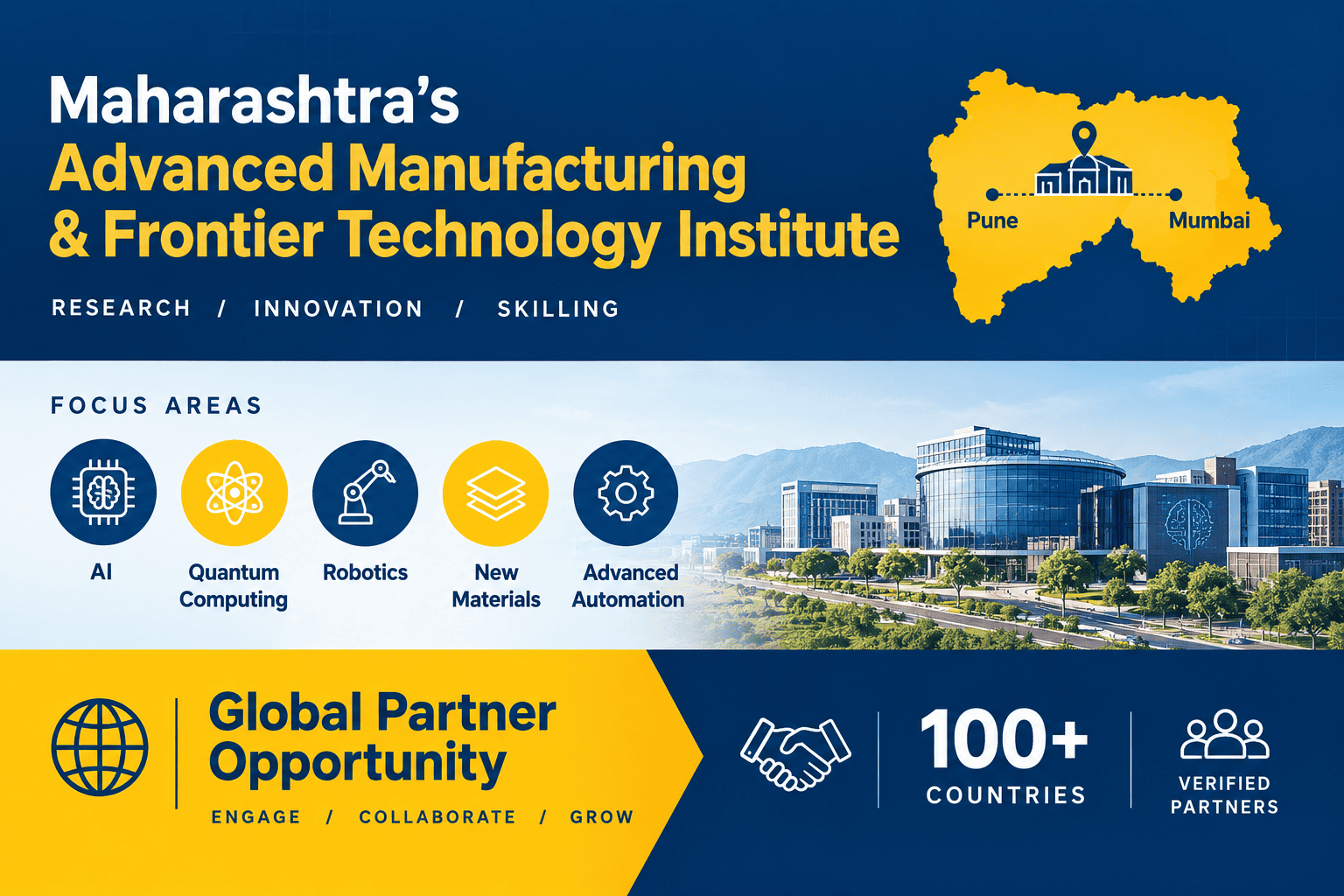
Direct Answer: The Advanced Manufacturing and Frontier Technology Institute (FTI) Maharashtra is a flagship initiative by the Government of Maharashtra to establish a world-class institution dedicated to research, innovation, and skilling in advanced manufacturing and frontier technologies. Announced by Chief Minister Devendra Fadnavis, the FTI is part of a broader strategy to position Maharashtra as India’s leading hub for high-value, technology-driven manufacturing. The initiative includes the establishment of a Global Frontier Technology Institute within an “Innovation City” to be developed between Pune and Mumbai, focused on areas including artificial intelligence, quantum computing, robotics, new materials, and advanced automation. The FTI is a key pillar of the Maharashtra State Manufacturing Mission, which aligns with NITI Aayog’s national Reimagining Manufacturing Mission. For global manufacturers and technology partners, the FTI represents a significant opportunity to engage with India’s emerging deep-tech ecosystem. GTsetu connects verified manufacturing and technology partners across 100+ countries, enabling businesses to discover and engage with credible partners in Maharashtra and beyond.
📅 Published October 2, 2026🔄 Updated October 2, 2026⏱ 20 min read✍️ GTsetu Editorial Team
10
Priority Sectors Supported
100+
Countries on GTsetu
5
Frontier Technology Domains
0%
Broker Commission
In October 2025, Maharashtra Chief Minister Devendra Fadnavis announced a landmark initiative that could reshape India’s manufacturing landscape: the establishment of a Global Frontier Technology Institute in Pune, as part of a broader Advanced Manufacturing and Frontier Technology Institute (FTI) initiative. The announcement, made alongside plans for a Maharashtra State Manufacturing Mission, signals a strategic pivot toward high-value, technology-driven manufacturing, a shift that has significant implications for global manufacturers, technology partners, and supply chains.
For businesses worldwide, understanding the FTI is not just about tracking policy developments in India. It is about recognizing a new node in the global advanced manufacturing network, one that will concentrate research talent, technology infrastructure, and industrial capability in a region already known for its automotive, engineering, and IT strength. Whether you are a manufacturer seeking technology partners, a distributor evaluating new sourcing regions, or a company exploring market entry into India, the FTI ecosystem is worth understanding.
This pillar guide explains what the FTI is, why it matters, its connection to Pune and the planned Innovation City, the frontier technologies it will focus on, and how global manufacturers can engage with this emerging ecosystem. For context on the broader landscape of global manufacturing partnerships, see Cross-Border Manufacturing Partnerships.
💡 Who This Guide Is For
Global manufacturers evaluating India as a sourcing or technology partner destination, distributors exploring new markets, business development teams tracking emerging manufacturing ecosystems, and anyone who needs to understand India’s advanced manufacturing strategy and its implications for global supply chains.
⚖️ Disclaimer
This guide provides commercial and strategic context based on publicly available information about the FTI initiative. Policy details, timelines, and programme specifics may evolve. Always verify current information with official government sources and engage qualified local counsel before making investment or partnership decisions.
SECTION 1
1 What Is the Advanced Manufacturing and Frontier Technology Institute (FTI)?
🏛️ Definition
The Advanced Manufacturing and Frontier Technology Institute (FTI) Maharashtra is a government-backed initiative to establish a world-class institution dedicated to research, innovation, and skilling in advanced manufacturing and frontier technologies. Announced by Chief Minister Devendra Fadnavis, the FTI is designed to serve as a bridge between industry, academia, and government, accelerating the adoption of emerging technologies in manufacturing and building a future-ready workforce. The initiative includes the establishment of a Global Frontier Technology Institute within a planned “Innovation City” between Pune and Mumbai.
The FTI is not a single institution but rather an ecosystem initiative. As described in official announcements, it encompasses: a Global Frontier Technology Institute of international standards, focused on research and advanced study; planned Frontier Tech Industrial Parks to support technology commercialization; residential complexes for workers; and collaborative R&D spaces for students, engineers, and entrepreneurs. The initiative is positioned as a cornerstone of Maharashtra’s strategy to lead India in advanced manufacturing.
The FTI’s formation was reviewed in a high-level meeting chaired by Chief Minister Fadnavis in Pune, with Deepak Karanjikar serving as convenor. The meeting focused on the institute’s role in supporting innovation, technological advancement, and the development of future-ready manufacturing capabilities in Maharashtra. This level of direct government engagement signals the strategic importance placed on the initiative.
2025
Year the FTI and Global Frontier Technology Institute were announced by CM Fadnavis
AI, Quantum, Robotics
Core frontier technology focus areas for the FTI’s research agenda
Pune-Mumbai
Location of the planned Innovation City hosting the Global Frontier Technology Institute
SECTION 2
2 Why the FTI Matters: Context and Drivers
The FTI initiative is best understood as Maharashtra’s response to a fundamental shift in global manufacturing: the transition from cost-driven production to technology-driven value creation. As global supply chains diversify and advanced economies compete on innovation, regions that can combine manufacturing capability with frontier technology research will capture the highest-value segments of global production.
🌐
Global Supply Chain Diversification
The “China Plus One” strategy is driving multinationals to diversify production across multiple geographies. Maharashtra aims to capture high-value segments of this shift by offering advanced manufacturing capability, not just low-cost labour.
🔬
Technology-Led Competitiveness
Advanced manufacturing, smart factories, AI-driven quality control, robotics, is becoming the basis of industrial competitiveness. The FTI is designed to build this capability in Maharashtra.
🏭
Industry 4.0 & 5.0 Adoption
Maharashtra’s Industries Policy identifies Smart Manufacturing (Industry 4.0 & 5.0) as a priority sector, with plans for Smart Industrial Parks and Fab Labs to support technology adoption.
🎓
Talent and Skilling Gap
Advanced manufacturing requires a workforce skilled in AI, robotics, and digital systems. The FTI will focus on skilling and training to build this talent pipeline, a critical enabler for industry growth.
The FTI is also aligned with national priorities. NITI Aayog’s Reimagining Manufacturing Mission aims to establish India as a global leader in advanced and sustainable manufacturing. Maharashtra’s Innovation City and FTI are positioned as state-level implementations of this national vision. For global manufacturers, this alignment signals policy stability and government commitment, important factors when evaluating long-term partnership or investment decisions. For related reading on how to assess manufacturing partners, see Partnership Evaluation Criteria.
SECTION 3
3 The Pune Connection: Why Pune Was Chosen
Pune is not an arbitrary choice for the FTI and the Global Frontier Technology Institute. The city has a unique combination of assets that make it ideally suited for an institution focused on advanced manufacturing and frontier technologies.
01
Educational Infrastructure
Pune hosts Savitribai Phule Pune University (SPPU) and over 800 affiliated colleges, along with premier institutions like the College of Engineering Pune (COEP, established 1854, one of Asia’s oldest engineering colleges). This concentration of academic excellence provides the talent pipeline and research capability essential for a frontier technology institute.
🎓 Over 800 colleges under SPPU
02
Industrial Base
Pune has a dense and diverse industrial ecosystem spanning automotive, engineering, IT, and pharmaceuticals. Major manufacturers, including global OEMs and their suppliers, have operations in and around the city. This industrial base provides the demand-side pull for advanced manufacturing technologies and a partner ecosystem for collaboration.
🏭 Automotive, engineering, and IT hub
03
Proximity to Mumbai
Pune’s location, close to Mumbai, combines Pune’s educational and industrial foundation with Mumbai’s global connectivity, financial infrastructure, and international trade linkages. The planned Innovation City explicitly leverages this corridor advantage.
📍 Pune-Mumbai corridor
04
Innovation Ecosystem
Pune has an established startup and innovation ecosystem, with incubators, accelerators, and R&D centres. The city is home to research institutions including CMTI (Central Manufacturing Technology Institute) and has a culture of industry-academia collaboration that the FTI aims to deepen.
🚀 CMTI and other research institutions
The Chief Minister’s announcement emphasized this rationale, stating that the Pune-Mumbai corridor was selected for its unique blend of advantages, “Pune’s strong educational and industrial foundation combined with Mumbai’s global connectivity and financial infrastructure”. The FTI is expected to further strengthen Pune’s position as a centre for frontier technology and advanced manufacturing.
SECTION 4
4 Innovation City: The Pune-Mumbai Corridor
The Innovation City is the physical manifestation of Maharashtra’s advanced manufacturing ambitions. Planned as a world-class industrial and educational centre between Pune and Mumbai, it will host the Global Frontier Technology Institute and a range of supporting infrastructure.
🏗️ What Innovation City Will Include
According to official announcements, Innovation City will feature: cutting-edge manufacturing parks for advanced industries; research hubs focused on frontier technologies; international university campuses (an “EduCity” model); collaborative R&D spaces for students, engineers, and entrepreneurs; ready-to-use industrial facilities for manufacturers and startups; and residential complexes for workers. The Global Frontier Technology Institute will be the centrepiece of this ecosystem.
The Innovation City concept reflects a global trend toward integrated innovation districts that co-locate research institutions, technology companies, and manufacturing facilities to accelerate commercialization. By creating physical proximity between academia, R&D, and production, these districts reduce the friction in technology transfer and talent mobility, a model pioneered in regions like Silicon Valley, Cambridge (UK), and Shenzhen.
For manufacturers evaluating India, Innovation City represents a future node in the global advanced manufacturing network. While full development will take years, the planning phase signals where Maharashtra’s industrial policy is headed: toward high-value, technology-intensive manufacturing rather than labour-cost competition. For context on evaluating manufacturing partnerships in emerging ecosystems, see Why Trust Breaks in Global Deals.
💡 GTsetu Insight
As Innovation City develops, it will create opportunities for global manufacturers to establish R&D partnerships, source from advanced manufacturing suppliers, and collaborate with research institutions. GTsetu’s verified network enables manufacturers to discover and engage with credible partners in Maharashtra’s emerging advanced manufacturing ecosystem.
SECTION 5
5 The Global Frontier Technology Institute
The Global Frontier Technology Institute is the specific institution planned within the broader FTI initiative and the Innovation City. Announced by Chief Minister Fadnavis, it is described as an institution of international standards dedicated to driving innovation and advanced research in frontier technologies.
The Institute’s focus areas, as indicated by official statements, include artificial intelligence, quantum computing, new materials, and advanced automation. These are the technologies that will define the next generation of manufacturing competitiveness, from AI-driven design and quality control to quantum-accelerated materials discovery and advanced robotics for precision assembly.
The Institute is expected to attract global universities, research hubs, and technology companies, creating a collaborative ecosystem for next-generation manufacturing innovation. This international orientation is significant: it signals that Maharashtra is not seeking to develop these capabilities in isolation, but rather to position itself as a node in the global frontier technology network. For manufacturers and technology partners, this creates potential entry points for collaboration, research partnerships, and technology commercialization.
Related to the FTI, the Government of Maharashtra has also announced a partnership with CANEUS International to establish a Mid-TRL (Technology Readiness Level 4-6) Innovation Acceleration and Skilling Institute in the Mumbai Metropolitan Region, focused on aerospace, space, energy, and deep technology. This complementary initiative reinforces Maharashtra’s strategy of building a comprehensive advanced technology ecosystem.
SECTION 6
6 Frontier Technologies: What They Are and Why They Matter
🔬 Definition
Frontier technologies in advanced manufacturing refer to emerging, high-impact technologies that are transforming production processes and enabling new capabilities. They are the technologies that will define competitive advantage in the coming decades, from how products are designed and made to how factories are operated and supply chains managed.
01
Artificial Intelligence (AI)
AI is being applied across manufacturing: predictive maintenance to reduce downtime, quality control through machine vision, supply chain optimization, and generative design for product development. AI-driven manufacturing enables higher efficiency, lower waste, and faster innovation cycles.
🤖 Predictive maintenance, quality control
02
Quantum Computing
While still emerging, quantum computing promises to transform materials discovery, optimization problems, and complex simulations that are intractable for classical computers. For manufacturing, this could accelerate the development of new materials and optimize complex production processes.
⚛️ Materials discovery, optimization
03
Robotics & Advanced Automation
From collaborative robots (cobots) working alongside humans to fully automated production lines, robotics is at the core of advanced manufacturing. Advances in machine learning and sensor technology are making robots more capable, flexible, and safer.
🦾 Cobots, automated assembly
04
New Materials
Advanced materials, composites, nanomaterials, smart materials, and lightweight alloys, enable new product capabilities and performance characteristics. These materials are critical for aerospace, automotive, energy, and electronics applications.
🧪 Composites, nanomaterials
05
3D Printing & Additive Manufacturing
Additive manufacturing enables rapid prototyping, custom part production, and complex geometries that are impossible with traditional methods. It is transforming how products are designed, produced, and distributed.
🖨️ Rapid prototyping, custom parts
06
Internet of Things (IoT) & Digital Twins
IoT sensors and digital twin technology create connected factories and supply chains, enabling real-time monitoring, predictive analytics, and remote operations. Digital twins allow virtual testing and optimization of production processes.
🌐 Connected factory, digital twin
These frontier technologies are central to Industry 4.0 (the digitalization of manufacturing) and Industry 5.0 (the integration of human creativity with smart systems). Maharashtra’s Industries Policy explicitly identifies Smart Manufacturing (Industry 4.0 & 5.0) as a priority sector, with support for technology adoption and the development of Smart Industrial Parks and Fab Labs. The FTI will be a key enabler of this technology adoption.
SECTION 7
7 The Maharashtra State Manufacturing Mission
The FTI is a pillar of the Maharashtra State Manufacturing Mission, which Chief Minister Fadnavis announced would be launched on the lines of the National Manufacturing Mission. The mission provides the policy and infrastructure framework within which the FTI operates.
The state mission is aligned with NITI Aayog’s Reimagining Manufacturing Mission, a national initiative to establish India as a global leader in advanced and sustainable manufacturing. Key elements of the state mission include: policy and infrastructure support for advanced manufacturing; development of Innovation City between Pune and Mumbai; support for global manufacturers and startups; and a focus on technology-led, innovation-driven growth.
📌 Invest Maharashtra Initiative
The Government of Maharashtra has launched ‘Invest Maharashtra’, a strategic initiative backed by a ₹3,000-crore outlay, including a ₹1,000-crore Catalytic Fund for frontier and emerging sectors. This initiative aims to strengthen investment promotion and position Maharashtra as a preferred destination for domestic and foreign investment. For manufacturers considering India, this represents a significant policy support mechanism.
The mission also connects to broader industrial policy. Maharashtra’s Industries, Investment & Services Policy 2025 identifies 16 priority sectors and multiple thrust sectors, with incentives for manufacturing units based on investment and employment. The FTI supports these sectors by building the technology and talent base required for their growth.
SECTION 8
8 Priority Sectors for Advanced Manufacturing
Maharashtra’s advanced manufacturing strategy targets specific sectors where the state can build competitive advantage. These priority sectors define the industrial context in which the FTI will operate and where global manufacturers can find partnership opportunities.
Priority Sector
Relevance to Frontier Technologies
Global Partnership Opportunities
Advanced Materials
New materials discovery and characterization often requires AI, quantum simulation, and advanced testing
R&D partnerships, material supply, joint development
Aerospace, Defence, Space Tech
Requires precision manufacturing, advanced automation, and rigorous quality control
Technology partnerships, component sourcing, MRO
Automotive & Auto Components (EV, Hybrid)
EV transition requires new battery technologies, lightweight materials, and smart manufacturing
EV supply chain partnerships, technology licensing
Semiconductors & ESDM
Chip design and fabrication require advanced automation, AI-driven process control
Fab partnerships, design services, equipment supply
Smart Manufacturing (Industry 4.0/5.0)
The core focus of the FTI, AI, IoT, robotics applied to production
Technology providers, system integrators, pilots
Battery & Energy Storage
Requires advanced materials, precision manufacturing, and quality control
Technology partnerships, material supply
Pharmaceuticals & Med-Tech
Requires GMP manufacturing, automation, and quality systems
Contract manufacturing, technology partnerships
Sustainable Manufacturing & Circular Economy
Requires process innovation, materials recycling, and energy efficiency
Green technology partnerships, recycling solutions
These sectors are supported by Maharashtra’s industrial policy, which provides incentives for units in priority sectors, including capital subsidies, stamp duty exemptions, power tariff subsidies, and employment-linked incentives. For global manufacturers, these incentives can materially improve the economics of establishing operations or partnerships in Maharashtra.
💡 GTsetu Insight
Manufacturers in these priority sectors can find verified partners in Maharashtra and across India through GTsetu. The platform’s six-point government verification ensures that potential partners are legitimate, registered entities, while the built-in NDA workflow protects sensitive technology and commercial information during due diligence.
SECTION 9
9 Global Implications for Manufacturers and Distributors
The FTI and Maharashtra’s advanced manufacturing strategy have implications that extend beyond India’s borders. For global manufacturers, distributors, and technology companies, the initiative represents both a market opportunity and a potential partnership destination.
🤝
Technology Partnership Opportunities
Global technology companies in AI, robotics, advanced materials, and industrial IoT can partner with the FTI and affiliated institutions for research collaboration, pilot projects, and commercialization.
🏭
Sourcing from Advanced Manufacturing Suppliers
As Maharashtra’s advanced manufacturing ecosystem matures, it will produce suppliers capable of high-precision, technology-intensive production, potential sourcing partners for global OEMs.
📈
Market Entry for Technology Providers
Companies providing advanced manufacturing technologies (robotics, AI systems, IoT platforms) can find customers among Maharashtra’s manufacturers adopting Industry 4.0 solutions.
🌍
Supply Chain Diversification
For multinationals pursuing China Plus One strategies, Maharashtra’s advanced manufacturing capabilities offer an alternative for high-value production, complementing lower-cost assembly locations.
However, engaging with an emerging ecosystem requires careful partner evaluation. As with any new market, the quality of partners varies, and verification is essential. Global manufacturers should apply the same rigor to partner evaluation in Maharashtra as they would anywhere: verifying company legitimacy, assessing technical capability, and structuring agreements to protect IP and manage risk. For guidance on evaluating partners, see Partnership Evaluation Criteria and Why Trust Breaks in Global Deals.
SECTION 10
10 How Global Manufacturers Can Engage with the FTI Ecosystem
Global manufacturers and technology companies can engage with the FTI and Maharashtra’s advanced manufacturing ecosystem through several pathways:
01
Research & Technology Partnerships
Partner with the FTI, Global Frontier Technology Institute, and affiliated academic institutions on research projects in AI, robotics, advanced materials, and related fields. These partnerships can provide access to research talent, facilities, and government funding.
🔬 Joint R&D, sponsored research
02
Establishing a Manufacturing Presence
Set up manufacturing operations in Maharashtra’s industrial corridors, leveraging the state’s Invest Maharashtra initiative, policy incentives, and industrial infrastructure. This provides access to the Indian market and positions you within the advanced manufacturing ecosystem.
🏭 FDI, joint ventures
03
Sourcing from Verified Suppliers
Identify and engage with Maharashtra’s advanced manufacturing suppliers for components, sub-assemblies, or finished goods. Use verification platforms like GTsetu to ensure supplier legitimacy and capability before committing to orders.
🔗 Supplier discovery, qualification
04
Technology Commercialization
For technology providers, Maharashtra’s manufacturing base offers a market for advanced manufacturing solutions, robotics, AI systems, IoT platforms, and digital manufacturing tools. Pilot projects with FTI affiliates can demonstrate value and lead to broader adoption.
🚀 Pilots, scale-up
💡 GTsetu Insight
GTsetu’s verified network includes manufacturers and distributors across India, including Maharashtra. Whether you are seeking a contract manufacturing partner, a technology collaborator, or a distribution partner, GTsetu’s government-verified profiles and NDA-first workflow provide a secure starting point for engagement. See Cross-Border Business Partnerships for guidance on structuring international collaborations.
SECTION 11
11 Partner Verification in India’s Advanced Manufacturing Ecosystem
India’s manufacturing sector is diverse, ranging from world-class advanced manufacturers to smaller, less sophisticated operations. When engaging with partners in Maharashtra’s emerging advanced manufacturing ecosystem, verification is essential, not because partners are likely to be fraudulent, but because the range of capabilities and credentials is wide, and the cost of partnering with the wrong company can be high.
🛡️ Verification Essentials for India Partnerships
At minimum, verify: legal name and registration number against the Ministry of Corporate Affairs (MCA21) registry; company status (active, not struck off); company type (private limited, LLP, etc.); date of incorporation (to confirm claimed experience); and registered address. For manufacturing partners, also verify factory location, certifications (ISO, GMP, etc.), and production capability through site visits or third-party audits.
The challenge is that India’s company registry data, while public, is not always easy to interpret for foreign companies, and the verification burden falls on the buyer. Platforms like GTsetu solve this by pre-verifying companies against government records, providing a trusted starting point for partner discovery. Every company on GTsetu is verified on six government-sourced points before joining the platform, including legal name, address, registration number, company status, company type, and incorporation date.
For manufacturers seeking partners in India’s advanced manufacturing sector, this verification layer is particularly valuable. It reduces the risk of engaging with a company that misrepresents its identity or capabilities, and it provides a documented audit trail for compliance purposes. For more on verification, see Supply Chain Partner Verification.
SECTION 12
12 How GTsetu Connects Verified Partners in Maharashtra and India
🌐 Platform Spotlight, GTsetu
Verified Manufacturing & Technology Partners Across India and 100+ Countries
The FTI initiative signals Maharashtra’s ambition to be a global hub for advanced manufacturing. For global manufacturers seeking partners in this ecosystem, whether contract manufacturers, technology collaborators, or distributors, the challenge is separating credible, capable companies from those that are not. GTsetu was built to solve this problem: a government-tie-up verified B2B matchmaking platform where manufacturers, technology companies, and distributors find and connect with verified partners across 100+ countries. Every company on GTsetu is verified using direct government tie-ups across six essential credentials: legal name, registered address, registration number, company status, company type, and date of incorporation. GTsetu does not verify import licences, industry certifications, financial standing, or production capabilities; those must be exchanged and validated directly between partners.
✅
Government Tie-Up Verification
6-point verification: legal name, registered address, registration number, company status, company type, incorporation date.
🕵️
Anonymous Discovery
Explore verified manufacturing and technology partner profiles across India and 100+ countries without revealing your identity until mutual interest is confirmed.
📄
Built-In NDA Workflow
Formalise confidentiality before sharing any technology, product specification, or proprietary information, with a full digital audit trail.
🚫
Zero Commission
No broker fees on any deal. GTsetu’s incentives are fully aligned with finding you the best partner.
🔐
Encrypted Collaboration
All documents and communications encrypted in transit and at rest. Secure B2B matchmaking from first contact.
🌍
100+ Countries
Active verified network for distributors, wholesale distributors, and technology partners across Asia, the Middle East, Europe, Africa, and the Americas.
QWhat is the Advanced Manufacturing and Frontier Technology Institute (FTI) Maharashtra?
The Advanced Manufacturing and Frontier Technology Institute (FTI) is a flagship initiative by the Government of Maharashtra to establish a world-class institution dedicated to research, innovation, and skilling in advanced manufacturing and frontier technologies. Announced by Chief Minister Devendra Fadnavis, the FTI is part of a broader strategy to position Maharashtra as India’s leading hub for high-value, technology-driven manufacturing. The institute will focus on areas including artificial intelligence, quantum computing, robotics, new materials, and advanced automation, serving as a bridge between industry, academia, and government.
QWhy is the FTI connected to Pune?
Pune is the natural home for the FTI due to its exceptional concentration of educational and industrial assets. The city hosts Savitribai Phule Pune University (SPPU) and over 800 affiliated colleges, the College of Engineering Pune (COEP, established 1854), and a dense ecosystem of automotive, engineering, and IT companies. Pune’s established manufacturing base, skilled talent pool, and proximity to Mumbai’s financial and logistical infrastructure make it ideal for an institution focused on advanced manufacturing and frontier technologies. The FTI is planned within an ‘Innovation City’ to be developed between Pune and Mumbai.
QWhat are frontier technologies in the context of advanced manufacturing?
Frontier technologies in advanced manufacturing refer to emerging, high-impact technologies that are transforming production processes and enabling new capabilities. These include artificial intelligence (AI) for predictive maintenance and quality control, quantum computing for materials discovery and optimization, robotics and advanced automation for precision assembly, 3D printing and additive manufacturing for rapid prototyping and custom parts, new materials (composites, nanomaterials, smart materials), and the Internet of Things (IoT) for connected factory systems. These technologies are central to Industry 4.0 and 5.0, enabling smart, sustainable, and highly efficient manufacturing.
QHow does the FTI relate to the Maharashtra State Manufacturing Mission?
The FTI is a key pillar of the Maharashtra State Manufacturing Mission, which aims to align the state’s industrial strategy with NITI Aayog’s national Reimagining Manufacturing Mission. The state mission provides policy, infrastructure, and financial support to advanced manufacturing sectors. The FTI serves as the knowledge and innovation engine for this mission, focusing on research, technology development, and workforce skilling. The mission also supports the development of ‘Innovation City’ between Pune and Mumbai, which will host the Global Frontier Technology Institute and related industrial and research infrastructure.
QWhat is the Global Frontier Technology Institute?
The Global Frontier Technology Institute is the specific institution planned within the broader FTI initiative and the Pune-Mumbai Innovation City. Announced by Chief Minister Devendra Fadnavis, it is described as an institution of international standards dedicated to driving innovation and advanced research in frontier technologies. Its focus areas include artificial intelligence, quantum computing, new materials, and advanced automation. The institute aims to attract global universities, research hubs, and technology companies, creating a collaborative ecosystem for next-generation manufacturing innovation.
QWhat is ‘Innovation City’ and why is it important?
Innovation City is a planned industrial and educational corridor to be developed between Pune and Mumbai. It is designed to be a world-class ecosystem for high-value manufacturing and innovation, hosting cutting-edge manufacturing parks, research hubs, international university campuses, and the Global Frontier Technology Institute. The location was chosen for its unique advantages: Pune’s strong educational and industrial foundation combined with Mumbai’s global connectivity and financial infrastructure. Innovation City represents a strategic effort to create an integrated environment where industry, academia, and research can collaborate closely, accelerating technology commercialization and talent development.
QHow can global manufacturers engage with the FTI and Maharashtra’s advanced manufacturing ecosystem?
Global manufacturers can engage through several pathways: (1) Establishing a presence in Maharashtra’s industrial corridors and special economic zones, supported by the state’s Invest Maharashtra initiative; (2) Partnering with the FTI and affiliated institutions on research and technology development projects; (3) Sourcing from or collaborating with Maharashtra’s advanced manufacturing suppliers, verified through platforms like GTsetu; (4) Participating in skill development and training programs aligned with frontier technologies; and (5) Leveraging Maharashtra’s policy incentives for priority sectors including semiconductors, aerospace, defense, and smart manufacturing. GTsetu provides a verified discovery platform to identify and connect with credible manufacturing and technology partners across Maharashtra and India.
QWhat sectors does the FTI and Maharashtra’s advanced manufacturing strategy prioritize?
Maharashtra’s priority sectors for advanced manufacturing include: Advanced Materials; Aerospace, Defense, Space Tech, and Shipbuilding; Automotive and Auto Components (especially EV, Hybrid, and Hydrogen Fuel Vehicles); Battery and Energy Storage (including Data Centres and Hydrogen Fuel Cells); Pharmaceuticals, Biotechnology, and Med-Tech; Semiconductors Fabrication and Electronics System Design and Manufacturing (ESDM); Smart Manufacturing (Industry 4.0 & 5.0); and Sustainable Manufacturing and Circular Economy. The FTI’s research focus on AI, quantum computing, robotics, new materials, and advanced automation directly supports these sectors.
QHow does GTsetu help manufacturers find verified partners in Maharashtra and India?
GTsetu is a verified B2B matchmaking platform that connects manufacturers and distributors across 100+ countries, including India and Maharashtra. Every company on GTsetu is verified using government tie-ups on six core credentials: legal name, registered address, registration number, company status, company type, and date of incorporation. This government-sourced verification ensures that when you identify a potential manufacturing or technology partner in Maharashtra’s advanced manufacturing ecosystem, you are engaging with a legitimate, registered entity. GTsetu’s built-in NDA workflow and encrypted workspace protect sensitive information during due diligence, and AI-assisted matching surfaces the highest-fit partners by industry, geography, and capability. Zero broker commission ensures deal economics stay between the parties.
Ready to Find Verified Manufacturing & Technology Partners in India?
Join 500+ verified manufacturers, technology companies, and distributors already building cross-border partnerships on GTsetu, with government-tie-up verification of six core credentials, built-in NDA workflows, and zero broker fees across 100+ countries. Discover credible partners in Maharashtra’s emerging advanced manufacturing ecosystem.
They represents the product, and research team behind GTsetu, a global B2B collaboration platform built to help companies explore cross-border partnerships with clarity and trust. The team focuses on simplifying early-stage international business discovery by combining structured company profiles, verification-led access, and controlled collaboration workflows.
With a strong emphasis on trust, and disciplined engagement, Team GTsetu shares insights on global trade, partnerships, and cross-border collaboration, helping businesses make informed decisions before entering deeper commercial discussions.