How Maharashtra’s Frontier Technology Institute Could Transform Advanced Manufacturing
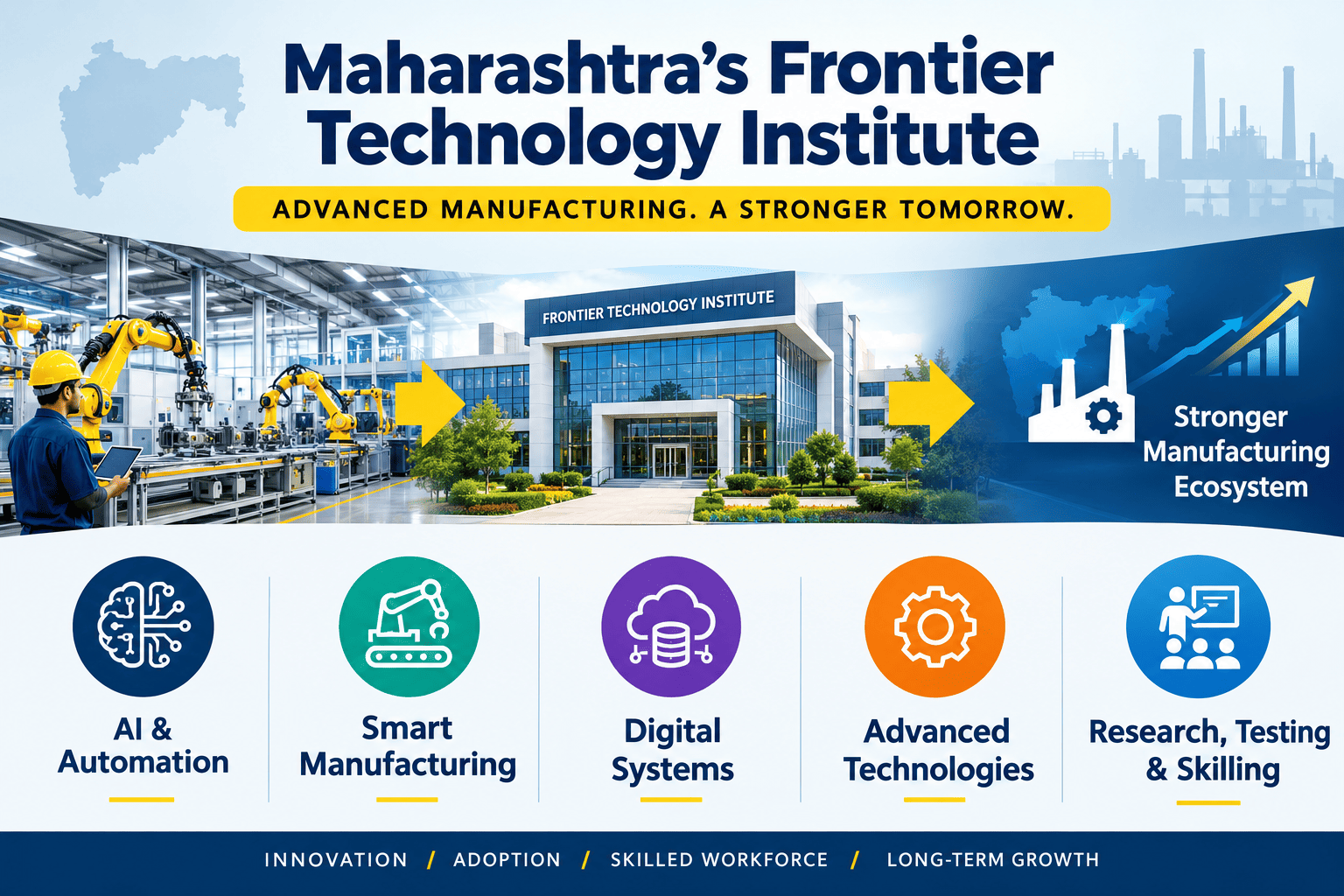
Direct Answer: Maharashtra’s proposed Frontier Technology Institute could be a catalyst for transforming advanced manufacturing across the state and beyond by accelerating the adoption of AI, automation, smart manufacturing, digital systems, and advanced production technologies on factory floors. By providing a dedicated hub for research, development, testing, and workforce upskilling, the institute could help manufacturers overcome the adoption barriers that currently slow technology integration. This guide explores the potential impact on factories, the key technologies involved, how manufacturers can prepare, and how partnering with a verified technology provider through a platform like GTsetu can accelerate the journey toward advanced manufacturing.
Maharashtra has long been one of India’s most important industrial states, home to automotive giants, pharmaceutical manufacturers, textile producers, and a growing electronics and engineering base. Yet like manufacturing hubs everywhere, its factories face intensifying pressure: rising labour costs, global competition, demand for higher quality and faster delivery, and the need to meet increasingly stringent environmental and compliance standards. The path forward for many of these manufacturers lies in advanced manufacturing, the integration of AI, automation, smart manufacturing systems, and digital technologies into every layer of production.
The proposed Frontier Technology Institute could be a decisive catalyst for that transformation. By creating a dedicated institution focused on frontier technologies, the state government could provide manufacturers with access to research, testing facilities, pilot programmes, and a pipeline of skilled workers trained in the technologies that modern factories require. This guide examines what the institute could mean for factories, the specific technologies that will matter most, the barriers that currently slow adoption, and how manufacturers can prepare, including by finding verified technology partners through platforms like GTsetu.
Manufacturers, plant managers, operations leaders, and technology providers interested in the future of advanced manufacturing in Maharashtra and beyond. It is also relevant for policymakers, industry associations, and business development teams seeking to understand the technology adoption landscape and how to find the right partners.
This guide provides general commercial and strategic analysis of advanced manufacturing trends and the potential role of a proposed institution. It is not investment, legal, or policy advice. The Frontier Technology Institute is a proposed initiative; details are subject to change. Always consult qualified advisors before making significant technology investment decisions.
1 Why Advanced Manufacturing Needs a Catalyst
Advanced manufacturing is not simply about buying new machines. It is a fundamental shift in how factories operate: from manual, disconnected processes to integrated, data-driven, and intelligent production systems. It encompasses AI, automation, IIoT, digital twins, additive manufacturing, and the digital systems that connect them. For many manufacturers, especially small and mid-sized enterprises, the journey from traditional to advanced manufacturing is blocked by three interconnected barriers: knowledge gaps (not knowing what technology fits), cost and risk concerns (fear of large capital outlays with uncertain returns), and talent shortages (lack of engineers and technicians trained in these technologies).
A dedicated institution like the Frontier Technology Institute can address all three by acting as a knowledge hub, a shared testing and piloting facility, and a workforce development engine. It can de-risk technology adoption by allowing manufacturers to experiment before committing capital, and it can create a pipeline of skilled workers who can implement and maintain these systems. For Maharashtra’s factories, this could be the difference between falling behind global competitors and becoming a leader in advanced production.
2 What the Frontier Technology Institute Could Do
The Frontier Technology Institute could serve as a central hub for advanced manufacturing in Maharashtra, performing several critical functions: research and development in AI, robotics, and smart manufacturing; testing and piloting of new technologies in a real-world factory-like environment; workforce training for engineers, technicians, and operators; industry collaboration by connecting manufacturers with technology providers and researchers; and policy and standards development to support technology adoption.
Research & Development Hub
The institute could conduct applied research in AI, machine learning, robotics, and advanced materials, and translate that research into practical solutions for factories. It could also serve as a collaboration point for industry and academia.
📍 Development of AI algorithms for predictive maintenance tailored to local manufacturing conditionsTesting & Piloting Facility
A dedicated space where manufacturers can test new technologies, such as cobots, IIoT sensors, or digital twin software, on a small scale before investing in full deployment. This de-risks adoption significantly.
📍 A pilot production line where a manufacturer can trial an automated quality inspection systemWorkforce Training & Upskilling
Training programmes for engineers, technicians, and operators on AI, automation, robotics, and digital systems. This addresses the critical talent shortage that slows technology adoption.
📍 Certification courses in industrial robotics programming and IIoT system integrationIndustry Collaboration & Matchmaking
Connecting manufacturers with technology providers, startups, and research institutions. This could include matchmaking events, demonstration days, and structured partnership programmes.
📍 An annual advanced manufacturing summit connecting factories with AI and automation vendorsStandards & Best Practices
Developing and promoting standards for smart manufacturing, data interoperability, and cybersecurity in industrial environments. This helps ensure that technologies work together and are secure.
📍 Guidelines for IIoT data protocols to ensure different vendors’ sensors can communicatePolicy & Incentive Advisory
Advising government on policies and incentives that encourage technology adoption, such as tax credits for automation investments or subsidies for digital upgrades. This can accelerate uptake across the state.
📍 A proposed scheme to co-fund AI pilot projects for SMEsFor a factory owner considering AI-based quality control, the institute could offer a pilot programme to test the technology on a sample production line, provide training for the operators who will use it, and help negotiate with the vendor. This reduces the risk and cost of adoption dramatically. See: technology partnership.
3 AI and Automation on the Factory Floor
Artificial intelligence and automation are the two most visible pillars of advanced manufacturing. AI brings intelligence, the ability to learn from data, predict failures, and optimize processes. Automation brings action, robots and cobots that perform physical tasks with consistency and speed. Together, they enable factories to operate with higher efficiency, better quality, and lower cost.
Predictive Maintenance
AI analyses sensor data from machines to predict when a component will fail, allowing maintenance to be scheduled before a breakdown occurs. This reduces unplanned downtime, which costs manufacturers millions annually.
AI-Powered Quality Control
Computer vision systems inspect products on the production line, detecting defects that human inspectors might miss. AI improves over time, making quality control faster and more accurate.
Robotic Automation
Industrial robots and collaborative robots (cobots) perform tasks such as welding, assembly, painting, and material handling. They improve consistency, reduce labour costs, and enable 24/7 operation.
Automated Material Handling
Automated Guided Vehicles (AGVs) and Autonomous Mobile Robots (AMRs) move materials within the factory, reducing manual handling and improving safety and efficiency.
For many factories, the first step into AI and automation is a pilot project on a single production line or process. The Frontier Technology Institute could provide the sandbox environment for such pilots, allowing manufacturers to see the technology in action before committing to a full rollout. For a deeper look at how technology partnerships work in this context, see our guide on technology partnerships.
4 Smart Manufacturing: IIoT, Digital Twins & Data
Smart manufacturing is the connective tissue that makes AI and automation possible at scale. It is built on a foundation of data, collected by sensors (IIoT), modelled in digital twins, and analysed by AI, to create a production environment that is visible, predictable, and continuously improving.
| Technology | What It Does | Factory Floor Impact | Adoption Stage |
|---|---|---|---|
| Industrial IoT (IIoT) | Sensors and connected devices that collect real-time data from machines, tools, and products | Provides the data foundation for all other smart manufacturing technologies; enables real-time monitoring and alerts | Early adoption |
| Digital Twins | Virtual replicas of physical assets, production lines, or entire factories | Simulate changes, test new processes, and optimize without disrupting actual production | Growing adoption |
| Predictive Analytics | AI and machine learning models that forecast equipment failures, quality issues, or demand | Reduces downtime, improves quality, and enables proactive decision-making | Maturing |
| Advanced Robotics | Robots and cobots that perform physical tasks with precision and consistency | Increases throughput, improves quality, reduces labour costs, and enhances safety | Mature |
| Additive Manufacturing | 3D printing of parts and components, layer by layer | Enables rapid prototyping, custom parts, and on-demand production, reducing inventory and lead times | Niche to growing |
Smart manufacturing creates a virtuous cycle: more data leads to better AI models, which lead to more optimized processes, which generate even more data. Factories that start collecting and using data early gain a compounding advantage over those that delay. The Frontier Technology Institute could help factories take that first step by providing guidance on sensor selection, data architecture, and analytics.
5 Digital Systems: MES, ERP & the Connected Factory
AI and automation do not operate in isolation. They require a digital backbone, a set of integrated systems that connect the shop floor to the top floor, enabling data to flow seamlessly from machines to management. The most important of these systems are:
Manufacturing Execution System (MES)
MES software manages and monitors production on the shop floor in real time. It tracks work orders, materials, equipment, and quality, providing a bridge between the physical production process and enterprise systems.
Enterprise Resource Planning (ERP)
ERP integrates all core business processes, finance, procurement, inventory, sales, and production planning, into a single system. It provides the top-level visibility and control that factories need to operate efficiently.
SCADA Systems
Supervisory Control and Data Acquisition (SCADA) systems monitor and control industrial processes. They collect data from sensors and PLCs and allow operators to supervise and adjust production parameters.
Integration Platforms
Middleware and integration platforms connect MES, ERP, SCADA, and IIoT devices, ensuring that data flows smoothly between systems. This integration is critical for creating a truly connected factory.
The challenge for many manufacturers is not choosing a single system, but integrating them into a cohesive architecture. The Frontier Technology Institute could provide reference architectures, integration guidelines, and pilot projects to help factories build their digital backbone without costly missteps. For guidance on how to structure these technology partnerships, see our article on technology partnership.
6 Barriers to Technology Adoption in Factories
Despite the clear benefits, many factories, especially SMEs, struggle to adopt advanced manufacturing technologies. Understanding these barriers is the first step to overcoming them, and the Frontier Technology Institute could play a role in addressing each.
High Upfront Costs
AI, robotics, and digital systems require significant capital investment. Many SMEs lack the financial resources or are unwilling to take the risk without proof of ROI. The institute could offer pilot programmes and shared facilities to reduce initial costs.
Lack of In-House Expertise
Implementing and maintaining advanced technologies requires skills that many factories do not have in-house. Training programmes from the institute could help bridge this gap, but hiring skilled talent remains a challenge.
Integration Complexity
New technologies must integrate with existing equipment and systems, which can be complex and disruptive. Factories fear production interruptions during implementation.
Uncertain ROI
It is often difficult to predict the return on investment for new technologies. Without clear evidence of benefit, decision-makers hesitate. The institute could provide case studies and benchmarking data.
Cybersecurity Concerns
Connecting factory equipment to networks introduces cybersecurity risks. Manufacturers need confidence that their data and operations are secure before adopting IIoT and cloud-based systems.
Regulatory and Standards Uncertainty
Lack of clear standards for data interoperability and cybersecurity can slow adoption, as manufacturers wait for clarity. The institute could help develop and promote standards.
By providing a neutral, trusted environment for testing, training, and collaboration, the Frontier Technology Institute can reduce each of these barriers. It can also act as a matchmaker, connecting factories with verified technology providers, similar to how B2B matchmaking tools help manufacturers find partners.
7 How Manufacturers Can Prepare for Advanced Manufacturing
Whether or not the Frontier Technology Institute becomes a reality, the shift toward advanced manufacturing is already underway. Manufacturers that prepare now will be best positioned to benefit. Here is a practical roadmap.
Conduct a Technology Needs Assessment
Identify your biggest operational pain points, downtime, quality defects, slow changeovers, high energy costs, and determine which technologies could address them. Prioritize based on potential impact and ease of implementation. See global market research for manufacturers for a structured approach.
Assess Your Digital Infrastructure
Evaluate your current systems: Do you have reliable data collection? Is your network infrastructure adequate? Are your machines connected? Understanding your starting point helps you plan a realistic upgrade path.
Define Clear Objectives and ROI Metrics
Set specific, measurable goals for any technology investment, e.g., reduce downtime by 20%, improve quality yield by 15%, or cut energy consumption by 10%. Define how you will measure success before you start.
Find and Verify Technology Partners
Identify technology providers with proven solutions and relevant experience. Verify their credentials using a platform like GTsetu, which provides government-tie-up verification of six core company credentials. This ensures you are engaging with legitimate, reliable partners. See partnership evaluation criteria for how to assess fit.
Start with a Pilot Project
Implement the technology on a small scale, one production line, one process, one plant, to validate the benefits and learn what works. Use the results to build the case for broader rollout. The Frontier Technology Institute could provide facilities for such pilots.
Invest in Workforce Training
Ensure your engineers, technicians, and operators are trained on the new technologies. This is often the most overlooked step and a common cause of failed implementations. Partner with the institute or other training providers.
Scale and Integrate
Once the pilot proves successful, scale the technology across other lines or plants, integrating it with your broader digital systems (MES, ERP). Continuous improvement should become part of your operating culture.
As you adopt advanced manufacturing technologies, ensure compliance with relevant industry standards and certifications. This is particularly important for international trade, where certifications can be a prerequisite for market access. See our guide on manufacturing certifications for international trade.
8 Finding Verified Technology Partners
The success of any advanced manufacturing initiative depends heavily on the technology partners you choose. A great partner can accelerate your journey; a poor one can set you back years. This is where GTsetu can play a critical role: it provides a verified B2B matchmaking platform that connects manufacturers with technology providers across 100+ countries, all verified using government tie-ups on six core credentials.
Your Verified Starting Point for Advanced Manufacturing Technology Partners
GTsetu is a government-tie-up verified B2B platform where manufacturers can discover, verify, and engage technology partners, AI providers, automation specialists, IIoT platform companies, digital twin developers, and system integrators, across 100+ countries. Every company on GTsetu is verified on six essential credentials: legal name, registered address, registration number, company status, company type, and date of incorporation. This removes the risk of engaging with unverified or misrepresented technology providers, allowing you to focus on evaluating technical fit and commercial terms.
GTsetu vs Traditional Partner Discovery
For a deeper understanding of how to build effective technology partnerships, see our guides on technology partnership, cross-border manufacturing partnerships, and business partnership contracts.
? Frequently Asked Questions
Ready to Find Verified Technology Partners for Advanced Manufacturing?
Join 500+ verified manufacturers, technology providers, and distributors already building advanced manufacturing partnerships on GTsetu, with government-tie-up verification of six core credentials, built-in NDA workflows, and zero broker fees across 100+ countries. Start your search for the right technology partner today.
Find Verified Partners → Explore the Platform
They represents the product, and research team behind GTsetu, a global B2B collaboration platform built to help companies explore cross-border partnerships with clarity and trust. The team focuses on simplifying early-stage international business discovery by combining structured company profiles, verification-led access, and controlled collaboration workflows.
With a strong emphasis on trust, and disciplined engagement, Team GTsetu shares insights on global trade, partnerships, and cross-border collaboration, helping businesses make informed decisions before entering deeper commercial discussions.