What Maharashtra’s Frontier Technology Push Means for MSME Manufacturers | GTsetu
Home ›
Blog ›
Maharashtra’s Frontier Technology Push & MSME Manufacturers
🏭 MSME & Advanced Manufacturing
What Maharashtra’s Frontier Technology Push Means for MSME Manufacturers
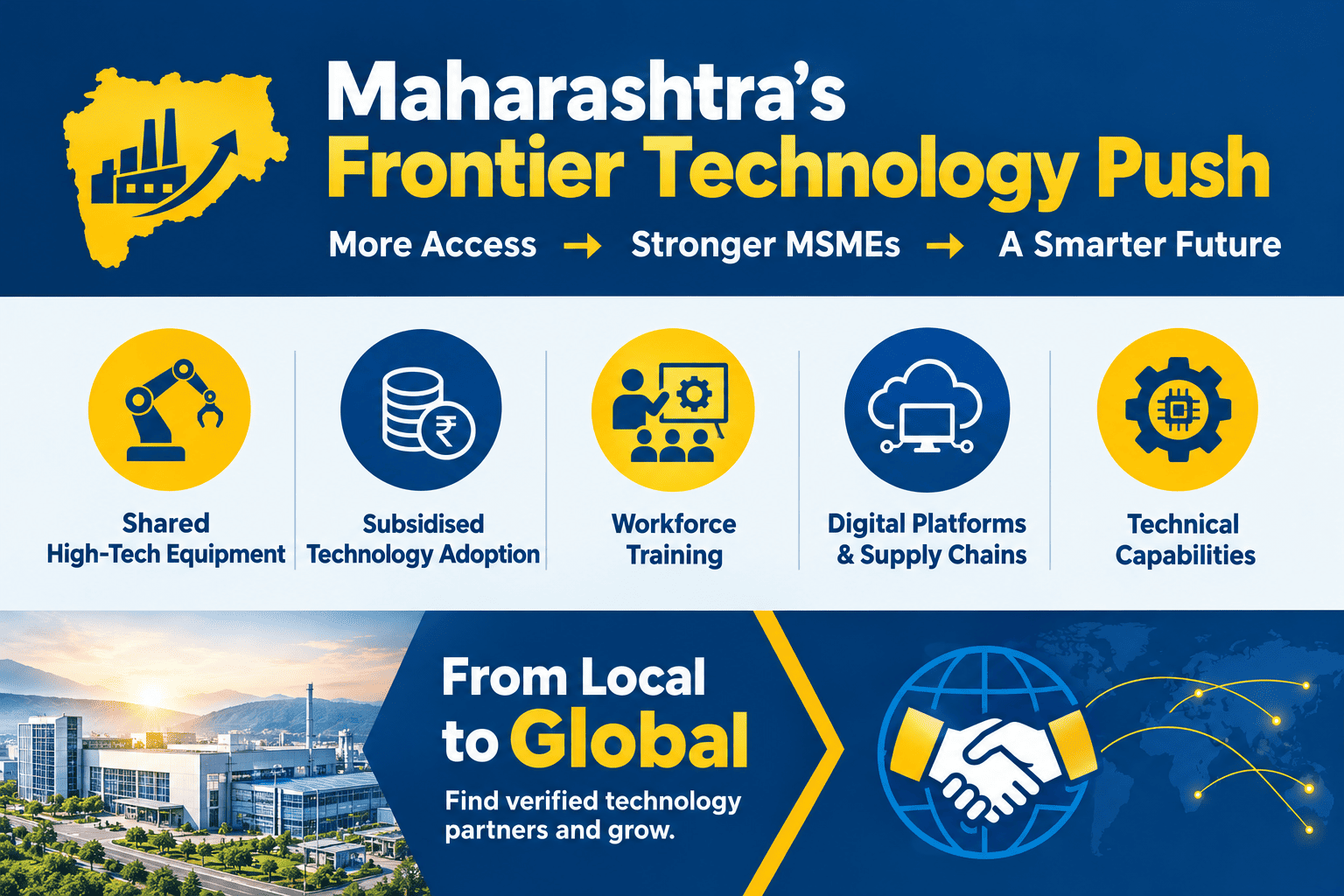
Direct Answer: Maharashtra’s frontier technology push, anchored by the proposed Frontier Technology Institute, could have a transformative impact on MSME manufacturers by making advanced technology, common facilities, skills, digital platforms, and technical capabilities more accessible. For smaller manufacturers that have historically been priced out of advanced manufacturing, the push could mean access to shared high-tech equipment, subsidised technology adoption, workforce training, and digital platforms that connect them to larger supply chains and technology partners. This guide explains the practical implications for MSMEs, what to expect, and how to prepare, including finding verified technology partners through platforms like GTsetu.
📅 Published October 3, 2026🔄 Updated October 3, 2026⏱ 15 min read✍️ GTsetu Editorial Team
5
Key Implications for MSMEs
100+
Countries on GTsetu
500+
Verified Companies
0%
Broker Commission
Maharashtra is home to one of India’s largest and most diverse MSME manufacturing ecosystems, thousands of small and mid-sized firms producing auto components, textiles, engineering goods, chemicals, food products, and electronics. These MSMEs are the backbone of the state’s industrial economy, but they also face a common set of constraints: limited access to capital for technology upgrades, difficulty attracting and retaining skilled technical talent, and a growing gap between their production capabilities and what larger buyers and export markets now expect.
The frontier technology push, a set of initiatives being driven by the Government of Maharashtra, including the proposed Frontier Technology Institute, is designed to address these constraints. For MSME manufacturers, this is a significant opportunity. If implemented effectively, it could give smaller firms access to advanced technology that was previously out of reach, shared common facilities that reduce capital costs, skills training that upgrades workforce capabilities, and digital platforms that connect them to larger supply chains and technology partners. This guide explains the practical implications for MSMEs and how to prepare.
💡 Who This Guide Is For
MSME manufacturers, small business owners, operations managers, and industry associations in Maharashtra and beyond who want to understand how the frontier technology push could affect their operations and how to position themselves to benefit. It is also relevant for policymakers and technology providers working with MSMEs.
⚖️ Editorial Notice
This guide provides general commercial and strategic analysis of the potential impact of Maharashtra’s frontier technology push on MSME manufacturers. It is not investment, legal, or policy advice. Specific schemes, eligibility criteria, and implementation details are subject to change. Always consult official government sources and qualified advisors before making investment decisions.
SECTION 1
1 Why This Matters for MSMEs
MSMEs play a critical role in Maharashtra’s manufacturing economy, but they often operate at a technology disadvantage compared to larger firms. Advanced manufacturing technologies, robotics, AI, IIoT, digital systems, have traditionally required capital investments and technical expertise that are out of reach for smaller manufacturers. This has created a productivity gap that makes it harder for MSMEs to compete for large contracts, meet the quality standards of global buyers, and expand into export markets.
The frontier technology push aims to close that gap. By creating shared infrastructure, providing training, and facilitating access to technology, the initiative could level the playing field for MSMEs. For a small auto component manufacturer, it could mean access to a common testing lab or a shared CNC machining centre. For a textile MSME, it could mean training on digital design tools or access to a shared digital printing facility. For all MSMEs, it could mean better access to the digital platforms and verified partner networks that larger firms take for granted.
Technology
Shared access to advanced machinery and testing equipment reduces capital barriers.
Skills
Training programmes upgrade workforce capabilities for digital and automated production.
Digital
Platforms connect MSMEs to technology providers, buyers, and global supply chains.
Funding
Subsidies and incentives reduce the cost of technology adoption and upgrade.
SECTION 2
2 Access to Advanced Technology
🎯 The Core Opportunity
The most direct benefit of the frontier technology push for MSMEs is access to advanced technology. This means not just awareness of new technologies, but practical, affordable access, through shared facilities, pilot programmes, subsidised adoption, and advisory support. For MSMEs, the goal is to move from watching technology from the sidelines to using it in their own operations.
🤖
Automation & Robotics
Access to shared robotic cells, cobots, and automated machinery through common facility centres. MSMEs can test automation on a small scale without purchasing equipment outright.
🔍
AI & Quality Control
AI-powered vision systems and quality inspection tools can be made available through pilot programmes, helping MSMEs improve product quality and reduce defects.
📊
Digital Systems (ERP/MES)
Access to affordable, cloud-based ERP and MES software tailored for small manufacturers, enabling digital record-keeping and production visibility.
📡
IIoT & Monitoring
Low-cost IIoT sensors and monitoring systems that allow MSMEs to track machine performance and energy use, identifying efficiency improvements.
🖨️
Additive Manufacturing
Access to 3D printing and rapid prototyping services for product development and small-batch production.
🔬
Testing & Certification Support
Shared testing facilities and advisory support to help MSMEs meet the certifications required for larger contracts and international trade.
✨ How MSMEs Benefit
Rather than purchasing a robot or a testing machine outright, an MSME can use a shared facility to complete a specific project or production run. This removes the capital barrier and allows the MSME to build confidence and experience with the technology before considering their own investment. It also enables MSMEs to bid for larger contracts that require capabilities they don’t have in-house.
SECTION 3
3 Common Facility Centres & Shared Infrastructure
Common Facility Centres (CFCs) are a cornerstone of the MSME support ecosystem. They are shared facilities, established under government schemes or industry clusters, that provide access to expensive machinery, testing equipment, design tools, or prototyping services that individual MSMEs could not afford on their own. The frontier technology push is expected to expand and upgrade these centres, making them hubs for advanced manufacturing technologies.
Produce precision components without capital investment in machinery
A small auto parts maker uses a shared CNC centre to produce a new component line
Testing & Quality Labs
Material testing, dimensional inspection, environmental testing, certification support
Verify product quality, meet buyer requirements, and prepare for certification
A textile MSME tests fabric strength and colorfastness at a shared lab before shipment
Design & Prototyping Centres
CAD/CAM software, 3D printers, design workstations, rapid prototyping
Develop new products, create prototypes, and refine designs before production
An electronics MSME prototypes a new enclosure using a shared 3D printer
Automation & Robotics Cells
Robotic arms, cobots, automated assembly cells, PLC training systems
Trial automation, train workers, and run small-batch automated production
A plastics manufacturer tests a cobot for a packaging operation
Digital Manufacturing Hubs
ERP/MES software access, IIoT kits, digital twin simulation tools, training
Implement digital systems on a pilot basis and train staff on digital tools
A food processing MSME pilots a cloud ERP system before full adoption
📌 Shared Facilities: A Proven Model
Common facility centres have been used successfully in India for years, from textile clusters in Surat to auto clusters in Pune. The frontier technology push could upgrade these centres with advanced technologies like robotics, AI-based inspection, and digital simulation tools. For MSMEs, the key is to identify the nearest CFC and understand what services it offers. Industry associations and state MSME departments can provide guidance.
SECTION 4
4 Skills Development & Workforce Training
Technology is only as effective as the people operating it. One of the biggest barriers to advanced manufacturing adoption among MSMEs is the lack of skilled workers who can operate, maintain, and troubleshoot modern equipment and digital systems. The frontier technology push includes a strong focus on skills development, training programmes designed to equip MSME workers with the technical capabilities they need.
🔧
Machine Operation & Maintenance
Training on CNC machines, automated equipment, and robotics, including basic programming and preventive maintenance.
💻
Digital Literacy & Software
Skills in using ERP, MES, CAD/CAM, and basic data analysis tools for production planning and quality tracking.
📡
IIoT & Smart Systems
Understanding sensors, data collection, and basic networking for smart manufacturing systems.
🔒
Cybersecurity Awareness
Basic practices for protecting digital systems and data in a connected factory environment.
📈
Lean & Digital Improvement
Combining traditional lean manufacturing principles with digital tools for continuous improvement.
🎓
Certification & Upskilling
Structured certification programmes that give workers recognized credentials in advanced manufacturing skills.
👥 The Talent Challenge for MSMEs
MSMEs often struggle to attract skilled technical talent because they cannot match the salaries and career progression offered by larger firms. Skills development programmes can help by upgrading the capabilities of existing workers, making them more productive with the technology the MSME adopts. For MSMEs, investing in training for current staff is often more practical than trying to hire new skilled workers. See: partnership evaluation criteria for assessing technology partners who can also provide training.
SECTION 5
5 Digital Platforms & Technical Capabilities
One of the most impactful elements of the frontier technology push for MSMEs is the emphasis on digital platforms, online tools and networks that connect MSMEs to technology providers, buyers, and larger supply chains. For small manufacturers, digital platforms can overcome the geographic and informational barriers that have historically limited their growth.
01
Technology Partner Discovery Platforms
Digital platforms that help MSMEs find and connect with verified technology providers, AI companies, automation vendors, IIoT solution providers, without relying on expensive consultants or brokers.
Platforms that connect MSMEs to larger manufacturers, OEMs, and global buyers looking for reliable suppliers. These platforms can help MSMEs move up the value chain and access new markets.
Online marketplaces where MSMEs can list their products and capabilities, reaching buyers they could not access through traditional channels. This includes both domestic and export markets.
Affordable, subscription-based ERP, MES, and quality management software designed for small manufacturers. Cloud delivery means no costly IT infrastructure or on-site servers required.
📍 Digital manufacturing hubs in common facility centres
05
Technical Advisory & Knowledge Portals
Online resources, webinars, and advisory services that help MSMEs understand technology options, evaluate solutions, and plan adoption roadmaps without expensive consulting fees.
🌐 GTsetu: A Digital Platform for MSME Manufacturers
GTsetu is a verified B2B matchmaking platform that helps MSME manufacturers find technology partners, suppliers, and distributors across 100+ countries. Every company on GTsetu is verified using government tie-ups on six core credentials, legal name, address, registration number, company status, company type, and date of incorporation, giving MSMEs confidence when engaging with new partners. The platform offers anonymous discovery, built-in NDA workflows, and zero broker commission. See: B2B matchmaking tools.
SECTION 6
6 Funding, Incentives & Support Schemes
Access to technology is often a question of capital. The frontier technology push is expected to be accompanied by funding and incentive schemes designed to reduce the cost of technology adoption for MSMEs. Understanding these schemes, and how to access them, is essential for MSME manufacturers looking to upgrade.
Support Type
What It Provides
How MSMEs Can Use It
Where to Learn More
Capital Subsidy for Technology Upgrade
Partial funding (typically 15–35%) for purchasing advanced machinery, digital systems, or automation equipment
Reduce the cost of a new CNC machine, ERP system, or robotic cell
State MSME department, district industries centres
Interest Subvention on Technology Loans
Reduced interest rates on loans taken for technology adoption
Lower the cost of financing new equipment or software
Banks, MSME financial institutions
Pilot & Demonstration Project Funding
Grants or co-funding for pilot projects testing new technologies in real production environments
Trial AI-based quality inspection or IIoT monitoring with reduced financial risk
Frontier Technology Institute, industry associations
Skill Development Subsidies
Funding for training programmes, often covering 50–100% of training costs
Train workers on new equipment, digital tools, or automation systems
Skill development missions, sector skill councils
Certification & Testing Support
Subsidised access to testing labs, certification bodies, and compliance advisory
Obtain certifications needed for larger contracts or export markets
Quality councils, common facility centres
Export Promotion Incentives
Support for international trade fairs, market development, and export certification
Explore export markets and find international buyers
Export promotion councils, DGFT
📋 Staying Informed
Government schemes and incentives change periodically. MSMEs should stay informed through their local District Industries Centre (DIC), industry associations, and state MSME department notifications. For guidance on how to structure technology partnerships that may qualify for support, see technology partnership.
SECTION 7
7 How MSMEs Can Prepare
The frontier technology push will create opportunities, but MSMEs need to be ready to take advantage of them. Here is a practical roadmap for small manufacturers looking to prepare for the transition to advanced manufacturing.
1
Conduct a Simple Technology Needs Assessment
Identify your biggest operational pain points, frequent machine breakdowns, quality defects, slow production, high energy costs, and determine which technologies could address them. Prioritize by potential impact and feasibility. See global market research for manufacturers for a structured approach.
2
Map Available Common Facilities & Support
Find out what Common Facility Centres (CFCs), testing labs, or training programmes are available in your area. Contact your local District Industries Centre or industry association to understand what’s available and how to access it.
3
Start with a Low-Risk Pilot
Don’t try to adopt everything at once. Start with a small pilot, one machine, one process, one software tool, to test the technology and learn what works. Use common facility centres or pilot programmes to reduce risk.
4
Invest in Basic Digital Tools First
Before advanced automation, get the digital basics right: digital record-keeping, basic ERP, or even a simple production tracking system. This builds the data foundation for more advanced technologies later.
5
Train Key Staff
Identify one or two key employees who can become your internal technology champions. Invest in their training on the technologies you plan to adopt. They will be critical to successful implementation.
6
Connect with Verified Technology Partners
Use a verified platform like GTsetu to find technology partners who understand the MSME context. Verify their credentials using the 6-point government verification, and use the built-in NDA workflow before sharing sensitive information. See partnership evaluation criteria for how to assess fit.
7
Plan for Scale-Up
Once a pilot proves successful, plan how to scale the technology across other processes or lines. Consider how the technology integrates with your broader digital systems and how it will support your growth into new markets or larger contracts.
The success of any technology adoption initiative depends heavily on the partners you choose. For MSMEs, this is especially critical, there is little room for costly mistakes. This is where GTsetu can play a vital role: it provides a verified B2B matchmaking platform that connects MSME manufacturers with technology providers, suppliers, and distributors across 100+ countries, all verified using government tie-ups on six core credentials.
🌐 Platform Spotlight, GTsetu
Your Verified Starting Point for MSME Technology Partnerships
GTsetu is a government-tie-up verified B2B platform where MSME manufacturers can discover, verify, and engage technology partners, AI providers, automation specialists, IIoT platform companies, digital systems vendors, and system integrators, across 100+ countries. Every company on GTsetu is verified on six essential credentials: legal name, registered address, registration number, company status, company type, and date of incorporation. This removes the risk of engaging with unverified or misrepresented technology providers, allowing MSMEs to focus on evaluating technical fit and commercial terms.
✅
6-Point Govt. Verification
Legal name, registered address, registration number, company status, company type, and incorporation date verified against official government records.
🕵️
Anonymous Discovery
Browse verified technology partner profiles without revealing your identity or strategic intentions until you are ready to engage.
📄
Built-In NDA Workflow
Formalize confidentiality before sharing any proprietary process details, production data, or technical specifications, with a full digital audit trail.
🚫
Zero Commission
No broker fees on any partnership formed. Your deal economics remain entirely between you and your verified partner.
🔐
Encrypted Collaboration
All documents and communications encrypted in transit and at rest, ensuring your technology strategy remains confidential.
🌍
100+ Countries
Access verified technology partners globally, including AI and automation leaders from India, Europe, North America, and Asia.
Maharashtra’s frontier technology push refers to a set of proposed government initiatives, including the proposed Frontier Technology Institute, designed to accelerate the adoption of advanced technologies such as AI, automation, robotics, smart manufacturing, and digital systems across the state’s industrial base, with a particular focus on making these technologies accessible to MSME manufacturers.
QHow will the frontier technology push help MSME manufacturers specifically?
MSME manufacturers could benefit through: (1) access to shared common facility centres equipped with advanced machinery and testing equipment; (2) technology demonstration and pilot programmes that de-risk adoption; (3) subsidised or co-funded technology upgrade schemes; (4) skills development and training programmes for MSME workers; (5) digital platforms that connect MSMEs to technology providers and larger supply chains; and (6) technical advisory support to help MSMEs select and implement the right technologies.
QWhat are common facility centres and how do they help MSMEs?
Common Facility Centres (CFCs) are shared infrastructure facilities, often established under government MSME schemes, that provide access to expensive machinery, testing labs, design studios, or prototyping equipment that individual small manufacturers cannot afford on their own. By sharing these facilities, MSMEs can access advanced manufacturing capabilities without the capital cost of owning the equipment.
QWhat digital platforms can MSME manufacturers use to find technology partners?
Verified B2B matchmaking platforms like GTsetu help MSME manufacturers find technology partners, suppliers, and distributors across 100+ countries. Every company on GTsetu is verified using government tie-ups on six core credentials: legal name, registered address, registration number, company status, company type, and date of incorporation. This gives MSMEs confidence when engaging with new technology providers or supply chain partners.
QWhat skills will MSME manufacturers need to adopt advanced technology?
MSME manufacturers will need skills in areas such as: digital literacy and basic data analysis; operating and maintaining automated machinery and robotics; understanding IIoT sensors and basic networking; using digital systems like ERP and MES; and basic cybersecurity awareness. Government training programmes and industry partnerships can help MSMEs develop these skills.
QHow can MSMEs prepare for the technology transition?
MSMEs can prepare by: conducting a simple technology needs assessment; identifying their most critical pain points (downtime, quality, cost); exploring common facility centres and pilot programmes; investing in basic digital tools first (such as ERP or digital record-keeping); training key staff; and connecting with verified technology partners through platforms like GTsetu to evaluate solutions without risking capital.
Ready to Find Verified Technology Partners for Your MSME?
Join 500+ verified manufacturers, technology providers, and distributors already building advanced manufacturing partnerships on GTsetu, with government-tie-up verification of six core credentials, built-in NDA workflows, and zero broker fees across 100+ countries. Start your search for the right technology partner today.
They represents the product, and research team behind GTsetu, a global B2B collaboration platform built to help companies explore cross-border partnerships with clarity and trust. The team focuses on simplifying early-stage international business discovery by combining structured company profiles, verification-led access, and controlled collaboration workflows.
With a strong emphasis on trust, and disciplined engagement, Team GTsetu shares insights on global trade, partnerships, and cross-border collaboration, helping businesses make informed decisions before entering deeper commercial discussions.