How to Get ISO 14001 Certification: Complete Step-by-Step Guide
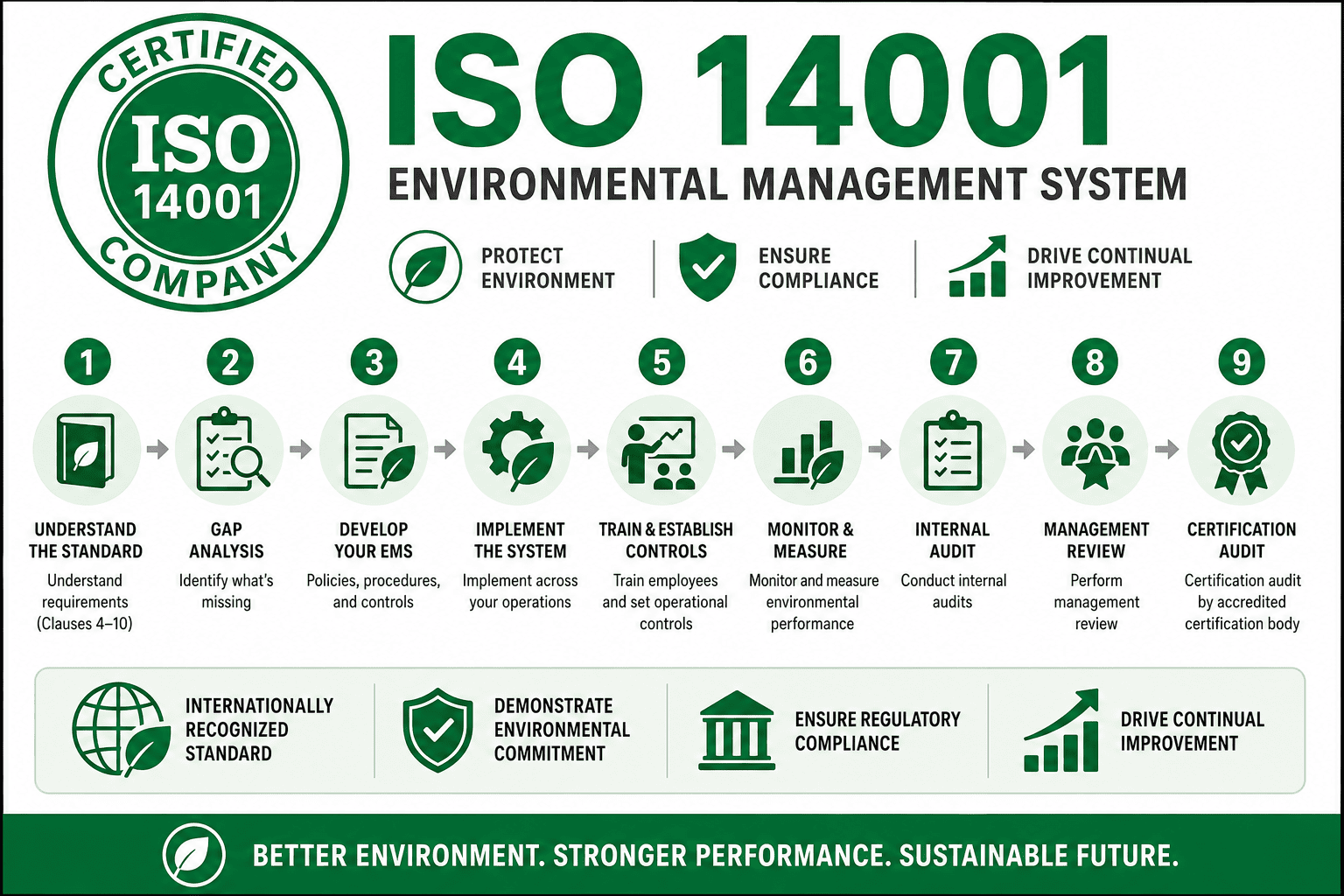
Direct Answer: ISO 14001 is the internationally recognized standard for Environmental Management Systems (EMS). Certification demonstrates your organization’s commitment to environmental protection, regulatory compliance, and continual improvement. The certification process involves: (1) understanding the standard’s requirements (Clauses 4-10), (2) conducting a gap analysis to identify what’s missing, (3) developing your EMS with documented policies, procedures, and controls, (4) implementing the system across your operations, (5) training employees and establishing operational controls, (6) monitoring and measuring environmental performance, (7) conducting internal audits, (8) performing a management review, and (9) completing the certification audit with an accredited certification body. GTsetu connects you with verified partners for compliance support, with zero broker commissions.
📅 June 23, 2026⏱ 16 min read✍️ GT Setu Editorial Team🔄 Updated regularly
360,000+
Certificates Issued Globally
6-18
Months to Certification
70%
Office Waste Recyclable
0%
GTsetu Broker Commission
Environmental management is no longer optional for organizations that want to remain competitive, compliant, and credible in today’s global marketplace. ISO 14001 is the most recognized international standard for Environmental Management Systems (EMS), with over 360,000 certificates issued globally. It provides a systematic framework for organizations to protect the environment, respond to changing environmental conditions, and improve their environmental performance.
Whether you are a manufacturer seeking to reduce waste and energy costs, a distributor needing to meet customer sustainability requirements, or any organization committed to environmental responsibility, ISO 14001 certification delivers tangible benefits: reduced environmental impact, regulatory compliance, operational efficiency, enhanced reputation, and competitive advantage. This guide provides a complete step-by-step roadmap to getting ISO 14001 certified, from understanding the requirements through to the certification audit and beyond. See also our guides on industrial business collaboration, global partner services, and cross-border business partnerships.
🌿 Who Is This Guide For?
This guide is written for environmental managers, quality assurance professionals, operations directors, sustainability leads, and business owners across all sectors, manufacturing, logistics, construction, healthcare, energy, and services, who are seeking ISO 14001 certification. It is also relevant for organizations integrating ISO 14001 with existing management systems (ISO 9001, ISO 45001) and for companies seeking to meet customer, regulator, or investor expectations for environmental performance. See also: global collaboration examples and partnership evaluation criteria.
SECTION 1
1 What Is ISO 14001 and Why Does It Matter?
🌍 The Standard Explained
ISO 14001 is the international standard for Environmental Management Systems (EMS). It specifies requirements for an organization to proactively identify and understand the environmental aspects of its activities, products, and services, and the associated environmental impacts. The standard provides a framework through which an organization can deliver environmental performance improvement in line with its environmental policy commitments. ISO 14001 is designed to be compatible and harmonized with other management system standards, including ISO 9001 (Quality Management) and ISO 45001 (Occupational Health and Safety), making it ideal for integration into existing management systems.
360,000+
ISO 14001 certificates issued globally, the most widely used EMS standard
70%
of office waste is recyclable, yet only 7.5% reaches recycling facilities
5.5%
increase in worldwide certificates in 2020, showing growing importance of UKAS accredited certification
🌱
Environmental Policy & Commitment
A formal statement of the organization’s commitment to environmental protection, compliance, and continual improvement. Sets the foundation for all EMS activities.
📋
Planning & Aspect Identification
Identifying environmental aspects, determining significant impacts, establishing compliance obligations, and setting measurable objectives to improve environmental performance.
👥
Support & Resources
Ensuring resources, competence, awareness, communication, and documented information are in place to support the EMS and achieve environmental objectives.
⚙️
Operation & Control
Implementing operational controls for significant environmental aspects, managing change, and preparing for and responding to environmental emergencies.
📊
Performance Evaluation
Monitoring, measuring, and evaluating environmental performance, conducting internal audits, and reviewing the EMS through management review.
🔄
Continual Improvement
Addressing nonconformities, implementing corrective actions, and pursuing ongoing improvement in environmental performance and the effectiveness of the EMS.
SECTION 2
2 Key Benefits of ISO 14001 Certification
ISO 14001 certification delivers benefits that extend far beyond compliance. Organizations that implement and certify their EMS consistently report improvements in environmental performance, operational efficiency, regulatory compliance, stakeholder trust, and competitive positioning.
🌿
Enhanced Environmental Performance
Systematic management of environmental aspects leads to reduced waste, lower energy consumption, decreased emissions, and improved resource efficiency. The structured approach ensures that environmental improvements are sustained and continually enhanced.
Core Benefit
⚖️
Regulatory Compliance Assurance
Ensures adherence to environmental laws and regulations, reducing the risk of fines, legal actions, and reputational damage. The compliance register and regular monitoring provide a systematic approach to meeting legal and other requirements.
Compliance
💰
Operational Efficiency & Cost Savings
Streamlined processes, resource efficiency, and waste reduction result in measurable cost savings. Organizations typically see 10-30% reductions in waste disposal costs and energy consumption through systematic EMS implementation.
Financial
🏆
Market Advantage & Reputation
Demonstrates a commitment to sustainability, enhancing reputation and competitiveness. Many customers, particularly in B2B sectors, now require ISO 14001 certification as a condition of supply or partnership.
Competitive
🤝
Stakeholder Trust & Confidence
Builds trust with customers, investors, regulators, employees, and the community by showcasing environmental responsibility. Certification provides independent verification of your environmental commitments.
Trust
🔗
Integration with Other Standards
ISO 14001 is designed to be compatible with ISO 9001 and ISO 45001 using the Annex SL high-level structure. Integration reduces duplication and creates a unified management system across quality, environment, and safety.
Integration
📈
Risk Management & Resilience
Systematic identification and management of environmental risks, including climate-related risks, enhances organizational resilience. Emergency preparedness planning ensures effective response to environmental incidents.
Risk
SECTION 3
3 Understanding ISO 14001 Requirements (Clauses 4-10)
ISO 14001 is structured around ten clauses, with Clauses 4-10 containing the requirements that must be met for certification. Understanding these requirements is the foundation of a successful certification journey. The standard follows the Plan-Do-Check-Act (PDCA) cycle for continual improvement.
Clause
Title
Key Requirements
What You Need to Do
4
Context of the Organization
Understand internal and external issues, identify interested parties, define the scope of the EMS
Document your organization’s context, stakeholders, and EMS boundaries
5
Leadership
Top management commitment, environmental policy, roles and responsibilities
The standard is built around the Plan-Do-Check-Act cycle: Plan (Clauses 4-6), understand context, establish policy, identify aspects, set objectives. Do (Clauses 7-8), provide resources, train staff, implement operational controls, prepare for emergencies. Check (Clause 9), monitor performance, conduct audits, review management. Act (Clause 10), address nonconformities, implement corrective actions, and continually improve. This cycle ensures your EMS is dynamic and continuously improving.
SECTION 4
4 Step 1: Gap Analysis & Initial Assessment
🔍 Where Are You Now?
A gap analysis is the critical first step in your ISO 14001 certification journey. It systematically compares your current environmental management practices against the requirements of the standard, identifying what you already have and what you need to develop, document, or improve. This assessment establishes a baseline and informs your implementation plan, timeline, and resource requirements.
01
Understand the Standard’s Requirements
Review ISO 14001:2015 (or the latest version) thoroughly. Familiarize yourself with each clause and its requirements. This includes understanding the context of the organization (Clause 4), leadership requirements (Clause 5), planning (Clause 6), support (Clause 7), operation (Clause 8), performance evaluation (Clause 9), and improvement (Clause 10). The standard’s text provides the definitive requirements, use it as your reference throughout the gap analysis process.
02
Map Current Environmental Management Practices
Document your existing environmental management activities, policies, procedures, and records. This includes environmental policies, aspect identification, compliance monitoring, training records, incident management, and any existing ISO 14001 elements that may have been implemented informally. Do not assume that what is not formalized doesn’t exist, many organizations have substantial environmental management practices that simply aren’t documented.
03
Identify Gaps Against Each Clause
For each clause and sub-clause of the standard, record whether the requirement is fully met, partially met, or not met. For partially met requirements, document what is already in place and what needs to be added or improved. For not met requirements, note the specific actions required to achieve compliance. This creates a clear roadmap of what needs to be done for certification.
04
Prioritize and Create an Action Plan
Based on the gap analysis, create a prioritized action plan addressing each gap. Prioritize by: regulatory compliance requirements (legal obligations come first), significant environmental aspects (the highest-impact areas), and easy wins (quick improvements that demonstrate progress). Assign responsibilities, allocate resources, and set realistic timelines for each action. Use project management tools to track progress against the plan.
05
Secure Top Management Commitment
Present the gap analysis findings and action plan to top management. Securing visible, documented commitment from leadership is essential, the standard requires top management to demonstrate leadership (Clause 5.1). This includes providing resources, defining roles, and actively participating in management reviews. Without management commitment, EMS implementation will struggle.
💡 Gap Analysis Tools
Consider using a dedicated gap analysis tool or checklist based on the ISO 14001 clauses. Many certification bodies and consultants provide gap analysis templates. For organizations already certified to ISO 9001, leverage the common Annex SL structure to reduce duplication and speed up the gap analysis process.
SECTION 5
5 Step 2: Developing Your Environmental Management System
With the gap analysis complete, the next step is to develop your Environmental Management System (EMS). This involves creating the policies, procedures, controls, and records that will form your documented EMS. The EMS is the “engine” that drives your environmental performance improvement.
Essential Elements of an EMS
📜
Environmental Policy
A formal statement of the organization’s commitment to environmental protection, compliance, and continual improvement. The policy must be appropriate to the nature and scale of environmental impacts, include a commitment to compliance and pollution prevention, and provide a framework for setting objectives.
🔍
Environmental Aspect & Impact Register
Identification and evaluation of environmental aspects (activities, products, or services that interact with the environment) and their potential impacts (positive or negative environmental changes). Significant aspects are prioritized for operational controls and objective setting.
📋
Compliance Obligations Register
Identification of all legal and other requirements applicable to the organization’s environmental aspects. This includes laws, regulations, permits, and voluntary commitments (e.g., customer requirements, industry codes). Regular updates ensure ongoing compliance.
🎯
Environmental Objectives & Targets
Specific, measurable, achievable, relevant, and time-bound (SMART) objectives aligned with the environmental policy. Objectives are supported by action plans defining responsibilities, resources, and timelines for achievement.
📄
Procedures & Work Instructions
Documented processes for managing significant environmental aspects, including operational controls, monitoring procedures, emergency response, and incident management. Work instructions provide step-by-step guidance for critical tasks.
📊
Records & Documented Information
Evidence of EMS implementation, training records, monitoring data, audit reports, management review minutes, and corrective action records. The standard distinguishes between “documents” (policies, procedures) and “records” (evidence of implementation).
🌿 Integrating with Existing Management Systems
If your organization already has ISO 9001 (Quality) or ISO 45001 (Health and Safety) in place, you can leverage the common Annex SL high-level structure to integrate your EMS. Common processes like document control, internal audit, management review, and corrective action can be shared across standards, reducing duplication and overhead. Use a single documented information management system (e.g., ISMS.online) to manage all standards in a centralized, efficient way.
SECTION 6
6 Step 3: Implementing the EMS
Implementation transforms your documented EMS from paper to practice. This is where the “Do” phase of the PDCA cycle happens, operationalizing the policies, procedures, and controls you have developed. Effective implementation requires employee involvement, training, communication, and operational control.
01
Establish Operational Controls
Implement the operational controls identified during planning for significant environmental aspects (Clause 8.1). This includes engineering controls (e.g., emission control equipment), administrative controls (e.g., procedures), and monitoring equipment. Ensure controls are documented, communicated, and maintained. For outsourced processes, ensure appropriate controls are in place and communicated to suppliers.
02
Employee Training & Competence
Provide training to all employees on the EMS (Clause 7.2). Training should cover: the environmental policy, significant aspects and impacts relevant to their role, their responsibilities in the EMS, operational controls they must follow, and emergency procedures. Maintain training records and evaluate competence. Consider role-based training, operators need different training than office staff.
03
Establish Communication Procedures
Define and implement communication processes for the EMS (Clause 7.4). This includes internal communication (e.g., sharing environmental performance data, policy updates) and external communication (e.g., engaging with stakeholders, reporting to regulators). Determine what needs to be communicated, to whom, how, and with what frequency.
04
Emergency Preparedness and Response
Develop and test emergency preparedness and response procedures (Clause 8.2). This includes identifying potential environmental emergencies (e.g., chemical spills, fires, releases), developing response plans, assigning responsibilities, and conducting regular drills. Review and revise plans based on drill outcomes and actual incidents.
05
Monitor Implementation Progress
Track implementation progress against your action plan. Use project management tools to monitor milestones, identify delays, and address issues promptly. Regular progress reviews ensure the implementation stays on track and stakeholders remain engaged. Celebrate milestones to maintain momentum and commitment.
The “Check” phase of the PDCA cycle (Clause 9) ensures your EMS is operating as planned and delivering environmental performance improvements. It involves monitoring and measurement, evaluation of compliance, internal audits, and management review. These processes provide the data and insights needed for informed decision-making and continual improvement.
Monitoring and Measurement
📈
Define Key Performance Indicators (KPIs)
Establish KPIs that track performance against environmental objectives. Examples: energy consumption per unit of production, waste generation rate, water usage intensity, emission levels. KPIs should be specific, measurable, and linked to objectives and targets.
🔬
Data Collection Methods
Define how data will be collected, measured, and recorded. Methods include: automated sensors (real-time monitoring of emissions, energy), manual sampling (water quality, waste characterization), and surveys (compliance status, stakeholder feedback). Ensure equipment is calibrated and maintained.
⚖️
Compliance Evaluation
Systematically evaluate compliance with legal and other requirements (Clause 9.1.2). This involves: maintaining a compliance register, conducting periodic compliance audits, and documenting compliance status. Any instances of non-compliance must be investigated and corrected.
📊
Data Analysis & Reporting
Analyze monitoring data to identify trends, anomalies, and improvement opportunities. Use statistical tools and trend analysis to understand performance patterns. Report findings to management and relevant stakeholders. Include both positive performance and areas needing improvement.
Internal Audits
01
Purpose of Internal Audits
Internal audits are essential for evaluating the effectiveness of the EMS and ensuring compliance with ISO 14001 requirements (Clause 9.2). They help identify areas for improvement, verify adherence to processes, and ensure that environmental objectives are being met. Audits are not punitive, they are learning opportunities that drive improvement.
02
Planning and Scheduling
Create an audit programme that covers all relevant processes and areas within the organization. The programme should be based on the significance of environmental aspects, compliance obligations, and previous audit results. Scheduling should ensure regular audits and comprehensive coverage within a specified timeframe. Audit frequency varies, higher-risk areas are audited more frequently.
03
Conducting the Audit
Define the audit scope, objectives, and criteria. Select qualified auditors independent of the activities being audited. Conduct the audit by gathering evidence through interviews, observations, and document reviews. Evaluate the evidence against audit criteria to identify nonconformities and areas for improvement.
04
Reporting and Follow-Up
Document audit findings, including nonconformities, observations, and opportunities for improvement. Provide a clear and concise report to management and relevant stakeholders. Ensure corrective actions are taken to address identified nonconformities. Monitor the effectiveness of these actions to prevent recurrence.
Management Review
💡 Management Review Inputs
For an effective management review (Clause 9.3), ensure you have these inputs: audit results and audit programmes, compliance obligation status, nonconformities and corrective actions, performance monitoring data (KPI results), feedback from stakeholders, changes in external and internal context, opportunities for improvement, and resource needs. Use this structured input to drive informed decision-making.
SECTION 8
8 Step 5: The Certification Audit
✅ The Final Step
The certification audit (also called the external audit or registration audit) is the final step in the certification process. It is conducted by an accredited certification body to verify that your EMS fully complies with ISO 14001 requirements. The audit is typically conducted in two stages: a Stage 1 audit (documentation review and readiness assessment) and a Stage 2 audit (on-site verification of implementation and effectiveness).
Audit Stage
What Happens
Key Activities
Typical Duration
Stage 1: Documentation Review
Certification body reviews your documented EMS to confirm it meets ISO 14001 requirements and that you are ready for the Stage 2 audit
Review of EMS documentation (policy, aspects register, procedures, objectives); identification of any major gaps; planning for Stage 2 audit
1-2 days (remote or on-site)
Stage 2: On-Site Verification
Auditors verify that your EMS is effectively implemented and operating as documented
Interviews with staff; observation of operations; review of records (training, monitoring, audits); verification of compliance; identification of nonconformities
2-5 days (on-site, depending on scope)
Surveillance Audits
Annual follow-up audits to ensure your EMS continues to be maintained and improved
Sample review of EMS areas; verification of corrective actions; review of changes and improvements
1-2 days annually
Recertification Audit
Full re-assessment every 3 years to confirm ongoing compliance and effectiveness
Comprehensive review of EMS over the full certification cycle; similar in scope to the initial Stage 2 audit
2-5 days every 3 years
💡 Selecting a Certification Body
Choose a certification body that is accredited by a recognized national accreditation body (e.g., UKAS in the UK, ANAB in the USA, DAkkS in Germany). Accreditation ensures the certification body operates to international standards and that your certificate will be recognized globally. Consider factors like: industry expertise, auditor competence, cost, location, and whether they can integrate with other certifications (e.g., ISO 9001, ISO 45001).
SECTION 9
9 Required Documentation for ISO 14001
Documentation is one of the most frequently misunderstood aspects of ISO 14001. The standard requires documented information to ensure the EMS is understood, implemented, and effective. There is a critical distinction between documents (policies, procedures, plans) and records (evidence of implementation). Both are required.
📜Required Document
Environmental Policy
A formal statement of the organization’s commitment to environmental protection, compliance, and continual improvement (Clause 5.2). Must be available to all employees and stakeholders. Signed by top management.
Key requirement: Commitment to compliance and pollution prevention
🔍Required Document
Environmental Aspect & Impact Register
Documentation of identified environmental aspects, their associated impacts, and the methodology used to determine significant aspects (Clause 6.1.2). Includes evaluation criteria and results.
Key requirement: Systematic identification and evaluation
📋Required Document
Compliance Obligations Register
Documentation of legal and other requirements applicable to the organization (Clause 6.1.3). Includes laws, regulations, permits, and voluntary commitments. Must be kept up-to-date.
Key requirement: Ongoing compliance monitoring
🎯Required Document
Environmental Objectives & Action Plans
Documentation of environmental objectives, targets, and action plans (Clause 6.2). Must be SMART (Specific, Measurable, Achievable, Relevant, Time-bound) and aligned with the environmental policy.
Key requirement: Clear, measurable, and resourced objectives
📊Required Record
Monitoring & Measurement Records
Records of monitoring and measurement activities for significant environmental aspects and compliance with operational controls (Clause 9.1.1). Includes data on KPIs, calibration records, and analysis results.
Key requirement: Evidence of performance tracking
📄Required Record
Internal Audit Reports
Documentation of internal audit programmes, audit plans, audit reports, and follow-up actions (Clause 9.2.2). Includes nonconformities, observations, and corrective actions.
Key requirement: Evidence of audit effectiveness
👥Required Record
Training & Competence Records
Records of training, awareness, and competence for all personnel performing tasks with environmental significance (Clause 7.2). Includes training needs analysis, training attendance, and competence evaluation.
Key requirement: Evidence of employee capability
🔄Required Record
Management Review Minutes
Documentation of management reviews, including inputs, outputs, decisions, and action items (Clause 9.3). Provides evidence of top management engagement and strategic direction.
Key requirement: Evidence of leadership commitment
💡 Document Control Best Practices
ISO 14001 requires control of documented information (Clause 7.5). Best practices include: use a centralized document management system with version control; ensure documents are available where and when needed; review and update documents regularly; and maintain an accurate document register. For efficiency, consider using a compliance management platform (like ISMS.online) that automates document control, version tracking, and approval workflows.
SECTION 10
10 Common Pitfalls & How to Avoid Them
📄
Treating It as a Documentation Exercise
Focusing on documents and procedures without genuine implementation is the most common pitfall. Avoid: write policies and procedures that reflect actual practice, not ideal practice; train employees thoroughly; and verify that the EMS is operating as documented.
👤
Inadequate Top Management Commitment
Without visible leadership commitment, the EMS will lack authority and resources. Avoid: ensure management actively participates in policy setting, resource allocation, and management reviews. Their commitment should be demonstrable, not just stated.
🔍
Poorly Defined Environmental Aspects
Incomplete or inaccurate aspects identification undermines the entire EMS. Avoid: involve cross-functional teams in the aspects identification process; consider all activities, products, and services; update the aspects register regularly.
🎯
Setting Unrealistic Objectives
Vague or unachievable objectives lead to frustration and loss of momentum. Avoid: set SMART objectives; align with your environmental policy; ensure objectives are resourced and supported by action plans.
👥
Insufficient Employee Training & Awareness
Employees who don’t understand their role in the EMS can’t effectively implement it. Avoid: provide role-based training; regularly communicate EMS performance; and encourage employee participation and feedback.
🔍
Inadequate Internal Audits
Internal audits that are superficial or infrequent miss critical nonconformities. Avoid: train internal auditors thoroughly; ensure audit coverage is comprehensive; and follow up on nonconformities effectively.
SECTION 11
11 How GTsetu Supports Your Compliance Journey
🌿 GTsetu, Verified Partners for Compliance & Sustainability
Find Verified Partners for Your ISO 14001 Implementation
Achieving ISO 14001 certification often requires support from external partners, consultants, training providers, certification bodies, and technology platforms. GTsetu connects you with compliance-verified partners across the full spectrum of environmental management and sustainability services. Every partner in GTsetu’s network has been verified through government-backed identity checks, and you can engage them securely with built-in NDA workflows, encrypted collaboration, and zero broker commissions.
📋
Consultancy & Advisory Support
Find verified environmental consultants and advisors to guide your gap analysis, EMS development, and implementation, with credentials verified and documented.
📚
Training & Competence Development
Connect with certified training providers offering ISO 14001 awareness, internal auditor, and implementation training, both in-person and online.
🏛️
Accredited Certification Bodies
Engage with UKAS-accredited certification bodies for your Stage 1, Stage 2, and surveillance audits, all verified and transparent in their accreditation status.
💻
Compliance Technology Platforms
Discover software solutions for EMS documentation, aspect tracking, compliance management, and performance monitoring, integrated with your existing systems.
🌱
Sustainability & ESG Partners
Connect with partners for carbon accounting, waste reduction, energy efficiency, and broader sustainability initiatives that complement your ISO 14001 EMS.
🔄
Integration & System Support
Find partners for integrating ISO 14001 with your existing ISO 9001 and ISO 45001 management systems, using the Annex SL high-level structure.
QWhat is ISO 14001 certification and why is it important?
ISO 14001 is the internationally recognized standard for Environmental Management Systems (EMS). It provides a framework for organizations to protect the environment, respond to changing environmental conditions, and improve their environmental performance. Certification demonstrates your commitment to sustainability, helps ensure regulatory compliance, reduces waste and energy consumption, enhances your reputation, and provides a competitive advantage in national and international markets.
QWhat are the key steps to getting ISO 14001 certified?
The key steps are: (1) Understand the standard requirements and conduct a gap analysis. (2) Secure top management commitment and define your environmental policy. (3) Identify environmental aspects and impacts. (4) Establish compliance obligations and set environmental objectives. (5) Develop and implement your Environmental Management System (EMS). (6) Train employees and establish operational controls. (7) Monitor, measure, and evaluate environmental performance. (8) Conduct internal audits. (9) Perform a management review. (10) Complete the certification audit with an accredited certification body.
QHow long does it take to get ISO 14001 certified?
The timeline varies depending on organization size, complexity, and existing management systems. Typically, it takes 6-18 months from initial gap analysis to certification. Smaller organizations with existing management systems may achieve certification in 6-9 months, while larger organizations with multiple sites or complex operations may take 12-18 months. The certification audit itself is usually conducted over 2-5 days depending on scope.
QWhat documentation is required for ISO 14001 certification?
Required documentation includes: Environmental Policy, Environmental Aspect and Impact Register, Compliance Obligations Register, Objectives and Targets documentation, Operational Control Procedures, Emergency Preparedness and Response Plans, Monitoring and Measurement Records, Internal Audit Reports, Management Review Minutes, and Records of Training, Competence, and Communication. The key distinction is that you need both documents (policies, procedures, plans) and records (evidence of implementation).
QWhat are the common pitfalls to avoid in ISO 14001 certification?
Common pitfalls include: (1) Treating it as a documentation exercise rather than a genuine management system. (2) Inadequate top management commitment. (3) Poorly defined environmental aspects and impacts. (4) Setting unrealistic objectives. (5) Insufficient employee training and awareness. (6) Inadequate internal audits. (7) Failing to address nonconformities properly. (8) Choosing an unaccredited certification body. (9) Not integrating with existing management systems. (10) Forgetting to maintain the system after certification.
QHow much does ISO 14001 certification cost?
Costs vary based on organization size, complexity, and scope. Typical costs include: gap analysis and consultancy fees ($3,000-$15,000), employee training ($2,000-$10,000), certification body audit fees ($5,000-$20,000), and ongoing maintenance costs ($3,000-$10,000 annually). Total costs typically range from $10,000 to $50,000 for first-time certification. The investment is usually recovered through reduced waste, energy savings, improved resource efficiency, and increased business opportunities.
Ready to Start Your ISO 14001 Certification Journey?
Connect with verified compliance partners, environmental consultants, and accredited certification bodies on GTsetu, compliance-backed verification, anonymous discovery, built-in NDA workflows, and zero broker commissions on every partnership you form.
They represents the product, and research team behind GTsetu, a global B2B collaboration platform built to help companies explore cross-border partnerships with clarity and trust. The team focuses on simplifying early-stage international business discovery by combining structured company profiles, verification-led access, and controlled collaboration workflows.
With a strong emphasis on trust, and disciplined engagement, Team GTsetu shares insights on global trade, partnerships, and cross-border collaboration, helping businesses make informed decisions before entering deeper commercial discussions.