How to Source Manufacturing Materials Internationally: Complete B2B Guide (2026) | GTsetu
Home ›
Blog ›
How to Source Manufacturing Materials Internationally
🌍 Global Sourcing & Procurement
How to Source Manufacturing Materials Internationally: Complete B2B Guide
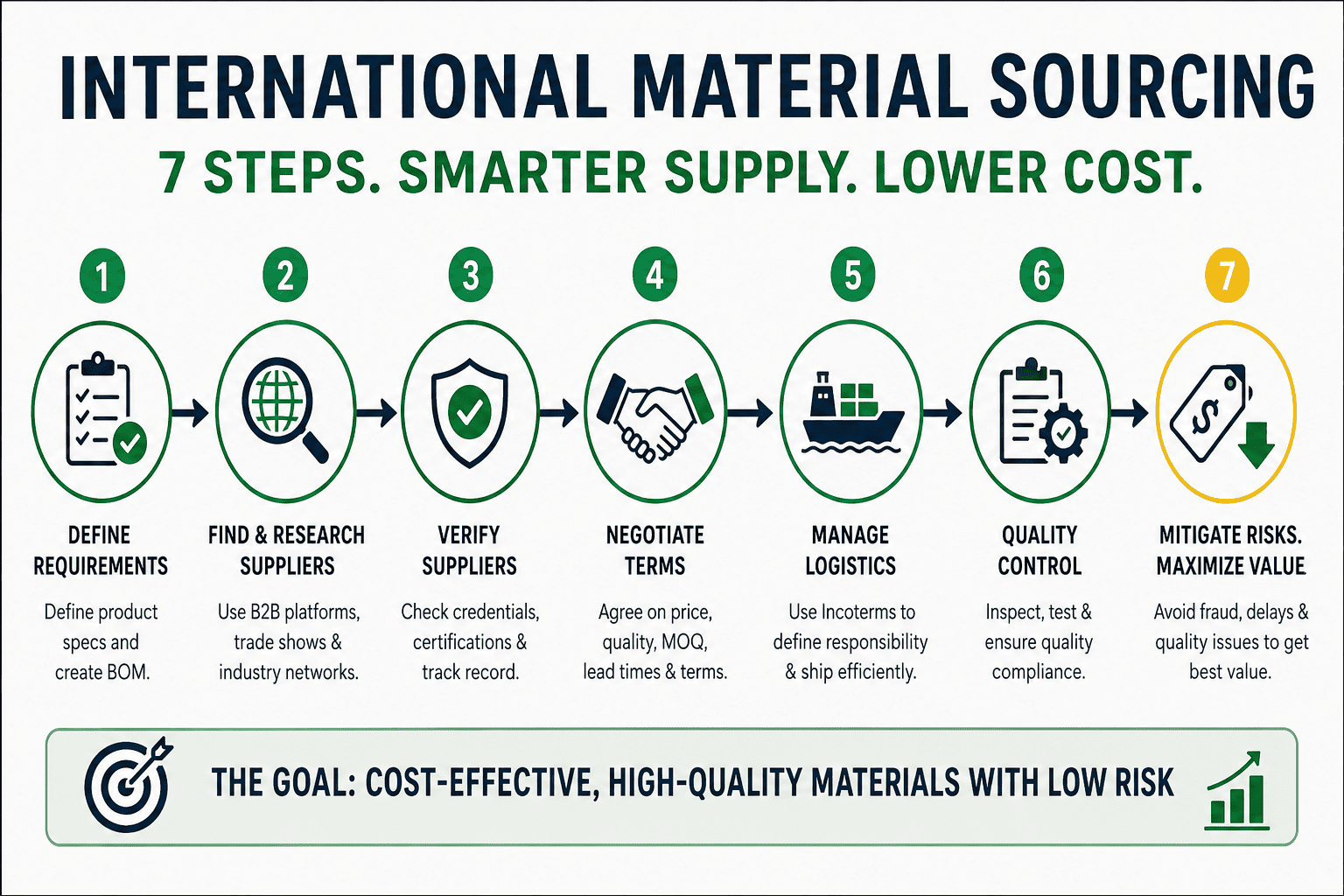
Direct Answer: Sourcing manufacturing materials internationally is the process of identifying, evaluating, and procuring raw materials, components, and sub-assemblies from suppliers in foreign markets. It begins with a clear definition of your product specifications and a detailed Bill of Materials (BOM). From there, you research potential suppliers via online B2B platforms, trade shows, and industry networks. The critical next step is verifying supplier legitimacy—this is where platforms like GTsetu provide government-tie-up verification of six core credentials (legal name, address, registration number, status, type, incorporation date) across 100+ countries. Once verified, you negotiate terms, manage logistics (using Incoterms to define responsibility), and implement quality control. The goal is to secure cost-effective, high-quality materials while mitigating risks like supplier fraud, quality inconsistency, and logistics delays. This guide provides a complete, step-by-step framework to master international material sourcing.
📅 Published August 24, 2026🔄 Updated August 24, 2026⏱ 18 min read✍️ GTsetu Editorial Team
6
Key Sourcing Steps
100+
Countries on GTsetu
500+
Verified Suppliers
0%
Broker Commission
International material sourcing is the backbone of global manufacturing. For a product company, the ability to reliably and cost-effectively procure raw materials, components, and sub-assemblies from international markets determines your cost structure, product quality, and supply chain resilience. The process, while complex, follows a structured path: define what you need, find and verify suppliers, negotiate terms, manage logistics, and maintain quality control. This guide breaks down each step with practical insights, drawing on industry best practices and the unique advantages of using a verified platform like GTsetu to de-risk the partner discovery phase.
This guide is written for founders, procurement managers, and operations leaders who are either new to international sourcing or looking to systematically improve their existing process. It covers the full sourcing lifecycle from the initial Bill of Materials to the final delivery of materials to your production line. For related reading, see our guides on contract vs captive manufacturing, ASEAN as a manufacturing hub, and logistics responsibilities in trade deals.
💡 Who This Guide Is For
Product founders, procurement teams, manufacturing operations leaders, and anyone responsible for sourcing raw materials, components, or finished goods from international markets. It is also relevant for distributors and sourcing agents who want a structured framework to guide their clients.
⚖️ Legal Disclaimer
This guide provides commercial and strategic context for international material sourcing. It is not legal or customs advice. Always engage qualified legal and customs counsel in the relevant jurisdictions before signing contracts or committing to import arrangements.
SECTION 1
1 Sourcing at a Glance: Key Models
Before diving into the step-by-step process, it is useful to understand the primary sourcing models available to a manufacturing company. The choice of model influences the level of control, cost structure, and risk exposure.
DS
Direct Sourcing
You identify and contract directly with manufacturers or raw material producers. Maximum control, but requires the most internal sourcing capability and supplier management. Best for strategic materials and long-term partnerships.
🔗 Direct Relationship
SA
Sourcing Agent
An intermediary who finds and vets suppliers on your behalf, negotiates pricing, and manages the procurement process. You pay a commission or service fee. Agents are valuable in complex or unfamiliar markets.
🤝 Fee-based Intermediary
SD
Supplier/Wholesale Distributor
You buy from a distributor who purchases from multiple manufacturers and offers a consolidated product range. Convenient for standard components, but you add a layer of markup. Good for smaller volumes or maintaining a broad supply base.
📦 Consolidated Supply
OM
Online Marketplace
Platforms like Alibaba, Global Sources, or ThomasNet connect buyers with thousands of suppliers. High reach, but verification is critical. Requires significant due diligence and sample testing.
💻 Digital Discovery
TM
Trade Show Sourcing
Attending industry trade shows to meet suppliers face-to-face, inspect samples, and build relationships. Effective for building trust and understanding new markets, but limited to show schedules and locations.
🏢 In-Person Discovery
✨ GTsetu Insight
The most secure and efficient approach for many companies is a hybrid model: use a verified platform like GTsetu for initial partner discovery (leveraging government-verified company data), then transition to a direct relationship for strategic materials. This combines the reach of digital discovery with the confidence of verified credentials. See: international business development consulting for scaling this strategy.
SECTION 2
2 Define Specifications & Create a Bill of Materials (BOM)
📋 Definition
A Bill of Materials (BOM) is a comprehensive list of all raw materials, components, sub-assemblies, and parts required to manufacture a product, including quantities, specifications, and sometimes supplier or cost information. It is the foundational document for all procurement and manufacturing activities and is essential for accurate cost estimation, supplier communication, and quality control.
Before you can source anything, you must know exactly what you need. The first step is therefore to define your product’s technical specifications and compile a detailed Bill of Materials (BOM). This is not a simple list—it should capture every physical item required for production, along with its quantity, unit of measure, and all relevant technical data (material grade, dimensions, tolerances, finish, etc.).
As the UpKeep guide emphasizes, you should “outline the kinds of tasks and stresses your product will have to withstand” to determine appropriate material specifications. A robust BOM also includes any industry-specific regulatory standards (e.g., RoHS for electronics, FDA compliance for food-contact materials). Creating a clear specification document signals to suppliers that you are a professional, serious buyer, which is the first step in building a credible sourcing relationship. See: partnership evaluation criteria for how to assess supplier fit against your BOM requirements.
Key Elements of a Sourcing Specification
📦
Materials & Grades
Specify the exact material (e.g., 6061-T6 aluminum, ABS plastic, 316 stainless steel) and any required material certifications (e.g., mill test reports).
📐
Dimensions & Tolerances
Provide detailed technical drawings with dimensions, tolerances, and surface finish requirements. Visuals reduce misunderstandings.
🏷️
Regulatory & Certification Needs
List any required certifications (ISO, UL, CE, RoHS, REACH, etc.). Indicate who is responsible for obtaining and maintaining them.
📦
Packaging & Labeling
Specify how materials should be packaged and labeled for shipment to your facility, including any special handling or storage instructions.
SECTION 3
3 How to Find International Suppliers
🔍 Primary Channels
There are three primary channels for finding international suppliers: online B2B platforms and directories (Alibaba, Global Sources, ThomasNet, industry-specific directories), industry trade shows and exhibitions (which offer face-to-face interaction and sample inspection), and professional networks and recommendations (industry associations, consultants, and sourcing agents). A combined approach often yields the best results, with online research providing initial reach and trade shows or recommendations adding a layer of trust through personal interaction.
1
Online B2B Platforms & Directories
Start your search on major B2B platforms like Alibaba and Global Sources. Use specific keywords for your material. Look for “Gold Suppliers” or verified badges, but understand these are not a substitute for your own due diligence. Also search industry-specific directories like Plastics News Directory, IQS Directory, or RISI for wood/paper products. As noted in the UpKeep guide, these directories are “well worth perusing.”
2
Industry Trade Shows & Exhibitions
Attending trade shows is a powerful way to meet suppliers face-to-face, inspect material samples, and gauge their professionalism. It allows for direct conversation and relationship-building that is difficult to replicate online. As the UpKeep guide states, you can “look at samples, ask questions, get contact information, and discuss ballpark pricing.” Trade shows are also excellent for understanding regional capability, such as the strengths of ASEAN as a manufacturing hub.
3
Recommendations & Industry Networks
Leverage your professional network. Talk to peers in your industry, join relevant industry associations, and ask for introductions. As the UpKeep guide notes, “If you’re part of any organizations related to your industry, you might try asking other members.” A recommendation from a trusted contact can significantly reduce the risk of engaging an unverified supplier. For a structured approach, consider a B2B matchmaking tool that uses verified data to recommend partners.
🎯 Pro Tip: Start with a Targeted Region
Don’t try to source from the entire world simultaneously. Start with a shortlist of 2-3 countries or regions known for expertise in your material category. For example, if sourcing textiles, start with Vietnam or India. For electronics, China or Taiwan. For automotive components, Thailand or Germany. This focus allows you to build deeper knowledge of the local supplier landscape and regulatory environment. See export readiness by region for a detailed assessment.
SECTION 4
4 Vetting & Verifying Supplier Credibility
Finding a supplier is not the same as finding a reliable supplier. Vetting is the single most important risk-mitigation step in the sourcing process. It is where you verify that the company you are about to engage is legally legitimate, has the capability you need, and has a history of reliable performance. A systematic vetting process protects you from fraud, misrepresentation, and costly disruptions.
🎯 The Core of Supplier Vetting
Effective supplier vetting involves checking three layers: Identity (is the company real and as it presents itself?), Capability (can they produce to your quality, volume, and delivery requirements?), and Compliance (do they meet legal, regulatory, and ethical standards?). Platforms like GTsetu dramatically simplify the identity layer by providing government-verified data (6-point verification) for every partner. Capability and compliance checks still require your direct investigation, sample requests, and factory audits.
Key Elements of Supplier Vetting
🏛️
Legal Identity Verification
Confirm the company’s legal name, registration number, address, company type, and status against official government records. This is the foundation of all other checks. GTsetu’s 6-point government-tie-up verification covers this layer completely.
🏭
Capability & Capacity
Request samples and conduct thorough sample inspections. Ask for production capacity, lead times, and evidence of similar products they have made. A factory audit, if feasible, is the gold standard for confirming capability, as described in guides on contract vs captive manufacturing.
📜
Certifications & Compliance
Verify any claimed certifications (ISO, BSCI, Sedex, sector-specific). Check if the supplier can provide the necessary documents for import (e.g., certificate of origin, material safety data sheets). Understand both the exporting and importing country’s regulatory requirements.
📈
Financial Health & References
For large contracts, assess the supplier’s financial stability through credit reports. Ask for and contact references from past clients, ideally in your industry. A history of on-time delivery and quality is the best predictor of future performance.
Always request and inspect product samples before placing commercial orders, as recommended by multiple sourcing guides.
Audits
On-site factory audits are the most reliable way to confirm actual production capability and working conditions.
NDA
Use a Non-Disclosure Agreement before sharing proprietary specifications or design files. GTsetu offers built-in NDA workflows.
🚩 Red Flags to Watch For
Be cautious of suppliers who: are reluctant to provide samples or references; have a very recent incorporation date but claim years of experience; have vague or inconsistent company names and addresses; request full payment upfront without a proven track record; or are not verifiable on official government registries. See: partnership evaluation criteria and common red flags in international partnerships.
SECTION 5
5 Negotiating Pricing, Terms & Contracts
Once you have identified a shortlist of verified suppliers who have passed your capability and sample checks, the next step is negotiating the commercial terms. This is not just about price—it involves payment terms, quality standards, delivery schedules, and a formal contract that protects both parties.
Key Commercial Terms to Negotiate
01
Pricing & Payment Terms
Negotiate the unit price, any volume discounts, and payment schedule (e.g., 30% deposit, 70% before shipment). Understand the currency risk—consider using forward contracts or pricing in a stable currency. As noted in the Inductus Global guide, factor in “fluctuating currencies and payment risk.”
02
Delivery & Lead Times
Clearly define the delivery schedule, including the Incoterm (see Section 6), who arranges and pays for logistics, and penalties for late delivery. Understand the total lead time, from order placement to arrival at your facility, to manage your own production planning.
03
Quality & Specification Standards
Incorporate your product specifications and quality standards directly into the contract. Define the acceptance criteria, inspection procedures, and the process for handling defective materials. Quality control in overseas manufacturing is a critical part of the negotiation.
04
Contract & Dispute Resolution
Formalize the agreement in a written contract that covers all terms. Include a clear dispute resolution clause specifying the governing law and arbitration or litigation venue. International contracts are complex, so consult a legal professional. See: dispute resolution in international contracts.
🤝 GTsetu’s Role in Negotiation
GTsetu itself does not broker or negotiate deals. Its core value is in the pre-negotiation phase: it provides government-verified supplier profiles, enabling you to enter negotiations with confidence in the supplier’s identity. This removes the “is this company real?” risk from the negotiation table, allowing you to focus on commercial terms. For complex negotiations, consider engaging a business development consultant.
SECTION 6
6 Logistics, Incoterms & Total Landed Cost
Logistics is not an afterthought—it is a direct driver of cost and delivery reliability. Understanding Incoterms (International Commercial Terms) is essential for defining who pays for freight, insurance, and customs, and who bears the risk at each stage of the journey. Your total cost for a material is not the supplier’s price; it’s the total landed cost, which includes the product cost, freight, insurance, customs duties, taxes, and any inland transportation to your facility.
📦 Total Landed Cost Calculation
Total Landed Cost = Product Price (ex-works) + Freight + Insurance + Customs Duties + Import Taxes + Inland Transportation + Port/Handling Fees.
Always calculate this before making a sourcing decision. A supplier with a slightly higher price but located closer to you or in a country with a favorable trade agreement may have a lower landed cost than a cheaper, more distant supplier.
Common Incoterms for Material Sourcing
Incoterm
Seller’s Responsibility
Buyer’s Responsibility
Best Suited For
EXW (Ex Works)
Make goods available at their premises
All costs and risks from pickup onward
Experienced buyers with their own logistics network; maximum control
FOB (Free on Board)
Responsible for export clearance and loading onto ship
Cost of main carriage, insurance, and import/onward transport
Common for sea freight where buyer wants control over main carrier selection
CIF (Cost, Insurance & Freight)
Arranges and pays for freight and minimum insurance to destination port
Import clearance, onward transport, and any additional insurance
Buyers who want a bundled cost to the port of destination
DDP (Delivered Duty Paid)
Maximum responsibility: delivers goods to buyer’s named place, including import clearance and duty payment
Unloading and onward handling
Buyers wanting maximum simplicity, especially for first-time imports
🌍 Logistics Responsibility in Practice
Responsibility for freight, customs clearance, and insurance should be explicitly defined in your supplier contract, not left to assumption. As the GTsetu guide on logistics responsibilities in trade deals explains, ambiguity in logistics allocation is a primary source of disputes and unplanned costs. For larger shipments, consider using a freight forwarder or logistics partner with experience in your trade lanes. Also factor in regional logistics infrastructure quality into your sourcing decision.
SECTION 7
7 Quality Control & Inspection
Maintaining consistent quality is one of the biggest challenges in international sourcing. While you should vet the supplier’s quality systems upfront, ongoing quality control (QC) is essential to catch defects before they reach your production line. A robust QC plan covers the entire production lifecycle.
Key Quality Control Checkpoints
1
Pre-Production
Verify all incoming raw materials against your specifications. This “incoming material inspection” ensures the right grade and quality of material is entering the production process. Request material test reports (MTRs) or certificates of analysis from the supplier.
2
During Production (In-Process)
Conduct inspections during manufacturing to catch and correct issues early. This is often done through a third-party inspection service. Check key process parameters, dimensions, and visual quality against the approved sample.
3
Final Inspection (Pre-Shipment)
This is the most critical checkpoint. A statistically significant sample of the final finished goods is inspected to ensure they conform to all specifications. This inspection is the buyer’s final opportunity to reject the shipment before it leaves the supplier’s country.
🔬 Independent Third-Party Inspections
For most international sourcing, using an independent third-party inspection company (e.g., SGS, Bureau Veritas, TÜV) is the most reliable way to ensure objectivity and quality. They have local inspectors worldwide and follow standardized sampling and reporting procedures. The cost of a third-party inspection is a small price to pay for ensuring your materials meet quality standards. See: quality control in contract manufacturing.
SECTION 8
8 Sourcing Regions: Strengths & Considerations
The best sourcing region for your materials depends on your industry, volume, cost targets, and quality requirements. No single location is best for everything. Understanding regional strengths allows you to target your search effectively. The following table provides a high-level overview based on insights from Custom Product, Inductus Global, and GTsetu’s own research on ASEAN as a manufacturing hub.
Region
Core Strengths
Key Sourcing Categories
Key Considerations
China
Deepest supply chain ecosystem; vast manufacturing capacity across all categories; cost-effective at scale
Mature automotive supply chain; good infrastructure; rising wages in automotive sector
Malaysia
Semiconductor and electronics leader; strong technical workforce
Semiconductors, E&E, medical devices, specialty chemicals
High-quality infrastructure; attractive for high-value manufacturing; limited scale for basic commodities
🌏 Diversification: The China Plus One Strategy
Many companies are actively diversifying their manufacturing base by adding a second source in Southeast Asia (Vietnam, Thailand, Malaysia) while maintaining a presence in China. This China Plus One strategy reduces supply chain risk and provides flexibility. It is a key trend shaping global sourcing. See: export readiness by region for a deeper comparison.
SECTION 9
9 Key Risks & How to Mitigate Them
🔍
Supplier Fraud & Misrepresentation
One of the most common risks: a supplier is not a legitimate manufacturer, or misrepresents its capabilities. Mitigation: Always perform a 6-point company verification (GTsetu’s standard). Request and inspect samples. For large orders, conduct a factory audit.
📉
Quality Inconsistency
Quality can vary between batches if the supplier does not have robust processes. Mitigation: Establish clear quality standards in your contract and use a multi-point inspection plan (pre-production, in-process, pre-shipment). Use third-party inspectors.
🚢
Logistics Delays & Hidden Costs
Port congestion, customs delays, and unexpected charges can derail your timeline and budget. Mitigation: Define Incoterms clearly and get an all-inclusive landed cost quote. Build buffer time into your schedule and use an experienced freight forwarder. See: logistics responsibilities guide.
💱
Currency Fluctuation
Exchange rate changes can make your materials more expensive than anticipated. Mitigation: Consider hedging using forward contracts. Negotiate pricing in a stable currency (like USD). Build currency volatility into your cost model.
🔐
Intellectual Property (IP) Theft
Sharing proprietary designs or formulas with an unverified supplier can lead to knock-offs. Mitigation: Use a robust NDA before disclosing any sensitive information. Protect your IP with patents and trademarks in key jurisdictions. Work with verified and reputable partners who have a track record of protecting client IP.
⚖️
Regulatory & Compliance Failures
Materials may not meet your country’s import regulations (e.g., safety standards, environmental compliance). Mitigation: Understand all import requirements before sourcing. Ensure your supplier can provide necessary certifications and documentation. Consult with customs brokers or legal counsel.
SECTION 10
10 How GTsetu Helps You Find Verified Suppliers
🌐 Platform Spotlight, GTsetu
The Verified Starting Point for International Material Sourcing
The most frequently cited cause of international sourcing failure is not poor contract drafting or logistics planning—it is choosing the wrong partner. A supplier who misrepresents their legal identity, capabilities, or financial standing can derail your entire supply chain. GTsetu was built to solve this foundational problem: a government-tie-up verified B2B discovery environment where manufacturers, procurement teams, and sourcing agents connect with verified suppliers across 100+ countries. Every company on GTsetu is verified using direct government tie-ups across six essential credentials: legal name, registered address, registration number, company status, company type, and date of incorporation. This gives you confidence that the entity you are engaging is legitimate before you even start negotiating.
✅
6-Point Govt. Verification
Legal name, registered address, registration number, company status, company type, and incorporation date verified against official records.
🕵️
Anonymous Discovery
Browse verified supplier profiles without revealing your identity or sourcing intentions until mutual interest is confirmed. This allows for strategic, risk-free market exploration.
📄
Built-In NDA Workflow
Formalize confidentiality before sharing any proprietary specification, design, or pricing information, with a full digital audit trail. Essential for protecting your IP.
🚫
Zero Commission
GTsetu does not take a cut on deals. It is a matching and verification platform, not a broker. Your deal economics stay between you and your verified partner.
🔐
Encrypted Collaboration
All documents and communications are encrypted in transit and at rest, ensuring your sourcing strategy remains confidential.
🌍
100+ Countries
Access verified suppliers across key manufacturing regions including China, Vietnam, India, Thailand, Malaysia, and beyond.
QWhat is the first step in sourcing manufacturing materials internationally?
The first and most critical step is to clearly define your product specifications and create a detailed Bill of Materials (BOM). This list of every raw material, component, and sub-assembly, along with its technical requirements and quantities, is the foundation for all subsequent sourcing activities. Without a precise BOM, you cannot effectively communicate with suppliers, get accurate quotes, or ensure quality.
QHow do I find reliable international material suppliers?
There are three primary channels: online B2B platforms and directories (Alibaba, Global Sources, ThomasNet), industry trade shows, and professional recommendations. The most reliable and secure approach, however, is to use a verified B2B platform like GTsetu. GTsetu provides government-tie-up verification of six core company credentials, giving you confidence in the supplier’s legal identity before you engage in commercial discussions.
QWhat is the difference between a sourcing agent and a distributor?
A sourcing agent acts as an intermediary, helping you find and vet suppliers, negotiate prices, and manage the procurement process, but they do not take title to the goods. They earn a commission or service fee. A distributor (in the context of materials) buys products from manufacturers and resells them, taking ownership and inventory risk and earning a margin on the resale. For sourcing raw materials, agents are often used for complex or bespoke requirements, while distributors are used for standard, catalog-type materials.
QWhat are the key logistics considerations when sourcing materials internationally?
Key logistics considerations include: choosing the right Incoterm (which defines who pays for freight, insurance, and customs), calculating the total landed cost (product cost + freight + insurance + duties), selecting a reliable freight forwarder, planning for potential delays, and ensuring proper documentation for customs clearance. The allocation of logistics responsibilities must be explicitly defined in your contract with the supplier.
QHow can GTsetu help with international material sourcing?
GTsetu simplifies and secures the most critical and risky part of sourcing: finding and verifying credible suppliers. It provides a platform where every supplier is verified against official government records on six points (legal name, address, registration number, status, type, incorporation date). It offers anonymous discovery to protect your strategy, built-in NDA workflows to protect your IP, and zero broker commissions, all across 100+ countries. This allows you to focus your energy on negotiating terms and managing relationships with confidence.
QWhat are the most common risks in international material sourcing and how can I mitigate them?
Common risks include supplier fraud (mitigate with 6-point verification), quality inconsistency (use samples and third-party inspections), logistics delays and hidden costs (use clear Incoterms and landed cost calculations), currency fluctuation (use hedging), IP theft (use NDAs), and regulatory failures (understand import requirements). A structured due diligence process covering identity, capability, compliance, and financial health is your primary defense.
QWhat is a Bill of Materials (BOM) and why is it important for sourcing?
A Bill of Materials (BOM) is the master list of all materials, components, and sub-assemblies needed to build your product, complete with quantities and technical specifications. It is important because it forms the basis of all supplier communication, cost estimation, quality control, and procurement planning. Without a complete and accurate BOM, you cannot get reliable quotes or ensure your supplier delivers exactly what you need.
QWhat regions are best for sourcing manufacturing materials?
The “best” region depends on your product and needs. China offers the deepest supply chain across most categories. Vietnam is strong for textiles, electronics, and furniture. India excels in textiles, chemicals, and pharmaceuticals. Thailand is a hub for automotive and electronics. Malaysia is a leader in semiconductors and high-value electronics. Many companies now adopt a China Plus One strategy, diversifying across regions to reduce risk. See the detailed table in Section 8 for a comprehensive comparison.
Ready to Find Verified Suppliers for Your Manufacturing Materials?
Join 500+ verified manufacturers, suppliers, and distributors already building cross-border sourcing partnerships on GTsetu, with government-tie-up verification of six core credentials, built-in NDA workflows, and zero broker fees across 100+ countries. Start your search for reliable, verified international suppliers today.
They represents the product, and research team behind GTsetu, a global B2B collaboration platform built to help companies explore cross-border partnerships with clarity and trust. The team focuses on simplifying early-stage international business discovery by combining structured company profiles, verification-led access, and controlled collaboration workflows.
With a strong emphasis on trust, and disciplined engagement, Team GTsetu shares insights on global trade, partnerships, and cross-border collaboration, helping businesses make informed decisions before entering deeper commercial discussions.