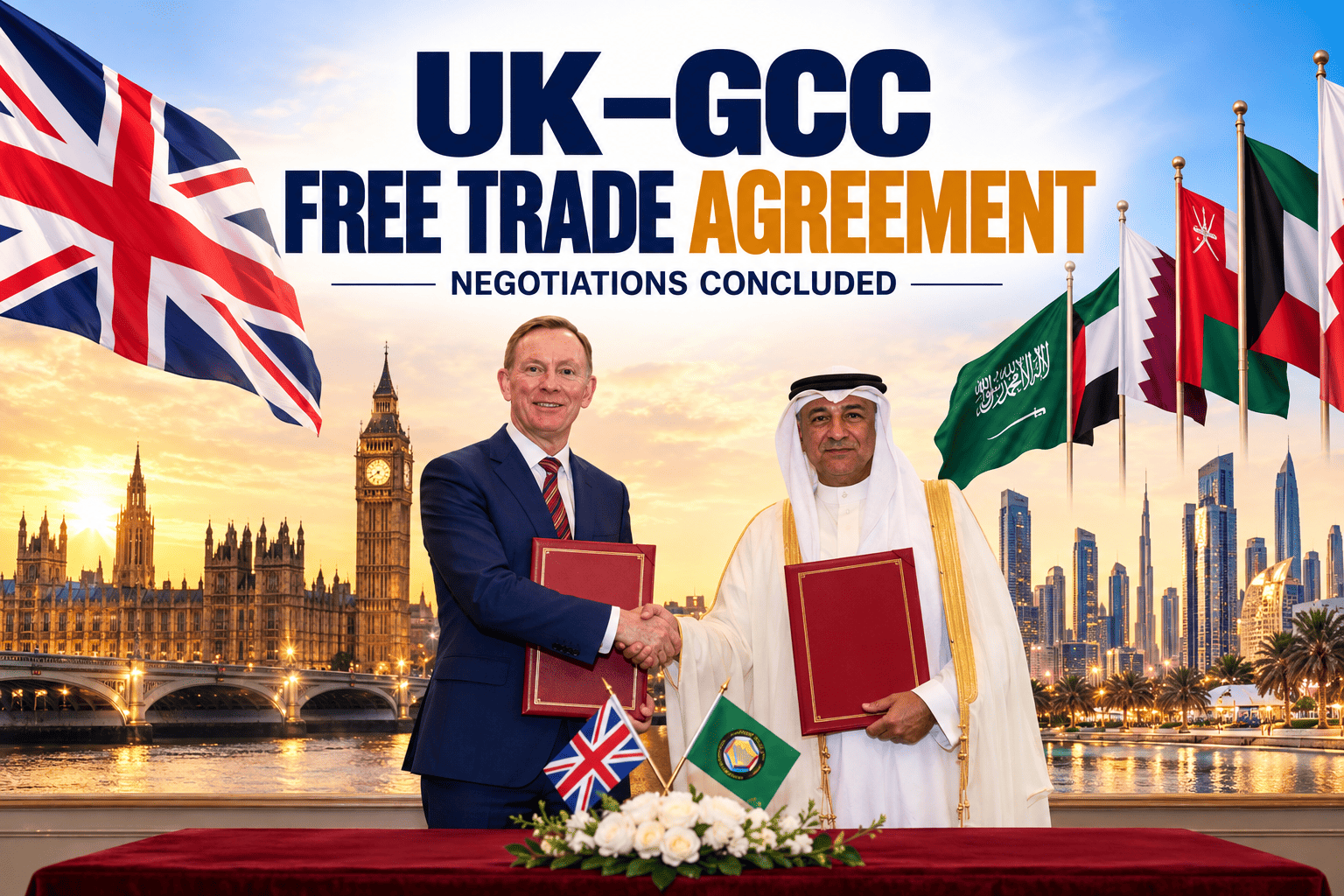
UK–GCC Free Trade Agreement: Full Summary & What It Means for Business
On 20 May 2026, the United Kingdom and the Gulf Cooperation Council concluded negotiations on a free trade agreement, the first FTA the GCC has ever agreed with a G7 nation. Negotiations are concluded but the treaty has not yet been signed; both sides are finalising the legal text ahead of signature and ratification. Here is what has been agreed, what it covers, and what it means for manufacturers, distributors, and businesses planning cross-border partnerships across the two regions.
📄 Agreement
UK–GCC Free Trade Agreement
Comprehensive FTA covering goods, services, investment, and digital trade
🌍 Parties
🇬🇧 UK — GCC
Bahrain, Kuwait, Oman, Qatar, Saudi Arabia, UAE
📅 Negotiations Concluded
20 May 2026
First FTA between the GCC and a G7 nation
🔖 Current Status
Concluded; not yet signed
Legal text being finalised ahead of signature and ratification
The UK–GCC Free Trade Agreement is a comprehensive deal between the United Kingdom and the six-member Gulf Cooperation Council: Bahrain, Kuwait, Oman, Qatar, Saudi Arabia, and the United Arab Emirates. Negotiations, launched in 2022, concluded on 20 May 2026 in London between the UK’s Minister of State for Trade Policy and the GCC’s Secretary General. It is the third FTA the GCC has concluded overall, after deals with Singapore and the European Free Trade Association, and the first with a G7 economy.
The GCC represents a combined GDP of roughly £1.8 trillion and an import market worth around $1.04 trillion, projected to almost double in real terms by 2050. Total UK-GCC trade was worth £53 billion in 2025, making the bloc the UK’s tenth-largest trading partner and eighth-largest goods export market. The UK government estimates the deal will add £3.7 billion a year to the UK economy in the long run, increase real wages by £1.9 billion annually, and grow bilateral trade by nearly 20% compared with 2040 projections.
💡 How to read this page
This page summarises the chapters UK and GCC negotiators have confirmed as agreed, based on the official conclusion summary. The legal text is still being finalised, so some details may be refined before signature. Section 5 covers the ratification steps still ahead, and Section 7 explains why an FTA, however comprehensive, does not by itself verify or formalise a long-term distributor or manufacturing partnership.
Section 1
Overview: What Was Agreed
The UK–GCC FTA is a “next-generation” agreement spanning goods, services, investment, digital trade, government procurement, intellectual property, and business mobility, alongside core legal chapters on dispute settlement, competition, and sustainable development. A few headline features stand out:
First GCC binding commitment on financial data flows. The deal protects the free flow of financial data between the UK and GCC and prohibits unjustified data localisation requirements, described as the first such binding commitment the GCC has made in any trade agreement.
Legally binding government procurement access with Bahrain and the UAE. Both countries, neither of which is a member of the WTO’s Agreement on Government Procurement, have taken on legally binding commitments to open their public procurement markets to UK suppliers.
TRIPS-plus intellectual property commitments. The IP chapter goes beyond the WTO’s TRIPS baseline, including patent term extensions for pharmaceuticals and exclusive use of pharmaceutical test data, novel provisions for GCC countries, alongside 32 enforcement articles covering civil, criminal, border, and digital enforcement.
The GCC’s most ambitious mobility, telecoms, labour, and environment commitments to date. Several chapters, including business mobility, telecommunications, anti-corruption, and animal welfare, mark firsts for the GCC in any trade agreement.
UAE commitments not extended to labour and environment. The General Collaboration and Sustainable Development chapter was negotiated with all six GCC states, but the UAE did not take on labour and environment commitments; the UK will continue discussing these bilaterally with the UAE.
Section 2
Why This Deal Matters
For the UK, the agreement is positioned as part of a wider run of deals following the EU, India, US, and South Korea agreements, and is framed around the UK’s 2025 Trade Strategy and Industrial Strategy. For the Gulf, the deal arrives as GCC states pursue economic diversification programmes such as Saudi Arabia’s Vision 2030 and the UAE’s Centennial Plan 2071, driving demand for healthcare, fintech, AI, advanced manufacturing, and clean energy expertise that UK firms are well placed to supply.
Investment ties are already substantial. GCC countries are home to four of the world’s top sovereign wealth funds, representing over $3.4 trillion in capital, and total bilateral investment between the UK and Gulf Arabian countries reached £485 billion in 2024. The FTA’s investment chapter introduces a modern Investor-State Dispute Settlement mechanism and comprehensive protections designed to give investors on both sides more certainty for long-term capital commitments, a theme closely tied to company global expansion planning more broadly.
Section 3
Goods Market Access & Tariffs
🏭
Advanced Manufacturing & Automotive
Immediate and phased tariff elimination across key industrial exports
Day-One Access
Turbojets and aerospace parts, currently facing 5% tariffs, gain immediate tariff-free access. Machinery and electronics, including internal combustion engines and most valves and centrifuges, lose their tariffs on entry into force. For automotive, full tariff elimination applies to all UK passenger car exports, with duties removed in full on entry into force for 90% of current UK car exports by value, hybrids included. Tariffs on electric vehicles and batteries are removed after 10 years.
💊
Life Sciences & Healthcare
Tariff removal on medical devices once the agreement is fully implemented
Phased Access
UK exports of medical devices, including surgical instruments and radiological devices, benefit from tariff removal once the agreement is fully implemented, supporting a sector the UK Industrial Strategy identifies as a strategic strength.
🧀
Agri-Food & Drink
Immediate tariff removal on key UK food exports into a net food-importing region
Day-One Access
UK food and drink exports to the Gulf, already worth £839 million, stand to gain. Cheddar cheese (facing tariffs of up to 6%), chocolate (up to 15%), and biscuits (up to 10%) all receive immediate tariff liberalisation at entry into force, as do Scottish smoked salmon (currently 5%) and UK pet food and animal feed. The UK will liberalise tariffs on all current GCC exports to the UK from day one, with pork, chicken, and eggs excluded from liberalisation.
Metric
Detail
GCC tariff lines fully liberalised
90%, within 10 years of entry into force
Share of UK exports (by value) gaining tariff removal
~93%, worth an estimated £580 million a year once fully implemented
Duties removed on day one
£360 million of the £580 million total
GCC common external tariff (customs union baseline)
5% on most industrial and agricultural goods
UK tariff liberalisation on GCC exports
All existing exports liberalised from day one, except pork, chicken, and eggs
Customs clearance commitment
Within 48 hours (6 hours for perishable goods), where requirements are met
Origin certification
Exporter self-certification permitted after initial registration
Section 4
Services, Investment & Digital Trade
Beyond goods, the agreement locks in market access and regulatory certainty across several services sectors. Legal, engineering, and construction services gain guarantees against new restrictions such as foreign ownership limits or local establishment requirements. The financial services chapter is described as the best terms the GCC has agreed to date in this sector, including the binding financial-data-flow commitment and improved equity caps relative to WTO baselines, allowing some UK firms to serve the region without setting up a local office.
The digital trade chapter obligates both sides to accept electronic trade documents, promote paperless trading, and permanently ban customs duties on electronic transmissions, while prohibiting unjustified data localisation for the first time in any GCC trade agreement. A professional services annex opens the door to future mutual recognition of qualifications, and a dedicated mobility chapter delivers what the UK government describes as the GCC’s most ambitious business-mobility commitments to any trading partner, including guaranteed visa access for a wide range of business activities and a bar on new economic-needs testing. Government procurement commitments with Bahrain and the UAE include an In-Country Value certification route for UK suppliers worth up to a 25% evaluation advantage on UAE federal bids, and a 10% price preference for UK SMEs established in Bahrain, details relevant to any distributor network strategy built around public-sector contracts in the region.
Section 5
Timeline: From Conclusion to Entry Into Force
June 2022
Negotiations launched
The UK and GCC begin formal FTA negotiations following a call for evidence and business engagement process.
20 May 2026
Negotiations concluded
Agreement reached in London between the UK’s Minister of State for Trade Policy and the GCC Secretary General; a conclusion summary and chapter-by-chapter breakdown published by the UK government.
In progress, as of 1 Oct 2026
Legal scrubbing of the treaty text
Both sides are finalising and legally verifying the full treaty text before it can be signed. The agreement has not yet been signed.
Pending
Signature
Once the legal text is finalised and verified, arrangements will be made for both sides to formally sign the treaty.
Pending
UK Trade and Agriculture Commission review & s42 report
The UK’s independent Trade and Agriculture Commission will scrutinise the deal for consistency with UK statutory protections on animal and plant health, animal welfare, and the environment, feeding into a government report under section 42 of the Agriculture Act 2020.
Pending
CRaG scrutiny & parliamentary procedure
The treaty will be subject to the UK’s standard pre-ratification scrutiny under the Constitutional Reform and Governance Act, alongside any legislation needed to implement it.
Pending
Ratification by GCC member states
Each of the six GCC member states must separately complete its own domestic ratification requirements.
Pending
Entry into force
The agreement takes effect once both the UK and all GCC member states have completed ratification.
📌 Status as of 1 October 2026
Negotiations are concluded, but the treaty has not yet been signed. There is no confirmed signature date or entry-into-force date at this stage. Businesses planning around the deal should track the UK government’s trade deal tracker pages and official GCC communications for updates, rather than assuming a specific go-live date.
Section 6
What It Means by Sector
✈️
Aerospace & advanced manufacturing
Immediate tariff-free access for turbojets, aerospace parts, and most machinery and electronics exports.
Day-one gains
🚗
Automotive
Full tariff elimination on passenger car exports, including hybrids; EVs and batteries liberalise after 10 years.
Day-one for most
🧬
Life sciences & healthcare
Tariff removal on medical devices such as surgical instruments and radiological equipment once fully implemented.
Phased
🌾
Agri-food & drink
Immediate tariff removal on cheese, chocolate, biscuits, smoked salmon, pet food, and animal feed.
Day-one gains
💳
Financial & professional services
Binding financial-data-flow protection, improved equity caps, and a route to serve clients without a local office.
New ground
🏗️
Government procurement
Legally binding public procurement access to Bahrain and UAE markets, with an In-Country Value certification route.
First-of-its-kind
💻
Technology & digital trade
Ban on unjustified data localisation, permanent customs-duty exemption on electronic transmissions, paperless trading.
First-of-its-kind
🧑💼
SMEs & business mobility
Dedicated SME support measures, self-certification of origin, and the GCC’s most ambitious mobility commitments to date.
Broad access
Section 7
The Gap an FTA Doesn’t Close
An FTA of this scale removes tariffs, simplifies customs, and gives businesses legal certainty to trade and invest across borders. What it does not do is verify the specific company on the other end of a deal, protect confidential terms during early-stage negotiation, or formalise a long-term distributor or manufacturing relationship. Those are commercial, not treaty-level, questions, and they matter just as much once tariffs come down, since lower barriers to entry tend to bring more unfamiliar counterparties into view, which is a common reason trust breaks down in global deals formed in newly opened markets.
For a UK manufacturer eyeing the Gulf, or a Gulf distributor evaluating UK suppliers once the deal takes effect, the practical next step after reading the tariff schedule is usually market research, partner evaluation, and a properly structured business partnership contract, the same due diligence process that applies whether the underlying trade is covered by a landmark FTA like this one, a newer deal such as the India-EU Free Trade Agreement, or a bilateral arrangement like Korea’s CEPA with Serbia.
🤝 For Long-Term Industrial Partnerships
GTsetu: Verified Long-Term Collaboration for Manufacturers, Distributors, and Raw Material Suppliers Entering GCC and UK Markets
As UK and GCC businesses prepare for lower tariffs and simplified customs, the practical challenge shifts from market access to finding the right partner. GTsetu is a structured partnership platform, not a marketplace or directory, where every company is verified on 6 government-sourced points before engagement, where discovery is anonymous until mutual interest is confirmed, where NDAs are executed digitally before any commercial information changes hands, and where all document exchange happens through an encrypted workspace, the kind of infrastructure that supports genuine technology partnership and supply chain relationships rather than one-off transactions.
GTsetu is used by industrial manufacturers, distribution companies, and raw material suppliers across 100+ countries, including the UK and all six GCC states, to find, vet, and formally engage with trade partners they intend to work with for the long term, supported by proper international materials sourcing practice and certification verification along the way.
🏛️
6-Point Government-Sourced Verification
Name, Address, Registration Number, Company Status, Company Type, and Date of Incorporation, verified using government tie-ups before any engagement.
🕵️
Anonymous Discovery
Browse verified partner profiles across 100+ countries without revealing your own identity or commercial strategy until you choose to engage.
📄
Built-In NDA Workflow
Digital NDA with timestamped signatures before any pricing, formulations, or product specs are shared.
🔐
Encrypted Document Workspace
All commercial documents shared through encrypted channels with a full access audit trail, not email attachments.
🌍
100+ Countries, Including the UK & GCC
Verified manufacturers and distributors across the UK, Gulf, Asia, Europe, Africa, and the Americas.
🚫
Zero Commission
No success fee, no broker commission, ever. Your partnership economics remain entirely between you and your partner.
The UK-GCC Free Trade Agreement is a comprehensive trade deal between the United Kingdom and the Gulf Cooperation Council, comprising Bahrain, Kuwait, Oman, Qatar, Saudi Arabia, and the UAE. Negotiations concluded on 20 May 2026, making it the first FTA the GCC has agreed with a G7 nation. It covers goods tariffs, services, investment, digital trade, government procurement, and business mobility.
QHas the UK-GCC FTA been signed yet?
As of 1 October 2026, negotiations have concluded but the treaty has not yet been signed. Both sides are finalising the legal text, after which the agreement will be signed and then go through ratification procedures, including UK parliamentary scrutiny under the CRaG Act and GCC member states’ own domestic processes, before entering into force.
QWhat tariffs will be removed under the UK-GCC FTA?
The GCC will fully liberalise 90% of its tariff lines within 10 years of entry into force. Tariffs will be removed on around 93% of UK exports to the GCC by value, worth an estimated £580 million a year once fully implemented, with £360 million of that removed on day one. The UK will liberalise tariffs on all existing GCC exports to the UK from day one, excluding pork, chicken, and eggs.
QWhat does the UK-GCC FTA mean for manufacturers and distributors?
The agreement lowers tariffs on advanced manufacturing goods, automotive products, medical devices, and food and drink, while simplifying customs clearance to within 48 hours (6 hours for perishables) and allowing exporter self-certification of origin. For manufacturers and distributors, this reduces the cost of entering Gulf markets, but finding and formally engaging a verified long-term distributor or manufacturing partner in the region still requires separate due diligence beyond what the FTA itself provides, covered further in partnership evaluation criteria.
Planning to Enter the UK or GCC Market Once the FTA Takes Effect?
GTsetu is purpose-built for manufacturers, distributors, and raw material suppliers seeking verified long-term trade partnerships across 100+ countries, including the UK and all six GCC states, with government-sourced partner verification, built-in NDA workflows, and zero commission.
They represents the product, and research team behind GTsetu, a global B2B collaboration platform built to help companies explore cross-border partnerships with clarity and trust. The team focuses on simplifying early-stage international business discovery by combining structured company profiles, verification-led access, and controlled collaboration workflows.
With a strong emphasis on trust, and disciplined engagement, Team GTsetu shares insights on global trade, partnerships, and cross-border collaboration, helping businesses make informed decisions before entering deeper commercial discussions.