Maharashtra’s FTI and the Future of Quantum Technology in Pune | GTsetu
Home ›
Blog ›
Maharashtra’s FTI and Quantum Technology in Pune
⚛️ Quantum Technology & Frontier Innovation
Maharashtra’s FTI and the Future of Quantum Technology in Pune
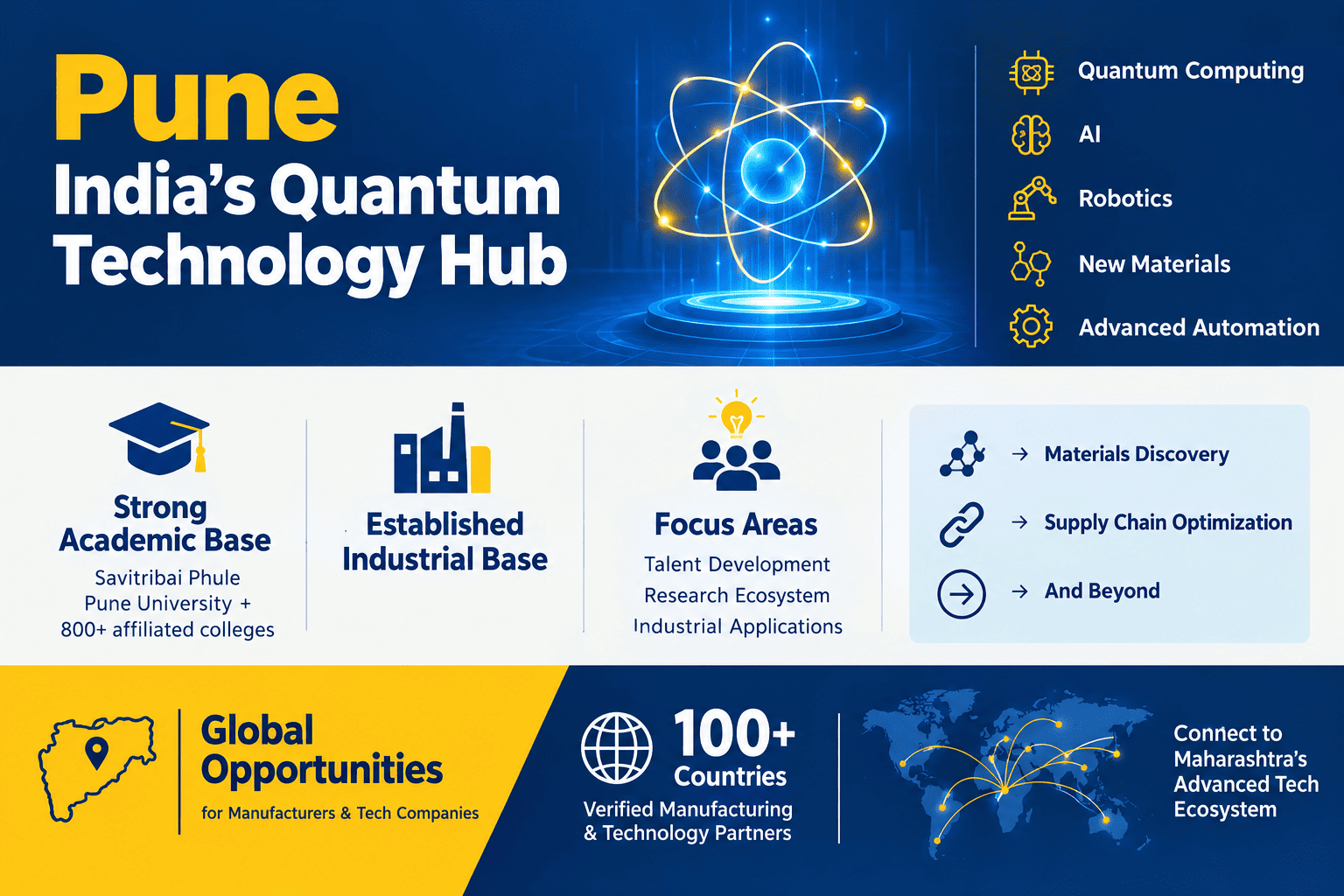
Direct Answer:Maharashtra’s Advanced Manufacturing and Frontier Technology Institute (FTI) and its flagship Global Frontier Technology Institute explicitly include quantum computing as a core research focus area, alongside artificial intelligence, robotics, new materials, and advanced automation. The FTI initiative positions Pune as a hub for quantum technology development in India, leveraging the city’s exceptional concentration of educational institutions, including Savitribai Phule Pune University and over 800 affiliated colleges, and its established industrial base. The initiative encompasses quantum talent development, research ecosystem building, and potential industrial applications ranging from materials discovery to supply chain optimization. For global manufacturers and technology companies, Pune’s emerging quantum ecosystem represents a significant opportunity to engage with India’s deep-tech future. GTsetu connects verified manufacturing and technology partners across 100+ countries, enabling businesses to discover and engage with credible partners in Maharashtra and India’s advanced technology ecosystem.
📅 Published October 3, 2026🔄 Updated October 3, 2026⏱ 18 min read✍️ GTsetu Editorial Team
₹6,003 Cr
National Quantum Mission Budget
100+
Countries on GTsetu
800+
Colleges in Pune Region
0%
Broker Commission
Quantum technology is no longer a distant scientific curiosity. It is moving from laboratory research toward industrial application, and the regions that build quantum capability now will capture disproportionate value in the coming decades. Against this backdrop, Maharashtra’s Advanced Manufacturing and Frontier Technology Institute (FTI) has placed quantum computing among its core research priorities, a decision with significant implications for Pune, for India’s technology ecosystem, and for global manufacturers watching the frontier technology landscape.
The FTI and its flagship Global Frontier Technology Institute are designed to develop capability in the technologies that will define next-generation manufacturing competitiveness: artificial intelligence, robotics, new materials, advanced automation, and quantum computing. For Pune, a city already known for its educational institutions and industrial base, this represents an opportunity to become a node in the global quantum technology network. For global manufacturers, it signals a new source of technology partners, research collaboration, and emerging industrial applications.
Global manufacturers and technology companies tracking frontier technology developments, research institutions exploring collaboration opportunities in India, business development teams assessing emerging technology ecosystems, and anyone who needs to understand the quantum technology landscape in Maharashtra and Pune.
⚖️ Disclaimer
This guide provides commercial and strategic context based on publicly available information about the FTI initiative and quantum technology developments. Policy details, timelines, and programme specifics may evolve. Always verify current information with official government sources and engage qualified local counsel before making investment or partnership decisions.
SECTION 1
1 What Is Quantum Technology and Why It Matters
⚛️ Definition
Quantum technology is a class of emerging technologies that harness the principles of quantum mechanics, superposition, entanglement, and quantum interference, to perform tasks that are impossible or computationally prohibitive for classical systems. The major domains of quantum technology include quantum computing (computation), quantum communication (secure information transfer), quantum sensing (precision measurement), and quantum materials (new materials with engineered quantum properties). For manufacturing, quantum technology promises transformative capabilities in materials discovery, process optimization, logistics, and secure communications.
Quantum computing is the most widely discussed quantum technology domain. Unlike classical computers, which process information in bits that are either 0 or 1, quantum computers use qubits that can exist in superposition, simultaneously 0, 1, or both, and can be entangled with other qubits. This enables quantum computers to explore many possible solutions simultaneously, offering potential exponential speedups for specific classes of problems: simulating molecular interactions for drug discovery and materials science, optimizing complex logistics and supply chain networks, and breaking certain types of cryptographic systems.
For manufacturers, quantum technology is relevant across multiple time horizons. Near-term applications include quantum-inspired optimization algorithms running on classical hardware, quantum sensing for precision measurement in advanced manufacturing, and quantum-safe cryptography to protect supply chain communications. Longer-term applications include quantum simulation for discovering new materials, battery chemistries, lightweight alloys, advanced composites, and quantum optimization for complex production and distribution networks.
01
Quantum Computing
Uses qubits to perform computations intractable for classical computers. Applications include materials simulation, optimization, cryptography, and machine learning. Still in early-stage development, with error correction a major challenge.
💻 Materials discovery, optimization
02
Quantum Communication
Uses quantum entanglement for secure information transfer. Quantum key distribution (QKD) enables theoretically unbreakable encryption, critical for protecting global supply chain communications against future quantum threats.
🔐 Secure communications, QKD
03
Quantum Sensing
Uses quantum systems for ultra-precise measurement of time, gravity, magnetic fields, and other physical quantities. Applications include navigation without GPS, medical imaging, and precision manufacturing metrology.
📡 Precision measurement, navigation
04
Quantum Materials
Engineered materials with quantum properties, superconductors, topological insulators, quantum dots, that enable new capabilities in electronics, energy, and sensing. Foundational to quantum computing hardware and advanced manufacturing.
🧪 Superconductors, quantum dots
₹6,003 Cr
India’s National Quantum Mission budget (2023–2031)
8 Years
Duration of the National Quantum Mission implementation period
The Advanced Manufacturing and Frontier Technology Institute (FTI) Maharashtra and its flagship Global Frontier Technology Institute explicitly include quantum computing among their core research focus areas. Alongside artificial intelligence, robotics, new materials, and advanced automation, quantum technology is one of the frontier technologies the FTI is designed to develop .
This focus is not incidental. Quantum technology is increasingly recognized as a foundational capability for advanced manufacturing competitiveness. Quantum simulation can accelerate the discovery of new materials, battery chemistries, lightweight alloys, advanced composites, that are critical for electric vehicles, aerospace, and sustainable manufacturing. Quantum optimization can improve complex supply chain and logistics networks. Quantum sensing can enable precision measurement capabilities that traditional technologies cannot match. By including quantum in its research agenda, the FTI is positioning Maharashtra to participate in these developments.
🔗 The FTI–Quantum Connection
The FTI’s quantum focus includes: research partnerships with universities and research institutions in quantum computing and quantum information science; talent development through curriculum design, fellowships, and training programmes; industry collaboration to translate quantum research into industrial applications; and infrastructure development for quantum research and testing. The Global Frontier Technology Institute, planned within the Pune-Mumbai Innovation City, is expected to be the primary vehicle for these quantum initiatives.
The FTI’s quantum focus also connects to the institute’s broader mission of supporting advanced manufacturing. Quantum technology is not a standalone research domain, it is an enabling technology that can accelerate progress in materials science, process optimization, and secure communications, all of which are directly relevant to manufacturing competitiveness. For global manufacturers, the FTI’s quantum initiatives represent an opportunity to engage with an emerging ecosystem that could produce new materials, new optimization tools, and new technology partners.
✨ GTsetu Insight
Global manufacturers seeking technology partners in India’s emerging quantum ecosystem can use GTsetu’s verified network to identify and engage with credible research institutions, technology companies, and manufacturing partners. The platform’s six-point government verification ensures that potential partners are legitimate, registered entities. See Technology Partnership: Complete Guide for how to structure these collaborations.
SECTION 3
3 Why Pune for Quantum Technology?
Pune’s selection as the home for the FTI and its quantum technology focus is grounded in the city’s exceptional concentration of educational, research, and industrial assets. Quantum technology development requires deep collaboration between physics, computer science, engineering, and industry, an ecosystem Pune already possesses.
01
Educational Infrastructure
Pune hosts Savitribai Phule Pune University (SPPU) and over 800 affiliated colleges, along with premier institutions like the College of Engineering Pune (COEP, established 1854). This concentration of academic excellence provides the talent pipeline and research capability essential for quantum technology development.
🎓 SPPU, COEP, 800+ colleges
02
Research Institutions
Pune is home to research institutions including CMTI (Central Manufacturing Technology Institute), IITM (Indian Institute of Tropical Meteorology), and various CSIR laboratories. These institutions provide research infrastructure and expertise that can support quantum technology initiatives.
🔬 CMTI, IITM, CSIR labs
03
Industrial Base
Pune has a dense and diverse industrial ecosystem spanning automotive, engineering, IT, and pharmaceuticals. Major manufacturers, including global OEMs and their suppliers, have operations in and around the city. This industrial base provides the demand-side pull for quantum technology applications and a partner ecosystem for collaboration.
🏭 Automotive, engineering, IT hub
04
Proximity to Mumbai
Pune’s location, close to Mumbai, combines Pune’s educational and industrial foundation with Mumbai’s global connectivity, financial infrastructure, and international trade linkages. The planned Innovation City explicitly leverages this corridor advantage .
📍 Pune-Mumbai corridor
The Chief Minister’s announcement emphasized this rationale, stating that the Pune-Mumbai corridor was selected for its unique blend of advantages, “Pune’s strong educational and industrial foundation combined with Mumbai’s global connectivity and financial infrastructure” . For quantum technology specifically, Pune’s concentration of physics and computer science talent, drawn from its universities and research institutions, is a critical asset. Quantum computing requires expertise in quantum mechanics, computer science, mathematics, and engineering, and Pune’s educational ecosystem produces talent across all these domains.
📌 Pune’s Quantum Advantage
Pune’s combination of educational institutions, research infrastructure, industrial base, and proximity to Mumbai creates an ecosystem uniquely suited to quantum technology development. The city already produces talent in physics, computer science, and engineering, the foundational disciplines for quantum research. The FTI and Global Frontier Technology Institute will build on this foundation to create specialized quantum capability.
SECTION 4
4 Quantum Talent Development: The Training Push
Quantum technology development requires a specialized workforce, physicists, computer scientists, engineers, and technicians with expertise in quantum mechanics, quantum information science, and related fields. Building this workforce is a central objective of the FTI’s quantum initiatives.
🎓 The Quantum Talent Challenge
Quantum technology is a skills-constrained field globally. The number of professionals with deep expertise in quantum computing, quantum communication, and quantum sensing is limited, and competition for this talent is intense. India, despite its strong educational base in physics and computer science, has historically lost quantum talent to institutions and companies abroad. The FTI’s quantum talent initiatives aim to build domestic capability and create pathways for quantum professionals to develop careers in India.
The FTI’s proposed quantum talent development initiatives are expected to include:
📚
Curriculum Development
Designing specialized courses and programmes in quantum computing, quantum information science, and quantum technology applications, in partnership with universities and research institutions.
🎓
Research Fellowships
PhD and postdoctoral fellowships in quantum technology, supporting research in quantum algorithms, quantum hardware, quantum communication, and quantum materials.
🏭
Industry-Academia Collaboration
Programmes that connect quantum researchers with industry partners, enabling translation of quantum research into industrial applications and providing students with industry exposure.
🔧
Professional Training
Training programmes for engineers and scientists transitioning into quantum-related roles, and for industry professionals seeking to understand quantum technology applications.
🌐
Global Partnerships
Collaboration with international universities and research institutions to bring global expertise to Pune, and to create exchange programmes for Indian quantum researchers.
🔬
Laboratory Infrastructure
Development of quantum research laboratories with equipment for quantum computing experiments, quantum communication testing, and quantum materials research.
The talent development objective is not only to produce quantum researchers but also to create a broader workforce that can apply quantum technology in industrial contexts. As quantum technology matures, demand will grow for professionals who understand both quantum principles and industrial applications, engineers who can integrate quantum sensors into manufacturing systems, software developers who can implement quantum-inspired algorithms, and managers who can assess quantum technology opportunities.
💡 GTsetu Insight
For global technology companies, the FTI’s quantum talent initiatives create opportunities for collaboration, joint training programmes, research partnerships, and access to a growing talent pool. GTsetu’s verified network can help identify credible research and technology partners in Maharashtra’s emerging quantum ecosystem. See Partnership Evaluation Criteria for how to assess potential collaborators.
SECTION 5
5 Building the Quantum Research Ecosystem
A thriving quantum technology ecosystem requires more than talent, it requires research institutions, industry collaboration, infrastructure, and a supportive policy environment. The FTI’s quantum initiatives are designed to build this ecosystem in Pune and Maharashtra.
01
University Research Partnerships
Collaboration with SPPU, COEP, IITs, and other institutions to establish quantum research groups, shared laboratories, and joint research programmes. These partnerships provide the academic foundation for quantum technology development.
🎓 SPPU, COEP, IIT partnerships
02
National Laboratory Collaboration
Partnership with national research institutions, CSIR laboratories, DRDO, ISRO, that have existing quantum research programmes. These collaborations leverage existing infrastructure and expertise.
🔬 CSIR, DRDO collaboration
03
Industry Quantum Labs
Encouraging technology companies and manufacturers to establish quantum research and application labs in Pune, creating industry-led research that translates quantum science into commercial applications.
🏭 Industry R&D labs
04
Quantum Startup Incubation
Support for quantum technology startups, providing incubation space, mentorship, funding access, and connections to industry partners. Startups are often the vehicle for translating quantum research into products.
🚀 Quantum startup ecosystem
05
International Research Collaboration
Partnerships with global quantum research leaders, universities, national laboratories, and companies, to bring international expertise to Pune and to position the city as a node in the global quantum network.
🌐 Global research partnerships
06
Quantum Testbeds and Infrastructure
Development of shared infrastructure, quantum computing testbeds, quantum communication test networks, cryogenic facilities, that researchers and companies can access for experimentation and development.
🔧 Shared quantum infrastructure
The research ecosystem being built around the FTI and Global Frontier Technology Institute is designed to be collaborative rather than isolated. The Innovation City model, co-locating research institutions, technology companies, and manufacturing facilities, is particularly suited to quantum technology, where the path from basic research to industrial application requires close collaboration between scientists, engineers, and industry partners.
For global manufacturers, this ecosystem represents a potential source of technology partners and research collaborators. Companies developing quantum technologies, whether quantum computing hardware, quantum software, or quantum sensing, may find partners in Pune’s emerging ecosystem. Companies seeking to apply quantum technology to manufacturing challenges may find research collaborators and pilot project opportunities.
SECTION 6
6 Potential Industrial Applications for Manufacturers
Quantum technology is still in early stages of development, and most industrial applications are years away from commercial viability. However, understanding the potential applications is important for manufacturers evaluating the long-term relevance of quantum technology to their operations.
Application Area
Quantum Technology Involved
Potential Manufacturing Impact
Timeline
Materials Discovery & Simulation
Quantum computing (quantum simulation)
Accelerated discovery of new materials: battery chemistries, lightweight alloys, advanced composites, superconductors
5–10+ years
Process Optimization
Quantum computing (optimization algorithms)
Optimization of complex production processes, resource allocation, scheduling, and quality control parameters
5–10 years
Supply Chain & Logistics
Quantum computing (optimization)
Optimization of complex supply chain networks, routing, inventory management, and distribution planning
5–10 years
Secure Communications
Quantum communication (QKD)
Quantum-safe encryption for supply chain communications, protecting against future quantum threats to classical cryptography
3–7 years
Precision Measurement & Sensing
Quantum sensing
Ultra-precise measurement for manufacturing metrology, quality control, and navigation systems in logistics
3–7 years
Drug Discovery (Pharma)
Quantum computing (molecular simulation)
Simulation of molecular interactions for drug discovery and development, accelerating pharmaceutical R&D
7–15 years
Machine Learning & AI
Quantum computing (quantum ML)
Quantum-enhanced machine learning for advanced quality control, predictive maintenance, and process optimization
7–15 years
It is important to note that these applications are largely in the research and early development stages. Quantum computers today are limited by qubit count, coherence times, and error rates. The transition from laboratory demonstrations to industrial applications will require significant advances in quantum hardware and software. However, the potential impact is substantial, which is why leading manufacturers and technology companies are investing in quantum research today, to be positioned for the applications that will emerge tomorrow.
💡 GTsetu Insight
Manufacturers exploring quantum technology applications can use GTsetu’s verified network to identify technology partners with quantum expertise, research institutions for collaboration, and potential pilot project opportunities. The platform’s six-point verification ensures that partners are legitimate entities. See Technology Partnership: Complete Guide for structuring quantum technology collaborations.
SECTION 7
7 India’s National Quantum Mission and FTI
🏛️ National Quantum Mission (NQM)
India’s National Quantum Mission (NQM), launched in 2023 with a budget of ₹6,003 crore, aims to develop quantum computing, quantum communication, quantum sensing, and quantum materials over an eight-year period (2023–2031). The mission is implemented by the Department of Science and Technology (DST) and involves research institutions, universities, and industry partners across India.
The NQM’s objectives align directly with the FTI’s quantum focus. The mission’s four verticals, quantum computing, quantum communication, quantum sensing, and quantum materials, correspond to the domains the FTI is expected to address. The FTI can serve as a state-level contributor to the national mission, providing research infrastructure, talent development, and industry collaboration that supports NQM objectives.
NQM Vertical
Objective
FTI Potential Contribution
Quantum Computing
Develop quantum computers with 50–1000 qubits, quantum algorithms, and applications
Research partnerships, quantum algorithm development, industry application pilots
Quantum Communication
Develop quantum key distribution, quantum repeaters, and secure communication networks
Testbed development, industry pilots for secure supply chain communications
Quantum Sensing & Metrology
Develop quantum sensors for precision measurement, navigation, and imaging
Develop materials for quantum computing and sensing, including superconductors and quantum dots
Materials research partnerships, advanced manufacturing applications
The FTI’s alignment with the NQM positions Pune as a node in India’s quantum technology network. For global companies, this alignment signals government commitment and policy stability, important factors when evaluating research partnerships or technology collaborations. The NQM provides a national framework that supports the FTI’s quantum initiatives, increasing the likelihood of sustained investment and progress.
For global manufacturers, technology companies, and research institutions, Pune’s emerging quantum ecosystem offers several pathways for engagement. These range from research partnerships to industry collaboration to establishing a presence in the Innovation City corridor.
01
Research Partnerships
Partner with the FTI, Global Frontier Technology Institute, and affiliated universities on quantum research projects. These partnerships can provide access to research talent, facilities, and government funding, and position your company within India’s quantum ecosystem.
🔬 Joint R&D, sponsored research
02
Industry Collaboration
Collaborate with the FTI and its industry partners on quantum technology applications, pilot projects, proof-of-concept demonstrations, and industrial use case development. These collaborations can help translate quantum research into practical manufacturing applications.
🏭 Pilot projects, use cases
03
Establishing R&D Presence
Set up R&D operations in the Pune-Mumbai Innovation City corridor, positioning your company within the emerging quantum ecosystem. This provides access to talent, research infrastructure, and collaboration opportunities with the FTI and other institutions.
🏢 R&D centre, Innovation City
04
Sponsoring Fellowships
Sponsor quantum research fellowships and PhD programmes at the FTI and affiliated universities. This builds relationships with emerging quantum talent, provides access to research outputs, and supports ecosystem development.
🎓 Fellowships, PhD sponsorship
05
Partnering with Quantum Startups
Engage with quantum technology startups emerging from Pune’s ecosystem, through investment, technology partnerships, or pilot projects. Startups are often the vehicle for translating quantum research into commercial products.
🚀 Startup partnerships, investment
06
Joining Quantum Consortia
Participate in quantum technology consortia that bring together industry, academia, and government. These consortia provide a structured framework for collaboration and can accelerate quantum technology development and adoption.
🤝 Industry consortia, working groups
Engagement with Pune’s quantum ecosystem should be approached with the same rigor as any other international partnership. As detailed in Why Trust Breaks in Global Deals, verification and structured partnership frameworks are essential for successful cross-border collaborations. For manufacturers seeking partners in India’s quantum ecosystem, GTsetu’s verified network provides a trusted starting point.
SECTION 9
9 Partner Verification in India’s Quantum Ecosystem
As with any emerging technology ecosystem, the range of organizations involved in quantum technology, from world-class research institutions to early-stage startups to opportunistic entities, is wide. Verification is essential before committing to research partnerships, technology collaborations, or investment relationships.
🛡️ Verification Essentials for Quantum Collaborations
At minimum, verify: legal name and registration number against the Ministry of Corporate Affairs (MCA21) registry; company status (active, not struck off); company type (private limited, LLP, research institution); date of incorporation (to confirm claimed experience); and registered address. For research institutions, verify accreditation and affiliation. For technology partners, verify technology ownership, IP portfolio, and research credentials. See Supply Chain Partner: How to Choose One for the complete verification framework.
The challenge is that India’s research and technology ecosystem is diverse, and verification requirements vary by organization type. Platforms like GTsetu solve this by pre-verifying companies against government records, providing a trusted starting point for partner discovery. Every company on GTsetu is verified on six government-sourced points before joining the platform, including legal name, address, registration number, company status, company type, and incorporation date.
10 How GTsetu Connects Verified Technology Partners
🌐 Platform Spotlight, GTsetu
Verified Manufacturing & Technology Partners Across India and 100+ Countries
The FTI’s quantum technology focus signals Maharashtra’s ambition to be a node in the global quantum network. For global manufacturers and technology companies seeking partners in this ecosystem, whether research collaborators, technology partners, or manufacturing partners, the challenge is separating credible, capable organizations from those that are not. GTsetu was built to solve this problem: a government-tie-up verified B2B matchmaking platform where manufacturers, technology companies, and distributors find and connect with verified partners across 100+ countries. Every company on GTsetu is verified using direct government tie-ups across six essential credentials: legal name, registered address, registration number, company status, company type, and date of incorporation. GTsetu does not verify import licences, industry certifications, financial standing, or production capabilities; those must be exchanged and validated directly between partners.
✅
Government Tie-Up Verification
6-point verification: legal name, registered address, registration number, company status, company type, incorporation date.
🕵️
Anonymous Discovery
Explore verified manufacturing and technology partner profiles across India and 100+ countries without revealing your identity until mutual interest is confirmed.
📄
Built-In NDA Workflow
Formalise confidentiality before sharing any technology, product specification, or proprietary information, with a full digital audit trail.
🚫
Zero Commission
No broker fees on any deal. GTsetu’s incentives are fully aligned with finding you the best partner.
🔐
Encrypted Collaboration
All documents and communications encrypted in transit and at rest. Secure B2B matchmaking from first contact.
🌍
100+ Countries
Active verified network for distributors, wholesale distributors, and technology partners across Asia, the Middle East, Europe, Africa, and the Americas.
QWhat is the connection between Maharashtra’s FTI and quantum technology?
Maharashtra’s Advanced Manufacturing and Frontier Technology Institute (FTI) and its flagship Global Frontier Technology Institute explicitly include quantum computing as a core research focus area. Alongside artificial intelligence, robotics, new materials, and advanced automation, quantum technology is one of the frontier technologies the FTI is designed to develop. The institute aims to build research capability, talent pipelines, and industry partnerships in quantum computing and related quantum technologies, positioning Pune as a node in India’s emerging quantum ecosystem.
QWhy is Pune suited to become a quantum technology hub?
Pune combines several assets that are critical for quantum technology development: a dense concentration of educational institutions including Savitribai Phule Pune University (SPPU), the College of Engineering Pune (COEP), and over 800 affiliated colleges; established research institutions such as CMTI and IITM; a strong industrial base in automotive, engineering, and IT; and proximity to Mumbai’s financial and international connectivity. Quantum technology development requires deep collaboration between physics, computer science, engineering, and industry, an ecosystem Pune already possesses.
QWhat is quantum computing and why does it matter for manufacturing?
Quantum computing uses quantum-mechanical phenomena such as superposition and entanglement to perform computations that are intractable for classical computers. For manufacturing, the potential applications include materials discovery and simulation, optimization of complex production processes, logistics and supply chain optimization, cryptography and secure communications, and drug discovery for pharmaceutical manufacturing. Quantum computing is not a replacement for classical computing, it is a specialized capability for specific classes of problems where classical methods are computationally prohibitive.
QWhat quantum talent development initiatives are planned under the FTI?
The FTI and Global Frontier Technology Institute are expected to include quantum technology in their research and skilling agenda. Plans include curriculum development in quantum computing and quantum information science, research fellowships and PhD programmes in partnership with universities, industry-academia collaboration for quantum technology applications, and training programmes for engineers and scientists transitioning into quantum-related roles. The objective is to build a talent pipeline that can support both research institutions and emerging quantum technology companies in Maharashtra and across India.
QWhat are the potential industrial applications of quantum technology for manufacturers?
Potential industrial applications of quantum technology include: quantum simulation for materials discovery (new alloys, composites, and battery materials); quantum optimization for supply chain and logistics; quantum machine learning for advanced manufacturing quality control; quantum sensing for precision measurement and navigation; and quantum cryptography for secure communications in global supply chains. These applications are largely in the research and early development stages, but they represent the long-term potential of quantum technology for manufacturing competitiveness.
QHow does the FTI’s quantum focus connect to India’s national quantum mission?
India’s National Quantum Mission (NQM), launched in 2023 with a budget of ₹6,003 crore, aims to develop quantum computing, quantum communication, quantum sensing, and quantum materials over an eight-year period. The FTI’s quantum focus aligns with this national initiative, positioning Maharashtra as a state-level contributor to India’s quantum technology ecosystem. The FTI can serve as a hub for research, talent development, and industry collaboration that supports the NQM’s objectives.
QHow can global companies engage with Pune’s emerging quantum ecosystem?
Global companies can engage through: research partnerships with the FTI, Global Frontier Technology Institute, and affiliated universities; industry collaboration on quantum technology applications; establishing R&D presence in the Pune-Mumbai Innovation City corridor; sponsoring quantum research fellowships and PhD programmes; and partnering with Indian quantum technology startups emerging from the ecosystem. GTsetu’s verified partner network can help identify credible research and technology partners in Maharashtra and across India.
QWhat is the timeline for the FTI’s quantum technology initiatives?
The FTI and Global Frontier Technology Institute were announced in 2025, with planning and development phases ongoing. The Innovation City between Pune and Mumbai is a multi-year development project. Quantum technology research and talent development initiatives are expected to ramp up in phases, beginning with curriculum development and research partnerships, followed by laboratory infrastructure and industry collaboration. Companies interested in engaging should monitor official announcements and establish early relationships with the institutions involved.
QHow does GTsetu help companies find verified technology partners in India?
GTsetu is a verified B2B matchmaking platform that connects manufacturers, technology companies, and distributors across 100+ countries, including India. Every company on GTsetu is verified using government tie-ups on six core credentials: legal name, registered address, registration number, company status, company type, and date of incorporation. This government-sourced verification ensures that when you identify a potential technology partner, research collaborator, or manufacturing partner in India’s emerging quantum ecosystem, you are engaging with a legitimate, registered entity. GTsetu’s built-in NDA workflow and encrypted workspace protect sensitive technology information during due diligence. Zero broker commission ensures deal economics stay between the parties.
Ready to Find Verified Technology Partners in India?
Join 500+ verified manufacturers, technology companies, and distributors already building cross-border partnerships on GTsetu, with government-tie-up verification of six core credentials, built-in NDA workflows, and zero broker fees across 100+ countries. Discover credible partners in Maharashtra’s emerging quantum technology ecosystem.
They represents the product, and research team behind GTsetu, a global B2B collaboration platform built to help companies explore cross-border partnerships with clarity and trust. The team focuses on simplifying early-stage international business discovery by combining structured company profiles, verification-led access, and controlled collaboration workflows.
With a strong emphasis on trust, and disciplined engagement, Team GTsetu shares insights on global trade, partnerships, and cross-border collaboration, helping businesses make informed decisions before entering deeper commercial discussions.