Which Products Are Covered by CBAM? A Guide for Indian Manufacturers and Exporters
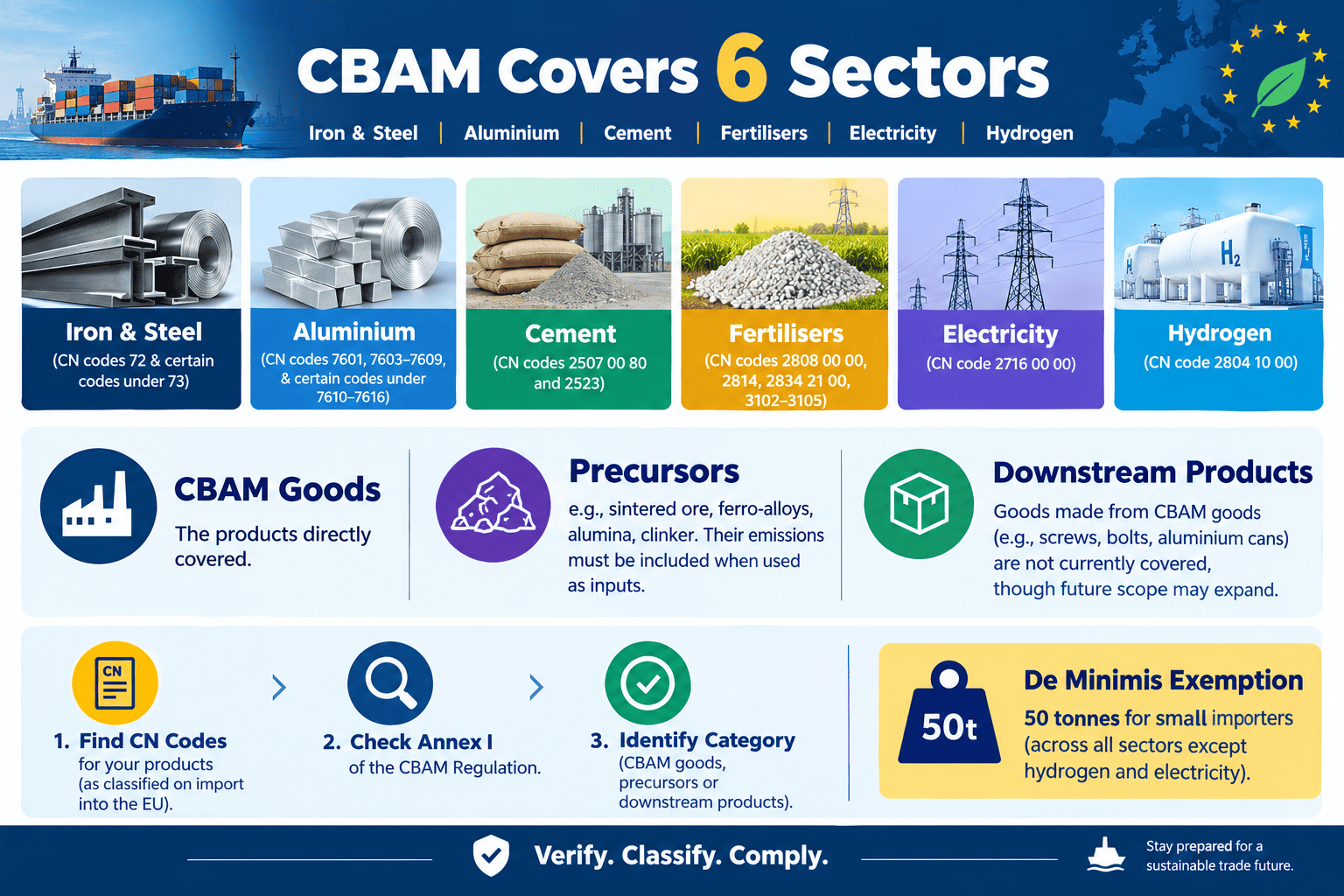
Direct Answer: CBAM currently covers six sectors: iron and steel (CN codes 72 and certain codes under 73), aluminium (CN codes 7601, 7603–7609, and certain codes under 7610–7616), cement (CN codes 2507 00 80 and 2523), fertilisers (CN codes 2808 00 00, 2814, 2834 21 00, 3102–3105), electricity (CN code 2716 00 00), and hydrogen (CN code 2804 10 00) . The critical distinction for manufacturers is between CBAM goods, the products directly covered, and their precursors (e.g., sintered ore, ferro-alloys, alumina, clinker), whose emissions must be included in embedded emissions calculations when they are used as inputs . Downstream products, goods manufactured from CBAM goods but not themselves listed in Annex I, such as screws, bolts, and aluminium cans, are not currently covered, though the European Commission has signalled future scope expansion may include them . Indian exporters must identify their products’ CN codes as classified on import into the EU, check them against Annex I of the CBAM Regulation, and determine whether they are CBAM goods, precursors, or downstream products. A 50-tonne de minimis exemption exists for small importers across all sectors except hydrogen and electricity . For the supply chain verification infrastructure that supports CBAM data exchange, see GTsetu’s supply chain partner guidance and why trust breaks in global deals.
The Carbon Border Adjustment Mechanism does not cover “manufactured goods” or “carbon-intensive industries” in general terms. It covers a specific, defined list of products identified by their Combined Nomenclature (CN) codes, set out in Annex I of the CBAM Regulation. Whether your product is in scope is not a matter of interpretation, it is a matter of customs classification.
For Indian manufacturers and exporters, this creates a practical first question before any CBAM compliance activity: is my product actually a CBAM good? If it is, the entire compliance apparatus, emissions monitoring, verification, embedded emissions reporting, and CBAM certificates, applies. If it is not, the obligations fall elsewhere in the supply chain. And if your product is a precursor, an input material to a CBAM good rather than a CBAM good itself, your emissions data may still be required, even though you are not directly regulated.
This guide explains the CBAM product scope in full: the six covered sectors, the specific CN codes within each, the critical distinction between CBAM goods and precursors, the downstream products that remain outside scope, the de minimis threshold, and the future expansion signals from the European Commission. For the broader regulatory context, see our guide on CBAM 2026 and what changes for Indian exporters.
Indian manufacturers and exporters of steel, aluminium, cement, fertilisers, and hydrogen; procurement and compliance teams at EU importers; customs brokers and trade consultants advising on CBAM classification; and business development professionals building India-EU trade partnerships under the carbon regime.
This guide provides commercial and regulatory context on the CBAM product scope. It is not legal, customs, or compliance advice. CBAM scope, CN code definitions, and implementing regulations continue to evolve. Always verify product classification with a qualified customs broker and consult official EU sources, including Annex I of the CBAM Regulation and the EU TARIC database, before making compliance decisions.
1 CBAM Product Scope at a Glance
CBAM currently covers six sectors. Each sector covers specific product categories defined by Combined Nomenclature (CN) codes. Here is a visual orientation across the covered sectors:
Whether a product is a CBAM good depends on its classification under the Combined Nomenclature, the EU’s customs classification system. Two products that appear similar in commercial terms may fall on different sides of the CBAM line if their CN codes differ. This is why accurate customs classification is the essential first step in any CBAM scope determination. See Section 2 for how CN codes and Annex I interact.
2 How CBAM Scope Is Defined (CN Codes & Annex I)
CBAM scope is defined in Annex I of the CBAM Regulation, which lists the specific goods covered by the mechanism, organised by sector and identified by their Combined Nomenclature (CN) codes. The CN is the EU’s eight-digit customs classification system, derived from the World Customs Organization’s Harmonized System (HS). Any product classified under a CN code listed in Annex I is a CBAM good, and imports of that product into the EU trigger CBAM obligations.
Understanding the Three Layers of CBAM Product Scope
CBAM Goods (Directly Covered)
Products whose CN codes are listed in Annex I. These are the goods for which embedded emissions must be reported and CBAM certificates surrendered. Examples: unwrought aluminium (CN 7601), Portland cement (CN 2523), nitric acid (CN 2808 00 00).
Precursors (Indirectly Relevant)
Input materials used in the production of CBAM goods, whose emissions must be included in the embedded emissions calculation. Some precursors are themselves CBAM goods (e.g., sintered ore for steel, alumina for aluminium); others are not. If your product is a precursor, you may need to provide emissions data to your downstream customer even though you are not directly regulated.
Downstream Products (Not Covered)
Goods manufactured from CBAM goods but not themselves listed in Annex I. Examples: screws, bolts, and similar articles made from steel (CN 7318); aluminium cans; automotive components; machinery. These are outside CBAM scope, though the Commission has signalled future expansion may include them.
For Indian manufacturers, the scope question is not simply “is my product steel or aluminium?” but “what is the CN code of my product as it would be classified on import into the EU, and is that code in Annex I?” A manufacturer of steel fasteners (CN 7318) is not producing a CBAM good, even though the input material, steel, is covered. A manufacturer of unwrought aluminium (CN 7601) is producing a CBAM good. The distinction determines the entire compliance pathway.
3 Iron & Steel: Covered Products
The iron and steel sector is the largest CBAM category by trade value. It covers products classified under CN Chapter 72 (with certain specific exclusions) and certain codes under CN Chapter 73. The covered products include raw and semi-finished steel, flat-rolled products, bars and rods, and certain tubes and pipes, but exclude certain downstream articles.
| Product Category | CN Codes (Indicative) | Covered? | Notes |
|---|---|---|---|
| Pig iron and spiegeleisen | 7201 | ✅ Covered | Raw iron product, foundational input to steelmaking |
| Ferro-alloys | 7202 | ✅ Partially Covered | Certain ferro-alloys are excluded (e.g., 7202 2, 7202 30, 7202 50-7202 99); others are covered as precursors |
| Ferrous products from direct reduction | 7203 | ✅ Covered | Direct reduced iron (DRI) and sponge iron |
| Ferrous waste and scrap | 7204 | ❌ Excluded | Scrap is excluded from CBAM scope |
| Iron and non-alloy steel ingots | 7206 | ✅ Covered | Semi-finished steel products |
| Flat-rolled products | 7208–7212 | ✅ Covered | Hot-rolled, cold-rolled, and coated steel sheet and plate |
| Bars and rods | 7213–7215 | ✅ Covered | Hot-rolled and cold-finished bars and rods |
| Angles, shapes, and sections | 7216 | ✅ Covered | Structural steel sections |
| Wire | 7217 | ✅ Covered | Steel wire products |
| Sheet piling and railway track construction material | 7301–7302 | ✅ Covered | Certain infrastructure steel products |
| Tubes, pipes, and hollow profiles | 7303–7307 | ✅ Covered | Seamless and welded steel pipe products |
| Structures and parts of structures | 7308 | ✅ Covered | Steel structures for construction and infrastructure |
| Reservoirs, tanks, and containers | 7309–7311 | ✅ Covered | Certain steel containers and pressure vessels |
| Screws, bolts, nuts, and similar articles | 7318 | ❌ Excluded | Downstream products, not covered |
| Other articles of iron or steel | 7326 | ❌ Excluded | Downstream products, not covered |
Note the exclusions: ferrous waste and scrap (7204) is excluded, screws and bolts (7318) are excluded as downstream products, and certain ferro-alloys (7202) are excluded. These exclusions mean that many Indian exporters of steel-derived products are not directly in CBAM scope, but they may still be required to provide emissions data to downstream CBAM good producers if their products are precursors.
4 Aluminium: Covered Products
The aluminium sector covers products classified under CN Chapter 76, including unwrought aluminium, bars, rods, profiles, wire, plates, sheets, strip, and foil. Certain downstream aluminium articles are excluded from scope.
| Product Category | CN Codes (Indicative) | Covered? | Notes |
|---|---|---|---|
| Unwrought aluminium | 7601 | ✅ Covered | Primary aluminium ingots, billets, and similar unwrought forms |
| Aluminium waste and scrap | 7602 | ❌ Excluded | Scrap is excluded, similar to steel scrap |
| Aluminium powders and flakes | 7603 | ✅ Covered | Aluminium powders and flakes |
| Aluminium bars, rods, and profiles | 7604 | ✅ Covered | Extruded and drawn aluminium products |
| Aluminium wire | 7605 | ✅ Covered | Aluminium wire products |
| Aluminium plates, sheets, and strip | 7606 | ✅ Covered | Rolled aluminium products |
| Aluminium foil | 7607 | ✅ Covered | Thin rolled aluminium foil |
| Aluminium tubes and pipes | 7608 | ✅ Covered | Aluminium tube and pipe products |
| Aluminium tube and pipe fittings | 7609 | ✅ Covered | Fittings for aluminium tubes and pipes |
| Aluminium structures | 7610 | ✅ Covered | Aluminium structures and parts of structures |
| Aluminium containers | 7611–7613 | ✅ Covered | Certain aluminium containers and containers for compressed gas |
| Stranded wire, cables, and plaited products | 7614 | ✅ Covered | Aluminium cable and stranded wire products |
| Other articles of aluminium | 7616 | ✅ Covered | Certain other aluminium articles (specific sub-codes may vary) |
The aluminium sector scope is broader than steel in terms of finished product inclusion, it covers structures (7610), containers (7611–7613), and certain other articles (7616). Indian aluminium extruders, rollers, and fabricators should verify their specific CN codes against Annex I to confirm coverage. For supply chain partner verification in the aluminium sector, see supply chain partner guidance.
5 Cement: Covered Products
The cement sector covers a narrow but clearly defined scope: kaolin and other kaolinic clays (CN 2507 00 80) and cement in various forms (CN 2523), including Portland cement, aluminous cement, slag cement, and supersulphate cement. The clinker used in cement production is a critical precursor whose emissions must be included in the embedded emissions calculation.
CN 2507 00 80, Kaolin
Kaolin and other kaolinic clays, whether or not calcined. This is a raw material input to cement and other industries.
CN 2523, Cement
Portland cement, aluminous cement, slag cement, supersulphate cement, and similar hydraulic cements, whether or not coloured or in the form of clinkers.
Clinker as Precursor
Cement clinker is a precursor to cement. Its emissions, including process emissions from calcination, must be included in the embedded emissions of the final cement product.
Downstream Cement Products
Concrete, mortar, and other cement-derived products are downstream and not currently covered under CBAM.
6 Fertilisers: Covered Products
The fertiliser sector covers a range of products classified under CN Chapter 28 (inorganic chemicals) and CN Chapter 31 (fertilisers). The covered products include nitric acid, ammonia, potassium nitrates, and mineral or chemical fertilisers containing nitrogen, phosphorus, or potassium.
| Product Category | CN Codes | Covered? | Notes |
|---|---|---|---|
| Nitric acid; sulphonitric acids | 2808 00 00 | ✅ Covered | Key input to fertiliser production |
| Ammonia, anhydrous or in aqueous solution | 2814 | ✅ Covered | Core nitrogen fertiliser input |
| Nitrates of potassium | 2834 21 00 | ✅ Covered | Potassium nitrate fertiliser |
| Mineral or chemical fertilisers, nitrogenous | 3102 | ✅ Covered | Nitrogen-based fertilisers |
| Mineral or chemical fertilisers, phosphatic | 3103 | ✅ Covered | Phosphorus-based fertilisers |
| Mineral or chemical fertilisers, potassic | 3104 | ✅ Covered | Potassium-based fertilisers |
| Mineral or chemical fertilisers containing two or three of the fertilising elements | 3105 | ✅ Covered | Compound and complex fertilisers |
The fertiliser sector scope includes not just finished fertilisers (3102–3105) but also key chemical inputs: nitric acid (2808 00 00), ammonia (2814), and potassium nitrates (2834 21 00). Indian chemical manufacturers producing these inputs for the fertiliser industry are directly in CBAM scope. For technology partnerships in emissions reduction, see technology partnership guidance.
7 Electricity
Electricity is covered under CN code 2716 00 00. Unlike the other sectors, electricity is not subject to the 50-tonne de minimis exemption, CBAM obligations apply from the first import. The embedded emissions of imported electricity are calculated based on the CO₂ emissions per MWh of the electricity, with specific rules for determining the emissions intensity of the electricity source.
CN 2716 00 00
Electrical energy, the only CN code in the electricity sector. Covered from first import, with no de minimis exemption.
Embedded Emissions
Calculated per MWh of electricity, based on the CO₂ emissions intensity of the electricity source and the applicable default values or actual data.
Cross-Border Trade
Applies to electricity imported into the EU from third countries, including through interconnected grids.
No De Minimis
The 50-tonne threshold does not apply to electricity. CBAM obligations apply from the first import, regardless of volume.
8 Hydrogen
Hydrogen is covered under CN code 2804 10 00. Like electricity, hydrogen is not subject to the 50-tonne de minimis exemption, CBAM obligations apply from the first import. The embedded emissions of hydrogen are calculated based on the production pathway, whether it is produced from renewable electricity (green hydrogen), natural gas with carbon capture (blue hydrogen), or fossil fuels without capture (grey hydrogen).
CN 2804 10 00
Hydrogen, the only CN code in the hydrogen sector. Covered from first import, with no de minimis exemption.
Production Pathway Matters
Embedded emissions vary dramatically by production method. Green hydrogen (electrolysis with renewable electricity) has near-zero embedded emissions; grey hydrogen (steam methane reforming) has high embedded emissions.
No De Minimis
The 50-tonne threshold does not apply to hydrogen. CBAM obligations apply from the first import, regardless of volume.
Precursors
Inputs to hydrogen production, natural gas, electricity, may be precursors whose emissions must be included in the embedded emissions calculation.
9 Precursors: The Hidden Scope
Precursors are input materials used in the production of CBAM goods, whose emissions must be included in the embedded emissions calculation. This is the part of CBAM scope that most exporters miss. Even if your product is not directly listed in Annex I, if it is a precursor to a CBAM good, your emissions data may be required by your downstream customer, and, in some cases, by the EU importer of the final CBAM good.
Key Precursors by Sector
Steel Precursors
Sintered ore, pig iron, direct reduced iron (DRI), ferro-alloys, and scrap (where used) are among the precursors whose emissions must be included in the embedded emissions of steel products.
Aluminium Precursors
Aluminium oxide (alumina), aluminium hydroxide, and anodes (carbon anodes used in electrolysis) are key precursors for primary aluminium production.
Cement Precursors
Cement clinker is the primary precursor for cement. Its emissions, including process emissions from the calcination of limestone, must be included in the embedded emissions of cement.
Fertiliser Precursors
Ammonia, nitric acid, and other chemical inputs are precursors for finished fertilisers. Their emissions must be included in the embedded emissions of fertiliser products.
Hydrogen Precursors
Natural gas (for steam methane reforming) and electricity (for electrolysis) are precursors to hydrogen production, with emissions varying dramatically by production pathway.
Electricity Precursors
For electricity imports, the fuel mix and generation source determine the embedded emissions. The emissions intensity of the electricity is itself the basis of the CBAM obligation.
If you supply a precursor to a CBAM good producer, for example, if you supply alumina to an aluminium smelter, or sintered ore to a steel plant, your emissions data may be required for your customer’s CBAM compliance, even if your product is not itself a CBAM good. Building verified, traceable emissions data into your supply chain is therefore a commercial necessity, not just a compliance one. For supply chain partner verification, see supply chain partner guidance and how to source manufacturing materials internationally.
10 Downstream Products: What Is Excluded
Downstream products, goods manufactured from CBAM goods but not themselves listed in Annex I, are not currently covered by CBAM. This is a critical exclusion for Indian manufacturers of finished goods that incorporate steel, aluminium, or other CBAM materials but are classified under different CN codes.
| Downstream Product | Input Material | CBAM Status | Reason |
|---|---|---|---|
| Screws, bolts, nuts, and similar articles | Steel | ❌ Excluded | CN 7318, downstream product not listed in Annex I |
| Aluminium cans and containers | Aluminium | ❌ Excluded | Downstream product, not listed in Annex I |
| Automotive components | Steel, aluminium | ❌ Excluded | Downstream products, not listed in Annex I |
| Machinery and equipment | Steel, aluminium | ❌ Excluded | Downstream products, not listed in Annex I |
| Concrete and mortar | Cement | ❌ Excluded | Downstream products, not listed in Annex I |
| Finished fertiliser blends | Fertiliser inputs | ⚠️ Check classification | Some fertiliser blends are covered (CN 3105); others may not be |
The European Commission has signalled that it may extend CBAM to downstream products in future. Indian manufacturers of downstream products, even those not currently covered, should monitor these developments, as future scope expansion could bring their products into the regime. The direction of travel is toward broader coverage, not narrower.
11 The 50-Tonne De Minimis and Scope
CBAM includes a 50-tonne de minimis exemption, calculated cumulatively per importer across all CBAM goods (excluding hydrogen and electricity) in a calendar year. If an importer stays below this threshold, they are exempt from CBAM obligations, no authorisation, no declaration, no certificate surrender. The exemption does not apply to hydrogen or electricity, where CBAM obligations apply from the first import, nor to indirect customs representatives.
Cumulative Annual Mass
The threshold is calculated per importer, regardless of how many consignments or indirect customs representatives are involved. Exceedance is based on cumulative annual mass across all CBAM goods.
Not for Indirect Reps
The de minimis exemption does not apply to indirect customs representatives, who are not “importers” under the CBAM Regulation.
Hydrogen and Electricity Excluded
For hydrogen and electricity, CBAM obligations apply from the very first import, the 50-tonne threshold does not apply.
Customs Code Y137
Importers exempt under the threshold use TARIC document code Y137 in the customs declaration when importing CBAM goods without authorisation.
12 Future Scope Expansion
CBAM is a living regulation. The European Commission is required to review the scope periodically and report on whether to extend it to additional products and sectors. The Commission has already signalled that it may consider extending CBAM to downstream products and new sectors in the future.
Downstream Products
Products manufactured from CBAM goods, automotive components, machinery, fasteners, and similar, are candidates for future inclusion. This would expand the number of Indian manufacturers in scope.
Additional Sectors
Other carbon-intensive sectors, such as plastics, chemicals, and glass, have been discussed as potential future additions. Indian exporters in these sectors should monitor developments.
Review Timeline
The Commission is required to report on scope extension by specific deadlines. The direction of travel is toward broader coverage, with reports expected to inform future legislative proposals.
Global Harmonisation
Other jurisdictions, including the UK, Canada, and Australia, are considering similar carbon border mechanisms. Future scope changes may align across multiple markets.
13 Product Scope Determination Checklist
For Indian manufacturers and exporters, determining whether your product is in CBAM scope requires a structured process. This checklist summarises the key steps.
Identify Your Product’s CN Code
Determine the Combined Nomenclature (CN) code of your product as it would be classified on import into the EU. This may differ from your HS code in other markets. Consult a customs broker or use the EU TARIC database to confirm the correct classification.
Check Against Annex I of the CBAM Regulation
Compare your CN code against the list of covered goods in Annex I. If your CN code is listed, your product is a CBAM good. If not, proceed to step 3.
Assess Precursor Status
If your product is not a CBAM good, determine whether it is a precursor to a CBAM good, an input material used in the production of a CBAM good. If so, your emissions data may be required by your downstream customer, even though you are not directly regulated.
Assess Downstream Status
If your product is manufactured from a CBAM good but is not itself listed in Annex I, it is a downstream product and is currently outside scope. Monitor future scope expansion as this may change.
Engage with Your EU Buyer
If your product is a CBAM good or a precursor, engage with your EU importer to understand the embedded emissions data they will require for CBAM compliance. This data must be verified by an accredited verifier where actual values are used.
Monitor Future Scope Changes
CBAM scope is expected to expand. Even if your product is not currently covered, monitor European Commission announcements on future scope changes, particularly regarding downstream products and additional sectors.
Determining CBAM scope is the first step. The second is building the verified supply chain partnerships that make CBAM data exchange possible. GTsetu’s supply chain partner framework and trust infrastructure provide the foundation for traceable, auditable emissions data across the value chain. See also manufacturing certifications for international trade and cross-border manufacturing partnerships.
14 How GTsetu Supports CBAM-Ready Partnerships
Verified Supply Chain Infrastructure for Carbon-Compliant Trade
CBAM compliance depends on data that flows across the supply chain, emissions data, production process details, raw material sourcing information. That data can only be exchanged with confidence between verified partners, using secure channels, under confidentiality frameworks. GTsetu provides the infrastructure that makes this possible: a government-tie-up verified B2B discovery environment where manufacturers, distributors, and suppliers connect with verified counterparts across 100+ countries, with built-in NDA workflows, encrypted document exchange, and zero broker commission. For Indian exporters determining CBAM scope and building compliant supply chains, this is the foundational layer of trust that compliance requires. See our guides on supply chain partners and why trust breaks in global deals.
GTsetu for CBAM-Ready Supply Chains
? Frequently Asked Questions
Building CBAM-Ready Supply Chain Partnerships?
Join 500+ verified manufacturers, suppliers, and distributors already building cross-border supply chain partnerships on GTsetu, with government-tie-up verification of six core credentials, built-in NDA workflows, encrypted document exchange, and zero broker fees across 100+ countries.
Find Verified Partners → Explore the Platform
They represents the product, and research team behind GTsetu, a global B2B collaboration platform built to help companies explore cross-border partnerships with clarity and trust. The team focuses on simplifying early-stage international business discovery by combining structured company profiles, verification-led access, and controlled collaboration workflows.
With a strong emphasis on trust, and disciplined engagement, Team GTsetu shares insights on global trade, partnerships, and cross-border collaboration, helping businesses make informed decisions before entering deeper commercial discussions.