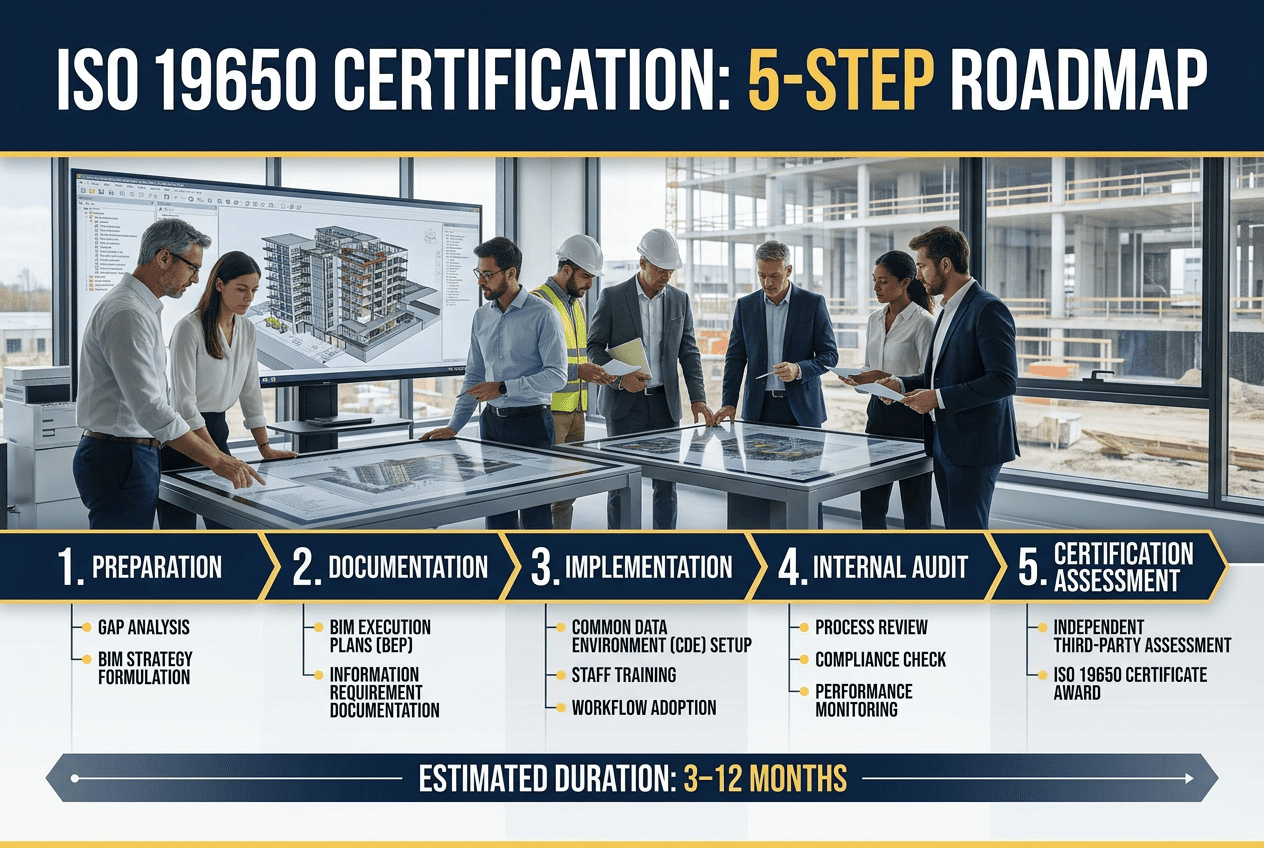
Direct Answer: ISO 19650 is the international standard for managing information over the whole life cycle of a built asset using building information modelling (BIM). Getting certified follows a 5-step process: Preparation (training, gap analysis, scope and roles), Documentation (information management procedures, BIM execution plan, information requirements, CDE workflow), Implementation (rolling out processes on live projects), Internal Audit (self-assessment against the standard) and Certification Assessment (independent assessment by an accredited body). Most organisations need roughly 3–12 months depending on size and BIM maturity. This guide explains every step, the parts of the standard, costs and common mistakes.
📅 November 2, 2026⏱ 15 min read✍️ GT Setu Editorial Team🔄 Updated regularly
6
Parts in the ISO 19650 Series
5
Key Steps to Certification
3–12
Months (Indicative Timeline)
0%
GTsetu Broker Commission
ISO 19650 is the international standard for organising and digitising information about buildings and civil engineering works, including infrastructure, using building information modelling (BIM). Developed from the British BIM standards, it gives clients, designers, contractors and asset operators a common framework for specifying, exchanging and managing information across the entire life of an asset.
For manufacturers, distributors and contractors in the built environment, ISO 19650 alignment is increasingly written into tenders and appointments. It signals that your organisation can deliver reliable, secure and well-structured information. This guide covers the full certification route and links to related standards such as ISO 9001 and ISO 27001. See also our guides on partnership evaluation criteria and business verification.
📋 Who Is This Guide For?
This guide is for BIM managers, information managers, project directors, quality managers and business owners in architecture, engineering, construction and asset management. It suits both the DIY route and the consultant-led route. If you already run a ISO 9001 quality system, you can reuse much of its document control and audit structure. See also supplier collaboration platforms and distributors and manufacturers.
SECTION 1
1 What Is ISO 19650 & Why Get Certified?
📋 The Standard Explained
ISO 19650 is a series of international standards for information management using BIM throughout the life cycle of a built asset. It defines concepts, principles and requirements for the delivery phase (design and construction), the operational phase, information exchange and security. Its core ideas include information requirements set by the appointing party, a common data environment (CDE), clear roles and responsibilities, and a level of information need that avoids producing more information than is useful. Certification demonstrates that your organisation applies these processes consistently, as assessed by an independent body.
🌐
Internationally Recognised Framework
ISO 19650 replaced a patchwork of national BIM approaches with one shared vocabulary, so teams in different countries can collaborate on the same asset.
🏛️
Client & Tender Requirements
Public and private clients increasingly ask for ISO 19650-aligned processes in tenders. Certification is credible proof of capability.
🔄
Life-Cycle Information Management
The standard connects project delivery to operations, so information created during design and construction remains useful for the asset owner.
🔐
Security-Minded Approach
Part 5 addresses the security of built-asset information, an area where ISO 27001 practices are a natural complement.
SECTION 2
2 Key Benefits of ISO 19650 Certification
Certification brings operational, commercial and strategic benefits. The exact gains depend on your starting point and the quality of implementation, so set measurable targets (for example fewer clashes, fewer information requests or faster handover) and track them.
🏷️
Enhanced Market Credibility
Independent assessment shows clients that your information management meets an international benchmark, opening doors to framework and public-sector work.
Commercial
💰
Reduced Rework & Waste
Clear information requirements and controlled exchanges reduce misunderstandings, duplicated effort and costly late changes.
Operational
🔗
Smoother Supply Chain Collaboration
A shared process and CDE let designers, contractors, manufacturers and suppliers exchange information predictably.
Partnership
📊
Better Handover Data
Structured, verified information at handover supports facility management and future refurbishment.
Analytical
👥
Role Clarity
Defined responsibilities for appointing party, lead appointed party and task teams reduce ambiguity.
People
📋
Risk & Compliance Support
Defined approval workflows and records help manage information, security and contractual risk. See our section on resilience and risk below.
Compliance
SECTION 3
3 The Parts of the ISO 19650 Series
ISO 19650 is a multi-part series. Organisations are normally assessed against the processes in Parts 1 to 3, with Parts 4 to 6 adding guidance on exchange, security and health and safety. Always confirm the current edition on the official ISO catalogue before scoping your assessment.
Part
Title / Focus
What It Means for You
ISO 19650-1
Concepts and principles
Defines terms, the information management framework, the CDE concept and the roles of appointing and appointed parties.
ISO 19650-2
Delivery phase of assets
Process requirements for the design and construction phase: assessment and need, invitation to tender, appointment, mobilisation, production and delivery.
ISO 19650-3
Operational phase of assets
Requirements for managing information while the asset is in use, including trigger events and updating the asset information model.
ISO 19650-4
Information exchange
Requirements for exchanging information and checking it against the requirements.
ISO 19650-5
Security-minded approach
Requirements for managing the security of information in built-asset projects and operations.
ISO 19650-6
Health and safety
Guidance on managing health and safety information across the asset life cycle; relevant alongside ISO 45001.
SECTION 4
4 Step 1: Preparation, Foundation & Planning
🏗️ Building the Foundation
Preparation ensures you have the knowledge, resources and support before documenting anything. For most organisations this phase takes 2–6 weeks and results in a clear scope, a gap analysis and named responsibilities.
1.1
Get Trained on ISO 19650
Train your BIM and information managers on Parts 1 and 2 (and Part 3 if you work in operations). Training from recognised providers builds shared language and confidence.
1.2
Secure Executive Support
Leadership must provide resources and endorse the information management policy. Present the business case: tender eligibility, reduced rework and client confidence.
1.3
Define Scope & Goals
Decide which offices, disciplines, project types and asset phases are in scope, and what outcomes you want. Use a structured approach similar to partnership evaluation criteria.
1.4
Conduct a Gap Analysis
Compare current BIM practice with the standard: roles, information requirements, CDE use, naming, review and approval, and security. Prioritise the gaps.
1.5
Plan the Project
Create a simple plan with milestones, owners and a pilot project. Appoint an information management lead.
1.6
Build Awareness
Brief project teams and key suppliers early so processes and tools change with their buy-in.
💡 Pro Tip: Pilot on a Live Project
Certification is easiest when you can show the processes working on a real appointment. Pick a suitable live project as a pilot, learn from it and then scale. Existing ISO 9001 document control makes this faster.
SECTION 5
5 Step 2: Documentation, Building Your Information Management System
Documentation should describe how your organisation actually works. Keep it practical, reuse existing quality-system templates where possible, and avoid copying the standard word for word.
Document
Description
Key Consideration
Information Management Policy & Procedures
Defines how information is requested, produced, checked, approved and exchanged.
Align with existing management-system procedures to avoid duplication.
Information Requirements (OIR, AIR, PIR, EIR)
Organisational, asset, project and exchange information requirements set by the appointing party.
Be specific about purpose, format, level of information need and delivery dates.
BIM Execution Plan (BEP)
Pre-appointment and post-appointment plans showing how the delivery team will meet the requirements.
Keep it updated as the team and project change.
TIDP / MIDP
Task and master information delivery plans showing what is delivered, by whom and when.
Link each deliverable to a milestone and responsible party.
CDE Workflow Definition
Describes states (work in progress, shared, published, archive), permissions and approval gates.
Define who can move information between states and how this is recorded.
Naming & Metadata Conventions
Rules for file naming, classification and metadata.
Apply consistently so information can be found and audited.
Information Protocol & Security Procedures
Contractual and security arrangements for information use and protection.
Coordinate with ISO 27001 controls where you hold certification.
Records
Evidence of reviews, approvals, audits, training and corrective actions.
Must be retrievable during assessment.
💡 Documentation Best Practices
DO: use plain language, diagrams and workflow charts; write procedures with the people who do the work.
DON’T: create documents nobody will use, or define workflows your CDE cannot actually enforce.
Implementation turns documents into daily practice. The goal is for project teams to follow the same information management workflow without constant supervision.
📢
Communicate the Policy
Leadership explains the information management policy and why it matters to bids, clients and project quality.
Leadership
🎓
Train Teams and Managers
Provide role-based training for information managers, task team leaders and model authors on naming, status codes and review.
Training
🗂️
Set Up the CDE
Configure the common data environment with agreed states, permissions, naming rules and approval workflows. Platforms such as Autodesk Construction Cloud are commonly used.
Tools
🔄
Run Live Projects
Apply the process from appointment to delivery: set requirements, plan delivery, exchange information and check it before sharing.
Delivery
✍️
Define Level of Information Need
Specify the geometrical, alphanumeric and documentation detail needed at each milestone, and avoid over-modelling.
Quality
📁
Keep Records
Retain evidence such as review logs, approval records and transmittals. Assessors will sample them.
Compliance
📣
Communicate Your Progress
Tell clients and partners about your ISO 19650 programme and target assessment date to support bids.
Commercial
SECTION 7
7 Step 4: Internal Audit, Self-Assessment
🔍 Verifying Your System
An internal audit checks whether your information management processes meet the standard and your own procedures. Audit real projects: check requirements, appointments, BEPs, CDE states, review records and security practice. Auditors must be impartial and should not audit their own work.
📋
Plan the Audit Programme
Schedule audits across offices and project types, with checklists mapped to the clauses you are assessed against.
👤
Appoint Competent Auditors
Use trained internal auditors or an external specialist who understand both BIM and audit practice.
🔎
Sample Live Projects
Trace information from requirement to delivery and confirm the CDE evidence matches the procedure.
✅
Close Nonconformities
Perform root-cause analysis, implement corrective actions and verify effectiveness before assessment.
📈
Hold a Management Review
Review audit results, client feedback and objectives with leadership and record decisions.
📄
Outsource If Needed
A pre-assessment by an experienced external auditor gives confidence before the formal visit.
The assessment is carried out by an independent certification body. Scheme details differ between bodies, so confirm requirements early. Typical stages are shown below.
Stage
What Happens
Key Focus
Application & Scoping
You submit scope, sites, headcount and project information; the body provides a quote and audit plan.
Accurate scope and sector competence.
Documentation Review
The assessor reviews procedures, templates and plans.
Completeness against the standard.
On-Site / Remote Assessment
Assessors interview staff and sample live projects, CDE records and exchanged information.
Effective implementation and evidence.
Reporting & Decision
Findings are reported; nonconformities are corrected and the body decides on certification.
Closing major findings.
Surveillance & Reassessment
Periodic surveillance visits and a full reassessment at the end of the certificate cycle.
Continual improvement and evidence of ongoing use.
💡 Preparing for Assessment
Brief staff, collate project evidence in advance and confirm CDE access for the assessor. Be honest and show how the process works in practice. For wider context on certification pathways see ISO 14001 and ISO 45001, which follow a similar assessment pattern.
SECTION 9
9 Costs & Timeline: What to Expect
The figures below are indicative only. Obtain written quotes from certification bodies and consultants before budgeting.
Factor
Impact on Cost
Impact on Timeline
Organisation Size
Cost rises with headcount, sites and disciplines.
Small: about 3–6 months; mid-sized: 6–9; large: 9–12+.
BIM Maturity
Mature teams spend less on training and rework.
Mature teams can move faster to assessment.
Number of Live Projects
More sampled projects mean more audit time.
You need evidence from at least one live appointment.
CDE & Tooling
Licences and configuration add cost.
Configuration can be quick if the platform is already in use.
Consultant Involvement
Adds consultancy fees; DIY lowers cost.
Experienced consultants shorten the documentation phase.
ISO 31000 is the international guideline on risk management. It is not certifiable, but it provides principles, a framework and a process (scope, context and criteria; risk assessment, covering identification, analysis and evaluation; risk treatment; monitoring and review; and communication). Applying it to built-asset information helps you identify and treat risks such as incomplete information, security breaches, late approvals and supplier failures before they affect delivery.
🔍
Identify Information Risks
List risks to information quality, availability, security and timing at each project stage.
📊
Analyse & Evaluate
Rate likelihood and impact and decide which risks need treatment, using consistent criteria.
🛡️
Treat & Control
Embed controls into the CDE workflow, the information protocol and supplier appointments.
🔄
Monitor & Review
Review risks at milestones and after trigger events. Link to ISO 22301 continuity planning and ISO 14971 if you supply medical-facility products.
SECTION 12
12 Common Mistakes & How to Avoid Them
📋
Treating It as Software Only
A CDE tool alone does not meet the standard. Avoid: define roles, requirements and approval workflows first.
🏛️
Weak Leadership Commitment
Without sponsorship, teams skip the process. Avoid: secure visible leadership support.
📖
Generic Plans Copied from Templates
Unadapted BEPs fail in practice. Avoid: tailor each plan to the appointment.
🔄
No Live Project Evidence
Assessors want proof of use. Avoid: start a pilot early and keep records.
🎓
Under-Training Suppliers
Supply-chain teams may not follow the process. Avoid: brief and onboard suppliers; see global partner service.
📊
Ignoring Audit Findings
Unresolved findings carry into assessment. Avoid: close actions with root-cause analysis. See risk allocation.
SECTION 13
13 How GTsetu Supports Your ISO 19650 Certification Journey
🔗 GTsetu, Verified B2B Platform
Connect with Verified Partners & Build Quality Supply Chains
ISO 19650 certification shows clients that your information is well managed. GTsetu complements it by connecting you with verified manufacturers, distributors and suppliers for built-environment projects.
✅
Verified Company ProfilesEvery company is verified on 6 key data points (Name, Address, Registration Number, Company Status, Company Type, Date of Incorporation) using government tie-ups.
🕵️
Anonymous DiscoveryBrowse verified partner profiles without revealing your identity until you are ready to engage.
📄
Built-In NDA WorkflowDigital mutual NDA with timestamped signatures before sensitive design or commercial data is shared.
🔐
Encrypted Document WorkspaceAES-256 encryption at rest, TLS in transit, role-based access and a full audit trail for secure exchange of specifications and contracts.
🚫
Zero Broker CommissionGTsetu charges zero commission on any partnership formed.
🌏
Global Network of Verified PartnersAccess verified manufacturers, distributors and suppliers across 100+ countries.
ISO 19650 is the international standard for organizing and digitizing information about buildings and civil engineering works using building information modelling (BIM). It sets out how information is specified, exchanged and managed across the whole life cycle of an asset, from design and construction through to operation. It matters because clear, consistent information management reduces rework, misunderstanding and risk, and many public clients now require it. Its security-minded approach also aligns with ISO 27001.
QWhat are the 5 main steps to get ISO 19650 certified?
The five steps are: (1) Preparation (understand the standard, run a gap analysis, define scope and appoint roles); (2) Documentation (information management procedures, BIM execution plan, information requirements and the CDE workflow); (3) Implementation (roll out the processes, train teams and run live projects); (4) Internal Audit (verify the system against the standard); and (5) Certification Assessment (independent assessment by an accredited body and issue of the certificate).
QIs ISO 19650 certification mandatory?
No. ISO 19650 is a voluntary standard, but public and private clients in many markets request or require ISO 19650-aligned information management in tenders and contracts. Organisations typically seek an independent assessment to prove their capability to clients.
QHow long does it take to get ISO 19650 certification?
It depends on organisation size, current BIM maturity and project load. As an indicative guide, a small practice with a mature BIM workflow may take 3-6 months, a mid-sized firm 6-9 months, and a large multi-office organisation 9-12 months or more. Because the standard is applied through real projects, evidence of live use is often the critical path.
QHow much does ISO 19650 certification cost?
Costs vary with organisation size, number of sites and projects, consultant involvement and the assessment body’s fees. As a rough indicator, small organisations often budget a few thousand US dollars for assessment and more for consultancy, tools and training, while larger organisations spend considerably more. Always obtain written quotes that include annual surveillance visits.
QWhat documents are needed for ISO 19650?
Typical documentation includes an information management policy and procedures, role responsibilities, a BIM execution plan (pre- and post-appointment), information requirements (OIR, AIR, PIR, EIR), task and master information delivery plans (TIDP/MIDP), an information protocol, naming and metadata conventions, and records of CDE workflows, reviews and approvals.
QHow do I choose an ISO 19650 certification body?
Choose an assessment body accredited by a national accreditation body (such as UKAS), with proven experience in the built environment and a recognised ISO 19650 certification scheme. Compare quotes, scope and surveillance arrangements, and check that your clients recognise the certificate. Apply the same rigour as in your partnership evaluation criteria.
Connect with verified manufacturers, distributors and suppliers on GTsetu: compliance-backed verification, anonymous discovery, built-in NDA workflows and zero broker commissions.
They represents the product, and research team behind GTsetu, a global B2B collaboration platform built to help companies explore cross-border partnerships with clarity and trust. The team focuses on simplifying early-stage international business discovery by combining structured company profiles, verification-led access, and controlled collaboration workflows.
With a strong emphasis on trust, and disciplined engagement, Team GTsetu shares insights on global trade, partnerships, and cross-border collaboration, helping businesses make informed decisions before entering deeper commercial discussions.