EN ISO 10993: Biological Evaluation of Medical Devices
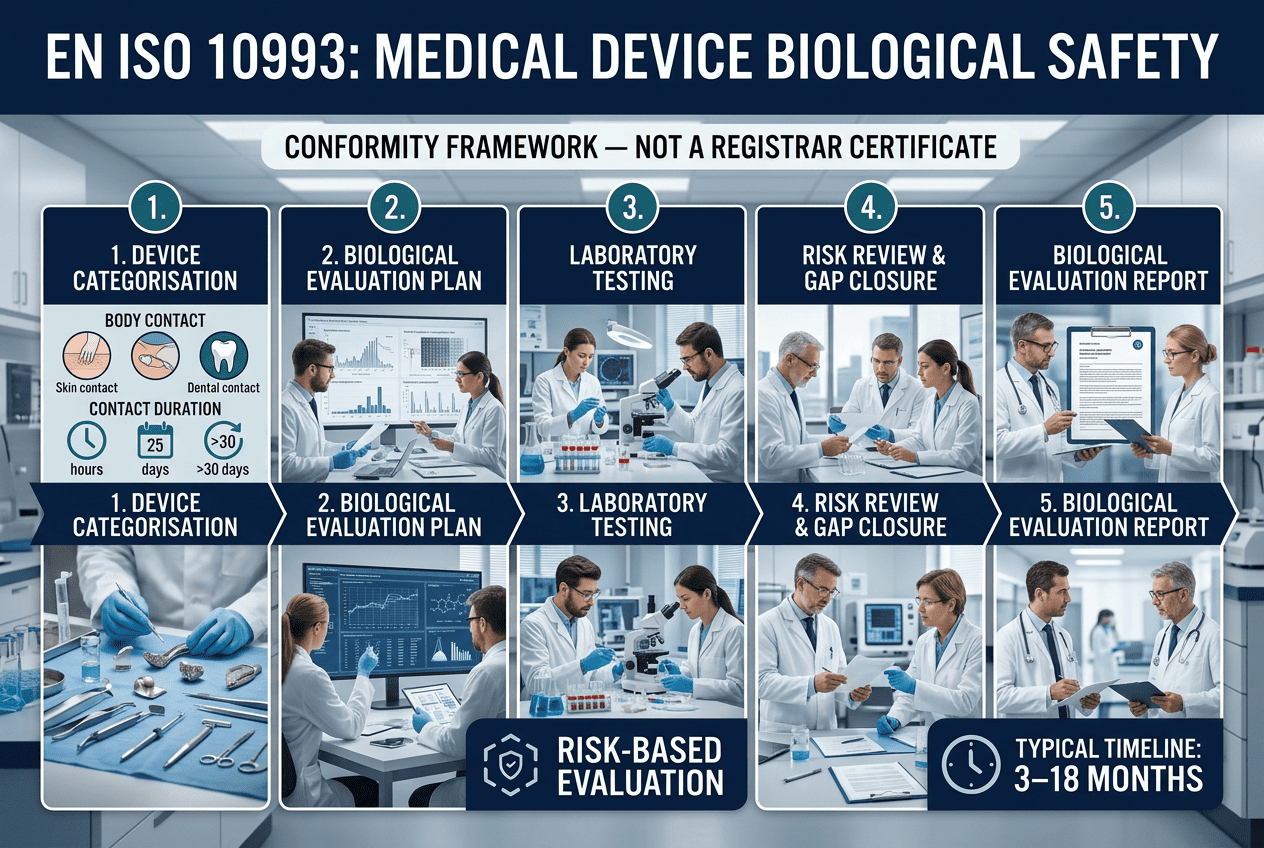
Direct Answer: EN ISO 10993 is the series of standards for evaluating the biological safety of medical devices. ISO 10993-1 sets the framework, within a risk management process, and later parts cover specific tests and assessments. It is a conformity framework, not a registrar certificate. Demonstrating compliance follows 5 steps: Preparation (device categorisation by body contact and duration), Documentation (biological evaluation plan and characterisation), Testing (only the endpoints needed, at competent laboratories), Internal Review (gap closure and risk file update) and Reporting & Submission (biological evaluation report in your regulatory file). Typical programmes take 3–18 months depending on device risk.
📅 November 3, 2026⏱ 15 min read✍️ GT Setu Editorial Team🔄 Updated regularly
20+
Parts in the ISO 10993 Series
5
Key Steps to Conformity
3–18
Months (Indicative Timeline)
0%
GTsetu Broker Commission
EN ISO 10993 is the family of standards for the biological evaluation of medical devices. It helps manufacturers show that device materials and finished products do not cause unacceptable biological harm, such as toxicity, irritation, sensitisation or blood-related reactions. The European EN ISO adoption is what notified bodies reference under EU rules, while the international ISO version is widely used elsewhere.
Biological evaluation sits inside your wider compliance system: a ISO 13485 quality management system, ISO 14971 risk management and, for many manufacturers, ISO 9001 processes. This guide explains the full route from device categorisation to the biological evaluation report. See also partnership evaluation criteria and business verification for supplier due diligence.
📋 Who Is This Guide For?
This guide is for regulatory affairs managers, quality and R&D leads, and device manufacturers, as well as component and material suppliers who are asked for biocompatibility data. It covers the evidence-based route and the consultant-led route. Related reading: supplier collaboration platforms and distributors and manufacturers.
SECTION 1
1 What Is EN ISO 10993 & Why It Matters
🧬 The Standard Explained
EN ISO 10993 is a series titled Biological evaluation of medical devices. ISO 10993-1 describes the evaluation and testing within a risk management process, covering device categorisation, relevant biological endpoints and the need for a structured evaluation. Other parts cover specific tests (such as cytotoxicity and sensitisation), chemical characterisation, toxicological risk assessment and sample preparation. The current edition of Part 1 is recent, so check the latest status on the ISO and CEN catalogues before planning. The approach is risk-based: you use existing data first and test only where gaps remain.
🌐
Global Regulatory Acceptance
Regulators in many regions, including those applying EU and US requirements, expect a biological evaluation aligned with ISO 10993.
🛡️
Patient Safety
The series is designed to identify biological hazards early, before devices reach patients.
🧪
Risk-Based, Not Test-Everything
Material data, chemical characterisation and toxicological assessment can reduce unnecessary testing and animal use.
🔗
Part of the Compliance Chain
Evidence feeds your risk file (ISO 14971) and technical documentation under your ISO 13485 system.
SECTION 2
2 Key Benefits of ISO 10993 Conformity
A well-run biological evaluation protects patients and speeds regulatory review. Gains depend on device type and how early you start, so plan evaluation during design, not at the end.
🏷️
Faster Market Access
A complete evaluation reduces regulator and notified body questions and avoids late-stage retesting.
Commercial
💰
Avoided Rework
Early material and chemistry choices prevent costly redesigns after a failed test.
Operational
🔗
Supplier Confidence
Biocompatibility data from material suppliers makes qualification of components easier.
Partnership
📊
Evidence-Based Decisions
Chemical characterisation and toxicological assessment support defensible, data-driven conclusions.
Analytical
👥
Clear Responsibilities
The plan defines who owns materials, testing, assessment and sign-off.
People
📋
Regulatory & Risk Alignment
Links biological hazards to your risk management and post-market activities.
Compliance
SECTION 3
3 The Parts of the ISO 10993 Series
The series is large and parts are updated at different times. The table lists the main parts used in most programmes. Always confirm current editions and any European (EN) adoptions on the official catalogues.
Part
Title / Focus
What It Means for You
ISO 10993-1
Evaluation and testing within a risk management process
Framework: categorise the device, identify endpoints, plan the evaluation.
ISO 10993-3
Genotoxicity, carcinogenicity and reproductive toxicity
Tests for genetic and long-term effects where required.
ISO 10993-4
Interactions with blood
Haemocompatibility testing for blood-contacting devices.
ISO 10993-5
In vitro cytotoxicity
A common first screening test of cell toxicity.
ISO 10993-6
Local effects after implantation
Evaluation of tissue response to implanted materials.
ISO 10993-10
Skin sensitisation
Assesses allergic response potential.
ISO 10993-11
Systemic toxicity
Assesses effects beyond the contact site.
ISO 10993-12
Sample preparation and reference materials
How to prepare device samples and extracts for testing.
ISO 10993-17
Toxicological risk assessment of constituents
Establishes allowable limits for leachable substances.
ISO 10993-18
Chemical characterisation of materials
Identifies and quantifies chemical constituents; may replace some biological tests.
ISO 10993-23
Tests for irritation
Covers irritation testing, including in vitro approaches.
Preparation defines what you are evaluating. Categorise the device by nature of body contact (surface, external communicating or implant) and contact duration (limited, prolonged or long-term), because these determine the biological endpoints to address. Allow 2–6 weeks.
1.1
Get Trained on ISO 10993
Make sure regulatory, quality and R&D staff understand Part 1 and the risk-based approach.
1.2
Secure Management Support
Biological evaluation needs budget, lab capacity and design-change authority. Align with your ISO 13485 management review.
1.3
Describe the Device & Materials
List all materials, additives, coatings, processing aids, sterilisation methods and manufacturing residues.
1.4
Categorise Body Contact & Duration
Determine contact type and cumulative duration, including multiple uses.
1.5
Gap Analysis
Compare existing data (supplier certificates, literature, prior tests) with required endpoints.
1.6
Plan the Project
Assign owners, laboratories and timelines, and set up links to the risk file.
💡 Pro Tip: Start in Design
Choosing materials with known biocompatibility history can remove entire test categories. If a change in material or process occurs later, reassess the evaluation. See also ISO 14971 for managing design changes through risk.
SECTION 5
5 Step 2: Documentation, Biological Evaluation Plan
Documentation shows an evaluator how you reached your conclusions. Keep it traceable: each endpoint should link to evidence or a justification.
Document
Description
Key Consideration
Biological Evaluation Plan (BEP)
Defines device, categorisation, endpoints, existing data and planned testing.
Approve before testing starts and update when the design changes.
Material & Process Description
Full list of materials, suppliers and manufacturing and sterilisation steps.
Include residues such as cleaning agents and EO.
Chemical Characterisation Report
Identifies extractables and leachables, often per Part 18.
Can reduce or replace some biological tests.
Toxicological Risk Assessment
Assesses chemical constituents against allowable limits, often per Part 17.
Performed by a qualified toxicologist.
Test Reports
Laboratory results for selected endpoints.
Check laboratory accreditation and test method versions.
Biological Evaluation Report (BER)
Summarises data, justifies conclusions and states residual risk.
Must be linked to the risk management file.
Supplier Documentation
Material declarations and change-notification agreements.
Change history, reviews, approvals and re-evaluation triggers.
Keep retrievable under document control.
💡 Documentation Best Practices
DO: justify every endpoint, whether tested or not.
DON’T: copy supplier certificates without checking that they match your final, sterilised device.
Use templates for the BEP and BER and keep them consistent with your technical file. Contract clarity matters too; see manufacturer-distributor contracts.
SECTION 6
6 Step 3: Testing, Generating the Evidence
Testing should be targeted. Start from the plan, use chemical characterisation to reduce the number of tests where acceptable, and use competent laboratories.
🧪
Confirm the Endpoints
Typical endpoints include cytotoxicity, sensitisation, irritation, systemic toxicity, genotoxicity, haemocompatibility and implantation, depending on category.
Planning
🧫
Prepare Representative Samples
Test final, finished, sterilised devices or justified representative samples, following Part 12.
Samples
🔬
Chemical Characterisation First
Run extractables studies to identify risks early and potentially avoid animal tests.
Chemistry
🏢
Select Accredited Laboratories
Use ISO/IEC 17025-accredited, GLP-compliant laboratories where required.
Laboratories
🐁
Minimise Animal Testing
Follow the principle of replacement, reduction and refinement and consider validated in vitro methods.
Ethics
📁
Control the Data
Keep raw data, protocols, deviations and final reports under document control.
Compliance
⚠️
Act on Failures
Investigate root cause, assess material or process changes, and retest as needed.
Corrective Action
SECTION 7
7 Step 4: Internal Review, Gap Closure
🔍 Verifying Your Evidence
Before reporting, review the complete evidence set against the plan. Check that every endpoint is addressed, that tested samples represent the final device, that toxicological conclusions are supported, and that residual risks are fed into your risk management file. Reviewers should be independent of the people who generated the data.
📋
Plan vs Evidence
Confirm each planned endpoint has data or a documented justification.
👤
Qualified Reviewers
Involve toxicologists, regulatory and quality staff with relevant competence.
🔎
Check Representativeness
Verify that samples reflect final materials, processing and sterilisation.
✅
Close Gaps
Resolve open findings and repeat tests where needed before reporting.
📈
Update the Risk File
Transfer conclusions and residual risks to your ISO 14971 file.
📄
Independent Check
An external regulatory consultant can pre-review the report before submission.
SECTION 8
8 Step 5: Reporting & Regulatory Submission
The biological evaluation report (BER) is the final record. It is normally reviewed by a notified body or regulator as part of your technical documentation. There is no separate ISO 10993 certificate; acceptance is through regulatory review.
Stage
What Happens
Key Focus
Finalise the BER
Summarise data, justify conclusions and state residual risk.
Confirm procedures and records meet ISO 13485 requirements.
Document control and change management.
Regulatory Review
Technical documentation reviewed by a notified body or regulator.
Responding to questions with evidence.
Maintenance
Re-evaluate on design, material, supplier or process changes and from post-market data.
Ongoing conformity.
💡 Preparing for Review
Keep a clear index of the evidence, make the toxicologist available for questions and prepare answers on material changes. Related standards you may be asked about include ISO 9001 and ISO 14001.
SECTION 9
9 Costs & Timeline: What to Expect
These ranges are indicative only. Get written quotes and a laboratory schedule before committing to a launch date.
Factor
Impact on Cost
Impact on Timeline
Contact Type & Duration
Implants and long-term devices need more endpoints.
Long-term devices may need 12–18 months or more.
Existing Data
Strong supplier and historical data reduces testing.
Can cut months from the plan.
Number of Materials
More materials increase characterisation effort.
Longer extraction and analysis schedules.
Chemical Characterisation
Adds upfront cost but may avoid biological tests.
Typically several weeks to months.
In Vivo Studies
Substantially higher cost.
Study length and lab availability drive timing.
Consultant Support
Adds fees; reduces rework.
Experienced toxicologists shorten review cycles.
📋 Reuse Your Management System
If you hold ISO 13485 or ISO 9001, reuse document control, supplier control and CAPA processes for the evaluation.
SECTION 10
10 How to Choose a Testing Laboratory
🏛️
Accreditation
Look for ISO/IEC 17025 accreditation covering the test methods you need, and GLP compliance where required.
🧪
Device Experience
Choose labs familiar with your device type and sterilisation method.
📋
Regulatory Acceptance
Confirm that your regulator or notified body accepts the laboratory’s reports.
💰
Cost & Value
Compare scope, turnaround, retest policy and report quality.
🌐
Global Capability
Multi-region submissions may benefit from labs with international recognition.
ISO 14971 is the risk management standard for medical devices, and ISO 10993-1 places biological evaluation inside that process. Biological hazards such as toxicity, sensitisation and degradation products are identified, evaluated and controlled, and residual risk is judged acceptable or not. Both rely on a quality system like ISO 13485, and information security of device and test data may fall under ISO 27001 and ISO 27701.
🔍
Identify Biological Hazards
Derive hazards from materials, additives, processing and use conditions.
📊
Estimate & Evaluate
Use test data and toxicological assessment to judge severity and acceptability.
🛡️
Control
Change materials, processes or labelling, or add controls where risk is not acceptable.
🔄
Monitor
Use post-market data and changes to trigger re-evaluation. Also see ISO 22301 for supply continuity and ISO 45001 for laboratory safety.
SECTION 12
12 Common Mistakes & How to Avoid Them
📋
Testing Without a Plan
Running a standard battery wastes money. Avoid: write the BEP first.
🏛️
Ignoring Material Changes
A supplier change can invalidate data. Avoid: require change notification and reassess.
📖
Testing Non-Representative Samples
Unsterilised or prototype samples may not reflect the final device. Avoid: justify representativeness.
🔄
Treating It as Test-Only
Reports without toxicological assessment can be rejected. Avoid: integrate chemistry and risk assessment.
🎓
Weak Supplier Control
Unverified suppliers undermine evidence; see global partner service. Avoid: qualify suppliers formally.
📊
Leaving the Risk File Unlinked
Conclusions must flow into the risk file. Avoid: cross-reference clearly. See risk allocation.
SECTION 13
13 How GTsetu Supports Your Compliance Journey
🔗 GTsetu, Verified B2B Platform
Connect with Verified Partners & Build Quality Supply Chains
A sound biological evaluation depends on reliable materials and suppliers. GTsetu complements your compliance work by connecting you with verified manufacturers, distributors and suppliers of medical device materials and components.
✅
Verified Company ProfilesEvery company is verified on 6 key data points (Name, Address, Registration Number, Company Status, Company Type, Date of Incorporation) using government tie-ups.
🕵️
Anonymous DiscoveryBrowse verified partner profiles without revealing your identity until you are ready to engage.
📄
Built-In NDA WorkflowDigital mutual NDA with timestamped signatures before sensitive material, formulation or commercial data is shared.
🔐
Encrypted Document WorkspaceAES-256 encryption at rest, TLS in transit, role-based access and a full audit trail for secure exchange of specifications and contracts.
🚫
Zero Broker CommissionGTsetu charges zero commission on any partnership formed.
🌏
Global Network of Verified PartnersAccess verified manufacturers, distributors and suppliers across 100+ countries.
EN ISO 10993 is the series of standards for the biological evaluation of medical devices. It describes how to assess whether materials and devices are safe for contact with the human body, as part of a risk management process. It is important because regulators and notified bodies expect a documented biological evaluation for devices that touch the body. It works alongside ISO 14971 risk management and a ISO 13485 quality system.
QIs there an ISO 10993 certificate?
Not in the way ISO 9001 has one. ISO 10993 is a series of evaluation and test standards, so you show conformity through a documented biological evaluation (plan, test data, toxicological assessment and report), usually reviewed during regulatory submissions or by a notified body. Always confirm requirements with your regulator or notified body.
QWhat are the 5 main steps to demonstrate ISO 10993 conformity?
(1) Preparation: define the device, materials, body contact and duration. (2) Documentation: write the biological evaluation plan and gather material and chemical characterisation. (3) Testing: run only the tests needed, at competent laboratories. (4) Internal Review: assess the data, close gaps and update the risk file. (5) Reporting and Submission: issue the biological evaluation report and include it in your regulatory file.
QHow long does biological evaluation take?
It depends on device type and contact duration. As an indicative guide, a low-risk surface-contact device with good material data may take 3-6 months, while implants or long-term devices with chemical characterisation and in vivo studies can take 12-18 months or more. Laboratory scheduling and test duration are usually the critical path.
QHow much does ISO 10993 testing cost?
Costs vary widely with device category, number of endpoints, sample preparation and laboratory. Simple in vitro tests can cost a few thousand US dollars, while a full programme for an implant can reach well into six figures. Always request written quotes and ask whether a toxicological risk assessment can reduce testing.
QWhich documents are required?
Typical documents include a biological evaluation plan (BEP), material and manufacturing process descriptions, chemical characterisation reports, toxicological risk assessment, test reports from accredited laboratories, and a biological evaluation report (BER) linked to your risk management file.
QHow do I choose a testing laboratory?
Select a laboratory with ISO/IEC 17025 accreditation for the relevant tests and good laboratory practice (GLP) compliance where required. Check experience with your device type, report quality and turnaround. Apply the same discipline as in your partnership evaluation criteria.
Connect with verified manufacturers, distributors and suppliers on GTsetu: compliance-backed verification, anonymous discovery, built-in NDA workflows and zero broker commissions.
They represents the product, and research team behind GTsetu, a global B2B collaboration platform built to help companies explore cross-border partnerships with clarity and trust. The team focuses on simplifying early-stage international business discovery by combining structured company profiles, verification-led access, and controlled collaboration workflows.
With a strong emphasis on trust, and disciplined engagement, Team GTsetu shares insights on global trade, partnerships, and cross-border collaboration, helping businesses make informed decisions before entering deeper commercial discussions.