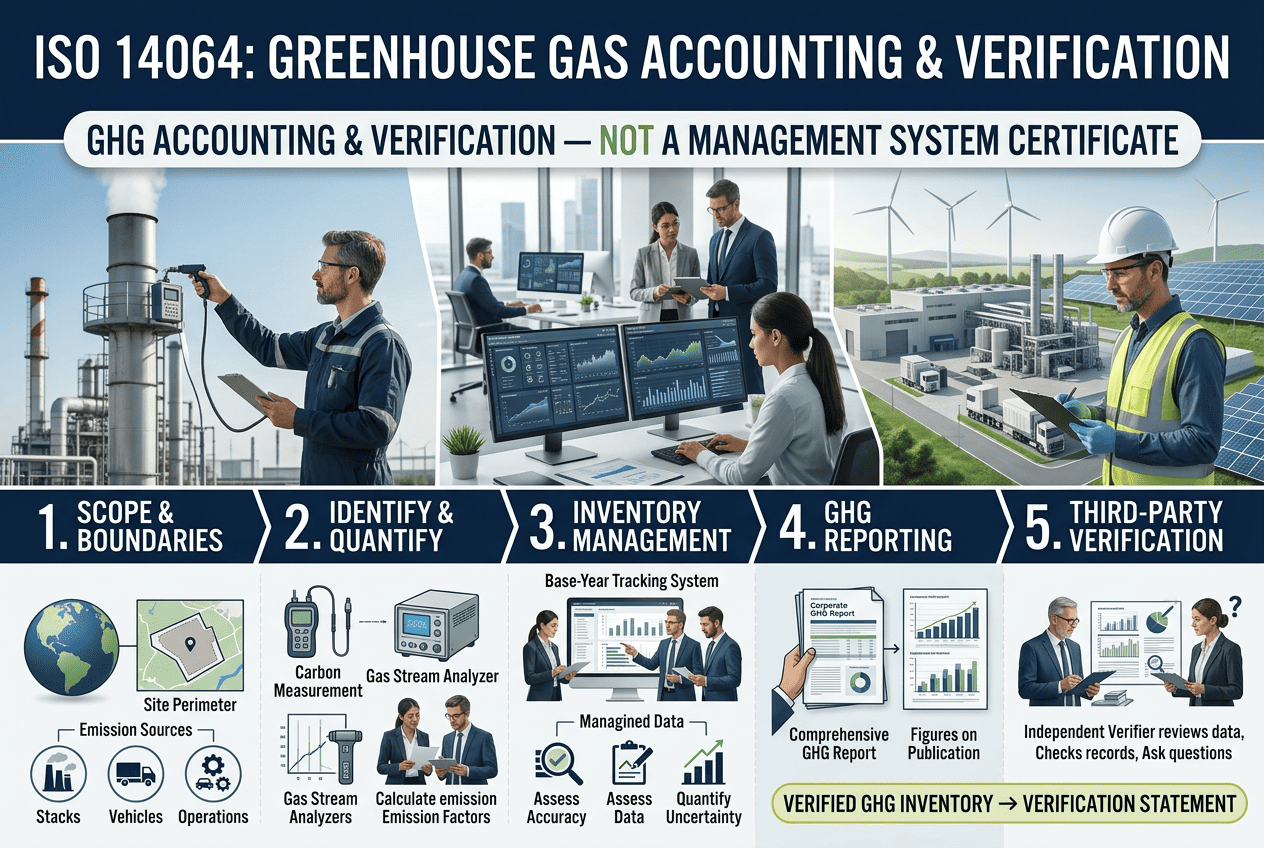
Direct Answer: ISO 14064 is the international family of standards for greenhouse gas (GHG) quantification, reporting and verification. It is not a management system standard, so there is no ISO 9001-style certificate. Instead, you build an ISO 14064-1 compliant GHG inventory and have it independently verified by a verification body, which issues a verification statement. The process has 5 steps: Scope & Boundaries, Identify & Quantify, Inventory Management (base year, uncertainty, data controls), GHG Reporting and Third-Party Verification. This guide covers Parts 1 to 4, realistic timelines, costs and common pitfalls.
📅 November 3, 2026⏱ 15 min read✍️ GT Setu Editorial Team🔄 Updated regularly
4
Parts in the ISO 14064 Series
6
Emission Categories (Part 1)
5
Steps to Verification
0%
GTsetu Broker Commission
ISO 14064 is the leading international standard series for measuring, reporting and verifying greenhouse gas emissions and removals. Developed by ISO technical committee ISO/TC 207, it gives organisations, project developers and verifiers a common, credible method so that carbon figures can be compared and trusted. The series includes ISO 14064-1:2018 (organisation level), ISO 14064-2:2019 (project level), ISO 14064-3:2019 (validation and verification) and ISO/TS 14064-4:2025 (guidance on applying Part 1).
For manufacturers, exporters and distributors, a verified GHG inventory is increasingly demanded by buyers, lenders and regulators as part of supply chain due diligence. This guide explains what ISO 14064 verification involves and how to achieve it. See our guides on partnership evaluation criteria and business verification for how sustainability credentials fit into partner due diligence.
⚠️ Important: Verification, Not Management System Certification
ISO 14064 does not certify a management system. The outcome is a verification or validation statement on your GHG report, issued by a verification body. Look for verifiers accredited against ISO 14065, and be precise in your claims: say “GHG inventory prepared per ISO 14064-1 and verified by [body]”. For management system certificates, see ISO 14001 and ISO 9001.
📋 Who Is This Guide For?
Sustainability managers, EHS and quality leaders, finance teams, founders and procurement professionals who need a credible carbon footprint. It suits manufacturers responding to customer emissions questionnaires, exporters preparing for carbon-related market requirements, and consultants supporting clients. See also supplier collaboration platforms and distributors and manufacturers.
SECTION 1
1 What Is ISO 14064 & What Does Verification Mean?
🌍 The Standard Explained
ISO 14064 is a series of standards on quantifying, monitoring, reporting, validating and verifying GHG emissions and removals. Part 1 sets requirements for designing and managing an organisation-level inventory, including boundaries, quantification and reporting. Part 2 covers GHG reduction or removal projects. Part 3 sets out how validation and verification bodies assess GHG statements. TS 14064-4 offers guidance on applying Part 1. Verification means an independent body evaluates whether your reported figures are accurate, complete and compliant with the standard.
Part
Scope
Who Uses It
ISO 14064-1:2018
Specification for quantification and reporting of GHG emissions and removals at organisation level.
Companies, public bodies, NGOs building an inventory.
ISO 14064-2:2019
Quantification, monitoring and reporting of GHG emission reductions or removal enhancements at project level.
Project developers, carbon-credit and offset projects.
ISO 14064-3:2019
Principles and requirements for verifying and validating GHG statements.
Verification and validation bodies, and organisations preparing for audit.
ISO/TS 14064-4:2025
Guidance for applying ISO 14064-1: boundaries, quantification methods and reporting, with examples.
Practitioners implementing Part 1.
🧾
GHG Inventory
A structured list of your emission sources, removals, activity data and calculated results for a reporting period.
🏛️
Verification Body
An independent organisation, ideally accredited against ISO 14065, that assesses your GHG statement under ISO 14064-3.
📜
Verification Statement
The conclusion issued by the verifier on the reliability of your GHG report, at a limited or reasonable level of assurance.
🎓
Personal Credentials
Training providers offer ISO 14064 workshops and credentials for individuals; these certify people, not the organisation’s inventory.
SECTION 2
2 Key Benefits of ISO 14064
A verified ISO 14064 inventory turns carbon data from an estimate into evidence. The benefits are commercial, operational and regulatory.
🏷️
Customer & Market Credibility
Verified figures reassure buyers who request emissions data and reduce the risk of greenwashing challenges.
Commercial
💰
Cost & Efficiency Insights
Quantifying energy, fuel and material use highlights waste and reduction opportunities.
Operational
🔗
Supply Chain Readiness
Consistent Scope 3 style data supports customer and supplier information requests.
Partnership
📊
Credible Targets
A base year and transparent methodology let you set and track reduction targets reliably.
Analytical
🏦
Access to Finance & Tenders
Lenders and procurement teams increasingly ask for verified sustainability data.
Finance
📋
Regulatory Preparedness
A solid inventory eases compliance with emerging climate disclosure and carbon pricing rules.
Compliance
SECTION 3
3 The 5 GHG Accounting Principles
ISO 14064 rests on five principles that guide every decision about boundaries, data and reporting. Verifiers test your inventory against them.
🎯
1. Relevance
Select sources, data and methods appropriate to the intended use of the inventory.
🧩
2. Completeness
Include all relevant emissions and removals within the chosen boundaries.
🔁
3. Consistency
Use consistent methods so that comparisons over time are meaningful.
📐
4. Accuracy
Reduce bias and uncertainty as far as practicable.
🔍
5. Transparency
Disclose sufficient, clear information so users can make decisions with confidence.
SECTION 4
4 Step 1: Scope & Boundaries
🏗️ Building the Foundation
Boundaries determine what is counted. Under ISO 14064-1 you set organisational boundaries using either a control approach (financial or operational) or an equity share approach, then reporting boundaries covering which direct and indirect emissions you will quantify. Plan 2 to 6 weeks for this phase.
1.1
Secure Management Support
Allocate a budget, name a GHG inventory lead and agree the purpose: customer disclosure, target setting, tender requirements or verification.
1.2
Get Trained
The inventory lead should understand ISO 14064-1 and TS 14064-4. Workshops from training bodies cover quantification and reporting hands-on.
1.3
Set Organisational Boundaries
Choose the control approach (financial or operational) or the equity share approach and apply it consistently to all facilities and subsidiaries.
1.4
Set Reporting Boundaries
Decide which direct and indirect emission categories are relevant and will be reported, with justification for any exclusions.
1.5
Define the Reporting Period
Typically a calendar or financial year. Align with other reports so that data can be reused.
1.6
Plan Responsibilities & Data Owners
Name data owners for energy, fuel, refrigerants, travel, purchasing and logistics, and set deadlines for data submission.
💡 Pro Tip: Start With Your Biggest Sites
If you have several facilities, pilot the inventory at the largest one, refine templates and then extend. The same phased approach works for building a B2B network: start focused and scale.
SECTION 5
5 Step 2: Identify Sources & Quantify Emissions
ISO 14064-1:2018 organises emissions into six categories. Identify which apply, collect activity data and convert it into tonnes of CO2-equivalent using documented emission factors.
Category
Examples
Typical Data Sources
1. Direct emissions and removals
Fuel burned on site, company vehicles, process emissions, refrigerant leaks.
Fuel invoices, meters, maintenance logs.
2. Indirect: imported energy
Purchased electricity, steam, heating and cooling.
Utility bills, meter readings, supplier factors.
3. Indirect: transportation
Business travel, employee commuting, upstream and downstream freight.
Travel records, logistics reports.
4. Indirect: products used by the organisation
Purchased goods and services, capital goods, waste disposal.
Procurement data, supplier information.
5. Indirect: use of the organisation’s products
Emissions from product use and end-of-life.
Product specifications, usage assumptions.
6. Other indirect sources
Any significant sources not covered above.
Case-by-case.
💡 Significance Criteria
You do not need to quantify every indirect source with equal rigour. Define and document significance criteria (size, influence, risk, stakeholder concern) to decide which indirect emissions to include. Verifiers will ask how you made these choices, so record the reasoning.
SECTION 6
6 Step 3: Inventory Management & Uncertainty
This step makes your numbers repeatable and auditable. It covers the data controls, base year and uncertainty analysis that verifiers focus on.
📅
Select a Base Year
Choose a historical reference year with reliable data and define when it will be recalculated, for example after structural changes or methodology updates.
Baseline
📈
Choose Quantification Methods
Use calculation-based methods with documented emission factors and global warming potentials, or direct measurement where appropriate. Record sources and versions.
Method
🎲
Assess Uncertainty
Evaluate and describe uncertainty in activity data and emission factors, and explain how you reduce it over time.
Accuracy
🗂️
Set Up Data Controls
Define procedures for data collection, review, retention and error correction so that every figure can be traced to evidence.
Controls
👥
Train Data Owners
Make sure the people who supply meter, fuel and purchasing data understand what is needed and by when.
People
🔄
Plan for Improvement
Document how data quality and coverage will be improved in future inventories.
Improvement
SECTION 7
7 Step 4: GHG Reporting
📝 Telling the Story Transparently
The GHG report is the document the verifier will assess. It should clearly describe the organisation, boundaries, reporting period, emissions and removals by category, methods, emission factors, base year, uncertainty and any exclusions. Use plain language and trace each figure back to supporting evidence.
🏢
Organisation & Boundaries
Describe entities, sites and the consolidation approach used.
📊
Results by Category
Present emissions and removals by gas and category, in tonnes of CO2e.
🧮
Methods & Factors
List calculation approaches, emission factor sources and GWP values.
📅
Base Year & Changes
State the base year, any recalculations and the reasons.
🎲
Uncertainty
Describe the main uncertainties and how they were evaluated.
🚫
Exclusions
Explain any excluded sources, with a justification based on your significance criteria.
SECTION 8
8 Step 5: Third-Party Verification
Verification is the closest equivalent to a certification audit. A verification body applying ISO 14064-3 reviews your GHG statement, tests evidence and issues a verification statement. You choose the level of assurance (limited or reasonable) based on the needs of your stakeholders.
Phase
What Happens
Key Focus
Engagement & Scoping
Agree objectives, criteria (ISO 14064-1), level of assurance, materiality and schedule with the verifier.
Clear boundaries and a shared understanding of what will be verified.
Strategic Analysis & Planning
The verifier reviews your report and systems to identify risk areas and plan the work.
Where misstatements could arise, such as large sources or manual data.
Evidence Gathering
Document review, interviews, site visits and sampling of data and calculations.
Misstatements and nonconformities are communicated and you correct them.
Timely, documented corrections.
Review & Verification Statement
An independent review of the verifier’s conclusions precedes issue of the statement.
The wording of the opinion and any qualifications.
Annual Cycle
Most organisations repeat the inventory and verification each reporting period.
Consistency over time and continued improvement.
💡 Choosing a Verification Body
Check that the body is accredited by a national accreditation body for ISO 14065, has verifiers with competence for your sector (ISO 14066 competence requirements), and is recognised by your customers or regulators. Compare scope, fees and timelines, and ask for references. Apply the same rigour as with any partnership evaluation.
SECTION 9
9 Costs & Timeline: What to Expect
There is no fixed price list for ISO 14064. Costs and timelines below are indicative planning guidance, not quotes; confirm current pricing with accredited verifiers, consultants and software providers.
Factor
Impact on Cost
Impact on Timeline
Organisation Size & Sites
More sites and sources mean more data collection and verification effort.
Organisations with metered energy and structured purchasing data spend less on cleanup.
Poor data adds weeks to months.
Scope of Indirect Emissions
Wider category coverage increases analysis and supplier data requests.
Value-chain data often takes the longest to obtain.
Level of Assurance
Reasonable assurance requires more verification work than limited assurance.
Reasonable assurance extends the verification phase.
Consultants & Software
Optional costs; carbon accounting tools reduce manual effort over time.
Tools speed repeat cycles.
Training
Workshop fees for the inventory lead and key data owners.
Courses typically run a few days.
📋 Reduce Cost Over Time
The first inventory is the most expensive. Standardised data templates, a clear base year and consistent methods make later cycles faster and cheaper. Evaluate providers using the same partnership evaluation criteria you would use for any B2B engagement.
SECTION 10
10 ISO 14064 and Other ISO Standards
A GHG inventory rarely stands alone. It feeds environmental, quality, safety and risk systems, and shares data with them. Explore each standard with its own step-by-step guide.
Risk-based thinking parallels GHG uncertainty and materiality assessment.
SECTION 11
11 Common Mistakes & How to Avoid Them
🏷️
Overclaiming “ISO 14064 Certified”
Implying a management system certificate that does not exist.
Avoid: State precisely that the inventory follows ISO 14064-1 and was verified by a named body.
🗺️
Unclear Boundaries
Changing consolidation approaches or leaving sites out without explanation.
Avoid: Document the boundary choice and apply it consistently every year.
📉
Weak Data Trail
Figures that cannot be traced to invoices, meter readings or records.
Avoid: Keep evidence for every input and assign data owners with deadlines.
🧮
Inconsistent Emission Factors
Mixing sources, years or GWP values without documentation.
Avoid: Maintain a factor register with sources and versions, and update deliberately.
🔗
Ignoring Indirect Emissions
Reporting only direct emissions and energy while supply chain impacts dominate.
Avoid: Apply significance criteria and engage suppliers early. See risk allocation for contractual data obligations.
🎓
No Internal Ownership
Leaving the inventory to one person with no support from finance, operations or procurement.
Avoid: Train data owners and use structured global partner service style onboarding for suppliers.
SECTION 12
12 How GTsetu Supports Your Climate Compliance Journey
🔗 GTsetu, Verified B2B Platform
Find Verified Partners for a Credible Supply Chain
Supply chain emissions depend on the partners you choose. GTsetu helps you connect with verified manufacturers, distributors and suppliers with confidentiality and secure collaboration built in. Our platform provides:
✅
Verified Company ProfilesEvery company is verified on 6 key data points (Name, Address, Registration Number, Company Status, Company Type, Date of Incorporation) using government tie-ups.
🕵️
Anonymous DiscoveryBrowse verified partner profiles without revealing your identity until you are ready to engage.
📄
Built-In NDA WorkflowDigital mutual NDA with timestamped signatures, activated before sensitive commercial or emissions data is shared.
🔐
Encrypted Document WorkspaceAES-256 encryption at rest, TLS in transit, role-based access and a full audit trail for exchanging sustainability documents.
🚫
Zero Broker CommissionGTsetu charges zero commission on any partnership formed.
🌏
Global Network of Verified PartnersAccess verified partners across 100+ countries to build a lower-carbon, better-documented supply base.
ISO 14064 is not a management system standard, so it does not lead to an ISO 9001-style management system certificate. Part 1 sets requirements for organisation-level GHG inventories, Part 2 for projects, and Part 3 for validation and verification. What you obtain is a third-party verification (or validation) statement issued by a verification body, ideally accredited against ISO 14065, confirming your GHG report or assertion. Individuals can also earn training credentials.
QWhat are the main steps to get ISO 14064 verification?
The five steps are: (1) Scope and boundaries: set organisational and reporting boundaries and assign responsibilities. (2) Identify and quantify: list GHG sources and removals, collect data and calculate emissions. (3) Inventory management: choose a base year, assess uncertainty and set up data controls. (4) Reporting: prepare a transparent GHG report. (5) Verification: engage a verification body for an independent assessment and receive a verification statement.
QWhat is the difference between ISO 14064-1, -2, -3 and TS 14064-4?
ISO 14064-1:2018 covers GHG inventories at organisation level. ISO 14064-2:2019 covers quantifying, monitoring and reporting reductions or removal enhancements at project level. ISO 14064-3:2019 specifies principles and requirements for validating and verifying GHG statements. ISO/TS 14064-4:2025 gives guidance on applying Part 1 to organisation-level inventories.
QHow long does ISO 14064 verification take?
Timelines depend on size, data availability and number of sites. As an indicative guide, a first GHG inventory and verification typically takes 3 to 6 months for small organisations, 6 to 9 months for medium organisations and 9 to 15 months for large or multi-site organisations. Repeat annual cycles are usually faster.
QHow much does ISO 14064 verification cost?
Costs vary with the number of sites, emission sources, data complexity, the level of assurance (limited or reasonable) and whether you use consultants or carbon accounting software. The main cost items are internal staff time, data systems, optional consulting, and the verification body fee. Obtain several quotes from accredited verifiers and confirm current pricing directly.
QHow does ISO 14064 relate to ISO 14001 and other standards?
ISO 14001 certifies an environmental management system, while ISO 14064 quantifies and verifies greenhouse gas emissions and removals. They are complementary: a 14001 EMS can use a 14064 inventory to set and track climate objectives. ISO 14064 data also supports energy, sustainability and supply chain reporting requests from customers.
Ready to Build a Verified, Lower-Carbon Supply Chain?
Connect with verified manufacturers, distributors and suppliers on GTsetu: compliance-backed verification, anonymous discovery, built-in NDA workflows and zero broker commissions.
They represents the product, and research team behind GTsetu, a global B2B collaboration platform built to help companies explore cross-border partnerships with clarity and trust. The team focuses on simplifying early-stage international business discovery by combining structured company profiles, verification-led access, and controlled collaboration workflows.
With a strong emphasis on trust, and disciplined engagement, Team GTsetu shares insights on global trade, partnerships, and cross-border collaboration, helping businesses make informed decisions before entering deeper commercial discussions.