🛡️ Occupational Health & Safety Certification Guide 2026
How to Get ISO 45001 Certification
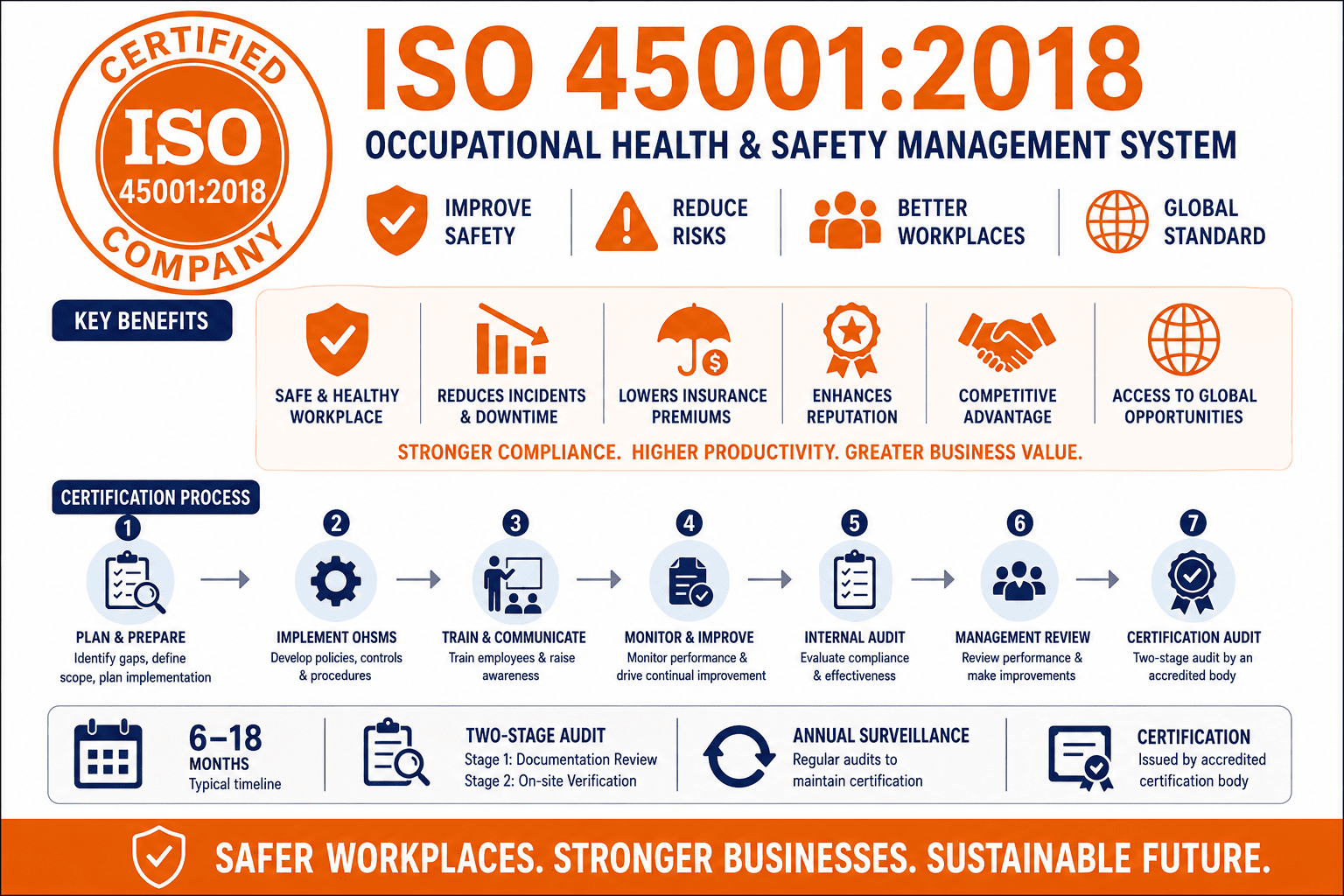
Direct Answer: ISO 45001:2018 is the international standard for Occupational Health and Safety Management Systems (OHSMS), designed to improve employee safety, reduce workplace risks, and create better working conditions worldwide. Achieving ISO 45001 certification demonstrates your organisation’s commitment to a safe and healthy workplace, reduces incidents and downtime, lowers insurance premiums, enhances your reputation, and provides a competitive advantage, particularly when seeking global supply chain partnerships, government contracts, and B2B collaborations. The certification process typically takes 6–18 months, involves a two-stage audit (Stage 1: documentation review; Stage 2: on-site implementation verification), and requires annual surveillance audits to maintain certification. GTsetu connects certified manufacturers and suppliers with verified global partners, with zero broker commissions.
📅 June 23, 2026⏱ 18 min read✍️ GT Setu Editorial Team🔄 Updated regularly
6–18
Months to Certification (Typical)
2-Stage
Audit Process: Documentation + On-Site
3 Yrs
Certification Validity with Annual Surveillance
0%
GTsetu Broker Commission
Every year, more than 2.7 million workers lose their lives due to occupational accidents, and 374 million non-fatal workplace injuries result in four or more days of absence from work, according to the International Labour Organization (ILO). The human cost is incalculable. The economic cost, lost productivity, healthcare expenses, compensation claims, legal fees, reputational damage, runs into the trillions of dollars annually.
ISO 45001:2018 is the first international standard for occupational health and safety management systems (OHSMS). Published in March 2018, it represents a landmark breakthrough: for the first time, organisations of all sizes and sectors can access a single, globally recognised framework that offers a clear pathway to developing robust occupational health and safety measures, protecting both employees and the organisation itself.
This guide covers everything you need to know about ISO 45001 certification: what it is, the key benefits, the requirements, the step-by-step certification process, costs, timelines, how to choose a certification body, and how ISO 45001 enhances your position in global supply chains. For broader context on building trusted business relationships, see our guides on business verification, supplier collaboration platforms, and partnership evaluation criteria.
🛡️ Who Is This Guide For?
This guide is written for manufacturers, distributors, industrial operators, supply chain managers, procurement professionals, quality managers, and business owners seeking to implement or transition to ISO 45001:2018. It is also relevant for companies evaluating potential suppliers and partners, understanding ISO 45001 helps you assess whether a partner is genuinely committed to worker safety and operational excellence. If you are exploring multiple certification standards, see our companion guides on contract manufacturing, OEM vs. ODM vs. EMS, and industrial business collaboration.
SECTION 1
1 What Is ISO 45001?
📋 Standard Overview
ISO 45001:2018 is the international standard for Occupational Health and Safety Management Systems (OHSMS). Published by the International Organization for Standardization (ISO) in March 2018, it specifies requirements for an OHSMS intended to improve the safety and health of employees, temporary workers, subcontractors, and other personnel. The standard supersedes OHSAS 18001 and is aligned with the High-Level Structure (HLS) framework, making it compatible with ISO 9001 (Quality Management) and ISO 14001 (Environmental Management).
2.7M+
Workers die annually from occupational accidents (ILO)
374M
Non-fatal workplace injuries per year causing 4+ days absence
97.3%
Increase in ISO 45001 certificates worldwide (2020 ISO Survey)
🏛️
High-Level Structure (HLS) Alignment
ISO 45001 follows the same HLS framework as ISO 9001:2015 and ISO 14001:2015, enabling seamless integration of quality, environmental, and health & safety management systems. This reduces duplication, lowers implementation costs, and streamlines auditing for organisations maintaining multiple certifications.
👔
Leadership & Management Responsibility
ISO 45001 places strong emphasis on top management’s responsibility for OH&S performance, not just delegation. The standard requires demonstrated leadership commitment, integration of OH&S into business processes, and active involvement in establishing, maintaining, and continually improving the OHSMS.
🧑🤝🧑
Worker Participation & Consultation
A significant new concept is the role of workers in identifying health and safety hazards. The standard requires consultation with workers at all levels, participation in hazard identification, incident investigation, and decision-making on OH&S matters. This reflects that those closest to the work understand the risks best.
📊
Risk-Based Thinking & Opportunities
ISO 45001 introduces the term “opportunities” beyond risk mitigation. It covers proactive measures that enhance OH&S performance beyond simply eliminating or minimising hazards, including improving worker wellbeing, productivity, and organisational resilience through better health and safety practices.
🔗
Explicit Inclusion of Subcontractors
The standard explicitly includes persons who are not permanently employed but work under the organisation’s responsibility, subcontractors, temporary workers, and outsourced processes. This expands the OHSMS scope to the full operational footprint, not just permanent employees.
🌍
Global Recognition & Standardisation
ISO 45001 provides a single, globally recognised framework for occupational health and safety, replacing national and regional standards (including BS OHSAS 18001). This enables multinational organisations to implement consistent OH&S practices across all locations, simplifying compliance and enhancing brand reputation worldwide.
SECTION 2
2 Key Benefits of ISO 45001 Certification
ISO 45001 certification delivers measurable benefits across safety, operational efficiency, financial performance, and commercial competitiveness. For manufacturers and industrial operators, the return on investment is not just in reduced incidents, it is in enhanced supplier qualification, customer trust, and supply chain partnership access. Supply chain partners increasingly require ISO 45001 certification as a condition of doing business.
🛡️
Worker Safety, Risk Reduction & Injury Prevention
The primary benefit: systematically identifying, assessing, and controlling workplace hazards. Organisations with ISO 45001-certified OHSMS consistently demonstrate lower incident rates, fewer lost-time injuries, and improved worker wellbeing. This directly protects your most valuable asset, your workforce.
Safety
📋
Regulatory Compliance Capability
ISO 45001 improves your ability to respond to regulatory requirements, reducing the risk of fines, enforcement actions, and legal exposure. The standard’s systematic compliance evaluation processes ensure you stay ahead of changing OH&S regulations in every jurisdiction where you operate.
Compliance
💰
Reduced Incident Costs & Lower Insurance Premiums
Fewer incidents mean lower direct costs: medical expenses, compensation claims, legal fees, and equipment damage. Fewer lost-time incidents mean reduced overtime and temporary staffing costs. Insurers frequently offer lower premiums to certified organisations, recognising the reduced risk profile.
Financial
⏱️
Reduced Downtime & Operational Disruption
Workplace incidents cause production stoppages, investigation time, and operational disruption that extend far beyond the incident itself. ISO 45001’s preventive approach reduces the frequency and severity of incidents, protecting production continuity and customer commitments.
Operational
🤝
Employee Attendance, Loyalty & Productivity
Workers who feel safe and valued have higher attendance, lower turnover, and better productivity. ISO 45001’s worker participation requirements demonstrate that you value employee input on safety, a direct driver of engagement and retention.
Culture
🌍
International Recognition & Brand Reputation
ISO 45001 certification is a globally recognised mark of commitment to worker safety and responsible operations. It differentiates you from competitors, reassures customers about supply chain integrity, and demonstrates social responsibility to investors, regulators, and the public.
Reputation
🔗
Supply Chain Qualification & Partnership Access
Increasing numbers of multinational buyers, OEMs, and distributor networks require ISO 45001 certification from their suppliers. Certification opens doors to contracts and partnerships that are closed to uncertified competitors, and it streamlines partner evaluation processes by demonstrating your organisation’s maturity.
Commercial
📊 The Business Case for ISO 45001
A 2024 study of ISO 45001-certified manufacturers found: 28% reduction in lost-time injury frequency over 3 years; 15–20% reduction in workers’ compensation insurance premiums; 23% improvement in employee retention in safety-critical roles; 4× faster qualification for major OEM supply contracts due to pre-certification. The ROI typically exceeds the certification investment within 12–18 months, with long-term benefits compounding over time.
SECTION 3
3 ISO 45001 Requirements & Key Clauses
ISO 45001:2018 follows the High-Level Structure common to all ISO management system standards. The requirements are organised into ten clauses, Clauses 4 through 10 contain the specific requirements for the OHSMS. Understanding these requirements is the foundation for successful implementation and certification.
Clause
Requirement
Key Actions for Implementation
Clause 4, Context of the Organisation
Understand the internal and external factors that affect OH&S, and define the scope of the OHSMS
Conduct external and internal context analysis; identify interested parties and their OH&S requirements; define OHSMS scope and boundaries
Clause 5, Leadership & Worker Participation
Top management must demonstrate leadership commitment, establish OH&S policy, and ensure worker participation and consultation
Issue signed OH&S policy; assign OH&S roles and responsibilities; establish consultation and participation mechanisms; ensure resources are available
Clause 6, Planning
Identify hazards, assess risks, determine legal and other requirements, and plan actions to address risks and opportunities
Conduct hazard identification and risk assessment (HIRA); determine applicable legal and regulatory requirements; plan actions to address risks and opportunities; establish OH&S objectives and plans
Clause 7, Support
Ensure resources, competence, awareness, communication, and documented information are available to support the OHSMS
Determine resource needs; establish competence requirements and training programmes; ensure worker awareness; define communication processes; create and control documented information
Clause 8, Operation
Plan, implement, and control processes to meet OH&S requirements and manage identified risks
Establish operational controls for significant hazards; manage procurement, outsourcing, and contractor processes; develop emergency preparedness and response procedures
Clause 9, Performance Evaluation
Monitor, measure, analyse, and evaluate OH&S performance; conduct internal audits and management reviews
Establish monitoring and measurement processes; conduct internal audits at planned intervals; perform management reviews with documented outputs; evaluate compliance with legal requirements
Clause 10, Improvement
Identify opportunities for improvement, investigate incidents, take corrective actions, and continually improve the OHSMS
Establish incident investigation and non-conformity management process; take corrective actions; implement continual improvement projects; document lessons learned
💡 Key Implementation Insight
The most common implementation gap is not in documentation, it is in worker participation (Clause 5.4) and operational control (Clause 8.1). Certification bodies consistently observe that organisations with documented procedures but limited worker involvement, and those that have risk assessments but not active operational controls, struggle during the Stage 2 audit. Focus on active engagement and practical control implementation, not just documentation, from the start.
SECTION 4
4 How to Get ISO 45001 Certified: Step-by-Step Process
01
Step 1: Secure Top Management Commitment
ISO 45001 requires demonstrated leadership commitment. Before any implementation work begins, ensure your top management understands the OHSMS requirements, approves resource allocation, and is prepared to actively participate in OH&S reviews and decision-making. Formal management sign-off on the OH&S policy is a prerequisite for the Stage 1 audit.
02
Step 2: Become Familiar with the Standard
Obtain the ISO 45001:2018 standard and understand its structure, terminology, and specific requirements. Consider ISO 45001 training for your implementation team. TÜV SÜD, TÜV Rheinland, Bureau Veritas, and NQA all offer ISO 45001 training and awareness programmes to help your team understand the standard’s requirements before implementation begins.
03
Step 3: Conduct a Gap Analysis
Compare your current OH&S practices against ISO 45001 requirements to identify gaps. This can be done internally or by engaging an external consultant. A gap analysis reveals: what you already have (e.g., existing safety procedures, risk assessments), what you partially have but need to improve (e.g., worker consultation, incident investigation), and what is completely absent (e.g., documented OHSMS, formal compliance evaluation).
04
Step 4: Develop and Document Your OHSMS
Based on the gap analysis, develop the required OHSMS elements: OH&S policy, hazard identification and risk assessment (HIRA) process, legal and other requirements register, OH&S objectives and plans, operational control procedures, emergency preparedness and response plans, competence and training programme, communication and consultation processes, documented information and document control procedures, internal audit procedure, management review process, and incident investigation and corrective action process.
05
Step 5: Implement and Operate the OHSMS
Deploy the documented OHSMS across your organisation: train all personnel on their roles and responsibilities; conduct hazard identification and risk assessments across all operations; implement operational controls; establish emergency response procedures; begin monitoring and measurement of OH&S performance; initiate worker consultation and participation processes; and maintain documented information as required by the standard.
Before inviting external certification auditors, conduct a full internal audit of your OHSMS to verify compliance with ISO 45001 requirements. Identify and address any non-conformities. Then, hold a formal management review: present OH&S performance data, internal audit results, compliance status, and improvement opportunities to top management for review and decision-making.
07
Step 7: Select a Certification Body
Choose an accredited certification body, such as TÜV SÜD, TÜV Rheinland, Bureau Veritas, NQA, or DNV, that has experience in your industry sector. Ensure the certification body is accredited by a recognised accreditation body (UKAS, DAKKS, JAS-ANZ, etc.). Obtain quotes, compare timelines, and confirm auditor competence in your sector.
08
Step 8: Stage 1, Documentation Review Audit
The Stage 1 audit reviews your OHSMS documentation against ISO 45001 requirements. The auditor assesses: whether your documented OHSMS addresses all requirements of the standard, whether the scope of certification is appropriate and defined, whether you have conducted hazard identification, risk assessment, and identified legal requirements, whether you have internal audit and management review records, and whether you are ready for the Stage 2 audit.
The Stage 2 audit is an on-site verification of your OHSMS implementation. The auditor will: conduct site inspections to verify operational controls, interview personnel at all levels, review records of hazard identification and risk assessment, verify worker participation processes, test emergency response procedures, audit incident investigations and corrective actions, review monitoring and measurement data, and evaluate compliance with legal and other requirements.
10
Step 10: Certification Decision & Issuance
The certification body reviews the audit findings. If successful, they issue an ISO 45001 certificate valid for three years. Your organisation is entered into the certification body’s public register, and you receive the ISO 45001 certificate and certification mark. You may publicise your certification on your website, marketing materials, and supplier collaboration platforms.
SECTION 5
5 The Audit Process: Stage 1 & Stage 2
The ISO 45001 certification audit is conducted in two stages. Understanding what each stage covers and how to prepare for them is essential for a smooth certification experience.
Audit Stage
Focus
What Auditors Review
Typical Duration
Key Success Factors
Stage 1, Documentation Review
Is your OHSMS documented correctly and ready for implementation verification?
OH&S policy, scope definition, hazard identification and risk assessment records, legal requirements register, OH&S objectives and plans, documented procedures for key processes, internal audit records, management review records
1–3 days (remote or on-site)
Complete documentation that addresses all clauses; records of internal audit and management review conducted; identified legal and other requirements; defined scope consistent with organisational activities
Stage 2, On-Site Implementation Verification
Is your OHSMS actually implemented and effective in practice?
Site inspections, worker interviews, hazard control verification, emergency response testing, operational control observation, training records, incident investigation records, monitoring and measurement data, compliance evaluation records
2–5 days (on-site, depending on organisation size)
Demonstrated worker participation; evidence of operational controls in place; effective hazard control measures; monitoring records showing performance; management review outputs; documented corrective actions
💡 Audit Preparation Best Practices
To ensure a successful ISO 45001 audit: (1) Conduct a thorough internal audit and address all non-conformities before the external audit. (2) Ensure all documentation is current, controlled, and readily accessible. (3) Brief all personnel on the audit schedule and their roles. (4) Have records organised by clause to show auditors exactly where to find evidence. (5) Be transparent about implementation status, auditors will identify gaps whether you admit them or not; admitting gaps with a planned corrective action is viewed favourably. (6) Assign a knowledgeable internal guide to accompany the auditor during site inspections.
SECTION 6
6 Costs & Timeline
The cost and timeline for ISO 45001 certification vary significantly based on organisation size, complexity, the state of existing management systems, and the certification body selected. The costs are generally lower for organisations already certified to ISO 9001 or ISO 14001, as the HLS structure enables integration and reduces duplication.
Cost/Time Element
Small Organisation (1–50 employees)
Mid-Size Organisation (50–500 employees)
Large Organisation (500+ employees)
Notes
Gap Analysis & Implementation Support
₹1–5 lakh
₹5–15 lakh
₹15–50 lakh+
Consultant fees; varies by scope and complexity; can be done internally with trained staff
Depends on existing OHSMS maturity; transition from OHSAS 18001 typically faster
Annual Surveillance Audit
1–2 days
2–4 days
4–8 days
Required to maintain certification; typically 25–50% of initial Stage 2 cost
Recertification Audit (every 3 years)
2–3 days
3–5 days
5–10 days
Similar scope to Stage 2; costs comparable to initial Stage 2 audit
💡 Cost Optimisation Strategies
To optimise your ISO 45001 certification investment: (1) If you already have ISO 9001 or ISO 14001, leverage the HLS framework to integrate OHSMS requirements without starting from scratch. (2) Conduct internal gap analysis and implementation with trained internal staff rather than external consultants for non-complex organisations. (3) Choose a certification body that offers combined audits for multiple standards to reduce audit days and fees. (4) Ensure readiness before the Stage 2 audit, failed or deferred audits add significant cost. (5) Plan certification at a time when operations are stable, not during major organisational changes or peak production periods.
SECTION 7
7 Choosing a Certification Body
Choosing the right certification body is a key success factor. An experienced, accredited certification body with sector-specific auditor competence provides a smoother audit process and greater value from the certification. The major certification bodies operating in India and globally are listed below.
Certification Body
Global Presence
Accreditations
Key Differentiator
Website Reference
TÜV SÜD
Global, 1,000+ locations
DAKKS, UKAS, and other national accreditation bodies
Strong in industrial, manufacturing, and automotive sectors; offers integrated audits with ISO 9001 & 14001; globally recognised certification mark
TÜV SÜD ISO 45001
Bureau Veritas
Global, 140+ countries
COFRAC, UKAS, ANSI-ASQ, and others
2,000+ auditors worldwide for ISO 45001; strong in energy, infrastructure, and manufacturing; comprehensive sector expertise
Strong in energy, maritime, and process industries; integrated management system expertise; global recognition
dnv.com (ISO 45001)
💡 How to Select a Certification Body
When choosing a certification body: (1) Check accreditation, ensure the body is accredited by a recognised accreditation body (UKAS, DAKKS, JAS-ANZ, etc.). (2) Assess sector experience, request auditor CVs and confirm they have experience in your industry sector. (3) Compare audit days, different bodies may estimate different audit day requirements; understand the basis. (4) Evaluate reputation, is the certification mark recognised by your customers and supply chain partners? (5) Check language support, if your team requires local language audit support, confirm availability. (6) Consider location, proximity to your operations affects travel costs and availability.
SECTION 8
8 OHSAS 18001 to ISO 45001 Transition
Organisations previously certified to OHSAS 18001 (the former occupational health and safety management system standard) must transition to ISO 45001:2018. The transition deadline was March 2021, but many organisations continue to transition. The key differences between the standards are:
🔄
Proactive vs. Reactive Approach
OHSAS 18001 focused primarily on risks and hazards, with limited emphasis on proactive solutions. ISO 45001 focuses on both risks and opportunities, a fundamentally more proactive, preventive approach to OH&S management.
📋
High-Level Structure (HLS) Alignment
ISO 45001 follows the HLS framework, giving it a common structure with ISO 9001 and ISO 14001. This enables seamless integration of quality, environmental, and OH&S management systems, reducing documentation duplication and simplifying auditing.
👔
Emphasis on Senior Management Responsibility
ISO 45001 places significantly more emphasis on the responsibility of senior management for OH&S performance, not just delegation but active leadership, participation, and accountability.
🧑🤝🧑
Explicit Inclusion of Subcontractors
ISO 45001 explicitly includes persons who are not permanently employed but work under the organisation’s responsibility, subcontractors, temporary workers, and outsourced processes, expanding the OHSMS scope beyond permanent employees.
📈
Introduction of “Opportunities”
ISO 45001 introduces the term “opportunities” as a new aspect in OH&S, covering proactive measures that go beyond mere elimination or minimisation of risks, including improving worker wellbeing, productivity, and organisational resilience.
🌍
Global Standardisation
ISO 45001 replaces OHSAS 18001 as the internationally recognised OH&S standard. Organisations certified to OHSAS 18001 should now hold ISO 45001 certification to demonstrate current compliance with global best practice.
📋 Transition Guidance
For organisations transitioning from OHSAS 18001 to ISO 45001: (1) Conduct a gap analysis against ISO 45001 requirements. (2) Pay particular attention to new requirements: context of the organisation (Clause 4), leadership and worker participation (Clause 5), and opportunities (Clause 6). (3) Update your documented OHSMS to align with the HLS structure. (4) Conduct internal audit and management review against ISO 45001 requirements. (5) Schedule a transition audit with your certification body. Many certification bodies offer specific transition audit services at reduced costs compared to full initial certification.
SECTION 9
9 Integrating ISO 45001 with ISO 9001 & ISO 14001
One of the most significant benefits of ISO 45001 is its compatibility with ISO 9001 (Quality Management) and ISO 14001 (Environmental Management) through the High-Level Structure (HLS). Integration offers substantial operational and cost advantages.
Aspect
Separate Management Systems
Integrated Management System (IMS)
Benefit of Integration
Documentation
Separate policies, procedures, and records for each standard
Single integrated policy; shared documentation structure; common procedures where applicable
Organisations with Integrated Management Systems (IMS) typically experience: 30–40% reduction in total audit days (Stage 1 + Stage 2 + surveillance); 25–35% lower certification and maintenance costs; consistent internal audit methodology reducing confusion; holistic decision-making at management review; and significantly improved operational efficiency through integrated process management. If you are already certified to ISO 9001 or ISO 14001, leverage the HLS framework to integrate ISO 45001, you will achieve certification faster and at lower cost.
SECTION 10
10 ISO 45001 & Global Supply Chain Partnerships
For manufacturers, distributors, and industrial operators, ISO 45001 certification is increasingly a competitive requirement rather than a differentiator. Major multinational buyers, OEMs, and distributor networks are incorporating ISO 45001 into their supplier collaboration and partnership evaluation criteria. Here is how ISO 45001 certification supports global supply chain success.
🔗
Supplier Qualification Requirement
Increasing numbers of OEMs and multinational buyers require ISO 45001 certification from their supply chain partners as a condition of doing business. Without certification, you may be disqualified from tenders before your commercial proposition is even evaluated.
Qualification
📋
Risk Reduction for Buyers
Buyers view ISO 45001 certification as evidence that your organisation systematically manages worker safety and operational risks, reducing their supply chain risk exposure. Certified suppliers are perceived as more reliable, more responsible partners with lower incident-related disruption risk.
Risk Management
🤝
Partner Evaluation Differentiator
When buyers evaluate multiple potential international wholesale distributors or contract manufacturers, ISO 45001 certification is a strong differentiator. It demonstrates maturity, professionalism, and operational excellence.
Differentiation
🌍
Global Supply Chain Consistency
For multinational buyers, ISO 45001 certification across their supply chain provides consistent OH&S standards globally, simplifying compliance monitoring, reducing audit costs, and protecting brand reputation across all markets.
Consistency
🛡️
ESG & Sustainability Credentials
ISO 45001 certification is increasingly recognised as part of an organisation’s ESG (Environmental, Social, Governance) credentials. It demonstrates a commitment to the ‘S’ in ESG, social responsibility and worker welfare, which is a key evaluation criteria for investors, customers, and regulators.
GTsetu’s platform connects manufacturers and distributors globally. Companies with ISO 45001 certification (along with ISO 9001 and ISO 14001) are clearly identifiable in partner discovery, enabling buyers to prioritise certified suppliers. GTsetu verifies company identities through government tie-ups, while certifications like ISO 45001 must be validated directly between partners. See our guide on international business development consulting and B2B matchmaking for how to leverage certifications in partnership development.
FAQ
? Frequently Asked Questions
QWhat is ISO 45001 certification?
ISO 45001:2018 is the international standard for Occupational Health and Safety Management Systems (OHSMS). Published in March 2018 by the International Organization for Standardization (ISO), it specifies requirements for an OHSMS intended to improve the safety and health of employees and other personnel. ISO 45001 supersedes OHSAS 18001 and follows the High-Level Structure (HLS) framework, making it easier to integrate with ISO 9001 (Quality Management) and ISO 14001 (Environmental Management). Certification demonstrates your organisation’s commitment to worker safety, risk reduction, and operational excellence.
QWhat are the key benefits of ISO 45001 certification?
The key benefits include: (1) Employee safety, risk reduction, and injury prevention, systematic hazard identification and control. (2) Improved regulatory compliance capability, reducing fines and legal exposure. (3) Reduced incident costs, lower medical, compensation, legal, and equipment damage costs. (4) Reduced downtime and operational disruption, fewer production stoppages. (5) Lower insurance premiums, certified organisations are viewed as lower risk. (6) Higher employee attendance and loyalty, workers feel valued and safe. (7) International recognition and brand reputation, globally recognised mark of responsibility. (8) Supply chain qualification and partnership access, certification is increasingly a requirement for major OEM and buyer contracts.
QWhat are the main requirements of ISO 45001?
The ISO 45001 requirements are organised into ten clauses. The requirements include: (1) Context of the organisation, understanding internal and external factors affecting OH&S. (2) Leadership and worker participation, top management commitment and worker consultation. (3) Planning, hazard identification, risk assessment, and legal requirements identification. (4) Support, resources, competence, awareness, communication, and documented information. (5) Operation, operational planning and control, including emergency preparedness. (6) Performance evaluation, monitoring, measurement, internal audit, and management review. (7) Improvement, incident investigation, corrective action, and continual improvement. The standard’s High-Level Structure makes it compatible with ISO 9001 and ISO 14001.
QHow long does ISO 45001 certification take?
The ISO 45001 certification process typically takes 6–18 months from initial gap analysis to certification, depending on organisation size, complexity, and the state of existing management systems. The two-stage audit process requires: (1) Stage 1 Audit, 1–2 weeks for documentation review and preparation. (2) Stage 2 Audit, typically 3–6 months after Stage 1 for full implementation verification. Certification is valid for three years, with annual surveillance audits required to maintain certification. Organisations already certified to ISO 9001 or ISO 14001 can typically achieve certification faster by leveraging the High-Level Structure to integrate ISO 45001 requirements.
QWhat is the difference between OHSAS 18001 and ISO 45001?
The key difference between OHSAS 18001 and ISO 45001 is the reactive vs. proactive approach. OHSAS 18001 focused primarily on risks and hazards without a strong emphasis on proactive solutions. ISO 45001 focuses on both risks and opportunities, a fundamentally more proactive, preventive approach. ISO 45001 also introduces: (1) High-Level Structure alignment with ISO 9001 and ISO 14001 for easier integration. (2) Greater emphasis on senior management responsibility and accountability. (3) Explicit inclusion of subcontractors and outsourced processes in the OHSMS scope. (4) The term “opportunities” as a new aspect in OH&S, covering issues beyond risk elimination. OHSAS 18001 certification transitioned to ISO 45001 by March 2021.
QHow do I get ISO 45001 certified with TÜV SÜD or other certification bodies?
The ISO 45001 certification process with recognised bodies like TÜV SÜD, TÜV Rheinland, Bureau Veritas, or NQA involves: (1) Gap analysis, assess current OH&S practices against ISO 45001 requirements. (2) Implementation, develop and document your OHSMS. (3) Optional preliminary audit, assess readiness for formal certification (offered by some bodies). (4) Stage 1 certification audit, documentation review to confirm your OHSMS design meets requirements. (5) Stage 2 certification audit, on-site implementation verification of the OHSMS in practice. (6) Certification decision, if successful, you receive ISO 45001 certification. (7) Annual surveillance audits, maintain certification. (8) Recertification audit, every three years to renew certification. Contact your chosen certification body directly for a tailored quote and timeline specific to your organisation.
Ready to Build Trust with ISO 45001-Certified Partnerships?
Connect with verified manufacturers, distributors, and supply chain partners on GTsetu, compliance-backed verification, anonymous discovery, built-in NDA workflows, and zero broker commissions on every partnership you form.
They represents the product, and research team behind GTsetu, a global B2B collaboration platform built to help companies explore cross-border partnerships with clarity and trust. The team focuses on simplifying early-stage international business discovery by combining structured company profiles, verification-led access, and controlled collaboration workflows.
With a strong emphasis on trust, and disciplined engagement, Team GTsetu shares insights on global trade, partnerships, and cross-border collaboration, helping businesses make informed decisions before entering deeper commercial discussions.