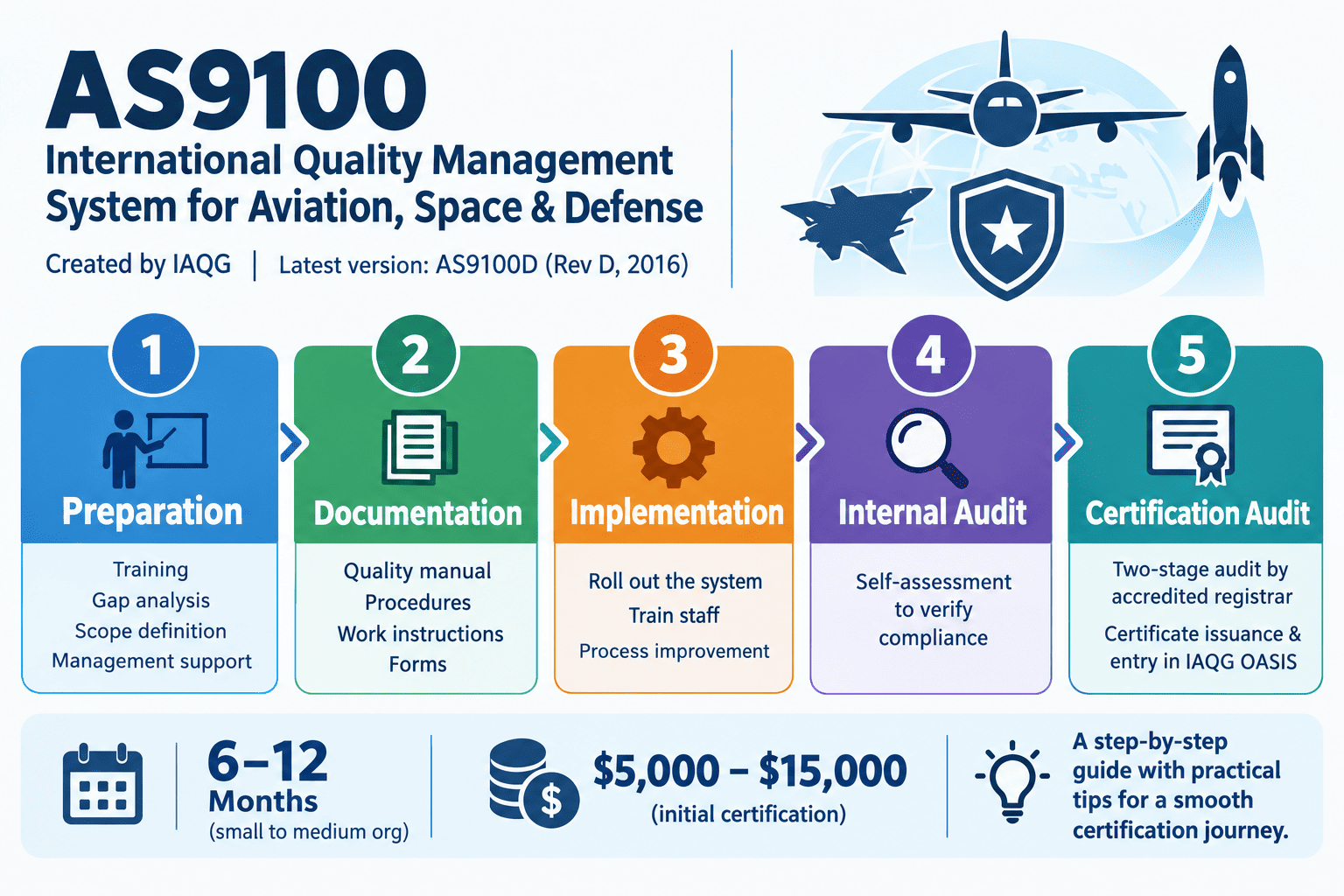
Direct Answer: AS9100 is the international Quality Management System (QMS) standard for the Aviation, Space and Defense (AS&D) industry, created by the International Aerospace Quality Group (IAQG). AS9100D (Rev D, 2016) is the most recent version. Getting certified involves a 5-step process: Preparation (training, gap analysis, scope definition, management support), Documentation (quality manual, procedures, work instructions, forms), Implementation (rolling out the system, training staff, process improvement), Internal Audit (self-assessment to verify compliance), and Certification Audit (two-stage audit by an accredited registrar, followed by certificate issuance and entry into the IAQG OASIS database). The process typically takes 6–12 months for a small to medium-sized organisation, with costs ranging from $5,000–$15,000 for initial certification. This guide walks you through every step, with practical tips for a smooth certification journey.
📅 May 5, 2026⏱ 16 min read✍️ GT Setu Editorial Team🔄 Updated regularly
1M+
Certified Organisations Worldwide
5
Key Steps to Certification
6–12
Months (Typical Timeline)
0%
GTsetu Broker Commission
AS9100 is the world’s most widely recognised aerospace quality management standard. Developed and published by the Society of Automotive Engineers (SAE) and supported by the International Aerospace Quality Group (IAQG), it specifies requirements for a Quality Management System (QMS) that organisations can use to demonstrate their ability to consistently provide products and services that meet customer and regulatory requirements. AS9100 is based on ISO 9001 and adds industry-specific requirements for safety, reliability, and regulatory compliance. With certification becoming increasingly important in the aerospace supply chain, AS9100 is the foundational certification for organisations that take quality seriously.
For manufacturers, distributors, and industrial companies in the aerospace, space, and defense sectors, AS9100 certification is often a prerequisite for doing business with large OEMs, government agencies, and international clients. It signals that your organisation has implemented robust processes for quality control, continuous improvement, and customer satisfaction. This guide covers the complete certification process, from initial preparation through to the final certification audit, and provides practical, actionable advice for a smooth journey. See our related guides on commercial due diligence, warranty clauses, and master services agreements to understand how AS9100 integrates with broader commercial frameworks.
📋 Who Is This Guide For?
This guide is written for quality managers, aerospace engineers, operations directors, and anyone responsible for implementing or maintaining a Quality Management System in their organisation. It covers both the DIY approach (using templates and internal resources) and the consultant-led route. It is equally relevant for manufacturers seeking certification to secure new aerospace clients, and for distributors who need to demonstrate quality management to their principals. For related partnership structures, see our guides on indemnification clauses, breach of contract, and termination for convenience.
SECTION 1
1 What Is AS9100 & Why Get Certified?
📋 The Standard Explained
AS9100 is the international standard that defines the requirements for a Quality Management System (QMS) specific to the Aviation, Space and Defense (AS&D) industry. It was developed by the International Aerospace Quality Group (IAQG) with the help of representatives from aviation, space and defense companies in the Americas, Asia/Pacific and Europe. The standard is based on ISO 9001 and adds industry-specific requirements for safety, reliability, counterfeit parts prevention, risk management, configuration management, and regulatory compliance. The current version is AS9100D (Rev D, 2016), with an amendment (ISO 9001:2015/AMD1:2024) addressing climate action changes. Certification demonstrates that your organisation has a documented QMS that meets these requirements, and that you are committed to consistent quality, customer satisfaction, and continuous improvement.
🌐
Globally Recognised Standard
AS9100 is recognised internationally and accepted throughout the aerospace supply chain, providing a common framework for quality across global supply chains and industries.
🏛️
Market Access & Competitive Advantage
Many large aerospace OEMs, government agencies, and international buyers require AS9100 certification as a condition for doing business. It differentiates you from non-certified competitors and opens doors to the aerospace supply chain.
🔄
Continuous Improvement Framework
AS9100 provides a systematic framework for identifying and implementing improvements across your organisation, leading to reduced errors, lower costs, and higher efficiency.
📈
Customer Satisfaction & Trust
Certification signals to your customers that you have robust quality controls and a commitment to meeting their requirements, building trust and strengthening relationships.
SECTION 2
2 Key Benefits of AS9100 Certification
AS9100 certification delivers tangible benefits across operational, commercial, and strategic dimensions. While the certification process requires investment, the return on that investment is well-documented across industries.
30%
Average reduction in operational errors reported by certified organisations (IAQG Survey)
Typical cost savings from reduced rework and waste after QMS implementation (Quality Progress)
🏷️
Enhanced Market Credibility
AS9100 certification signals to customers, partners, and regulators that you have a validated system for managing quality. This credibility opens doors to new business opportunities with aerospace OEMs and primes.
Commercial
💰
Cost Reduction & Efficiency Gains
By systematically identifying and eliminating the root causes of errors and inefficiencies, certified organisations reduce rework, waste, and non-conformance costs. The process-focused approach drives operational efficiency.
Operational
🔗
Supply Chain Integration
AS9100 provides a common framework for quality management across aerospace supply chains, enabling smoother collaboration with partners, easier audits, and more consistent quality throughout the value chain.
Partnership
📊
Data-Driven Decision Making
The standard requires organisations to collect and analyse quality data, enabling evidence-based decisions. This reduces reliance on intuition and improves the quality of operational and strategic decisions.
Analytical
👥
Employee Engagement & Clarity
Clear processes, defined responsibilities, and documented procedures improve employee understanding of their roles and how their work contributes to quality objectives, increasing engagement and reducing ambiguity.
People
📋
Regulatory & Risk Management
The risk-based thinking embedded in AS9100D helps organisations proactively identify and mitigate quality-related risks, reducing exposure to regulatory non-compliance and product liability issues.
Compliance
SECTION 3
3 AS9100 Versions & Related Standards
AS9100 has evolved over several revisions, each building on the previous version and aligning with updates to ISO 9001. Understanding the different versions and related standards is essential for selecting the right certification for your organisation.
Version
Year
Key Changes
AS9100D (Rev D)
2016
Based on ISO 9001:2015. Includes Annex L High Level Structure, context of the organization, interested parties, accountability of top management, documented information, risk-based thinking, communication, and change management. Adds unique aerospace requirements: counterfeit parts prevention, human factors, product safety, ethics training, supplier monitoring, and purchasing flow-down.
AS9100C (Rev C)
2009
Based on ISO 9001:2008. Introduced special requirements, critical items, project management, risk management, configuration management, work transfers, key characteristics, and First Article Inspection (FAI).
AS9100B (Rev B)
2004
Based on ISO 9001:2000. Emphasized adherence to statutory and regulatory requirements and continual improvement. Removed all references to ISO 9001:1994.
AS9100A (Rev A)
2000
Included ASQ/ISO 9001:2000 and specified additional requirements for the aerospace industry. Two sections: one aligned with ISO 9001:2000 and one legacy model aligned with ISO 9001:1994.
AS9100 (Initial)
1999
Included ASQ 9001:2000 quality system requirements along with specific requirements for the aerospace industry.
AS9000
1997
Based on ISO 9001:1994 with additional requirements for the aerospace industry. Created to address the specific requirements of aerospace customers.
🔧
AS9110, MRO Stations
Aerospace Management Systems for Maintenance, Repair and Overhaul (MRO) Stations. Adds additional requirements to AS9100 relating to the maintenance of commercial, private and military aircraft.
📦
AS9120, Stockist Distributors
Aerospace Management Systems for Stockist Distributors. Adds requirements for the sourcing and production of aerospace components and materials.
💡 AS9100 = ISO 9001 + Aerospace Requirements
Certification to AS9100 includes certification to the popular ISO 9001 standard as well. A copy of the ISO 9001 standard is not required because the text is already included in the AS9100 Standard. AS9100 mentions several other guidance standards that you should understand, but these additional standards don’t require certification, they provide guidance. See our related guides on commercial due diligence and due diligence to understand how AS9100 integrates with partner evaluation.
SECTION 4
4 Step 1: Preparation, Foundation & Planning
🏗️ Building the Foundation
The preparation phase sets the foundation for your entire AS9100 certification project. The goal is to ensure you have the knowledge, resources, and support in place before beginning the detailed work of documentation and implementation. This phase typically takes 2–4 weeks for a small organisation, longer for larger or more complex operations.
1.1
Get Trained on AS9100
If you are managing the certification process, you need to understand the standard’s requirements and how to apply them in your organisation. Consider an AS9100 implementer training course, online or in-person, to build foundational knowledge. If you are working with a consultant, ensure you understand the key concepts to be an informed client.
1.2
Secure Executive Support
Top management commitment is critical. They must “walk the talk” by allocating resources, supporting the project, and communicating its importance. Provide executives with a concise overview of AS9100’s role in the business and the benefits certification will deliver, including access to aerospace OEMs.
1.3
Define Your Quality Goals & Scope
Define the specific operational and commercial benefits you want from certification (e.g., reduced error rates, new customer acquisition). Clearly define the scope of your QMS: which products, departments, locations, or activities will be included? You can exclude certain areas, but consider the pros and cons of limiting the scope. See indemnification clauses for a framework that can also apply to scope definition.
1.4
Conduct a Gap Analysis
Assess how compliant your organisation already is with AS9100 requirements and identify gaps. This helps you prioritise efforts and create a more accurate project plan. You can do this internally or with a consultant. For small organisations, multiple targeted mini-gap analyses during the documentation and implementation stages can be effective.
1.5
Create a Simple Project Plan
Plan your implementation steps, milestones, target dates, and responsibilities. For small and medium organisations, avoid complex Gantt charts; focus on a clear, simple plan that everyone understands. Define who will be the AS9100 point person (Management Representative) responsible for achieving and maintaining certification.
1.6
Generate Employee Awareness
Inform your staff about the AS9100 project early to prevent rumors and build engagement. Explain how certification benefits the company and individual employees, addressing concerns about job security and work processes. This creates buy-in and transforms staff into stakeholders in the project’s success.
💡 Pro Tip: Start Small and Scale
For organisations with multiple locations or product lines, consider a phased approach. Start with a pilot implementation in one department or location, learn from the experience, and then roll out to the rest of the organisation. This reduces risk and allows you to refine your approach based on real-world feedback. The same principle applies when building market entry partnerships, start with a focused approach and scale.
SECTION 5
5 Step 2: Documentation, Building Your QMS
Documentation is often considered the most challenging phase of AS9100 certification. It requires aligning documents with the standard’s technical requirements while tailoring them to your company’s unique context and needs. The goal is to create a documentation set that is useful, practical, and compliant, not a bureaucratic burden.
Document Type
Description
Key Consideration
Quality Policy
A statement of your organisation’s commitment to quality, approved by top management. It must be communicated to and understood by all employees.
Keep it concise and specific to your organisation. It should provide a framework for setting quality objectives.
Quality Objectives
Measurable goals aligned with the quality policy. They should be documented, monitored, and communicated. Examples: “reduce customer complaints by 20% in 12 months.”
Objectives should be SMART (Specific, Measurable, Achievable, Relevant, Time-bound).
Scope Statement
Defines the boundaries of your QMS: which products, services, locations, and activities are included and excluded.
Be clear about what is in scope and what is out. This is a key document for the auditor.
Procedures
Documented processes that describe how activities are performed. They can be combined or split to fit your business needs; there is no requirement to follow the ISO standard’s structure.
Create as many procedures as needed to address every requirement of AS9100, but avoid unnecessary bureaucracy. Use your company’s vernacular.
Work Instructions
Detailed step-by-step guidance for specific tasks, especially where errors would be costly or where tasks are rarely performed. They should be written by the people who do the work.
Use any format that’s useful: text, flowcharts, checklists, or even visual media. Focus on the end user’s needs.
Forms & Checklists
Tools for recording data, capturing evidence, and guiding work. They can serve as both work instructions (before completion) and records (after completion).
Create forms where they save time and effort in meeting AS9100 requirements. Avoid creating forms for their own sake.
Process Maps (Flowcharts)
Visual representations of workflows, showing how processes interact, where bottlenecks exist, and how inputs become outputs.
Useful for understanding and improving processes during implementation. Can be created by staff mapping their own work on a whiteboard.
Records
Evidence that you meet the requirements stated in your procedures, policy, objectives, and work instructions. AS9100D specifically requires records in multiple clauses.
Records must be retained for a defined period and be legible, identifiable, and retrievable. They are a key focus of audits.
💡 Documentation Best Practices
DO: Look for the simplest way to meet a requirement and adapt it to your business. Use your company’s vernacular and avoid “ISO language.” Use diagrams and illustrations rather than long-winded text. Use a visually appealing and easy-to-understand layout.
DON’T: Include time-consuming references to other documents. Include bureaucratic requirements that are not suitable for your company’s circumstances or culture. Create documents that don’t add value to your operations.
Consider using documentation templates, pre-written documents designed to be tailored to your company’s needs. They save time, reduce errors, and provide a reliable starting point. Ensure they come with detailed customisation instructions. This approach is also effective when drafting warranty clauses, start with a proven template and customise.
SECTION 6
6 Step 3: Implementation, Rolling Out Your QMS
Implementation is where your carefully designed QMS becomes a reality. This phase involves introducing your procedures to the workforce, training them, and guiding them through adjustments to improve their work processes. The goal is seamless integration into daily operations, supported by a compelling incentive for adopting the new processes.
📢
Introduce the Quality Policy
Top management should communicate the quality policy, explaining its significance and how the company will put it into practice. Staff must understand the policy and connect it to their individual responsibilities, this is a mandatory requirement of AS9100.
Leadership
🎓
Provide Manager Training
Department managers and team leaders are critical to making the QMS an integral part of daily operations. Equip them with knowledge and skills to leverage AS9100 for tangible benefits and involve them actively in implementation. Targeted manager training is a high-leverage activity.
Training
📋
Introduce Procedures Gradually
Start with document control, then introduce other procedures. The method of communication depends on your organisation’s size: staff meetings, a trickle-down approach via department managers, or a combination. The key is to ensure everyone understands their new roles and responsibilities.
Rollout
🔄
Achieve Process Improvement
Empower staff to redesign their work processes to align with AS9100 requirements. Teams can map existing processes on a whiteboard, identify bottlenecks and repetitions, and agree on improvements. The redesigned workflows should then be documented. This approach builds motivation and buy-in.
Improvement
✍️
Have Staff Develop Work Instructions
Detailed step-by-step guidance is essential for rarely performed or high-risk activities. Staff directly involved in the work should write these instructions, using any format (text, flowchart, visual) that is beneficial to the end user. This ensures practicality and accuracy.
Empowerment
📁
Keep Records
As you integrate AS9100 requirements into operations, records are being created and kept on file. These records will be reviewed by auditors to assess compliance. Ensure records are complete, legible, and properly stored.
Compliance
📣
Reap Early Marketing Benefits
Even before certification, you can start marketing your commitment to quality. Inform customers proactively about your pending accreditation, describe your QMS, and announce your intended certification date. This can help you secure new business earlier in the process.
Commercial
SECTION 7
7 Step 4: Internal Audit, Self-Assessment
🔍 Verifying Your QMS
Internal audits are a mandatory requirement of AS9100 and play a critical role in ensuring the effectiveness of your QMS. These self-inspections involve observing work processes, interviewing management and staff, and examining records. The objective is to verify compliance not only with AS9100 requirements but also with your own procedures and work instructions. Internal audits must be conducted before seeking certification and periodically thereafter. They can be performed by trained internal staff or outsourced to expert auditors.
📋
Set Up the Audit Program
Develop an audit schedule and methods for planning and preparing your audits. Create documents, forms, and checklists that support the audit process. Consider using lead auditor training that includes a module on managing the audit program.
👤
Appoint Qualified Auditors
Small businesses often rely on their AS9100 point person, quality manager, or safety inspector. Larger companies may form an audit team. Auditors should be objective and impartial, they cannot audit their own work. Being an auditor is typically an additional responsibility, not a full-time role.
🎓
Provide Auditor Training
Auditors must be familiar with the AS9100D standard, possess strong auditing skills, be capable of reporting findings and following up on corrective actions, and ideally, promote best practices and add operational value. Consider lead auditor training for your auditors.
🔄
Start Audits Early
Use internal audits as training tools to support implementation. You can start auditing during Step 3, focusing on specific requirements or procedures initially, and expanding the scope as the system matures. This early start helps identify and fix issues before the formal certification audit.
✅
Conduct a Complete Internal Audit
To be eligible for AS9100 registration, you must complete a comprehensive internal audit covering your entire QMS. The audit can be divided into multiple partial audits, focusing on specific departments or processes at a time. Address all identified nonconformities before proceeding to the certification audit.
📄
Outsource If Needed
If you lack internal audit expertise, you can outsource the pre-certification internal audit to experienced auditors. This ensures that all issues with your QMS are identified and addressed, increasing confidence in passing the certification audit.
💡 Internal Audit as a Management Tool
Many organisations view internal audits purely as a certification requirement, but they are a powerful management tool. Use them to identify process improvements, uncover hidden inefficiencies, and engage employees in quality thinking. A well-conducted internal audit provides valuable insights that go far beyond compliance. This same principle applies to material breach assessments, treat them as strategic tools, not just checkboxes.
SECTION 8
8 Step 5: Certification Audit, Getting Certified
The certification audit is the final step in obtaining AS9100 certification. It is conducted by an independent, third-party auditor from an accredited certification body (registrar). The audit is similar to your internal audits but with regulated scope and number of audit days. Successful completion results in the issuance of your AS9100 certificate, valid for three years.
Audit Stage
What Happens
Key Focus
Stage 1 Audit (Documentation Review)
The auditor reviews your quality manual, procedures, and other documentation to ensure they meet AS9100 requirements and that your QMS is ready for the on-site audit.
Completeness and adequacy of documentation. Identification of any gaps or nonconformities that must be addressed before Stage 2.
Stage 2 Audit (On-Site Verification)
The auditor visits your site to verify that your QMS is effectively implemented and working in practice. They will interview employees, observe processes, and review records.
Effective implementation of the QMS. Evidence that procedures are being followed and that the system is achieving its objectives. Verification that Stage 1 nonconformities have been addressed.
Audit Report & Decision
Following Stage 2, the auditor prepares a report detailing findings. If no major nonconformities are found, or if corrective actions are successfully implemented, the certification body issues your AS9100 certificate.
Overall conformity assessment. The certificate is valid for three years from the date of issue.
Surveillance Audits
During the three-year certificate validity period, the certification body conducts annual surveillance audits to ensure your QMS remains compliant and effective.
Ongoing compliance. The auditor checks that the QMS is being maintained and that continuous improvement is taking place.
Recertification Audit
After three years, you must undergo a recertification audit to renew your certificate. This is typically a more comprehensive audit than surveillance audits.
Full system re-assessment. You must demonstrate that your QMS remains effective and has evolved to meet changing business needs.
💡 Preparing for the Certification Audit
Prepare your company and staff: Ensure work areas are organised, outdated documents are removed, and staff are ready for the auditor. Explain what to expect, reduce anxiety, and rehearse typical questions like “How do you know you perform your work correctly?” and “How do you contribute to the company’s quality policy objectives?” Staff should answer truthfully without volunteering additional information.
Select your registrar: Choose an accredited certification body that has experience in your industry. Compare quotes, check their reputation, and ensure they are recognised by your customers or industry bodies. See due diligence for a framework that also applies to registrar selection.
SECTION 9
9 Costs & Timeline: What to Expect
The cost and timeline for AS9100 certification vary significantly based on organisation size, complexity, existing processes, and the resources you allocate to the project. Understanding these variables upfront helps in planning and budget setting.
Factor
Impact on Cost
Impact on Timeline
Organisation Size (Employees)
Small (1–50): $5,000–$10,000 Medium (50–250): $10,000–$20,000 Large (250+): $20,000+
Complexity extends documentation, implementation, and audit phases
Number of Working Shifts
Multi-shift operations require more audit time to cover all shifts, increasing cost
May extend the audit schedule slightly
Use of Templates / Digital Tools
Reduces consultant fees and internal time, significantly lowering cost
Can cut timeline by 30–50% by streamlining documentation and implementation
Consultant Involvement
Full consultant support: adds $5,000–$20,000+ to cost; DIY with templates: lower cost
Consultant can accelerate timeline by providing expertise and templates
📋 Digital & Low-Cost Certification Options
Several providers offer digital AS9100 certification platforms that significantly reduce cost and timeline. These digital solutions can bring certification within reach for small organisations that might otherwise find the traditional consultant-led route prohibitive. When evaluating such options, use the same commercial due diligence criteria you would apply to any B2B engagement.
SECTION 10
10 How to Choose a Certification Body (Registrar)
The certification body (also called a registrar) is the independent organisation that will conduct your audit and issue your AS9100 certificate. Choosing the right registrar is a critical decision that affects the cost, timeline, and market recognition of your certification.
🏛️
Accreditation Status
Ensure the registrar is accredited by a recognised national accreditation body (e.g., ANAB in the US, UKAS in the UK, DAKKS in Germany, JAS-ANZ in Australia/New Zealand). Accreditation ensures the registrar follows international standards for certification and is competent to audit.
🏭
Industry Experience
Choose a registrar with auditors who have experience in your specific industry. They will understand your processes, terminology, and risks, leading to a more relevant and valuable audit. Industry-specific auditors can also provide useful insights and best practice suggestions.
📋
Market Recognition
Consider whether your customers or industry bodies recognise the registrar’s certificate. In some industries, specific registrars are preferred or required. If you are exporting to a specific region, a registrar with local recognition in that market may be advantageous.
💰
Cost & Value
Compare quotes from multiple registrars. The cheapest option is not always the best, consider the value of the audit, the auditor’s expertise, and the registrar’s reputation. Ensure you understand what is included in the quoted fee (e.g., travel expenses, annual surveillance audits).
🌐
Global Capability
If you have or plan to have multiple sites in different countries, choose a registrar that can audit all sites consistently. This simplifies the management of your certification across locations and avoids the need to work with multiple registrars.
🤝
Relationship & Support
Choose a registrar you feel comfortable working with. The relationship should be collaborative, not adversarial. A good auditor will help you improve your QMS, not just find faults. Assess their responsiveness and communication during the quoting process as an indicator.
💡 Registrar Selection Checklist
When evaluating registrars, ask: Are you accredited by a recognised national accreditation body? Do you have auditors with experience in my industry? What is your audit process and how many days do you typically allocate for my organisation type? What is included in your fee and are there additional costs? How do you handle nonconformities and what is the process for issuing the certificate? Can you provide references from clients in my industry? How do you conduct surveillance audits? Use this information alongside your due diligence criteria to make an informed decision.
SECTION 11
11 Common Mistakes & How to Avoid Them
📋
Over-Documentation & Bureaucracy
Creating excessive documentation that adds no operational value and makes the system difficult to maintain. This creates employee resentment and audit fatigue.
Avoid: Focus on what is necessary to control your processes and demonstrate compliance. Use the simplest approach that meets the requirements. Ask: “Does this document add value?”
🏛️
Lack of Management Commitment
When leadership does not actively support the QMS, it becomes a compliance exercise for employees rather than a strategic initiative, leading to poor implementation and audit failures.
Avoid: Secure top management commitment from the start. Ensure they understand the business case for certification and communicate their support visibly to the organisation.
📖
“ISO Language” Instead of Your Language
Using standard-specific jargon instead of your company’s natural language makes procedures confusing and difficult for employees to follow and maintain.
Avoid: Write procedures in your company’s everyday language. Use diagrams and illustrations. Make them user-friendly and practical for the people who will use them.
🔄
Treating Certification as the End Goal
Focusing solely on passing the audit rather than building a QMS that improves operations. This leads to a system that is maintained only for the auditor, not for business performance.
Avoid: Design your QMS to solve real operational problems. Use the internal audits and management reviews for genuine improvement, not just audit readiness.
🎓
Inadequate Staff Training
Employees who do not understand the QMS or how their role contributes to it will not follow procedures consistently, leading to nonconformities and audit findings.
Avoid: Invest in training at all levels. Explain the “why” behind the procedures. Make training engaging and relevant to employees’ daily work. Consider using master services agreement models for structured training programmes.
📊
Ignoring the Internal Audit Results
Failing to address internal audit findings before the certification audit, or treating internal audits as a tick-box exercise without taking corrective action.
Avoid: Use internal audits as a genuine check on your system. Address all findings promptly. Conduct root cause analysis and implement corrective actions that prevent recurrence. See consequential damages principles applied to quality risks.
SECTION 12
12 How GTsetu Supports Your AS9100 Certification Journey
🔗 GTsetu, Verified B2B Platform
Connect with Verified Partners & Build Aerospace Supply Chains
AS9100 certification is a powerful tool for demonstrating quality to customers and partners. GTsetu complements your certification by connecting you with verified manufacturers, distributors, and suppliers who meet rigorous quality standards. Our platform provides:
✅
Verified Company Profiles
Every company on GTsetu is verified on 6 key data points (Name, Address, Registration Number, Company Status, Company Type, Date of Incorporation) using government tie-ups, complementing your AS9100 due diligence.
🕵️
Anonymous Discovery
Browse verified partner profiles without revealing your identity until you’re ready to engage, protecting your sourcing strategy and commercial confidentiality.
📄
Built-In NDA Workflow
Digital mutual NDA with timestamped signatures, activated before any sensitive commercial or technical data is exchanged, supporting your IP protection and confidentiality commitments under AS9100.
🔐
Encrypted Document Workspace
AES-256 encryption at rest, TLS in transit, role-based access controls, and full audit trail, ensuring the secure exchange of quality documentation, specs, and contracts with partners.
🚫
Zero Broker Commission
GTsetu charges zero commission on any partnership formed. All commercial value stays between you and your verified partner, supporting the cost management objectives of your QMS.
🌏
Global Network of Verified Partners
Access verified manufacturers, distributors, and suppliers across 100+ countries, supporting your aerospace supply chain quality objectives and enabling you to build a network of AS9100-aligned partners.
QWhat is AS9100 certification and why is it important?
AS9100 is the internationally recognized Quality Management System (QMS) standard for the Aviation, Space and Defense (AS&D) industry. It is based on ISO 9001 and adds industry-specific requirements for safety, reliability, and regulatory compliance. Certification demonstrates that your company has implemented a QMS that meets these requirements, ensuring consistent product quality, customer satisfaction, and continuous improvement. It is often a prerequisite for doing business with aerospace OEMs and primes. For manufacturers and distributors, it provides a competitive edge and is a key factor in exclusivity clause negotiations with potential clients.
QWhat are the 5 main steps to get AS9100 certified?
The 5 main steps are: (1) Preparation, get trained, secure management support, conduct a gap analysis, define scope, and plan your project. (2) Documentation, create your quality manual, procedures, work instructions, and forms tailored to your business. (3) Implementation, roll out the new system, train your team, and improve processes. (4) Internal Audit, conduct a self-assessment to verify the system works and complies with AS9100. (5) Certification Audit, undergo a two-stage audit by an accredited registrar and receive your certificate. This structured approach is similar to building any market entry partnership, start with a solid foundation and build methodically.
QHow long does it take to get AS9100 certification?
The timeline varies by company size and readiness. For small organizations (under 50 employees), the process typically takes 6-8 months. Medium organizations (50-250 employees) usually take 8-12 months. Large organizations (250+ employees) may take 12-15 months. The timeline includes preparation, documentation, implementation, internal audit, and the final certification audit. Using templates or digital tools can significantly reduce the time to certification, sometimes to just a few months.
QHow much does AS9100 certification cost?
The cost varies based on company size, number of employees, number of processes, complexity of the management system, industry risk level, and number of working shifts. Factors include: registrar fees (for the certification audit), consultant fees (if hired), internal resource time, and ongoing surveillance audit costs. A typical range for a small to medium company is $5,000-$15,000 for the initial certification, with annual surveillance audits costing $2,000-$5,000. Digital solutions can offer more cost-effective subscription-based models for smaller organisations.
QWhat documents are required for AS9100 certification?
Key required documents include: Quality Policy, Quality Objectives, Scope Statement, Quality Manual, documented procedures (as needed to demonstrate control), work instructions (for critical tasks), forms and records, and process maps. AS9100D specifically requires documented information to support the operation of the QMS. The approach should be to create as many procedures as necessary to adequately address every requirement of the standard, tailored to your business needs. Using templates can help ensure completeness and reduce the burden of starting from scratch, much like using a warranty clause template saves time in legal drafting.
QHow do I choose an AS9100 certification body (registrar)?
Choose a reputable registrar that is accredited by a national accreditation body (e.g., ANAB, UKAS, DAKKS, JAS-ANZ) and recognized by the IAQG. Evaluate several certification bodies, check if they follow CASCO standards, and compare quotes. Consider their industry experience, auditor qualifications, and whether they are recognized by your customers or industry bodies. A good registrar will assign auditors with relevant experience in your industry sector and aerospace quality management. The selection process should mirror the rigor you would apply when using commercial due diligence to choose any business partner.
QWhat happens during an AS9100 certification audit?
The certification audit is conducted in two stages. Stage 1 (Documentation Review): The auditor reviews your quality manual, procedures, and other documentation to ensure they meet AS9100 requirements and that your QMS is ready for the on-site audit. Stage 2 (On-Site Verification): The auditor visits your site to verify that your QMS is effectively implemented and working in practice. They interview employees, observe processes, and review records. If successful, the auditor recommends certification, and the certification body issues your AS9100 certificate, valid for three years.
Connect with verified manufacturers, distributors, and suppliers on GTsetu, compliance-backed verification, anonymous discovery, built-in NDA workflows, and zero broker commissions. Find partners who share your commitment to quality and aerospace excellence.
They represents the product, and research team behind GTsetu, a global B2B collaboration platform built to help companies explore cross-border partnerships with clarity and trust. The team focuses on simplifying early-stage international business discovery by combining structured company profiles, verification-led access, and controlled collaboration workflows.
With a strong emphasis on trust, and disciplined engagement, Team GTsetu shares insights on global trade, partnerships, and cross-border collaboration, helping businesses make informed decisions before entering deeper commercial discussions.