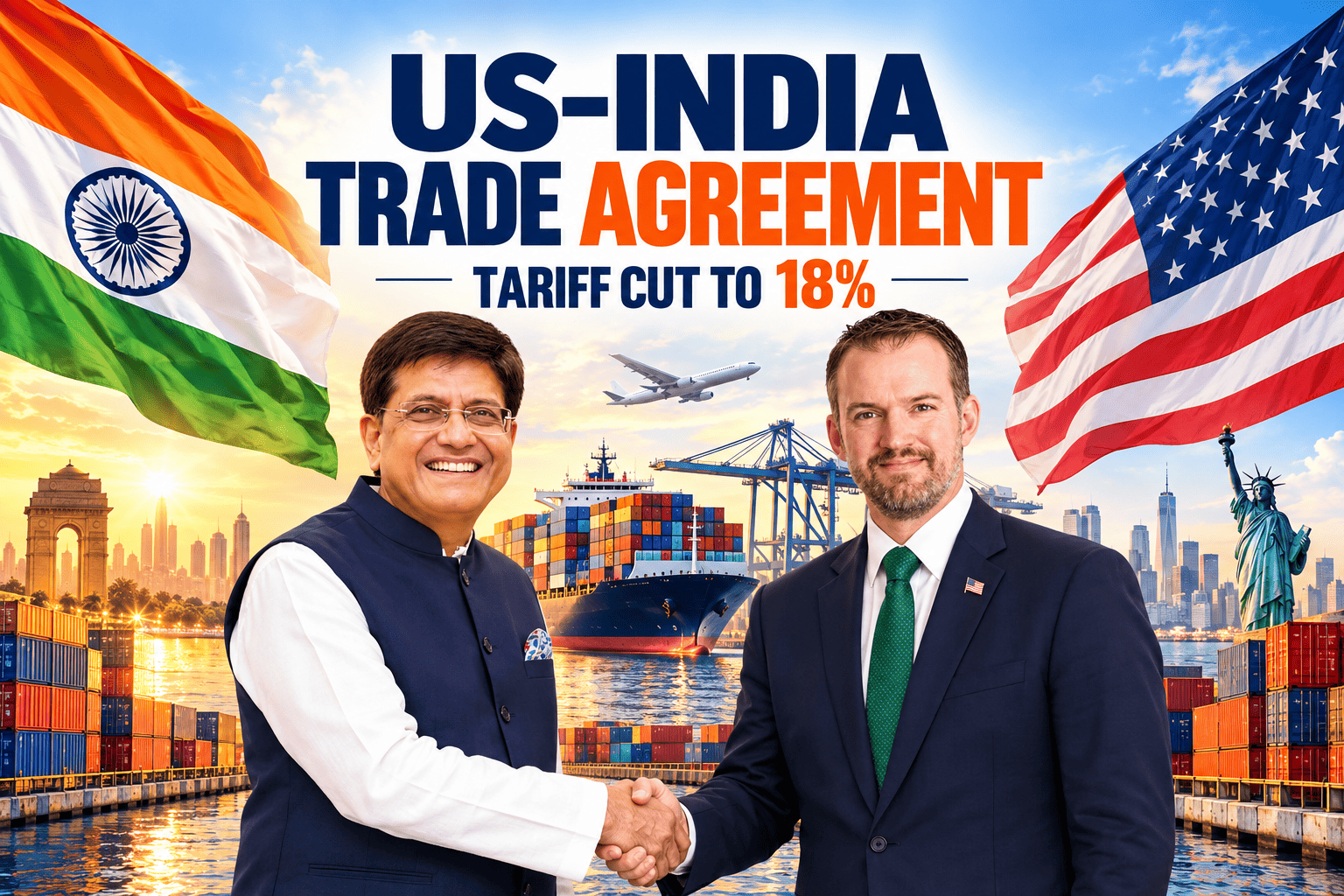
U.S.–India Trade Deal: What the Interim Framework Means for Business
On 6 February 2026, the United States and India announced a framework for an interim trade agreement, cutting the U.S. reciprocal tariff on Indian goods from 25 percent to 18 percent and removing a separate 25 percent surcharge tied to India’s purchases of Russian oil. The framework commits India to eliminating or reducing tariffs on U.S. industrial and agricultural goods and to purchasing over $500 billion in U.S. energy, technology, and other products, while both sides keep negotiating the fuller Bilateral Trade Agreement (BTA) behind it. As of 1 October 2026, that broader deal remains unsigned, with Commerce Minister Piyush Goyal and U.S. Trade Representative Jamieson Greer still working to finalise terms. This article lays out what was actually agreed, what is still open, and what businesses trading between the two countries should watch for next.
📅 Published February 10, 2026⏱ 11 min read✍️ GTsetu Editorial🔄 Updated October 1, 2026
Date Announced
6 Feb 2026
Parties
🇺🇸 USA – 🇮🇳 India
Agreement
Interim Trade Framework
Type
Trade Framework
Status (1 Oct 2026)
Framework agreed; not a signed FTA
Trade frameworks like this one tend to get reported as finished deals the day they are announced, when in practice they are closer to a ceasefire with a roadmap attached. The February announcement genuinely changed tariff rates and genuinely set direction for a fuller agreement, but it is not itself a signed free trade agreement, and as of October 2026 the follow-on Bilateral Trade Agreement it points toward is still being negotiated. Understanding that distinction matters for any business trying to plan around it.
Section 1
The Framework in Numbers
The core of the announcement was tariff relief, backed by a large Indian purchase commitment and a roadmap for the negotiations still to come.
25% → 18%
Reduction in the U.S. reciprocal tariff applied to Indian goods, announced 6 February 2026
0%
Additional Russia-oil-linked surcharge remaining, after the 25% add-on was removed by executive order
$500B+
Value of U.S. energy, ICT, coal, and other products India intends to purchase under the framework
37%
Average Indian tariff on agricultural goods cited by the U.S. as the baseline this framework addresses
💡 A framework is not a treaty
The 6 February announcement was a Joint Statement setting out agreed terms and direction, not a ratified or fully implemented trade agreement. Tariff changes tied to it (the removal of the Russia-oil surcharge and the reduction to 18%) took effect through a U.S. executive order, but the broader package, including rules of origin, digital trade rules, and non-tariff barrier commitments, is still being implemented and negotiated.
Section 2
What Actually Changed on 6 February
The announcement followed a phone call between President Trump and Prime Minister Modi, after which the two sides reached a framework for an interim agreement on reciprocal trade. Two concrete tariff actions came out of that call and the Joint Statement that followed:
The 25% Russia-oil surcharge was removed. President Trump agreed to remove the additional 25 percent tariff the U.S. had placed on Indian imports, in recognition of India’s commitment to stop purchasing Russian Federation oil, and signed an executive order to that effect.
The reciprocal tariff was cut from 25% to 18%. Citing India’s willingness to address systemic imbalances in the bilateral trade relationship and shared national security concerns, the U.S. lowered its baseline reciprocal tariff on India accordingly.
Prime Minister Modi publicly welcomed the framework, describing it as reflecting the “growing depth, trust and dynamism” of the India-U.S. partnership, and framing it as a boost to Make in India, India’s MSMEs, startups, farmers, and fishermen, while strengthening investment and technology ties and supply chain resilience.
Section 3
What’s in the Framework: Core Commitments
The Key Terms, As Announced
Beyond the tariff numbers, the Joint Statement and accompanying fact sheet laid out a set of commitments covering market access, purchasing, digital trade, and economic security cooperation.
1
India’s Market Access Commitments
Tariff elimination or reduction on U.S. industrial and agricultural goods
Market Access
India will eliminate or reduce tariffs on all U.S. industrial goods and a wide range of U.S. food and agricultural products, explicitly naming dried distillers’ grains, red sorghum, tree nuts, fresh and processed fruit, soybean oil, wine and spirits, and additional products. The U.S. side frames this against a baseline where India has maintained tariffs as high as an average of 37 percent on agricultural goods and over 100 percent on certain autos, among the highest of any major economy.
🎯
Why it matters: U.S. exporters in these specific categories gain the clearest, most immediate benefit from the framework, ahead of whatever the broader BTA eventually covers.
2
India’s Purchase Commitments
Over $500 billion across energy, technology, and coal
Purchasing
India intends to buy more American products and purchase over $500 billion of U.S. energy, information and communication technology, coal, and other products under the framework. This purchasing commitment sits alongside, rather than instead of, the tariff reductions, and is one of the headline figures the U.S. side has used to characterise the deal’s scale.
🎯
Why it matters: A commitment of this size signals where U.S. exporters in energy and technology sectors should expect demand to grow, though the pace and mechanics of delivery depend on the BTA still being finalised.
3
Non-Tariff Barriers, Rules of Origin, and Digital Trade
Addressing protectionist practices and setting digital trade rules
Regulatory
India committed to address non-tariff barriers affecting bilateral trade in priority areas, with both sides set to negotiate rules of origin ensuring agreed benefits accrue predominately to the United States and India, limiting pass-through from third countries. India also committed to negotiate a robust set of bilateral digital trade rules addressing discriminatory or burdensome practices and other barriers to digital trade, a priority area given India’s size as a digital market.
🎯
Why it matters: Rules of origin in particular will determine whether goods merely transshipped through India or the U.S. qualify for preferential treatment, a detail with direct implications for any cross-border manufacturing strategy built around this corridor.
The two countries committed to strengthen economic security alignment to enhance supply chain resilience and innovation, through complementary actions addressing non-market policies of third parties, and cooperation on inbound and outbound investment reviews and export controls. The framework also commits both sides to significantly increase bilateral trade in technology products and expand joint technology cooperation, extending the relationship well beyond traditional goods trade.
🎯
Why it matters: This is the clearest signal that the relationship is being built as a long-term strategic and technology partnership, not just a tariff adjustment, relevant to anyone evaluating a technology partnership spanning the two countries.
Section 4
What’s Still Being Negotiated
The February framework explicitly describes itself as a step toward a fuller Bilateral Trade Agreement, not a substitute for one. Per the Terms of Reference for the BTA, the two countries will continue negotiations covering a long list of unresolved areas:
Area Still Under Negotiation
What It Covers
Remaining tariff barriers
Categories not addressed in the February framework’s initial list
Additional non-tariff barriers
Broader protectionist practices beyond the priority areas already named
Technical barriers to trade
Standards, testing, and certification requirements
Customs and trade facilitation
Border procedures and clearance processes
Services and investment
Market access for services and investment protections
Intellectual property
IP protection and enforcement standards
Labor and environment
Standards commonly attached to modern trade agreements
Government procurement
Access to public-sector contracts in each market
State-owned enterprise practices
Trade-distorting or unfair practices by SOEs
This list is long by design, since a framework announced in a single Joint Statement cannot resolve the full scope of issues a comprehensive bilateral agreement typically covers. It is also why describing the February announcement as a finished “trade deal” overstates what was actually signed, even though the tariff relief it delivered was real and immediate.
Section 5
Timeline: From Tariff Dispute to Framework to BTA Talks
2 Apr 2025
U.S. declares a national emergency over trade deficits
President Trump cites a large, persistent U.S. goods trade deficit and a lack of reciprocity in bilateral trade relationships as the basis for broader tariff action, setting the stage for the India dispute.
2025
Tariffs on India escalate to 50%
A 25% reciprocal tariff and a separate 25% surcharge tied to India’s continued purchases of Russian oil push combined U.S. tariffs on Indian goods to roughly 50%, straining the relationship.
~30 Jan 2026
Trump-Modi call reaches a framework
A phone call between the two leaders produces agreement on a framework for an Interim Agreement on reciprocal trade, alongside reaffirmed commitment to the broader BTA negotiations.
6 Feb 2026
Joint Statement and fact sheet released
The White House and U.S. Embassy India publish the Joint Statement and fact sheet detailing tariff cuts, market access commitments, and the roadmap toward a full BTA. PM Modi publicly welcomes the framework.
28 Sep 2026
Jaishankar signals “more or less an understanding”
India’s External Affairs Minister tells an Asia Society event in New York that the two sides have reached broad understanding on the trade agreement, while noting that changes to the U.S. tariff framework have complicated the timing of its conclusion.
29 Sep – 5 Oct 2026
Goyal travels to the U.S. for BTA and interim deal talks
Commerce Minister Piyush Goyal meets USTR Jamieson Greer in Washington and attends the G20 Trade Ministers’ meeting in Milwaukee, aiming to finalise the interim agreement amid new complications from a U.S. law allowing tariffs of up to 100% on countries buying Russian oil or gas.
30 Sep 2026
Modi and Trump hold a follow-up call
The two leaders review bilateral cooperation in trade, defence, energy, and critical technologies, and agree to maintain close engagement, as Goyal’s talks with Greer continue. No interim agreement is finalised at this point.
📌 Status as of 1 October 2026
The February framework remains the most concrete, implemented outcome to date, the tariff reduction and surcharge removal are in effect. The interim agreement it describes, and the fuller BTA behind that, are both still being negotiated, with talks complicated most recently by new U.S. legislation enabling steep tariffs on countries buying significant volumes of Russian oil or gas. India has raised concerns with Washington over that law. Businesses should treat the relationship as actively in motion rather than settled.
Section 6
What This Means for Businesses Trading With India
For a business actually moving goods, components, or services between the U.S. and India, the practical takeaway is that conditions have improved but the rulebook is not finished. Treating the February framework as the final word risks missing changes still to come in rules of origin, services access, or additional tariff categories, exactly the kind of uncertainty that makes formal contracting and risk allocation matter more, not less, during a transition period like this one.
🏛️
Verify counterpart registration independently
Confirm a partner’s legal registration and current standing before committing, regardless of where tariff policy eventually lands.
GTsetu: Verified Discovery and Secure Engagement While Policy Keeps Moving
A tariff framework changes the economics of trade between two countries. It does not verify who you are actually doing business with, protect your specifications during negotiation, or give you a formal record if a disagreement arises later. That gap is what GTsetu is built to close. It is a structured partnership platform, not a directory or a general marketplace, where every company is verified on 6 government-sourced points before engagement, where discovery is anonymous until mutual interest is confirmed, where NDAs are executed digitally before any commercial information changes hands, and where document exchange happens through an encrypted workspace rather than email attachments.
GTsetu is used by industrial manufacturers, distributors, and raw material suppliers across 100+ countries, including both the United States and India, to build out a distributor network, source international wholesale distribution partners, or find manufacturing and technology partnership relationships they intend to keep for years, not a single shipment timed to a tariff window.
🏛️
6-Point Government-Sourced Verification
Name, Address, Registration Number, Company Status, Company Type, and Date of Incorporation, verified using government tie-ups before any engagement.
🕵️
Anonymous Discovery
Browse verified manufacturer and distributor profiles across 100+ countries without revealing your own identity or sourcing strategy until you choose to engage.
📄
Built-In NDA Workflow
Digital NDA with timestamped signatures before any pricing, formulations, or product specs are shared.
🔐
Encrypted Document Workspace
All commercial documents shared through encrypted channels with a full access audit trail, not email attachments.
🌍
100+ Countries, Including the U.S. and India
Verified manufacturers and distributors across Asia, the Middle East, Europe, Africa, Australia, and the Americas.
🚫
Zero Commission
No success fee, no broker commission, ever. Your partnership economics remain entirely between you and your partner.
QHas the U.S. and India signed a free trade agreement?
No. As of 1 October 2026, the two countries have a framework for an interim trade agreement, announced on 6 February 2026, and a broader Bilateral Trade Agreement (BTA) is still under negotiation. No comprehensive FTA has been signed. Commerce Minister Piyush Goyal and USTR Jamieson Greer continued talks through late September and early October 2026 to try to finalise the interim agreement.
QWhat tariff changes have already taken effect?
Following a call between President Trump and Prime Minister Modi, the additional 25% tariff the U.S. had imposed on Indian goods over India’s purchases of Russian oil was removed by executive order, and the U.S. reciprocal tariff on India was lowered from 25% to 18%. These changes were announced in the 6 February 2026 Joint Statement and fact sheet.
QWhat is India committing to buy from the United States?
Under the framework, India intends to purchase over $500 billion of U.S. energy, information and communication technology, coal, and other products, alongside eliminating or reducing tariffs on U.S. industrial goods and a wide range of agricultural products including distillers’ grains, red sorghum, tree nuts, fresh and processed fruit, soybean oil, and wine and spirits.
QWhat is still being negotiated between the U.S. and India?
The Terms of Reference for the broader Bilateral Trade Agreement cover remaining tariff and non-tariff barriers, technical barriers to trade, customs and trade facilitation, good regulatory practices, trade remedies, services and investment, intellectual property, labor, environment, government procurement, and trade-distorting practices of state-owned enterprises. As of late September 2026, talks were complicated by a new U.S. law allowing tariffs of up to 100% on countries buying significant volumes of Russian oil or gas, which India has flagged as a concern.
GTsetu is purpose-built for manufacturers, distributors, and raw material suppliers in industrial sectors seeking verified long-term trade partnerships, across 100+ countries including the U.S. and India, with government-sourced partner verification, built-in NDA workflows, and zero commission.
They represents the product, and research team behind GTsetu, a global B2B collaboration platform built to help companies explore cross-border partnerships with clarity and trust. The team focuses on simplifying early-stage international business discovery by combining structured company profiles, verification-led access, and controlled collaboration workflows.
With a strong emphasis on trust, and disciplined engagement, Team GTsetu shares insights on global trade, partnerships, and cross-border collaboration, helping businesses make informed decisions before entering deeper commercial discussions.