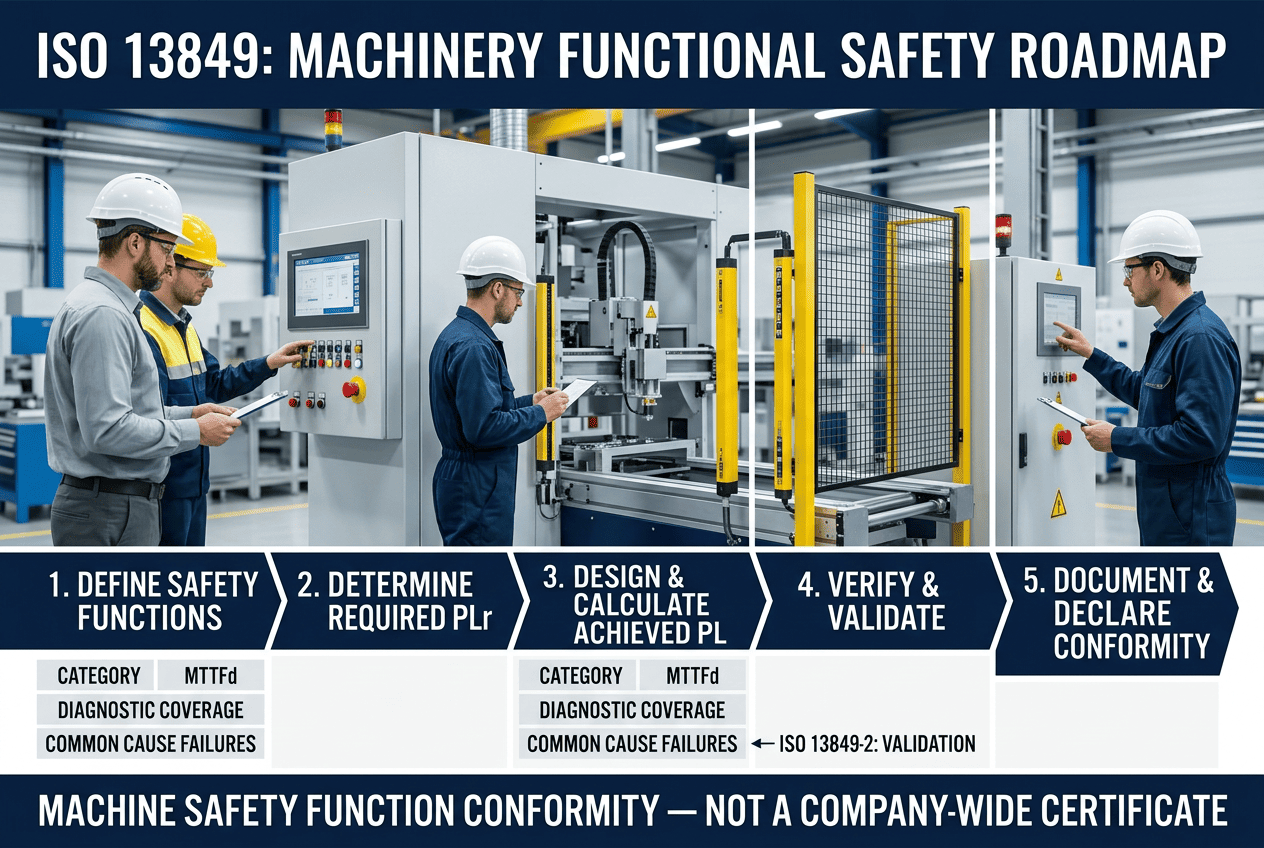
Direct Answer: ISO 13849 is the international standard for the safety of machinery, safety-related parts of control systems. Unlike ISO 9001 or ISO 27001, it is not a management system, so there is no company-wide “ISO 13849 certificate”; instead you demonstrate that each machine safety function meets the standard, optionally backed by third-party assessment. The process has 5 steps: Define Safety Functions (risk assessment), Determine Required Performance Level (PLr), Design & Calculate the Achieved PL (category, MTTFd, diagnostic coverage, common cause failures), Verify & Validate (ISO 13849-2), and Document, Assess & Declare Conformity. Effort ranges from a few weeks for simple machines to several months for complex ones. This guide walks you through every step.
📅 November 3, 2026⏱ 17 min read✍️ GT Setu Editorial Team🔄 Updated regularly
a–e
Performance Levels (PL)
5
Key Steps to Compliance
5
Designated Architectures (B, 1, 2, 3, 4)
0%
GTsetu Broker Commission
ISO 13849 is the internationally recognised standard for the functional safety of machinery control systems. Its first part, ISO 13849-1, sets out safety requirements and guidance on the principles for the design and integration of safety-related parts of control systems (SRP/CS), including software design, and expresses the reliability of each safety function as a Performance Level (PL). The second part, ISO 13849-2, specifies how to validate those safety functions through analysis and testing.
For machine builders, system integrators, and component manufacturers, ISO 13849 compliance is often central to demonstrating that emergency stops, guard interlocks, light curtains, two-hand controls, and safe drives are dependable enough for the risk they control. Because it is a product and system safety standard rather than a management system, the route to “certification” differs from standards such as ISO 9001. This guide explains what that means in practice, and shows how it connects with ISO 45001 (occupational health and safety) and ISO 14971 (risk management). See also our articles on partnership evaluation criteria and business verification.
📋 Who Is This Guide For?
This guide is written for machine builders, control and safety engineers, system integrators, OEMs, plant owners modifying machinery, and component manufacturers who need to design, verify, or document machine safety functions. It is equally relevant for distributors and sourcing teams assessing whether a supplier’s machines and safety components meet recognised requirements. For related partnership structures, see our guides on supplier collaboration platforms and distributors and manufacturers.
⚠️ Important: “Certification” Means Something Different Here
There is no accredited “ISO 13849 management system certificate” for a company. What you can obtain is (a) a documented demonstration of conformity for your own machine or safety function, and optionally (b) an independent certificate or test report for a product or safety function from a testing, inspection, or certification body. Applicable legal requirements, such as CE marking in the EU, are separate obligations in which ISO 13849 helps provide a presumption of conformity when the relevant edition is harmonised. Always confirm current requirements for your market.
SECTION 1
1 What Is ISO 13849 & Why Comply?
⚙️ The Standard Explained
ISO 13849 is titled Safety of machinery, Safety-related parts of control systems. Part 1 (ISO 13849-1, currently the 2023 edition) covers general principles for design, including categories, reliability data, diagnostics, systematic failure avoidance, and software. Part 2 (ISO 13849-2) covers validation. The central idea is that each safety function, such as stopping a machine when a guard is opened, must reach a Performance Level (PL a–e) at least as high as the required Performance Level (PLr) determined by risk assessment. The standard applies to electrical, hydraulic, pneumatic, and mechanical technologies and is widely used alongside IEC 62061, which takes a related approach using Safety Integrity Levels (SIL).
🛡️
Safer Machines
A structured method to ensure safety functions are reliable enough for the risk they control, reducing the chance of dangerous failures at the machine.
🏛️
Legal & Market Conformity
Applying relevant harmonised standards supports compliance with machinery legislation such as the EU Machinery Directive (and, from 20 January 2027, the Machinery Regulation) and with customer requirements.
🌐
Widely Used Method
A common language, PL, PFHd, category, shared by machine builders, component suppliers, and assessors worldwide.
🔗
Supply Chain Clarity
Safety component manufacturers publish PL, PFHd, MTTFd, and diagnostic coverage data, making it easier to build and verify safety functions.
SECTION 2
2 Key Benefits of ISO 13849 Compliance
Applying ISO 13849 delivers safety, legal, and commercial benefits. The structure forces design decisions to be traceable to a risk assessment rather than made by habit.
PL a–e
Five levels expressing the reliability of each safety function
2 parts
ISO 13849-1 for design and ISO 13849-2 for validation
5
Designated architectures: categories B, 1, 2, 3, and 4
🛡️
Reduced Risk of Injury
Safety functions are designed to perform reliably when needed, lowering the likelihood of dangerous failures that could injure operators or maintenance staff.
Safety
⚖️
Supports Legal Conformity
A documented, standards-based approach supports technical files, declarations of conformity, and customer audits, and can reduce liability exposure.
Compliance
🏷️
Customer & Tender Credibility
Machine buyers increasingly request evidence of PL calculations and validation reports, so a clear dossier helps win and retain business.
Commercial
💰
Right-Sized Safety Design
Matching achieved PL to required PL avoids both under-protection and costly over-engineering of safety circuits.
Efficiency
🔧
Maintainability & Lifecycle Clarity
Assumptions such as proof-test intervals and mission time are documented, supporting maintenance planning and later modifications.
Lifecycle
🔗
Smoother Supplier Collaboration
Standardised component data and shared terminology make it easier to specify, source, and verify safety components across the supply chain.
Partnership
SECTION 3
3 Key Concepts: PL, Categories, MTTFd, DC & CCF
ISO 13849-1 combines several parameters to estimate the Performance Level a safety function can achieve. Understanding them is essential before you begin design work.
📊
Performance Level (PL)
A discrete level from a (lowest) to e (highest) describing the ability of a safety function to perform under foreseeable conditions. Each corresponds to a range of PFHd, the average probability of dangerous failure per hour.
🏗️
Categories (B, 1, 2, 3, 4)
Designated architectures describing structure and fault behaviour, from basic (B) and well-tried components (1), to testing (2), redundancy (3), and redundancy with high diagnostic coverage (4).
⏳
MTTFd
Mean time to dangerous failure of each channel, classed as low (3 to under 10 years), medium (10 to under 30 years), or high (30 to 100 years). Values are capped at 100 years per channel.
🔍
Diagnostic Coverage (DC)
The effectiveness of fault detection, classed as none (under 60%), low (60–90%), medium (90–99%), or high (99% and above).
🔗
Common Cause Failure (CCF)
Measures against failures from a single cause affecting redundant channels. A score of at least 65 out of 100 is required for categories 2, 3, and 4.
💾
Systematic Failures & Software
Requirements for avoiding systematic faults in design, and for safety-related embedded and application software, including development, verification, and modification control.
Performance Level
Average Probability of Dangerous Failure per Hour (PFHd)
PL a
≥ 10⁻⁵ to < 10⁻⁴
PL b
≥ 3 × 10⁻⁶ to < 10⁻⁵
PL c
≥ 10⁻⁶ to < 3 × 10⁻⁶
PL d
≥ 10⁻⁷ to < 10⁻⁶
PL e
≥ 10⁻⁸ to < 10⁻⁷
📋 ISO 13849 vs IEC 62061
ISO 13849-1 uses Performance Levels (a–e) and is common for mixed technologies, while IEC 62061 uses Safety Integrity Levels (SIL 1–3) and focuses on electrical, electronic, and programmable systems. Both address safety functions of machinery and can be used to demonstrate conformity; the choice often depends on technology, customer preference, and company practice. Guidance on applying both is provided in ISO/TR 23849.
Every ISO 13849 project starts with a risk assessment. You identify hazards across the machine’s life, decide which risks need risk reduction by control measures, and specify each safety function, what it does, when it acts, and how quickly. This phase can take days for a simple machine or weeks for complex lines.
1.1
Define Machine Limits & Intended Use
Document intended use, foreseeable misuse, operating modes (automatic, setup, maintenance), users, and environment. Safety functions must be specified for all relevant modes.
1.2
Identify Hazards & Assess Risk
Follow a recognised risk assessment process such as ISO 12100 to identify hazards, estimate risk, and decide where safety-related control functions are needed. Organisations running a safety management system can align this work with ISO 45001.
1.3
Apply Inherently Safe Design First
Where possible, remove or reduce hazards by design and use guards before relying on control-based protective measures. Safety-related control functions complement, rather than replace, these measures.
1.4
Specify Each Safety Function
For every function, record the trigger (for example, guard opened), the safe state (for example, safe torque off), response time, reset behaviour, priority, and interfaces. Examples include emergency stop, interlocked guard, light curtain muting, and speed monitoring.
1.5
Identify Applicable Standards & Requirements
Check type-C (machine-specific) standards, which may prescribe the required PL or architecture for your machine type, along with legal requirements in your target markets. Where machines use medical, food, or automotive contexts, see related guides such as ISO 13485, ISO 22000, and ISO 26262.
1.6
Plan the Project & Assign Competence
Assign engineers with the right competence, plan milestones for design, calculation, validation, and documentation, and decide whether third-party review will be sought.
💡 Pro Tip: Start With a Safety Function List
A numbered safety function list (SF1, SF2, …) with a one-line specification each becomes the backbone of your calculations, test plan, and technical file. Keeping it under change control avoids mismatches later, a principle that also applies when you build a B2B network: begin with a clear, focused list.
SECTION 5
5 Step 2: Determine the Required Performance Level
For each safety function, ISO 13849-1 provides a risk graph to determine the required Performance Level (PLr) from three parameters. This is a deliberate decision that should be justified and recorded.
Risk Graph Parameter
Options
Key Consideration
S, Severity of injury
S1: slight (normally reversible) injury S2: serious (normally irreversible) injury, including death
Assess the realistic worst credible outcome of the hazard, not the typical outcome.
F, Frequency and/or exposure to hazard
F1: seldom to less often, and/or short exposure F2: frequent to continuous, and/or long exposure
Consider how often and how long people are in the danger zone across all operating modes.
P, Possibility of avoiding the hazard or limiting harm
P1: possible under specific conditions P2: scarcely possible
Consider speed of hazard development, operator awareness, and ability to escape.
Result, PLr
Combining S, F, and P gives PLr from a to e
Higher severity, exposure, and difficulty of avoidance lead to a higher required PL.
⚠️ Check Type-C Standards
If a machine-specific (type-C) standard exists for your machine, it may specify the required PL or architecture directly. In that case, follow it, and document any deviation with a justified risk assessment.
SECTION 6
6 Step 3: Design & Calculate the Achieved PL
With PLr set, you design the safety-related parts of the control system and estimate the achieved PL. Typically a safety function is split into subsystems, input (sensor), logic, and output (actuator), whose values are combined.
🏗️
Choose the Architecture (Category)
Select category B, 1, 2, 3, or 4 for each subsystem based on required PL and fault tolerance. Higher PLs typically require redundancy and diagnostics.
Design
🔌
Select Components & Collect Reliability Data
Use manufacturer data (PL, PFHd, B10d, MTTFd, DC) for safety components such as safety relays, safety PLCs, light curtains, and drives. Use well-tried components and principles where the standard requires them.
Components
🧮
Estimate MTTFd, DC & CCF
Calculate MTTFd from component data and operating cycles, estimate diagnostic coverage from the measures applied, and score common cause failure measures against the standard’s checklist.
Calculation
🧰
Use a Calculation Tool
Software such as the free SISTEMA tool from IFA (Germany) helps model safety functions and calculate achieved PL consistently. Check that you use a current version and understand its assumptions.
Tools
💾
Address Software & Systematic Failures
Apply requirements for safety-related software, parameterisation, version control, and design practices that prevent systematic faults. Networked systems may also warrant security considerations, see ISO 27001.
Software
✅
Confirm Achieved PL ≥ PLr
Compare the achieved PL for each safety function with its PLr. If it falls short, improve architecture, diagnostics, or component reliability, then recalculate.
Result
💡 Pro Tip: Prefer Components With Published Safety Data
Choosing safety components that come with certified or manufacturer-published PL and PFHd values simplifies calculation and review. Evaluate suppliers using the same rigour as any partnership evaluation, and confirm data is current and applicable to your operating conditions.
SECTION 7
7 Step 4: Verification & Validation
🔍 Proving It Works
Calculation alone is not enough. ISO 13849-2 requires you to validate that each safety function performs as specified, using analysis and testing, including fault behaviour. Validation should be planned from the start and carried out by people not solely responsible for the design where practical.
📋
Write a Validation Plan
Define what will be validated, by what methods (analysis, inspection, functional tests, fault injection), and the acceptance criteria for each safety function.
🧪
Test Functions & Response Times
Verify that each function triggers correctly in all modes, reaches the safe state, and meets response-time and stopping-distance requirements.
⚡
Validate Fault Behaviour
Test the effect of specified faults, such as wiring faults, contact welding, or loss of supply, to confirm the system detects them or fails safely, as the category requires.
🌡️
Check Environmental & EMC Conditions
Confirm that components are suitable for the temperature, vibration, ingress, and electromagnetic conditions of the intended environment.
🛠️
Review Maintenance & Proof-Test Needs
Define inspection, proof-test, and replacement intervals needed to maintain the assumed reliability, and include them in user information.
🔄
Close Gaps & Re-Validate After Changes
Correct any shortfalls, update calculations, and re-validate after design changes. Modifications to safety functions can invalidate earlier results.
SECTION 8
8 Step 5: Documentation, Assessment & Conformity
The final step is to compile evidence, decide on any third-party assessment, and complete the conformity process required in your market. Good documentation is what customers, auditors, and authorities will actually review.
Output
What It Contains
Key Focus
Risk Assessment Report
Hazards, risk estimation, measures, and the resulting safety functions.
Traceability from each hazard to a safety function.
Safety Function Specifications & PLr Rationale
Function description, safe state, response time, and the S/F/P decisions giving PLr.
Justified, consistent PLr values.
Design & Calculation Records
Architecture diagrams, category, MTTFd, DC, CCF scoring, component data sheets, and PL calculation outputs.
Reproducible results with data sources noted.
Validation Plan & Report
Test methods, results, fault tests, and conclusions per ISO 13849-2.
Evidence each function meets its specification and PLr.
User Information & Maintenance Instructions
Operating limits, inspection and proof-test intervals, and residual-risk information.
Assumptions made in calculations carried through to the user.
Technical File & Declaration of Conformity
Compiled documentation and, where required, the declaration and marking for your market.
Complete, current, and retrievable on request.
Optional Third-Party Report or Certificate
Independent review or testing by an accredited or notified body.
Adds credibility; mandatory only where legislation requires it for specific machine types.
💡 Confirm Current Legal Requirements
Legal requirements and harmonised standard editions change. In the EU, the Machinery Directive 2006/42/EC is being replaced by Regulation (EU) 2023/1230, which applies from 20 January 2027, and the harmonised edition of ISO 13849-1 should be checked in the Official Journal. Other markets have their own rules. Verify with your assessor or legal adviser before finalising your conformity route, and keep supplier agreements aligned, see manufacturer–distributor contracts.
SECTION 9
9 Costs & Timeline: What to Expect
There is no fixed fee schedule for ISO 13849 because there is no single certificate. Cost and timeline depend mainly on engineering effort and the level of independent assessment you choose. The guidance below is indicative; confirm with quotes.
Factor
Impact on Cost
Impact on Timeline
Number of Safety Functions
More functions mean more calculations, tests, and documentation
Roughly linear: from days for a few functions to months for large lines
Required Performance Level
Higher PLr (d, e) generally needs redundancy, diagnostics, and more validation
Longer design and test cycles
Use of Pre-Certified Safety Components
Reduces calculation and testing effort, but components cost more
Faster design and review
Software & Programmable Logic
Adds verification, version control, and documentation effort
Extends validation
Calculation Tools & Training
SISTEMA is free; training and engineering time are the main costs
Competent teams complete work faster with fewer iterations
Consulting Support
Adds cost but can reduce rework and review risk
Experienced support can shorten the timeline
Third-Party Assessment or Notified Body Involvement
Fees depend on scope, number of functions, and body; obtain quotes
Adds scheduling time; plan lead times early
📋 Practical Planning Guide
As a rough guide, a simple machine with a handful of safety functions may need a few weeks of engineering and validation effort, while complex machines, production lines, or systems with extensive safety software can take several months. Build time into your project for design iterations, validation testing, and any third-party review, and keep the safety function list under change control to avoid late rework.
SECTION 10
10 How to Choose a Testing or Certification Body
Independent assessment is optional for many machines but valuable for safety components, complex systems, or customer assurance. Choose a body whose competence and recognition match your needs. Where EU legislation requires it for particular machine types, a notified body must be used.
🏛️
Accreditation & Notification Status
Check the body is accredited for the relevant scope (for example product or functional safety certification) or, where required, officially notified under the applicable machinery legislation.
🏭
Machine & Technology Experience
Choose assessors experienced with your machine type and safety technologies, such as safety PLCs, safe drives, or pneumatics, so reviews are relevant and efficient.
📋
Market Recognition
Confirm customers and target markets accept the body’s certificates and reports, especially for export.
💰
Cost & Scope Clarity
Compare quotes on scope, number of safety functions, testing, report revisions, and follow-up changes. The lowest quote is not always the best value.
⏱️
Lead Times & Availability
Ask about typical turnaround for reviews and tests, and book early if you have a launch or tender deadline.
🤝
Communication & Support
A collaborative assessor who explains findings helps you improve the design, not just receive a verdict. Note any independence rules between consulting and certification.
💡 Assessor Selection Checklist
Ask: What accreditation or notification do you hold for this scope? Have you assessed similar machines or components? What will you review and test, and what will you need from us? How are findings and revisions handled? What is your lead time? Can you provide references? Use these answers alongside your partnership evaluation criteria.
SECTION 11
11 Common Mistakes & How to Avoid Them
🎯
Skipping or Rushing the Risk Assessment
Choosing a PLr by habit rather than analysis leads to under- or over-protection.
Avoid: Derive each PLr from documented hazards and the S/F/P parameters, and record the reasoning.
🧮
Treating Calculation as Validation
A good PL number does not prove the circuit works or handles faults.
Avoid: Plan and perform ISO 13849-2 validation, including fault tests, and keep the records.
🔌
Using Incorrect or Outdated Component Data
Wrong B10d, MTTFd, or DC values, or data for different operating conditions, invalidate results.
Avoid: Use current manufacturer data, check applicability, and note the source and version.
💾
Ignoring Software & Parameters
Safety logic and parameters that change without control can undermine hardware reliability.
Avoid: Apply version control, access protection, and re-validation after changes.
🔧
Forgetting Maintenance Assumptions
Calculations assume proof tests and replacement intervals that users may never perform.
Avoid: Document the intervals and instructions and pass them to users. Consider structured models like global partner service for support and training.
📑
Weak Change Management
Modifications to machines or safety functions without re-assessment can break compliance.
Avoid: Control changes, re-run risk assessment and calculations where needed, and allocate responsibilities clearly, see risk allocation principles.
Related Standards to Consider
ISO 13849 often sits within a wider compliance programme. Organisations commonly combine it with ISO 9001 for quality management, ISO 45001 for occupational health and safety, and ISO 14001 for environmental management. Risk-based thinking is shared with ISO 14971 (medical device risk management) and ISO 26262 (automotive functional safety). Connected machines may also benefit from ISO 27001 and ISO 27701 for information security and privacy, ISO 22301 for business continuity, and ISO 20000 for IT service management. Food and medical machinery makers should also see ISO 22000 and ISO 13485.
SECTION 12
12 How GTsetu Supports Your Compliance Journey
🔗 GTsetu, Verified B2B Platform
Connect with Verified Partners & Build Safer Supply Chains
Machinery safety depends on good components, competent integrators, and trustworthy suppliers. GTsetu complements your ISO 13849 work by connecting you with verified manufacturers, distributors, and suppliers, with built-in confidentiality and secure collaboration features. Our platform provides:
✅
Verified Company Profiles
Every company on GTsetu is verified on 6 key data points (Name, Address, Registration Number, Company Status, Company Type, Date of Incorporation) using government tie-ups, complementing your supplier due diligence.
🕵️
Anonymous Discovery
Browse verified partner profiles without revealing your identity until you’re ready to engage, protecting your sourcing strategy and commercial confidentiality.
📄
Built-In NDA Workflow
Digital mutual NDA with timestamped signatures, activated before any sensitive design, safety, or commercial data is exchanged.
🔐
Encrypted Document Workspace
AES-256 encryption at rest, TLS in transit, role-based access controls, and full audit trail, enabling secure exchange of datasheets, safety data, specifications, and contracts with partners.
🚫
Zero Broker Commission
GTsetu charges zero commission on any partnership formed. All commercial value stays between you and your verified partner.
🌏
Global Network of Verified Partners
Access verified manufacturers, distributors, and suppliers across 100+ countries, helping you source safety components and integration partners with confidence.
ISO 13849 is the international standard for the safety of machinery, safety-related parts of control systems. Part 1 (ISO 13849-1) gives safety requirements and guidance on the principles for design and integration of safety-related parts of control systems (SRP/CS), including the design of software, and expresses the reliability of each safety function as a Performance Level (PL a to e). Part 2 (ISO 13849-2) covers validation. Compliance helps machine builders show that safety functions such as emergency stops, guard interlocks, and light curtains are reliable enough for the risk they control, and supports legal conformity such as CE marking. It is also a factor in partnership evaluation by machine buyers.
QIs there an official ISO 13849 certification?
ISO 13849 is not a management system standard, so organisations are not “certified to ISO 13849” in the way they are to ISO 9001. Instead, a manufacturer demonstrates that a machine or safety function conforms through risk assessment, calculation, verification, validation, and technical documentation. Optional third-party assessment, a certificate or test report for a safety component or safety function from an accredited body or notified body, can provide independent evidence. Some machine types listed in Annex IV of the EU Machinery Directive require involvement of a notified body.
QWhat are the 5 main steps to comply with ISO 13849?
The 5 main steps are: (1) Define Safety Functions through risk assessment. (2) Determine the Required Performance Level (PLr) for each function. (3) Design & Calculate the achieved PL using category, MTTFd, diagnostic coverage, and common cause failure measures. (4) Verify & Validate under ISO 13849-2. (5) Document, Assess & Declare Conformity, with optional third-party assessment. Building a distributor network follows a similar logic: foundation first, then methodical build-out.
QWhat is Performance Level (PL) in ISO 13849?
Performance Level is a discrete level from a to e that expresses the ability of safety-related parts of a control system to perform a safety function under foreseeable conditions. PL e is the highest. Each level corresponds to a range of the average probability of dangerous failure per hour (PFHd), from 10⁻⁵ to under 10⁻⁴ for PL a, down to 10⁻⁸ to under 10⁻⁷ for PL e. The achieved PL must be equal to or greater than the required PL (PLr) determined by risk assessment.
QHow long does ISO 13849 compliance take?
Timelines vary widely with machine complexity and the number of safety functions. As an indicative guide, a simple machine with a few safety functions may take a few weeks of engineering effort, while a complex machine or line with many safety functions and software can take several months, including validation testing and documentation. Third-party assessments add scheduling time.
QHow much does ISO 13849 compliance cost?
Costs depend on the number and complexity of safety functions, whether you use pre-certified safety components, engineering time, test equipment, training, and optional consulting or third-party assessment fees. Using components with manufacturer-provided safety data (PL, PFHd, MTTFd, diagnostic coverage) and free calculation tools such as SISTEMA reduces effort. Obtain quotes from several providers for assessment and consulting services, as fees vary by scope.
QHow do I choose a testing or certification body for ISO 13849?
Choose a body accredited for the relevant scope, for example product or functional safety certification accredited by a national accreditation body, or a notified body under the EU Machinery Directive or Regulation where required. Check that it has experience with your machine type and safety technologies, that its certificates are accepted by your customers and target markets, and compare quotes and lead times. Apply the same rigor you would when using partnership evaluation criteria to select any business partner.
Connect with verified manufacturers, distributors, and suppliers on GTsetu, compliance-backed verification, anonymous discovery, built-in NDA workflows, and zero broker commissions. Find partners who share your commitment to safety.
They represents the product, and research team behind GTsetu, a global B2B collaboration platform built to help companies explore cross-border partnerships with clarity and trust. The team focuses on simplifying early-stage international business discovery by combining structured company profiles, verification-led access, and controlled collaboration workflows.
With a strong emphasis on trust, and disciplined engagement, Team GTsetu shares insights on global trade, partnerships, and cross-border collaboration, helping businesses make informed decisions before entering deeper commercial discussions.