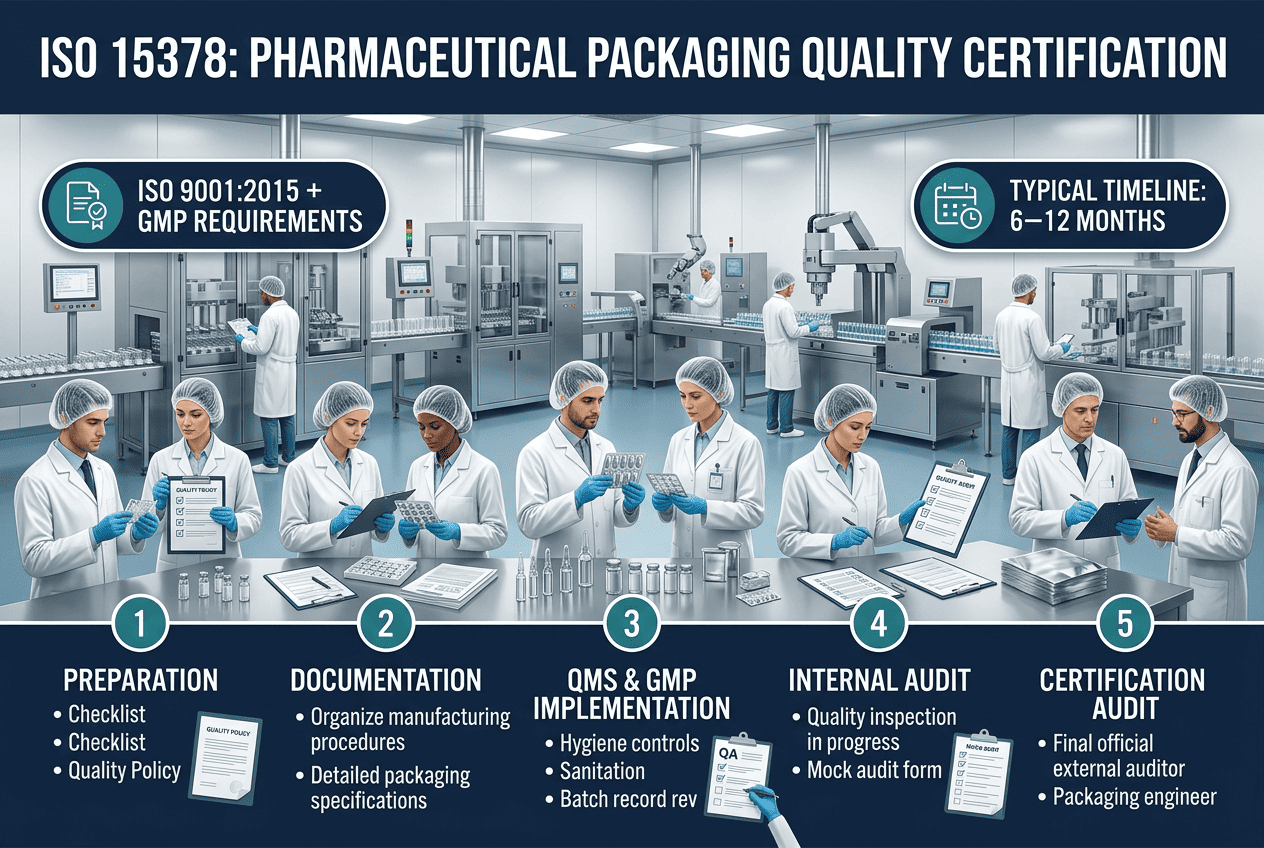
Direct Answer: ISO 15378 is the quality management standard for primary packaging materials for medicinal products. It applies ISO 9001:2015 with added requirements based on Good Manufacturing Practice (GMP). Getting certified follows a 5-step process: Preparation (training, scope, gap analysis), Documentation (policy, procedures, specifications, records), Implementation (rolling out QMS and GMP controls), Internal Audit (self-assessment) and Certification Audit (two-stage audit by an accredited certification body). Most packaging manufacturers need roughly 6–12 months, and less if an ISO 9001 system already exists. This guide walks through every step, plus costs, documentation and common mistakes.
📅 November 2, 2026⏱ 14 min read✍️ GT Setu Editorial Team🔄 Updated regularly
2017
Current Edition (+ Amd 1:2024)
5
Key Steps to Certification
6–12
Months (Typical Timeline)
0%
GTsetu Broker Commission
ISO 15378 is the international standard that sets particular requirements for applying ISO 9001 to the manufacture of primary packaging materials for medicinal products, with reference to Good Manufacturing Practice (GMP). Primary packaging, such as vials, ampoules, closures, blister films, tubes and bottles, is in direct contact with the medicine, so a packaging defect can become a patient-safety problem. The standard bridges the general quality framework in ISO 9001 and the hygiene, traceability and control expectations of pharmaceutical manufacturing.
The current edition is ISO 15378:2017, amended in 2024 by Amendment 1, which adds climate action changes. This guide covers the complete certification process, from preparation to the final audit, and shows how it fits with other management system standards such as ISO 13485 and ISO 14971. See also our guides on partnership evaluation criteria and business verification.
💊 Who Is This Guide For?
This guide is written for quality managers, plant heads, regulatory and QA teams, and business owners at companies that make containers, closures, films, laminates, tubes or other primary packaging for pharmaceuticals. It also helps pharmaceutical buyers who need to understand what a supplier’s ISO 15378 certificate means. For related partnership structures, see our guides on supplier collaboration platforms and distributors and manufacturers.
SECTION 1
1 What Is ISO 15378 & Why Get Certified?
💊 The Standard Explained
ISO 15378:2017 is titled “Primary packaging materials for medicinal products: particular requirements for the application of ISO 9001:2015, with reference to good manufacturing practice (GMP)”. It follows the ISO 9001 structure and adds pharmaceutical requirements such as product safety, contamination and cross-contamination control, cleanliness, traceability, change control and validation. It is a certifiable standard, so an accredited certification body can audit your organisation against it and issue a certificate.
🧪
Patient-Safety Focus
Primary packaging touches the medicine. ISO 15378 builds controls into the QMS to reduce contamination, mix-ups and defects that could affect product quality.
🏛️
Supplier Qualification
Pharmaceutical manufacturers must qualify their packaging suppliers. A certificate helps you pass that process faster and with fewer queries.
🔗
Built on ISO 9001
If you already run an ISO 9001 system, you extend it rather than start again.
🌐
Global Market Access
An internationally recognised standard helps packaging makers sell into regulated pharmaceutical supply chains across regions.
SECTION 2
2 Key Benefits of ISO 15378 Certification
ISO 15378 delivers commercial, operational and risk-management benefits. The exact return depends on your starting maturity and customer base.
ISO 9001 + GMP
One integrated system instead of two parallel ones
3 years
Typical certificate cycle, with surveillance audits in between
Pharma-ready
Aligned with what pharmaceutical customers audit for
🏷️
Stronger Customer Confidence
A third-party certificate gives pharmaceutical buyers independent evidence that your quality and GMP controls work.
Commercial
🛡️
Fewer Defects & Complaints
Defined specifications, in-process checks and change control reduce variability, rework and customer returns.
Operational
🔍
Traceability & Recall Readiness
Batch and material traceability lets you isolate a problem quickly and show customers exactly what was affected.
Traceability
⚖️
Risk-Based Thinking
Risk management is built into planning, supplier control and change management, which lowers regulatory and liability exposure.
Compliance
🌱
Climate-Aware Management
Amendment 1:2024 adds climate action considerations to the context of the organisation and the needs of interested parties.
Sustainability
SECTION 3
3 Core GMP-Based Requirements
On top of the ISO 9001 clauses, ISO 15378 adds requirements that reflect pharmaceutical expectations. Check the full text of the standard for exact wording, as the points below are a practical summary.
🧼
Contamination & Hygiene Control
Defined cleanliness, personnel hygiene, pest control and controlled environments suited to the product’s risk.
🏷️
Identification & Traceability
Materials, batches and finished packaging are identified so each lot can be traced end to end.
🔄
Change Control
Changes to materials, processes, equipment or suppliers are assessed, approved and communicated to customers where required.
✅
Validation & Qualification
Critical processes and equipment are validated or qualified to show consistent output.
📦
Supplier & Material Control
Raw material and service suppliers are evaluated and monitored, with clear specifications and incoming inspection.
⚠️
Risk Management
Product and process risks are identified and controlled, in the spirit of ISO 14971 risk thinking.
SECTION 4
4 Step 1: Preparation, Foundation & Planning
🏗️ Building the Foundation
The preparation phase gives you the knowledge, resources and management support to start. For most packaging manufacturers it takes 3–6 weeks, longer for multi-site operations.
1.1
Get Trained on ISO 15378 & GMP
Your project lead should understand both ISO 9001 and the GMP expectations of your pharmaceutical customers. Implementer or internal auditor training for ISO 15378 is a good start.
1.2
Secure Executive Support
Management must provide budget, people and time, and own the quality policy. See our guide on company global expansion for how quality supports growth.
1.3
Define Scope & Product Risk
List the products, sites and processes in scope, and which customers and markets you serve. Higher-risk products, such as parenteral packaging, need tighter controls.
1.4
Conduct a Gap Analysis
Compare current practice with ISO 15378 clauses and customer quality agreements. Highlight gaps in hygiene, traceability, validation and change control first.
1.5
Create a Project Plan
Set milestones, owners and dates, and name a Management Representative. Keep the plan simple enough that every department head understands it.
1.6
Build Staff Awareness
Explain early why the project matters. Operators and supervisors on the shop floor will carry out most GMP controls.
💡 Pro Tip: Start From ISO 9001
If you already hold ISO 9001, map your existing procedures to ISO 15378 first and add only what is missing. Companies that serve device customers may also review ISO 13485 to avoid duplicated effort.
SECTION 5
5 Step 2: Documentation, Building Your QMS
Documentation turns your processes and GMP expectations into controlled, usable instructions. Keep it practical: the standard sets what must be controlled, not how many pages you write.
Document Type
Description
Key Consideration
Quality Policy & Objectives
Management’s commitment to quality, product safety and GMP, with measurable goals.
Make objectives measurable, such as complaint rate or defect rate.
Scope Statement
Products, sites and activities covered by the QMS, with any justified exclusions.
Be precise, since the certificate will state this scope.
Procedures
Document control, training, contamination control, traceability, change control, nonconformity, CAPA, supplier control and internal audit.
Write in your own language and avoid unnecessary bureaucracy.
Specifications & Quality Agreements
Product and material specifications, plus agreed requirements with pharmaceutical customers.
Keep them current and version-controlled.
Validation Documents
Plans, protocols and reports for critical processes, equipment and cleaning.
Link validation to risk assessments.
Work Instructions & Forms
Step-by-step guidance and checklists for critical tasks, written with the people doing the work.
Use visuals and checklists where they reduce error.
Records
Batch records, inspection results, training, calibration, audit and corrective action records.
Records must be legible, retrievable and kept for the defined retention period.
💡 Documentation Best Practices
DO: Reuse your ISO 9001 documents, use templates with clear customisation guidance, and keep one controlled master for each document. DON’T: Copy standard text word for word or create documents nobody uses. The same template-first logic applies when drafting manufacturer-distributor contracts.
SECTION 6
6 Step 3: Implementation, Rolling Out GMP Controls
Implementation puts the documented system into daily practice. Plan enough time for training and for records to build up, because auditors look for evidence that procedures are actually followed.
📢
Communicate the Quality Policy
Management explains the policy and what it means for each role, including product safety and GMP responsibilities.
Leadership
🎓
Train by Role
Train operators, QC staff, maintenance and supervisors on hygiene, gowning, line clearance, labelling and documentation practice.
Training
🏭
Apply Controls on the Floor
Implement environmental monitoring, cleaning schedules, material segregation, line clearance and in-process inspection.
Operations
🔧
Validate & Calibrate
Complete validation of critical processes and keep equipment calibration and maintenance up to date.
Validation
🧾
Run Change Control & CAPA
Use the change control and corrective action procedures on real events so you have genuine records to show.
Compliance
🤝
Align Suppliers & Customers
Share requirements with raw material suppliers and confirm quality agreements with your pharmaceutical customers.
Partnership
SECTION 7
7 Step 4: Internal Audit, Self-Assessment
🔍 Verifying Your QMS
Internal audits check that your system meets ISO 15378, your own procedures and customer requirements. Complete a full internal audit cycle and a management review before the certification audit, then close all nonconformities with root-cause corrective action.
📋
Plan the Audit Programme
Schedule audits by process risk and past results, and cover all shifts, areas and clauses.
👤
Use Competent, Impartial Auditors
Auditors need ISO 15378 and GMP knowledge and must not audit their own work.
🔎
Audit on the Floor
Observe cleaning, line clearance, labelling and traceability in practice, not only in documents.
🛠️
Close Findings Properly
Use root-cause analysis and verify effectiveness before the certification audit.
📈
Hold a Management Review
Review audit results, complaints, objectives and resources, and record decisions.
📄
Outsource If Needed
An experienced external auditor can run a pre-certification audit if you lack internal expertise.
💡 Internal Audit as a Management Tool
Treat internal audits as a source of improvements, not a checkbox. The same mindset helps in partnership evaluations.
SECTION 8
8 Step 5: Certification Audit, Getting Certified
The certification audit is carried out by an independent certification body. After a successful audit and a positive certification decision, you receive an ISO 15378 certificate, typically valid for three years subject to surveillance audits.
Audit Stage
What Happens
Key Focus
Stage 1 Audit
The auditor reviews your documentation, scope, readiness and internal audit and management review records.
Readiness for Stage 2 and any gaps to close first.
Stage 2 Audit
On-site audit of the whole system, with interviews, process observation and record sampling.
Effective implementation of ISO 9001 and GMP-based requirements.
Findings & Decision
Nonconformities are raised and closed, then the certification body decides on certification.
Timely, root-cause corrective action.
Surveillance Audits
Periodic audits during the certificate cycle to confirm the system is maintained.
Ongoing compliance and improvement.
Recertification Audit
Full reassessment before the certificate expires.
Sustained effectiveness and changes to scope or processes.
💡 Preparing for the Audit
Keep work areas clean and organised, remove obsolete documents, and brief staff to answer honestly and only what is asked. Confirm that your certification body is accredited for the relevant scope. See partnership evaluation criteria for a selection framework.
SECTION 9
9 Costs & Timeline: What to Expect
Costs and timelines vary widely, so treat the table below as a planning guide and request written quotes from several accredited certification bodies.
Factor
Impact on Cost
Impact on Timeline
Existing ISO 9001 System
Lowers cost, since you extend rather than build.
Often 4–8 months in total.
Organisation Size & Sites
More people and sites mean more audit days.
Multi-site rollouts take longer.
Product Risk & Environment
Sterile or parenteral packaging and controlled environments cost more to validate and monitor.
Validation can extend the schedule.
Process Complexity
Moulding, printing, coating and assembly lines each add scope.
More processes mean more documentation and evidence.
Consultant Involvement
Adds fees but can reduce internal effort.
Experienced support can shorten the project.
Certification Body Fees
Stage 1, Stage 2 and annual surveillance audits are quoted separately.
Book audit dates early.
📋 Budget Beyond the Audit Fee
Plan for training, validation work, environmental monitoring, calibration, internal resource time and annual surveillance audits. If you also need ISO 14001 or ISO 45001, ask whether your certification body can combine audits.
SECTION 10
10 How to Choose a Certification Body
Your certification body affects cost, credibility and how smoothly your audits run. Compare more than price.
🏛️
Accreditation & Scope
Confirm the body is accredited by a recognised national accreditation body for ISO 15378 and your product scope.
🏭
Pharma Packaging Experience
Choose auditors who understand your materials, processes and GMP expectations.
📋
Customer Recognition
Ask key pharmaceutical customers whether they accept the certificate.
💰
Clear Quote
Check audit days, travel, surveillance and recertification costs.
🌐
Multi-Site Capability
For several sites or countries, choose a body that can audit consistently.
🤝
Responsiveness
Quick, clear answers during quoting usually predict a smoother audit relationship.
SECTION 11
11 Common Mistakes & How to Avoid Them
📋
Treating It as Plain ISO 9001
Ignoring GMP-based requirements leads to audit findings.
Avoid: Run the gap analysis against the full ISO 15378 text.
🏛️
Weak Management Commitment
Without visible support, GMP discipline fades on the floor.
Avoid: Give managers clear roles and review progress regularly.
🔄
Poor Change Control
Unrecorded changes to materials or processes are a classic finding.
Avoid: Route every change through one approval process.
🎓
Inadequate Training
Staff who do not understand hygiene and documentation rules cause deviations.
Avoid: Train by role and record competence.
📊
Ignoring Internal Audit Results
Open findings carry into the certification audit.
Avoid: Close findings with root-cause analysis. See risk allocation principles.
📦
Weak Supplier Control
Raw material variation can affect packaging quality.
Avoid: Qualify suppliers and keep specifications current.
SECTION 12
12 Related ISO Standards
ISO 15378 often sits alongside other management system standards. Explore our guides to plan an integrated system.
Functional safety for automotive electronics, a different sector but a similar safety-by-design discipline.
SECTION 13
13 How GTsetu Supports Your ISO 15378 Certification Journey
🔗 GTsetu, Verified B2B Platform
Connect with Verified Partners & Build Quality Supply Chains
ISO 15378 shows your quality discipline. GTsetu complements your certification by connecting you with verified manufacturers, distributors and suppliers. Our platform provides:
✅
Verified Company ProfilesEvery company on GTsetu is verified on 6 key data points (Name, Address, Registration Number, Company Status, Company Type, Date of Incorporation) using government tie-ups.
🕵️
Anonymous DiscoveryBrowse verified partner profiles without revealing your identity until you’re ready to engage.
📄
Built-In NDA WorkflowDigital mutual NDA with timestamped signatures, activated before any sensitive commercial or technical data is exchanged.
🔐
Encrypted Document WorkspaceAES-256 encryption at rest, TLS in transit, role-based access controls, and full audit trail for specifications and quality agreements.
🚫
Zero Broker CommissionGTsetu charges zero commission on any partnership formed. All commercial value stays between you and your verified partner.
🌏
Global Network of Verified PartnersAccess verified manufacturers, distributors, and suppliers across 100+ countries.
QWhat is ISO 15378 certification and why is it important?
ISO 15378 is the international standard that sets particular requirements for applying ISO 9001:2015 to primary packaging materials for medicinal products, with reference to Good Manufacturing Practice (GMP). Certification shows that a packaging manufacturer runs a QMS that combines ISO 9001 with GMP principles such as contamination control, traceability, change control and risk management. Pharmaceutical companies commonly look for it when qualifying suppliers. See also partnership evaluation.
QWhat are the 5 main steps to get ISO 15378 certified?
(1) Preparation: train your team, secure management support, define scope and run a gap analysis. (2) Documentation: build your policy, procedures, specifications and records. (3) Implementation: roll out the system, train staff and apply GMP controls. (4) Internal Audit: verify the system and fix nonconformities. (5) Certification Audit: a two-stage audit by an accredited certification body. Like building any distributor network, start with a solid foundation.
QHow long does it take to get ISO 15378 certification?
Organisations that already hold ISO 9001 and run GMP-style controls often need roughly 4 to 8 months. Those building a quality system and hygiene controls from scratch typically need 8 to 12 months or more. The time covers preparation, documentation, implementation, internal audit and the two-stage certification audit.
QHow much does ISO 15378 certification cost?
Cost depends on company size, number of sites and processes, product risk, controlled-environment needs, consultant involvement and the audit days quoted by the certification body. Budget for the certification audit, annual surveillance audits, training, validation, and internal resource time, and compare written quotes from several accredited bodies.
QIs ISO 9001 required before ISO 15378?
ISO 15378 is built on ISO 9001:2015, so it includes the full ISO 9001 framework plus GMP-related requirements. A separate ISO 9001 certificate is not always required first, but companies that already operate an ISO 9001 system usually reach ISO 15378 faster.
Connect with verified manufacturers, distributors, and suppliers on GTsetu: compliance-backed verification, anonymous discovery, built-in NDA workflows, and zero broker commissions. Find partners who share your commitment to quality.
They represents the product, and research team behind GTsetu, a global B2B collaboration platform built to help companies explore cross-border partnerships with clarity and trust. The team focuses on simplifying early-stage international business discovery by combining structured company profiles, verification-led access, and controlled collaboration workflows.
With a strong emphasis on trust, and disciplined engagement, Team GTsetu shares insights on global trade, partnerships, and cross-border collaboration, helping businesses make informed decisions before entering deeper commercial discussions.