Why Trust Breaks in Global Deals, And How to Build It That Lasts
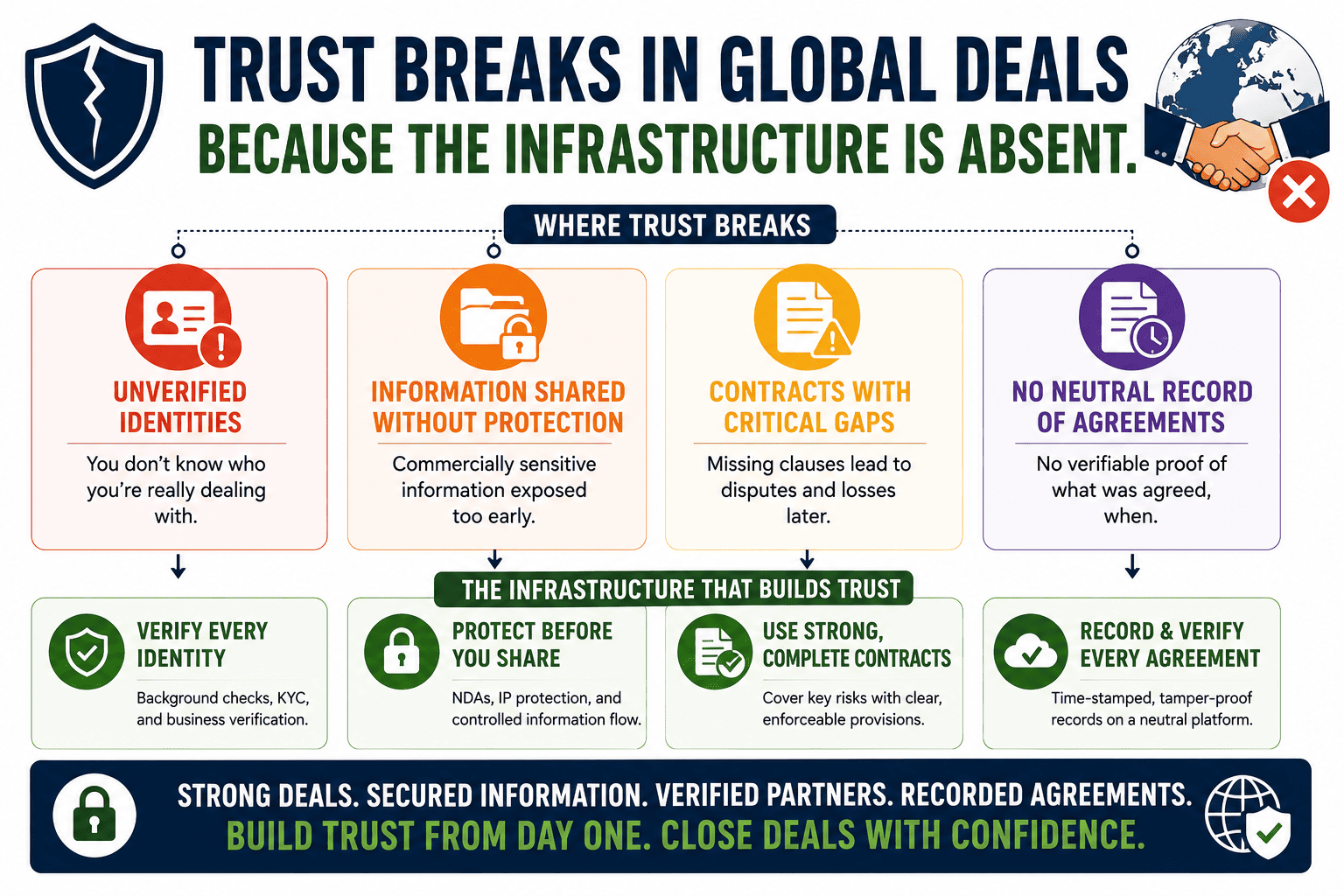
The core answer: Trust breaks in global deals not because people are dishonest, though that happens too, but because the infrastructure of trust is absent from the beginning. Unverified identities, commercially sensitive information shared before legal protection exists, contracts with gaps in the provisions that matter most, and no neutral record of what was agreed when: these are the structural conditions under which trust collapses. This guide maps every major trust failure point in cross-border industrial trade, and the specific verification, legal, and platform infrastructure that prevents them.
📅 July 14, 2026⏱ 19 min read✍️ GTsetu Editorial Team🔄 Updated regularly
7
Trust Failure Modes
73%
Failures Trace to Formation
6-Point
Govt Verification (GTsetu)
100+
Countries Covered
Every business relationship is built on trust. But trust in global industrial trade, between manufacturers and distributors across borders, between raw material suppliers and manufacturing principals in different regulatory environments, between technology partners in markets governed by different legal systems, is a more fragile and more deliberately constructed thing than the word implies. It does not emerge naturally from good intentions. It is built through specific actions, verified through specific processes, and protected through specific legal structures. When any of those elements are absent, trust does not just erode over time. It breaks, suddenly, expensively, and often irreversibly.
The 2026 business environment makes this more acute. A Forbes Business Council analysis published this month describes trust as having become “the infrastructure of global capital”, the hidden layer that determines what scales, where investment flows, and which commercial relationships hold under pressure. Research from Harvard Business School identifies what it calls the “dark side of trust”, the risk that familiarity and trust between commercial partners suppress the due diligence that would catch the first warning signs of misrepresentation or divergence. And across international trade policy, the rules-based multilateral trading system that governed global commerce for decades is being renegotiated in real time.
For manufacturers, distributors, and raw material suppliers navigating cross-border industrial partnerships, the question is not whether trust matters. It is: what does it actually take to build it, and what are the specific mechanisms through which it breaks?
💡 Who This Guide Is For
This article is written for manufacturers entering international distribution arrangements, distributors evaluating manufacturing principals, raw material suppliers building long-term supply relationships, and procurement and business development teams managing cross-border industrial partnerships. For the practical legal and commercial framework that structures these relationships, see: business partnership contracts and cross-border business partnerships.
SECTION 1
1 Trust Is Infrastructure, Not a Feeling
📖 The Core Reframe
Trust in global trade is not primarily an emotional or relational construct. It is infrastructure, a set of verifiable conditions that allow two parties in different jurisdictions, with different legal systems, different commercial norms, and different information sets, to transact with confidence that their counterparty is who they claim to be, will honour what they agreed to, and will not use the commercial relationship as leverage against them. When that infrastructure is absent, when identity is unverified, information is unprotected, and agreements are incomplete, trust does not exist regardless of how warm the relationship feels.
This distinction matters because most trust failures in global industrial trade are not caused by bad people. They are caused by missing infrastructure. A distributor who receives pricing information before an NDA is in place is not necessarily dishonest, but the information is now unprotected, and if the relationship ends badly, they will use it. A manufacturer who receives a tooling payment without clear ownership documentation in the contract is not necessarily planning to withhold the moulds, but if the relationship sours, ownership will be disputed. The infrastructure that prevents these outcomes is not trust. It is verification, legal protection, and documented agreements. Trust is what you extend to a counterparty after that infrastructure is in place.
Layer 1 Identity Verification
Confirming that the entity you are dealing with is legally real, currently active, registered under the name it presents, and the type of business it claims to be. Without this layer, every other trust structure is built on an assumption that may be false. GTsetu verifies this across 6 government-sourced credentials before any engagement on the platform.
Layer 2 Information Protection
Ensuring that commercially sensitive information, pricing, product specifications, market strategy, capacity data, is shared only after a legally binding confidentiality agreement is in place, and only through encrypted channels that cannot be forwarded without a record. Without this layer, your commercial data is a liability from the moment you share it.
Layer 3 Contractual Clarity
Agreements that define not just what each party will do, but what happens when they do not, clear performance conditions, termination rights, IP ownership, tooling provisions, stock handling, and exit mechanisms. Ambiguity in any of these provisions is not a neutral state; it is a future dispute waiting for a trigger. See: contract between manufacturer and distributor.
Layer 4 Audit Trail & Accountability
A timestamped, verifiable record of all interactions, NDA signatures, document exchanges, commercial decisions, and performance reviews, that can be produced in a dispute and demonstrates that both parties understood and agreed to the terms under which they were operating. Without this layer, disputes become “he said, she said” exercises in a foreign legal system. See: global collaboration examples.
SECTION 2
2 The 7 Ways Trust Actually Breaks in Global Deals
Trust in global industrial trade partnerships breaks through a predictable set of failure modes, most of which are structural rather than interpersonal. Understanding each one is the first step to preventing it.
🎭
1. Identity Misrepresentation
The partner is not who they claimed to be, a trading company presenting as a direct manufacturer, an agent presenting as a distributor with market reach, a newly registered entity presenting years of claimed trading history, or a company operating under a different legal name than presented. Without 6-point government tie-up verification, none of these misrepresentations are caught before the relationship begins. See: common red flags in international partnerships.
🔓
2. Unprotected Information Sharing
Pricing, product specifications, customer lists, and market strategy are shared before an NDA is in place, or shared via unencrypted email that can be forwarded without the sender’s knowledge or consent. Once commercially sensitive information leaves your control without legal protection, it cannot be recalled. Every subsequent interaction with that counterparty takes place with your strategic information already in their hands.
📋
3. Contract Ambiguity
Agreements that define the upside of the relationship clearly but leave the downside provisions ambiguous, performance conditions attached to exclusivity but with no measurable threshold, termination rights without a defined process, IP licensing without scope or reversion provisions, tooling payments without ownership documentation. These gaps are not neutral; they are leverage that the party with more local legal knowledge will exploit when the relationship deteriorates. See: who owns tooling and moulds.
💸
4. Payment and Financial Risk
A partner who consistently pays late, requests extended credit beyond agreed terms, or whose financial health deteriorates during the partnership creates a trust problem that compounds over time. By the time financial distress becomes obvious, the exposure, in unpaid invoices, stranded inventory, and inaccessible assets held by the partner, is often significant. Early warning systems and credit terms written into agreements are the prevention; recovery is expensive and uncertain.
🌐
5. Jurisdictional and Regulatory Divergence
The governing law and jurisdiction clauses in a contract determine which legal rules apply, but mandatory local law in the partner’s country can override what the contract says. A termination that is valid under English law may create compensation obligations under EU commercial agency law. A distribution arrangement valid in India may trigger commercial agency registration requirements in the UAE. These divergences are not failures of good faith, they are structural realities that create liability if not anticipated in the original agreement.
🤝
6. Familiarity Suppressing Due Diligence
Harvard Business School research on the “dark side of trust” identifies a specific risk: that established familiarity between commercial partners leads both parties to reduce verification rigour, legal scrutiny, and performance monitoring, precisely because the relationship feels secure. The result is that warning signs that would be caught in arm’s length due diligence are missed, and trust breaks harder and faster when problems eventually surface because neither party has documentation to support their position.
📉
7. Strategic Misalignment Over Time
Even relationships that begin with genuine alignment drift apart as businesses evolve. An acquisition changes a distributor’s ownership and priorities. A new product range makes the original supply arrangement economically uncompetitive. A market entry by a new competitor changes the territory’s commercial dynamics. Partnerships that lack structured review mechanisms, formal annual assessments of exclusivity conditions, volume commitments, and strategic alignment, accumulate misalignment silently until it becomes a crisis. See: partnership evaluation criteria.
73%
of international partnership failures trace back to formation-stage gaps, not events that occurred during the relationship
1 in 3
cross-border manufacturer-distributor terminations involve IP or brand misuse claims by the exiting partner
12–24
months: average timeline for contested cross-border commercial partnership disputes to resolve through arbitration
SECTION 3
3 Real-World Trust Failure Scenarios
⚠️ Scenarios, How Trust Breaks in Practice
Abstract failure modes become clearer as specific scenarios. The following are representative patterns drawn from the kinds of cross-border industrial trade partnership failures that recur across manufacturing, distribution, and supply chain relationships. The names and details are illustrative, but the structural failures are real and common.
🎭
Scenario 1, Identity Fraud
The Trading Company That Called Itself a Distributor
An Indian manufacturer of industrial chemicals enters a distribution agreement with a company in Southeast Asia that presents itself as an established regional distributor with 15 years of market presence and an existing buyer network. The manufacturer shares full pricing sheets and product formulations ahead of the contract, eager to close the relationship. The agreement is signed. Twelve months later, volumes are negligible, and the “distributor” is quoting the manufacturer’s formulations to competing producers to undercut them on price in the same market. An investigation reveals the entity was registered two years prior, had no prior distribution history, and the contact was acting as an agent for a competing manufacturer.
What prevented it: 6-point government tie-up verification (incorporation date would have revealed a 2-year-old entity, not a 15-year-old one), NDA before sharing formulations, and anonymous discovery before revealing identity. See: common red flags in international partnerships.
🔓
Scenario 2, Unprotected Information
The Pricing Sheet That Became a Competitor’s Tool
A European distributor evaluating Indian manufacturing partners for a private label product line shares detailed unit cost targets and margin expectations with three shortlisted manufacturers during a sourcing trip, before any NDA is in place, via email, with no encryption. One of the manufacturers declines the partnership but keeps the pricing intelligence. Within six months, that manufacturer approaches the distributor’s key retail accounts directly with a competing product priced precisely at the margin level the distributor had revealed. The distributor has no legal recourse, the information was shared voluntarily, without confidentiality protection.
What prevented it: NDA execution before sharing any commercial information, encrypted document sharing instead of email attachments, and anonymous discovery to evaluate partners without immediately revealing commercial intent. See: business partnership contracts.
🔧
Scenario 3, Tooling Dispute
The Moulds No One Could Retrieve
A consumer goods brand commissions a contract manufacturer in Vietnam to produce a specialised product line. The brand funds the tooling and moulds, a $280,000 investment, paying the cost as an add-on to the first year’s production orders, characterised simply as “tooling cost” without specifying ownership. Three years later, the relationship deteriorates over quality issues. The brand terminates the contract and requests return of the tooling. The manufacturer refuses, claiming the tooling payment was a purchase and the moulds are their asset. The contract is silent on the question. The brand faces a choice: write off $280,000 or pursue litigation in a Vietnamese court against a local manufacturer, in Vietnamese, under Vietnamese law.
What prevented it: Explicit tooling ownership provisions in the original contract, specifying that the payment was a conditional loan recovered through production volume and that ownership remained with the brand throughout. See: who owns tooling and moulds.
🌍
Scenario 4, Jurisdictional Surprise
The Termination That Created a Compensation Claim
A manufacturer appoints an exclusive distributor in Germany under an English-law governed distribution agreement. After four years, the manufacturer terminates for poor performance. The termination is valid under the contract’s English law provisions. However, the distributor registers a claim under the EU Commercial Agents Directive, which the parties had not addressed in the agreement, asserting statutory compensation rights based on four years of market development. The claim is valued at 18 months of historical gross margin. The manufacturer had no awareness of this mandatory EU provision when the contract was drafted.
What prevented it: Local legal advice on mandatory jurisdiction-specific rules before drafting the agreement, and an explicit contract provision addressing the Commercial Agents Directive and its application or exclusion. See: ending a business partnership contract.
🤝
Scenario 5, Familiarity Complacency
The Partner Who Was “Like Family” Until They Weren’t
An Indian manufacturer has worked with a Middle East distributor for nine years. The relationship is personal, the owners know each other’s families. Annual performance reviews stopped happening after year three because “we trust each other.” Payment terms drifted from 30 to 90 days because “they always pay eventually.” The distribution agreement has not been reviewed since it was signed. When the distributor’s ownership changes following a family succession dispute, the new management invokes a provision in the original agreement, never discussed in nine years of trading, that grants them a right of first refusal on any new products the manufacturer develops for the region. The manufacturer is now locked out of launching a new product line through any other channel in the territory.
What prevented it: Regular structured performance reviews, annual contract review with legal counsel, and the discipline to apply the same diligence to established partners as to new ones. See: partnership evaluation criteria and building a distributor network.
SECTION 4
4 Geopolitical and Systemic Trust Erosion
Beyond the bilateral trust failures between specific commercial partners, the broader system within which global trade partnerships operate is itself under strain. The multilateral, rules-based trading framework that provided a stable backdrop for cross-border commercial relationships since the post-WWII era is, in the words of Michael Froman, former US Trade Representative, effectively “dead” as a functioning consensus system. What replaces it is a landscape of bilateral and regional agreements, tariff volatility, sanctions exposure, and regulatory fragmentation that creates new sources of trust erosion even within well-structured partnerships.
⚖️
Tariff and Trade Policy Volatility
Supply chains and distribution agreements structured around a specific tariff regime can be disrupted overnight by policy changes, import duties, export controls, anti-dumping investigations, or sanctions that suddenly make a product uneconomic to trade or legally impossible to ship. Agreements that do not account for this risk, through price renegotiation triggers, force majeure provisions, or supply chain flexibility clauses, become impossible to perform without either party having breached. See: the true cost of global expansion.
🏛️
Sanctions and Regulatory Exposure
A distributor or supplier that is clean at the time of contracting may become a sanctions risk through subsequent changes in ownership, jurisdiction of incorporation, or the regulatory status of their products. Without ongoing compliance monitoring and change-of-control provisions in the agreement, manufacturers and distributors can find themselves in violation of trade sanctions they did not know about through a partner relationship they believed to be low-risk.
🌐
Digital Trust Infrastructure
As Forbes noted in its July 2026 analysis, trust has become the decisive infrastructure layer of global capital, with stablecoins processing over $41 trillion in on-chain transactions and digital settlement systems becoming institutional. For industrial trade, this means the documentation, verification, and audit trail infrastructure of commercial relationships is itself migrating to digital platforms, where the integrity of that record depends on the platform’s verification and encryption standards, not just the parties’ good faith.
ℹ️ The Resilient Partnership in a Volatile World
Against a backdrop of geopolitical volatility and regulatory fragmentation, the partnerships that survive are not necessarily the ones with the strongest bilateral relationships, they are the ones with the most rigorous formation infrastructure. Verified identities, clear legal documentation, defined exit mechanisms, and encrypted audit trails create a commercial relationship that can be renegotiated, adapted, or cleanly concluded regardless of the external environment. The true cost of weak formation is not felt in stable conditions, it is felt precisely when external pressure tests the partnership. See: collaboration agreement vs joint venture and the true cost of global expansion.
SECTION 5
5 The Dark Side of Trust: When Familiarity Creates Risk
Harvard Business School research into what it terms the “dark side of trust” identifies a counterintuitive dynamic that is directly relevant to industrial trade partnerships: that high levels of interpersonal trust between commercial partners frequently lead to reduced formal oversight, weaker contractual rigour, and suppressed due diligence, creating exposure that would not exist in a more arm’s-length relationship.
🔬 The Research Finding
When trust between commercial partners is high, parties tend to: skip formal performance reviews because “we talk all the time anyway”; allow payment term drift because “they always pay in the end”; allow contract renewal without substantive review because “the relationship works”; and avoid raising performance concerns directly because “we don’t want to damage the relationship.” The result is that the formal accountability structures, the ones that protect both parties when the relationship eventually hits friction, atrophy precisely when the relationship feels most secure. The longer the relationship, the greater this risk.
For industrial trade partnerships, manufacturer-distributor relationships that routinely run for five, ten, or fifteen years, this is a specific and serious risk. The solution is not to treat partners with suspicion. It is to maintain structured review mechanisms regardless of relationship quality: annual contract reviews, formal performance assessments against defined metrics, regular legal counsel reviews of agreement terms, and clear processes for raising and resolving commercial concerns that do not depend on the personal relationship remaining positive.
Conduct formal annual performance reviews against documented volume commitments and market development targets, regardless of how well the relationship feels at a personal level
Review the distribution or supply agreement with legal counsel every 2–3 years, updating provisions that no longer reflect the current commercial reality or regulatory environment
Maintain payment term discipline in writing and in practice, do not allow informal extensions to become the de facto norm without documenting them
Apply the same identity and financial due diligence to partner renewals as to new appointments, change of ownership, financial distress, or regulatory issues can develop within an established relationship
Keep a record of all significant commercial decisions, commitments, and deviations from agreed terms, do not rely on personal recollection for what was agreed when
Ensure that key commercial knowledge about the partner and their market is held institutionally, not just by the relationship manager, people change roles, and the institutional record must be comprehensive
SECTION 6
6 The Trust Architecture for Global Industrial Deals
Building trust that holds in global industrial deals requires an architecture, a set of specific, sequenced elements that together create the conditions under which both parties can transact with confidence. The following framework maps what that architecture looks like across the lifecycle of a cross-border trade partnership.
Partnership Stage
Trust Infrastructure Required
Without It, The Risk Is
GTsetu’s Role
Discovery
6-point govt verification of partner identity; anonymous browsing to protect expansion strategy
Engaging with a misrepresented entity; revealing commercial plans to a competitor or broker
✅ 6-point verification + anonymous discovery built in
First Contact
NDA before any commercial information is shared; encrypted document channels
Pricing, product data, market strategy in the hands of an unprotected counterparty
✅ Built-in NDA workflow triggered before data exchange
✓ Timestamped audit trail; signed documents; verifiable record
Broker commissions
✗ 5–15% of deal value to intermediaries
✓ Zero commission on any partnership formed
SECTION 7
7 GTsetu: Verified Trust Infrastructure for Trade Partnerships
GTsetu is built to provide exactly the trust infrastructure that global industrial trade partnerships need at the formation stage, the point at which most trust failures are seeded, and the point at which addressing them costs the least.
🔐 Trust Is Infrastructure, GTsetu Builds It
The Verified Partnership Platform for Manufacturers, Distributors & Suppliers
Every trust failure described in this guide traces back to missing formation infrastructure. GTsetu provides that infrastructure: 6-point government verification of every company before any engagement, anonymous discovery to protect your strategy, built-in NDA workflows before any commercial data is shared, encrypted document workspaces, zero broker commissions, and a full timestamped audit trail, across 100+ countries.
🏛️
6-Point Govt VerificationLegal name, registered address, registration number, company status, type, and incorporation date, confirmed via government tie-ups. The identity layer that prevents every scenario in Section 3.
🕵️
Anonymous DiscoveryEvaluate verified partners across 100+ countries without revealing your identity, expansion plans, or commercial intent during the search phase.
📄
NDA Before Data SharingBuilt-in NDA workflow triggered before any pricing, product, or strategy information changes hands, with full digital audit trail and timestamps.
🔐
Encrypted Document WorkspaceAES-256 at rest, TLS in transit. No unprotected email attachments for pricing sheets, product specs, or contract drafts, ever.
📋
Full Audit TrailTimestamped, downloadable record of all verifications, NDA signatures, document exchanges, and engagement milestones, the evidence base that assumed-trust relationships never have.
🚫
Zero CommissionNo percentage of partnership value extracted. All deal economics stay between the trading parties, always. No broker extracting 5–15% from every relationship you form.
🌍
100+ CountriesVerified manufacturers, distributors, and raw material suppliers across the Middle East, Europe, Southeast Asia, Africa, Australia, and the Americas.
🏭
Industrial Sector FocusManufacturers, distributors, and raw material suppliers in industrial sectors, not general directories, not FMCG RFQ platforms, not consumer marketplaces. See: B2B matchmaking tools.
A trust failure in one global deal does not have to become the template for the next one. The most important insight from every failed partnership is that it reveals, with the specificity of lived experience, exactly which infrastructure elements were absent. The path from a failed partnership to a better one is straightforward: identify what was missing at formation, implement it with the next partner, and use a platform that provides verified counterparties and the legal infrastructure to start the relationship on grounds that hold.
🔍
Step 1: Diagnose the Failure Honestly
Before appointing a replacement partner, identify precisely what failed and why. Was it identity misrepresentation that could have been caught? Unprotected information sharing? A contract gap that created liability? Familiarity complacency that let warning signs go unaddressed? Each failure type has a specific prevention, and the diagnosis determines which prevention matters most in your next relationship. See: common red flags in international partnerships.
🏛️
Step 2: Start with Government-Verified Identity
Whatever else you change, make independent identity verification mandatory for the next partner. 6-point government verification, legal name, registered address, registration number, status, type, and incorporation date, is the baseline that every other trust infrastructure layer is built on. Without it, all subsequent investment in legal protection and contractual clarity is premised on an identity that may be false. See: partnership evaluation criteria.
📄
Step 3: Protect Information Before the First Conversation
Implement NDA-first as an absolute rule, no pricing, no specifications, no market strategy before the confidentiality agreement is signed and the channel is encrypted. This single discipline eliminates one of the most common and most irreversible trust failures in partnership formation. See: business partnership contracts.
📋
Step 4: Address Every Gap the Previous Agreement Had
Use the failure of the previous agreement as a checklist for what the new one must contain, the performance conditions that were vague, the IP provisions that were absent, the tooling ownership that was unresolved, the termination clause that was too weak. Every gap in a contract is a future dispute waiting for circumstances to expose it. See: contract between manufacturer and distributor.
🔁
Step 5: Build Review Mechanisms In From the Start
Commit in writing to annual formal performance reviews, biannual contract review with legal counsel, and a clear process for raising and escalating commercial concerns that does not depend on the personal relationship remaining comfortable. The discipline of structured review prevents the familiarity complacency that Harvard identifies as one of the most damaging trust risks in long-running partnerships. See: international business development consulting.
🌍
Step 6: Use a Platform That Provides Infrastructure, Not Just Contacts
Most partner discovery happens through directories, trade shows, and broker networks, all of which provide contacts without verification, legal protection, or audit infrastructure. GTsetu provides verified identities, NDA workflows, encrypted document workspaces, and zero commissions, the entire formation infrastructure layer in a single platform. See: international wholesale distributors and B2B matchmaking tools.
⚠️ The Cost of Getting It Wrong Again
The average timeline for a contested cross-border commercial dispute to resolve through arbitration is 12–24 months. The average cost, legal fees, arbitration costs, management time, lost market access, and distraction from core business, can easily exceed the total value of the partnership’s first year of trading. A failed international partnership rarely costs less than six figures in direct and indirect losses. The infrastructure to prevent it, verified identities, NDA protection, clear contracts, and an audit trail, costs a fraction of that. See: the true cost of global expansion.
FAQ
? Frequently Asked Questions
QWhy does trust break down in global business deals?
Trust breaks down in global business deals for seven primary structural reasons: unverified partner identity (the business is not who it claims to be); unprotected information sharing (commercially sensitive data shared before legal protection is in place); contract ambiguity (key provisions left incomplete, creating exploitable gaps); payment and financial risk that was not allocated clearly; jurisdictional divergence between the contract’s governing law and mandatory local law in the partner’s market; familiarity complacency that suppresses due diligence in established relationships; and strategic misalignment that accumulates without structured review mechanisms. Most of these failures are preventable at the formation stage, they are not the result of bad actors, but of missing trust infrastructure.
QWhat are the biggest trust risks in international trade partnerships?
The biggest trust risks in international trade partnerships are: (1) engaging with a counterparty whose legal identity has not been independently verified against government records, meaning you cannot confirm they are who they say they are; (2) sharing pricing, product specifications, or market strategy before an NDA is legally in place, meaning that information has no legal protection; (3) signing distribution or supply agreements without explicitly defined performance conditions, exclusivity terms, IP ownership, and termination rights; (4) leaving tooling and mould ownership ambiguous in manufacturing contracts, the most frequently disputed asset in cross-border manufacturing partnership terminations; and (5) failing to maintain a documented, timestamped audit trail of commercial interactions, the only reliable evidence base when disputes cross jurisdictions. See: common red flags in international partnerships.
QHow can manufacturers and distributors build trust in global deals?
Manufacturers and distributors build sustainable trust in global deals by treating trust as infrastructure rather than a relationship quality. The specific actions are: verify every partner’s identity against government records before engagement (not through a directory listing or paid badge); execute an NDA before sharing any commercially sensitive information; use encrypted document channels for all commercial data exchange; structure agreements with explicitly defined rights, obligations, performance conditions, and exit mechanisms; maintain a complete timestamped audit trail of all significant commercial interactions; and use structured annual review mechanisms rather than relying on informal relationship continuity. GTsetu provides the platform infrastructure for all of these elements specifically for industrial sector cross-border partnerships. See: cross-border business partnerships.
QWhat is the “dark side of trust” in business partnerships?
The “dark side of trust” is a concept from Harvard Business School research describing the counterintuitive risk that high interpersonal trust between commercial partners leads to reduced formal oversight, weaker contractual rigour, and suppressed due diligence. When a relationship feels secure and personal, both parties tend to stop applying the verification and review processes that would catch early warning signs of misrepresentation, financial distress, or strategic divergence. The result is that trust breaks harder and faster when problems eventually surface, because neither party has the documentation needed to support their position, and the warning signs that preceded the crisis were not recorded. The prevention is to maintain structured formal review mechanisms regardless of how comfortable the relationship feels at any given moment. See: partnership evaluation criteria.
QHow does GTsetu help build trust in global trade partnerships?
GTsetu provides the trust infrastructure that global industrial trade partnerships need at the formation stage, the point at which most trust failures are seeded. Every company on the platform is verified against government records across 6 credentials (legal name, registered address, registration number, company status, type, and incorporation date) before any engagement is permitted. Anonymous discovery allows manufacturers and distributors to evaluate verified partners without revealing their identity or commercial intent during the search phase. Built-in NDA workflows are triggered before any commercial information is shared, ensuring legal protection exists from the first substantive conversation. Encrypted document workspaces ensure pricing, product specifications, and contracts are never shared through unprotected channels. And a full timestamped audit trail provides the evidence base that disputed relationships always need but assumed-trust ones never have. Zero broker commissions mean all deal economics stay between the trading parties. See: B2B matchmaking tools.
QWhat role does geopolitics play in trust breaking in global deals?
Geopolitical instability and the fragmentation of the rules-based trading system introduce systemic trust risks that affect even well-structured bilateral partnerships. Tariff changes can make agreements economically unworkable overnight. Sanctions exposure can make a previously compliant partner legally untouchable. Regulatory divergence, as the EU, US, and other major markets apply different and sometimes conflicting compliance requirements, can create obligations for one party that are incompatible with the other’s market requirements. Agreements that do not address these risks through price renegotiation triggers, force majeure provisions covering regulatory events, change-of-control clauses, and sanctions compliance obligations are exposed to trust failures that neither party caused and neither anticipated. See: the true cost of global expansion and collaboration agreement vs joint venture.
Stop Building on Assumed Trust. Start with Verified Infrastructure.
GTsetu connects manufacturers, distributors, and raw material suppliers across 100+ countries with 6-point government-verified partners, anonymous discovery, built-in NDA workflows, encrypted document workspaces, and zero broker commissions. Trust is infrastructure. Build it right from the first conversation.
They represents the product, and research team behind GTsetu, a global B2B collaboration platform built to help companies explore cross-border partnerships with clarity and trust. The team focuses on simplifying early-stage international business discovery by combining structured company profiles, verification-led access, and controlled collaboration workflows.
With a strong emphasis on trust, and disciplined engagement, Team GTsetu shares insights on global trade, partnerships, and cross-border collaboration, helping businesses make informed decisions before entering deeper commercial discussions.