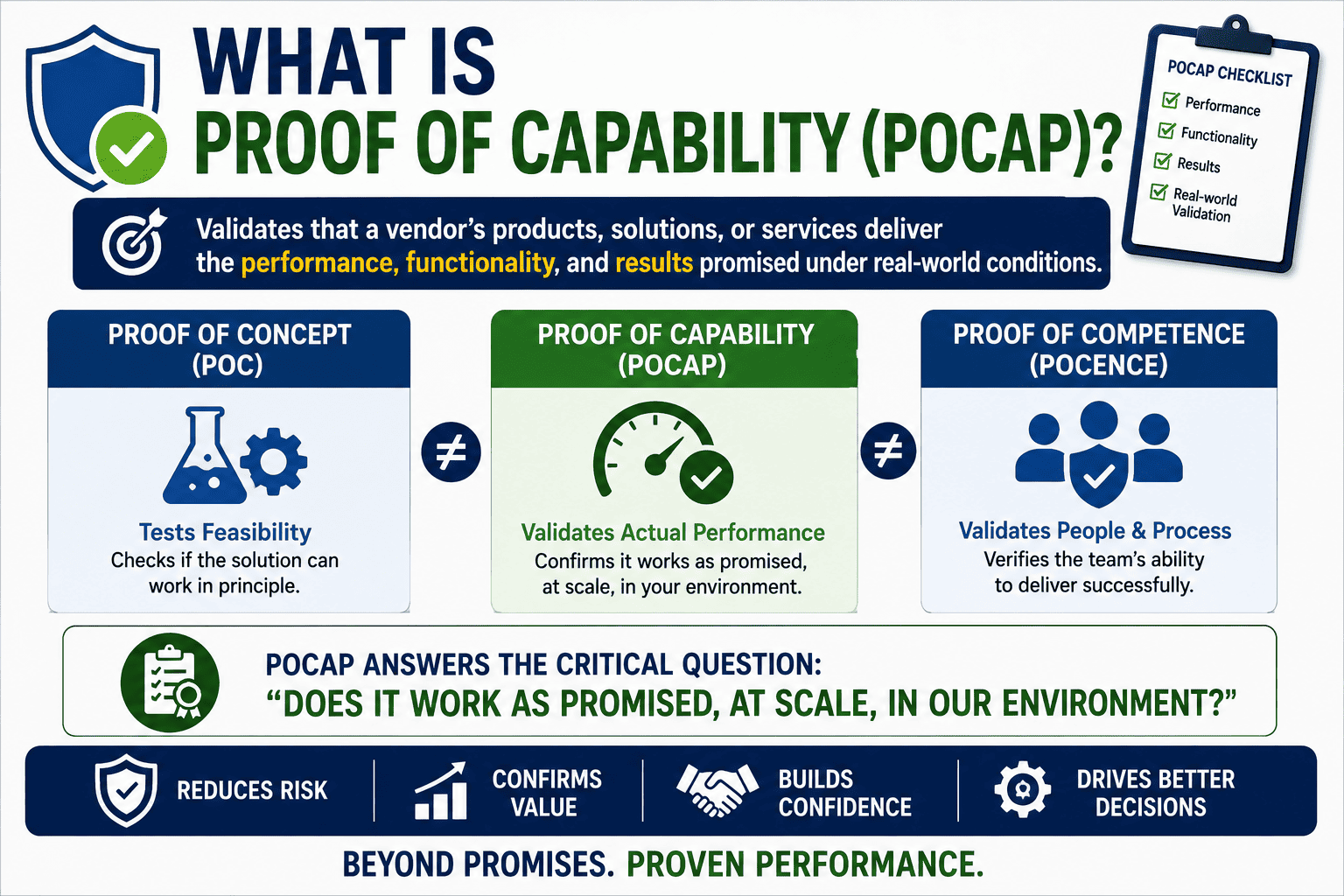
Why Proof of Capability Matters
In business partnerships and procurement, the gap between what a vendor promises and what they actually deliver is a primary source of project failure. Data sheet specifications often reflect ideal conditions, not real-world performance. Proof of Capability closes this gap by subjecting products and solutions to controlled, realistic testing before full commitment. For buyers, it reduces the risk of costly implementation failures, contract disputes, and operational disruption. For vendors, a successful PoCap builds trust, differentiates them from competitors, and accelerates the sales cycle.
📊 Key Statistic
Organizations that require formal Proof of Capability testing in their vendor selection process report 40% fewer implementation failures and significantly higher satisfaction with their technology investments compared to those that rely solely on vendor datasheets and references.
Proof of Concept vs. Capability vs. Competence
These three terms are often used interchangeably, but they represent distinct and complementary stages of validation. Understanding the differences is essential for effective vendor selection and partnership management.
| Aspect | Proof of Concept (PoC) | Proof of Capability (PoCap) | Proof of Competence (PoComp) |
|---|
| Primary Question | Can it work? | Does it work as specified? | Can they deliver it? |
| Focus | Feasibility of an idea or technology in a controlled environment. | Performance, functionality, and results against real-world requirements. | The team’s skills, experience, and ability to execute successfully. |
| Scope | Narrow, often limited to a single feature or function. | Broad, covering full performance specifications and use cases. | Human and organizational: expertise, project management, support. |
| Environment | Lab or controlled test environment. | Simulated or actual production-like conditions. | Evaluated through past performance, credentials, and interviews. |
| Outcome | Go/No-go decision for further investment. | Performance data and validation of vendor claims. | Confidence in the team’s ability to deliver. |
| Analogy | Proving an aircraft can get off the ground. | Proving it can fly the specified range, payload, and fuel efficiency. | Proving the pilot has the training and experience to fly it. |
💡 Practical Insight
As Michael van Rooyen notes in his LinkedIn article, “Proof of Capability” is about testing the vendor’s products to validate the capability of the proposed system, while “Proof of Competence” validates the integrator’s ability to deliver. Both are essential, but they serve different purposes in the vendor selection process.
How to Conduct Proof of Capability
The Proof of Capability Testing Process
A structured PoCap process ensures that testing is objective, comprehensive, and produces actionable results. The following steps provide a framework for validating vendor capabilities in a procurement or partnership context.
1
Define Clear Performance Requirements
Translate business needs into specific, measurable criteria: throughput, response time, accuracy, scalability, reliability, and any industry-specific metrics. These become the benchmark for success.
2
Design a Realistic Test Environment
Create a testing environment that mirrors actual operating conditions: data volumes, user loads, network latency, and integration points. Avoid “greenfield” tests that don’t reflect real-world complexity.
3
Execute Controlled Tests
Run the tests according to a pre-defined script. Include both standard and edge cases. Document all procedures and results meticulously to ensure transparency and reproducibility.
4
Analyze Results Against Benchmarks
Compare performance data against the defined requirements. Identify gaps, anomalies, and areas where the vendor’s solution excels or falls short. Use statistical analysis where appropriate.
5
Document Findings and Make Decisions
Prepare a comprehensive report that includes test results, analysis, and recommendations. Use this data to inform contract negotiations, vendor selection, and implementation planning.
Proof of Capability in Contracts & Agreements
Proof of Capability is not just a pre-contract activity; it should be embedded in the contractual framework. The following clauses are relevant to establishing and enforcing capability requirements.
| Contract Clause | How It Relates to Proof of Capability |
|---|
| Warranty Clause | Warranties can specify that the product or service will meet the performance standards validated during the PoCap process. Breach of warranty can trigger remedies. |
| Limitation of Liability | PoCap results can be used to establish baseline performance, and any failure to meet that baseline may affect liability caps or exclusions. |
| Indemnification Clause | If a vendor’s failure to meet capability standards causes losses to the buyer, indemnification provisions may be triggered. |
| Material Breach | Failure to meet the capability standards established through PoCap can be defined as a material breach, allowing for termination or other remedies. |
| Master Services Agreement (MSA) | An MSA can incorporate PoCap as a key part of the vendor onboarding process, with specific performance standards and testing protocols. |
| Termination for Convenience | If PoCap testing reveals that the vendor’s solution does not meet requirements, the buyer may terminate the contract for convenience, subject to the terms of that clause. |
Broader Context & Integration
Proof of Capability in Due Diligence
Proof of Capability is a critical component of both commercial due diligence and broader due diligence processes. While financial and legal due diligence assess the health and compliance of a potential partner, PoCap validates that their products or services can actually deliver the value they promise. This is especially important in technology, manufacturing, and infrastructure projects where performance directly impacts business outcomes.
🔗 Integration Point
In M&A transactions, the buyer’s due diligence team should include a technical workstream focused on PoCap. This validates that the target company’s products are not just marketable but actually perform to specifications. Findings can significantly affect valuation and deal structure.
Key Performance Indicators (KPIs) for Capability Validation
Measuring capability requires specific, quantifiable metrics. The following KPIs are commonly used in PoCap testing, depending on the nature of the product or service.
| Category | Example KPIs | Measurement Method |
|---|
| Performance | Response time, throughput, latency, processing speed | Load testing, performance monitoring tools |
| Reliability | Uptime, mean time between failures (MTBF), error rate | Stress testing, long-duration stability tests |
| Scalability | Performance degradation under increasing load, capacity limits | Scale testing with incremental load increases |
| Quality | Accuracy, precision, defect rate, output quality | Quality assurance testing, sampling, inspection |
| Security | Vulnerability scan results, penetration test outcomes | Security assessments, penetration testing |
| Integration | API response times, data consistency, error handling | Integration testing, end-to-end workflow tests |
Real-World Applications
Examples of Proof of Capability in Action
| Industry | Application | What Is Tested |
|---|
| Cloud Computing | Migrating to a new cloud provider | API performance, data transfer speeds, reliability under peak load, failover capabilities |
| Manufacturing | New production equipment acquisition | Throughput, defect rates, energy consumption, maintenance requirements |
| Software | Enterprise software selection | System integration, user capacity, data processing speed, reporting accuracy |
| Telecommunications | Network equipment procurement | Data throughput, latency, signal reliability, capacity under load |
| Medical Devices | New diagnostic equipment | Accuracy, consistency, reliability, performance across different conditions |
Risks & Mitigation
Common Risks in Capability Validation & Mitigation Strategies
⚠️
Vendor-Optimized Test Environments
Mitigation: Require testing in an environment that closely mimics your production setup. Insist on using your own data (with appropriate anonymization) and realistic workloads.
⚠️
Incomplete or Unclear Requirements
Mitigation: Invest time in defining requirements before testing. Engage all stakeholders to ensure that all critical performance dimensions are captured.
⚠️
Confirmation Bias
Mitigation: Use independent evaluators or a blind testing process. Establish objective success criteria before testing begins.
⚠️
Insufficient Time for Proper Testing
Mitigation: Build adequate time for testing into the procurement timeline. Rushing PoCap testing often leads to missed issues that surface later at greater cost.
⚠️
Ignoring the Competence Component
Mitigation: Remember that a capable product is not enough. Conduct a separate Proof of Competence evaluation to validate the team’s ability to implement and support the solution.
FAQ
Frequently Asked Questions About Proof of Capability
QWhat is the difference between Proof of Concept and Proof of Capability?
Proof of Concept (PoC) validates that an idea or technology is feasible and can work in a controlled environment. Proof of Capability (PoCap) goes further to verify that the product, system, or service delivers the actual performance, features, and results specified in real-world conditions, answering the question: does it work as promised under actual operating conditions?
QHow do you test for Proof of Capability in a vendor selection process?
Testing for Proof of Capability typically involves a structured process: define clear performance requirements and success criteria; conduct a controlled pilot or trial under conditions that simulate real-world use; collect data on key metrics (speed, reliability, output quality, scalability); and compare results against the vendor’s specified capabilities and your business requirements. Independent verification or third-party testing can add credibility.
QWhat is the difference between Proof of Capability and Proof of Competence?
Proof of Capability validates that the product or solution meets its performance specifications. Proof of Competence validates that the team or partner has the skills, experience, and resources to successfully implement, manage, and deliver the project. A capable product implemented by an incompetent team will fail, and a competent team cannot fix an incapable product. Both are necessary for success.
QHow does Proof of Capability relate to due diligence?
Proof of Capability is a critical component of technical due diligence, especially in M&A and major procurement. While financial and legal due diligence assess the health and compliance of a potential partner, PoCap validates that their products or services can actually deliver the value they promise, which directly impacts valuation and deal structure.
QCan a small business conduct Proof of Capability testing?
Yes, small businesses can adapt PoCap to their scale. The key is to define realistic requirements for your context and conduct testing that provides sufficient confidence for your decision. This might involve a phased approach, starting with a smaller pilot and scaling up as confidence builds. Engaging with existing customers or industry groups can also provide valuable capability insights.