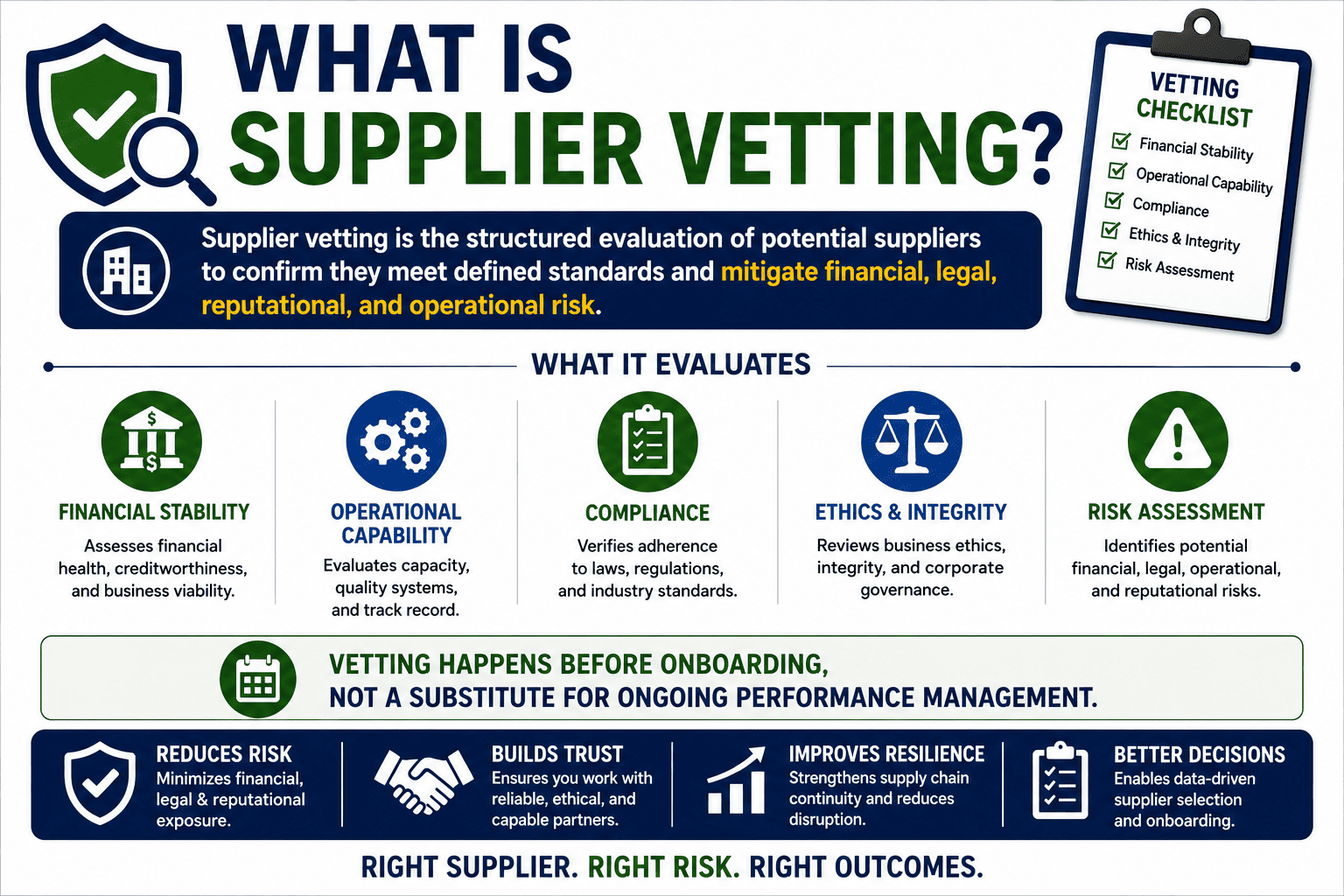
Why Supplier Vetting Matters in Procurement
Every supplier relationship carries inherent risk. A financially unstable supplier may fail to deliver. One with poor compliance practices may expose the organization to regulatory penalties or reputational damage. Vetting filters these risks before they enter the supply base. Procurement teams that invest in rigorous vetting reduce downstream incidents and build a foundation of trusted, qualified suppliers. As supply chains extend globally and regulatory scrutiny intensifies, vetting has become a non-negotiable component of responsible procurement.
📊 Key Statistic
Organizations with a structured supplier vetting process report up to 40% fewer supply chain disruptions and significantly lower compliance violations, according to procurement benchmarking studies. Rigorous vetting builds a resilient supply base and protects against financial and reputational harm.
The Core Process of Supplier Vetting
The process begins when a new supplier is identified as a candidate through a sourcing event, unsolicited outreach, or internal referral. Procurement initiates the vetting workflow by requesting standard documentation: registration documents, financial statements, quality certifications, compliance declarations, and references.
The received documentation is reviewed against predefined criteria. Financial assessments examine credit ratings and trading history. Compliance checks verify certifications and regulatory standing. Ethics screens include sanctions list checks, anti-bribery declarations, and environmental or labor practice reviews.
For higher-value or higher-risk categories, vetting extends to on-site assessments or third-party audits. Results are reviewed against the organization’s risk threshold. Suppliers meeting all criteria are approved; those with minor gaps receive conditional approval with remediation requirements; those failing critical criteria are rejected or escalated. All outcomes are documented for audit purposes.
Core Components of Supplier Vetting
| Component | Description |
|---|
| Financial Due Diligence | Confirms the supplier has the stability to fulfill obligations, reviewing credit ratings, payment history, and any insolvency proceedings. |
| Compliance & Regulatory Verification | Confirms all applicable legal requirements are met, including licenses, certifications, and industry-specific regulations. |
| Ethics & Integrity Screening | Identifies connections to sanctioned entities, involvement in corrupt practices, or adverse media coverage related to fraud or misconduct. |
| Operational Capability Assessment | Validates that the supplier has the infrastructure, capacity, quality systems, and technical expertise to meet requirements. |
Red Flags That Should Halt or Escalate Vetting
🚩
Sanctions List Match
Any connection to sanctioned individuals or entities requires immediate legal escalation before proceeding.
🚩
Refusal to Provide Documentation
Reluctance to share financial statements or compliance declarations is a significant indicator of risk.
🚩
Adverse Media Findings
Recent coverage involving fraud, labor violations, or regulatory action warrants deeper investigation before approval.
🚩
Inconsistencies in Capability
Discrepancies between stated capability and what audits confirm require additional scrutiny.
🚩
Opaque Ownership Structure
Complex ownership arrangements in jurisdictions with weak oversight increase compliance and corruption risk.
KPIs of Supplier Vetting
| Dimension | Sample KPIs |
|---|
| Process Efficiency | Average vetting cycle time, % completed within target timeframe |
| Approval Outcomes | % approved, % conditionally approved, % rejected |
| Risk Coverage | % of new suppliers vetted before first purchase order |
| Risk Detection | # of red flags identified and escalated during vetting |
Key Terms in Supplier Vetting
| Term | Definition |
|---|
| Supplier Onboarding | The process of registering, validating, and activating a new supplier in the organization’s systems. |
| Due Diligence | Structured investigation of a supplier’s financial, operational, legal, and ethical standing before engagement. |
| Sanctions Screening | A check against government and international lists of restricted individuals, entities, and countries. |
| Supplier Risk Rating | A score or classification reflecting the overall risk level a supplier presents based on vetting data. |
| Third-Party Audit | An independent assessment of a supplier’s facilities or management systems by an external party. |
| Supplier Master | The central record of all approved, active suppliers within an organization’s procurement system. |
| Conditional Approval | An onboarding status granted to a supplier that meets most criteria but must resolve identified gaps within a defined timeframe. |
Best Practices & Technology
7 Supplier Vetting Best Practices You Should Know
Based on insights from GEP, Zycus, and Certa, these best practices help organizations build a resilient and risk-proof supply chain.
1
Identify Potential Supplier Risks
Conduct a comprehensive review of your suppliers, their locations and the industries they operate in to identify potential vulnerabilities. Use supplier management software to leverage data efficiently.
2
Categorize and Prioritize Risks
Develop a risk matrix or scoring system to objectively evaluate and rank risks based on potential impact and likelihood. Focus on the most critical risks first.
3
Gather Comprehensive Supplier Information
Request financial statements, certifications, quality control processes, insurance coverage, business continuity plans, and information on sub-suppliers.
4
Assess Supplier Risk Factors
Evaluate financial stability, geographic location, industry volatility, past performance, regulatory compliance history, and any legal or ethical issues. Assign risk ratings for objective decision-making.
5
Develop Mitigation Strategies and Contingency Plans
Work collaboratively with high-risk suppliers to address identified risks. Implement monitoring, diversify your supplier base, or renegotiate contracts to include risk mitigation clauses.
6
Invest in Tools and Technology
Utilize supplier management tools that meet the specific needs of your procurement organization. A cloud-based source-to-pay platform ensures traceability and real-time visibility into supplier performance.
7
Implement Ongoing Monitoring and Evaluation
Continuously monitor supplier performance, financial health, and industry developments. Establish KPIs and conduct regular assessments to track compliance and performance.
Vendor Vetting Deep Dive
Guide to Effective Vendor Vetting
Vetting potential vendors or suppliers is a crucial aspect of conducting business, often forming the bedrock of a company’s supply chain strategy. By examining the financial stability, track records, and client feedback of potential vendors, businesses can form strategic partnerships that are reliable and aligned with long-term growth objectives.
Understanding Vendor Vetting
Vetting refers to the process of performing a thorough investigation before deciding to go into business with a vendor. The vetting procedure can involve numerous steps, from checking financial stability to understanding a vendor’s company culture. It involves carrying out due diligence to determine a vendor’s capability to fulfill contractual obligations reliably and within set quality standards. A well-executed vetting process helps avoid potential supply disruptions, manage costs more effectively, and ensure a high-quality supply chain.
Core Criteria for Evaluating Vendors
| Criterion | Description |
|---|
| Reputation | Research the vendor’s history, client reviews, and standing in the industry. Seek references from past or current clients. |
| Financial Stability | Assess financial statements and indicators of fiscal health. Ensure the vendor can support your needs long-term. |
| Industry Experience | Evaluate the vendor’s track record within your specific industry. Confirm familiarity with industry regulations and best practices. |
| Technological Capability | Review the vendor’s technological infrastructure and software systems. Consider their ability to innovate and adapt to new technologies. |
| Customer Support | Assess responsiveness, support channels, and escalation procedures. Look for dedicated account managers or support teams. |
| Compliance and Certifications | Verify adherence to relevant laws, regulations, and required certifications. |
| Alignment with Business Needs | Ensure the vendor’s values, culture, and capabilities match your strategic objectives. |
Benefits of Thorough Vendor Vetting
- Improved Supply Chain Reliability: Vetting leads to dependable partners who deliver on time, reducing disruptions and maintaining a positive reputation.
- Reduced Legal Liabilities: Identifies potential legal risks, like compliance issues, early to avoid expensive legal problems.
- Better Pricing: Understanding a vendor’s strengths and weaknesses provides leverage for negotiating better pricing and more favorable terms.
- Enhanced Risk Management: Evaluates financial stability, operational resilience, and risk mitigation strategies, enabling proactive identification of risks and contingency planning.
Identifying Potential Vendors
- Online Research: Use search engines, B2B marketplaces, and customer reviews to find and compare potential suppliers.
- Industry Events: Attend trade shows and conferences to meet vendors face-to-face, experience products firsthand, and gauge market reputation.
- Referrals: Seek unbiased insights from business contacts and industry associates about their direct experiences with suppliers.
- Industry-Specific Directories: Use curated directories to find specialized vendors quickly, with detailed profiles, product catalogs, and customer reviews.
Initial and Detailed Vendor Analysis
Begin with a thorough assessment of each potential vendor’s financial health by analyzing balance sheets and income statements. Examine their portfolio for case studies, testimonials, and evidence of previous projects. Engage with a vendor’s existing clients to gain insights into operational efficiency and customer service quality. For detailed analysis, ensure vendors are compliant with all relevant regulations, such as data protection and security standards. Look for any potential red flags, such as legal disputes or negative press coverage. Assess their company culture and values to ensure a good fit with your business.
Evaluating Physical and Network Security Standards
Assessing a vendor’s physical and network security standards is critical, especially when sensitive data, business continuity, or regulatory compliance are at stake. Examine physical security controls like secure entry points, surveillance systems, and visitor logs. On the network security front, evaluate firewalls, intrusion detection, encryption (in transit and at rest), patch management, and role-based access controls. Industry certifications like ISO 27001, SOC 1 and SOC 2, or PCI DSS provide a baseline, but request recent audit reports to verify ongoing compliance.
📋 Vendor Cybersecurity Checklist
Use a structured checklist to evaluate employee training, third-party management, monitoring practices, physical security, and regulatory compliance. This ensures nothing critical is overlooked and helps you make informed, risk-aware decisions.
Negotiation, Contract Formation, and SLAs
Once you’ve selected a vendor, negotiate to set the groundwork for a fruitful collaboration. Understand the agreement fully, define the scope of work with detailed timelines and KPIs, address risks with mitigation strategies, and consult with a legal expert. A critical component is the Service-Level Agreement (SLA), which defines the level of service expected. Include provisions for monitoring, reporting, escalation procedures, and remedies for non-compliance, such as financial penalties or service credits.
Robust vendor contracts should incorporate essential clauses like:
- Indemnification: Requires the vendor to compensate for losses arising from their actions or negligence.
- Intellectual Property (IP) Ownership: Specify who owns any IP developed during the engagement.
- Assignment and Subcontracting: Restrict the vendor from transferring obligations without your consent.
- Termination for Convenience or Cause: Provides flexibility to end the contract for any reason or specific breaches.
- Dispute Resolution: Outline the process for resolving disagreements, such as mediation or arbitration.
Ongoing Monitoring and Auditing
Once a vendor relationship is established, ongoing monitoring and auditing are essential to ensure vendors continue to meet expectations, comply with contractual and regulatory requirements, and adapt to evolving business needs. Regular monitoring involves systematically reviewing vendor performance against agreed-upon service levels and compliance benchmarks. Periodic audits, whether internal or by third parties, provide an objective assessment of a vendor’s adherence to obligations, security protocols, and industry standards. This is especially critical in industries subject to frequent regulatory changes or heightened risk environments.
Contractual & Legal Context
Key Contractual Clauses Related to Supplier Vetting
Findings from supplier vetting directly influence the terms and structure of contracts. Below are key clauses that are often impacted by the vetting process.
| Clause | How Vetting Influences It |
|---|
| Master Services Agreement (MSA) | Vetting results inform the scope, payment terms, and governance structure defined in the MSA. |
| Warranty Clause | Vetting helps define the scope of warranties, identifying specific representations the supplier must make. |
| Indemnification Clause | Identified risks and potential liabilities are addressed through specific indemnities to protect the buyer. |
| Material Breach | Vetting helps define what constitutes a material breach in the context of misrepresentation or compliance failure. |
| Non-Compete Clause | Prevents the supplier from engaging with competitors, especially relevant for strategic suppliers identified during vetting. |
| Limitation of Liability | Vetting findings influence the negotiation of liability caps and exceptions. |
| Exclusivity Clause | May be included if the supplier has unique capabilities identified during the vetting process. |
| Breach of Contract | Inaccuracies or compliance failures uncovered during vetting can be treated as a breach, with specified remedies. |
| Condition Precedent | Vetting may be a condition precedent that must be satisfied before the contract becomes binding. |
| Commercial Framework Agreement | Sets terms for future purchases, often used after a vendor has been thoroughly vetted and approved. |
| Consequential Damages | Vetting helps assess potential consequential damages from supplier failure or misrepresentation. |
| Definitive Agreement | The final contract executed after vetting, incorporating all negotiated terms and conditions. |
Risks & Mitigation
Common Risks in the Vetting Process & How to Mitigate Them
⚠️
Inconsistent Vetting Depth
Mitigation: Apply a tiered framework where low-risk suppliers receive lighter scrutiny, and high-risk strategic partners undergo comprehensive vetting.
⚠️
Treating Vetting as One-Time Event
Mitigation: Implement periodic re-vetting, especially for strategic suppliers, and conduct ad-hoc reviews triggered by significant changes or market events.
⚠️
Relying Solely on Self-Reported Information
Mitigation: Validate supplier-provided documentation through independent sources, third-party audits, and on-site assessments for high-risk categories.
⚠️
Creating Bottlenecks That Delay Sourcing
Mitigation: Use structured workflows with defined turnaround standards. Leverage technology to automate information collection and initial screening.
FAQ
Frequently Asked Questions About Supplier Vetting
QWhat is supplier vetting?
Supplier vetting is the structured evaluation of a potential supplier’s financial, operational, compliance, and ethical standing before engagement. It protects the organization from financial, legal, reputational, or operational exposure.
QHow is supplier vetting different from supplier performance management?
Vetting occurs before onboarding; performance management tracks suppliers already active in the supply base. Vetting filters risks before they enter the supply chain; performance management ensures ongoing compliance and quality.
QWhat are the core components of supplier vetting?
Core components include financial due diligence, compliance and regulatory verification, ethics and integrity screening, and operational capability assessment. Each confirms the supplier meets standards in these critical areas.
QWhat red flags should halt the vetting process?
Key red flags include: sanctions list matches, refusal to provide standard documentation, adverse media findings, inconsistencies between stated and verified capability, and opaque ownership structures.
QHow often should approved suppliers be re-vetted?
Strategic and high-risk suppliers are typically re-vetted annually, with ad-hoc reviews triggered by significant changes such as ownership shifts, regulatory updates, or negative media coverage.
QWhat happens if a supplier fails vetting?
Failed suppliers are rejected, given the opportunity to remediate specific gaps, or escalated for a risk acceptance decision. Conditional approval may be granted with defined remediation requirements.