Global Market Research for Manufacturers: Complete B2B Guide (2026) | GTsetu
Home ›
Blog ›
Global Market Research for Manufacturers
📊 Market Intelligence & Strategy
Global Market Research for Manufacturers: Complete B2B Guide
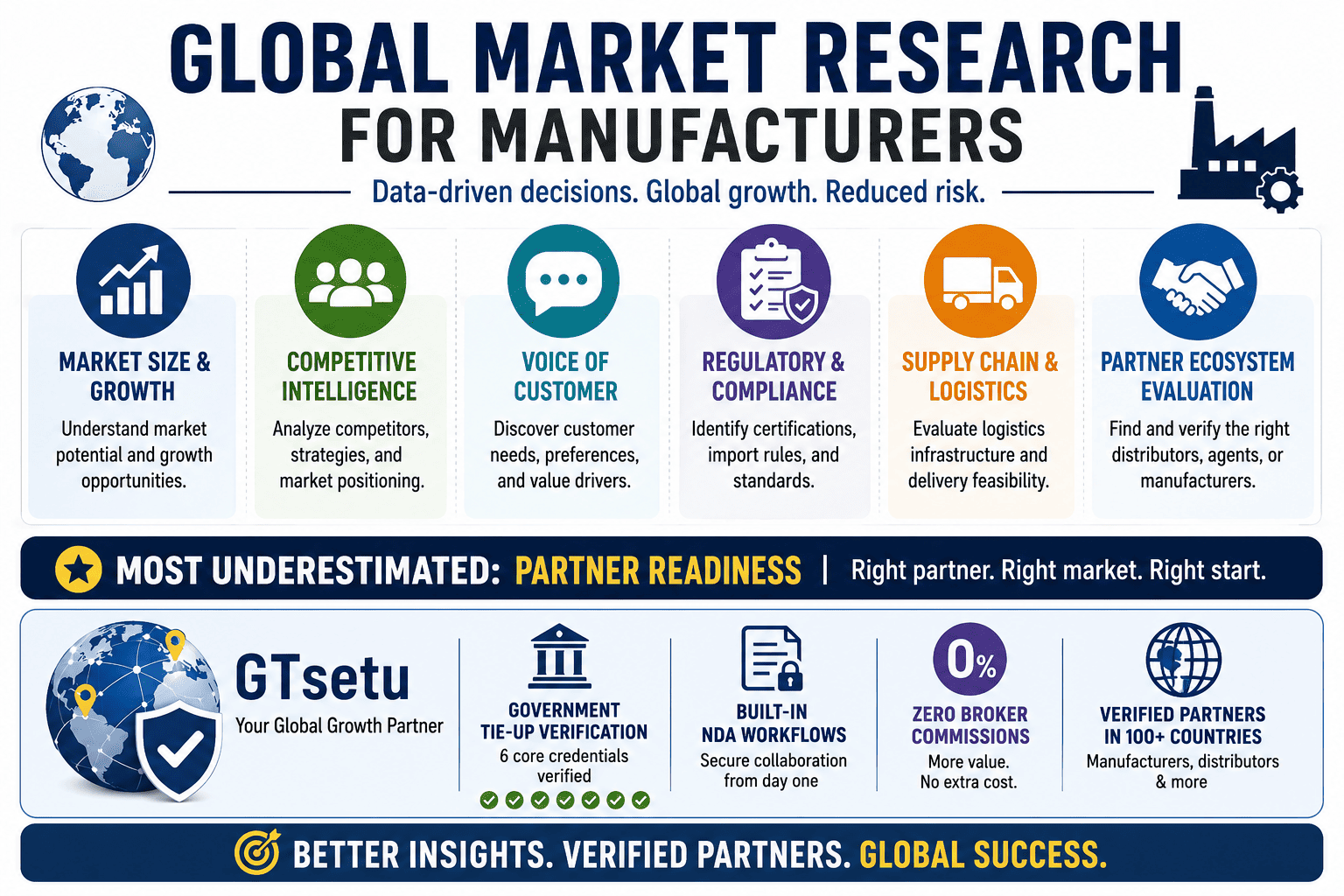
Direct Answer:Global market research for manufacturers is the systematic process of gathering, analyzing, and interpreting data about foreign markets to inform production, sourcing, and market entry decisions. It covers market sizing and growth forecasts, competitive intelligence (who else is in the market and how they compete), voice of customer (what customers actually need and how they perceive value), regulatory and compliance requirements (certifications, import rules, standards), supply chain and logistics infrastructure (can your product reach the market competitively), and partner ecosystem evaluation (identifying and verifying distributors, agents, or contract manufacturers). Unlike domestic research, global market research must account for cross-border differences in regulation, culture, currency, logistics costs, and commercial practice. The most frequently underestimated component is partner readiness—having a verified, commercially aligned partner in the target market before the first shipment is attempted. This is where platforms like GTsetu provide verified manufacturing and distribution partners across 100+ countries with government-tie-up verification of six core credentials, built-in NDA workflows, and zero broker commissions.
📅 Published February 23, 2026🔄 Updated August 24, 2026⏱ 18 min read✍️ GTsetu Editorial Team
6
Pillars of Export Readiness
100+
Countries on GTsetu
4
EPI Framework Pillars
0%
Broker Commission
Every manufacturer who has ever considered entering a new international market has faced the same challenge: how do you know whether the market is worth entering, whether your product fits, whether you can compete, and whether you can actually get your product to customers profitably? The answer is global market research: the systematic process of gathering and analyzing data about foreign markets to inform commercial decisions.
Global market research is not a single activity. It is a portfolio of investigations: market sizing, competitive intelligence, customer research, regulatory mapping, logistics assessment, and partner evaluation. Each component answers a different question. Together, they tell you whether a market is viable, how to enter it, and what it will cost. This guide covers all of them comprehensively, with a particular focus on the partner readiness gap that is the most frequently underestimated cause of international market entry failure.
💡 Who This Guide Is For
Manufacturers evaluating international market entry, procurement leaders assessing new sourcing regions, business development teams building export strategy, and anyone who needs to understand how global market research informs production, sourcing, and partnership decisions.
⚖️ Disclaimer
This guide provides commercial and strategic context for understanding global market research. It is not legal, tax, or investment advice. Always engage qualified local counsel and conduct current market research before committing to any market entry decision.
SECTION 1
1 What Is Global Market Research for Manufacturers?
🎯 Definition
Global market research for manufacturers is the systematic process of gathering, analyzing, and interpreting data about foreign markets to inform production, sourcing, and market entry decisions. It answers six core questions: (1) How large is the market and how fast is it growing? (2) Who are the competitors and how do they compete? (3) What do customers actually need and how do they perceive value? (4) What regulatory and compliance requirements apply to your product? (5) Can your product reach the market competitively given logistics and landed cost? (6) What partners (distributors, agents, contract manufacturers) are available and verifiably legitimate in the market?
Global market research is distinct from domestic market research in several critical ways. Cross-border research must account for different regulatory regimes, cultural expectations, currency fluctuations, logistics costs, and commercial practices. A product that is competitive in one country may be uncompetitive in another after landed cost calculation. A marketing message that works in one culture may fail in another. A distribution model that is standard in one market may be unavailable in another.
For manufacturers, global market research is particularly important because production decisions are capital-intensive and long-term. Entering the wrong market with the wrong product, or entering the right market with the wrong partner, can tie up capital and management attention for years. Conversely, well-researched market entry decisions can generate sustained competitive advantage and revenue growth. As noted by the NIST MEP National Network, market research is “an integral step in assessing your company’s competitive advantage and key opportunities.”
7.2%
Business entities in large-scale verification exercises have discrepancies in claimed credentials, per GTsetu verification data
85%
Commercial disputes in cross-border trade involve identity or credentials never independently verified, per GTsetu analysis
10+
Years of export history is the minimum threshold most experienced buyers expect from a manufacturing partner
SECTION 2
2 Why Market Research Matters for Manufacturers
The commercial consequences of inadequate market research are specific, common, and expensive. Manufacturers who enter markets without sufficient research typically discover problems only after investment has been committed, leading to stranded inventory, uncompetitive pricing, regulatory non-compliance, and failed partnerships. As the NIST MEP National Network explains, “gathering and analyzing essential data on customers, competitors, supply chains, industries, markets, and trends provides companies with the information they need to make informed decisions, mitigate risk, and grow their business.”
💰
Prevents Uncompetitive Pricing
Products competitive at ex-works pricing often become uncompetitive after freight, insurance, duties, and distribution margins. Global market research captures landed cost before entry.
📋
Avoids Regulatory Non-Compliance
Product certification, labelling requirements, and import licensing vary by country. Discovering these after production is costly and delays entry. Research identifies requirements upfront.
🤝
Identifies the Right Partner
Partner evaluation is part of market research. Finding and verifying distributors, agents, or contract manufacturers before committing to a market is the most underestimated success factor.
📈
Validates Demand Assumptions
Market sizing and growth forecasts test whether the market is large enough and growing fast enough to justify the investment required to enter it.
🏆
Reveals Competitive Positioning
Competitive intelligence identifies who you are competing against, their pricing, distribution, and strengths, enabling you to differentiate your offering.
🚚
Assesses Logistics Feasibility
Logistics assessment confirms whether your product can reach the market at competitive cost and within required transit times, a fundamental viability check.
📌 The “Partner Readiness” Gap
Market research often stops at market sizing and competitive intelligence, skipping partner evaluation. Yet partner readiness—having a verified, commercially aligned distribution or supply chain partner identified and qualified in the target market—is the most frequently cited cause of export failures. See Partnership Evaluation Criteria for how to assess potential partners systematically.
SECTION 3
3 Key Components of Global Market Research
Global market research for manufacturers comprises six core components, each answering a different question about the target market. No single component is sufficient; the full picture requires all six.
01
Market Sizing & Forecasting
Total addressable market, growth rates, demand drivers, and future projections. Tells you whether the market is large enough and growing fast enough to justify investment.
📊 A manufacturer evaluating the ASEAN electronics market uses market sizing to estimate total demand and growth trajectory over 5 years
02
Competitive Intelligence
Competitor identification, market share, pricing, positioning, strengths, and weaknesses. Reveals competitive gaps and differentiation opportunities.
🎯 A machinery manufacturer maps competitor distribution networks in the GCC to identify underserved channels
03
Voice of the Customer (VoC)
Customer needs, satisfaction, preferences, and requirements through surveys, interviews, and focus groups. Provides qualitative insights that quantitative data alone cannot capture.
🗣️ A consumer goods manufacturer conducts VoC research in Southeast Asia to understand packaging preferences and pricing sensitivity
📜 A medical device manufacturer maps FDA-equivalent regulatory pathways for each target market in Latin America
05
Supply Chain & Logistics Assessment
Infrastructure quality, transit times, port connectivity, warehousing availability, and landed cost analysis. Confirms physical feasibility of market entry.
🚢 A heavy equipment manufacturer assesses port capacity and inland transport costs for each potential African market
06
Partner Ecosystem Evaluation
Identification and verification of distributors, agents, contract manufacturers, and joint venture partners in the target market. The most frequently underestimated component.
🤝 A manufacturer uses GTsetu’s distributor network to find and verify potential distribution partners in India and Southeast Asia
SECTION 4
4 Market Sizing & Growth Forecasting
📊 Definition
Market sizing estimates the total addressable market (TAM), serviceable addressable market (SAM), and serviceable obtainable market (SOM) for your product in a target geography. Growth forecasting projects how that market will evolve over time based on demand drivers, economic trends, and competitive dynamics.
Market sizing is the foundational component of global market research. Without a credible estimate of market size and growth, you cannot determine whether a market is worth entering, set realistic sales targets, or make investment decisions. Market research firms like Global Market Insights, Market Research Future, and BCC Research provide industry-specific market sizing reports that aggregate data across countries and sectors. For manufacturers, these reports are a starting point rather than a conclusion, they should be supplemented with primary research and local data sources.
The NIST MEP National Network notes that market research “can also uncover technical opportunities to solve persistent challenges or get your products into new markets. It can identify needs, key drivers, and the competitive environment.” Market sizing is the quantitative foundation for this discovery process.
How to Approach Market Sizing
📐
Top-Down Approach
Start with industry-level data (total market size, growth rates from industry reports) and narrow down to your specific product category and geography.
📊
Bottom-Up Approach
Build market size from customer-level data (number of potential customers × average spend) and competitor data (competitor revenue × market share).
📈
Growth Drivers Analysis
Identify the economic, demographic, and technological drivers that will expand or contract the market. Validate through primary research with industry experts.
🔍
Competitor-Based Estimation
If competitor revenues are known, aggregate them and adjust for unaccounted competitors to estimate total market size and growth trajectory.
💡 GTsetu Insight
Market sizing data from industry reports is valuable but should be stress-tested against local knowledge. The partnership evaluation criteria guide helps manufacturers assess whether local distributors’ market estimates are credible and realistic.
SECTION 5
5 Competitive Intelligence & Landscape Analysis
🎯 Definition
Competitive intelligence is the systematic gathering and analysis of information about competitors in a target market: who they are, their market share, pricing, distribution methods, product positioning, strengths, and weaknesses. It enables a new entrant to differentiate, avoid direct competition in saturated segments, and identify genuine market gaps.
For manufacturers entering a new market, competitive intelligence answers three critical questions: (1) Who are we competing against, both direct competitors (same product category) and indirect competitors (substitute products)? (2) How do they compete—on price, quality, service, innovation, or distribution? (3) What are the gaps in their coverage that represent opportunities for a new entrant?
As noted by Greenbook, “experienced analysts and business experts help organizations make decisions with confidence through thoughtfully designed and well-executed research.” Competitive intelligence is central to this confidence, providing the data needed to position products effectively.
Competitive Intelligence Framework
Dimension
What to Assess
Where to Find Information
Competitor Identification
Direct competitors (same product), indirect competitors (substitutes), and potential new entrants
Industry reports, trade associations, distributor interviews, retail channel observation
Market Share & Positioning
Revenue estimates, unit sales, market share percentages, brand positioning and messaging
Published financials, market research reports, trade show presence, customer surveys
Pricing & Distribution
Price points, discount structures, distribution channels, territory coverage, exclusivity arrangements
Customer reviews, VoC research, distributor feedback, industry analyst reports
Gap Analysis
Where competitors are weak or absent, creating opportunity for a new entrant
Cross-referencing competitive coverage with customer needs and market demand
SECTION 6
6 Voice of the Customer (VoC) in Manufacturing
🗣️ Definition
The Voice of the Customer (VoC) in manufacturing market research is the direct collection and analysis of customer feedback, needs, and preferences through surveys, focus groups, and one-on-one interviews. It provides the qualitative data—customer motivations, pain points, and unarticulated needs—that quantitative market sizing alone cannot capture.
As the NIST MEP National Network explains, VoC research is integral to market research: “Customer surveys and questionnaires provide quantitative data, while focus groups and in-depth one-on-one interviews fill in important qualitative findings of behaviors, motivations, and emotions that complete the picture for your business operations and opportunities.”
For manufacturers, VoC research goes beyond satisfaction metrics to uncover product quality expectations, pricing sensitivity, service requirements, and unarticulated needs. A VoC study might reveal that customers in a target market value after-sales service more than product features, or that they expect certain certifications that are not standard in the manufacturer’s home market. These insights are essential for product adaptation and market positioning.
VoC Research Methods
📝
Surveys & Questionnaires
Quantitative data on satisfaction, needs, and preferences. Can be deployed at scale across customer segments and geographies. Best for measuring what customers want and how satisfied they are.
🎤
One-on-One Interviews
In-depth qualitative interviews with key customers, prospects, and industry experts. Uncover motivations, decision-making processes, and unarticulated needs.
👥
Focus Groups
Group discussions that reveal social dynamics and collective perceptions. Useful for testing product concepts, packaging, and messaging with target customer groups.
🔍
Customer Advisory Boards
Ongoing customer panels that provide continuous feedback on product development, market positioning, and competitive dynamics. Long-term strategic input from key customers.
💡 GTsetu Insight
VoC research is most powerful when combined with partner evaluation. Local distributors often have deep customer insights that can inform product adaptation and positioning. Partnership evaluation criteria should include the distributor’s access to customer feedback and market intelligence.
SECTION 7
7 Regulatory & Compliance Landscape
Regulatory compliance is a market entry blocker, not a market entry challenge. If your product does not meet the destination market’s regulatory requirements, it simply cannot be sold. Identifying and addressing regulatory requirements is therefore a non-negotiable component of global market research.
Regulatory Category
What It Covers
Examples
Product Certification & Standards
Product-specific safety, quality, and performance standards
CE marking (EU), UL (US), CCC (China), BIS (India), SASO (Saudi Arabia)
Import & Export Licensing
Permits required to import or export certain product categories
Drug import licences (pharma), SIRA permits (UAE), food import registration
Labelling & Packaging
Language, content, and format requirements for product labelling
Arabic labelling for GCC, nutritional information panels, country of origin marking
Product Registration
Formal registration of the product with a regulatory authority
Drug registration (FDA, EMA, CDSCO), cosmetic product notification (EU CPNP)
Environmental & Sustainability
Environmental compliance, chemical restrictions, recycling requirements
Manufacturers can access regulatory information through: MEP National Network experts, BCC Research sector-specific reports, national trade promotion agencies, and local legal counsel in the target market. Regulatory research should be conducted at the product-category level, not the generic market level, as requirements vary significantly by product type.
SECTION 8
8 Supply Chain & Logistics Assessment
A product that is competitive at ex-works pricing may become uncompetitive after freight, insurance, duties, and distribution margins are added. Logistics assessment answers the fundamental question: can your product reach the target market profitably and reliably?
As noted in GTsetu’s logistics responsibilities guide, “logistics is not a downstream detail of a trade deal, it is a direct driver of landed cost, and by extension, of margin.” The logistics assessment component of global market research should answer: What are the freight costs and transit times for your product category to the target market? What are the port and inland logistics capabilities? What are the duties and import taxes? And what are the warehousing and distribution costs?
🚢
Freight Cost & Transit Time
Shipping costs and duration from factory to target market. Varies by product weight, volume, mode (air/sea), and route. Critical for landed cost calculation.
🏗️
Port & Inland Infrastructure
Port capacity, customs efficiency, road and rail connectivity, and warehousing availability. The export readiness by region guide provides country-level logistics capability assessments.
💰
Duties, Taxes & Import Costs
Import duties, value-added taxes (VAT/GST), and other import-related costs. Trade agreements (FTAs) can reduce or eliminate duties, affecting market viability.
🏬
Warehousing & Distribution
Availability and cost of warehousing, last-mile delivery, and in-country distribution networks. May require partnership with a local logistics provider or distributor with in-house logistics capability.
💡 Landed Cost Calculator
A landed cost calculator is an essential tool for manufacturers evaluating market entry. It should include: ex-works price + freight + insurance + duties + import taxes + warehousing + distribution margin + any other in-country costs. Manufacturers should not commit to a market without modeling landed cost and comparing it to market prices.
SECTION 9
9 Partner Ecosystem & Verification
🤝 Definition
Partner ecosystem evaluation is the identification and verification of distributors, agents, contract manufacturers, and other commercial partners in the target market. It is the most frequently underestimated component of global market research and the most commonly cited cause of export failures. Without a verified, commercially aligned partner in the market, your product arrives with no sales infrastructure.
Partner evaluation has two dimensions: identification (finding potential partners) and verification (confirming they are legitimate and commercially capable). Identification can be done through trade missions, industry associations, trade shows, and B2B platforms. Verification, however, is more challenging in cross-border contexts because company registries, business practices, and commercial norms vary significantly by country.
As detailed in GTsetu’s guide on company background verification (KYB), proper verification involves checking: legal name, registration number, registered address, company status, company type, and date of incorporation against official government records. This six-point verification is the minimum standard for any cross-border commercial relationship.
Partner Evaluation Criteria
Dimension
What to Assess
Verification Method
Company Identity
Legal name, registration number, address, status, type, incorporation date
For manufacturers seeking verified partners globally, GTsetu’s distributor network provides government-verified company profiles with six-point verification, built-in NDA workflows, and anonymous discovery, across 100+ countries. This closes the partner readiness gap before any commercial commitment is made.
SECTION 10
10 Export Readiness: The EPI Framework
🏛️ Definition
The Export Preparedness Index (EPI) is a composite ranking framework developed by NITI Aayog (India’s national policy institution) in collaboration with the Institute of Competitiveness. It assesses and compares the export readiness of regions (states, countries) across four primary pillars, providing both a diagnostic tool for identifying structural gaps and a benchmarking mechanism for tracking progress over time.
The EPI framework is relevant to manufacturers because it translates directly into a company-level export readiness assessment. The four pillars—Policy, Business Ecosystem, Export Ecosystem, and Export Performance—each correspond to specific questions a manufacturer must answer before entering a new market.
📜
Pillar 1: Policy
Export promotion policies, trade agreements, special economic zones, export finance institutions, and state-level export facilitation. For manufacturers: what policy tools reduce entry cost, accelerate certification, or provide financial support?
🏭
Pillar 2: Business Ecosystem
Industrial base diversity and competitiveness, MSME presence, skill availability, R&D investment, and business environment quality. For buyers: how deep is the supplier ecosystem?
🚢
Pillar 3: Export Ecosystem
Physical and digital infrastructure: port connectivity, road/rail links, warehousing, customs efficiency, trade facilitation. For exporters: can your product reach the market at competitive cost?
📊
Pillar 4: Export Performance
Historical and current export output: total export value, growth rate, trade basket diversification, number of trading partners. For market entrants: what does actual performance data tell you about demonstrated capability?
💡 EPI Key Finding
Analysis of India’s EPI results consistently shows: coastal states with strong port connectivity (Maharashtra, Gujarat, Karnataka, Tamil Nadu, Andhra Pradesh) outperform landlocked states on the Export Ecosystem pillar, regardless of Policy or Business Ecosystem scores. The lesson for B2B manufacturers: logistics infrastructure is the hardest readiness gap to close quickly, assess it first, before regulatory and partner gaps, because it constrains everything else.
Global market research must be region-specific because export readiness varies dramatically across geographies. The following overview covers the major B2B trade regions relevant to manufacturers. For a detailed country-level assessment, see the full export readiness by region guide.
Region
Overall Readiness
Key Strengths
Key Gaps
East & Southeast Asia
High (8.0–9.5/10)
Deep manufacturing ecosystems; world-class ports; dense supplier networks; mature logistics
China: IP protection challenges; ASEAN: regulatory fragmentation; variable quality consistency
South Asia (India, Bangladesh, etc.)
Improving (6.0–7.5/10)
Large manufacturing base; improving infrastructure; growing domestic market; PLI incentives
12 Contract vs Captive Manufacturing in Global Strategy
For manufacturers evaluating global market entry, the make-vs-buy decision—whether to outsource production to a contract manufacturer or invest in captive (in-house) manufacturing—is directly connected to market research. As detailed in GTsetu’s contract vs captive manufacturing guide, the choice between these models has direct implications for capital efficiency, product quality, speed to market, IP protection, and partner strategy.
🏭 Quick Definition
Contract manufacturing means outsourcing production to a specialist third-party manufacturer who builds to your specifications—you own the IP, they own the factory. Captive manufacturing (in-house) means you own and operate the production facility yourself. The core trade-off is capital efficiency and flexibility (contract) versus direct control and long-run unit economics (captive).
Dimension
Contract Manufacturing
Captive Manufacturing
Upfront capital
✓ Low, pay per unit
✗ High, facilities, equipment, tooling
Cost structure
✓ Variable, scales with volume
✗ Fixed, exists regardless of output
Speed to market
✓ Fast, CM has existing capability
✗ Slow, facility setup 6–24 months
IP & process protection
~ Manageable via NDA and CM selection
✓ Maximum, all processes in-house
Unit economics at high volume
~ Competitive but CM margin included
✓ Best, fixed cost fully amortised
Operational focus
✓ Freed for product, market, brand
✗ Significant internal resource required
💡 Market Research Connection
Global market research informs the contract vs captive decision in multiple ways: market sizing tells you whether volumes justify captive investment; competitive intelligence reveals whether manufacturing capability is a competitive advantage; regulatory research identifies whether local production (via CM) is required; and partner ecosystem evaluation identifies potential CMs in the target market. See the full guide for the complete decision framework.
SECTION 13
13 Primary & Secondary Research Methods
Global market research for manufacturers relies on two categories of research: secondary research (existing data from published sources) and primary research (new data collected directly from customers, experts, and market participants). Both are essential; they answer different questions and have different strengths and limitations.
Secondary Research Methods
📊
Industry Reports
Published market research from firms like Global Market Insights, BCC Research, and Market Research Future. Provide market sizing, growth forecasts, competitive landscape, and regulatory overviews.
🏛️
Government & Trade Data
Export/import statistics, trade associations, and economic data from national statistical offices and trade promotion agencies. Essential for trade flow analysis and market validation.
📰
Trade Press & Media
Industry-specific publications, trade journals, and business media. Provide competitive intelligence, regulatory updates, and market trend information.
📋
Company Registries & KYB
National company registries provide the foundation for partner verification. See GTsetu’s KYB guide for the complete process and global registry sources.
Primary Research Methods
🗣️
Customer Interviews & Surveys
Direct collection of customer feedback, needs, and preferences. Provides VoC data that secondary research cannot capture. Essential for understanding customer motivations and price sensitivity.
🤝
Distributor & Partner Interviews
Interviews with potential distributors, agents, and industry experts. Provide market intelligence, competitive data, and partner capability assessment. See partnership evaluation criteria for interview frameworks.
🏪
Retail & Channel Observation
On-the-ground observation of retail channels, distribution points, and competitive presence. Provides real-world insight into pricing, positioning, and channel dynamics.
🔍
Trade Show & Industry Event Research
Trade shows provide concentrated access to competitors, distributors, and customers. Critical for partner identification and competitive intelligence gathering.
💡 GTsetu Insight
Primary research is where international business development consulting adds significant value. Experienced consultants can design and execute primary research programmes that address specific market entry questions with local expertise.
SECTION 14
14 Market Entry Decision Framework
Market research is not an end in itself; it is the foundation for a market entry decision. The following framework translates research findings into a structured go/no-go decision.
🧭 Market Entry Decision Guide
If market sizing suggests total addressable market is < $50M and growing < 5% annually…
→ Caution, probably not worth entry
Re-evaluate
The market may be too small to justify the entry investment. Consider adjacent markets or alternative entry strategies.
If competitive intelligence shows a saturated market with 3+ strong incumbents…
→ Enter only with a clear differentiator
Differentiate
Need a clear competitive advantage (price, quality, service, technology, distribution gap). Without it, entry is high-risk.
If regulatory compliance timeline is > 12 months and cost is significant…
→ Factor into entry timing and budget
Plan
Regulatory compliance is a blocker. Add it to the timeline and budget explicitly; do not assume it will be faster or cheaper than estimated.
If landed cost analysis shows your product is uncompetitive…
→ Do not enter without cost adjustment
Re-price
Either reduce production cost, find a more efficient logistics route, or consider local manufacturing (CM or captive). Entry with uncompetitive pricing is unsustainable.
If no verified partner exists and partner evaluation is incomplete…
→ Do not enter without a partner
Partner First
Partner readiness is the most critical success factor. Entering without a verified partner is the most common cause of export failure. Use GTsetu’s distributor network to find and verify partners first.
If all five conditions are satisfied, market is viable, competitive gap exists, compliance is manageable, landed cost is competitive, and a verified partner is in place…
→ Proceed to market entry
Execute
Structured market entry with a clear plan, a verified partner, and a realistic timeline. Then monitor, review, and adjust as the market responds.
SECTION 15
15 How GTsetu Connects Verified Manufacturing Partners
🌐 Platform Spotlight, GTsetu
Verified Manufacturing & Distribution Partners Across 100+ Countries
Global market research identifies opportunity; verified partners deliver it. The most frequently cited cause of international market entry failure is not poor product-market fit or inadequate market research—it is choosing the wrong partner or choosing not to verify a partner before committing. GTsetu was built to close this gap: a government-tie-up verified B2B matchmaking platform where manufacturers, brand owners, and distributors find and connect with verified partners, across 100+ countries, with built-in NDA infrastructure and zero broker commission. Every company on GTsetu is verified using direct government tie-ups across six essential credentials: legal name, registered address, registration number, company status, company type, and date of incorporation. GTsetu does not verify import licences, industry certifications, financial standing, or production capabilities; those must be exchanged and validated directly between partners.
✅
Government Tie-Up Verification
6-point verification: legal name, registered address, registration number, company status, company type, incorporation date.
🕵️
Anonymous Discovery
Explore verified manufacturing and distribution partner profiles across 100+ countries without revealing your identity until mutual interest is confirmed.
📄
Built-In NDA Workflow
Formalise confidentiality before sharing any product specification, pricing structure, or proprietary information, with a full digital audit trail.
🚫
Zero Commission
No broker fees on any deal. GTsetu’s incentives are fully aligned with finding you the best partner.
🔐
Encrypted Collaboration
All documents and communications encrypted in transit and at rest. Secure B2B matchmaking from first contact.
🌍
100+ Countries
Active verified network for distributors, wholesale distributors, and manufacturing collaborators across Asia, the Middle East, Europe, Africa, and the Americas.
QWhat is global market research for manufacturers?
Global market research for manufacturers is the systematic process of gathering, analyzing, and interpreting data about foreign markets to inform production, sourcing, and market entry decisions. It covers market sizing and growth forecasting, competitive intelligence, voice of customer research, regulatory and compliance assessment, supply chain and logistics analysis, and partner ecosystem evaluation. It is distinct from domestic market research because it must account for cross-border differences in regulation, culture, currency, and logistics.
QWhat are the key components of global market research for manufacturers?
The key components are: (1) Market Sizing & Forecasting, total addressable market, growth rates, and demand drivers; (2) Competitive Intelligence, competitor identification, market share, pricing, and positioning; (3) Voice of Customer (VoC), direct customer feedback on needs and satisfaction; (4) Regulatory & Compliance Landscape, product certification, import/export requirements, and standards; (5) Supply Chain & Logistics Assessment, infrastructure quality, lead times, and landed cost analysis; and (6) Partner Ecosystem Evaluation, identification and verification of distributors, agents, or contract manufacturers in the target market.
QWhat is the Export Preparedness Index (EPI)?
The Export Preparedness Index (EPI) is a composite ranking framework developed by NITI Aayog (India’s national policy institution) in collaboration with the Institute of Competitiveness. It assesses and compares the export readiness of regions across four pillars: Policy (export promotion policies, trade agreements), Business Ecosystem (industrial diversity, skill availability, business environment), Export Ecosystem (ports, logistics, customs infrastructure, warehousing), and Export Performance (actual export output, growth, and diversification). The EPI provides a diagnostic tool for identifying structural gaps and benchmarking progress over time.
QWhat is the “voice of the customer” in manufacturing market research?
The Voice of the Customer (VoC) in manufacturing market research is the direct collection and analysis of customer feedback, needs, and preferences through surveys, focus groups, and one-on-one interviews. For manufacturers, VoC research goes beyond satisfaction metrics to uncover product quality expectations, pricing sensitivity, service requirements, and unarticulated needs. It provides the qualitative data that complements quantitative market sizing and competitive intelligence, enabling data-driven decisions on product development, positioning, and market entry strategy.
QHow does competitive intelligence help manufacturers enter new markets?
Competitive intelligence helps manufacturers entering new markets by identifying who the existing competitors are, their market share and positioning, pricing strategies, distribution methods, and strengths and weaknesses. This information enables new entrants to differentiate their offering, avoid direct competition in saturated segments, identify gaps in the market, and develop a realistic market entry strategy. Without competitive intelligence, a manufacturer risks entering a market with a product that is undifferentiated, overpriced, or misaligned with customer expectations.
QWhat is the importance of market size and growth forecasting for manufacturers?
Market size and growth forecasting tells a manufacturer how many potential customers exist, what the total addressable market is worth, and how fast it is growing. This information is essential for: determining whether a market is worth entering, setting realistic sales targets, making investment decisions on production capacity, estimating the viability of exporting versus local manufacturing, and evaluating the potential return on market entry investment. Reliable forecasts combine secondary data (industry reports, government statistics) with primary research (customer surveys, expert interviews).
QWhat are the six pillars of export readiness?
The six pillars of export readiness are: (1) Regulatory Readiness, does the product meet destination-market regulatory requirements and certification standards; (2) Logistics and Infrastructure Readiness, can the product reach the market at competitive cost and within required timeframes; (3) Partner Readiness, has a verified distribution or supply chain partner been identified and qualified; (4) Financial Readiness, can the company manage extended payment terms, currency risk, and upfront market entry costs; (5) Market Intelligence Readiness, is there sufficient data on demand, competition, and channel dynamics; and (6) Institutional Readiness, what trade agreements, export finance, and government support are available to reduce entry costs and risk.
QWhat is the role of contract manufacturing in global market research?
Contract manufacturing (CM) is the outsourcing of production to a specialist third-party manufacturer who builds products to the client’s specifications while the client owns the IP and the CM owns the factory. In global market research, evaluating CM options is part of the supply chain and logistics assessment, determining whether local production via CM is more viable than exporting finished goods. The make-vs-buy decision (contract vs captive manufacturing) directly affects market entry strategy, landed cost, speed to market, and IP protection requirements. See GTsetu’s guide on Contract Manufacturer vs Captive Manufacturing for the complete comparison.
QHow do manufacturers find verified partners for global market entry?
The most efficient and secure approach is through a B2B verification and matchmaking platform like GTsetu. GTsetu provides verified manufacturer and distributor profiles across 100+ countries with government-tie-up verification of six core credentials: legal name, registered address, registration number, company status, company type, and incorporation date. Built-in NDA workflows protect sensitive information during due diligence, anonymous discovery enables risk-free exploration of potential partners, and zero broker commission ensures deal economics stay between the parties. This closes the partner readiness gap that is the most frequently underestimated cause of global market entry failure. See GTsetu’s distributor network for more details.
Ready to Find Verified Manufacturing & Distribution Partners Globally?
Join 500+ verified manufacturers, brand owners, and distributors already building cross-border partnerships on GTsetu, with government-tie-up verification of six core credentials, built-in NDA workflows, and zero broker fees across 100+ countries. Close the partner readiness gap before you commit to market entry.
They represents the product, and research team behind GTsetu, a global B2B collaboration platform built to help companies explore cross-border partnerships with clarity and trust. The team focuses on simplifying early-stage international business discovery by combining structured company profiles, verification-led access, and controlled collaboration workflows.
With a strong emphasis on trust, and disciplined engagement, Team GTsetu shares insights on global trade, partnerships, and cross-border collaboration, helping businesses make informed decisions before entering deeper commercial discussions.